

The DOI matches its Crossref record; 6 of the 6 references it cites were found in a registry or an index.
A further critique of the analytic strategy of adjusting for covariates to identify biologic mediation
Abstract
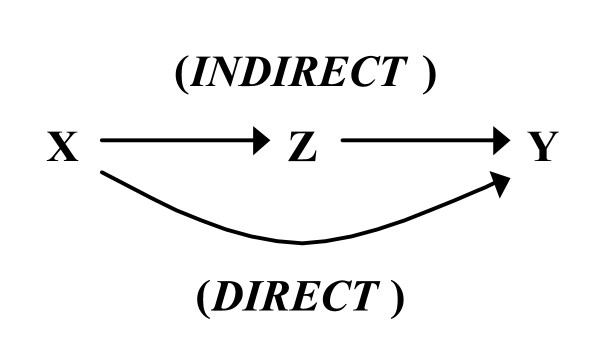
Background: Epidemiologic research is often devoted to etiologic investigation, and so techniques that may facilitate mechanistic inferences are attractive. Some of these techniques rely on rigid and/or unrealistic assumptions, making the biologic inferences tenuous. The methodology investigated here is effect decomposition: the contrast between effect measures estimated with and without adjustment for one or more variables hypothesized to lie on the pathway through which the exposure exerts its effect. This contrast is typically used to distinguish the exposure's indirect effect, through the specified intermediate variables, from its direct effect, transmitted via pathways that do not involve the specified intermediates. Methods: We apply a causal framework based on latent potential response types to describe the limitations inherent in effect decomposition analysis. For simplicity, we assume three measured binary variables with monotonic effects and randomized exposure, and use difference contrasts as measures of causal effect. Previous authors showed that confounding between intermediate and the outcome threatens the validity of the decomposition strategy, even if exposure is randomized. We define exchangeability conditions for absence of confounding of causal effects of exposure and intermediate, and generate two example populations in which the no-confounding conditions are satisfied. In one population we impose an additional prohibition against unit-level interaction (synergism). We evaluate the performance of the decomposition strategy against true values of the causal effects, as defined by the proportions of latent potential response types in the two populations. Results: We demonstrate that even when there is no confounding, partition of the total effect into direct and indirect effects is not reliably valid. Decomposition is valid only with the additional restriction that the population contain no units in which exposure and intermediate interact to cause the outcome. This restriction implies homogeneity of causal effects across strata of the intermediate. Conclusions: Reliable effect decomposition requires not only absence of confounding, but also absence of unit-level interaction and use of linear contrasts as measures of causal effect. Epidemiologists should be wary of etiologic inference based on adjusting for intermediates, especially when using ratio effect measures or when absence of interacting potential response types cannot be confidently asserted.
Overview
The claims and statistics of this paper haven’t been checked yet.
Run the check — free, no account needed. It reads the open-access text and checks the sources it cites.
Integrity signals
Registry
Cites
Statistics
Figures
Verification
Claims the paper makes
The claims and statistics of this paper haven’t been checked yet.
Run the check — free, no account needed. It reads the open-access text and checks the sources it cites.
Claims other papers make about this one
Each is checked against this paper’s own text: does it say what the citing paper says it does?
The cited source says what the claim attributes to it.
In the citing paper
“In addition, most studies that adopted the “add-one-in” approach to mediation analysis did not evaluate the extent to which their analyses violated the key assumptions involved in using this method for inferring mediation (Kaufman et al. 2004; Valeri and Vanderweele 2013).”
From Exposure to Air Pollution in Relation to Risk of Dementia and Related Outcomes: An Updated Systematic Review of the Epidemiological Literature (2021) · cites this paper as Kaufman et al. 2004
Self-check
Percentages, sums and reported differences re-computed from the paper’s own numbers.
The self-check needs the paper’s full text.
Citations
Cites
Robins, J. (1986) · Mathematical Modelling · doi:10.1016/0270-0255(86)90088-6 · Cited by 2,451
Lantz, P. M., House, J. S., Lepkowski, J. M., Williams, D. R., Mero, R. P., & Chen, J. (1998) · JAMA · doi:10.1001/jama.279.21.1703 · Cited by 1,514
Confounding and Collapsibility in Causal Inference
Greenland, S., Pearl, J., & Robins, J. M. (1999) · Statistical Science · doi:10.1214/ss/1009211805 · Cited by 933 · cited 1×
“It is now possible to specify exchangeability conditions that are sufficient to guarantee that there is no confounding, meaning that associational measures and causal effects are equivalent[28].”
ROTHMAN, K. J., GREENLAND, S., & WALKER, A. M. (1980) · American Journal of Epidemiology · doi:10.1093/oxfordjournals.aje.a113015 · Cited by 859
Everson, S. A., Kauhanen, J., Kaplan, G. A., Goldberg, D. E., Julkunen, J., Tuomilehto, J., & Salonen, J. T. (1997) · American Journal of Epidemiology · doi:10.1093/oxfordjournals.aje.a009245 · Cited by 301 · cited 1×
“relation between hostility and incident myocardial infarction[10], and that the protective effect of gene CCR5 heterozygosity on clinical AIDS occurrence is completely mediated through an effect on CD4 cell count[11].”
Research works printed but not linked: 29
- Koopman JS, Weed DL: Epigenesis theory: a mathematical model relating causal concepts of pathogenesis in individuals to disease patterns in populations. Am J Epidemiol 1990, 132:366–390. · DOI
- Thompson WD: Effect modification and the limits of biological inference from epidemiologic data. J Clin Epidemiol 1991, 44:221–232. · DOI
- Greenland S, Poole C: Invariants and noninvariants in the concept of interdependent effects. Scand J Work Environ Health 1988, 14:125–129. · DOI
- MacLehose RF, Kaufman S, Kaufman JS, Poole C: Bounding causal effects under uncontrolled confounding using counterfactuals. Epidemiology, in press.
- Susser M: Causal Thinking in the Health Sciences: Concepts and Strategies in Epidemiology Oxford University Press: New York 1973.
- Szklo M, Nieto FJ: Epidemiology: Beyond the Basics Aspen Publishers: Gaithersburg, MD 2000.
- Heck KE, Pamuk ER: Explaining the relation between education and postmenopausal breast cancer. Am J Epidemiol 1997, 145:366–372. · DOI
- Lim U, Cassano PA: Homocysteine and blood pressure in the Third National Health and Nutrition Examination Survey, 1988–1994. Am J Epidemiol 2002, 156:1105–1113. · DOI
- Taylor JM, Wang Y, Ahdieh L, Chmiel JS, Detels R, Giorgi JV, Kaslow R, Kingsley L, Margolick J: Causal pathways for CCR5 genotype and HIV progression. J Acquir Immune Defic Syndr 2000, 23:160–171. · DOI
- Robins JM, Greenland S: Identifiability and exchangeability for direct and indirect effects. Epidemiology 1992, 3:143–155. · DOI · Paper page
- Poole C, Kaufman JS: What does the standard adjustment for downstream mediators tell us about social effect pathways? Am J Epidemiol 2000, 151:S52.
- Cole SR, Hernan MA: Fallibility in estimating direct effects. Int J Epidemiol 2002, 31:163–165. · DOI · Paper page
- Kaufman S, Kaufman JS, MacLehose RF, Greenland S, Poole C: Improved estimation of controlled direct effects in the presence of unmeasured confounding of intermediate variables. Stat Med, in press.
- Baron RM, Kenny DA: The moderator-mediator variable distinction in social pychological research: Conceptual, strategic, and statistical considerations. Journal of Personality and Social Psychology 1986, 51:1173–1182. · DOI · Paper page
- MacKinnon DP: Mediating variable. International Encyclopedia of the Social and Behavioral sciences (Edited by: Smelser NJ, Baltes PB). New York: Elsevier 2002, 9503–9507.
- Wright S: The method of path coefficients. Annals of Mathematical Statistics 1934, 5:161–215. · DOI
- Holland PW: Causal inference, path analysis, and recursive structural equations models. Sociological Methodology (Edited by: Clogg CC). American Sociological Association: Washington, DC 1988, 449–484.
- Pearl J: Causality: Models, Reasoning and Inference Cambridge University Press: Cambridge 2000.
- Rubin DB: Formal modes of statistical inference for causal effects. J Statist Plann Inference 1990, 25:279–292. · DOI · Paper page
- Greenland S, Robins JM: Identifiability, exchangeability, and epidemiological confounding. Int J Epidemiol 1986, 15:433–439. · DOI · Paper page
- Bollen KA: Total, direct and indirect effects in structural equation models. Sociological Methodology (Edited by: Clogg CC). American Sociological Association: Washington, DC 1987, 37–69.
- Stolzenberg RM: The measurement and decomposition of casual effects in nonlinear and nonadditive models. Sociological Methodology (Edited by: Schuessler KF). Jossey-Bass: San Francisco 1980, 459–488.
- Terry MB, Neugut AI, Schwartz S, Susser E: Risk factors for a causal intermediate and an endpoint: reconciling differences. Am J Epidemiol 2000, 151:339–345. · DOI
- Joffe MM, Colditz GA: Restriction as a method for reducing bias in the estimation of direct effects. Stat Med 1998, 17:2233–2249. · DOI
- Sobel ME: Effect analysis and causation in linear structural equation models. Psychometrika 1990, 55:495–515. · DOI
- Winship C, Morgan SL: The estimation of causal effects from observational data. Annual Review of Sociology 1999, 25:659–707. · DOI · Paper page
- Bollen KA: Structural Equations with Latent Variables John Wiley and Sons: New York, NY 1989. · DOI
- Robins JM: Semantics of causal DAG models and the identification of direct and indirect effects. Highly Structured Stochastic Systems (Edited by: Green P, Hjort N, Richardson S). Oxford University Press: London 2003, 70–81. · DOI
- Pearl J: Direct and Indirect Effects. Proceedings of the Seventeenth Conference on Uncertainty in Artificial Intelligence San Francisco, CA: Morgan Kaufmann 2001, 411–420.
Cited by
Sorted by citations
Overadjustment bias and unnecessary adjustment in epidemiologic studies.
Schisterman, E. F., Cole, S. R., & Platt, R. W. (2009) · Epidemiology · doi:10.1097/ede.0b013e3181a819a1 · Cited by 2,096
“Such estimates are vulnerable to collider-stratification bias or exposure interactions with the intermediate variable.(14) (6) Epidemiology • Volume 20, Number 4, July 2009 Overadjustment in Epidemiologic Studies”
BackgroundU.S. Disparities in Health: Descriptions, Causes, and Mechanisms
Adler, N. E., & Rehkopf, D. H. (2008) · Annual Review of Public Health · doi:10.1146/annurev.publhealth.29.020907.090852 · Cited by 1,212
Odds Ratios for Mediation Analysis for a Dichotomous Outcome
VanderWeele, T. J., & Vansteelandt, S. (2010) · American Journal of Epidemiology · doi:10.1093/aje/kwq332 · Cited by 809
Marginal Structural Models for the Estimation of Direct and Indirect Effects
VanderWeele, T. J. (2009) · Epidemiology · doi:10.1097/ede.0b013e31818f69ce · Cited by 583
Bias Formulas for Sensitivity Analysis for Direct and Indirect Effects
VanderWeele, T. J. (2010) · Epidemiology · doi:10.1097/ede.0b013e3181df191c · Cited by 435
Emsley, R., Dunn, G., & White, I. R. (2010) · Statistical Methods in Medical Research · doi:10.1177/0962280209105014 · Cited by 356
Milner, A., Page, A., & LaMontagne, A. D. (2014) · Psychological Medicine · doi:10.1017/s0033291713001621 · Cited by 255
Nandi, A., Glymour, M. M., & Subramanian, S. V. (2014) · Epidemiology · doi:10.1097/ede.0000000000000038 · Cited by 237
Weuve, J., Bennett, E. E., Ranker, L., Gianattasio, K. Z., Pedde, M., Adar, S. D., Yanosky, J. D., & Power, M. C. (2021) · Environmental Health Perspectives · doi:10.1289/ehp8716 · Cited by 209
Ananth, C. V., & VanderWeele, T. J. (2011) · American Journal of Epidemiology · doi:10.1093/aje/kwr045 · Cited by 123
Counterfactual graphical models for longitudinal mediation analysis with unobserved confounding
Shpitser, I. (2013) · Cognitive Science · doi:10.1111/cogs.12058 · Cited by 106
“Proportion explained”: a causal interpretation for standard measures of indirect effect?
Hafeman, D. M. (2009) · American Journal of Epidemiology · doi:10.1093/aje/kwp283 · Cited by 98
Prenatal ambient air pollution exposure and SOD2 promoter methylation in maternal and cord blood
Zhou, G., He, T., Huang, H., Feng, F., Liu, X., Li, Z., Zhang, Y., & Ba, Y. (2019) · Ecotoxicology and Environmental Safety · doi:10.1016/j.ecoenv.2019.06.039 · Cited by 35
Metadata
- Authors
- Kaufman, J. S., MacLehose, R. F., & Kaufman, S.
- Venue
- Epidemiologic Perspectives & Innovations
- Published
- 2004-10-08
- Volume
- 1
- Issue
- 1
- ISSN
- 1742-5573
- PMC
- PMC526390
- Cited by
- 207
- References
- 6
- Language
- en
About these checks
Registry, retraction, Cites and statistics results are computed, not judged, with one exception: a printed reference that no index lists is read once by a model before it counts as a citation error. Claims are extracted by a model and kept only when their quote appears verbatim in the text; each cited source is then checked, with a model’s help, for whether it says what the claim relies on. Those verdicts can be wrong — read the claim’s quote and the cited source before relying on one.
Statistics and arithmetic are recomputed, not judged.
Confidence bands are shown only for fields calibrated on our annotated test set. None is calibrated yet, so no band is shown.
What counts as a claim ›How we measure confidence ›How we check this ›
Are you an author, or do you see a problem with this page? Request a review
