

The DOI matches its Crossref record; 55 of the 56 references it cites were found in a registry or an index.
Effect of gait speed on gait rhythmicity in Parkinson's disease: variability of stride time and swing time respond differently
Open accessAbstract
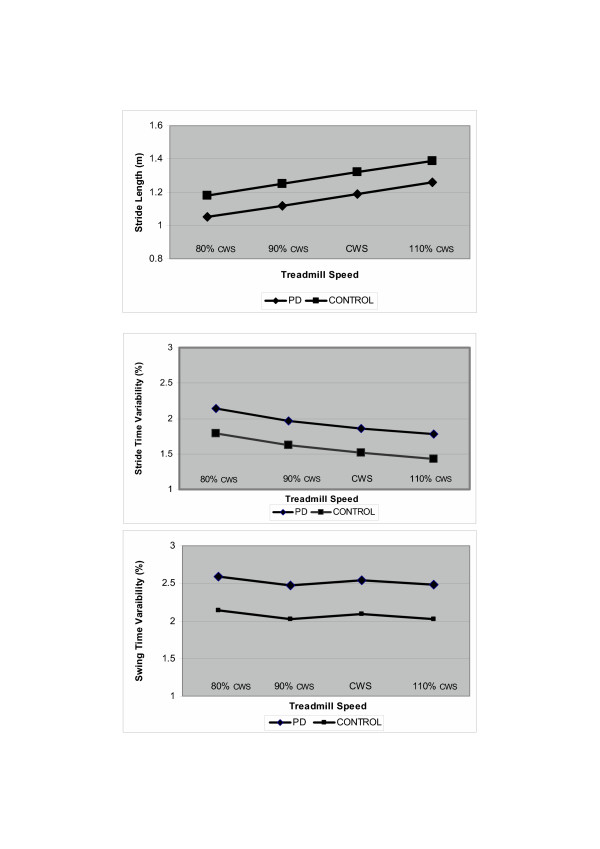
BACKGROUND: The ability to maintain a steady gait rhythm is impaired in patients with Parkinson's disease (PD). This aspect of locomotor dyscontrol, which likely reflects impaired automaticity in PD, can be quantified by measuring the stride-to-stride variability of gait timing. Previous work has shown an increase in both the variability of the stride time and swing time in PD, but the origins of these changes are not fully understood. Patients with PD also generally walk with a reduced gait speed, a potential confounder of the observed changes in variability. The purpose of the present study was to examine the relationship between walking speed and gait variability. METHODS: Stride time variability and swing time variability were measured in 36 patients with PD (Hoehn and Yahr stage 2-2.5) and 30 healthy controls who walked on a treadmill at four different speeds: 1) Comfortable walking speed (CWS), 2) 80% of CWS 3) 90% of CWS, and 4) 110% of CWS. In addition, we studied the effects of walking slowly on level ground, both with and without a walker. RESULTS: Consistent with previous findings, increased variability of stride time and swing time was observed in the patients with PD in CWS, compared to controls. In both groups, there was a small but significant association between treadmill gait speed and stride time variability such that higher speeds were associated with lower (better) values of stride time variability (p = 0.0002). In contrast, swing time variability did not change in response to changes in gait speed. Similar results were observed with walking on level ground. CONCLUSION: The present results demonstrate that swing time variability is independent of gait speed, at least over the range studied, and therefore, that it may be used as a speed-independent marker of rhythmicity and gait steadiness. Since walking speed did not affect stride time variability and swing time variability in the same way, it appears that these two aspects of gait rhythmicity are not entirely controlled by the same mechanisms. The present findings also suggest that the increased gait variability in PD is disease-related, and not simply a consequence of bradykinesia.
Overview
The claims and statistics of this paper haven’t been checked yet.
Run the check — free, no account needed. It reads the open-access text and checks the sources it cites.
Integrity signals
Registry
Cites
Statistics
Figures
Verification
Claims the paper makes
The claims and statistics of this paper haven’t been checked yet.
Run the check — free, no account needed. It reads the open-access text and checks the sources it cites.
Claims other papers make about this one
Each is checked against this paper’s own text: does it say what the citing paper says it does?
In the citing paper
“Gait impairments that involve reductions in speed and step length as well as increased stride length variability are common in PD and impact quality of life 23.”
From Exercise-enhanced neuroplasticity targeting motor and cognitive circuitry in Parkinson's disease (2013) · cites this paper as [23]
Self-check
Percentages, sums and reported differences re-computed from the paper’s own numbers.
The self-check needs the paper’s full text.
Citations
Cites
Folstein, M. F., Folstein, S. E., & McHugh, P. R. (1975) · Journal of Psychiatric Research · doi:10.1016/0022-3956(75)90026-6 · Cited by 88,282
Hirono, N., Mori, E., Ikejiri, Y., Imamura, T., Shimomura, T., Hashimoto, M., Yamashita, H., & Ikeda, M. (1997) · PubMed · Cited by 21,012
Kok, J. S., Berg, I. J., & Scherder, E. J. A. (2013) · Dementia and Geriatric Cognitive Disorders Extra · doi:10.1159/000353441 · Cited by 20,589
Older Adults' Reasons for Using Technology while Aging in Place
Peek, S. T. M., Luijkx, K. G., Rijnaard, M. D., Nieboer, M. E., van der Voort, C. S., Aarts, S., van Hoof, J., Vrijhoef, H. J., & Wouters, E. (2015) · Gerontology · doi:10.1159/000430949 · Cited by 19,852
Sensitivity and False Alarm Rate of a Fall Sensor in Long-Term Fall Detection in the Elderly
Kangas, M., Korpelainen, R., Vikman, I., Nyberg, L., & Jämsä, T. J. (2014) · Gerontology · doi:10.1159/000362720 · Cited by 19,007
Parkinsonism: onset, progression, and mortality
Hoehn, M. M., & Yahr, M. D. (1967) · Neurology · doi:10.1212/wnl.17.5.427 · Cited by 12,107
Overdependence on degraded gist memory in Alzheimer's disease.
Gallo, D. A., Shahid, K. R., Olson, M. A., Solomon, T. M., Schacter, D. L., & Budson, A. E. (2006) · Neuropsychology · doi:10.1037/0894-4105.20.6.625 · Cited by 4,757
Predicting the Probability for Falls in Community-Dwelling Older Adults Using the Timed Up & Go Test
Shumway‐Cook, A., Brauer, S., & Woollacott, M. H. (2000) · Physical Therapy · doi:10.1093/ptj/80.9.896 · Cited by 3,355
Unified Parkinson's Disease Rating Scale
(2012) · Springer eBooks · doi:10.1007/springerreference_184495 · Cited by 3,071
Diagnostic Criteria for Parkinson Disease
Gelb, D. J., Oliver, E., & Gilman, S. (1999) · Archives of Neurology · doi:10.1001/archneur.56.1.33 · Cited by 2,822
Research works printed but not linked: 3
- Baltadjieva R, Giladi N, Balash Y, Herman T, Hausdorff JM: Gait changes in de novo Parkinson's disease patients: A force/rhythm dichotomy. Movement Disorders 2004, 19: S138-S138.
- Lowenthal J, Gruedlinger L, Baltadjieva R, Herman T, Hausdorff JM, Giladi N: Effects of rhythmic auditory stimulation on gait dynamics in Parkinson's disease. Movement Disorders 2004, 19: S139-S139.
- Rochester L, Hetherington V, Jones D, Nieuwboer A, Willems AM, Kwakkel G, Van Wegen G: The effect of rhythmical cues on walking during a simple and dual functional motor task in a complex environment in people with Parkinson's disease. Arch Phys Med Rehabil 2005, in press.
Cited by
Sorted by citations
Items 201–285 of 285
Early Diagnosis of Parkinson’s Disease and Severity Assessment based on Gait using 1D-CNN
Sharma, N. P., Junaid, I., & Ari, S. (2023) · International Conference on Smart Technologies and Systems for Next Generation Computing (ICSTSN) · doi:10.1109/icstsn57873.2023.10151641 · Cited by 4
Zhou, J., Wang, R., Liu, Y., Cheng, S., Liu, H.-H., & Yang, Y. (2025) · Journal of science and medicine in sport · doi:10.1016/j.jsams.2025.06.009 · Cited by 4
Sant, A., Wickström, N., Zügner, R., & Tranberg, R. (2012) · International Conference on Bio-inspired Systems and Signal Processing · doi:10.5220/0003707601800188 · Cited by 4
Ciolko, A. A., Tobias, M. E., & Ehrensberger, M. T. (2015) · Journal of Biomedical Materials Research Part B Applied Biomaterials · doi:10.1002/jbm.b.33499 · Cited by 4
Isolating the speed factor is crucial in gait analysis for Parkinson’s disease
Patoz, A., Malatesta, D., & Burtscher, J. (2023) · Frontiers in Neuroscience · doi:10.3389/fnins.2023.1119390 · Cited by 4
Multifractal Study of Parkinson’s and Huntington’s Diseases with Human Gait Data
Ghosh, D. C., Samanta, S., & Chakraborty, S. (2019) · Springer eBooks · doi:10.1007/978-981-13-3552-5_5 · Cited by 4
Huan, X., Zhou, H., Jung, B., & Ma, L. (2025) · IEEE Access · doi:10.1109/access.2025.3543749 · Cited by 3
Acute and Lingering Impairments in Post-concussion Postural Control
Buckley, T. A. (2014) · Springer eBooks · doi:10.1007/978-1-4939-0295-8_8 · Cited by 3
Automated Algorithm for Neurodegenerative Disorder Detection Using Gait-Based Features
Tengshe, R., Singh, A., Raj, P., Yadav, S., Fathima, S. K., & Fatimah, B. (2023) · Lecture notes in networks and systems · doi:10.1007/978-981-19-7874-6_19 · Cited by 3
Pe, S., Nicora, G., Guerra, B. M. V., Sozzi, S., & Parimbelli, E. (2024) · IEEE International Forum on Research and Technology for Society and Industry (RTSI) · doi:10.1109/rtsi61910.2024.10761630 · Cited by 3
Mediolateral stability during gait in people with Parkinson's disease
Chatterjee, S. (2010) · doi:10.31274/etd-180810-1208 · Cited by 3
Characterizing Stair Ambulation Kinetics and the Effects of Dual Tasking in Parkinson’s Disease
Jones, S. V., Waltz, C., Zimmerman, E. M., Koop, M. M., Hastilow, K., & Alberts, J. L. (2025) · Journal of Clinical Medicine · doi:10.3390/jcm14165830 · Cited by 2
Silveira-Ciola, A. P., Seuthe, J., Coelho, D. B., Faria, M. H., Santinelli, F. B., Schlenstedt, C., & Barbieri, F. A. (2026) · Scientific Reports · doi:10.1038/s41598-026-46469-y · Cited by 2
How is dynamic balance during walking affected by PD?
Mancini, M., Nutt, J. G., & Horak, F. B. (2019) · Elsevier eBooks · doi:10.1016/b978-0-12-813874-8.00006-4 · Cited by 2
Ensemble Learning Classifier with Optimal Feature Selection for Parkinson's Disease
Khera, P., & Kumar, N. (2020) · International Conference on Advances in Computing, Communication and Materials (ICACCM) · doi:10.1109/icaccm50413.2020.9212961 · Cited by 2
Parkinson's Disease Detection with Gait Recognition using Soft Computing Techniques
Shukla, A., Rathore, C. P., & Bhansali, N. (2019) · IGI Global eBooks · doi:10.4018/978-1-7998-0414-7.ch068 · Cited by 2
Random walk: Random number generation during backward and forward walking- the role of aging
Shapiro, M., Shaki, S., Gottlieb, U., & Springer, S. (2022) · Frontiers in Aging Neuroscience · doi:10.3389/fnagi.2022.888979 · Cited by 2
Exploring the role of ankle muscle function in gait impairments and fall risk in Parkinson's disease
Skinner, J. W., & Needle, A. R. (2024) · Human Movement Science · doi:10.1016/j.humov.2024.103316 · Cited by 2
An algorithm for stance and swing phase detection of human gait cycle
Dasgupta, H. (2015) · International Conference on Electronics and Communication Systems (ICECS) · doi:10.1109/ecs.2015.7124944 · Cited by 2
Research on Classification of Gait Signal Based on Neural Network
Yin, J. (2013) · Applied Mechanics and Materials · doi:10.4028/www.scientific.net/amm.303-306.1081 · Cited by 2
Tanabe, S., Saitoh, E., Ohtsuka, K., Teranishi, T., Tomita, Y., & Muraoka, Y. (2013) · Clinics and Practice · doi:10.4081/cp.2013.e30 · Cited by 2
Parkinson's Disease Detection with Gait Recognition using Soft Computing Techniques
Shukla, A., Rathore, C. P., & Bhansali, N. (2015) · Advances in medical technologies and clinical practice book series · doi:10.4018/978-1-4666-9530-6.ch014 · Cited by 2
Hordacre, B. G. (2017) · Journal of Novel Physiotherapy and Physical Rehabilitation · doi:10.17352/2455-5487.000040 · Cited by 2
Amaral-Felipe, K. M., Yamada, P. D. A., Cursino, M. P., Rodrigues, B. F., Hallal, C. Z., & Faganello-Navega, F. R. (2017) · Motricidade · doi:10.6063/motricidade.7895 · Cited by 2
Cantürk, İ. (2020) · European Journal of Science and Technology · doi:10.31590/ejosat.699099 · Cited by 2
[Automatic recognition and analysis of hemiplegia gait].
Zhu, Y., Xu, W., Wang, R., Yang, T., Lu, W., & Wang, H. (2019) · PubMed Central · doi:10.7507/1001-5515.201806044 · Cited by 2
Ito, T. (2024) · Open Journal of Therapy and Rehabilitation · doi:10.4236/ojtr.2024.122013 · Cited by 1
Saegner, K., Romijnders, R., Ruff, I., Welzel, J., Hansen, C., Warmerdam, E., Conceição, P., & Maetzler, W. (2025) · Journal of NeuroEngineering and Rehabilitation · doi:10.1186/s12984-025-01835-1 · Cited by 1
Mancini, M., Silva‐Batista, C., Shah, V. V., Horak, F. B., Carlson‐Kuhta, P., Safarpour, D., & Gomez, C. M. (2025) · Neurorehabilitation and neural repair · doi:10.1177/15459683251395729 · Cited by 1
Validating wearable sensors as an assessment tool for Parkinson’s disease
Silis, K., Kieran, N. W., Shawki, N., Madarshahian, S., Liang, T., & Serruya, M. D. (2026) · Disability and Rehabilitation · doi:10.1080/09638288.2026.2629784 · Cited by 1
Gait Variability Is an Independent Marker of Frailty
Islam, A. (2012) · Scholarship@Western (Western University) · Cited by 1
Classification of Parkinson’s Disease-Associated Gait Patterns
Nguyen, K. T. T. M., Rui, J. G. M., Nguyen, B. P., Chua, M. C. H., & Yang, Y. O. (2021) · Advances in intelligent systems and computing · doi:10.1007/978-981-15-7527-3_56 · Cited by 1
Santos, G. V., d’Alencar, M. S., Helene, A. F., Roque, A. C., Miranda, J. G. V., & Piemonte, M. E. P. (2023) · Frontiers in Neurology · doi:10.3389/fneur.2023.1243445 · Cited by 1
Nguyen, Q. D. N., Tran, T. H., & Nakano, T. (2023) · International Conference on Information Technology: IoT and Smart City (ICIT) · doi:10.1145/3638985.3638996 · Cited by 1
Detecting Parkinson's Disease Using XGBoost
Singh, U. J. M. (2023) · International Journal of Science and Research (IJSR) · doi:10.21275/sr23417234157 · Cited by 1
Betätigungsorientierte Therapieansätze für parkinsonspezifische Themen
Orellana, A. (2021) · Springer eBooks · doi:10.1007/978-3-662-62583-5_14 · Cited by 1
Gait unsteadiness analysis from motion primitives
Sant'Anna, A. D., de Morais, W. O., & Wickström, N. (2008) · Gerontechnology · doi:10.4017/gt.2008.07.02.141.00 · Cited by 1
Modeling Human Dynamics for Powered Exoskeleton Control
Smith, A. (2019) · uO Research (University of Ottawa) · doi:10.20381/ruor-24105 · Cited by 1
Specific Cognitive Domains Associated with Gait Performance in Mild Cognitive Impairment
Gordon, E. M. (2014) · Scholarship@Western (Western University)
Novel exposure to concurrent music compromises locomotor performance in Parkinson's disease
de Bruin, N. (2008) · Open ULeth Scholarship (OPUS) (University of Lethbridge)
Quantitative assessment of human gait patterns using biomechanical and dynamical tools
Park, K. (2012) · Illinois Digital Environment for Access to Learning and Scholarship (University of Illinois at Urbana-Champaign)
Parkinsonian patients walking on treadmill: A comparative surface EMG study
Capecci, M., Bombace, V. G., Saltarelli, F., Cecchetelli, V., Cardinali, V., Badialetti, S., Latella, G., Provinciali, L., & Ceravolo, M. G. (2006) · Gait & Posture · doi:10.1016/j.gaitpost.2006.09.032
Stance duration variability in patients with osteoarthritis of the hip
Yamada, M., HIROTA, S., Ono, R., & ANDOH, H. (2006) · Journal of the Society of Biomechanisms · doi:10.3951/sobim.30.211
Biomechanical Analysis of Gait Adaptability in Parkinson's Disease
Schwed, M. A. (2013) · The Open Rehabilitation Journal · doi:10.2174/1874943701306010049
People with Parkinson's disease should avoid performing dual-tasks while walking: myth or reality?
Fok, P. (2009) · Minerva Access (University of Melbourne)
Jia, J., Ni, H., Wang, T., Zhao, W., Song, Y., Deng, J., & Zhou, X. (2015) · IEEE International Conference on e-Health Networking, Applications and Services (Healthcom) · doi:10.1109/healthcom.2015.7454532
Gait and Tremor Monitoring System for Patients with Parkinson’s Disease Using Wearable Sensors
Perumal, S. V. (2016) · Digital Commons - University of South Florida (University of South Florida)
Muscle Activation Signals During Gait Parkinson’s Disease are More Rhythmic than in Healthy Controls
Thrasher, T. A., & Fisher, S. P. (2016) · Journal of Neurological Research And Therapy · doi:10.14302/issn.2470-5020.jnrt-15-750
Akram, S. B. (2008) · UWSpace (University of Waterloo)
The role of the prefrontal cortex in the control of dual-task gait
Wrightson, J. G. (2016)
A Step Towards Design and Validation of Portable, Cost-effective Device for Gait Characterization
Solanki, D., Das, A., & Lahiri, U. (2018) · IEEE/ACIS International Conference on Computer and Information Science (ICIS) · doi:10.1109/icis.2018.8466455
Icesi, U., Andres Navarro, C., Ospina, B., & Cali, P. U. J. (2019) · Editorial Universidad Icesi eBooks · doi:10.18046/eui/iys.2.2019
UTICAJ STRUKTURISANOG TRETMANA NA PARAMETRE HODA U REHABILITACIJI OBOLELIH OD PARKINSONOVE BOLESTI
Beogradu, U. U., & Fakultet, M. (2015)
Diagnosis of Parkinson’s Disease using Fast Fourier Transform
Priya, S., Rani, P. A. J., & Su, S. (2020) · International Conference on Devices, Circuits and Systems (ICDCS) · doi:10.1109/icdcs48716.2020.243580
Prediction of Parkinson's disease using Local Ternary Pattern for Gait Signals
Priya, S., Ebenezer, A. S., & Mathu, T. (2020) · International Conference on Smart Systems and Inventive Technology (ICSSIT) · doi:10.1109/icssit48917.2020.9214266
Chang, D. (2020) · ERA: Education and Research Archive (University of Alberta) · doi:10.7939/r3-6kgn-kh35
Gait analysis using body-installed RGB-D camera and inertial sensors
Suh, Y. S., & Dang, D. C. (2022) · Conference on Human System Interactions · doi:10.1109/hsi55341.2022.9869451
A Low-Dimensional Feature Vector Representation for Gait-based Parkinson’s Disease Detection
Ölmez, E., Akbulut, O., & Sertbaş, A. (2023) · Kocaeli Journal of Science and Engineering · doi:10.34088/kojose.1126113
Deep Learning-Based Detection of Parkinson’s Disease Using Gait
Kumar, A., Jaiswal, A., Sharma, L. D., Singh, P., & Kumar, J. (2024) · Lecture notes in networks and systems · doi:10.1007/978-981-97-1841-2_35
Sixty hertz STN-DBS and L-Dopa reduces gait variability in parkinson’s disease
Ramdhani, R., Kline, M., Islam, S., Fitzpatrick, T., & Khojandi, A. (2025) · Neurological Sciences · doi:10.1007/s10072-025-08053-6
Temporal and Spatial Dynamics of Motor Dysfunction in Preclinical Parkinson’s Disease and Aging
Nair, N., Hey, G. E., Becsey, A., Kari, T., Becsey, X., Root, J., & Vedam‐Mai, V. (2025) · Journal of Psychiatry and Brain Science · doi:10.20900/jpbs.20250009
Ayeesha Banu, W., & Shilpa, N. (2025) · Neural Computing and Applications · doi:10.1007/s00521-025-11621-8
Kinect Enabled Deep Learning Model for Parkinson’s Gait Analysis
Kalimuthu, M., Arunkumar, M., Karthick, R., Makesh, S., & Maurya, A. (2025) · International Conference on Electronics and Sustainable Communication Systems (ICESC) · doi:10.1109/icesc65114.2025.11212339
Pooja, Veer, K., & Pahuja, S. K. (2025) · Proceedings of the National Academy of Sciences India Section A Physical Sciences · doi:10.1007/s40010-025-00948-5
Ito, T., Koyama, S., Tan, K., & Tanabe, S. (2025) · Biomimetics · doi:10.3390/biomimetics10120820
Wong, P.-L., Yang, Y.-R., Hung, C.-W., Yeh, N.-C., Cheng, S.-J., & Wang, R.-Y. (2026) · Journal of Movement Disorders · doi:10.14802/jmd.25346 · Cited by 1
Kajiwara, S., Terui, Y., Okada, K., Wakasa, M., Uemura, S., Saito, A., Kimoto, M., Maruyama, M., Oikawa, T., Horikawa, M., et al. (2026) · Clinical Biomechanics · doi:10.1016/j.clinbiomech.2026.106809
Baudendistel, S. T., Tueth, L. E., Duncan, R. P., Haussler, A. M., Birov, L., & Earhart, G. M. (2026) · Frontiers in Human Neuroscience · doi:10.3389/fnhum.2026.1808526
Carter, M., & Wang, H. (2026) · Biomedical Signal Processing and Control · doi:10.1016/j.bspc.2026.110421
Li, H., Ma, J., Cao, B., Ren, X., Chen, Y., Guo, Q., Li, B., Baryskievic, I. A., Baryskievic, A., & Tsviatkou, V. (2026) · Fractal and Fractional · doi:10.3390/fractalfract10050297
Phukan, K., & Das, P. (2026) · Cureus Journal of Computer Science. · doi:10.7759/s44389-026-00069-z
Sýkorová, D., Kolářová, B., Kolář, P., Krahulík, D., Afifi, A. N. M., Otruba, P., & Nevrlý, M. (2026) · Journal of Integrative Neuroscience · doi:10.31083/jin48076
Jin, L. (2026) · Applied Sciences · doi:10.3390/app16136296 · Cited by 1
GRU-RBF-based knee joint state estimation for lower limb dynamic modelling
Li, W., Huang, H.-Y., Zhang, Y., & Li, Y. (2026) · Journal of the Franklin Institute · doi:10.1016/j.jfranklin.2026.108921
Fu, X., Jiang, M., & Al‐qaness, M. A. A. (2026) · Bioengineering · doi:10.3390/bioengineering13080905
Wang, Z., Xia, Y., & Zhang, G. (2026) · Bioengineering · doi:10.3390/bioengineering13091092
Bicer, M., Kirk, C., Agoriwo, M. W., Cham, M., Akpalu, A., Okubadejo, N., Sarvestan, J., Lumsdon, J., Okkaoğlu, Y., Brittain, K., et al. (2026) · Frontiers in Aging Neuroscience · doi:10.3389/fnagi.2026.1899045
Workplace tripping risk identification via millimeter-wave radar-based contactless gait analysis
Wang, L., Zhang, M., Han, S., Zhang, J., Ren, W., Hu, Y., Min, Q., & Li, H. (2026) · Journal of Safety Research · doi:10.1016/j.jsr.2026.10.003
Takeda, Y., Kuramoto, Y., Tsuji, S., Doe, N., Yamahara, K., & Yoshimura, S. (2026) · Brain Research · doi:10.1016/j.brainres.2026.150617
The Dimensionality and Control of Human Walking
Wang, X. (2012) · The Sydney eScholarship Repository (The University of Sydney)
Metadata
- Authors
- Frenkel-Toledo, S., Giladi, N., Peretz, C., Herman, T., Gruendlinger, L., & Hausdorff, J. M.
- Affiliations
- Tel Aviv University (IL)
- Tel Aviv Sourasky Medical Center (IL)
- Harvard University (US)
- Corresponding author
- Hausdorff, Jeffrey M
- Venue
- Journal of NeuroEngineering and Rehabilitation
- Published
- 2005-07-31
- Volume
- 2
- Issue
- 1
- Pages
- 23-23
- ISSN
- 1743-0003 (ISSN-L)
- PMC
- PMC1188069
- OpenAlex
- W2095634651
- Cited by
- 285
- References
- 56
- Citations by year
- 2026: 16 · 2025: 20 · 2024: 12 · 2023: 14 · 2022: 16 · 2021: 18 · 2020: 26 · 2019: 24 · 2018: 19 · 2017: 17 · 2016: 18 · 2015: 12 · 2014: 4 · 2013: 8 · 2012: 12
- FWCI
- 22.76
- Type
- journal article
- Language
- en
- Open access
- gold
- doi.org
- Licence
- cc-by
- Locations
- Journal of NeuroEngineering and Rehabilitation (publishedVersion, cc-by)
- Europe PMC (PubMed Central) (publishedVersion, cc-by)
- PubMed Central (publishedVersion, cc-by)
- PubMed (publishedVersion)
- Digital Access to Scholarship at Harvard (DASH) (Harvard University) (submittedVersion, cc-by)
- DOAJ (DOAJ: Directory of Open Access Journals) (submittedVersion, cc-by-sa)
- Funders
- Parkinson's Disease Foundation
- National Institute on Aging
- National Center for Research Resources
- Topics
- Health Sciences › Health Professions › Physical Therapy, Sports Therapy and Rehabilitation › Balance, Gait, and Falls Prevention
- Life Sciences › Neuroscience › Cognitive Neuroscience › Motor Control and Adaptation
- Health Sciences › Medicine › Clinical Neurology › Deep Brain Stimulation and Movement Disorders
- Keywords
- Parkinson's disease, walking speed, stride time variability, gait variability, automaticity, bradykinesia, treadmill walking, walker use
About these checks
Registry, retraction, Cites and statistics results are computed, not judged, with one exception: a printed reference that no index lists is read once by a model before it counts as a citation error. Claims are extracted by a model and kept only when their quote appears verbatim in the text; each cited source is then checked, with a model’s help, for whether it says what the claim relies on. Those verdicts can be wrong — read the claim’s quote and the cited source before relying on one.
Statistics and arithmetic are recomputed, not judged.
Confidence bands are shown only for fields calibrated on our annotated test set. None is calibrated yet, so no band is shown.
What counts as a claim ›How we measure confidence ›How we check this ›
Are you an author, or do you see a problem with this page? Request a review
