

Learning to perform a new movement with robotic assistance: comparison of haptic guidance and visual demonstration
Open accessThe DOI matches its Crossref record; 42 of the 42 references it cites were found in a registry or an index.
Abstract
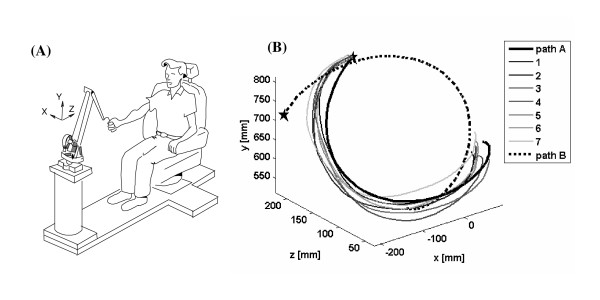
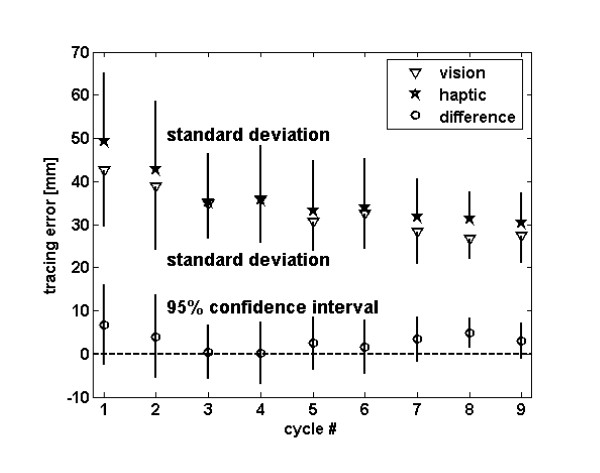
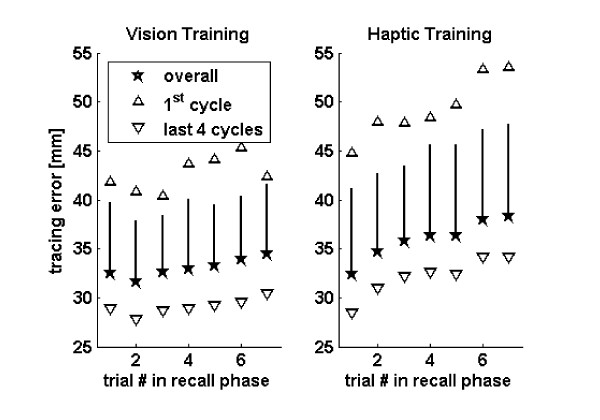
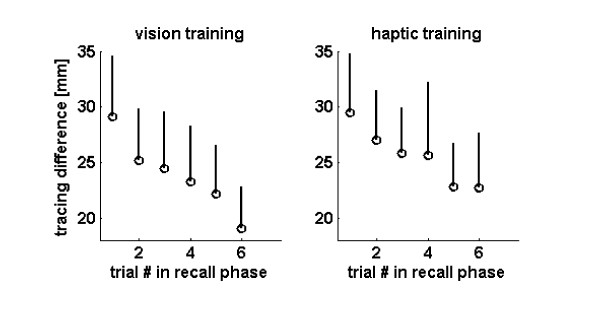
Background: Mechanical guidance with a robotic device is a candidate technique for teaching people desired movement patterns during motor rehabilitation, surgery, and sports training, but it is unclear how effective this approach is as compared to visual demonstration alone. Further, little is known about motor learning and retention involved with either robot-mediated mechanical guidance or visual demonstration alone. Methods: Healthy subjects (n = 20) attempted to reproduce a novel three-dimensional path after practicing it with mechanical guidance from a robot. Subjects viewed their arm as the robot guided it, so this "haptic guidance" training condition provided both somatosensory and visual input. Learning was compared to reproducing the movement following only visual observation of the robot moving along the path, with the hand in the lap (the "visual demonstration" training condition). Retention was assessed periodically by instructing the subjects to reproduce the path without robotic demonstration. Results: Subjects improved in ability to reproduce the path following practice in the haptic guidance or visual demonstration training conditions, as evidenced by a 30–40% decrease in spatial error across 126 movement attempts in each condition. Performance gains were not significantly different between the two techniques, but there was a nearly significant trend for the visual demonstration condition to be better than the haptic guidance condition (p = 0.09). The 95% confidence interval of the mean difference between the techniques was at most 25% of the absolute error in the last cycle. When asked to reproduce the path repeatedly following either training condition, the subjects' performance degraded significantly over the course of a few trials. The tracing errors were not random, but instead were consistent with a systematic evolution toward another path, as if being drawn to an "attractor path". Conclusion: These results indicate that both forms of robotic demonstration can improve short-term performance of a novel desired path. The availability of both haptic and visual input during the haptic guidance condition did not significantly improve performance compared to visual input alone in the visual demonstration condition. Further, the motor system is inclined to repeat its previous mistakes following just a few movements without robotic demonstration, but these systematic errors can be reduced with periodic training.
Overview
The claims and statistics of this paper haven’t been checked yet.
Free: it reads the open-access text and checks the first 5 claims that cite a source we can check. Create a free account to check every claim.
Integrity signals
Registry
Cites
Statistics
Figures
Verification
Claims the paper makes
The claims and statistics of this paper haven’t been checked yet.
Free: it reads the open-access text and checks the first 5 claims that cite a source we can check. Create a free account to check every claim.
Claims other papers make about this one
Each is checked against this paper’s own text: does it say what the citing paper says it does?
The source backs part of the claim, not all of it — or backs it for a different population, condition or comparison.
In the citing paper
“both visual and visuo-haptic training improved short-term retention of a novel path, whereas position control did not result in any significant improvement (Liu, Cramer, & Reinkensmeyer, 2006).”
From Augmented visual, auditory, haptic, and multimodal feedback in motor learning: A review (2013) · cites this paper as Liu et al., 2006
Experimental — accuracy not yet measuredThe cited source says what the claim attributes to it.
In the citing paper
“Haptic guidance combined with visual instruction was even marginally less effective in teaching a 3-D hand movement than was visual instruction alone (Liu et al., 2006).”
From Augmented visual, auditory, haptic, and multimodal feedback in motor learning: A review (2013) · cites this paper as Liu et al., 2006
Self-check
Percentages, sums and reported differences re-computed from the paper’s own numbers.
The self-check needs the paper’s full text.
Citations
Cites
Lum, P. S., Burgar, C. G., Shor, P. C., Majmundar, M., & Van der Loos, M. (2002) · Archives of Physical Medicine and Rehabilitation · doi:10.1053/apmr.2001.33101 · Cited by 1,159
Compensatory strategies for reaching in stroke
Cirstea, M. C., & Levin, M. F. (2000) · Brain · doi:10.1093/brain/123.5.940 · Cited by 1,006
Motor learning elicited by voluntary drive
Lotze, M. (2003) · Brain · doi:10.1093/brain/awg079 · Cited by 691
The Effect of Robot-Assisted Therapy and Rehabilitative Training on Motor Recovery Following Stroke
Aisen, M. L., Krebs, H. I., Hogan, N., McDowell, F., & Volpe, B. T. (1997) · Archives of Neurology · doi:10.1001/archneur.1997.00550160075019 · Cited by 516
Effects of robotic therapy on motor impairment and recovery in chronic stroke
Fasoli, S. E., Krebs, H. I., Stein, J., Frontera, W. R., & Hogan, N. (2003) · Archives of Physical Medicine and Rehabilitation · doi:10.1053/apmr.2003.50110 · Cited by 512
Robotics, Motor Learning, and Neurologic Recovery
Reinkensmeyer, D. J., Emken, J. L., & Cramer, S. C. (2004) · Annual Review of Biomedical Engineering · doi:10.1146/annurev.bioeng.6.040803.140223 · Cited by 415
Self-citationMattar, A. A. G., & Gribble, P. L. (2005) · Neuron · doi:10.1016/j.neuron.2005.02.009 · Cited by 408
Robotic techniques for upper limb evaluation and rehabilitation of stroke patients
Colombo, R., Pisano, F., Micera, S., Mazzone, A., Delconte, C., Carrozza, M. C., Dario, P., & Minuco, G. (2005) · IEEE Transactions on Neural Systems and Rehabilitation Engineering · doi:10.1109/tnsre.2005.848352 · Cited by 399
Haptic guidance: experimental evaluation of a haptic training method for a perceptual motor skill
Feygin, D., Keehner, M., & Tendick, R. (2003) · Proceedings 10th Symposium on Haptic Interfaces for Virtual Environment and Teleoperator Systems. HAPTICS 2002 · doi:10.1109/haptic.2002.998939 · Cited by 394
Kahn, L. E., Zygman, M. L., Rymer, W. Z., & Reinkensmeyer, D. J. (2006) · Journal of NeuroEngineering and Rehabilitation · doi:10.1186/1743-0003-3-12 · Cited by 375
Self-citation
Research works printed but not linked: 2
- Trombly CA Occupational therapy for dysfunction, 4th Edition 1995 4th Baltimore, Williams and Wilkins
- Park SS Howe RD Torchiana DF Virtual fixtures for robot-assisted minimally-invasive cardiac surgery Proc Fourth International Conference on Medical Image Computing and Computer-Assisted Intervention 2001 14 17
Cited by
Items 101–137 of 137
Sensory-Motor Interactions and the Manipulation of Movement Error
Parmar, P. N., Huang, F. C., & Patton, J. L. (2022) · Springer eBooks · doi:10.1007/978-3-031-08995-4_11 · Cited by 2
Hardware Capacity—End of Life Perspective
Xing, B., & Marwala, T. (2017) · Studies in systems, decision and control · doi:10.1007/978-3-319-67480-3_6 · Cited by 2
Supporting Unskilled People in Manual Tasks through Haptic-Based Guidance
Covarrubias, M., Bordegoni, M., Cugini, U., & Gatti, E. (2013) · IGI Global eBooks · doi:10.4018/978-1-4666-2491-7.ch018 · Cited by 2
Neuroergonomic assessment of the robotic enhancement of surgery
James, D. R. C. (2012) · doi:10.25560/9652 · Cited by 2
Sensing the Machine: Evaluating Multi-modal Interaction for Intelligent Dynamic Guidance
Bechinie, C., Zafari, S., Gallhuber, K., Kröninger, L., Puthenkalam, J., & Tscheligi, M. (2024) · ACM International Conference on Intelligent User Interfaces (IUI) · doi:10.1145/3640543.3645179 · Cited by 2
Assistance à l'Apprentissage de la Dextérité en Laparoscopie
Candalh-Touta, N. (2018) · theses.fr (ABES) · doi:10.70675/8005f6a6zb0a8z4bb4zb904zb7f1784ae575 · Cited by 2
On sensorimotor function and the relationship between proprioception and motor learning
Wong, J. D. (2012) · Scholarship@Western (Western University) · Cited by 1
Zenzeri, J., Basteris, A., Kostic, M. D., Popović, D. B., Sanguineti, V., Mohan, V., & Morasso, P. (2011) · Gait & Posture · doi:10.1016/j.gaitpost.2010.10.062 · Cited by 1
Three-dimensional, task-oriented robot therapy
Klamroth-Marganska, V. (2018) · Elsevier eBooks · doi:10.1016/b978-0-12-811995-2.00014-x · Cited by 1
Effects of physical guidance on motor control and learning during human walking
Domingo, A. (2009) · Deep Blue (University of Michigan) · Cited by 1
The Effects of Aging on Sensory Feedback Utilization During the Planning of Upper Limb Movements
Goodman, R. S. (2021) · TSpace (University of Toronto) · Cited by 1
A Unified Multi-Layer Framework for Skill Acquisition from Imperfect Human DemonstrationsPreprint
Yang, Z.-Q., & Kermani, M. R. (2026) · arXiv (Cornell University) · doi:10.48550/arxiv.2604.08341 · Cited by 1
Error-Encoded Vibrotactile Feedback to Enhance Motor Adaptation
Gnemmi, A. (2012) · Figshare
Supporting Unskilled People in Manual Tasks through Haptic-Based Guidance
Covarrubias, M., Bordegoni, M., Cugini, U., & Gatti, E. (2013) · IGI Global eBooks · doi:10.4018/978-1-4666-4422-9.ch048
Haptic-Enabled Collaborative Virtual Environments for Skills Training
Moghimi, S. (2008) · MacSphere (McMaster University) · doi:10.71548/5518
Neuromuscular control of Lokomat guided gait: evaluation of training parameters
van Kammen, K. (2018) · University of Groningen research database (University of Groningen / Centre for Information Technology)
Towards Skill Transfer via Learning-Based Guidance in Human-Robot Interaction
Zahedi, S. E. (2017) · Spectrum Research Repository (Concordia University)
An exploration of the utility of augmented haptic feedback for learning a curve-tracing task
Williams, C. K. (2018) · TSpace (University of Toronto)
Modulation of Haptic Task Characteristics to Facilitate Motor Learning
Basalp, E. (2020) · Repository for Publications and Research Data (ETH Zurich) · doi:10.3929/ethz-b-000471540
Mostofinejad, A., Goodman, R. S., Loria, T. D., Thaut, M. H., & Tremblay, L. (2023) · Neurorehabilitation · doi:10.3233/nre-220286
Rätz, R., Conti, F., Thaler, I., Müri, R. M., & Marchal–Crespo, L. (2024) · Research Square · doi:10.21203/rs.3.rs-4155027/v1
Robot-assisted therapy for retraining ankle-foot movements
Asín-Prieto, G., Martínez-Expósito, A., Pons, J. L., & Moreno, J. C. (2025) · Elsevier eBooks · doi:10.1016/b978-0-12-819877-3.00013-5
Sato, N., Nishizawa, H., & Kimura, T. (2025) · Journal of Physical Therapy Science · doi:10.1589/jpts.37.361
Minkes-Weiland, S. (2025) · University of Groningen research database (University of Groningen / Centre for Information Technology) · doi:10.33612/diss.1426327018
Comparison of Enhanced Visual and Haptic Features in a Virtual Reality-Based Haptic Simulation
Clamann, M. P., Ma, W., & KABER, D. B. (2013) · Lecture notes in computer science · doi:10.1007/978-3-642-39330-3_59
A Haptic Guidance System for Stroke Rehabilitation
Sabe, E. (2007) · DiVA (Digitala Vetenskapliga Arkivet)
Talari Progetto per la riabilitazione sensomotoria di pazienti allettati a seguito di ictus
Toso, F. (2018) · AirIuav (Università Iuav di Venezia) · doi:10.25432/toso-francesca_phd2018-05-10
Evaluating the Value Proposition of Adopting Virtual Reality (VR) for Construction Safety Training
Lopez, J. (2024) · CU Scholar (University of Colorado Boulder)
Mamani Aliaga, K. E. (2017) · Communities in DSpace (Pontifical Catholic University of Peru)
吉田, 直. (2007) · Institutional Repositories DataBase (IRDB) · doi:10.15083/00076796
Kim, C., Moon, Y., & Choi, J. (2026) · Sensors · doi:10.3390/s26092740
Sense the Machine: Using Multi-Modal Cues for Providing Intelligent Guidance
Zafari, S., Kröninger, L., Puthenkalam, J., & Tscheligi, M. (2026) · ACM Transactions on Interactive Intelligent Systems · doi:10.1145/3830236
Bouchard, A. (2016) · Knowledge UdeS (Institutional Deposit of the University of Sherbrooke)
Verbal, Visual and Kinesthetic Instructions for Preschool Children on Motor Skill Competence
Niznikowski, Т., Niźnikowska, E. A., Łuba-Arnista, W., Mastalerz, А., Sadowski, J., Starzak, M., Arnista, P., Moreira, M. A. D. A. G., Nogal, M., Czaja, R., et al. (2026) · Journal of Kinesiology and Exercise Sciences · doi:10.5604/01.3001.0055.9603
Haptic Handwriting training system
Lopes, J. P. L. R. V. (2020) · Portuguese National Funding Agency for Science, Research and Technology (RCAAP Project by FCT)
Takai, A., Lisi, G., Noda, T., Teramae, T., Imamizu, H., & Morimoto, J. (2021) · doi:10.3389/fnins.2021.704402.s001
Robotic guidance : velocity profile symmetry and online feedback use during manual aiming
Srubiski, S. L. (2012) · TSpace (University of Toronto)
Metadata
- Authors
- Liu, J., Cramer, S. C., & Reinkensmeyer, D.
- Affiliations
- University of California, Irvine (US)
- Corresponding author
- Reinkensmeyer, DJ
- ORCID
- Cramer, S C
- Venue
- Journal of NeuroEngineering and Rehabilitation
- Published
- 2006-08-31
- Volume
- 3
- Issue
- 1
- Pages
- 20-20
- ISSN
- 1743-0003 (ISSN-L)
- PMC
- PMC1569852
- OpenAlex
- W2171063000
- Cited by
- 119
- References
- 41
- Citations by year
- 2026: 4 · 2025: 3 · 2024: 7 · 2023: 2 · 2022: 3 · 2021: 2 · 2020: 5 · 2019: 3 · 2018: 4 · 2017: 10 · 2016: 6 · 2015: 8 · 2014: 6 · 2013: 10 · 2012: 9
- FWCI
- 3.56
- Type
- journal article
- Language
- en
- Open access
- gold
- doi.org
- Licence
- cc-by
- Locations
- Journal of NeuroEngineering and Rehabilitation (publishedVersion, cc-by)
- Europe PMC (PubMed Central) (publishedVersion, cc-by)
- PubMed (publishedVersion)
- eScholarship (California Digital Library) (submittedVersion)
- DOAJ (DOAJ: Directory of Open Access Journals) (submittedVersion)
- Funders
- National Institutes of Health (N01-HD-3–)
- Topics
- Life Sciences › Neuroscience › Cognitive Neuroscience › Motor Control and Adaptation
- Physical Sciences › Engineering › Biomedical Engineering › Prosthetics and Rehabilitation Robotics
- Social Sciences › Psychology › Social Psychology › Social Robot Interaction and HRI
- Keywords
- robotic assistance, haptic guidance, visual demonstration, motor learning, motor retention, somatosensory input, visual input, motor rehabilitation
About these checks
Registry, retraction, Cites and statistics results are computed, not judged, with one exception: a printed reference that no index lists is read once by a model before it counts as a citation error. Claims are extracted by a model and kept only when their quote appears verbatim in the text; each cited source is then checked, with a model’s help, for whether it says what the claim relies on. Those verdicts can be wrong — read the claim’s quote and the cited source before relying on one.
Statistics and arithmetic are recomputed, not judged.
Confidence bands are shown only for fields calibrated on our annotated test set. None is calibrated yet, so no band is shown.
What counts as a claim ›How we measure confidence ›How we check this ›
Are you an author, or do you see a problem with this page? Request a review
Data sources
Bibliographic data: Semantic Scholar, OpenAlex, Crossref.
Contains information from the Semantic Scholar Academic Graph Datasets, made available under the ODC Attribution License (ODC-BY 1.0).
Semantic Scholar’s data is described in: Kinney, R., et al. (2023). The Semantic Scholar Open Data Platform. arXiv:2301.10140.
