

Learning to perform a new movement with robotic assistance: comparison of haptic guidance and visual demonstration
Open accessThe DOI matches its Crossref record; 42 of the 42 references it cites were found in a registry or an index.
Abstract
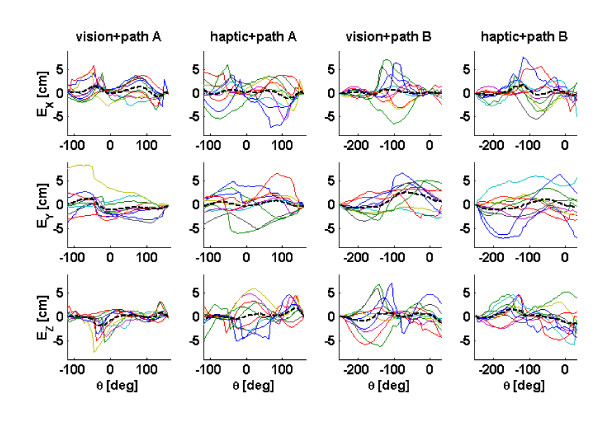
Background: Mechanical guidance with a robotic device is a candidate technique for teaching people desired movement patterns during motor rehabilitation, surgery, and sports training, but it is unclear how effective this approach is as compared to visual demonstration alone. Further, little is known about motor learning and retention involved with either robot-mediated mechanical guidance or visual demonstration alone. Methods: Healthy subjects (n = 20) attempted to reproduce a novel three-dimensional path after practicing it with mechanical guidance from a robot. Subjects viewed their arm as the robot guided it, so this "haptic guidance" training condition provided both somatosensory and visual input. Learning was compared to reproducing the movement following only visual observation of the robot moving along the path, with the hand in the lap (the "visual demonstration" training condition). Retention was assessed periodically by instructing the subjects to reproduce the path without robotic demonstration. Results: Subjects improved in ability to reproduce the path following practice in the haptic guidance or visual demonstration training conditions, as evidenced by a 30–40% decrease in spatial error across 126 movement attempts in each condition. Performance gains were not significantly different between the two techniques, but there was a nearly significant trend for the visual demonstration condition to be better than the haptic guidance condition (p = 0.09). The 95% confidence interval of the mean difference between the techniques was at most 25% of the absolute error in the last cycle. When asked to reproduce the path repeatedly following either training condition, the subjects' performance degraded significantly over the course of a few trials. The tracing errors were not random, but instead were consistent with a systematic evolution toward another path, as if being drawn to an "attractor path". Conclusion: These results indicate that both forms of robotic demonstration can improve short-term performance of a novel desired path. The availability of both haptic and visual input during the haptic guidance condition did not significantly improve performance compared to visual input alone in the visual demonstration condition. Further, the motor system is inclined to repeat its previous mistakes following just a few movements without robotic demonstration, but these systematic errors can be reduced with periodic training.
Overview
The claims and statistics of this paper haven’t been checked yet.
Free: it reads the open-access text and checks the first 5 claims that cite a source we can check. Create a free account to check every claim.
Integrity signals
Registry
Cites
Statistics
Figures
Verification
Claims the paper makes
The claims and statistics of this paper haven’t been checked yet.
Free: it reads the open-access text and checks the first 5 claims that cite a source we can check. Create a free account to check every claim.
Claims other papers make about this one
Each is checked against this paper’s own text: does it say what the citing paper says it does?
The source backs part of the claim, not all of it — or backs it for a different population, condition or comparison.
In the citing paper
“both visual and visuo-haptic training improved short-term retention of a novel path, whereas position control did not result in any significant improvement (Liu, Cramer, & Reinkensmeyer, 2006).”
From Augmented visual, auditory, haptic, and multimodal feedback in motor learning: A review (2013) · cites this paper as Liu et al., 2006
Experimental — accuracy not yet measuredThe cited source says what the claim attributes to it.
In the citing paper
“Haptic guidance combined with visual instruction was even marginally less effective in teaching a 3-D hand movement than was visual instruction alone (Liu et al., 2006).”
From Augmented visual, auditory, haptic, and multimodal feedback in motor learning: A review (2013) · cites this paper as Liu et al., 2006
Self-check
Percentages, sums and reported differences re-computed from the paper’s own numbers.
The self-check needs the paper’s full text.
Citations
Cites
Lum, P. S., Burgar, C. G., Shor, P. C., Majmundar, M., & Van der Loos, M. (2002) · Archives of Physical Medicine and Rehabilitation · doi:10.1053/apmr.2001.33101 · Cited by 1,159
Compensatory strategies for reaching in stroke
Cirstea, M. C., & Levin, M. F. (2000) · Brain · doi:10.1093/brain/123.5.940 · Cited by 1,006
Motor learning elicited by voluntary drive
Lotze, M. (2003) · Brain · doi:10.1093/brain/awg079 · Cited by 691
The Effect of Robot-Assisted Therapy and Rehabilitative Training on Motor Recovery Following Stroke
Aisen, M. L., Krebs, H. I., Hogan, N., McDowell, F., & Volpe, B. T. (1997) · Archives of Neurology · doi:10.1001/archneur.1997.00550160075019 · Cited by 516
Effects of robotic therapy on motor impairment and recovery in chronic stroke
Fasoli, S. E., Krebs, H. I., Stein, J., Frontera, W. R., & Hogan, N. (2003) · Archives of Physical Medicine and Rehabilitation · doi:10.1053/apmr.2003.50110 · Cited by 512
Robotics, Motor Learning, and Neurologic Recovery
Reinkensmeyer, D. J., Emken, J. L., & Cramer, S. C. (2004) · Annual Review of Biomedical Engineering · doi:10.1146/annurev.bioeng.6.040803.140223 · Cited by 415
Self-citationMattar, A. A. G., & Gribble, P. L. (2005) · Neuron · doi:10.1016/j.neuron.2005.02.009 · Cited by 408
Robotic techniques for upper limb evaluation and rehabilitation of stroke patients
Colombo, R., Pisano, F., Micera, S., Mazzone, A., Delconte, C., Carrozza, M. C., Dario, P., & Minuco, G. (2005) · IEEE Transactions on Neural Systems and Rehabilitation Engineering · doi:10.1109/tnsre.2005.848352 · Cited by 399
Haptic guidance: experimental evaluation of a haptic training method for a perceptual motor skill
Feygin, D., Keehner, M., & Tendick, R. (2003) · Proceedings 10th Symposium on Haptic Interfaces for Virtual Environment and Teleoperator Systems. HAPTICS 2002 · doi:10.1109/haptic.2002.998939 · Cited by 394
Kahn, L. E., Zygman, M. L., Rymer, W. Z., & Reinkensmeyer, D. J. (2006) · Journal of NeuroEngineering and Rehabilitation · doi:10.1186/1743-0003-3-12 · Cited by 375
Self-citation
Research works printed but not linked: 2
- Trombly CA Occupational therapy for dysfunction, 4th Edition 1995 4th Baltimore, Williams and Wilkins
- Park SS Howe RD Torchiana DF Virtual fixtures for robot-assisted minimally-invasive cardiac surgery Proc Fourth International Conference on Medical Image Computing and Computer-Assisted Intervention 2001 14 17
Cited by
Augmented visual, auditory, haptic, and multimodal feedback in motor learning: A review
Sigrist, R., Rauter, G., Riener, R., & Wolf, P. (2013) · Psychonomic Bulletin & Review · doi:10.3758/s13423-012-0333-8 · Cited by 1,416
Robot-assisted movement training for the stroke-impaired arm: Does it matter what the robot does?
Kahn, L. E., Lum, P. S., Rymer, W. Z., & Reinkensmeyer, D. J. (2006) · The Journal of Rehabilitation Research and Development · doi:10.1682/jrrd.2005.03.0056 · Cited by 274
Self-citationCan proprioceptive training improve motor learning?
Wong, J. D., Kistemaker, D. A., Chin, A., & Gribble, P. L. (2012) · Journal of Neurophysiology · doi:10.1152/jn.00122.2012 · Cited by 176
Haptic Guidance Can Enhance Motor Learning of a Steering Task
Crespo, L. M., & Reinkensmeyer, D. J. (2008) · Journal of Motor Behavior · doi:10.3200/jmbr.40.6.545-557 · Cited by 166
Self-citationHaptic Guidance Improves the Visuo-Manual Tracking of Trajectories
Bluteau, J., Coquillart, S., Payan, Y., & Gentaz, E. (2008) · PLoS ONE · doi:10.1371/journal.pone.0001775 · Cited by 153
Lewek, M. D., Cruz, T. H., Moore, J. L., Roth, H. R., Dhaher, Y. Y., & Hornby, T. G. (2009) · Physical Therapy · doi:10.2522/ptj.20080180 · Cited by 137
The effect of haptic guidance, aging, and initial skill level on motor learning of a steering task
Marchal-Crespo, L., McHughen, S., Cramer, S. C., & Reinkensmeyer, D. J. (2010) · Experimental Brain Research · doi:10.1007/s00221-009-2026-8 · Cited by 143
Self-citationMilot, M.-H., Marchal-Crespo, L., Green, C. S., Cramer, S. C., & Reinkensmeyer, D. J. (2010) · Experimental Brain Research · doi:10.1007/s00221-009-2014-z · Cited by 139
Self-citationCan Robots Help the Learning of Skilled Actions?
Reinkensmeyer, D. J., & Patton, J. L. (2009) · Exercise and Sport Sciences Reviews · doi:10.1097/jes.0b013e3181912108 · Cited by 133
Self-citationSigrist, R., Rauter, G., Riener, R., & Wolf, P. (2013) · Journal of Motor Behavior · doi:10.1080/00222895.2013.826169 · Cited by 134
Design of a Rotational Hydroelastic Actuator for a Powered Exoskeleton for Upper Limb Rehabilitation
Stienen, A. H. A., Hekman, E. E. G., ter Braak, H., Aalsma, A. M. M., van der Helm, F. C. T., & van der Kooij, H. (2009) · IEEE Transactions on Biomedical Engineering · doi:10.1109/tbme.2009.2018628 · Cited by 128
Dampace: dynamic force-coordination trainer for the upper extremities
Stienen, A. H. A., Hekman, E. E. G., van der Helm, F. C. T., Prange, G. B., Jannink, M. J. A., Aalsma, A. M. M., & van der Kooij, H. (2007) · International Conference on Rehabilitation Robotics · doi:10.1109/icorr.2007.4428519 · Cited by 124
Lee, J., & Choi, S. (2010) · 2010 IEEE Haptics Symposium · doi:10.1109/haptic.2010.5444635 · Cited by 118
GAIT ANALYSIS: SYSTEMS, TECHNOLOGIES, AND IMPORTANCE
Akhtaruzzaman, M., Shafie, A. A., & Khan, M. R. (2016) · Journal of Mechanics in Medicine and Biology · doi:10.1142/s0219519416300039 · Cited by 118
Prevalence of haptic feedback in robot-mediated surgery: a systematic review of literature
Amirabdollahian, F., Livatino, S., Vahedi, B., Gudipati, R., Sheen, P., Gowrie‐Mohan, S., & Vasdev, N. (2017) · Journal of Robotic Surgery · doi:10.1007/s11701-017-0763-4 · Cited by 115
Self-adaptive robot training of stroke survivors for continuous tracking movements
Vergaro, E., Casadio, M., Squeri, V., Giannoni, P., Morasso, P., & Sanguineti, V. (2010) · Journal of NeuroEngineering and Rehabilitation · doi:10.1186/1743-0003-7-13 · Cited by 114
Basalp, E., Wolf, P., & Marchal–Crespo, L. (2021) · IEEE Transactions on Haptics · doi:10.1109/toh.2021.3104518 · Cited by 104
Dampace: Design of an Exoskeleton for Force-Coordination Training in Upper-Extremity Rehabilitation
Stienen, A. H. A., Hekman, E. E. G., Prange, G. B., Jannink, M. J. A., Aalsma, A. M. M., van der Helm, F. C. T., & van der Kooij, H. (2009) · Journal of Medical Devices · doi:10.1115/1.3191727 · Cited by 92
Haptic Guidance Benefits Musical Motor Learning
Grindlay, G. (2008) · Symposium on Haptic Interfaces for Virtual Environment and Teleoperator Systems · doi:10.1109/haptics.2008.4479984 · Cited by 91
Klein, J., Spencer, S. J., & Reinkensmeyer, D. J. (2012) · IEEE Transactions on Neural Systems and Rehabilitation Engineering · doi:10.1109/tnsre.2012.2195202 · Cited by 83
Self-citationA robotic wheelchair trainer: design overview and a feasibility study
Marchal-Crespo, L., Furumasu, J., & Reinkensmeyer, D. J. (2010) · Journal of NeuroEngineering and Rehabilitation · doi:10.1186/1743-0003-7-40 · Cited by 80
Self-citationvan Kammen, K., Boonstra, A. M., van der Woude, L. H. V., Reinders‐Messelink, H. A., & den Otter, R. (2017) · Journal of NeuroEngineering and Rehabilitation · doi:10.1186/s12984-017-0244-z · Cited by 73
Effects of physical guidance on short-term learning of walking on a narrow beam
Domingo, A., & Ferris, D. P. (2009) · Gait & Posture · doi:10.1016/j.gaitpost.2009.07.114 · Cited by 72
Motor Learning Perspectives on Haptic Training for the Upper Extremities
Williams, C. K., & Carnahan, H. (2014) · IEEE Transactions on Haptics · doi:10.1109/toh.2013.2297102 · Cited by 65
Brokaw, E. B., Murray, T. M., Nef, T., & Lum, P. S. (2011) · The Journal of Rehabilitation Research and Development · doi:10.1682/jrrd.2010.04.0064 · Cited by 56
Effects of robotically modulating kinematic variability on motor skill learning and motivation
Duarte, J. E., & Reinkensmeyer, D. J. (2015) · Journal of Neurophysiology · doi:10.1152/jn.00163.2014 · Cited by 52
Self-citationRobot assistance of motor learning: A neuro-cognitive perspective
Heuer, H., & Lüttgen, J. (2015) · Neuroscience & Biobehavioral Reviews · doi:10.1016/j.neubiorev.2015.07.005 · Cited by 50
Force Field Adaptation Can Be Learned Using Vision in the Absence of Proprioceptive Error
Melendez-Calderon, A., Masia, L., Gassert, R., Sandini, G., & Burdet, E. (2011) · IEEE Transactions on Neural Systems and Rehabilitation Engineering · doi:10.1109/tnsre.2011.2125990 · Cited by 49
Jafari, N., Adams, K. D., & Tavakoli, M. (2016) · Journal of Rehabilitation and Assistive Technologies Engineering · doi:10.1177/2055668316668147 · Cited by 47
Stienen, A. H. A., Hekman, E. E. G., ter Braak, H., Aalsma, A. M. M., van der Helm, F. C. T., & van der Kooij, H. (2008) · IEEE/RAS-EMBS International Conference on Biomedical Robotics and Biomechatronics (BioRob) · doi:10.1109/biorob.2008.4762873 · Cited by 44
Expertise-Based Performance Measures in a Virtual Training Environment
Huegel, J. C., Celik, O., Israr, A., & O'Malley, M. K. (2009) · Presence: Teleoperators and Virtual Environments · doi:10.1162/pres.18.6.449 · Cited by 37
Effect of robotic guidance on motor learning of a timing task
Crespo, L. M., & Reinkensmeyer, D. J. (2008) · 2008 2nd IEEE RAS & EMBS International Conference on Biomedical Robotics and Biomechatronics · doi:10.1109/biorob.2008.4762796 · Cited by 38
Self-citationA tendon-based parallel robot applied to motor learning in sports
Rauter, G., von Zitzewitz, J., Duschau-Wicke, A., Vallery, H., & Riener, R. (2010) · 2010 3rd IEEE RAS & EMBS International Conference on Biomedical Robotics and Biomechatronics · doi:10.1109/biorob.2010.5627788 · Cited by 41
Rauter, G., Sigrist, R., Riener, R., & Wolf, P. (2015) · IEEE Transactions on Haptics · doi:10.1109/toh.2015.2431686 · Cited by 42
Reinkensmeyer, D. J., Galvez, J. A., Marchal–Crespo, L., Wolbrecht, E. T., & Bobrow, J. E. (2007) · International Conference on Rehabilitation Robotics · doi:10.1109/icorr.2007.4428547 · Cited by 39
Self-citationRobot-Assisted Rehabilitation Therapy: Recovery Mechanisms and Their Implications for Machine Design
Bejarano, N. C., Maggioni, S., Rijcke, L. D., Cifuentes, C. A., & Reinkensmeyer, D. J. (2015) · Biosystems & biorobotics · doi:10.1007/978-3-319-24901-8_8 · Cited by 37
Self-citationLee, H., & Choi, S. (2014) · IEEE Haptics Symposium · doi:10.1109/haptics.2014.6775449 · Cited by 37
Asín-Prieto, G., Martínez-Expósito, A., Barroso, F. O., Urendes, E. J., Gonzalez-Vargas, J. E., Alnajjar, F., González-Alted, C., Shimoda, S., Pons, J. L., & Moreno, J. C. (2020) · Frontiers in Bioengineering and Biotechnology · doi:10.3389/fbioe.2020.00113 · Cited by 37
Williams, C. K., Tremblay, L., & Carnahan, H. (2016) · Frontiers in Psychology · doi:10.3389/fpsyg.2016.02010 · Cited by 35
The influence of haptic guidance on the production of spatio-temporal patterns
Lüttgen, J., & Heuer, H. (2011) · Human Movement Science · doi:10.1016/j.humov.2011.07.002 · Cited by 32
Kümmel, J., Krämer, A., & Grüber, M. (2014) · Human Movement Science · doi:10.1016/j.humov.2014.08.003 · Cited by 30
The effect of skill level matching in dyadic interaction on learning of a tracing task
Kager, S., Hussain, A., Cherpin, A., Melendez-Calderon, A., Takagi, A., Endo, S., Burdet, E., Hirche, S., Ang, M. H., & Campolo, D. (2019) · International Conference on Rehabilitation Robotics · doi:10.1109/icorr.2019.8779485 · Cited by 29
Training Toddlers Seated on Mobile Robots to Steer Using Force-Feedback Joystick
Agrawal, S. K., Chen, X., Ragonesi, C. B., & Galloway, J. C. (2011) · IEEE Transactions on Haptics · doi:10.1109/toh.2011.67 · Cited by 29
Rodriguez‐Guerrero, C., Knaepen, K., Fraile, J. C., Turiel, J. P., Gonzalez-de-Garibay, V., & Lefeber, D. (2017) · Frontiers in Neuroscience · doi:10.3389/fnins.2017.00242 · Cited by 28
Robotic guidance benefits the learning of dynamic, but not of spatial movement characteristics
Lüttgen, J., & Heuer, H. (2012) · Experimental Brain Research · doi:10.1007/s00221-012-3190-9 · Cited by 28
Robot-assisted intermanual transfer of handwriting skills
Basteris, A., Bracco, L., & Sanguineti, V. (2012) · Human Movement Science · doi:10.1016/j.humov.2011.12.006 · Cited by 26
Haptic Guidance and Haptic Error Amplification in a Virtual Surgical Robotic Training Environment
Oquendo, Y. A., Coad, M. M., Wren, S. M., Lendvay, T. S., Nisky, I., Jarc, A., Okamura, A. M., & Chua, Z. (2024) · IEEE Transactions on Haptics · doi:10.1109/toh.2024.3350128 · Cited by 23
Rätz, R., Conti, F., Thaler, I., Müri, R. M., & Marchal–Crespo, L. (2024) · Journal of NeuroEngineering and Rehabilitation · doi:10.1186/s12984-024-01439-1 · Cited by 23
Active Prospective Control Is Required for Effective Sensorimotor Learning
Snapp‐Childs, W., Casserly, E. D., Mon-Williams, M. A., & Bingham, G. P. (2013) · PLoS ONE · doi:10.1371/journal.pone.0077609 · Cited by 23
Neural Efficiency of Human–Robotic Feedback Modalities Under Stress Differs With Gender
Nuamah, J. K., Mantooth, W. P., Karthikeyan, R., Mehta, R. K., & Ryu, S. C. (2019) · Frontiers in Human Neuroscience · doi:10.3389/fnhum.2019.00287 · Cited by 22
Augmented feedback, virtual reality and robotics for designing new rehabilitation methods
Robertson, J. V. G., & Roby-Brami, A. (2010) · Collection de l'Académie européenne de médecine de réadaptation · doi:10.1007/978-2-8178-0034-9_12 · Cited by 22
Influence of Varied Human Movement Control on Task Performance and Feeling of Telepresence
Peer, A., Pongrac, H., & BUSS, M. J. (2010) · PRESENCE Virtual and Augmented Reality · doi:10.1162/pres_a_00007 · Cited by 21
The Influence of Robotic Guidance on Different Types of Motor Timing
Lüttgen, J., & Heuer, H. (2013) · Journal of Motor Behavior · doi:10.1080/00222895.2013.785926 · Cited by 22
Effects of robotic guidance on sensorimotor control: Planning vs. online control?
Manson, G. A., Alekhina, M. I., Srubiski, S. L., Williams, C. K., Bhattacharjee, A., & Tremblay, L. (2014) · Neurorehabilitation · doi:10.3233/nre-141168 · Cited by 17
Bouchard, A. E., Corriveau, H., & Milot, M.-H. (2015) · Frontiers in Systems Neuroscience · doi:10.3389/fnsys.2015.00052 · Cited by 17
Transfer of skills between human operators through haptic training with robot coordination
Park, C. H., Yoo, J. W., & Howard, A. (2010) · Proceedings - IEEE International Conference on Robotics and Automation/Proceedings · doi:10.1109/robot.2010.5509160 · Cited by 16
Sensory-Motor Interactions and Error Augmentation
Patton, J. L., & Huang, F. C. (2016) · Springer eBooks · doi:10.1007/978-3-319-28603-7_5 · Cited by 16
Zahedi, E., Dargahi, J., Kia, M., & Zadeh, M. (2017) · IEEE Robotics and Automation Letters · doi:10.1109/lra.2017.2660071 · Cited by 15
A New Myohaptic Device to Assess Wrist Function in the Lab and in the Clinic – The Wristalyzer
Grimaldi, G., Lammertse, P., Braber, N. V. D., Meuleman, J., & Manto, M. U. (2008) · Lecture notes in computer science · doi:10.1007/978-3-540-69057-3_4 · Cited by 14
The applicability of motor learning to neurorehabilitation
Krakauer, J. W. (2020) · Oxford University Press eBooks · doi:10.1093/med/9780198824954.003.0007 · Cited by 14
Bouchard, A. E., Corriveau, H., & Milot, M.-H. (2016) · Disability and Rehabilitation · doi:10.1080/09638288.2016.1205151 · Cited by 14
Real world haptic exploration for telepresence of the visually impaired
Park, C. H., & Howard, A. (2012) · ACM/IEEE International Conference on Human-Robot Interaction (HRI) · doi:10.1145/2157689.2157701 · Cited by 13
Model-Based Haptic Guidance in Surgical Skill Improvement
Safavi, A., & Zadeh, M. (2015) · Conference proceedings/Conference proceedings - IEEE International Conference on Systems, Man, and Cybernetics · doi:10.1109/smc.2015.198 · Cited by 13
The impact of haptic guidance on musical motor learning
Grindlay, G. (2007) · DSpace@MIT (Massachusetts Institute of Technology) · Cited by 15
Lopez, J., Bhandari, S., Perry, L., Ayer, S. K., Hallowell, M. R., & Jones, M. (2025) · Journal of Construction Engineering and Management · doi:10.1061/jcemd4.coeng-15981 · Cited by 12
Exoskeleton Training through Haptic Sensation Transfer in Immersive Virtual Environment
Ye, Y., Shi, Y., Lee, Y.-J., Burks, G., Srinivasan, D., & Du, J. (2022) · ASCE Construction Research Congress (CRC) · doi:10.1061/9780784483961.059 · Cited by 12
Transfer of dynamic motor skills acquired during isometric training to free motion
Melendez-Calderon, A., Tan, M. R. T., Bittmann, M. F., Burdet, E., & Patton, J. L. (2017) · Journal of Neurophysiology · doi:10.1152/jn.00614.2016 · Cited by 11
Movement Strategy Discovery during Training via Haptic Guidance
Gibo, T. L., & Abbink, D. A. (2016) · IEEE Transactions on Haptics · doi:10.1109/toh.2016.2516984 · Cited by 11
Enhancing User Performance by Adaptively Changing Haptic Feedback Cues in a Fitts's Law Task
Rowland, D., Davis, B., Higgins, T. M., & Fey, A. M. (2024) · IEEE Transactions on Haptics · doi:10.1109/toh.2024.3358188 · Cited by 10
Haptic Assistance That Restricts the Use of Redundant Solutions is Detrimental to Motor Learning
Lokesh, R., & Ranganathan, R. (2020) · IEEE Transactions on Neural Systems and Rehabilitation Engineering · doi:10.1109/tnsre.2020.2990129 · Cited by 10
Development of novel devices for upper-extremity rehabilitation
Stienen, A. H. A. (2008) · doi:10.3990/1.9789036527842 · Cited by 10
Weiland, S., Smit, I. H., Reinders‐Messelink, H. A., van der Woude, L. H. V., van Kammen, K., & den Otter, R. (2018) · PLoS ONE · doi:10.1371/journal.pone.0198473 · Cited by 9
Robotic learning of motion using demonstrations and statistical models for surgical simulation
Yang, T., Chui, C. K., Liu, J., Huang, W., Su, Y., & Chang, S. K.-Y. (2013) · International Journal of Computer Assisted Radiology and Surgery · doi:10.1007/s11548-013-0967-7 · Cited by 9
Self-citationThe effect of haptic cues on motor and perceptual based implicit sequence learning
Kim, D.-W., Johnson, B. J., Gillespie, R. B., & Seidler, R. D. (2014) · Frontiers in Human Neuroscience · doi:10.3389/fnhum.2014.00130 · Cited by 9
Shaping Human Movement via Bimanually-Dependent Haptic Force Feedback
Boehm, J. R., Fey, N. P., & Fey, A. M. (2023) · IEEE World Haptics Conference (WHC) · doi:10.1109/whc56415.2023.10224475 · Cited by 8
Buist, M. L., Damercheli, S., Zbinden, J., Truong, M. T. N., Mastinu, E., & Ortiz-Catalan, M. (2024) · IEEE Transactions on Neural Systems and Rehabilitation Engineering · doi:10.1109/tnsre.2024.3379996 · Cited by 8
Automated kinesthetic trainer enhances kinesthetic memory development
Zhong, P., & Stone, R. (2013) · International Journal of Industrial Ergonomics · doi:10.1016/j.ergon.2013.02.007 · Cited by 8
Safavi, A., & Zadeh, M. (2017) · IEEE/CAA Journal of Automatica Sinica · doi:10.1109/jas.2017.7510634 · Cited by 8
Stienen, A. H. A., Hekman, E. E. G., Schouten, A. C., van der Helm, F. C. T., & van der Kooij, H. (2009) · Applied Bionics and Biomechanics · doi:10.1080/11762320902879888 · Cited by 8
Kager, S., Hussain, A., Budhota, A., Dailey, W., Hughes, C. M., Vishwanath, D. A., Kuah, C. W. K., Ng, C. Y., Yam, L. H. L., Xiang, L., et al. (2019) · Journal of Rehabilitation and Assistive Technologies Engineering · doi:10.1177/2055668319881583 · Cited by 7
How does physical guidance affect motor learning and learner’s workload?
Yamaguchi, K., Akizuki, K., Yamamoto, R., Yabuki, J., & Ohashi, Y. (2020) · Journal of Physical Therapy Science · doi:10.1589/jpts.32.621 · Cited by 7
Learning force patterns with a multimodal system using contextual cues
Rodríguez-Arce, J., Gutiérrez, T., Portillo-Rodríguez, O., & Sánchez, E. (2017) · International Journal of Human-Computer Studies · doi:10.1016/j.ijhcs.2017.10.007 · Cited by 7
Error Augmentation and the Role of Sensory Feedback
Patton, J. L., & Huang, F. C. (2011) · Springer eBooks · doi:10.1007/978-1-4471-2277-7_5 · Cited by 6
Anwendungspotential von Telepräsenz- und Teleaktionssystemen für die Präzisionsmontage
Acker, A. (2011) · Cited by 6
Acquisition of motor skills in isometric conditions through synesthetic illusions of movement
Melendez-Calderon, A., Bittmann, M. F., Tan, M. R. T., Burdet, E., & Patton, J. L. (2015) · IEEE World Haptics Conference (WHC) · doi:10.1109/whc.2015.7177749 · Cited by 5
Bayesian Estimation of Potential Performance Improvement Elicited by Robot-Guided Training
Takai, A., Lisi, G., Noda, T., Teramae, T., Imamizu, H., & Morimoto, J. (2021) · Frontiers in Neuroscience · doi:10.3389/fnins.2021.704402 · Cited by 5
Design and control for a gait rehabilitation robot
Chisholm, K. (2010) · Carleton University's Institutional Repository (MacOdrum Library, Carleton University) · doi:10.22215/etd/2010-09123 · Cited by 5
Robotic Platform with Visual Paradigm to Induce Motor Learning in Healthy Subjects
Asín-Prieto, G., González, J. E., Pons, J. L., & Moreno, J. C. (2017) · Advances in intelligent systems and computing · doi:10.1007/978-3-319-70836-2_47 · Cited by 4
Muramatsu, H., Itaguchi, Y., Yamada, C., Yoshizawa, H., & Katsura, S. (2024) · IEEE Transactions on Neural Systems and Rehabilitation Engineering · doi:10.1109/tnsre.2024.3427319 · Cited by 4
Progressive reduction versus fixed level of support during training: When less is less
Snapp‐Childs, W., Wang, X. M., & Bingham, G. P. (2015) · Human Movement Science · doi:10.1016/j.humov.2015.11.010 · Cited by 4
A Comparison of Virtual Reality-Based Psychomotor Task Training with Visual and Haptic Aiding
Ma, W., KABER, D. B., Gil, G.-H., Clamann, M. P., Jeon, W., Zhu, B., & Currie, N. J. (2017) · Advances in intelligent systems and computing · doi:10.1007/978-3-319-60018-5_26 · Cited by 4
Cross-Cultural Training: History, Developments, Future Directions
Taras, V., Liu, Y., Mehta, A., Stackhouse, M. R. D., & González-Pérez, M. A. (2020) · SAGE Publications Ltd eBooks · doi:10.4135/9781529714340.n37 · Cited by 4
New trends in neurorehabilitation of subjects with central nervous system lesions
Popović, D. B., & Popović, M. B. (2010) · Slovenian Medical Journal · Cited by 4
Robotics‐based telepresence using multi‐modal interaction for individuals with visual impairments
Park, C. H., & Howard, A. (2014) · International Journal of Adaptive Control and Signal Processing · doi:10.1002/acs.2495 · Cited by 4
Duarte, J. E. (2014) · eScholarship (California Digital Library) · Cited by 4
Actively Guided Practice Enhances Kinesthetic Memory Development
Stone, R. (2013) · Proceedings of the Human Factors and Ergonomics Society Annual Meeting · doi:10.1177/1541931213571137 · Cited by 3
A Novel Pulley-Based Simulator for Ureteroscopy with Visuo-Haptic Feedback
Madera, J., Peters, C. A., & Fey, A. M. (2022) · IEEE Haptics Symposium · doi:10.1109/haptics52432.2022.9765615 · Cited by 3
Circles on pommel horse with a suspended aid: Mass-centre rotation and hip joint moment
Fujihara, T., & Gervais, P. (2012) · Journal of Sports Sciences · doi:10.1080/02640414.2012.695078 · Cited by 3
Effect of Intermittent Haptic Disturbance in Motor Skill Training
Siti, N. Z. A., Su, E. L. M., & Yeong, C. F. (2013) · Applied Mechanics and Materials · doi:10.4028/www.scientific.net/amm.432.403 · Cited by 3
User-driven human robot interaction: A null space optimization and inertia shaping method
Yang, Z.-Q., & Kermani, M. R. (2026) · Control Engineering Practice · doi:10.1016/j.conengprac.2026.106958 · Cited by 2
Metadata
- Authors
- Liu, J., Cramer, S. C., & Reinkensmeyer, D.
- Affiliations
- University of California, Irvine (US)
- Corresponding author
- Reinkensmeyer, DJ
- ORCID
- Cramer, S C
- Venue
- Journal of NeuroEngineering and Rehabilitation
- Published
- 2006-08-31
- Volume
- 3
- Issue
- 1
- Pages
- 20-20
- ISSN
- 1743-0003 (ISSN-L)
- PMC
- PMC1569852
- OpenAlex
- W2171063000
- Cited by
- 119
- References
- 41
- Citations by year
- 2026: 4 · 2025: 3 · 2024: 7 · 2023: 2 · 2022: 3 · 2021: 2 · 2020: 5 · 2019: 3 · 2018: 4 · 2017: 10 · 2016: 6 · 2015: 8 · 2014: 6 · 2013: 10 · 2012: 9
- FWCI
- 3.56
- Type
- journal article
- Language
- en
- Open access
- gold
- doi.org
- Licence
- cc-by
- Locations
- Journal of NeuroEngineering and Rehabilitation (publishedVersion, cc-by)
- Europe PMC (PubMed Central) (publishedVersion, cc-by)
- PubMed (publishedVersion)
- eScholarship (California Digital Library) (submittedVersion)
- DOAJ (DOAJ: Directory of Open Access Journals) (submittedVersion)
- Funders
- National Institutes of Health (N01-HD-3–)
- Topics
- Life Sciences › Neuroscience › Cognitive Neuroscience › Motor Control and Adaptation
- Physical Sciences › Engineering › Biomedical Engineering › Prosthetics and Rehabilitation Robotics
- Social Sciences › Psychology › Social Psychology › Social Robot Interaction and HRI
- Keywords
- robotic assistance, haptic guidance, visual demonstration, motor learning, motor retention, somatosensory input, visual input, motor rehabilitation
About these checks
Registry, retraction, Cites and statistics results are computed, not judged, with one exception: a printed reference that no index lists is read once by a model before it counts as a citation error. Claims are extracted by a model and kept only when their quote appears verbatim in the text; each cited source is then checked, with a model’s help, for whether it says what the claim relies on. Those verdicts can be wrong — read the claim’s quote and the cited source before relying on one.
Statistics and arithmetic are recomputed, not judged.
Confidence bands are shown only for fields calibrated on our annotated test set. None is calibrated yet, so no band is shown.
What counts as a claim ›How we measure confidence ›How we check this ›
Are you an author, or do you see a problem with this page? Request a review
Data sources
Bibliographic data: Semantic Scholar, OpenAlex, Crossref.
Contains information from the Semantic Scholar Academic Graph Datasets, made available under the ODC Attribution License (ODC-BY 1.0).
Semantic Scholar’s data is described in: Kinney, R., et al. (2023). The Semantic Scholar Open Data Platform. arXiv:2301.10140.
