

Diet induced thermogenesis
Open accessThe DOI matches its Crossref record; 34 of the 35 references it cites were found in a registry or an index, and 1 are not checked yet.
Abstract
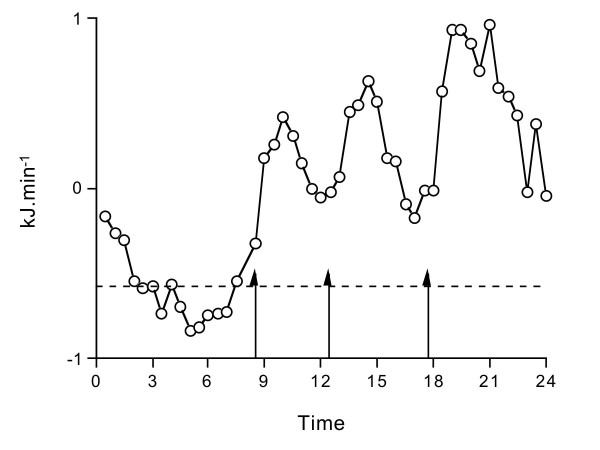
Objective: Daily energy expenditure consists of three components: basal metabolic rate, diet-induced thermogenesis and the energy cost of physical activity. Here, data on diet-induced thermogenesis are reviewed in relation to measuring conditions and characteristics of the diet. Methods: Measuring conditions include nutritional status of the subject, physical activity and duration of the observation. Diet characteristics are energy content and macronutrient composition. Results: Most studies measure diet-induced thermogenesis as the increase in energy expenditure above basal metabolic rate. Generally, the hierarchy in macronutrient oxidation in the postprandial state is reflected similarly in diet-induced thermogenesis, with the sequence alcohol, protein, carbohydrate, and fat. A mixed diet consumed at energy balance results in a diet induced energy expenditure of 5 to 15 % of daily energy expenditure. Values are higher at a relatively high protein and alcohol consumption and lower at a high fat consumption. Protein induced thermogenesis has an important effect on satiety. In conclusion, the main determinants of diet-induced thermogenesis are the energy content and the protein- and alcohol fraction of the diet. Protein plays a key role in body weight regulation through satiety related to diet-induced thermogenesis.
Overview
The claims and statistics of this paper haven’t been checked yet.
Free: it reads the open-access text and checks the first 5 claims that cite a source we can check. Create a free account to check every claim.
Integrity signals
Registry
Cites
Statistics
Figures
Verification
Claims the paper makes
The claims and statistics of this paper haven’t been checked yet.
Free: it reads the open-access text and checks the first 5 claims that cite a source we can check. Create a free account to check every claim.
Claims other papers make about this one
Each is checked against this paper’s own text: does it say what the citing paper says it does?
The source backs part of the claim, not all of it — or backs it for a different population, condition or comparison.
In the citing paper
“The thermic effect of food, which is called diet-induced thermogenesis, is increased energy expenditure that results from nutrient processing; these values are highest for protein.”
From Optimal Diet Strategies for Weight Loss and Weight Loss Maintenance (2021) · cites this paper as [48]
Experimental — accuracy not yet measuredThe cited source says what the claim attributes to it.
In the citing paper
“A fraction (∼10%) of the TDEE can be explained by the thermic effect of food (TEF) (Westerterp, 2004).”
From Effect of Exercise Training on Fat Loss—Energetic Perspectives and the Role of Improved Adipose Tissue Function and Body Fat Distribution (2021) · cites this paper as Westerterp, 2004
Self-check
Percentages, sums and reported differences re-computed from the paper’s own numbers.
The self-check needs the paper’s full text.
Citations
Cites
Determinants of 24-hour energy expenditure in man. Methods and results using a respiratory chamber.
Ravussin, E., Lillioja, S., Anderson, T. E., Christin, L., & Bogardus, C. (1986) · Journal of Clinical Investigation · doi:10.1172/jci112749 · Cited by 1,166 · cited 1×
“Reported within-subject variability in DIT, determined with a respiration chamber, is 43 to 48% [5,9].”
Raben, A., Agerholm-Larsen, L., Flint, A., Holst, J. J., & Astrup, A. (2003) · The American Journal of Clinical Nutrition · doi:10.1093/ajcn/77.1.91 · Cited by 365 · cited 3×
“0 % of the energy content of the meal [12].”
InfluentialWesterterp-Plantenga, M., Rolland, V, Wilson, S., & Westerterp, K. (1999) · European Journal of Clinical Nutrition · doi:10.1038/sj.ejcn.1600782 · Cited by 361 · cited 1×
“Satiety scores were higher during meals with a high-protein/high-carbohydrate diet, as well as over 24 h, than with a high-fat diet [22].”
Self-citationMeasuring the thermic effect of food
Reed, G., & Hill, J. (1996) · The American Journal of Clinical Nutrition · doi:10.1093/ajcn/63.2.164 · Cited by 253 · cited 2×
“Reed GW, Hill JO: Measuring the thermic effect of food.”
Diet induced thermogenesis measured over 24h in a respiration chamber: effect of diet composition
Westerterp, K., Wilson, S., & Rolland, V (1999) · International Journal of Obesity · doi:10.1038/sj.ijo.0800810 · Cited by 251 · cited 4×
“The use of a respiration chamber to measure DIT has the advantage of reproducing more physiological conditions over a longer period of time while regular meals are consumed throughout the day [5,6].”
InfluentialSelf-citationHealth issues related to alcohol consumption
Macdonald, I. A., & Europe, I. (1999) · Medical Entomology and Zoology · Cited by 229
Piers, L., Walker, K., Stoney, R., Soares, M., & O'Dea, K. (2002) · International Journal of Obesity · doi:10.1038/sj.ijo.0801993 · Cited by 187
Johnston, C. S., Day, C. S., & Swan, P. D. (2002) · Journal of the American College of Nutrition · doi:10.1080/07315724.2002.10719194 · Cited by 181 · cited 1×
“Postprandial thermogenesis was increased 100% on a high-protein/low-fat diet versus a high-carbohydrate/lowfat diet in healthy subjects [23].”
Thermic effect of food and sympathetic nervous system activity in humans
Tappy, L. (1996) · Reproduction Nutrition Development · doi:10.1051/rnd:19960405 · Cited by 177 · cited 1×
“The intestinal absorption of nutrients, the initial steps of their metabolism and the storage of the absorbed but not immediately oxidized nutrients [15].”
Resting metabolic rate and diet-induced thermogenesis: a methodological reappraisal
Weststrate, J. (1993) · American Journal of Clinical Nutrition · doi:10.1093/ajcn/58.5.592 · Cited by 174 · cited 1×
“Results Reported intra-individual variability in DIT, determined with ventilated-hood systems, is 6 to 30% [7,8].”
Cited by
Items 501–600 of 614
Nutrition, the Point of View of Both Physician and Patient (We)
Ciampolini, M. (2016)
Damascena, H. L. (2016) · RIUnB Institutional Repository (University of Brasília) · doi:10.26512/2016.06.d.21746
The effects of energy availability on bone metabolism and health
Papageorgiou, M. (2016) · Nottingham Trent University's Institutional Repository (Nottingham Trent Repository)
Effects of Food Consumption on Cell Proliferation in the Brain of Python regius
Habroun, S. S. (2017) · DigitalCommons - CalPoly (California State Polytechnic University) · doi:10.15368/theses.2017.86 · Cited by 1
“To put this into perspective, the average maximum increase in metabolic rate for humans during digestion is about 25% and in fishes is 136%, but for pythons consuming a meal 25% of its body mass, this number is an extraordinary 687% (Westerterp 2004; Secor 2009).”
BackgroundDevelopment of a handheld breath analyser for the monitoring of energy expenditure
Vincent, T. A. (2026) · Warwick Research Archive Portal (University of Warwick) · doi:10.82444/warw.33746602
How are overall energy intake and expenditure related to obesity?
Westerterp, K. R. (2017) · PubMed · Cited by 3
Self-citationMyers, A. (2017) · White Rose eTheses Online (University of Leeds, The University of Sheffield, University of York) · Cited by 1
Module 1: Monitoring Food Intake, Physical Activity and Body Weight
Grave, R. D., Sartirana, M., Ghoch, M. E., & Calugi, S. (2018) · Springer eBooks · doi:10.1007/978-3-319-91497-8_4
Lonac, M. C., Bell, C., Hickey, M. S., Nelson-Ceschin, T. L., & Melby, C. L. (2007) · Digital Collections of Colorado (Colorado State University) · doi:10.25675/3.022168
Guede-Fernández, F. (2018) · UPCommons institutional repository (Universitat Politècnica de Catalunya) · doi:10.5821/dissertation-2117-121196
“Cuando la persona está en balance energético, el gasto es igual al consumo, se estima que el ETA es un 10 % del GCT diario [43].”
BackgroundInteractions in complex traits
Young, A. T. I. S. (2016) · Oxford University Research Archive (ORA) (University of Oxford) · doi:10.5287/ora-00rv2wgkz
Investigations of the Mechanisms of Diabetes Remission: A Focus on Adaptive Thermogenesis
Corley, B. (2019) · Otago University Research Archive (University of Otago) · Cited by 2
Kanazawa, M., Watanabe, M., & Suzuki, T. (2019) · Nutrition Research · doi:10.1016/j.nutres.2019.02.007
Energy Estimations And The Creation Of An Artificial Immune System
Liberg, L. (2019) · Chalmers Publication Library (Chalmers University of Technology)
Langan‐Evans, C. (2021) · Liverpool John Moores University · doi:10.24377/ljmu.t.00010812 · Cited by 1
Raste, Y. (2016) · Spiral (Imperial College London) · doi:10.25560/55133
Quartey, P. (2019) · American Journal of Biomedical Science & Research · doi:10.34297/ajbsr.2019.06.001046
Examining Resting and Total Energy Expenditure in Patients with Cancer
Purcell, S. A. (2019) · ERA: Education and Research Archive (University of Alberta) · doi:10.7939/r3-r8h9-6243
Pavlidou, E. (2019) · Institutional Repository Hellanicus · doi:10.26215/heal.uoa.205
VLIYaNIE KhIMIChESKOGO SOSTAVA GOTOVYKh BLYuD NA PIShchEVOY TERMOGENEZ
Егоренкова, Н. П. (2016) · Medical academic journal · doi:10.17816/maj164210-211 · Cited by 2
Role of exercise, cold, and the biological clock on energy balance in humans: The ACTIBATE study
Manzano, A., & Miguel, F. (2020) · LA Referencia (Red Federada de Repositorios Institucionales de Publicaciones Científicas)
Nutritional determinants & cardiometabolic risk outcomes in children and adolescents with obesity
Saner, C. (2020) · UTUPub (University of Turku)
The Mechanistic Approach to Tackle Obesity Using Traditional Herbal Plants
Khan, S. (2020) · Advances in medical diagnosis, treatment, and care (AMDTC) book series · doi:10.4018/978-1-7998-4808-0.ch005 · Cited by 1
El-Mowafy, M. A., & Elmaadawy, A. A. (2016) · مجلة بحوث التربية النوعية · doi:10.21608/mbse.2016.139100
A Multi-Scale Immune System Simulator for the Onset of Type 2 Diabetes
Palumbo, M. C., & Castiglione, F. (2023) · SEMA SIMAI Springer series · doi:10.1007/978-3-031-35715-2_6
Burgin, A. (2019) · Worcester Research and Publications (University of Worcester)
Supermarket Shopping and Nutritional Outcomes: A Panel Data Analysis for Urban KenyaPreprint
Demmler, K., Ecker, O., & Qaim, M. (2017) · RePEc: Research Papers in Economics · doi:10.22004/ag.econ.253860 · Cited by 2
Rosante, M. C., Marine, D. A., Furino, V. D. O., Speretta, G. F. F., Lino, A. D. D. S., Andre, R. A., Silvestre, J. G., Sene‐Fiorese, M., Duarte, F. D. O., Selistre-de-Araújo, H. S., et al. (2021) · Revista Brasileira de Educação Física e Esporte · doi:10.11606/issn.1981-4690.v35i1p159-175
Martins, N. (2020) · White Rose eTheses Online (University of Leeds, The University of Sheffield, University of York)
Fortin-Lacombe, J. (2020) · uO Research (University of Ottawa) · doi:10.20381/ruor-25810
DesLauriers, A. G. C. (2021) · ERA: Education and Research Archive (University of Alberta) · doi:10.7939/r3-c1de-rd26
高強度・短時間・間欠的運動が運動後の安静時酸素摂取量に与える影響に関する研究
勝憲, 街. (2019) · Institutional Repositories DataBase (IRDB) · doi:10.34382/00009459
Vily‐Petit, J. (2020) · theses.fr (ABES) · doi:10.70675/aaa9ce42z5f23z4953z8620z47e74ff7a235 · Cited by 1
Måltidens inverkan på energiomsättning
Söderqvist, J. (2009) · Örebro University Library (Örebro University)
Interaction of Dietary Protein and Energy Balance
Martens, E. A. P., Mattes, R. D., Westerterp‐Plantenga, M. S., Bergeron, N., Siri-Tarino, P. W., Bray, G. A., & Krauss, R. M. (2017) · CRC Press eBooks · doi:10.1201/9781315119410-17
Assessment of free-living energy expenditure
Chowdhury, E. A., Peacock, O. J., & Thompson, D. (2022) · Routledge eBooks · doi:10.4324/9781003045267-18
Interaction of dietary protein with energy balance
Martens, E. A. P. (2014) · Research Publications (Maastricht University) · doi:10.26481/dis.20141211em
Protein intake and weight control
Clifton, P. (2010) · Woodhead Publishing Limited eBooks · doi:10.1533/9781845690840.2.242
Increased Energy/Reduced Digestion
Voytyuk, M. (2016) · Springer eBooks · doi:10.1007/978-3-319-16999-6_2952-1
Increased Energy/Reduced Digestion
Voytyuk, M. (2021) · Springer eBooks · doi:10.1007/978-3-319-19650-3_2952
A commercial R&D perspective on weight control foods and ingredients
Mela, D. J. (2010) · Woodhead Publishing Limited eBooks · doi:10.1533/9781845690840.3.493
Heindl, Z. (2022) · ISU Red - Research and eData (Illinois State University) · doi:10.30707/etd2022.20220705065051524295.999991
Clinical Evaluation, Lifestyle, and Pharmacological Management of Obesity
Kolli, S., Tchang, B. G., Redmond, I. P., Barenbaum, S. R., & Saunders, K. H. (2022) · Springer eBooks · doi:10.1007/978-3-030-94953-2_14
Bellissimo, N., Fansabedian, T., Wong, V. C. H., de Zepetnek, J. O. T., Brett, N. R., Schwartz, A., Cassin, S. E., Suitor, K., & Rousseau, D. (2023) · doi:10.32920/21397524.v1
GLP-1 Secretion Induced by Dietary Proteins and Peptides, and Its Hypoglycemic and Thermic Effects
Hira, T. (2024) · Nippon Eiyo Shokuryo Gakkaishi · doi:10.4327/jsnfs.77.13
Quessada, C. (2021) · theses.fr (ABES) · doi:10.70675/a105cc13zc708z4ac1zada4zba58281e9122
Bedeutung des Energieverbrauchs
Müller, M. J., & Bosy‐Westphal, A. (2024) · Springer eBooks · doi:10.1007/978-3-662-58895-6_13
Ling, C. Y., Yeo, M. T. Y., Kang, Y., Ng, S. M., Bi, X., & Henry, C. J. (2024) · Journal of the American Nutrition Association · doi:10.1080/27697061.2024.2426563
Lauran, M., Jafari, A. M., Ali, K. M., & Hosseini, M. (2024) · Journal of Biostatistics and Epidemiology · doi:10.18502/jbe.v10i1.17151 · Cited by 1
The Importance of Dietary Intervention in Obesity Management
Seo, Y. B. (2024) · Korean Journal of Family Practice · doi:10.21215/kjfp.2024.14.4.193
間接熱量計と酸素代謝を活用した高齢重症患者への栄養アセスメント
清水, 健., & 健, 蛯. (2025) · The Japanese Journal of SURGICAL METABOLISM and NUTRITION · doi:10.11638/jssmn.59.1_19
Wakamatsu, J., Tan, Y., Kato, S., Abe, H., Kawahara, M., Hayakawa, T., & Kumura, H. (2025) · Journal of Thermal Biology · doi:10.1016/j.jtherbio.2025.104101
Suzuyama, C. A., Takakura, S., Takii, M., Kishimoto, J., Suematsu, T., Toda, K., Yamashita, M., Hata, T., & Sudo, N. (2025) · BioPsychoSocial Medicine · doi:10.1186/s13030-025-00332-0
Feeling sick is an emotion meant to help you get better faster
Schrock, J. M. (2019) · The Conversation · doi:10.64628/aai.4vk7rweu9
High protein diet and health: The role of protein snacks
Qi, X., & Tester, R. F. (2025) · Food Nutrition Chemistry · doi:10.18686/fnc355
Xiao, S., Qian, Z., Tang, C., & Huang, Z. (2025) · Intelligent Data Analysis · doi:10.1177/1088467x251395623
Leitão, A. E. (2025) · Digital Library of Theses and Dissertations (Universidade de São Paulo) · doi:10.11606/t.39.2025.tde-23102025-153202
An automated image-based dietary assessment application: a pilot study
Lee, L., Bishop, R., & Stanley, J. (2025) · Journal of Nutritional Science · doi:10.1017/jns.2025.10045
“The non-linear Hildebrand equation was derived in participants who were fasted for only 2 h; therefore, the VO 2 measurements may include some degree of DIT, as DIT can contribute to total EE for up to 10 h following consumption (36) .”
CHROMATIN ACCESSIBILITY CHANGES DURING ADIPOSE BEIGING AND MELANOCYTE STEM CELL ACTIVATION
Lee, S. (2022) · eCommons (Cornell University) · doi:10.7298/w7e7-kv88
Chakravarty, P., Cozzi, G., Scantlebury, D. M., Özgül, A., & Aminian, K. (2024) · Figshare · doi:10.6084/m9.figshare.26592758
Parker, L. (2024) · Liverpool John Moores University · doi:10.24377/ljmu.t.00024102
Acosta Manzano, F. M. (2020) · Figshare · doi:10.6084/m9.figshare.12187944
Additional file 1 of Associations of alcohol consumption with breast tissue composition
Yaghjyan, L., Heng, Y. J., Baker, G. M., ROSNER, B. A., & Tamimi, R. M. (2024) · Figshare · doi:10.6084/m9.figshare.26579228
Suonpää, M. (2016) · Jyväskylä University Digital Archive (University of Jyväskylä) · Cited by 2
Why do ABCC5 KO mice show a lean phenotype?
McKay, E. J. (2018) · Oxford University Research Archive (ORA) (University of Oxford) · doi:10.5287/ora-xr7w4yrdz
Schmalle, V., Renz, J., Ferrario, P. G., Seifert, S., Engelbert, A. K., Wittek, O., Merz, B., Brennan, L., Manach, C., Rist, M. J., et al. (2026) · JMIR Research Protocols · doi:10.2196/77571
“…the estimated REE, the AEE measured by accelerometry, and the diet-induced thermogenesis (DIT), which is assumed as 10% of the sum of REE and AEE [42]: Habitual Diet Assessment (30-Day Food Frequency Questionnaire) The validated 57-item FFQ applied in the German Health Interview and Examination…”
THE IMPACT OF COFFEE BIOACTIVE COMPOUNDS ON OBESITY: MECHANISMS AND CLINICAL PERSPECTIVES
Bartolik, S., Górnicka, I., Pastuszek, A., Pastuszek, R., Rosiewicz, M., Janda, A., Durowicz, M., Bieńkowska, K., Drzymała, J., & Kierepka, U. (2025) · International Journal of Innovative Technologies in Social Science · doi:10.31435/ijitss.4(48).2025.4337
Mayasari, A. C., Rinarto, N. D., & Setyani, R. D. N. (2026) · Jurnal PROMKES · doi:10.20473/jpk.v14.isi1.2026.157-162
Empirical Evaluation of the Mass Balance Model in Human Bodyweight RegulationPreprint
Arencibia‐Albite, F. (2026) · Research Square · doi:10.21203/rs.3.rs-8576437/v1
Minge, M. M., Henriksen, C., Augestad, E. M. S., Blomhoff, R., Hägele, F. A., Dörner, R., Rising, R., Ulven, S. M., & Olsén, T. (2026) · Physiological Reports · doi:10.14814/phy2.70740 · Cited by 1
Marcantei, C., Metz, L., Ramos, I., Pereira, B., Dutheil, F., de Saint-Vincent, S., Duclos, M., & Isacco, L. (2026) · Nutrition Metabolism and Cardiovascular Diseases · doi:10.1016/j.numecd.2026.104637
Mello, D. G. A., dos Anjos, L. A., Ravelli, M. N., Ferriolli, E., & Pfrimer, K. (2026) · American Journal of Human Biology · doi:10.1002/ajhb.70222
“DIT is different for each nutrient, and reported values are 0%–3% for fat, 5%–10% for carbohydrates, 20%–30% for protein, and 10%–30% for alcohol (Westerterp 2004).”
Khoshnevisan, F. (2024) · TSpace (University of Toronto)
Age-Related Changes in Energy Expenditure
Botushanov, N. P., Botushanov, A., & Botushanova, A. D. (2026) · Open Access Macedonian Journal of Medical Sciences · doi:10.3889/oamjms.2026.12051
アスリートにおける日常生活活動及び食事誘発性エネルギー消費量の特徴
Goshozono, M. (2024) · Institutional Repositories DataBase (IRDB)
Effet des acides gras polyinsaturés sur la conversion des adipocytes blancs en adipocytes brites
Ghandour, R. A. (2016) · theses.fr (ABES) · doi:10.70675/9e4d31dcz030dz40f4zbf5fz69f142a246bc · Cited by 1
Rôle des acides aminés dans la limitation de l’adiposité sous régime hyperprotéique.
Chalvon‐Demersay, T. (2016) · theses.fr (ABES) · doi:10.70675/a57a2c96za03ez4d86zb7d1z880d7d2c03ad
Impact de l'acide octanoïque alimentaire sur l'octanoylation de la Ghréline, chez le rat
Lemarié, F. L. (2016) · theses.fr (ABES) · doi:10.70675/e882787az2359z4f02z8225z49a146903f2e · Cited by 1
Jesus, F., Francisco, R., Bernardino, A. V., Nunes, C. L., Dickinson, S., Rocha, P. M., Minderico, C. S., Sardinha, L. B., Schoeller, D. A., & Silva, A. M. (2026) · International Journal of Sport Nutrition and Exercise Metabolism · doi:10.1123/ijsnem.2025-0120
Rahimi, V., & Jahromi, M. K. (2026) · Advances in Integrative Medicine · doi:10.1016/j.aimed.2026.100668
Dukan diet, ketogenic diet and low glycemic index diet: Biochemical basis and metabolic consequences
Muszalska, A., Gaj, Z., Roczyński, B., Łompieś, K., Polok, I., Jaworska, Z., & Słowikowski, B. K. (2026) · Nutrition · doi:10.1016/j.nut.2026.113289
Vujović, N., Koh, H.-C., Heng, S. W., Panjwani, P., Zee, C., Wang, W., Qian, J., Garaulet, M., & Scheer, F. A. J. L. (2026) · Metabolism · doi:10.1016/j.metabol.2026.156655
Goulet, N., Lyndon, S., Beauregard, N., McInnis, K., Mauger, J., Doucet, É., & Imbeault, P. (2026) · medRxiv · doi:10.64898/2026.05.25.26354032
Ammattilaiskamppailu-urheilijoiden ravintovalmennus ja painonvetostrategiat
Repo, P. (2026) · Theseus (Ammattikorkeakoulujen)
Goshozono, M., Miura, N., Ishizu, T., Torii, S., Hayashi, N., & Taguchi, M. (2026) · European Journal of Applied Physiology · doi:10.1007/s00421-026-06305-7
“DIT is known to be approximately 10% of energy intake when ingesting a meal with a typical nutritional compo - sition (Tappy 1996 ; Westerterp 2004).”
InfluentialDoes Aging Affect Diet-Induced Thermogenesis? Revisiting the Evidence from Human Studies
Gonzalez, K. D., Dalamaga, Μ., Hu, L., & Magkos, F. (2026) · Current Obesity Reports · doi:10.1007/s13679-026-00730-7
“[ 15, 52 ].”
InfluentialNightingale, T. E., Hodgkiss, D. D., Farrow, M. T., MAHER, J. L., Thompson, D., & Bilzon, J. (2026) · Research Square · doi:10.21203/rs.3.rs-9707223/v1
Data-driven control of split heat-pump system based on thermal preference prediction
Čulić, A., Nižetić, S., Perković, T., Gambiroža, J. Č., & Stančić, I. (2026) · Energy and Buildings · doi:10.1016/j.enbuild.2026.118039
Benito‐Vázquez, I., Méndez-Albiñana, P., Fernández-Quintero, A., Morán-Valero, M. I., Moreno, F. J., Díez‐Municio, M., Fernández, N., Monge, L., Uranga, J. A., & Blanco‐Rivero, J. (2026) · International Journal of Molecular Sciences · doi:10.3390/ijms27167086
“…effect of protein, which dissipates a substantially larger fraction of ingested energy as heat compared to carbohydrates or fats and by the upregulation of amino acid oxidation and ureagenesis that occurs at supraphysiological protein intakes, effectively limiting net nitrogen retention [34,35].”
Moein, A. R., Pourvaghar, M. J., Kazeminasab, F., Baharlooie, M., Bagheri, R., Willoughby, D. S., & Dutheil, F. (2026) · Journal of Diabetes & Metabolic Disorders · doi:10.1007/s40200-026-02032-0
“Furthermore, their combined effects on adipose tis - sue metabolism remain insufficiently characterized, particu - larly in diabetic conditions where hormonal and metabolic dysregulation may alter adaptive responses [ 16 , 17 ].”
Polok, I., Łompieś, K., Roczyński, B., Mliczek, A., Muszalska, A., & Wiecanowska, J. (2026) · Quality in Sport · doi:10.12775/qs.2026.67.74391
Alcántara, J. M. A., Henriksson, P., Herráiz-Adillo, Á., Jurado‐Fasoli, L., Amaro‐Gahete, F. J., Martínez‐Téllez, B., & Ruiz, J. R. (2026) · European Journal of Nutrition · doi:10.1007/s00394-026-04073-w
“MIT, also known as the thermic effect of food, represents the increase in EE in response to food intake as the body processes nutrients for digestion, absorption, and storage [6, 7].”
Sudo, M., Ando, S., Tomiga-Takae, R., Kose, Y., Komiyama, T., Anjiki, K., Yamada, Y., Ebine, N., Shigemori, Y., Higaki, Y., et al. (2026) · Experimental Gerontology · doi:10.1016/j.exger.2026.113284
Uchizawa, A., Kondo, E., Enomóto, Y., Yajima, K., Tamai, S., Watanabe, K., Ito, A., Kosugi, M., Higaki, Y., & Sagayama, H. (2026) · Scandinavian Journal of Medicine and Science in Sports · doi:10.1111/sms.70362
“DIT was estimated separately as 10% of TEE [2, 26].”
Andersen, S. S. H., Kjølbæk, L., Halford, J. C. G., Harrold, J. A., & Raben, A. (2026) · Nutrients · doi:10.3390/nu18172863
“The energy and protein content of a meal are the primary factors influencing postprandial energy expenditure [37].”
Goldberg, E. (2026) · Oxford Journal of Student Scholarship · doi:10.65161/recxjavyxmo0cvxvi
Ralph, N., Coory, J. A., & Rodda, D. (2026) · Clinical Nutrition Open Science · doi:10.1016/j.nutos.2026.100732
Metadata
- Authors
- Westerterp, K. R.
- Affiliations
- Maastricht University (NL)
- Corresponding author
- Westerterp, Klaas R
- ORCID
- Westerterp, Klaas R
- Venue
- Nutrition & Metabolism
- Published
- 2004-08-18
- Volume
- 1
- Issue
- 1
- Pages
- 5-5
- ISSN
- 1743-7075 (ISSN-L)
- PMC
- PMC524030
- OpenAlex
- W2169310913
- Cited by
- 570
- References
- 33
- Citations by year
- 2026: 41 · 2025: 36 · 2024: 37 · 2023: 34 · 2022: 31 · 2021: 46 · 2020: 35 · 2019: 31 · 2018: 32 · 2017: 35 · 2016: 32 · 2015: 18 · 2014: 24 · 2013: 30 · 2012: 24
- FWCI
- 3.72
- Type
- journal article
- Language
- en
- Open access
- gold
- doi.org
- Licence
- cc-by
- Locations
- Nutrition & Metabolism (publishedVersion, cc-by)
- PubMed Central (publishedVersion, cc-by)
- PubMed (publishedVersion)
- Research Publications (Maastricht University) (submittedVersion, cc-by)
- DOAJ (DOAJ: Directory of Open Access Journals) (submittedVersion, cc-by-sa)
- Research Publications (Maastricht University) (submittedVersion, other-oa)
- Topics
- Life Sciences › Neuroscience › Endocrine and Autonomic Systems › Regulation of Appetite and Obesity
- Health Sciences › Medicine › Physiology (medical) › Adipose Tissue and Metabolism
- Health Sciences › Nursing › Nutrition and Dietetics › Muscle metabolism and nutrition
- Keywords
- diet-induced thermogenesis, daily energy expenditure, basal metabolic rate, macronutrient oxidation, satiety, body weight regulation, macronutrient composition
About these checks
Registry, retraction, Cites and statistics results are computed, not judged, with one exception: a printed reference that no index lists is read once by a model before it counts as a citation error. Claims are extracted by a model and kept only when their quote appears verbatim in the text; each cited source is then checked, with a model’s help, for whether it says what the claim relies on. Those verdicts can be wrong — read the claim’s quote and the cited source before relying on one.
Statistics and arithmetic are recomputed, not judged.
Confidence bands are shown only for fields calibrated on our annotated test set. None is calibrated yet, so no band is shown.
What counts as a claim ›How we measure confidence ›How we check this ›
Are you an author, or do you see a problem with this page? Request a review
Data sources
Bibliographic data: Semantic Scholar, OpenAlex, Crossref.
Contains information from the Semantic Scholar Academic Graph Datasets, made available under the ODC Attribution License (ODC-BY 1.0).
Semantic Scholar’s data is described in: Kinney, R., et al. (2023). The Semantic Scholar Open Data Platform. arXiv:2301.10140.
