

Diet induced thermogenesis
Open accessThe DOI matches its Crossref record; 34 of the 35 references it cites were found in a registry or an index, and 1 are not checked yet.
Abstract
Objective: Daily energy expenditure consists of three components: basal metabolic rate, diet-induced thermogenesis and the energy cost of physical activity. Here, data on diet-induced thermogenesis are reviewed in relation to measuring conditions and characteristics of the diet. Methods: Measuring conditions include nutritional status of the subject, physical activity and duration of the observation. Diet characteristics are energy content and macronutrient composition. Results: Most studies measure diet-induced thermogenesis as the increase in energy expenditure above basal metabolic rate. Generally, the hierarchy in macronutrient oxidation in the postprandial state is reflected similarly in diet-induced thermogenesis, with the sequence alcohol, protein, carbohydrate, and fat. A mixed diet consumed at energy balance results in a diet induced energy expenditure of 5 to 15 % of daily energy expenditure. Values are higher at a relatively high protein and alcohol consumption and lower at a high fat consumption. Protein induced thermogenesis has an important effect on satiety. In conclusion, the main determinants of diet-induced thermogenesis are the energy content and the protein- and alcohol fraction of the diet. Protein plays a key role in body weight regulation through satiety related to diet-induced thermogenesis.
Overview
The claims and statistics of this paper haven’t been checked yet.
Free: it reads the open-access text and checks the first 5 claims that cite a source we can check. Create a free account to check every claim.
Integrity signals
Registry
Cites
Statistics
Figures
Verification
Claims the paper makes
The claims and statistics of this paper haven’t been checked yet.
Free: it reads the open-access text and checks the first 5 claims that cite a source we can check. Create a free account to check every claim.
Claims other papers make about this one
Each is checked against this paper’s own text: does it say what the citing paper says it does?
The source backs part of the claim, not all of it — or backs it for a different population, condition or comparison.
In the citing paper
“The thermic effect of food, which is called diet-induced thermogenesis, is increased energy expenditure that results from nutrient processing; these values are highest for protein.”
From Optimal Diet Strategies for Weight Loss and Weight Loss Maintenance (2021) · cites this paper as [48]
Experimental — accuracy not yet measuredThe cited source says what the claim attributes to it.
In the citing paper
“A fraction (∼10%) of the TDEE can be explained by the thermic effect of food (TEF) (Westerterp, 2004).”
From Effect of Exercise Training on Fat Loss—Energetic Perspectives and the Role of Improved Adipose Tissue Function and Body Fat Distribution (2021) · cites this paper as Westerterp, 2004
Self-check
Percentages, sums and reported differences re-computed from the paper’s own numbers.
The self-check needs the paper’s full text.
Citations
Cites
Determinants of 24-hour energy expenditure in man. Methods and results using a respiratory chamber.
Ravussin, E., Lillioja, S., Anderson, T. E., Christin, L., & Bogardus, C. (1986) · Journal of Clinical Investigation · doi:10.1172/jci112749 · Cited by 1,166 · cited 1×
“Reported within-subject variability in DIT, determined with a respiration chamber, is 43 to 48% [5,9].”
Raben, A., Agerholm-Larsen, L., Flint, A., Holst, J. J., & Astrup, A. (2003) · The American Journal of Clinical Nutrition · doi:10.1093/ajcn/77.1.91 · Cited by 365 · cited 3×
“0 % of the energy content of the meal [12].”
InfluentialWesterterp-Plantenga, M., Rolland, V, Wilson, S., & Westerterp, K. (1999) · European Journal of Clinical Nutrition · doi:10.1038/sj.ejcn.1600782 · Cited by 361 · cited 1×
“Satiety scores were higher during meals with a high-protein/high-carbohydrate diet, as well as over 24 h, than with a high-fat diet [22].”
Self-citationMeasuring the thermic effect of food
Reed, G., & Hill, J. (1996) · The American Journal of Clinical Nutrition · doi:10.1093/ajcn/63.2.164 · Cited by 253 · cited 2×
“Reed GW, Hill JO: Measuring the thermic effect of food.”
Diet induced thermogenesis measured over 24h in a respiration chamber: effect of diet composition
Westerterp, K., Wilson, S., & Rolland, V (1999) · International Journal of Obesity · doi:10.1038/sj.ijo.0800810 · Cited by 251 · cited 4×
“The use of a respiration chamber to measure DIT has the advantage of reproducing more physiological conditions over a longer period of time while regular meals are consumed throughout the day [5,6].”
InfluentialSelf-citationHealth issues related to alcohol consumption
Macdonald, I. A., & Europe, I. (1999) · Medical Entomology and Zoology · Cited by 229
Piers, L., Walker, K., Stoney, R., Soares, M., & O'Dea, K. (2002) · International Journal of Obesity · doi:10.1038/sj.ijo.0801993 · Cited by 187
Johnston, C. S., Day, C. S., & Swan, P. D. (2002) · Journal of the American College of Nutrition · doi:10.1080/07315724.2002.10719194 · Cited by 181 · cited 1×
“Postprandial thermogenesis was increased 100% on a high-protein/low-fat diet versus a high-carbohydrate/lowfat diet in healthy subjects [23].”
Thermic effect of food and sympathetic nervous system activity in humans
Tappy, L. (1996) · Reproduction Nutrition Development · doi:10.1051/rnd:19960405 · Cited by 177 · cited 1×
“The intestinal absorption of nutrients, the initial steps of their metabolism and the storage of the absorbed but not immediately oxidized nutrients [15].”
Resting metabolic rate and diet-induced thermogenesis: a methodological reappraisal
Weststrate, J. (1993) · American Journal of Clinical Nutrition · doi:10.1093/ajcn/58.5.592 · Cited by 174 · cited 1×
“Results Reported intra-individual variability in DIT, determined with ventilated-hood systems, is 6 to 30% [7,8].”
The Thermic Effect of Food and Obesity: A Critical Review
de Jonee, L., & Bray, G. A. (1997) · Obesity Research · doi:10.1002/j.1550-8528.1997.tb00584.x · Cited by 173 · cited 3×
“References 1. de Jonge L, Bray GA: The thermic effect of food and obesity: a critical review.”
InfluentialThe appetizing effect of an apéritif in overweight and normal-weight humans
Westerterp‐Plantenga, M. S., & Verwegen, C. R. T. (1999) · American Journal of Clinical Nutrition · doi:10.1093/ajcn/69.2.205 · Cited by 167
Thermic effect of food in humans: methods and results from use of a respiratory chamber
Tataranni, P., Larson, D., Snitker, S., & Ravussin, É. (1995) · American Journal of Clinical Nutrition · doi:10.1093/ajcn/61.5.1013 · Cited by 156
The significance of protein in food intake and body weight regulation
Westerterp-Plantenga, M. S. (2003) · Current Opinion in Clinical Nutrition and Metabolic Care · doi:10.1097/00075197-200311000-00005 · Cited by 142 · cited 2×
“High-protein diets are favored for weight maintenance, also after weight loss, by favoring maintenance or regain of fat-free mass, by reducing the energy efficiency through a higher thermogenesis, and by reducing intake through an increased satiety [19].”
Overnight and basal metabolic rates in men and women.
Goldberg, G. R., Prentice, A. M., Davies, H. L., & Murgatroyd, P. R. (1988) · PubMed · Cited by 119
Thermic effect of food in humans: methods and results from use of a respiratory chamber.
Tataranni, P. A., Larson, D. E., Snitker, S., et al. (1995) · PubMed · doi:10.1093/ajcn/61.4.1013 · Cited by 113 · cited 4×
“The use of a respiration chamber to measure DIT has the advantage of reproducing more physiological conditions over a longer period of time while regular meals are consumed throughout the day [5,6].”
InfluentialThe Thermic Effect of Food and Obesity: Discrepant Results and Methodological Variations
Granata, G. P., & Brandon, L. J. (2002) · Nutrition Reviews · doi:10.1301/002966402320289359 · Cited by 99 · cited 3×
“Granata and Brandon [2] suggested the theory that DIT is reduced in obesity appears to be attractive and plausible, yet discrepant findings persist in the literature and research has uncovered numerous flaws Page 1 of 5 (page number not for citation purposes) and concerns regarding the methods used to measure and calc…”
InfluentialLabayen, I., Forga, L., & Martínez, J. A. (1999) · European Journal of Nutrition · doi:10.1007/s003940050057 · Cited by 91
Diurnal variation in postabsorptive resting metabolic rate and diet-induced thermogenesis
Weststrate, J. A., Weys, P. J., Poortvliet, E. J., Deurenberg, P., & Hautvast, J. G. (1989) · The American Journal of Clinical Nutrition · doi:10.1093/ajcn/50.5.908 · Cited by 70 · cited 1×
“Weststrate et al [3] investigated whether repeated measurements varied with time of day and found no significant diurnal variation in DIT.”
Meal-Induced Thermogenesis and Obesity: Is a Fat Meal a Risk Factor for Fat Gain in Children?1
Maffeis, C., Schutz, Y., Grezzani, A., Provera, S., Piacentini, G., & Tatò, L. (2001) · The Journal of Clinical Endocrinology & Metabolism · doi:10.1210/jcem.86.1.7132 · Cited by 64 · cited 1×
“decrease after the exchange of 28 en% fat for carbohydrate [14].”
White, M. D., Papamandjaris, A. A., & Jones, P. J. H. (1999) · American Journal of Clinical Nutrition · doi:10.1093/ajcn/69.5.883 · Cited by 56
Effect of ethanol on energy expenditure
Suter, P. M., Jequier, E., & Schutz, Y. (1994) · American Journal of Physiology-Regulatory, Integrative and Comparative Physiology · doi:10.1152/ajpregu.1994.266.4.r1204 · Cited by 53
Meal-Induced Thermogenesis and Obesity: Is a Fat Meal a Risk Factor for Fat Gain in Children?
Maffeis, C. (2001) · The Journal of Clinical Endocrinology & Metabolism · doi:10.1210/jc.86.1.214 · Cited by 45
Influence of autonomic nervous system on nutrient-induced thermogenesis in humans.
Acheson, K. J. (1993) · PubMed · Cited by 43
Thermogenesis induced by a high-carbohydrate meal in fasted lean and overweight young men:
Marques-Lopes, I., Forga, L., & Martínez, J. A. (2002) · Nutrition · doi:10.1016/s0899-9007(02)00950-4 · Cited by 41
Alcohol energy intake and habitual physical activity in older adults
Westerterp, K. R., Meijer, E. P., Goris, A. H. C., & Kester, A. D. M. (2004) · British Journal Of Nutrition · doi:10.1079/bjn20031013 · Cited by 41 · cited 1×
“In a recent study, it was shown that subjects with higher alcohol consumption are habitually more active [21].”
Self-citationde Venne, W. P. H. G. V., Westerterp, K. R., Hermans-Limpens, T. J. F. M. B., de Graaf, C., Hof, K. H. V. H., & Weststrate, J. A. (1996) · Metabolism · doi:10.1016/s0026-0495(96)90271-1 · Cited by 37 · cited 2×
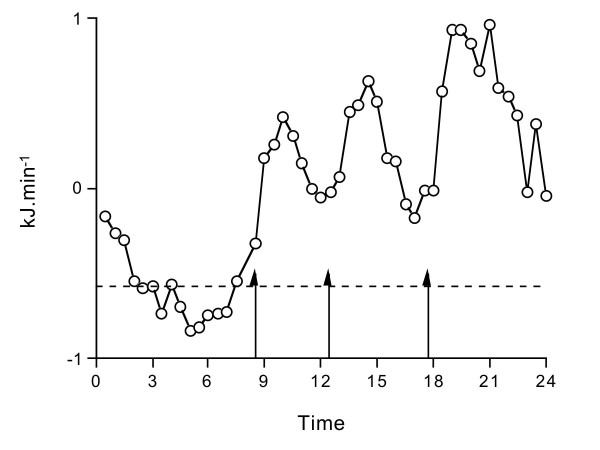
“Data are from a study where DIT was calculated by plotting the residual of the individual relationship between energy expenditure and physical activity in time, as measured over 30-min intervals from a 24-h observation in a respiration chamber [10].”
Self-citation(1984) · Alcohol and Alcoholism · doi:10.1093/oxfordjournals.alcalc.a044395 · Cited by 34
Sweet taste of aspartame and sucrose: effects on diet-induced thermogenesis
Prat‐Larquemin, L., Oppert, J., Bellisle, F., & Guy-grand, B. (2000) · Appetite · doi:10.1006/appe.1999.0310 · Cited by 33
Reliability of the measurement of postprandial thermogenesis in men of three levels of body fatness
Segal, K. R., Chun, A., Coronel, P., Cruz-Noori, A., & Santos, R. (1992) · Metabolism · doi:10.1016/0026-0495(92)90316-3 · Cited by 32 · cited 1×
“Results Reported intra-individual variability in DIT, determined with ventilated-hood systems, is 6 to 30% [7,8].”
Alcohol and its acute effects on resting metabolic rate and diet-induced thermogenesis
Weststrate, J. A., Wunnink, I., Deurenberg, P., & Hautvast, J. G. A. J. (1990) · British Journal of Nutrition · doi:10.1079/bjn19900042 · Cited by 31 · cited 1×
“6 % of the energy content of the meal, when 22% of the energy content of a meal was exchanged for an alcoholic aperitif [11].”
Papamandjaris, A. A., White, M. D., & Jones, P. J. H. (1999) · Obesity Research · doi:10.1002/j.1550-8528.1999.tb00406.x · Cited by 15
If it isn’t a gerrymander, what is it?
Johnston, R. J. (2002) · Political Geography · doi:10.1016/s0962-6298(01)00067-1 · Cited by 14
Does Prolonged Exercise Alter Diet-Induced Thermogenesis?
OHNAKA, M., Iwamoto, M., Sakamoto, S., Niwa, Y., Matoba, H., Nakayasu, K., & Nakaya, Y. (1998) · Annals of Nutrition and Metabolism · doi:10.1159/000012750 · Cited by 8
Sekhar, R. V., Shetty, P. S., & Kurpad, A. V. (1998) · PubMed · Cited by 7
Cited by
Brown and beige fat: Development, function and therapeutic potential
Harms, M., & Seale, P. (2013) · Nature Medicine · doi:10.1038/nm.3361 · Cited by 2,328
Specific dynamic action: a review of the postprandial metabolic response
Secor, S. M. (2009) · Journal of Comparative Physiology B · doi:10.1007/s00360-008-0283-7 · Cited by 690
Dietary protein, weight loss, and weight maintenance
Westerterp-Plantenga, M. S., Nieuwenhuizen, A., Tomé, D., Soenen, S., & Westerterp, K. R. (2009) · Annual Review of Nutrition · doi:10.1146/annurev-nutr-080508-141056 · Cited by 570
Self-citationImpact of Heat Stress on Poultry Health and Performances, and Potential Mitigation Strategies
Wasti, S., Sah, N., & Mishra, B. (2020) · Animals · doi:10.3390/ani10081266 · Cited by 455
Behavioral thermoregulation in mammals: a review
Terrien, J. (2011) · Frontiers in Bioscience · doi:10.2741/3797 · Cited by 402
Metadata
- Authors
- Westerterp, K. R.
- Affiliations
- Maastricht University (NL)
- Corresponding author
- Westerterp, Klaas R
- ORCID
- Westerterp, Klaas R
- Venue
- Nutrition & Metabolism
- Published
- 2004-08-18
- Volume
- 1
- Issue
- 1
- Pages
- 5-5
- ISSN
- 1743-7075 (ISSN-L)
- PMC
- PMC524030
- OpenAlex
- W2169310913
- Cited by
- 570
- References
- 33
- Citations by year
- 2026: 41 · 2025: 36 · 2024: 37 · 2023: 34 · 2022: 31 · 2021: 46 · 2020: 35 · 2019: 31 · 2018: 32 · 2017: 35 · 2016: 32 · 2015: 18 · 2014: 24 · 2013: 30 · 2012: 24
- FWCI
- 3.72
- Type
- journal article
- Language
- en
- Open access
- gold
- doi.org
- Licence
- cc-by
- Locations
- Nutrition & Metabolism (publishedVersion, cc-by)
- PubMed Central (publishedVersion, cc-by)
- PubMed (publishedVersion)
- Research Publications (Maastricht University) (submittedVersion, cc-by)
- DOAJ (DOAJ: Directory of Open Access Journals) (submittedVersion, cc-by-sa)
- Research Publications (Maastricht University) (submittedVersion, other-oa)
- Topics
- Life Sciences › Neuroscience › Endocrine and Autonomic Systems › Regulation of Appetite and Obesity
- Health Sciences › Medicine › Physiology (medical) › Adipose Tissue and Metabolism
- Health Sciences › Nursing › Nutrition and Dietetics › Muscle metabolism and nutrition
- Keywords
- diet-induced thermogenesis, daily energy expenditure, basal metabolic rate, macronutrient oxidation, satiety, body weight regulation, macronutrient composition
About these checks
Registry, retraction, Cites and statistics results are computed, not judged, with one exception: a printed reference that no index lists is read once by a model before it counts as a citation error. Claims are extracted by a model and kept only when their quote appears verbatim in the text; each cited source is then checked, with a model’s help, for whether it says what the claim relies on. Those verdicts can be wrong — read the claim’s quote and the cited source before relying on one.
Statistics and arithmetic are recomputed, not judged.
Confidence bands are shown only for fields calibrated on our annotated test set. None is calibrated yet, so no band is shown.
What counts as a claim ›How we measure confidence ›How we check this ›
Are you an author, or do you see a problem with this page? Request a review
Data sources
Bibliographic data: Semantic Scholar, OpenAlex, Crossref.
Contains information from the Semantic Scholar Academic Graph Datasets, made available under the ODC Attribution License (ODC-BY 1.0).
Semantic Scholar’s data is described in: Kinney, R., et al. (2023). The Semantic Scholar Open Data Platform. arXiv:2301.10140.
