

Trait impulsivity and impaired prefrontal impulse inhibition function in adolescents with internet gaming addiction revealed by a Go/No-Go fMRI study
Open accessThe DOI matches its Crossref record; 72 of the 72 references it cites were found in a registry or an index.
Abstract
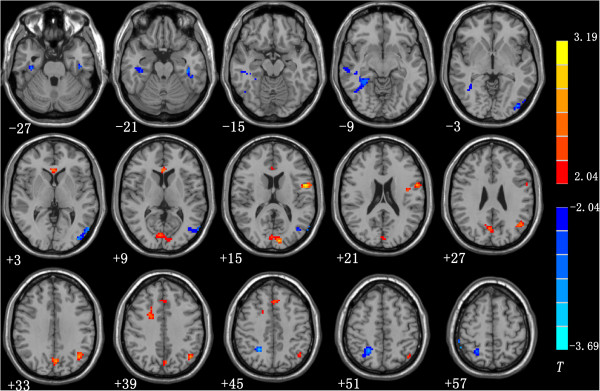
BACKGROUND: Recent studies suggest that Internet gaming addiction (IGA) is an impulse disorder, or is at least related to impulse control disorders. In the present study, we hypothesized that different facets of trait impulsivity may be specifically linked to the brain regions with impaired impulse inhibition function in IGA adolescents. METHODS: Seventeen adolescents with IGA and seventeen healthy controls were scanned during performance of a response-inhibition Go/No-Go task using a 3.0 T MRI scanner. The Barratt Impulsiveness Scale (BIS)-11 was used to assess impulsivity. RESULTS: There were no differences in the behavioral performance on the Go/No-Go task between the groups. However, the IGA group was significantly hyperactive during No-Go trials in the left superior medial frontal gyrus, right anterior cingulate cortex, right superior/middle frontal gyrus, left inferior parietal lobule, left precentral gyrus, and left precuneus and cuneus. Further, the bilateral middle temporal gyrus, bilateral inferior temporal gyrus, and right superior parietal lobule were significantly hypoactive during No-Go trials. Activation of the left superior medial frontal gyrus was positively associated with BIS-11 and Chen Internet Addiction Scale (CIAS) total score across IGA participants. CONCLUSIONS: Our data suggest that the prefrontal cortex may be involved in the circuit modulating impulsivity, while its impaired function may relate to high impulsivity in adolescents with IGA, which may contribute directly to the Internet addiction process.
Overview
The claims and statistics of this paper haven’t been checked yet.
Free: it reads the open-access text and checks the first 5 claims that cite a source we can check. Create a free account to check every claim.
Integrity signals
Registry
Cites
Statistics
Figures
Verification
Claims the paper makes
The claims and statistics of this paper haven’t been checked yet.
Free: it reads the open-access text and checks the first 5 claims that cite a source we can check. Create a free account to check every claim.
Claims other papers make about this one
Each is checked against this paper’s own text: does it say what the citing paper says it does?
The source backs part of the claim, not all of it — or backs it for a different population, condition or comparison.
In the citing paper
“Most studies to date of inhibitory control using the Go/No-Go Task have employed versions with neutral stimuli (i.e., without addiction-related stimuli) and observed no reductions in behavioral performance (Ding et al., 2014), although results are mixed across the existing studies (see meta-analysis by Smith et al., 2014).”
From Integrating psychological and neurobiological considerations regarding the development and maintenance of specific Internet-use disorders: An Interaction of Person-Affect-Cognition-Execution (I-PACE) model (2016) · cites this paper as Ding et al., 2014
Experimental — accuracy not yet measuredThe cited source says what the claim attributes to it.
In the citing paper
“Both neuro imaging and electrophysiology techniques have uncovered slight cognitive differences that were not apparent behaviorally (Ding et al., 2014; Gao et al., 2019).”
From Problematic social media use and inhibitory control among post-secondary students (2025) · cites this paper as Ding et al., 2014
Self-check
Percentages, sums and reported differences re-computed from the paper’s own numbers.
The self-check needs the paper’s full text.
Citations
Cites
Diagnostic and Statistical Manual of Mental Disorders
American Psychiatric Association (2013) · doi:10.1176/appi.books.9780890425596 · Cited by 116,369
Diagnostic and Statistical Manual of Mental Disorders
Williams, J. B. W., & First, M. (2013) · Encyclopedia of Social Work · doi:10.1093/acrefore/9780199975839.013.104 · Cited by 109,519
Control of goal-directed and stimulus-driven attention in the brain
Corbetta, M., & Shulman, G. L. (2002) · Nature Reviews Neuroscience · doi:10.1038/nrn755 · Cited by 12,881 · cited 1×
“These circuits appear to be critical for the executive control needed to guide goaldirected and stimulus-driven attention [54].”
BackgroundA self-rating depression scale
ZUNG, W. W. K. (1965) · Archives of General Psychiatry · doi:10.1001/archpsyc.1965.01720310065008 · Cited by 9,813 · cited 1×
“Before scanning, four questionnaires were used to assess the participants’ behavioral and personality features: the Chen Internet Addiction Scale (CIAS) [29], the Self-Rating Anxiety Scale (SAS) [30], the Self-rating Depression Scale (SDS) [31], and the Barratt Impulsiveness Scale-11 (BIS-11) [32].”
MethodThe Brain's Default Network: Anatomy, Function, and Relevance to Disease
Buckner, R. L., Andrews‐Hanna, J. R., & Schacter, D. L. (2008) · Annals of the New York Academy of Sciences · doi:10.1196/annals.1440.011 · Cited by 9,761
Functional connectivity in the resting brain: a network analysis of the default mode hypothesis
Greicius, M. D., Krasnow, B., Reiss, A. L., & Menon, V. (2003) · Proceedings of the National Academy of Sciences · doi:10.1073/pnas.0135058100 · Cited by 6,358 · cited 1×
“As both the medial PFC and precuneus are part of the default-mode network (regions that are typically deactivated during active task performance [64], the increased deactivation in these regions in IGA group compared with controls suggests an impairment in turning off the default mode during attempts to inhibit.”
Internet Addiction: The Emergence of a New Clinical Disorder
YOUNG, K. S. (1998) · CyberPsychology & Behavior · doi:10.1089/cpb.1998.1.237 · Cited by 5,513 · cited 6×
“The diagnostic questionnaire for Internet addiction was adapted from DSM-IV criteria for pathological gambling by Young [28].”
MethodInfluentialA Rating Instrument For Anxiety Disorders
Zung, W. W. K. (1971) · Psychosomatics · doi:10.1016/s0033-3182(71)71479-0 · Cited by 4,578
The role of the medial frontal cortex in cognitive control
Ridderinkhof, K. R., Ullsperger, M., Crone, E. A., & Nieuwenhuis, S. (2004) · Science · doi:10.1126/science.1100301 · Cited by 2,974 · cited 1×
“Moreover, the VMPFC has an anatomically intrinsic corticocortical network [50,51] and an extrinsic connection with the striatum, thalamus, brain stem, and limbic structures, including the amygdale, a circuit that is thought to contribute to impulsivity control [50,52].”
BackgroundOngur, D. (2000) · Cerebral Cortex · doi:10.1093/cercor/10.3.206 · Cited by 2,627 · cited 1×
“Moreover, the VMPFC has an anatomically intrinsic corticocortical network [50,51] and an extrinsic connection with the striatum, thalamus, brain stem, and limbic structures, including the amygdale, a circuit that is thought to contribute to impulsivity control [50,52].”
Background
Research works printed but not linked: 2
- Young K Internet addiction: symptoms, evaluation and treatment Innovat Clin Practice A Source Book 1999 10 19 31
- Chen SHWL Su YJ Wu HM Yang PF Development of Chinese internet addcition scale and its psychometric study Chin J Psychol 2003 10 279 294
Cited by
Items 201–293 of 293
Mao, Z., Huang, J., Zhang, M., Zhang, M. L., Zhao, C., Liu, Z., & Xing, X. (2025) · Behavioural Brain Research · doi:10.1016/j.bbr.2025.115558 · Cited by 6
Akbaba, D., & Yıldız, E. Ç. (2024) · Journal of Dependence · doi:10.51982/bagimli.1269225 · Cited by 8
Cao, H.-L., Meng, Y., Wei, W., Li, T., Li, M., & Guo, W. (2024) · Brain Imaging and Behavior · doi:10.1007/s11682-024-00888-5 · Cited by 5
“Although the middle temporal gyrus is involved in various functions, such as language, memory, emotional processing, and audiovisual integration, studies have pro - posed that the middle temporal gyrus may inhibit impul - sivity in addiction-related disorders (Ding et al., 2014; Sun et al., 2017).”
Letkiewicz, A. M., Wakschlag, L. S., Briggs‐Gowan, M. J., Cochran, A. L., Wang, L., Norton, E. S., & Shankman, S. A. (2024) · Journal of Psychiatric Research · doi:10.1016/j.jpsychires.2024.08.038 · Cited by 7
Infanti, A., Valls-Serrano, C., Billieux, J., & Perales, J. C. (2024) · The Spanish Journal of Psychology · doi:10.1017/sjp.2024.16 · Cited by 5
“Regarding psychological variables, impulsivity (Ding et al., 2014; Ryu et al., 2018) and antisocial traits (Anderson et al., 2008; Müller et al., 2015; T ’ ng et al., 2020), among other individual differences factors, have been associated with problematic gaming symptoms.”
BackgroundPor trás da tela: uso e consequências dos jogos online para multijogadores
Cassel, P. A., Terribile, T. G., & Machado, J. C. (2019) · Research Society and Development · doi:10.33448/rsd-v8i10.1421 · Cited by 6
Substance and Behavioral Addictions Assessment Instruments
Grigsby, T. J. (2020) · Cambridge University Press eBooks · doi:10.1017/9781108632591.012 · Cited by 7
Functional Neural Alterations in Pathological Internet Use: A Meta-Analysis of Neuroimaging Studies
Peng, W., Hao, Q., Gao, H., Wang, Y., Wang, J., Tu, Y., Yu, S., Li, H., & Zhu, T. (2022) · Frontiers in Neurology · doi:10.3389/fneur.2022.841514 · Cited by 8
“Other studies found that abnormal activation of SFG and MFG might be involved in the control of impulsivity in the subjects with PIU (48, 49).”
BackgroundHwang, R.-J., Hsu, H., Ni, L., Chen, H.-J., Lee, Y.-S., & Chuang, Y.-O. (2022) · BMC Women s Health · doi:10.1186/s12905-022-01729-7 · Cited by 7
Zhang, Y., Zhong, X., Shao, Y., & Gong, J. (2023) · Brain Sciences · doi:10.3390/brainsci13111508 · Cited by 5
“For example, a follow-up assessment was conducted to track changes in HUD trait impulsivity over time and its dynamic relationship with the insula (or other brain regions FC) and addictive behaviors.”
BackgroundSelf-citationZhang, S.-S., Zhong, Y.-Q., Li, X., & Peng, M. (2024) · BMC Psychology · doi:10.1186/s40359-024-01698-6 · Cited by 6
“Additionally, it has been proposed that the impulsive symptoms observed in individuals with PIU may be indicative of an underlying deficiency in inhibitory control [7], implicating that disrupted inhibitory control serving as a fundamental cognitive vulnerability factor for PIU.”
BackgroundInfluence of reinforcement learning on the inhibitory control of Internet gaming disorder
Zhang, M., Zhao, C., Zhang, M. L., Mao, S., Yang, M., Mao, Z., & Xing, X. (2024) · PsyCh Journal · doi:10.1002/pchj.772 · Cited by 5
“…this conclusion, and found that the inhibition control performance was worse in the Go/No-Go task and impaired prefrontal function might relate to high impulsivity in adolescents with IGD, which might contribute directly to the Internet addiction process (Chen et al., 2021; Ding et al., 2014).”
Behavior, neuropsychology and fMRI
Bennett, M. R., Hatton, S. N., Hermens, D. F., & Lagopoulos, J. (2016) · Progress in Neurobiology · doi:10.1016/j.pneurobio.2016.07.001 · Cited by 7
Prevention and Treatment of Sex Addiction
Reid, R. C., Grubbs, J. B., & Kraus, S. W. (2020) · Cambridge University Press eBooks · doi:10.1017/9781108632591.025 · Cited by 4
Tikhonov, P., Levchuk, A. G., Trufanov, A. G., Efimtsev, A., & Zubkov, M. A. (2023) · Computers in Human Behavior · doi:10.1016/j.chb.2023.108052 · Cited by 5
Neuroimaging findings in adolescent gaming disorder: a systematic review
Khor, E. Y., McNamara, N., Columb, D., & McNicholas, F. (2023) · Irish Journal of Psychological Medicine · doi:10.1017/ipm.2023.36 · Cited by 9
“These findings suggest that the right hemisphere may be fully engaged, requiring the left hemisphere to play a role in response inhibition (Ding et al., 2014).”
InfluentialLi, Q., Luo, X., Wei, M., Cui, S., Yang, S., Li, Y., He, S., & Dong, G. (2025) · BMC Psychiatry · doi:10.1186/s12888-025-07419-6 · Cited by 5
“Neuroimaging studies have further revealed abnormal activation in the prefrontal cortex and related functional areas in IGD, particularly in domains such as executive control [11, 75, 81], craving regulation [75], and reward processing [12].”
Berta, K., Pesthy, Z. V., Vékony, T., Farkas, B. C., Király, O., Demetrovics, Z., Németh, D., & Kun, B. (2025) · Computers in Human Behavior · doi:10.1016/j.chb.2025.108878 · Cited by 6
Zhou, H., He, Y., Liu, L., Yin, J., Xiong, A. Y., Leong, K. H., Wu, A. M. S., & Potenza, M. N. (2025) · International Journal of Clinical and Health Psychology · doi:10.1016/j.ijchp.2025.100547 · Cited by 5
An Overview of the Neurobiology of Impulsivity in Gambling and Gaming Disorder
Punia, K., & Balodis, I. M. (2019) · Current Behavioral Neuroscience Reports · doi:10.1007/s40473-019-00190-5 · Cited by 5
Serrano-Fernández, M.-J., Boada‐Grau, J., Assens-Serra, J., Boada-Cuerva, M., & Vigil‐Colet, A. (2019) · Anales de Psicología · doi:10.6018/analesps.35.3.354941 · Cited by 4
“…has also been identified as an important predisposing factor in other types of addictions such as internet addiction (Cao, Su, Liu, & Gao, 2007; Choi, Park et al., 2014; Lee et al., 2012) and online gaming (Choi, Kim et al., 2014; Ding et al., 2014; Metcalf & Pammer, 2014; Nuyens et al., 2016).”
BackgroundGaming Disorder and Its Treatment
Griffiths, M. D., Kuss, D. J., & Pontes, H. M. (2020) · Cambridge University Press eBooks · doi:10.1017/9781108632591.029 · Cited by 7
Lisdexamfetamine Alters BOLD-fMRI Activations Induced by Odor Cues in Impulsive Children
Hidalgo-Tobón, S., Suárez, P. D., Pérez, E. B., Hernández-López, J. M., García, J., & Alonso, B. D. C. (2020) · CNS & Neurological Disorders - Drug Targets · doi:10.2174/1871527319666200613222502 · Cited by 3
Treatment of Alcohol, Tobacco, and Other Drug (ATOD) Misuse
Sussman, S. Y., & Bolshakova, M. (2020) · Cambridge University Press eBooks · doi:10.1017/9781108632591.022 · Cited by 3
The Role of Culture in Addiction
Hoffman, B. R., & Unger, J. B. (2020) · Cambridge University Press eBooks · doi:10.1017/9781108632591.018 · Cited by 4
Impact of impulsivity on the relationship of the brain structures with school performance
Yoon, Y. B., & Jung, W. H. (2025) · npj Science of Learning · doi:10.1038/s41539-025-00344-z · Cited by 3
Personality and impulsivity traits associated with problematic online gaming and poker playing
Anci, E., Rothen, S., Tra, C., Liberacka-Dwojak, M., Rochat, L., Wiłkość-Dębczyńska, M., Starčević, V., Berle, D., Athanasopoulou, C., Cruz, G. V., et al. (2025) · Scientific Reports · doi:10.1038/s41598-025-28965-9 · Cited by 4
“This result is in accordance with findings of an association between PUI and impulsivity 58,67–69 and between PUI and attention deficit/hyperactivity disorder 70 .”
Paulino, S., Mesquita, B., Fraga, A. M., Gomes, H. S., & Madeira, L. (2023) · Cyberpsychology Journal of Psychosocial Research on Cyberspace · doi:10.5817/cp2023-1-3 · Cited by 3
Shamsi, F., Sindhu, I., & Fatima, S. (2023) · International Multi-disciplinary Conference in Emerging Research Trends (IMCERT) · doi:10.1109/imcert57083.2023.10075233 · Cited by 3
“Spending huge time on screen, specially playing video games can causes physiological dis-functioning [10].”
BackgroundSimilarities and Differences between Gambling Disorder and other Addiction-like Behaviors
Fauth‐Bühler, M. (2019) · Springer eBooks · doi:10.1007/978-3-030-03060-5_11 · Cited by 3
Passionate Love Addiction: An Evolutionary Survival Mechanism That Can Go Terribly Wrong
Bolshakova, M., Fisher, H. E., Aubin, H., & Sussman, S. Y. (2020) · Cambridge University Press eBooks · doi:10.1017/9781108632591.026 · Cited by 2
Philosophical Issues in the Addictions
Glackin, S. N. (2020) · Cambridge University Press eBooks · doi:10.1017/9781108632591.007 · Cited by 2
Sussman, S. Y. (2020) · Cambridge University Press eBooks · doi:10.1017/9781108632591.020 · Cited by 2
Wann machen digitale Spiele krank? Überlegungen zur Gaming Disorder im ICD-11
Mikusky, D., & Abler, B. (2021) · Nervenheilkunde · doi:10.1055/a-1300-7787 · Cited by 3
“In einer Untersuchung mit dem Go/NoGo-Task, bei dem vorschnelle Reaktionen unterdrückt werden müssen, zeigten jugendliche Probanden mit abhängigem digitalem Spielverhalten im Vergleich zur Kontrollgruppe bei vergleichbarer Aufgabendurchführung eine erhöhte präfrontale Reaktivität, insbesondere in Abhängigkeit der Ausp…”
BackgroundInfluentialPontes, H. D. O. M. (2017) · Nottingham Trent University's Institutional Repository (Nottingham Trent Repository) · doi:10.25959/23226491 · Cited by 6
Cipriano, A., Cella, S., Schimmenti, A., & Musetti, A. (2024) · Behaviour and Information Technology · doi:10.1080/0144929x.2024.2440108 · Cited by 1
“…offering additional support, alongside other studies (e.g. Sibilla, Musetti, and Mancini 2021) that obsessiveness is positively associated with PG. Problematic video game players may display some OCD symptoms, such as pre-occupation, urge, and impaired response inhibition (Ding et al. 2014).”
Cognitive Benefits and Challenges of Gaming
Zadey, S., Kelleher, B., & Vasa, J. (2025) · Springer eBooks · doi:10.1007/978-3-032-00325-6_11 · Cited by 1
Prevention and Treatment of Work Addiction
Quiñones, C., & Griffiths, M. D. (2020) · Cambridge University Press eBooks · doi:10.1017/9781108632591.028 · Cited by 3
Adolescent Internet Gaming Disorder: A Narrative Review
Field, T. M. (2019) · Archives of Medical Case Reports and Case Study · doi:10.31579/2688-7517/005 · Cited by 1
“In a study by the same group that reported reduced gray matter on a sample of Internet gaming disorder adolescents versus healthy controls [59], white matter changes were also correlated with greater impulsivity [54].”
BackgroundNew Addictions in Youth: Internet Addiction and Internet Gaming Disorder
Milani, L. (2021) · Advances in mental health and addiction · doi:10.1007/978-3-030-82408-2_10 · Cited by 2
Neural Mechanisms Underlying Internet Gaming Disorder
Edited, B., Zhang, J.-T., & Brand, M. (2019) · Frontiers research topics · doi:10.3389/978-2-88945-655-0 · Cited by 1
Mordeno, I. G., Navarro, R. A., & Generalao, J. G. (2022) · International Journal of Mental Health and Addiction · doi:10.1007/s11469-022-00759-4 · Cited by 3
Sussman, S. Y. (2020) · Cambridge University Press eBooks · doi:10.1017/9781108632591.003 · Cited by 1
The EEG Study on Addictive Inducement of Game Disorder in Undergraduate Students
Yu, Z., Li, L., Zhang, Y., Lin, M., Wu, Z., Wang, Z., Kuang, S., & Xu, G. (2023) · IEEE Transactions on Instrumentation and Measurement · doi:10.1109/tim.2023.3277101 · Cited by 1
“[45] applied fMRI to assess the function of the prefrontal cortex in GD.”
MethodSelf-citationXue, R., Li, J., & Yang, H. (2025) · Cerebral Cortex · doi:10.1093/cercor/bhae493 · Cited by 1
Inhibitory control efficiency in successful weight loss participants
Olds, K. C. (2015) · ScholarWorks -A service of University of Vermont Libraries (University of Vermont) · Cited by 2
Adult ADHD and Non-Substance-Related Disorders
Pallanti, S., & Salerno, L. (2020) · Springer eBooks · doi:10.1007/978-3-030-39051-8_17 · Cited by 1
Mora-Fernández, J., Khan, A., Estévez, F., Webster, F., Fárez, M. I., & Torres, F. A. (2020) · Lecture notes in computer science · doi:10.1007/978-3-030-49907-5_5 · Cited by 1
Adolescent Drug Misuse Prevention: Challenges in School-Based Programming
Scheier, L. M. (2020) · Cambridge University Press eBooks · doi:10.1017/9781108632591.021 · Cited by 1
Measurement, Prevention, and Treatment of Exercise Addiction
Hausenblas, H. A., Mann, D. T. Y., & Downs, D. S. (2020) · Cambridge University Press eBooks · doi:10.1017/9781108632591.036 · Cited by 4
Antonietti, A., Colombo, B., & Rodella, C. (2014) · Springer eBooks · doi:10.1007/978-1-4614-7883-6_582-1 · Cited by 1
Phaneuf-Hadd, C. V. (2019) · Deep Blue (University of Michigan) · Cited by 1
Brain intrinsic network connectivity in individuals with frequent tanning behavior
Ketcherside, A., Filbey, F. M., Aubert, P. M., Seibyl, J. P., Price, J. L., & Adinoff, B. H. (2018) · The American Journal of Drug and Alcohol Abuse · doi:10.1080/00952990.2018.1461878
“Last, the inferior temporal gyrus has been linked with impulsivity in those with internet gaming addiction (47).”
BackgroundPerturbação de Jogos de Internet: Revisão da Evidência Científica
Beirão, D., Sousa, T., Assunção, P., Malheiro, A., & Gonzaga, D. (2019) · Gazeta Médica · doi:10.29315/gm.v6i3.268 · Cited by 5
Neuroimaging In Adolescents with Internet Gaming Disorder: A Systematic Review
Gül, M. K., Demirci, E., & Özmen, S. (2020) · Çocuk ve Gençlik Ruh Sağlığı Dergisi / Turkish Journal of Child and Adolescent Mental Health · doi:10.4274/tjcamh.galenos.2020.21931 · Cited by 1
Neurobiology of technological addiction : Impulsive compulsive spectrum
Ghosal, M. K. (2016) · Bengal Journal of Psychiatry · doi:10.51332/bjp.2016.v21.i2.22
Compton, W. M., & Blanco, C. (2020) · Cambridge University Press eBooks · doi:10.1017/9781108632591.001
Novel Psychoactive Substances: A New Challenge for Prevention and Treatment
Kapitány‐Fövény, M., Corazza, O., Marrinan, S., & Demetrovics, Z. (2020) · Cambridge University Press eBooks · doi:10.1017/9781108632591.032
Human Laboratory Paradigms in Addictions Research
Morris, V. L., Arshad, F., Balodis, I. M., Reed, D. D., MacKillop, J. M., & Amlung, M. T. (2020) · Cambridge University Press eBooks · doi:10.1017/9781108632591.010
Anhedonia in Addictive Behaviors
Dyer, W. G., Leventhal, A. M., Goldenson, N. I., & Bello, M. S. (2020) · Cambridge University Press eBooks · doi:10.1017/9781108632591.039 · Cited by 2
American Legal Issues in Addiction Treatment and Research
Willick, D. H. (2020) · Cambridge University Press eBooks · doi:10.1017/9781108632591.041
Strack, R. W., Orsini, M. M., Ewald, D. R., & Scheier, L. M. (2020) · Cambridge University Press eBooks · doi:10.1017/9781108632591.019
مصطفى, م. (2020) · مجلة البحث العلمى فى التربية · doi:10.21608/jsre.2020.128473
Clinical and Research Methods in the Addictions
Sussman, S. Y. (2020) · Cambridge University Press eBooks · doi:10.1017/9781108632591.008
Levels of Analysis and Etiology
Sussman, S. Y. (2020) · Cambridge University Press eBooks · doi:10.1017/9781108632591.014
Ongoing and Future Research Directions
Sussman, S. Y. (2020) · Cambridge University Press eBooks · doi:10.1017/9781108632591.030
Sussman, S. Y. (2020) · Cambridge University Press eBooks · doi:10.1017/9781108632591.002
Srivastava, A. B., & Gold, M. S. (2020) · Cambridge University Press eBooks · doi:10.1017/9781108632591.033
Sussman, S. Y. (2020) · Cambridge University Press eBooks · doi:10.1017/9781108632591.042
Demirkaya, S. K., Avcıl, S., Aksu, H., Özgür, B. G., Güleş, Z., & Öztürk, S. (2022) · Journal of Clinical Psychiatry · doi:10.5505/kpd.2022.94770 · Cited by 1
Effect of alternate nostril breathing on evoked potentials among internet addicts
Udayakumar, K. P., Mahendiran, P., Kushalappa, J. A., & Jayamala Annachira, S. (2022) · Bioinformation · doi:10.6026/973206300181075
Construction and Validation of Adolescent Psychological Pathology Inventory in Cyberspace
Adibnia, F., Kalantari, M., & Adibnia, F. (2022) · فصلنامه روان شناسی کاربردی · doi:10.52547/apsy.2022.225520.1250 · Cited by 1
Suicidio e adolescenza. Tra Covid e cultura dell'iperconnessione
Martini, R., & Giaquinta, N. (2023) · PSICOBIETTIVO · doi:10.3280/psob2023-001011 · Cited by 2
Impulsivity: A Transdiagnostic Approach to Understanding Adolescent Substance Use
Lamichhane, B., Li, Z., Sabharwal, A., & Moukaddam, N. J. (2024) · Adolescent Psychiatry · doi:10.2174/0122106766297440240430133940 · Cited by 1
To Play or Not to Play: An Investigation Into The Effect of Video Game Use on Executive Functions
Hipkiss, S. R. D. (2024) · Cronfa (Swansea University) · doi:10.23889/suthesis.66918 · Cited by 1
Understanding Internet Gaming Disorder in the Technology Era
Ünal‐Aydın, P., Tvrtković, S., & Aydın, O. (2024) · Integrated science · doi:10.1007/978-3-031-64288-3_4
Engagement in sports and children's cognitive abilities: An analysis of executive functions
Buha, N. S., Dučić, B., & Japundža‐Milisavljević, M. (2024) · Inovacije u nastavi · doi:10.5937/inovacije2404017b · Cited by 1
Behavioral and psychological correlates of problematic smartphone use in street ketamine users
Lin, C.-H., Lin, Y.-L., & Chan, C.-H. (2025) · BMC Psychology · doi:10.1186/s40359-025-02778-x · Cited by 1
“These deficits affect auditory and visual processing, emotional regulation, and cognition [10, 11].”
Berta, K., Pesthy, Z. V., Vékony, T., Farkas, B. C., Király, O., Demetrovics, Z., Németh, D., & Kun, B. (2025) · medRxiv · doi:10.1101/2025.10.08.25334347
Vanes, L. D., Rakesh, D., Banaschewski, T., Bokde, A. L. W., Desrivières, S., Flor, H., Garavan, H., Gowland, P. A., Grigis, A., Heinz, A., et al. (2025) · Biological Psychiatry Cognitive Neuroscience and Neuroimaging · doi:10.1016/j.bpsc.2025.09.015 · Cited by 3
“Neuroimaging studies report altered ITG function and structure in relation to internalizing (61–63) or externalizing (64,65) symptoms, or both (66), though inconsistencies remain with respect to the timing and direction of effects.”
Neurobiological Basis of Gaming Behavior
de Aguiar, F. O., Veiga, D. D. L., Gaiotto, L. A. V., Almeida, T. M., de Oliveira, R. L., & Uchida, R. R. (2025) · Springer eBooks · doi:10.1007/978-3-032-00325-6_2
A Review on the Research of Response Inhibition of Internet Addiction Disorder
余, 虹. (2020) · Advances in Psychology · doi:10.12677/ap.2020.103038
Lorenzetti, V., Gaillard, A., Beyer, E., Kowalczyk, M. A., Kamboj, S. K., Manning, V., & Gleeson, J. (2024) · Figshare · doi:10.6084/m9.figshare.26594987
Niu, X., Gao, X., Zhang, M., Dang, J., Sun, J., Lang, Y., Wang, W., Wei, Y., Cheng, J., Han, S., et al. (2023) · Figshare · doi:10.6084/m9.figshare.23917026
Self-citationADHD and Me, Me and ADHD: Breaking Free from the Media Storm
Schäperklaus, S. (2025) · Zenodo (CERN European Organization for Nuclear Research) · doi:10.5281/zenodo.15204136
Non-reinforced Preference Change
Cantor, A., Or, M. B., Itzkovitch, A., & Schönberg, T. (2026) · Springer eBooks · doi:10.1007/978-3-032-02925-6_13
Inhibitory control in problematic usage of the internet: An ALE meta-analysis
Li, X., Yang, J., Turel, O., Zhang, S., & He, Q. (2026) · NeuroImage · doi:10.1016/j.neuroimage.2026.121859
Perianes, A. J., Monfort-Vinuesa, C., Saiz-Clar, E., Egea-Romero, M. P., Rebate, C., Rodriguez-Cañas, M., Villarroel, C. S., & Rincon, E. (2026) · Healthcare · doi:10.3390/healthcare14060724
Falcione, K., Malik, M., Wheeler, B. L., & Weber, R. (2026) · NeuroImage · doi:10.1016/j.neuroimage.2026.122036
Li, M.-H., Jiang, A.-H., Xu, X.-F., Li, S., Luo, X., & Dong, G. (2026) · Journal of Psychiatric Research · doi:10.1016/j.jpsychires.2026.06.027
Xu, X., Wang, H., Cui, S., Ni, H., & Dong, G.-H. (2026) · Computers in Human Behavior · doi:10.1016/j.chb.2026.109107
Zhao, H., Wu, B., & Zhou, J. (2026) · The Journal of Genetic Psychology · doi:10.1080/00221325.2026.2706583
Li, Y., Li, S., Wei, M., Luo, X., He, Y., Li, R., & Dong, G. (2026) · SSRN Electronic Journal · doi:10.2139/ssrn.7592581
Metadata
- Authors
- Ding, W.-N., Sun, J.-H., Sun, Y.-W., Chen, X., Zhou, Y., Zhuang, Z.-G., Li, L., Zhang, Y., Xu, J.-R., & Du, Y.-S.
- Affiliations
- Shanghai Jiao Tong University (CN)
- Corresponding author
- Zhou, Yan
- Venue
- Behavioral and Brain Functions
- Published
- 2014-05-30
- Volume
- 10
- Issue
- 1
- Pages
- 20-20
- ISSN
- 1744-9081 (ISSN-L)
- PMC
- PMC4050412
- OpenAlex
- W2161562531
- Cited by
- 294
- References
- 72
- Citations by year
- 2026: 8 · 2025: 23 · 2024: 22 · 2023: 27 · 2022: 20 · 2021: 17 · 2020: 70 · 2019: 29 · 2018: 15 · 2017: 27 · 2016: 14 · 2015: 20 · 2014: 2
- FWCI
- 68.44
- Type
- journal article
- Language
- en
- Open access
- gold
- doi.org
- Licence
- cc-by
- Locations
- Behavioral and Brain Functions (publishedVersion, cc-by)
- Europe PMC (PubMed Central) (publishedVersion, cc-by)
- PubMed Central (publishedVersion, cc-by)
- PubMed (publishedVersion)
- Funders
- National Natural Science Foundation of China (81201172, S30203, 81171325)
- Science and Technology Commission of Shanghai Municipality
- Shanghai Leading Academic Discipline Project (81201172, 81171325, S30203)
- Topics
- Social Sciences › Sociology and Political Science › Impact of Technology on Adolescents
- Life Sciences › Neuroscience › Cognitive Neuroscience › Neural and Behavioral Psychology Studies
- Social Sciences › Psychology › Clinical Psychology › Gambling Behavior and Treatments
- Keywords
- online game addiction, trait impulsivity, impulse inhibition, prefrontal cortex, adolescents, go/no-go task, response inhibition, anterior cingulate cortex, Barratt Impulsiveness Scale, Chen Internet Addiction Scale
- MeSH terms
- Adolescent, Female, Humans, Image Processing, Computer-Assisted, Impulsive Behavior, Magnetic Resonance Imaging, Male, Neuropsychological Tests, Personality, Surveys and Questionnaires, Behavior, Addictive, Prefrontal Cortex, Video Games, Internet, Young Adult
About these checks
Registry, retraction, Cites and statistics results are computed, not judged, with one exception: a printed reference that no index lists is read once by a model before it counts as a citation error. Claims are extracted by a model and kept only when their quote appears verbatim in the text; each cited source is then checked, with a model’s help, for whether it says what the claim relies on. Those verdicts can be wrong — read the claim’s quote and the cited source before relying on one.
Statistics and arithmetic are recomputed, not judged.
Confidence bands are shown only for fields calibrated on our annotated test set. None is calibrated yet, so no band is shown.
What counts as a claim ›How we measure confidence ›How we check this ›
Are you an author, or do you see a problem with this page? Request a review
Data sources
Bibliographic data: Semantic Scholar, OpenAlex, Crossref.
Contains information from the Semantic Scholar Academic Graph Datasets, made available under the ODC Attribution License (ODC-BY 1.0).
Semantic Scholar’s data is described in: Kinney, R., et al. (2023). The Semantic Scholar Open Data Platform. arXiv:2301.10140.
