

Process evaluations for cluster-randomised trials of complex interventions: a proposed framework for design and reporting
Open accessThe DOI matches its Crossref record; 42 of the 42 references it cites were found in a registry or an index.
Abstract
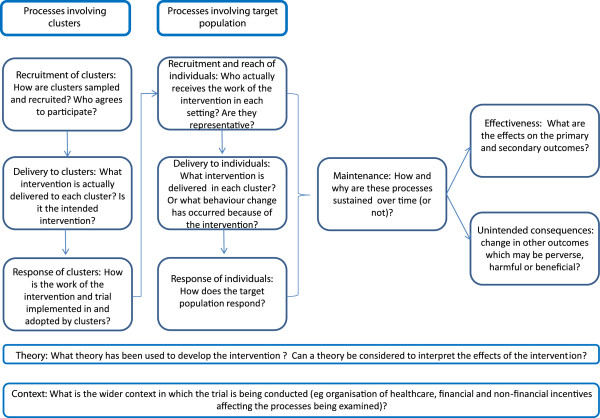
BACKGROUND: Process evaluations are recommended to open the 'black box' of complex interventions evaluated in trials, but there is limited guidance to help researchers design process evaluations. Much current literature on process evaluations of complex interventions focuses on qualitative methods, with less attention paid to quantitative methods. This discrepancy led us to develop our own framework for designing process evaluations of cluster-randomised controlled trials. METHODS: We reviewed recent theoretical and methodological literature and selected published process evaluations; these publications identified a need for structure to help design process evaluations. We drew upon this literature to develop a framework through iterative exchanges, and tested this against published evaluations. RESULTS: The developed framework presents a range of candidate approaches to understanding trial delivery, intervention implementation and the responses of targeted participants. We believe this framework will be useful to others designing process evaluations of complex intervention trials. We also propose key information that process evaluations could report to facilitate their identification and enhance their usefulness. CONCLUSION: There is no single best way to design and carry out a process evaluation. Researchers will be faced with choices about what questions to focus on and which methods to use. The most appropriate design depends on the purpose of the process evaluation; the framework aims to help researchers make explicit their choices of research questions and methods. TRIAL REGISTRATION: Clinicaltrials.gov NCT01425502.
Overview
The claims and statistics of this paper haven’t been checked yet.
Free: it reads the open-access text and checks the first 5 claims that cite a source we can check. Create a free account to check every claim.
Integrity signals
Registry
Cites
Statistics
Figures
Verification
Claims the paper makes
The claims and statistics of this paper haven’t been checked yet.
Free: it reads the open-access text and checks the first 5 claims that cite a source we can check. Create a free account to check every claim.
Claims other papers make about this one
Each is checked against this paper’s own text: does it say what the citing paper says it does?
The source backs part of the claim, not all of it — or backs it for a different population, condition or comparison.
In the citing paper
“Attempts to understand the dynamics of implementation and to evaluate their effects are either front-loaded into clinical trials in the form of programme theories that specify their expected mode of operation and outcomes or revealed in retrospective ‘process’ evaluations of activity over time and the effects of this activity on outcomes [1, 2].”
From Implementation, context and complexity (2016) · cites this paper as [2]
Experimental — accuracy not yet measuredThe cited source says what the claim attributes to it.
In the citing paper
“These evaluations are integral for providing explanations to trial outcomes and to understand future implementation challenges in different settings.49 54”
Self-check
Percentages, sums and reported differences re-computed from the paper’s own numbers.
The self-check needs the paper’s full text.
Citations
Cites
Developing and evaluating complex interventions: the new Medical Research Council guidance
Craig, P., Dieppe, P., Macintyre, S., Michie, S., Nazareth, I., & Petticrew, M. (2008) · BMJ · doi:10.1136/bmj.a1655 · Cited by 10,995 · cited 2×
“terature on process evaluation and the RE-AIM framework [3,11,19,23,26,27,31], and on published process evaluations”
BackgroundMethodAudit and feedback: effects on professional practice and healthcare outcomes
Ivers, N., Jamtvedt, G., Flottorp, S., Young, J. M., Odgaard-Jensen, J., French, S. D., O'Brien, M. A., Johansen, M., Grimshaw, J., & Oxman, A. D. (2012) · Cochrane Database of Systematic Reviews · doi:10.1002/14651858.cd000259.pub3 · Cited by 5,485 · cited 1×
“This approach is similar to most trials of audit and feedback [16] and to many trials involving a professional training intervention, as in the OPERA trial where a training intervention is delivered to nursing home staff and physiotherapists who deliver an intervention of physical activity and physiotherapy to residen…”
ResultConsort 2010 statement: extension to cluster randomised trials
Campbell, M. K., Piaggio, G., Elbourne, D. R., Altman, D. G., & for the CONSORT Group (2012) · BMJ · doi:10.1136/bmj.e5661 · Cited by 3,510
CONSORT statement: extension to cluster randomised trials
Campbell, M. K., Elbourne, D. R., & Altman, D. G. (2004) · BMJ · doi:10.1136/bmj.328.7441.702 · Cited by 2,557 · cited 4×
“At a minimum, recruitment is likely to be monitored to fulfil CONSORT requirements for reporting findings of the main trial [28], but a more in-depth understanding of why clusters participate (or not) can inform the interpretation and implementation of trial findings.”
BackgroundMethodInfluentialImplementing, Embedding, and Integrating Practices: An Outline of Normalization Process Theory
May, C., & Finch, T. (2009) · Sociology · doi:10.1177/0038038509103208 · Cited by 2,115
Developing and Evaluating Complex Interventions: New Guidance
Craig, P., Dieppe, P. A., MacIntyre, S., Michie, S., Nazareth, I., & Petticrew, M. P. (2006) · UCL Discovery (University College London) · Cited by 1,974
Michie, S., Johnston, M., Francis, J., Hardeman, W., & Eccles, M. (2008) · Applied Psychology · doi:10.1111/j.1464-0597.2008.00341.x · Cited by 1,789 · cited 1×
“Similar to understanding the response of organisational or individual professionals to interventions directed at them, it may be helpful to draw on prior [37] or other relevant theory [38] to examine individual responses.”
BackgroundProcess evaluation in randomised controlled trials of complex interventions
Oakley, A., Strange, V., Bonell, C., Allen, E., & Stephenson, J. (2006) · BMJ · doi:10.1136/bmj.332.7538.413 · Cited by 1,247
Design and Analysis of Cluster Randomization Trials in Health Research
DONNER, A. P., & Klar, N. S. (2000) · Cited by 1,236
Process evaluation for public health interventions and research
Steckler, A., Linnan, L. A., & Israel, B. A. (2002) · Cited by 863
Cited by
Process evaluation of complex interventions: Medical Research Council guidance
Moore, G. F., Audrey, S., Barker, M., Bond, L., Bonell, C., Hardeman, W., Moore, L., O'Cathain, A., Tinati, T., Wight, D., et al. (2015) · BMJ · doi:10.1136/bmj.h1258 · Cited by 6,204
Interventions to improve antibiotic prescribing practices for hospital inpatients
Davey, P., Brown, E., Charani, E., Fenelon, L., Gould, I. M., Holmes, A., Ramsay, C. R., Wiffen, P. J., & Wilcox, M. (2013) · Cochrane Database of Systematic Reviews · doi:10.1002/14651858.cd003543.pub3 · Cited by 1,864
Interventions to improve antibiotic prescribing practices for hospital inpatients
Davey, P., Marwick, C. A., Scott, C. L., Charani, E., McNeil, K., Brown, E., Gould, I. M., Ramsay, C. R., & Michie, S. (2017) · Cochrane Database of Systematic Reviews · doi:10.1002/14651858.cd003543.pub4 · Cited by 1,068
Implementation, context and complexity
May, C. R., Johnson, M., & Finch, T. (2016) · Implementation Science · doi:10.1186/s13012-016-0506-3 · Cited by 978
“Attempts to understand the dynamics of implementation and to evaluate their effects are either front-loaded into clinical trials in the form of programme theories that specify their expected mode of operation and outcomes or revealed in retrospective ‘process’ evaluations of activity over time and the effects of this…”
BackgroundDe Silva, M. J., Breuer, E., Lee, L., Asher, L., Chowdhary, N., Lund, C., & Patel, V. (2014) · Trials · doi:10.1186/1745-6215-15-267 · Cited by 738
Metadata
- Authors
- Grant, A., Treweek, S., Dreischulte, T., Foy, R., & Guthrie, B.
- Affiliations
- University of Dundee (GB)
- University of Leeds (GB)
- Corresponding author
- Grant, Aileen
- Venue
- Trials
- Published
- 2013
- Volume
- 14
- Issue
- 1
- Pages
- 15
- ISSN
- 1745-6215 (ISSN-L)
- PMC
- PMC3600672
- OpenAlex
- W2128920447
- Cited by
- 541
- References
- 42
- Citations by year
- 2026: 27 · 2025: 21 · 2024: 68 · 2023: 55 · 2022: 47 · 2021: 65 · 2020: 55 · 2019: 33 · 2018: 44 · 2017: 35 · 2016: 32 · 2015: 31 · 2014: 20 · 2013: 7
- FWCI
- 54.34
- Type
- journal article
- Language
- en
- Open access
- gold
- doi.org
- Licence
- cc-by
- Locations
- Trials (publishedVersion, cc-by)
- Europe PMC (PubMed Central) (publishedVersion, cc-by)
- PubMed Central (publishedVersion, cc-by)
- PubMed (publishedVersion)
- Edinburgh Research Explorer (University of Edinburgh) (publishedVersion, cc-by)
- White Rose Research Online (University of Leeds, The University of Sheffield, University of York) (acceptedVersion)
- Discovery Research Portal (University of Dundee) (submittedVersion)
- Stirling Online Research Repository (University of Stirling) (submittedVersion, cc-by)
- Open access LMU (Ludwid Maxmilian's Universitat Munchen) (submittedVersion)
- Open Access Institutional Repository at Robert Gordon University (Robert Gordon University) (submittedVersion, cc-by)
- Funders
- Scottish Government
- Chief Scientist Office, Scottish Government Health and Social Care Directorate
- Topics
- Health Sciences › Health Professions › General Health Professions › Health Policy Implementation Science
- Social Sciences › Public Administration › Evaluation and Performance Assessment
- Physical Sciences › Mathematics › Statistics and Probability › Advanced Causal Inference Techniques
- Keywords
- process evaluation, complex interventions, intervention implementation, participant responses, reporting guidelines, research design
- MeSH terms
- Humans, Outcome and Process Assessment, Health Care, Research Design, Treatment Outcome, Practice Guidelines as Topic, Evidence-Based Medicine, Information Dissemination, Qualitative Research
About these checks
Registry, retraction, Cites and statistics results are computed, not judged, with one exception: a printed reference that no index lists is read once by a model before it counts as a citation error. Claims are extracted by a model and kept only when their quote appears verbatim in the text; each cited source is then checked, with a model’s help, for whether it says what the claim relies on. Those verdicts can be wrong — read the claim’s quote and the cited source before relying on one.
Statistics and arithmetic are recomputed, not judged.
Confidence bands are shown only for fields calibrated on our annotated test set. None is calibrated yet, so no band is shown.
What counts as a claim ›How we measure confidence ›How we check this ›
Are you an author, or do you see a problem with this page? Request a review
How to cite
Cite CoChat for the checks on this page, and the paper for its own findings.
- This page
- CoChat. (2026). Citation check: Process evaluations for cluster-randomised trials of complex interventions: a proposed framework for design and reporting. https://app.cochat.ai/papers/10.1186/1745-6215-14-15
- The paper
- Grant, A., Treweek, S., Dreischulte, T., Foy, R., & Guthrie, B. (2013). Process evaluations for cluster-randomised trials of complex interventions: a proposed framework for design and reporting. Trials. https://doi.org/10.1186/1745-6215-14-15
Data sources
Bibliographic data: Semantic Scholar, OpenAlex, Crossref.
Contains information from the Semantic Scholar Academic Graph Datasets, made available under the ODC Attribution License (ODC-BY 1.0).
Semantic Scholar’s data is described in: Kinney, R., et al. (2023). The Semantic Scholar Open Data Platform. arXiv:2301.10140.
