

Process evaluations for cluster-randomised trials of complex interventions: a proposed framework for design and reporting
Open accessThe DOI matches its Crossref record; 42 of the 42 references it cites were found in a registry or an index.
Abstract
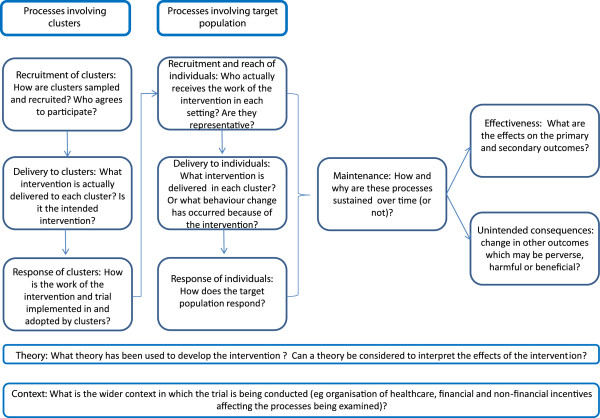
BACKGROUND: Process evaluations are recommended to open the 'black box' of complex interventions evaluated in trials, but there is limited guidance to help researchers design process evaluations. Much current literature on process evaluations of complex interventions focuses on qualitative methods, with less attention paid to quantitative methods. This discrepancy led us to develop our own framework for designing process evaluations of cluster-randomised controlled trials. METHODS: We reviewed recent theoretical and methodological literature and selected published process evaluations; these publications identified a need for structure to help design process evaluations. We drew upon this literature to develop a framework through iterative exchanges, and tested this against published evaluations. RESULTS: The developed framework presents a range of candidate approaches to understanding trial delivery, intervention implementation and the responses of targeted participants. We believe this framework will be useful to others designing process evaluations of complex intervention trials. We also propose key information that process evaluations could report to facilitate their identification and enhance their usefulness. CONCLUSION: There is no single best way to design and carry out a process evaluation. Researchers will be faced with choices about what questions to focus on and which methods to use. The most appropriate design depends on the purpose of the process evaluation; the framework aims to help researchers make explicit their choices of research questions and methods. TRIAL REGISTRATION: Clinicaltrials.gov NCT01425502.
Overview
The claims and statistics of this paper haven’t been checked yet.
Free: it reads the open-access text and checks the first 5 claims that cite a source we can check. Create a free account to check every claim.
Integrity signals
Registry
Cites
Statistics
Figures
Verification
Claims the paper makes
The claims and statistics of this paper haven’t been checked yet.
Free: it reads the open-access text and checks the first 5 claims that cite a source we can check. Create a free account to check every claim.
Claims other papers make about this one
Each is checked against this paper’s own text: does it say what the citing paper says it does?
The source backs part of the claim, not all of it — or backs it for a different population, condition or comparison.
In the citing paper
“Attempts to understand the dynamics of implementation and to evaluate their effects are either front-loaded into clinical trials in the form of programme theories that specify their expected mode of operation and outcomes or revealed in retrospective ‘process’ evaluations of activity over time and the effects of this activity on outcomes [1, 2].”
From Implementation, context and complexity (2016) · cites this paper as [2]
Experimental — accuracy not yet measuredThe cited source says what the claim attributes to it.
In the citing paper
“These evaluations are integral for providing explanations to trial outcomes and to understand future implementation challenges in different settings.49 54”
In the citing paper
“The non-RCT literature highlighted many of the same issues as the RCT reviews,9,20 particularly the need for better reporting of the content and make-up of interventions, as well as greater insight into any process evaluation.37”
From Challenges in designing, conducting, and reporting oral health behavioral intervention studies in primary school age children: methodological issues (2014) · cites this paper as [37]
Self-check
Percentages, sums and reported differences re-computed from the paper’s own numbers.
The self-check needs the paper’s full text.
Citations
Cites
Developing and evaluating complex interventions: the new Medical Research Council guidance
Craig, P., Dieppe, P., Macintyre, S., Michie, S., Nazareth, I., & Petticrew, M. (2008) · BMJ · doi:10.1136/bmj.a1655 · Cited by 10,995 · cited 2×
“terature on process evaluation and the RE-AIM framework [3,11,19,23,26,27,31], and on published process evaluations”
BackgroundMethodAudit and feedback: effects on professional practice and healthcare outcomes
Ivers, N., Jamtvedt, G., Flottorp, S., Young, J. M., Odgaard-Jensen, J., French, S. D., O'Brien, M. A., Johansen, M., Grimshaw, J., & Oxman, A. D. (2012) · Cochrane Database of Systematic Reviews · doi:10.1002/14651858.cd000259.pub3 · Cited by 5,485 · cited 1×
“This approach is similar to most trials of audit and feedback [16] and to many trials involving a professional training intervention, as in the OPERA trial where a training intervention is delivered to nursing home staff and physiotherapists who deliver an intervention of physical activity and physiotherapy to residen…”
ResultConsort 2010 statement: extension to cluster randomised trials
Campbell, M. K., Piaggio, G., Elbourne, D. R., Altman, D. G., & for the CONSORT Group (2012) · BMJ · doi:10.1136/bmj.e5661 · Cited by 3,510
CONSORT statement: extension to cluster randomised trials
Campbell, M. K., Elbourne, D. R., & Altman, D. G. (2004) · BMJ · doi:10.1136/bmj.328.7441.702 · Cited by 2,557 · cited 4×
“At a minimum, recruitment is likely to be monitored to fulfil CONSORT requirements for reporting findings of the main trial [28], but a more in-depth understanding of why clusters participate (or not) can inform the interpretation and implementation of trial findings.”
BackgroundMethodInfluentialImplementing, Embedding, and Integrating Practices: An Outline of Normalization Process Theory
May, C., & Finch, T. (2009) · Sociology · doi:10.1177/0038038509103208 · Cited by 2,115
Developing and Evaluating Complex Interventions: New Guidance
Craig, P., Dieppe, P. A., MacIntyre, S., Michie, S., Nazareth, I., & Petticrew, M. P. (2006) · UCL Discovery (University College London) · Cited by 1,983
Michie, S., Johnston, M., Francis, J., Hardeman, W., & Eccles, M. (2008) · Applied Psychology · doi:10.1111/j.1464-0597.2008.00341.x · Cited by 1,789 · cited 1×
“Similar to understanding the response of organisational or individual professionals to interventions directed at them, it may be helpful to draw on prior [37] or other relevant theory [38] to examine individual responses.”
BackgroundProcess evaluation in randomised controlled trials of complex interventions
Oakley, A., Strange, V., Bonell, C., Allen, E., & Stephenson, J. (2006) · BMJ · doi:10.1136/bmj.332.7538.413 · Cited by 1,247
Design and Analysis of Cluster Randomization Trials in Health Research
DONNER, A. P., & Klar, N. S. (2000) · Cited by 1,236
Process evaluation for public health interventions and research
Steckler, A., Linnan, L. A., & Israel, B. A. (2002) · Cited by 863
Cited by
Process evaluation of complex interventions: Medical Research Council guidance
Moore, G. F., Audrey, S., Barker, M., Bond, L., Bonell, C., Hardeman, W., Moore, L., O'Cathain, A., Tinati, T., Wight, D., et al. (2015) · BMJ · doi:10.1136/bmj.h1258 · Cited by 6,204
Interventions to improve antibiotic prescribing practices for hospital inpatients
Davey, P., Brown, E., Charani, E., Fenelon, L., Gould, I. M., Holmes, A., Ramsay, C. R., Wiffen, P. J., & Wilcox, M. (2013) · Cochrane Database of Systematic Reviews · doi:10.1002/14651858.cd003543.pub3 · Cited by 1,864
Interventions to improve antibiotic prescribing practices for hospital inpatients
Davey, P., Marwick, C. A., Scott, C. L., Charani, E., McNeil, K., Brown, E., Gould, I. M., Ramsay, C. R., & Michie, S. (2017) · Cochrane Database of Systematic Reviews · doi:10.1002/14651858.cd003543.pub4 · Cited by 1,068
Implementation, context and complexity
May, C. R., Johnson, M., & Finch, T. (2016) · Implementation Science · doi:10.1186/s13012-016-0506-3 · Cited by 978
“Attempts to understand the dynamics of implementation and to evaluate their effects are either front-loaded into clinical trials in the form of programme theories that specify their expected mode of operation and outcomes or revealed in retrospective ‘process’ evaluations of activity over time and the effects of this…”
BackgroundDe Silva, M. J., Breuer, E., Lee, L., Asher, L., Chowdhary, N., Lund, C., & Patel, V. (2014) · Trials · doi:10.1186/1745-6215-15-267 · Cited by 738
Skivington, K., Matthews, L., Simpson, S. A., Craig, P., Baird, J., Blazeby, J. M., Boyd, K. A., Craig, N., French, D. P., McIntosh, E., et al. (2021) · Health Technology Assessment · doi:10.3310/hta25570 · Cited by 522
Process evaluation in complex public health intervention studies: the need for guidance
Moore, G., Audrey, S., Barker, M., Bond, L., Bonell, C., Cooper, C., Hardeman, W., Moore, L., O'Cathain, A., Tinati, T., et al. (2014) · Journal of Epidemiology and Community Health · doi:10.1136/jech-2013-202869 · Cited by 350
“9 Process evaluations may usefully combine quantitative assessments of hypothesised mediators with qualitative investigation of unanticipated or complex causal pathways, and unanticipated consequences.”
Standards for Reporting Implementation Studies (StaRI): explanation and elaboration document
Pinnock, H., Barwick, M., Carpenter, C. R., Eldridge, S., Grandes, G., Griffiths, C. J., Rycroft-Malone, J., Meissner, P., Murray, E., Patel, A., et al. (2017) · BMJ Open · doi:10.1136/bmjopen-2016-013318 · Cited by 342
Koorts, H., Eakin, E., Estabrooks, P., Timperio, A., Salmon, J., & Bauman, A. (2018) · International Journal of Behavioral Nutrition and Physical Activity · doi:10.1186/s12966-018-0678-0 · Cited by 335
“mechanisms in the intervention context that may explain outcomes or how to move from research to practice [44].”
BackgroundMöhler, R., Köpke, S., & Meyer, G. (2015) · Trials · doi:10.1186/s13063-015-0709-y · Cited by 317
“[16] Set of criteria for reporting process evaluation in (cluster) randomized controlled trials of complex interventions The first version of the CReDECI guideline comprised 16 items, covering the development, feasibility and piloting, and evaluation stages of complex interventions.”
MethodInfluentialDesigning and undertaking randomised implementation trials: guide for researchers
Wolfenden, L., Foy, R., Presseau, J., Grimshaw, J. M., Ivers, N. M., Powell, B. J., Taljaard, M., Wiggers, J., Sutherland, R., Nathan, N., et al. (2021) · BMJ · doi:10.1136/bmj.m3721 · Cited by 270
Self-citationRaine, R., Fitzpatrick, R., Barratt, H., Bevan, G., Black, N., Boaden, R., Bower, P., Campbell, M., Denis, J.-L., Devers, K., et al. (2016) · Health Services and Delivery Research · doi:10.3310/hsdr04160 · Cited by 186
Self-citationContext and implementation: A concept analysis towards conceptual maturity
Pfadenhauer, L. M., Mozygemba, K., Gerhardus, A., Hofmann, B., Booth, A., Lysdahl, K. B., Tummers, M., Burns, J., & Rehfuess, E. A. (2015) · Zeitschrift für Evidenz, Fortbildung und Qualität im Gesundheitswesen · doi:10.1016/j.zefq.2015.01.004 · Cited by 189
Borek, A. J., Abraham, C., Greaves, C. J., Gillison, F., Tarrant, M., Morgan-Trimmer, S., McCabe, R., & Smith, J. R. (2019) · Health Psychology Review · doi:10.1080/17437199.2019.1625282 · Cited by 152
Taking account of context in systematic reviews and guidelines considering a complexity perspective
Booth, A., Moore, G., Flemming, K., Garside, R., Rollins, N., Tunçalp, Ö., & Noyes, J. (2019) · BMJ Global Health · doi:10.1136/bmjgh-2018-000840 · Cited by 116
on behalf of the EPOCH trial group, Stephens, T., Peden, C. J., Pearse, R. M., Shaw, S. E., Abbott, T. E. F., Jones, E. L., Kocman, D., & Martin, G. P. (2018) · Implementation Science · doi:10.1186/s13012-018-0823-9 · Cited by 138
Evaluating the Impact of Physical Activity Apps and Wearables: Interdisciplinary Review
McCallum, C., Rooksby, J., & Gray, C. M. (2018) · JMIR mhealth and uhealth · doi:10.2196/mhealth.9054 · Cited by 126
“In addition to effectiveness, assessing user engagement and acceptability are important to (1) generate a better understanding of the overall impact; (2) explain variation in the outcomes; and (3) reveal (potentially interactive) influences on effectiveness [16,19].”
BackgroundEnhancing Reporting of Behavior Change Intervention Evaluations
Abraham, C., Johnson, B. T., de Bruin, M., & Luszczynska, A. (2014) · JAIDS Journal of Acquired Immune Deficiency Syndromes · doi:10.1097/qai.0000000000000231 · Cited by 120
Parkinson, B., Meacock, R., Sutton, M., Fichera, E., Mills, N., Shorter, G. W., Treweek, S., Harman, N. L., Brown, R. C. H., Gillies, K., et al. (2019) · Trials · doi:10.1186/s13063-019-3710-z · Cited by 103
Self-citationPay for performance for hospitals
Mathes, T., Pieper, D., Morche, J., Polus, S., Jaschinski, T., & Eikermann, M. (2019) · Cochrane Database of Systematic Reviews · doi:10.1002/14651858.cd011156.pub2 · Cited by 136
O’Cathain, A., Goode, J., Drabble, S. J., Thomas, K. J., Rudolph, A., & Hewison, J. (2014) · Trials · doi:10.1186/1745-6215-15-215 · Cited by 109
“Researchers have started this process by identifying the poor methodological quality of qualitative research and a lack of integration of the qualitative and trial findings [6], describing how clinical trials units can manage qualitative research [11], presenting a framework for designing process evaluations for clust…”
Reed, J. E., McNicholas, C., Woodcock, T., Issen, L., & Bell, D. (2014) · BMJ Quality & Safety · doi:10.1136/bmjqs-2014-003103 · Cited by 118
Kennedy, A., Rogers, A., Chew-Graham, C., Blakeman, T., Bowen, R., Gardner, C., Lee, V., Morris, R., & Protheroe, J. (2014) · Implementation Science · doi:10.1186/s13012-014-0129-5 · Cited by 104
“The WISE approach [20] is an intervention with evidence-based components, designed to provide and encourage SMS uptake and delivery across a whole health system [21].”
Kennedy, A., Rogers, A., Bowen, R., Lee, V., Blakeman, T., Gardner, C., Morris, R., Protheroe, J., & Chew-Graham, C. (2014) · International Journal of Nursing Studies · doi:10.1016/j.ijnurstu.2013.11.008 · Cited by 97
“2010) and as such, it is appropriate that it forms the framework for the process evaluation of the trial (Grant et al. 2013).”
French, C., Pinnock, H., Forbes, G., Skene, I., & Taylor, S. J. (2020) · Trials · doi:10.1186/s13063-020-04762-9 · Cited by 101
Berger‐Höger, B., Liethmann, K., Mühlhauser, I., Haastert, B., & Steckelberg, A. (2019) · International Journal of Nursing Studies · doi:10.1016/j.ijnurstu.2019.01.013 · Cited by 93
Sepsis: diagnosis and management
Gauer, R. L., Forbes, D. A., & Boyer, N. L. (2024) · Pharmaceutical journal/The pharmaceutical journal · doi:10.1211/pj.2024.1.323850 · Cited by 213
Evans, R., Brockman, R., Grey, J., Bell, S. L., Harding, S., Gunnell, D., Campbell, R. M., Murphy, S., Ford, T. J., Hollingworth, W., et al. (2018) · Trials · doi:10.1186/s13063-018-2617-4 · Cited by 79
How to Design and Evaluate Interventions to Improve Outcomes for Patients with Multimorbidity
Smith, S. M., Bayliss, E. A., Mercer, S. W., Gunn, J. M., Vestergaard, M., Wyke, S., Salisbury, C., & Fortin, M. (2013) · Journal of Comorbidity · doi:10.15256/joc.2013.3.21 · Cited by 100
“Hidden” Social Networks in Behavior Change Interventions
Hunter, R. F., McAneney, H., Davis, M., Tully, M. A., Valente, T. W., & Kee, F. (2015) · American Journal of Public Health · doi:10.2105/ajph.2014.302399 · Cited by 68
Dziedzic, K., French, S., Davis, A. M., Geelhoed, E. A., & Porcheret, M. (2016) · Best Practice & Research Clinical Rheumatology · doi:10.1016/j.berh.2016.08.004 · Cited by 81
The practice of ‘doing’ evaluation: lessons learned from nine complex intervention trials in action
Reynolds, J., DiLiberto, D., Mangham‐Jefferies, L., Ansah, E., Lal, S. D., Mbakilwa, H., Bruxvoort, K. J., Webster, J., Vestergaard, L. S., Yeung, S., et al. (2014) · Implementation Science · doi:10.1186/1748-5908-9-75 · Cited by 79
“Within this literature, it is acknowledged that understanding the dynamics between the trial context and the nature of the intervention is important for interpreting the mechanisms of effect of an intervention and its potential transferability [14].”
BackgroundInfluentialPalmer, V. J., Chondros, P., Piper, D., Callander, R., Weavell, W., Godbee, K., Potiriadis, M., Richard, L., Densely, K., Herrman, H., et al. (2015) · BMJ Open · doi:10.1136/bmjopen-2014-006688 · Cited by 71
Fynn, J. F., Hardeman, W., Milton, K. E., & Jones, A. (2020) · BMC Public Health · doi:10.1186/s12889-020-09062-0 · Cited by 75
“complex interventions [44, 54, 84], natural experiments [114] or cluster randomised trials [91]).”
BackgroundMethodGrant, A. M., Bugge, C., & Wells, M. (2020) · Trials · doi:10.1186/s13063-020-04880-4 · Cited by 75
Self-citationFroggatt, K. A., Best, A., Bunn, F., Burnside, G., Coast, J., Dunleavy, L., Goodman, C. M., Hardwick, B., Jackson, C., Kinley, J., et al. (2020) · Health Technology Assessment · doi:10.3310/hta24060 · Cited by 76
for the AFFINITIE programme, Lorencatto, F., Gould, N. J., McIntyre, S. A., During, C., Bird, J., Walwyn, R. E. A., Cicero, R., Glidewell, L., Hartley, S., et al. (2016) · Implementation Science · doi:10.1186/s13012-016-0528-x · Cited by 73
Self-citationNurses’ perceptions of a pressure ulcer prevention care bundle: a qualitative descriptive study
Roberts, S., McInnes, E., Wallis, M. C., Bucknall, T. K., Banks, M., & Chaboyer, W. P. (2016) · BMC Nursing · doi:10.1186/s12912-016-0188-9 · Cited by 79
“A semi-structured interview guide was developed based on published methodology [16, 19] and piloting of the intervention [20].”
MethodKlingberg, S., Draper, C. E., Micklesfield, L. K., Benjamin‐Neelon, S. E., & van Sluijs, E. M. F. (2019) · International Journal of Environmental Research and Public Health · doi:10.3390/ijerph16071212 · Cited by 69
Omer, S., Golden, E., & Priebe, S. (2016) · PLoS ONE · doi:10.1371/journal.pone.0148415 · Cited by 66
Hagen, S., Bugge, C., Dean, S. G., Elders, A., Hay‐Smith, J., Kilonzo, M. M., McClurg, D., Abdel‐Fattah, M., Agur, W., Andreis, F., et al. (2020) · Health Technology Assessment · doi:10.3310/hta24700 · Cited by 127
“Total (N= 600), n (%) Basic PFMT (N= 300) Biofeedback PFMT (N= 300) 1 265 (83) 279 (93) 544 (91) 2 235 (78) 245 (81) 480 (80) 3 189 (63) 198 (66) 387 (65) 4 175 (58) 185 (62) 360 (60) 5 166 (53) 156 (52) 322 (54) 6 175 (58) 182 (61) 357 (60) Total 1205 (67) 1245 (69) 2450 (68) PROCESS EVALUATION”
Self-citationA Framework for the Study of Complex mHealth Interventions in Diverse Cultural Settings
Maar, M. A., Yeates, K., Perkins, N. J., Boesch, L., Hua‐Stewart, D., Liu, P. P., Sleeth, J., & Tobe, S. W. (2017) · JMIR mhealth and uhealth · doi:10.2196/mhealth.7044 · Cited by 60
Essential Ingredients and Innovations in the Design and Analysis of Group-Randomized Trials
Murray, D. M., Taljaard, M., Turner, E. L., & George, S. M. (2019) · Annual Review of Public Health · doi:10.1146/annurev-publhealth-040119-094027 · Cited by 63
Mann, C., Shaw, A., Guthrie, B., Wye, L., Man, M., Chaplin, K., & Salisbury, C. (2019) · BMJ Open · doi:10.1136/bmjopen-2019-031438 · Cited by 64
Self-citationImplementation science: a reappraisal of our journal mission and scope
Foy, R., Sales, A. E., Wensing, M., Aarons, G. A., Flottorp, S. A., Kent, B., Michie, S., O’Connor, D. A., Rogers, A. E., Sevdalis, N., et al. (2015) · Implementation Science · doi:10.1186/s13012-015-0240-2 · Cited by 68
“We welcome process evaluations (qualitative, quantitative or mixed methods) which can increase understanding of a range of issues affecting the outcomes of effectiveness studies, such as intervention uptake and adherence, influence of context, mechanisms of action and unintended consequences [17].”
MethodSelf-citationBerendsen, B., Kremers, S., Savelberg, H. H. C. M., Schaper, N. C., & Hendriks, M. R. (2015) · BMC Family Practice · doi:10.1186/s12875-015-0254-5 · Cited by 62
Quasdorf, T., Riesner, C., Dichter, M., Dortmann, O., Bartholomeyczik, S., & Halek, M. (2016) · Journal of Clinical Nursing · doi:10.1111/jocn.13522 · Cited by 65
“Because process evaluations are performed to elucidate the effects of interventions (Grant et al. 2013) and because we wanted to compare the results among the study groups, all study groups were included in the process evaluation embedded in Leben-QD II.”
MethodResultMöhler, R., Guiteras, A. R., Renom, H., & Meyer, G. (2018) · Cochrane Database of Systematic Reviews · doi:10.1002/14651858.cd009812.pub2 · Cited by 63
McIntyre, S. A., Francis, J., Gould, N. J., & Lorencatto, F. (2018) · Translational Behavioral Medicine · doi:10.1093/tbm/iby110 · Cited by 63
Walshe, C., & Roberts, D. (2018) · Current Opinion in Supportive and Palliative Care · doi:10.1097/spc.0000000000000370 · Cited by 61
Griffin, T. L., Pallan, M. J., Clarke, J. L., Lancashire, E. R., Lyon, A., Parry, J. M., & Adab, P. (2014) · International Journal of Behavioral Nutrition and Physical Activity · doi:10.1186/s12966-014-0112-1 · Cited by 56
McCarthy, C., Clyne, B., Corrigan, D., Boland, F., Wallace, E., Moriarty, F., Fahey, T. P., Hughes, C. M., Gillespie, P., & Smith, S. M. (2017) · Implementation Science · doi:10.1186/s13012-017-0629-1 · Cited by 59
Anselmi, L., Binyaruka, P., & Borghi, J. (2017) · Implementation Science · doi:10.1186/s13012-016-0540-1 · Cited by 53
“It enables theory building and enhances intervention design [6] and can support the plausibility of outcome effects being associated with the intervention in a non-randomised study [7], increasing the internal validity of evaluation in social sciences [1, 5].”
Backgroundthe CobALT research team, Fairall, L., Petersen, I., Zani, B., Folb, N., Georgeu-Pepper, D., Selohilwe, O., Petrus, R., Mntambo, N., Bhana, A., et al. (2018) · Trials · doi:10.1186/s13063-018-2517-7 · Cited by 53
“This will allow for more in-depth investigation of the variations between arms and clusters that may emerge in the outcome data [88].”
Randell, R., Honey, S., Hindmarsh, J., Alvarado, N., Greenhalgh, J., Pearman, A. D., Long, A., Cope, A., Gill, A., Gardner, P. H., et al. (2017) · Health Services and Delivery Research · doi:10.3310/hsdr05200 · Cited by 67
“Complex interventions have the potential to produce unintended consequences, which may be beneficial or harmful, and process evaluations have been identified as providing an opportunity to systematically identify and quantify unexpected unintended outcomes.(45) We wanted to capture impacts outside the scope of the tri…”
BackgroundA method for assessing fidelity of delivery of telephone behavioral support for smoking cessation
Lorencatto, F., West, R., Bruguera, C., & Michie, S. (2014) · Journal of Consulting and Clinical Psychology · doi:10.1037/a0035149 · Cited by 52
Rahn, A. C., Köpke, S., Backhus, I., Kasper, J., Anger, K., Untiedt, B., Alegiani, A. C., Kleiter, I., Mühlhauser, I., & Heesen, C. (2017) · International Journal of Nursing Studies · doi:10.1016/j.ijnurstu.2017.08.011 · Cited by 57
“The pilot RCT was accompanied by an embedded mixed methods (Creswell JW, Plano Clark VL, 2011) process evaluation to gain information on the feasibility and the acceptability of the programme (Grant et al., 2013).”
BackgroundMethodSmit, L. C., Schuurmans, M. J., Blom, J. W., Fabbricotti, I. N., Jansen, A. P. D., Kempen, G. I. J. M., Koopmans, R. T. C. M., Looman, W., Melis, R. J. F., Metzelthin, S., et al. (2017) · Journal of Clinical Epidemiology · doi:10.1016/j.jclinepi.2017.12.013 · Cited by 56
“Measuring intervention fidelity may reveal whether a lack of success is due to inappropriate service delivery or program inadequacies [26,29,50].”
BackgroundResearch Methodologies for Total Worker Health ®: Proceedings From a Workshop
Tamers, S. L., Goetzel, R. Z., Kelly, K. M., Luckhaupt, S. E., Nigam, J. A. S., Pronk, N. P., Rohlman, D. S., Baron, S., Brosseau, L. M., Bushnell, T., et al. (2018) · Journal of Occupational and Environmental Medicine · doi:10.1097/jom.0000000000001404 · Cited by 51
“Each of these designs for studying intervention effectiveness can be supplemented with in-depth examination of the intervention process using qualitative and/or quantitative data to document intervention feasibility and the reasons for success or failure, as well as long-term sustainability.(27)”
BackgroundQualitative evaluation of a sports-based mental health literacy program for adolescent males
Wynters, R., Liddle, S. K., Swann, C., Schweickle, M. J., & Vella, S. A. (2021) · Psychology of sport and exercise · doi:10.1016/j.psychsport.2021.101989 · Cited by 50
Blacklock, C., Gonçalves, D. C., Mickan, S. M., Willcox, M. L., Roberts, N. W., Bergström, A., & Mant, D. (2016) · PLoS ONE · doi:10.1371/journal.pone.0145206 · Cited by 54
“Data on recruitment, delivery, response, maintenance, effectiveness and unintended consequences, are gathered during and after the trial using mixed methods [66].”
van de Glind, I., Bunn, C., Gray, C. M., Hunt, K., Andersen, E., Jelsma, J. M., Morgan, H. M., Pereira, H. V., Roberts, G. C., Rooksby, J., et al. (2017) · Trials · doi:10.1186/s13063-017-2095-0 · Cited by 54
“Either way, the learning from trial delivery of an intervention is maximised [6, 7].”
BackgroundSelf-citationMuntinga, M. E., Leeuwen, K. M. V., Schellevis, F., Nijpels, G., & Jansen, A. P. D. (2015) · BMC Health Services Research · doi:10.1186/s12913-014-0662-6 · Cited by 54
the CIPHER team, Haynes, A. S., Brennan, S., Carter, S. M., O’Connor, D. A., Schneider, C. H., Turner, T., & Gallego, G. (2014) · Implementation Science · doi:10.1186/s13012-014-0113-0 · Cited by 54
on behalf of the PACE trial group, Oosterveld‐Vlug, M., Onwuteaka-Philipsen, B. D., ten Koppel, M., van Hout, H. P. J., Smets, T., Pivodic, L., Tanghe, M., Noortgate, N. J. V. D., Hockley, J., et al. (2019) · Implementation Science · doi:10.1186/s13012-019-0953-8 · Cited by 53
Process evaluations of primary care interventions addressing chronic disease: a systematic review
Liu, H., Mohammed, A., Shanthosh, J., News, M., Laba, T., Hackett, M. L., Peiris, D., & Jan, S. (2019) · BMJ Open · doi:10.1136/bmjopen-2018-025127 · Cited by 51
Lovell, K., Bee, P., Brooks, H. L., Cahoon, P., Callaghan, P., Carter, L., Cree, L., Davies, L. M., Drake, R., Fraser, C., et al. (2018) · PLoS ONE · doi:10.1371/journal.pone.0201533 · Cited by 48
van Nassau, F., Singh, A. S., Hoekstra, T., van Mechelen, W., Brug, J., & Chinapaw, M. J. M. (2016) · Health Education Research · doi:10.1093/her/cyw007 · Cited by 47
“Randomized-controlled trials (RCTs) of such programs are often criticized as being a ‘black box’, since it can be difficult to know why (or why not) the program worked without examining underlying processes [3].”
BackgroundKim, H., Park, Y., Jung, Y., Choi, H., Lee, S., Kim, G.-S., Yang, D., Paik, M. C., & Lee, T.-J. (2017) · BMC Geriatrics · doi:10.1186/s12877-017-0459-7 · Cited by 47
“Guided by the framework for designing process evaluation for cluster-randomized trials of a complex intervention [61], we aim to explain the potential differences between the expected and real outcomes, and provide insights on the facilitating and inhibiting contextual factors in program implementation as well as the…”
MethodBlackaby, J., Byrne, J., Bellass, S., Canvin, K., & Foy, R. (2023) · Health & Justice · doi:10.1186/s40352-022-00200-x · Cited by 50
“Third, we focused our review on studies assessing the effectiveness of implementation strategies and acknowledge that further valuable insights into why strategies succeed or not could be added by mixed-method process evaluations (Grant et al., 2013).”
MethodSelf-citationMutale, W., Stringer, J. S. A., Chintu, N., Chilengi, R., Mwanamwenge, M. T., Kasese, N., Balabanova, D., Spicer, N., Lewis, J. J., & Ayles, H. (2014) · PLoS ONE · doi:10.1371/journal.pone.0093977 · Cited by 50
Scholl, I., Hahlweg, P., Lindig, A., Bokemeyer, C., Coym, A., Hanken, H., Müller, V., Smeets, R., Witzel, I., Kriston, L., et al. (2018) · Implementation Science · doi:10.1186/s13012-018-0740-y · Cited by 44
“As described by Damschroder [42], the CFIR will be used to guide the process evaluation, aided by additional recommendations [70, 71].”
MethodDale, C., Rose, L., Carbone, S., Smith, O. M., Burry, L. D., Fan, E., Amaral, A. C. K.-B., McCREDIE, V. A., Pinto, R. L., Quiñonez, C., et al. (2019) · Trials · doi:10.1186/s13063-019-3673-0 · Cited by 45
Liu, Y., Wadey, C. A., BARKER, A. R., & Williams, C. A. (2024) · BMC Public Health · doi:10.1186/s12889-024-17786-6 · Cited by 44
“Recognising the growing importance of process evaluation, a cascade of frameworks emerged under the term ‘process evaluation’ [24, 27–29].”
Drury, P., Levi, C. R., D’Este, C. A., McElduff, P., McInnes, E., Hardy, J., Dale, S., Cheung, N. W., Grimshaw, J., Quinn, C., et al. (2013) · International Journal of Stroke · doi:10.1111/ijs.12202 · Cited by 44
Pramanik, S., Ghosh, A., Nanda, R. B., de Rouw, M., Forth, P., & Albert, S. (2018) · BMC Public Health · doi:10.1186/s12889-018-5458-x · Cited by 47
Everett, C., Fox, K. A. A., Reynolds, C., Fernandez, C., Sharples, L. D., Stocken, D. D., Carruthers, K. F., Hemingway, H., Yan, A. T.-K., Goodman, S. G., et al. (2019) · BMJ Open · doi:10.1136/bmjopen-2019-032165 · Cited by 43
Palmer, V. J., Piper, D. A., Richard, L., Furler, J., Herrman, H., Cameron, J., Godbee, K., Pierce, D., Callander, R., Weavell, W., et al. (2016) · International Journal of Qualitative Methods · doi:10.1177/1609406916672216 · Cited by 40
“’s, REAIM framework for evaluating CRCTs was used as a preliminary guide and adapted to formulate the key areas to evaluate (Grant et al., 2013).”
BackgroundMethodDenti, L., Caminiti, C., Scoditti, U., Zini, A., Malferrari, G., Zedde, M., Guidetti, D., Baratti, M., Vaghi, L., Montanari, E., et al. (2017) · Stroke · doi:10.1161/strokeaha.117.018135 · Cited by 40
Murdoch, J., Varley, A., Fletcher, E., Britten, N., Price, L., Calitri, R., Green, C., Lattimer, V., Richards, S. H., Richards, D. A., et al. (2015) · BMC Family Practice · doi:10.1186/s12875-015-0263-4 · Cited by 45
“The approach may utilise both quantitative and qualitative methods, and has the potential to provide important explanations for observed effects between different study arms [14].”
MethodMann, C., Shaw, A. R. G., Guthrie, B., Wye, L., Man, M., Hollinghurst, S. P., Brookes, S. T., Bower, P., Mercer, S. W., & Salisbury, C. (2016) · BMJ Open · doi:10.1136/bmjopen-2016-011260 · Cited by 39
Self-citationDevelopment of an education campaign to reduce delays in pre-hospital response to stroke
On behalf of the Educazione e Ritardo di Ospedalizzazione (E.R.O.I) study group, Caminiti, C., Schulz, P. J., Marcomini, B., Iezzi, E., Riva, S., Scoditti, U., Zini, A., Malferrari, G., Zedde, M., et al. (2017) · BMC Emergency Medicine · doi:10.1186/s12873-017-0130-9 · Cited by 43
“Standardization was also considered a pre-requisite to perform monitoring throughout campaign implementation [57].”
BackgroundSmedegaard, S., Brondeel, R., Christiansen, L. B., & Skovgaard, T. (2017) · International Journal of Behavioral Nutrition and Physical Activity · doi:10.1186/s12966-017-0614-8 · Cited by 39
McInnes, E., Dale, S., Craig, L., Phillips, R., Fasugba, O., Schadewaldt, V., Cheung, N. W., Cadilhac, D. A.-M., Grimshaw, J., Levi, C. R., et al. (2020) · Implementation Science · doi:10.1186/s13012-020-01057-0 · Cited by 39
“Frameworks for the design and reporting of the process evaluation of complex interventions developed by the United Kingdom (UK) Medical Research Council [14] and C-RCTs [17] informed the design, conduct and reporting of this study.”
MethodDale, S., Levi, C. R., Ward, J., Grimshaw, J., Jammali‐Blasi, A., D’Este, C. A., Griffiths, R., Quinn, C., Evans, M. K., Cadilhac, D. A.-M., et al. (2015) · Worldviews on Evidence-Based Nursing · doi:10.1111/wvn.12078 · Cited by 39
Jeffries, M., Phipps, D. L., Howard, R. L., Avery, A. J., Rodgers, S., & Ashcroft, D. M. (2017) · BMC Health Services Research · doi:10.1186/s12913-017-2131-5 · Cited by 42
“Given the complexity of healthcare interventions, [25 – 27] realist evaluation provides a detailed understanding of what makes an intervention work, rather than a simple cause-and-effect relationship between an intervention and its outcome(s).”
BackgroundLongworth, G. R., de Boer, J., Goh, K., Agnello, D. M., McCaffrey, L., Zapata-Restrepo, J. R., An, Q., CHASTIN, S. F. M., Davis, A., Altenburg, T. M., et al. (2024) · BMJ Global Health · doi:10.1136/bmjgh-2023-014483 · Cited by 40
“76 Grant et al. 77 Table 1 presents, in order of highest to lowest number of cited times, details of the frameworks that were used in the included studies to guide the process evaluation, including the modifications to the original framework.”
MethodReuther, S., Holle, D., Buscher, I., Dortmann, O., Müller, R., Bartholomeyczik, S., & Halek, M. (2014) · Trials · doi:10.1186/1745-6215-15-319 · Cited by 38
“For the process evaluation, the framework for cluster randomized controlled trials (RCTs) [43] will be used.”
Methodon behalf of the OPTI-SCRIPT study team, Clyne, B., Cooper, J. A., Hughes, C. M., Fahey, T. P., & Smith, S. M. (2016) · Trials · doi:10.1186/s13063-016-1513-z · Cited by 38
Masterson‐Algar, P., Burton, C. R., & Rycroft‐Malone, J. (2016) · BMJ Open · doi:10.1136/bmjopen-2016-013002 · Cited by 35
Roberts, S., Wallis, M. C., McInnes, E., Bucknall, T. K., Banks, M., Ball, L., & Chaboyer, W. P. (2017) · Worldviews on Evidence-Based Nursing · doi:10.1111/wvn.12226 · Cited by 34
“It is especially important to assess individuals’ response to an intervention that requires adherence or behavior change (Grant et al., 2013).”
InfluentialEftedal, M., Kvaal, A. M., Ree, E., Øyeflaten, I., & Maeland, S. (2017) · BMC Health Services Research · doi:10.1186/s12913-017-2709-y · Cited by 37
“Many studies in this field are criticised for providing little information about the content of the interventions and how they are delivered [45].”
BackgroundChaboyer, W. P., Bucknall, T. K., Webster, J., McInnes, E., Banks, M., Wallis, M. C., Gillespie, B. M., Whitty, J. A., Thalib, L., Roberts, S., et al. (2015) · International Journal of Nursing Studies · doi:10.1016/j.ijnurstu.2015.04.018 · Cited by 34
Sheard, L., Marsh, C., O'Hara, J. K., Armitage, G., Wright, J., & Lawton, R. (2017) · BMJ Open · doi:10.1136/bmjopen-2016-014558 · Cited by 36
Petersen, I., Bhana, A., Folb, N., Thornicroft, G., Zani, B., Selohilwe, O., Petrus, R., Mntambo, N., Georgeu-Pepper, D., Kathree, T., et al. (2018) · Trials · doi:10.1186/s13063-018-2518-6 · Cited by 36
“These interviews will be informed by the 6-month depression primary outcome data, and conducted post hoc on purposefully sampled clusters and individuals to understand variations in the clusters that may emerge in the outcome data and analysed using thematic analysis [65].”
Rahn, A. C., Köpke, S., Kasper, J., Vettorazzi, E., Mühlhauser, I., & Heesen, C. (2015) · Trials · doi:10.1186/s13063-015-0611-7 · Cited by 33
“A process evaluation is of great use to understand the results of a study, and to later translate a successful intervention into practice [41,70].”
BackgroundInfluentialDogar, O. F., Elsey, H., Khanal, S., & Siddiqi, K. (2016) · The Journal of Smoking Cessation · doi:10.1017/jsc.2015.20 · Cited by 34
Service user experiences of REFOCUS: a process evaluation of a pro-recovery complex intervention
Wallace, G., Bird, V., Leamy, M. C., Bacon, F., Boutillier, C. L., Janosik, M., Macpherson, R., Williams, J., & Slade, M. (2016) · Social Psychiatry and Psychiatric Epidemiology · doi:10.1007/s00127-016-1257-9 · Cited by 35
“In line with best practise trial methodology [19], a process evaluation, aiming to understand the experience of individuals receiving and delivering the REFOCUS intervention, was undertaken as part of the RCT.”
MethodBuhse, S., Kuniß, N., Liethmann, K., Müller, U. A., Lehmann, T., & Mühlhauser, I. (2018) · BMJ Open · doi:10.1136/bmjopen-2018-024004 · Cited by 37
Elsey, H., Khanal, S., Manandhar, S., Sah, D., Baral, S., Siddiqi, K., & Newell, J. N. (2015) · Implementation Science · doi:10.1186/s13012-016-0466-7 · Cited by 37
Metadata
- Authors
- Grant, A., Treweek, S., Dreischulte, T., Foy, R., & Guthrie, B.
- Affiliations
- University of Dundee (GB)
- University of Leeds (GB)
- Corresponding author
- Grant, Aileen
- Venue
- Trials
- Published
- 2013
- Volume
- 14
- Issue
- 1
- Pages
- 15
- ISSN
- 1745-6215 (ISSN-L)
- PMC
- PMC3600672
- OpenAlex
- W2128920447
- Cited by
- 541
- References
- 42
- Citations by year
- 2026: 27 · 2025: 21 · 2024: 68 · 2023: 55 · 2022: 47 · 2021: 65 · 2020: 55 · 2019: 33 · 2018: 44 · 2017: 35 · 2016: 32 · 2015: 31 · 2014: 20 · 2013: 7
- FWCI
- 54.34
- Type
- journal article
- Language
- en
- Open access
- gold
- doi.org
- Licence
- cc-by
- Locations
- Trials (publishedVersion, cc-by)
- Europe PMC (PubMed Central) (publishedVersion, cc-by)
- PubMed Central (publishedVersion, cc-by)
- PubMed (publishedVersion)
- Edinburgh Research Explorer (University of Edinburgh) (publishedVersion, cc-by)
- White Rose Research Online (University of Leeds, The University of Sheffield, University of York) (acceptedVersion)
- Discovery Research Portal (University of Dundee) (submittedVersion)
- Stirling Online Research Repository (University of Stirling) (submittedVersion, cc-by)
- Open access LMU (Ludwid Maxmilian's Universitat Munchen) (submittedVersion)
- Open Access Institutional Repository at Robert Gordon University (Robert Gordon University) (submittedVersion, cc-by)
- Funders
- Scottish Government
- Chief Scientist Office, Scottish Government Health and Social Care Directorate
- Topics
- Health Sciences › Health Professions › General Health Professions › Health Policy Implementation Science
- Social Sciences › Public Administration › Evaluation and Performance Assessment
- Physical Sciences › Mathematics › Statistics and Probability › Advanced Causal Inference Techniques
- Keywords
- process evaluation, complex interventions, intervention implementation, participant responses, reporting guidelines, research design
- MeSH terms
- Humans, Outcome and Process Assessment, Health Care, Research Design, Treatment Outcome, Practice Guidelines as Topic, Evidence-Based Medicine, Information Dissemination, Qualitative Research
About these checks
Registry, retraction, Cites and statistics results are computed, not judged, with one exception: a printed reference that no index lists is read once by a model before it counts as a citation error. Claims are extracted by a model and kept only when their quote appears verbatim in the text; each cited source is then checked, with a model’s help, for whether it says what the claim relies on. Those verdicts can be wrong — read the claim’s quote and the cited source before relying on one.
Statistics and arithmetic are recomputed, not judged.
Confidence bands are shown only for fields calibrated on our annotated test set. None is calibrated yet, so no band is shown.
What counts as a claim ›How we measure confidence ›How we check this ›
Are you an author, or do you see a problem with this page? Request a review
Data sources
Bibliographic data: Semantic Scholar, OpenAlex, Crossref.
Contains information from the Semantic Scholar Academic Graph Datasets, made available under the ODC Attribution License (ODC-BY 1.0).
Semantic Scholar’s data is described in: Kinney, R., et al. (2023). The Semantic Scholar Open Data Platform. arXiv:2301.10140.
