

Theory of Change: a theory-driven approach to enhance the Medical Research Council's framework for complex interventions
Open accessThe DOI matches its Crossref record; 43 of the 43 references it cites were found in a registry or an index.
Abstract
BACKGROUND: The Medical Research Councils' framework for complex interventions has been criticized for not including theory-driven approaches to evaluation. Although the framework does include broad guidance on the use of theory, it contains little practical guidance for implementers and there have been calls to develop a more comprehensive approach. A prospective, theory-driven process of intervention design and evaluation is required to develop complex healthcare interventions which are more likely to be effective, sustainable and scalable. METHODS: We propose a theory-driven approach to the design and evaluation of complex interventions by adapting and integrating a programmatic design and evaluation tool, Theory of Change (ToC), into the MRC framework for complex interventions. We provide a guide to what ToC is, how to construct one, and how to integrate its use into research projects seeking to design, implement and evaluate complex interventions using the MRC framework. We test this approach by using ToC within two randomized controlled trials and one non-randomized evaluation of complex interventions. RESULTS: Our application of ToC in three research projects has shown that ToC can strengthen key stages of the MRC framework. It can aid the development of interventions by providing a framework for enhanced stakeholder engagement and by explicitly designing an intervention that is embedded in the local context. For the feasibility and piloting stage, ToC enables the systematic identification of knowledge gaps to generate research questions that strengthen intervention design. ToC may improve the evaluation of interventions by providing a comprehensive set of indicators to evaluate all stages of the causal pathway through which an intervention achieves impact, combining evaluations of intervention effectiveness with detailed process evaluations into one theoretical framework. CONCLUSIONS: Incorporating a ToC approach into the MRC framework holds promise for improving the design and evaluation of complex interventions, thereby increasing the likelihood that the intervention will be ultimately effective, sustainable and scalable. We urge researchers developing and evaluating complex interventions to consider using this approach, to evaluate its usefulness and to build an evidence base to further refine the methodology. TRIAL REGISTRATION: Clinical trials.gov: NCT02160249.
Overview
The claims and statistics of this paper haven’t been checked yet.
Free: it reads the open-access text and checks the first 5 claims that cite a source we can check. Create a free account to check every claim.
Integrity signals
Registry
Cites
Statistics
Figures
Verification
Claims the paper makes
The claims and statistics of this paper haven’t been checked yet.
Free: it reads the open-access text and checks the first 5 claims that cite a source we can check. Create a free account to check every claim.
Claims other papers make about this one
Each is checked against this paper’s own text: does it say what the citing paper says it does?
The source backs part of the claim, not all of it — or backs it for a different population, condition or comparison.
In the citing paper
“This participatory process appears to have been crucial for building the shared ownership and the political will necessary to overcome implementation barriers, a finding consistent with literature emphasizing the importance of co-creation in settings where top-down approaches often fail [17].”
From Co-creating systems change for mental health: a theory of change approach from the MeHPriC initiative in Lagos, Nigeria (2025) · cites this paper as [17]
Experimental — accuracy not yet measuredThe source backs part of the claim, not all of it — or backs it for a different population, condition or comparison.
In the citing paper
“Existing guidance for developing public health interventions does not provide information for researchers about how to work with intervention providers to co-produce and prototype the content and delivery of new interventions prior to evaluation.”
From Development of a framework for the co-production and prototyping of public health interventions (2017) · cites this paper as [7]
Experimental — accuracy not yet measuredThe source backs part of the claim, not all of it — or backs it for a different population, condition or comparison.
In the citing paper
“These guidelines support development of a theoretical rationale for an intervention, but provide scant pragmatic instruction on how to develop intervention materials and delivery methods.”
From Development of a framework for the co-production and prototyping of public health interventions (2017) · cites this paper as [7]
Experimental — accuracy not yet measuredThe source backs part of the claim, not all of it — or backs it for a different population, condition or comparison.
In the citing paper
“It complements other intervention development guidance by providing more detail on the process of the early stages of intervention development and co-production that receives limited attention in existing guidance on intervention development [1–12].”
From Development of a framework for the co-production and prototyping of public health interventions (2017) · cites this paper as [7]
Experimental — accuracy not yet measuredThe cited source says what the claim attributes to it.
In the citing paper
“Theory of Change (ToC) has emerged as a key planning and evaluation tool suited to these demands.”
From Co-creating systems change for mental health: a theory of change approach from the MeHPriC initiative in Lagos, Nigeria (2025) · cites this paper as [17]
5 more claims about this paper
Create a free account to see every claim other papers make about this one.
Self-check
Percentages, sums and reported differences re-computed from the paper’s own numbers.
The self-check needs the paper’s full text.
Citations
Cites
The theory of planned behavior
Ajzen, I. (1991) · Organizational Behavior and Human Decision Processes · doi:10.1016/0749-5978(91)90020-t · Cited by 134,657
Developing and evaluating complex interventions: the new Medical Research Council guidance
Craig, P., Dieppe, P., Macintyre, S., Michie, S., Nazareth, I., & Petticrew, M. (2008) · BMJ · doi:10.1136/bmj.a1655 · Cited by 10,995 · cited 3×
“Background The updated Medical Research Council (MRC) framework for complex interventions [1] is a set of guidelines for designing and evaluating complex interventions which has been widely influential in the field [2].”
BackgroundAgent-based modeling: Methods and techniques for simulating human systems
Bonabeau, E. (2002) · Proceedings of the National Academy of Sciences · doi:10.1073/pnas.082080899 · Cited by 4,500
Specification, evaluation, and interpretation of structural equation models
Bagozzi, R. P., & Yi, Y. (2012) · Journal of the Academy of Marketing Science · doi:10.1007/s11747-011-0278-x · Cited by 3,735 · cited 1×
“In order for this to be achi eved, appropriate modelling techniques need to be applied, drawing on methods from other fields such as structural equation modelling [28], discrete-event simulation models [29], agent-base d modelling [30], and system dynamics modelling [31].”
MethodMurray, E., Treweek, S., Pope, C., MacFarlane, A., Ballini, L., Dowrick, C., Finch, T., Kennedy, A., Mair, F., O'Donnell, C., et al. (2010) · BMC Medicine · doi:10.1186/1741-7015-8-63 · Cited by 1,478
Designing and evaluating complex interventions to improve health care
Campbell, N. C., Murray, E., Darbyshire, J., Emery, J., Farmer, A., Griffiths, F., Guthrie, B., Lester, H., Wilson, P., & Kinmonth, A. L. (2007) · BMJ · doi:10.1136/bmj.39108.379965.be · Cited by 1,331 · cited 1×
“The MRC guidance calls for more detailed and standardized descriptions of complex interventions in published reports to facilitate exchange of knowledge and to encourage synthesis of results from similar studies [1,32].”
BackgroundTechniques for Evaluating Training Programs
Kirkpatrick, D. L. (1975) · Training and development journal · Cited by 1,234
Chen, H.-T. (1990) · Medical Entomology and Zoology · Cited by 1,227
System Dynamics Modeling: Tools for Learning in a Complex World
Sterman, J. D. (2001) · California Management Review · doi:10.2307/41166098 · Cited by 1,216
Rahman, A., Malik, A., Sikander, S., Roberts, C., & Creed, F. (2008) · The Lancet · doi:10.1016/s0140-6736(08)61400-2 · Cited by 993
Research works printed but not linked: 7
- James C Theory of Change Review: A report comissioned by Comic Relief 2011
- Weiss CH Connell JP, Kubisch AC, Schorr LB, Weiss CH Nothing As Practical As Good Theory: Exploring Theory-Based Evaluation For Comprehensive Community Initiatives For Children And Families New Approaches to Evaluating Community Initiatives Volume 1 Concepts, Methods and Contexts 1995 Washington DC: The Aspen Institute 65 92
- Anderson A The Community Builder’s Approach to Theory of Change. A Practical Guide to Theory Development 2005 New York: The Aspen Institute
- Department for International Development How to Note: Guidance on using revised Logical Framework 2011 London
- Clark H Andersen A Theories of Change and Logic Models: Telling Them Apart. 2004 Presented at the American Evaluation Association Conference 2004 Atlanta, Georgia
- Taplin D Rasic M Theory of Change Technical Papers: A series of papers to support development of theories of change based on practice in the field 2013 New York: ActKnowledge
- Taplin DH Rasic M Facilitator's Source Book: Source Book for facilitators leading Theory of Change development sessions 2012 New York: ActKnowledge
Cited by
Items 101–200 of 736
Complex intervention modelling should capture the dynamics of adaptation
Greenwood-Lee, J., Hawe, P., Nettel-Aguirre, A., Shiell, A., & Marshall, D. A. (2016) · BMC Medical Research Methodology · doi:10.1186/s12874-016-0149-8 · Cited by 36
“The guidance places emphasis on theory driven approaches that demonstrate causal mechanisms between the intervention and its outcomes [13].”
BackgroundTran, N. T., Gaffield, M. E., Seuc, A. H., Landoulsi, S., Yaméogo, W. M. E., Cuzin-Kihl, A., Kouanda, S., Thiéba, B., Mashinda, D. K., Yodi, R., et al. (2018) · BMC Health Services Research · doi:10.1186/s12913-018-3199-2 · Cited by 35
“The phased approach adopted in this study, with the different specific objectives, levels of activities, and intermediate and final results, is underpinned by the theory of change [55].”
MethodFreeman, M. C., Ellis, A. S., Ogutu, E. A., Caruso, B. A., Linabarger, M., Micek, K., Muga, R., Girard, A. W., Wodnik, B. K., & Arriola, K. J. (2020) · BMJ Global Health · doi:10.1136/bmjgh-2020-002806 · Cited by 42
“43 We began by adapting key pieces from the Starr and Fornoff theory of change development model (2016) to identify the current problems, underlying causes of the problems, long-term changes needed and the activities required to achieve long-term change.”
Lowe, H., Brown, L. J., Ahmad, A., Daruwalla, N., Gram, L., Osrin, D., Panchal, K., Watson, D., Zimmerman, C., & Mannell, J. (2022) · Social Science & Medicine · doi:10.1016/j.socscimed.2022.115064 · Cited by 47
“VAW prevention interventions in LMIC settings have used several techniques to disrupt social norms of violence, including community activism (Abramsky et al., 2016), group training (Gibbs et al., 2020), and participatory decision-making (Shannon and Mannell, 2021).”
BackgroundEaton, J., Gureje, O., De Silva, M., Sheikh, T. L., Ekpe, E. E., Abdulaziz, M., Muhammad, A., Akande, Y., Onukogu, U., Onyuku, T., et al. (2018) · International Journal of Mental Health Systems · doi:10.1186/s13033-018-0188-0 · Cited by 34
“This was done using Theory of Change (ToC), an increasingly respected method for exploring and documenting the factors that contribute to how and why an intervention achieves the desired impact [41].”
MethodChibanda, D., Abas, M., Musesengwa, R., Merritt, C., Sorsdahl, K. R., Mangezi, W. O., Bandawe, C., Cowan, F. M., Araya, R., Gomo, E., et al. (2020) · Cambridge Prisms Global Mental Health · doi:10.1017/gmh.2019.32 · Cited by 37
“In recent years, it has been used extensively in planning, implementing and evaluating mental health initiatives (Breuer et al., 2014; De Silva et al., 2014; Hailemariam et al., 2015; Chibanda et al., 2016a).”
MethodSelf-citationGooding, K., Makwinja, R., Nyirenda, D., Vincent, R., & Sambakunsi, R. (2018) · Wellcome Open Research · doi:10.12688/wellcomeopenres.13790.1 · Cited by 39
Aromatario, O., Hoye, A. V., Vuillemin, A., Foucaut, A.-M., Pommier, J., & Cambon, L. (2019) · BMC Public Health · doi:10.1186/s12889-019-7828-4 · Cited by 42
Evans, K., Spiby, H., & Morrell, C. J. (2020) · BMC Pregnancy and Childbirth · doi:10.1186/s12884-020-03469-8 · Cited by 33
Shepperd, S., Cradduck-Bamford, A., Butler, C., Ellis, G., Godfrey, M., Gray, A. M., Hemsley, A. G., Khanna, P., Langhorne, P., Mäkelä, P., et al. (2022) · Health and Social Care Delivery Research · doi:10.3310/htaf1569 · Cited by 45
Aggarwal, S., Patton, G. C., Berk, M., & Patel, V. (2021) · Social Psychiatry and Psychiatric Epidemiology · doi:10.1007/s00127-020-02005-5 · Cited by 37
Self-citationVirani, A., Duffett‐Leger, L., & Letourneau, N. L. (2021) · Health Technology · doi:10.21037/ht-20-28 · Cited by 40
Kühne, F., Ehmcke, R., Härter, M. C., & Kriston, L. (2015) · Journal of Evaluation in Clinical Practice · doi:10.1111/jep.12384 · Cited by 41
Daruwalla, N., Jaswal, S., Fernandes, P., Pinto, P., Hate, K., Ambavkar, G., Kakad, B., Gram, L., & Osrin, D. (2019) · Wellcome Open Research · doi:10.12688/wellcomeopenres.15128.1 · Cited by 43
HCI Contributions in Mental Health: A Modular Framework to Guide Psychosocial Intervention Design
Slovak, P., & Munson, S. A. (2024) · Proceedings of the CHI Conference on Human Factors in Computing Systems · doi:10.1145/3613904.3642624 · Cited by 34
Crankshaw, T. L., Kriel, Y., Milford, C., Cordero, J. P., Mosery, N., Steyn, P. S., & Smit, J. A. (2019) · BMC Health Services Research · doi:10.1186/s12913-019-4490-6 · Cited by 33
D’Mello-Guyett, L., Greenland, K., Bonneville, S., D’hondt, R., Mashako, M., Gorski, A., Verheyen, D., den Bergh, R. V., Maes, P., Checchi, F., et al. (2020) · Conflict and Health · doi:10.1186/s13031-020-00294-w · Cited by 33
“The process evaluation framework also allows implementation and change processes to be explored [47], the utility of theories underpinning intervention design such as hygiene kit distribution from health care facilities (HCFs) to be examined [53] and questions or hypotheses for future research to be generated.”
BackgroundMethodGiles, F. C., Crawford, S. B., Hackworth, N. J., Hokke, S., & Nicholson, J. M. (2021) · PLoS ONE · doi:10.1371/journal.pone.0261643 · Cited by 30
“A theory of change (or program logic model) explains how and why an initiative is intended to work [68].”
BackgroundWallner, M., Mayer, H., Adlbrecht, L., Hoffmann, A. L., Fahsold, A., Holle, B., Zeller, A., & Palm, R. (2023) · International Journal of Nursing Studies · doi:10.1016/j.ijnurstu.2023.104451 · Cited by 35
Breuer, E., Subba, P., Luitel, N. P., Jordans, M. J. D., Silva, M. J. D., Marchal, B., & Lund, C. (2018) · BMJ Global Health · doi:10.1136/bmjgh-2018-001023 · Cited by 30
Self-citationGlobal mental health in 2015: 95% implementation
Silva, M. J. D., & Ryan, G. K. (2016) · The Lancet Psychiatry · doi:10.1016/s2215-0366(15)00567-2 · Cited by 30
Luthuli, S., Daniel, M., & Corbin, J. H. (2024) · International Journal for Equity in Health · doi:10.1186/s12939-024-02139-x · Cited by 39
Zamboni, K., Singh, S., Tyagi, M., Hill, Z. E., Hanson, C., & Schellenberg, J. (2021) · Implementation Science · doi:10.1186/s13012-020-01058-z · Cited by 32
Domoney, J., Fulton, E., Stanley, N., McIntyre, A., Heslin, M., Byford, S., Bick, D., Ramchandani, P., Macmillan, H., Howard, L., et al. (2019) · Journal of Family Violence · doi:10.1007/s10896-019-00037-3 · Cited by 26
Husain, N., Lunat, F., Lovell, K., Miah, J., Chew-Graham, C. A., Bee, P., Waqas, A., Pierce, M., Sharma, D., Atif, N., et al. (2024) · The Lancet · doi:10.1016/s0140-6736(24)01612-x · Cited by 27
Pathways towards scaling up Problem Management Plus in Turkey: a theory of change workshop
Fuhr, D. C., Acartürk, C., Uygun, E., McGrath, M., İlkkurşun, Z., Kaykha, S., Sondorp, E., Sijbrandij, M., Ventevogel, P., Cuijpers, P. J., et al. (2020) · Conflict and Health · doi:10.1186/s13031-020-00278-w · Cited by 26
Nyboer, E. A., Nguyen, V. M., Young, N., Rytwinski, T., Taylor, J. J., Lane, J. F., Bennett, J., Harron, N., Aitken, S. M., Auld, G. A., et al. (2021) · Frontiers in Conservation Science · doi:10.3389/fcosc.2021.693129 · Cited by 36
Robert, É., Zongo, S., Rajan, D., & Ridde, V. (2022) · BMC Health Services Research · doi:10.1186/s12913-022-08120-0 · Cited by 38
“This requirement leads to the second challenge: identifying and agreeing on an accountability ceiling [63].”
BackgroundPoyai, T., Pongpunpurt, P., Leknoi, U., Painmanakul, P., & Chawaloesphonsiya, N. (2024) · Process Safety and Environmental Protection · doi:10.1016/j.psep.2024.08.013 · Cited by 30
Jonkman, N. H., Groenwold, R. H. H., Trappenburg, J. C. A., Hoes, A. W., & Schuurmans, M. J. (2017) · Journal of Clinical Epidemiology · doi:10.1016/j.jclinepi.2017.01.004 · Cited by 30
“Future IPD meta-analyses on self-management interventions could apply a more deterministic approach and use a logic model [26] or a theory of change model [27] to identify possible causal mechanisms.”
InfluentialEvaluation of cash transfer programs in sub-Saharan Africa: A methodological review
Owusu‐Addo, E., Renzaho, A. M. N., & Smith, B. J. (2018) · Evaluation and Program Planning · doi:10.1016/j.evalprogplan.2018.02.010 · Cited by 35
Scantlebury, A., McDaid, C., Dawson, V., Elphick, H., Fairhurst, C. M., Hewitt, C. E., Parker, A., Spiers, G., Thomas, M. R., Wright, K. E., et al. (2018) · Developmental Medicine & Child Neurology · doi:10.1111/dmcn.13972 · Cited by 30
Semrau, M., Ali, O., Deribe, K., Mengiste, A., Tesfaye, A., Kinfe, M., Bremner, S. A., Hounsome, N., Kelly‐Hope, L. A., MacGregor, H., et al. (2020) · BMJ Open · doi:10.1136/bmjopen-2020-037675 · Cited by 27
Lall, D., Engel, N., Srinivas, P. N., Devadasan, N., Horstman, K., & Criel, B. (2020) · BMJ Open · doi:10.1136/bmjopen-2020-040271 · Cited by 29
Theory-driven formative research to inform the design of a national sanitation campaign in Tanzania.
Czerniewska, A., Muangi, W. C., Aunger, R., Massa, K., & Curtis, V. (2019) · PLoS ONE · doi:10.1371/journal.pone.0221445 · Cited by 25
Bacchus, L., d’Oliveira, A. F. P. L., Pereira, S., Schraiber, L. B., de Aguiar, J. M., Graglia, C. G. V., Bonin, R. G., Feder, G. S., & Colombini, M. (2023) · BMC Family Practice · doi:10.1186/s12875-023-02150-1 · Cited by 35
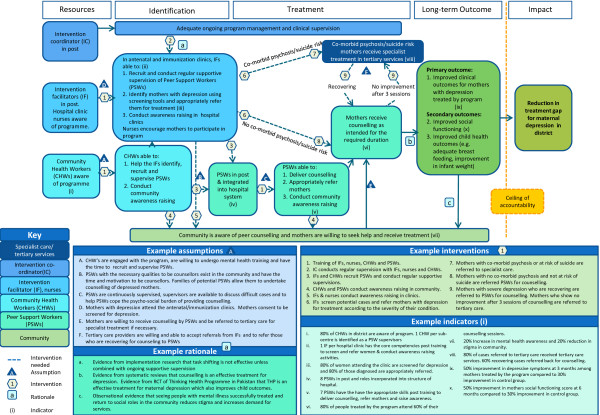
“1), which surfaced mechanisms about how the intervention was expected to work at different stages (intermediate outcomes), and the conditions required to enable change (assumptions), in order to achieve the desired longer-term outcomes [31, 32].”
BackgroundBernays, S., Lanyon, C., Tumwesige, E., Aswiime, A., Ngwenya, N. B., Nxumalo, V., Shahmanesh, M., & Seeley, J. (2021) · Global Public Health · doi:10.1080/17441692.2021.1953105 · Cited by 26
“We present our applied theory of change to demonstrate how the intervention seeks to e ff ectively foster protective factors in order to develop resilience in ‘ high-risk ’ settings, in ways that are locally pertinent (Breuer et al., 2016; De Silva et al., 2014; Fergus & Zimmerman, 2005).”
MethodMannell, J., Washington, L., Khaula, S., Khoza, Z., Mkhwanazi, S., Burgess, R. A., Brown, L. J., Jewkes, R. K., Shai, N., Willan, S., et al. (2023) · BMJ Global Health · doi:10.1136/bmjgh-2022-011463 · Cited by 27
Liu, H., Muhunthan, J., Hayek, A., Hackett, M. L., Laba, T., Peiris, D., & Jan, S. (2016) · Systematic Reviews · doi:10.1186/s13643-016-0314-5 · Cited by 27
Nakku, J. E. M., Rathod, S. D., Garman, E. C., Ssebunnya, J., Kangere, S., Silva, M. D., Patel, V., Lund, C., & Kigozi, F. N. (2019) · International Journal of Mental Health Systems · doi:10.1186/s13033-019-0319-2 · Cited by 33
Self-citationBreuer, E., Comas‐Herrera, A., Freeman, E., Albanese, E., Alladi, S., Amour, R., Evans-Lacko, S. E., Ferri, C. P., Govia, I., Astudillo‐García, C. I., et al. (2021) · Dementia · doi:10.1177/14713012211029105 · Cited by 28
Self-citationPetersen, I., Selohilwe, O., Georgeu-Pepper, D., Ras, C., Zani, B., Petrus, R., Anderson, L. R., Mntambo, N., Kathree, T., Bhana, A., et al. (2022) · BMC Health Services Research · doi:10.1186/s12913-022-08874-7 · Cited by 32
“Engagement of key stakeholders in the co-design of systems strengthening interventions is vital in identifying potential challenges and solutions to promote uptake of innovations in real-world settings [41].”
BackgroundPerry, A., Waterman, M. G., Dale, V., Moore, K., & House, A. O. (2021) · EClinicalMedicine · doi:10.1016/j.eclinm.2020.100702 · Cited by 26
“Complex interventions are notoriously difficult to implement and evaluate where uncertainty about the stability of the environment exists [32-35].”
BackgroundCross, S. P. M., Nicholas, J., Mangelsdorf, S. N., Valentine, L., Baker, S. T. E., McGorry, P. D., Gleeson, J., & Álvarez‐Jiménez, M. (2023) · JMIR Formative Research · doi:10.2196/49846 · Cited by 28
Überlegungen des Expertenbeirats zu Anträgen im Rahmen des Innovationsfonds
Blettner, M., Dierks, M., Donner‐Banzhoff, N., Hertrampf, K., Klusen, N., Köpke, S., Masanneck, M., Pfaff, H., Richter, R., & Sundmacher, L. (2018) · Zeitschrift für Evidenz Fortbildung und Qualität im Gesundheitswesen · doi:10.1016/j.zefq.2018.01.004 · Cited by 31
Wilbur, J., Bright, T. M., Mahon, T., Hameed, S., Torondel, B., Mulwafu, W., Kuper, H., & Polack, S. (2018) · International Journal of Environmental Research and Public Health · doi:10.3390/ijerph15122746 · Cited by 26
“If behaviour change is achieved, this will suggest a positive causal link between inputs and outcomes [36].”
BackgroundMethodWahid, S. S., Pedersen, G. A., Ottman, K. E., Burgess, A., Gautam, K., Martini, T., Viduani, A. C., Momodu, O., Lam, C., Fisher, H. L., et al. (2020) · BMJ Open · doi:10.1136/bmjopen-2019-034335 · Cited by 26
Ponsford, R., Meiksin, R., Bragg, S., Crichton, J., Emmerson, L., Tancred, T., Tilouche, N., Morgan, G. S., Gee, P., Young, H., et al. (2021) · Pilot and Feasibility Studies · doi:10.1186/s40814-020-00752-5 · Cited by 28
Meiksin, R., Meléndez‐Torres, G. J., Falconer, J., Witzel, T. C., Weatherburn, P., & Bonell, C. P. (2021) · Systematic Reviews · doi:10.1186/s13643-020-01523-2 · Cited by 26
“They also help evaluators determine what to measure to assess whether and how an intervention works and which components, if any, are most important [44].”
BackgroundRomão, D. M. M., Setti, C., Arruda, L. H. M., de Melo, R. C., de Araújo, B. C., Tan, A. R., DeMaio, P., & Kuchenmüller, T. (2023) · PLoS ONE · doi:10.1371/journal.pone.0282808 · Cited by 26
“In reality, the development process is continuous, involving reflection and adaptation as new evidence comes to light, requiring the causal pathways to be changed [15].”
BackgroundAlejandre, J. C., CHASTIN, S. F. M., Irvine, K. N., Georgiou, M., Khanna, P., Tieges, Z., Smith, N., Chong, Y.-Y., Onagan, F. C., Price, L., et al. (2023) · Health & Social Care in the Community · doi:10.1155/2023/6551521 · Cited by 27
“Logic models are composed of inputs, activities, outputs, and outcomes [49].”
MethodBreuer, E., Silva, M. J. D., & Lund, C. (2018) · Cambridge Prisms Global Mental Health · doi:10.1017/gmh.2018.13 · Cited by 28
“Theory of change (ToC) has gained prominence in recent years as an alternative way to conceptualise programme design and evaluation in global mental health (De Silva et al. 2014; Asher et al. 2016; Chibanda et al. 2016).”
BackgroundMethodSelf-citationBayly, J., Edwards, B., Peat, N., Warwick, G., Hennig, I. M., Arora, A., Wilcock, A., Higginson, I. J., & Maddocks, M. M. (2018) · Pilot and Feasibility Studies · doi:10.1186/s40814-018-0350-0 · Cited by 23
Dawson-Squibb, J.-J., & de Vries, P. J. (2019) · Journal of Autism and Developmental Disorders · doi:10.1007/s10803-019-04176-w · Cited by 31
Tesfaye, A., Semrau, M., Ali, O., Kinfe, M., Tamiru, M., Fekadu, A., & Davey, G. (2021) · PLoS neglected tropical diseases · doi:10.1371/journal.pntd.0009332 · Cited by 23
Powell, C., Tomlinson, J., Quinn, C., & Fylan, B. (2022) · Age and Ageing · doi:10.1093/ageing/afac089 · Cited by 23
“A theory-driven approach is more likely to improve the effectiveness, sustainability and scalability of an intervention [41].”
Ammenwerth, E., Hyppönen, H., de Keizer, N. F., Nykänen, P., Rigby, M., Scott, P., Talmon, J. L., Georgiou, A., & Magrabi, F. (2016) · Yearbook of Medical Informatics · doi:10.15265/iy-2016-013 · Cited by 32
A One Health evaluation framework
Rüegg, S. R., Häsler, B., Nielsen, L. R., Buttiġieġ, S. C., Santa, M., Aragrande, M., Canali, M., Ehlinger, T. J., Queenan, K., Chantziaras, I., et al. (2018) · Wageningen Academic Publishers eBooks · doi:10.3920/9789086868759_005 · Cited by 26
Wirtz, M. A., Bitzer, E. M., Albert, U., Ansmann, L., Bögel, M., Ernstmann, N., Hollederer, A., Hower, K. I., Nowak, M., & Vollmar, H. C. (2019) · Das Gesundheitswesen · doi:10.1055/a-0862-0588 · Cited by 30
“[21] De Silva MJ, Breuer E, Lee L et al.”
Ryan, G. K., Kamuhiirwa, M., Mugisha, J., Baillie, D. W. H., Hall, C., Newman, C. P., Nkurunungi, E., Rathod, S. D., Devries, K. M., Silva, M. J. D., et al. (2019) · BMC Psychiatry · doi:10.1186/s12888-019-2360-8 · Cited by 23
Castro, N. A. B., Zamora, A. A. C., Castruita, R. M. C., Banda-Sauceda, N. C., & de la Cruz, M. (2020) · Frontiers in Psychology · doi:10.3389/fpsyg.2019.02668 · Cited by 29
“…important that an exercise program places emphasis on satisfying interpersonal, organizational, and environmental factors (Glanz and Bishop, 2010; De Silva et al., 2014) such as promoting enjoyment and interaction among exercise participants while increasing accessibility and safety at exercise…”
BackgroundAlonge, O., Chiumento, A., Hamoda, H. M., Gaber, E., Huma, Z., Abbasinejad, M., Hosny, W., Shakiba, A., Minhas, A., Saeed, K., et al. (2020) · Health Policy and Planning · doi:10.1093/heapol/czaa124 · Cited by 26
Hiltensperger, R., Ryan, G. K., Ben-Dor, I. A., Charles, A., Epple, E., Kalha, J., Korde, P., Kotera, Y., Mpango, R. S., Moran, G. S., et al. (2024) · BMC Health Services Research · doi:10.1186/s12913-024-10990-5 · Cited by 20
“…were purposively selected to represent diverse groups in line with guidance provided to all sites by the UPSIDES Implementation Plan [23], including: service user and carer representatives, clinical staff members, Table 1 Core components of Theory of Change (ToC, adapted from De Silva et al. [16])”
BackgroundMethodInfluentialD’Mello-Guyett, L., Cumming, O., Rogers, E., D’hondt, R., Mengitsu, E., Mashako, M., den Bergh, R. V., Welo, P. O., Maes, P., & Checchi, F. (2022) · Conflict and Health · doi:10.1186/s13031-022-00445-1 · Cited by 22
Johansson, T., Tishelman, C., Eriksson, L. E., Cohen, J., & Goliath, I. (2022) · BMC Geriatrics · doi:10.1186/s12877-022-02915-w · Cited by 29
“After completed analysis, we noted the relevance of a Theory of Change (ToC) [41] approach for conceptualizing our findings.”
MethodProcess evaluation of a National Primary Eye Care Programme in Rwanda
on behalf of the Rwanda Primary Eye Care Process evaluation group, Yip, J. L. Y., Bright, T. M., Ford, S., Mathenge, W. C., & Faal, H. B. (2018) · BMC Health Services Research · doi:10.1186/s12913-018-3718-1 · Cited by 24
Unpacking ‘the cloud’: a framework for implementing public health approaches to palliative care
Pfaff, K., Dolovich, L. R., Howard, M., Sattler, D., Zwarenstein, M., & Marshall, D. (2019) · Health Promotion International · doi:10.1093/heapro/day123 · Cited by 23
Analyzing Indian mental health systems: Reflecting, learning, and working towards a better future
Mahajan, P., Rajendran, P., Sunderamurthy, B., Keshavan, S., & Bazroy, J. (2019) · Journal of Current Research in Scientific Medicine · doi:10.4103/jcrsm.jcrsm_21_19- · Cited by 25
Designing evaluations to provide evidence to inform action in new settings
Davey, C., Hassan, S., Cartwright, N. D., Humphreys, M., Masset, E., Prost, A., Gough, D., Oliver, S. R., Bonell, C. P., & Hargreaves, J. (2018) · doi:10.51744/cip2 · Cited by 24
“For De Silva et al., a theory of change is a ‘representation of the causal pathways through which an intervention is expected to achieve its impact within the constraints of the setting in which it is implemented’ (De Silva et al., 2014).”
BackgroundNaseralallah, L. M. A., Koraysh, S., Alasmar, M., & Aboujabal, B. (2024) · American Journal of Health-System Pharmacy · doi:10.1093/ajhp/zxae177 · Cited by 24
Paterson, C., Karatzias, T., Harper, S. F., Dougall, N. J., Dickson, A., & Hutton, P. (2018) · British Journal of Clinical Psychology · doi:10.1111/bjc.12209 · Cited by 22
Berghs, M. J., Atkin, K. M., Hatton, C., & Thomas, C. (2019) · BMC Public Health · doi:10.1186/s12889-019-7334-8 · Cited by 22
Turner, R. R., Arden, M. A., Reale, S., Sutton, E. J., Taylor, S. J., Bourke, L., Greenfield, D., Morrissey, D., Brown, J. E., Doherty, P., et al. (2021) · BMC Health Services Research · doi:10.1186/s12913-021-06266-x · Cited by 25
Monitoring and evaluation for thinking and working politically
Aston, T., Roche, C., Schaaf, M., & Cant, S. (2021) · Evaluation · doi:10.1177/13563890211053028 · Cited by 25
“At the same time, the use of generative logic through early theory development within RCTs for complex interventions is becoming more common and increasingly recommended (De Silva et al., 2014; Jamal et al., 2015), demonstrating the weakness of experimental methods without solid theory.”
BackgroundKocher, A., Simon, M., Dwyer, A. A., Villiger, P. M., Künzler‐Heule, P., Geest, S. D., Berben, L., & Nicca, D. (2019) · Journal of Advanced Nursing · doi:10.1111/jan.14185 · Cited by 24
Lessons from a theory of change-driven evaluation of a global mental health funding portfolio
Esponda, G. M., Ryan, G. K., Estrin, G. L., Usmani, S., Lee, L., Murphy, J., Qureshi, O., Endale, T., Regan, M., Eaton, J., et al. (2021) · International Journal of Mental Health Systems · doi:10.1186/s13033-021-00442-6 · Cited by 23
Self-citationde Nooijer, K., Pivodic, L., Noortgate, N. J. V. D., Pype, P. F., Evans, C., & den Block, L. V. (2021) · Palliative Medicine · doi:10.1177/02692163211040187 · Cited by 26
Purnawan, E., Brunori, G., & Prosperi, P. (2021) · Horticulturae · doi:10.3390/horticulturae7120546 · Cited by 19
Toh, G., Pearce, E., Vines, J., Ikhtabi, S., Birken, M., Pitman, A., & Johnson, S. (2022) · BMC Psychiatry · doi:10.1186/s12888-022-03889-0 · Cited by 22
Making internationalization of higher education a national strategic focus
Garwe, E. C., & Thondhlana, J. (2021) · Journal of Applied Research in Higher Education · doi:10.1108/jarhe-09-2020-0323 · Cited by 8
Sidhu, M. S., Pollard, J., & Sussex, J. (2022) · BMJ Open · doi:10.1136/bmjopen-2021-053222 · Cited by 18
Vaucher, P., Michiels, W., Lambert, S. J., Favre, N., Perez, B., Baertschi, A., Favrat, B., & Gache, P. (2016) · International Journal of Drug Policy · doi:10.1016/j.drugpo.2016.03.006 · Cited by 19
“During the past ten years, important methodological advances have been made with regard to how to develop and implement new policies designed to change people’s behaviour (De Silva et al., 2014; Michie et al., 2015; Moore et al., 2015).”
BackgroundGreenland, K., Chipungu, J., Chilekwa, J. C., Chilengi, R., & Curtis, V. (2017) · Globalization and Health · doi:10.1186/s12992-017-0302-0 · Cited by 21
Program Evaluation of Population- and System-Level Policies: Evidence for Decision Making
Walker, S., Fox, A., Altunkaya, J., Colbourn, T., Drummond, M., Griffin, S., Gutacker, N., Revill, P. A., & Sculpher, M. (2021) · Medical Decision Making · doi:10.1177/0272989x211016427 · Cited by 23
“Theory-based approaches can be used to build this understanding by defining the hypothesized causal chains.(69,70) Approaches such as mechanism mapping, in which potential mechanism-context interactions are identified, or group model building, in which a diverse set of practitioners collaborate to develop causal model…”
How ‘The Daily Mile™’ works in practice: A process evaluation in a UK primary school
Harris, J., Milnes, L. J., & Mountain, G. (2019) · Journal of Child Health Care · doi:10.1177/1367493519880049 · Cited by 23
“A logic model developed using ‘theory of change’ approach considered causal assumptions and guided method selection (De Silva et al., 2014).”
MethodBamford, C., Wilcock, J., Brunskill, G., Wheatley, A., Dening, K. H., Manthorpe, J., Allan, L. M., Banerjee, S., Booi, L., Griffiths, S., et al. (2023) · PLoS ONE · doi:10.1371/journal.pone.0283818 · Cited by 18
“While the overall purpose of the ToC is wellestablished [42, 43], the process of developing a ToC varies [44, 45].”
BackgroundMethodInfluentialSchafer, M., Lachman, J. M., Gardner, F. E. M., Zinser, P., Calderón, F., Han, Q., Facciolà, C., & Clements, L. (2023) · BMC Public Health · doi:10.1186/s12889-023-16649-w · Cited by 21
“As such, underpinning an intervention with relevant theory in order to initiate change is key [38, 65].”
BackgroundRyan, G. K., Bauer, A., Bass, J., & Eaton, J. (2018) · BMJ Open · doi:10.1136/bmjopen-2017-018193 · Cited by 18
“57 Outcomes will be mapped onto a causal pathway, and indicators attached to the corresponding outcomes.”
BackgroundMethodInfluentialMoore, G., Michie, S., Anderson, J., Belesova, K., Crane, M. A., Deloly, C., Dimitroulopoulou, S., Gitau, H., Hale, J., Lloyd, S. J., et al. (2021) · Wellcome Open Research · doi:10.12688/wellcomeopenres.16542.2 · Cited by 22
Panulo, M., Chidziwisano, K., Beattie, T. K., Tilley, E., Kambala, C. Y., & Morse, T. (2022) · International Journal of Environmental Research and Public Health · doi:10.3390/ijerph19116771 · Cited by 20
Owolabi, M. O., Olowoyo, P., Mocumbi, A. O., Ogah, O. S., Odili, A. N., Wahab, K., Ojji, D. B., Adeoye, A. M., Akinyemi, R., Akpalu, A. K., et al. (2023) · Journal of Human Hypertension · doi:10.1038/s41371-023-00828-8 · Cited by 24
Exceptional responders in conservation
Post, G. S., & Geldmann, J. (2018) · Conservation Biology · doi:10.1111/cobi.13006 · Cited by 18
“However, the use of a Theory of Change architecture can focus inter- and multi-disciplinary teams (De Silva et al. 2014) on commonalities that fit within the study parameters.”
BackgroundLucas, P. J., Ingram, J. C., Redmond, N. M., Cabral, C., Turnbull, S., & Hay, A. D. (2017) · BMC Medical Research Methodology · doi:10.1186/s12874-017-0455-9 · Cited by 20
“However, methods and advice for how to achieve this to develop a specific intervention are sparse [17, 64, 65].”
Investigating Stakeholder Perceptions of Fish Decline: Making Sense of Multiple Mental Models
Horowitz, J., Pressey, R. L., Gurney, G. G., Wenger, A. S., & Pahang, K. (2018) · Sustainability · doi:10.3390/su10041222 · Cited by 18
Comprehensive Geriatric Assessment in hospital and hospital-at-home settings: a mixed-methods study
Gardner, M. P., Shepperd, S., Godfrey, M., Mäkelä, P., Tsiachristas, A., Singh-Mehta, A., Ellis, G., Khanna, P., Langhorne, P., Makin, S., et al. (2019) · Health Services and Delivery Research · doi:10.3310/hsdr07100 · Cited by 23
Walshe, C., Kinley, J., Patel, S., Goodman, C. M., Bunn, F., Lynch, J. K., Scott, D. R. M., Lund, A. D., Stacpoole, M., Preston, N. J., et al. (2019) · BMC Geriatrics · doi:10.1186/s12877-019-1275-z · Cited by 19
Appiah, R., Fadiji, A. W., Wissing, M. P., & Schutte, L. (2021) · Journal of Community Psychology · doi:10.1002/jcop.22566 · Cited by 18
Mo, Y., Chen, L., Zhou, Y., Bone, A. E., Maddocks, M. M., & Evans, C. (2024) · Journal of Cachexia Sarcopenia and Muscle · doi:10.1002/jcsm.13576 · Cited by 17
Munakampe, M. N., Nkole, T., Silumbwe, A., Zulu, J. M., Cordero, J. P., & Steyn, P. S. (2020) · BMC Health Services Research · doi:10.1186/s12913-020-05589-5 · Cited by 18
Using path analysis to test theory of change: a quantitative process evaluation of the MapSan trial
Bick, S., Buxton, H., Chase, R. P., Ross, I., Adriano, Z., Capone, D., Knee, J., Brown, J. M., Nalá, R., Cumming, O., et al. (2021) · BMC Public Health · doi:10.1186/s12889-021-11364-w · Cited by 17
Metadata
- Authors
- De Silva, M. J., Breuer, E., Lee, L., Asher, L., Chowdhary, N., Lund, C., & Patel, V.
- Affiliations
- University of Cape Town (ZA)
- London School of Hygiene & Tropical Medicine (GB)
- Sangath (IN)
- Venue
- Trials
- Published
- 2014-07-05
- Volume
- 15
- Issue
- 1
- Pages
- 267-267
- ISSN
- 1745-6215 (ISSN-L)
- PMC
- PMC4227087
- OpenAlex
- W2168592755
- Semantic Scholar
- 3e60e98b482d24e5c55f1fae2a695136f7b1ea41
- Cited by
- 738
- References
- 43
- Citations by year
- 2026: 57 · 2025: 74 · 2024: 108 · 2023: 98 · 2022: 87 · 2021: 93 · 2020: 58 · 2019: 55 · 2018: 41 · 2017: 21 · 2016: 30 · 2015: 15 · 2014: 1
- FWCI
- 28.63
- Type
- journal article
- Language
- en
- Open access
- gold
- doi.org
- Licence
- Locations
- Trials (publishedVersion, cc-by)
- Europe PMC (PubMed Central) (publishedVersion, cc-by)
- PubMed Central (publishedVersion, cc-by)
- PubMed (publishedVersion)
- LSHTM Research Online (London School of Hygiene and Tropical Medicine) (acceptedVersion)
- Open University of Cape Town (University of Cape Town) (submittedVersion, cc-by)
- Funders
- London School of Hygiene and Tropical Medicine
- Wellcome Trust (084674, 100142/Z/12/Z, 100714)
- Department for International Development (HRPC10)
- Grand Challenges Canada
- National Institute of Mental Health (U19MH095687, U19MH095699)
- Topics
- Social Sciences › Public Administration › Evaluation and Performance Assessment
- Health Sciences › Health Professions › General Health Professions › Health Policy Implementation Science
- Physical Sciences › Mathematics › Statistics and Probability › Advanced Causal Inference Techniques
- Keywords
- theory of change, complex interventions, MRC framework for complex interventions, theory-based evaluation, intervention design, stakeholder engagement, causal pathways, process evaluation, intervention effectiveness, knowledge gaps, health interventions
- MeSH terms
- Humans, Mental Health, Guidelines as Topic, Biomedical Research
About these checks
Registry, retraction, Cites and statistics results are computed, not judged, with one exception: a printed reference that no index lists is read once by a model before it counts as a citation error. Claims are extracted by a model and kept only when their quote appears verbatim in the text; each cited source is then checked, with a model’s help, for whether it says what the claim relies on. Those verdicts can be wrong — read the claim’s quote and the cited source before relying on one.
Statistics and arithmetic are recomputed, not judged.
Confidence bands are shown only for fields calibrated on our annotated test set. None is calibrated yet, so no band is shown.
What counts as a claim ›How we measure confidence ›How we check this ›
Are you an author, or do you see a problem with this page? Request a review
Data sources
Bibliographic data: Semantic Scholar, OpenAlex, Crossref.
Contains information from the Semantic Scholar Academic Graph Datasets, made available under the ODC Attribution License (ODC-BY 1.0).
Semantic Scholar’s data is described in: Kinney, R., et al. (2023). The Semantic Scholar Open Data Platform. arXiv:2301.10140.
