

Theory of Change: a theory-driven approach to enhance the Medical Research Council's framework for complex interventions
Open accessThe DOI matches its Crossref record; 43 of the 43 references it cites were found in a registry or an index.
Abstract
BACKGROUND: The Medical Research Councils' framework for complex interventions has been criticized for not including theory-driven approaches to evaluation. Although the framework does include broad guidance on the use of theory, it contains little practical guidance for implementers and there have been calls to develop a more comprehensive approach. A prospective, theory-driven process of intervention design and evaluation is required to develop complex healthcare interventions which are more likely to be effective, sustainable and scalable. METHODS: We propose a theory-driven approach to the design and evaluation of complex interventions by adapting and integrating a programmatic design and evaluation tool, Theory of Change (ToC), into the MRC framework for complex interventions. We provide a guide to what ToC is, how to construct one, and how to integrate its use into research projects seeking to design, implement and evaluate complex interventions using the MRC framework. We test this approach by using ToC within two randomized controlled trials and one non-randomized evaluation of complex interventions. RESULTS: Our application of ToC in three research projects has shown that ToC can strengthen key stages of the MRC framework. It can aid the development of interventions by providing a framework for enhanced stakeholder engagement and by explicitly designing an intervention that is embedded in the local context. For the feasibility and piloting stage, ToC enables the systematic identification of knowledge gaps to generate research questions that strengthen intervention design. ToC may improve the evaluation of interventions by providing a comprehensive set of indicators to evaluate all stages of the causal pathway through which an intervention achieves impact, combining evaluations of intervention effectiveness with detailed process evaluations into one theoretical framework. CONCLUSIONS: Incorporating a ToC approach into the MRC framework holds promise for improving the design and evaluation of complex interventions, thereby increasing the likelihood that the intervention will be ultimately effective, sustainable and scalable. We urge researchers developing and evaluating complex interventions to consider using this approach, to evaluate its usefulness and to build an evidence base to further refine the methodology. TRIAL REGISTRATION: Clinical trials.gov: NCT02160249.
Overview
The claims and statistics of this paper haven’t been checked yet.
Free: it reads the open-access text and checks the first 5 claims that cite a source we can check. Create a free account to check every claim.
Integrity signals
Registry
Cites
Statistics
Figures
Verification
Claims the paper makes
The claims and statistics of this paper haven’t been checked yet.
Free: it reads the open-access text and checks the first 5 claims that cite a source we can check. Create a free account to check every claim.
Claims other papers make about this one
Each is checked against this paper’s own text: does it say what the citing paper says it does?
The source backs part of the claim, not all of it — or backs it for a different population, condition or comparison.
In the citing paper
“This participatory process appears to have been crucial for building the shared ownership and the political will necessary to overcome implementation barriers, a finding consistent with literature emphasizing the importance of co-creation in settings where top-down approaches often fail [17].”
From Co-creating systems change for mental health: a theory of change approach from the MeHPriC initiative in Lagos, Nigeria (2025) · cites this paper as [17]
Experimental — accuracy not yet measuredThe source backs part of the claim, not all of it — or backs it for a different population, condition or comparison.
In the citing paper
“Existing guidance for developing public health interventions does not provide information for researchers about how to work with intervention providers to co-produce and prototype the content and delivery of new interventions prior to evaluation.”
From Development of a framework for the co-production and prototyping of public health interventions (2017) · cites this paper as [7]
Experimental — accuracy not yet measuredThe source backs part of the claim, not all of it — or backs it for a different population, condition or comparison.
In the citing paper
“These guidelines support development of a theoretical rationale for an intervention, but provide scant pragmatic instruction on how to develop intervention materials and delivery methods.”
From Development of a framework for the co-production and prototyping of public health interventions (2017) · cites this paper as [7]
Experimental — accuracy not yet measuredThe source backs part of the claim, not all of it — or backs it for a different population, condition or comparison.
In the citing paper
“It complements other intervention development guidance by providing more detail on the process of the early stages of intervention development and co-production that receives limited attention in existing guidance on intervention development [1–12].”
From Development of a framework for the co-production and prototyping of public health interventions (2017) · cites this paper as [7]
Experimental — accuracy not yet measuredThe cited source says what the claim attributes to it.
In the citing paper
“Theory of Change (ToC) has emerged as a key planning and evaluation tool suited to these demands.”
From Co-creating systems change for mental health: a theory of change approach from the MeHPriC initiative in Lagos, Nigeria (2025) · cites this paper as [17]
5 more claims about this paper
Create a free account to see every claim other papers make about this one.
Self-check
Percentages, sums and reported differences re-computed from the paper’s own numbers.
The self-check needs the paper’s full text.
Citations
Cites
The theory of planned behavior
Ajzen, I. (1991) · Organizational Behavior and Human Decision Processes · doi:10.1016/0749-5978(91)90020-t · Cited by 90,587
Developing and evaluating complex interventions: the new Medical Research Council guidance
Craig, P., Dieppe, P., Macintyre, S., Michie, S., Nazareth, I., & Petticrew, M. (2008) · BMJ · doi:10.1136/bmj.a1655 · Cited by 10,995 · cited 3×
“Background The updated Medical Research Council (MRC) framework for complex interventions [1] is a set of guidelines for designing and evaluating complex interventions which has been widely influential in the field [2].”
BackgroundAgent-based modeling: Methods and techniques for simulating human systems
Bonabeau, E. (2002) · Proceedings of the National Academy of Sciences · doi:10.1073/pnas.082080899 · Cited by 4,500
Specification, evaluation, and interpretation of structural equation models
Bagozzi, R. P., & Yi, Y. (2012) · Journal of the Academy of Marketing Science · doi:10.1007/s11747-011-0278-x · Cited by 3,735 · cited 1×
“In order for this to be achi eved, appropriate modelling techniques need to be applied, drawing on methods from other fields such as structural equation modelling [28], discrete-event simulation models [29], agent-base d modelling [30], and system dynamics modelling [31].”
MethodMurray, E., Treweek, S., Pope, C., MacFarlane, A., Ballini, L., Dowrick, C., Finch, T., Kennedy, A., Mair, F., O'Donnell, C., et al. (2010) · BMC Medicine · doi:10.1186/1741-7015-8-63 · Cited by 1,478
Designing and evaluating complex interventions to improve health care
Campbell, N. C., Murray, E., Darbyshire, J., Emery, J., Farmer, A., Griffiths, F., Guthrie, B., Lester, H., Wilson, P., & Kinmonth, A. L. (2007) · BMJ · doi:10.1136/bmj.39108.379965.be · Cited by 1,331 · cited 1×
“The MRC guidance calls for more detailed and standardized descriptions of complex interventions in published reports to facilitate exchange of knowledge and to encourage synthesis of results from similar studies [1,32].”
BackgroundTechniques for Evaluating Training Programs
Kirkpatrick, D. L. (1975) · Training and development journal · Cited by 1,234
Chen, H.-T. (1990) · Medical Entomology and Zoology · Cited by 1,227
System Dynamics Modeling: Tools for Learning in a Complex World
Sterman, J. D. (2001) · California Management Review · doi:10.2307/41166098 · Cited by 1,216
Rahman, A., Malik, A., Sikander, S., Roberts, C., & Creed, F. (2008) · The Lancet · doi:10.1016/s0140-6736(08)61400-2 · Cited by 993
Research works printed but not linked: 7
- James C Theory of Change Review: A report comissioned by Comic Relief 2011
- Weiss CH Connell JP, Kubisch AC, Schorr LB, Weiss CH Nothing As Practical As Good Theory: Exploring Theory-Based Evaluation For Comprehensive Community Initiatives For Children And Families New Approaches to Evaluating Community Initiatives Volume 1 Concepts, Methods and Contexts 1995 Washington DC: The Aspen Institute 65 92
- Anderson A The Community Builder’s Approach to Theory of Change. A Practical Guide to Theory Development 2005 New York: The Aspen Institute
- Department for International Development How to Note: Guidance on using revised Logical Framework 2011 London
- Clark H Andersen A Theories of Change and Logic Models: Telling Them Apart. 2004 Presented at the American Evaluation Association Conference 2004 Atlanta, Georgia
- Taplin D Rasic M Theory of Change Technical Papers: A series of papers to support development of theories of change based on practice in the field 2013 New York: ActKnowledge
- Taplin DH Rasic M Facilitator's Source Book: Source Book for facilitators leading Theory of Change development sessions 2012 New York: ActKnowledge
Cited by
Process evaluation of complex interventions: Medical Research Council guidance
Moore, G. F., Audrey, S., Barker, M., Bond, L., Bonell, C., Hardeman, W., Moore, L., O'Cathain, A., Tinati, T., Wight, D., et al. (2015) · BMJ · doi:10.1136/bmj.h1258 · Cited by 6,204
Timotheou, S., Miliou, O., Dimitriadis, Y., Sobrino, S. V., Giannoutsou, N., Cachia, R., Monés, A. M., & Ioannou, A. (2023) · Education and Information Technologies · doi:10.1007/s10639-022-11431-8 · Cited by 816
“Theory of change as a methodological approach has also been used by researchers to develop models for evaluation in the field of education (e.g., Aromatario et al., 2019; Chapman & Sammons, 2013; De Silva et al., 2014).”
MethodTaxonomy of approaches to developing interventions to improve health: a systematic methods overview
O’Cathain, A., Croot, L., Sworn, K., Duncan, E., Rousseau, N., Turner, K., Yardley, L., & Hoddinott, P. (2019) · Pilot and Feasibility Studies · doi:10.1186/s40814-019-0425-6 · Cited by 576
Skivington, K., Matthews, L., Simpson, S. A., Craig, P., Baird, J., Blazeby, J. M., Boyd, K. A., Craig, N., French, D. P., McIntosh, E., et al. (2021) · Health Technology Assessment · doi:10.3310/hta25570 · Cited by 522
Using theory of change to design and evaluate public health interventions: a systematic review
Breuer, E., Lee, L., De Silva, M., & Lund, C. (2015) · Implementation Science · doi:10.1186/s13012-016-0422-6 · Cited by 425
“Logic models are conceptually similar to ToC but are usually presented in a linear form with boxes for inputs, activities, outputs and outcomes with little explanation of the causal pathways linking them [3].”
BackgroundMethodInfluentialSelf-citationCraig, P., Di Ruggiero, E., Frohlich, K. L., Mykhalovskiy, E., White, M., on behalf of the Canadian Institutes of Health Research (CIHR)–National Institute for Health Research (NIHR) Context Guidance Authors Group (listed alphabetically), Campbell, R., Cummins, S., Edwards, N., Hunt, K., et al. (2018) · doi:10.3310/cihr-nihr-01 · Cited by 370
Bleijenberg, N., de Man-van Ginkel, J. M., Trappenburg, J. C. A., Ettema, R. G. A., Sino, C. G., Heim, N., Hafsteindóttir, T. B., Richards, D. A., & Schuurmans, M. J. (2018) · International Journal of Nursing Studies · doi:10.1016/j.ijnurstu.2017.12.001 · Cited by 334
Development of a framework for the co-production and prototyping of public health interventions
Hawkins, J., Madden, K., Fletcher, A., Midgley, L., Grant, A., Cox, G., Moore, L., Campbell, R., Murphy, S., Bonell, C., et al. (2017) · BMC Public Health · doi:10.1186/s12889-017-4695-8 · Cited by 310
Fletcher, A., Jamal, F., Moore, G., Evans, R. E., Murphy, S., & Bonell, C. (2016) · Evaluation · doi:10.1177/1356389016652743 · Cited by 294
“Indeed, the MRC guidance has been criticised by some for the use of the term ‘complex’ in the absence of engagement with complexity theories and thinking (Anderson 2008; De Silva et al., 2014).”
MethodMoore, G. F., & Evans, R. E. (2017) · SSM - Population Health · doi:10.1016/j.ssmph.2016.12.005 · Cited by 235
“…such as 6 Steps in Quality Intervention Development (Wight, Wimbush, Jepson & Doi, 2015), Medical Research Council guidance on process evaluations (Moore et al., 2015), and supplementary tools to support integration of theory-based approaches with the MRC framework (De Silva et al., 2014).”
MethodZamboni, K., Baker, U., Tyagi, M., Schellenberg, J., Hill, Z., & Hanson, C. (2020) · Implementation Science · doi:10.1186/s13012-020-0978-z · Cited by 231
“2) in the form of a preliminary programme theory [21, 23].”
BackgroundMethodBehaviour Centred Design: towards an applied science of behaviour change
Aunger, R., & Curtis, V. (2016) · Health Psychology Review · doi:10.1080/17437199.2016.1219673 · Cited by 221
“The BCD framework offers both a theory of change for behaviour (De Silva et al., 2014; Retolaza, 2011; Vogel, 2012), and a practical process for designing and evaluating interventions.”
MethodMa, R., Mann, F., Wang, J., Lloyd-Evans, B., Terhune, J., Al-Shihabi, A., & Johnson, S. (2020) · Social Psychiatry and Psychiatric Epidemiology · doi:10.1007/s00127-019-01800-z · Cited by 195
“The development of a clear theory of change is now regarded as an important step in the development of complex health interventions [97, 98].”
BackgroundSocial Entrepreneurship and Sustainability: A Conceptual Framework
Kamaludin, M. F., Xavier, J. A., & Amin, M. (2021) · Journal of Social Entrepreneurship · doi:10.1080/19420676.2021.1900339 · Cited by 223
“It will also show all the different other paths that might lead to change even though some of the items depicted are not related to the services offered by the said organisation (De Silva et al. 2014).”
BackgroundAsher, L., Patel, V., & De Silva, M. J. (2017) · BMC Psychiatry · doi:10.1186/s12888-017-1516-7 · Cited by 163
Self-citationLanglois, E. V., Straus, S. E., Antony, J., King, V. J., & Tricco, A. C. (2019) · BMJ Global Health · doi:10.1136/bmjgh-2018-001178 · Cited by 160
Preconditions for successful advance care planning in nursing homes: A systematic review.
Gilissen, J., Pivodic, L., Smets, T., Gastmans, C., Vander Stichele, R., Deliens, L., & Van den Block, L. (2017) · International Journal of Nursing Studies · doi:10.1016/j.ijnurstu.2016.12.003 · Cited by 156
Garcia, A. L., Reardon, R., McDonald, M., & Vargas-Garcia, E. J. (2016) · Current Nutrition Reports · doi:10.1007/s13668-016-0185-3 · Cited by 151
Lewin, S., Hendry, M., Chandler, J., Oxman, A. D., Michie, S., Shepperd, S., Reeves, B. C., Tugwell, P., Hannes, K., Rehfuess, E. A., et al. (2017) · BMC Medical Research Methodology · doi:10.1186/s12874-017-0349-x · Cited by 147
Designing for Emotion Regulation Interventions: An Agenda for HCI Theory and Research
Slovak, P., Antle, A., Theofanopoulou, N., Daudén Roquet, C., Gross, J., & Isbister, K. (2023) · ACM Transactions on Computer-Human Interaction · doi:10.1145/3569898 · Cited by 142
Minary, L., Trompette, J., Kivits, J., Cambon, L., Tarquinio, C., & Alla, F. (2019) · BMC Medical Research Methodology · doi:10.1186/s12874-019-0736-6 · Cited by 137
“Last decade has seen the emergence of theory driven RCT that use theory of change (ToC) as a pragmatic framework which describes how the intervention affects change [14].”
BackgroundInfluentialDivan, G., Bhavnani, S., Leadbitter, K., Ellis, C., Dasgupta, J., Abubakar, A. A., Elsabbagh, M., Hamdani, S. U., Servili, C., Patel, V., et al. (2021) · Journal of Child Psychology and Psychiatry · doi:10.1111/jcpp.13404 · Cited by 150
“A key strategy in the adaptation process must be to ensure the socio-cultural acceptability, relevance, and physical accessibility to local stakeholders, especially parents and caregivers (Divan, 2017) while retaining the core mechanistic active components of the original treatment.”
BackgroundSelf-citationBirdthistle, I. J., Schaffnit, S. B., Kwaro, D., Shahmanesh, M., Ziraba, A. K., Kabiru, C. W., Phillips‐Howard, P. A., Chimbindi, N., Ondenge, K., Gourlay, A. J., et al. (2018) · BMC Public Health · doi:10.1186/s12889-018-5789-7 · Cited by 140
Greenwood-Lee, J., Jewett, L., Woodhouse, L. J., & Marshall, D. A. (2018) · BMC Health Services Research · doi:10.1186/s12913-018-3745-y · Cited by 138
“Theory driven approaches are necessary [16]; approaches that consider mechanisms of causality [17, 18] by mapping out the deficiencies, why they arise, and which strategies can be used to intervene based on evidence showing effectiveness.”
BackgroundAsher, L., Hanlon, C., Birhane, R., Habtamu, A., Eaton, J., Weiss, H. A., Patel, V., Fekadu, A., & De Silva, M. (2018) · BMC Psychiatry · doi:10.1186/s12888-018-1818-4 · Cited by 118
Self-citationBreuer, E., De Silva, M. J., Shidaye, R., Petersen, I., Nakku, J., Jordans, M. J. D., Fekadu, A., & Lund, C. (2016) · British Journal of Psychiatry · doi:10.1192/bjp.bp.114.153841 · Cited by 111
Self-citationKapologwe, N., Kalolo, A., Kibusi, S. M., Chaula, Z., Nswilla, A., Teuscher, T. M., Aung, K., & Borghi, J. (2019) · Health Research Policy and Systems · doi:10.1186/s12961-018-0400-3 · Cited by 124
Population health intervention research: the place of theories
Panel, D., Moore, G. F., Cambon, L., Michie, S., Arwidson, P., Ninot, G., Ferron, C., Potvin, L., Kellou, N., Charlesworth, J., et al. (2019) · Trials · doi:10.1186/s13063-019-3383-7 · Cited by 119
Evaluation of district mental healthcare plans: The PRIME consortium methodology
De Silva, M. J., Rathod, S. D., Hanlon, C., Breuer, E., Chisholm, D., Fekadu, A., Jordans, M., Kigozi, F., Petersen, I., Shidhaye, R., et al. (2016) · British Journal of Psychiatry · doi:10.1192/bjp.bp.114.153858 · Cited by 106
Self-citationCambon, L., Terral, P., & Alla, F. (2019) · BMC Public Health · doi:10.1186/s12889-019-6663-y · Cited by 104
“In theory of change [25, 29, 30], the intervention components or ingredients mentioned earlier are fleshed out and examined separately from those of context, as a way to study how they contribute to producing outcomes.”
Rathod, S. D., De Silva, M. J., Ssebunnya, J., Breuer, E., Murhar, V., Luitel, N. P., Medhin, G., Kigozi, F., Shidhaye, R., Fekadu, A., et al. (2016) · PLOS ONE · doi:10.1371/journal.pone.0162038 · Cited by 103
Self-citationHampshire, K. N., Islam, N., Kissel, B., Chase, H., & Gundling, K. E. (2022) · The Lancet Planetary Health · doi:10.1016/s2542-5196(22)00045-6 · Cited by 100
How to achieve the desired outcomes of advance care planning in nursing homes: a theory of change
Gilissen, J., Pivodic, L., Gastmans, C., Stichele, R. V., Deliëns, L., Breuer, E., & den Block, L. V. (2018) · BMC Geriatrics · doi:10.1186/s12877-018-0723-5 · Cited by 106
“Terminology Definition (adapted from De Silva, 2015 [36])”
BackgroundMethodInfluentialSelf-citationNakimuli‐Mpungu, E., Musisi, S., Smith, C. M., von Isenburg, M., Akimana, B., Shakarishvili, A., Nachega, J. B., Mills, E. J., Chibanda, D., Ribeiro, M., et al. (2021) · Journal of the International AIDS Society · doi:10.1002/jia2.25722 · Cited by 101
“First, we adopted the Theory of Change Framework proposed by De Silva et al [27] to guide our synthesis.”
MethodInfluentialAsher, L., Fekadu, A., Hanlon, C., Mideksa, G., Eaton, J., Patel, V., & Silva, M. J. D. (2015) · PLoS ONE · doi:10.1371/journal.pone.0143572 · Cited by 100
Self-citationEllis-Smith, C. I., Higginson, I. J., Daveson, B. A., Henson, L. A., Evans, C., & BuildCARE, O. B. O. (2018) · PLoS ONE · doi:10.1371/journal.pone.0200240 · Cited by 101
“Theory of Change provides a framework for unpacking the ‘black box’ of a complex intervention [29], developed from research evidence or from stakeholder consultation [30].”
BackgroundLakerveld, J., Woods, C. B., Hebestreit, A., Brenner, H., Flechtner‐Mors, M., Harrington, J. M., Kamphuis, C. B. M., Laxy, M., Łuszczyńska, A., Mazzocchi, M., et al. (2020) · Food Policy · doi:10.1016/j.foodpol.2020.101873 · Cited by 98
“Such policies prescribe what procedure could be followed (Storcksdieck et al., 2014; Rütten and Pfeifer, 2016; Dreyhaupt et al., 2012).”
BackgroundKearney, C. A., Benoit, L., Gonzálvez, C., & Keppens, G. (2022) · Frontiers in Education · doi:10.3389/feduc.2022.1044608 · Cited by 71
Systematic review of the use of process evaluations in knowledge translation research
Scott, S. D., Rotter, T., Flynn, R., Brooks, H. M., Plesuk, T., Bannar‐Martin, K. H., Chambers, T., & Hartling, L. (2019) · Systematic Reviews · doi:10.1186/s13643-019-1161-y · Cited by 102
Deeny, S. R., & Steventon, A. (2015) · BMJ Quality & Safety · doi:10.1136/bmjqs-2015-004278 · Cited by 81
A scoping review of frameworks in empirical studies and a review of dissemination frameworks
Baumann, A. A., Hooley, C., Kryzer, E., Morshed, A. B., Gutner, C. A., Malone, S. M., Walsh‐Bailey, C., Pilar, M. R., Sandler, B., Tabak, R. G., et al. (2022) · Implementation Science · doi:10.1186/s13012-022-01225-4 · Cited by 88
Lin, C.-P., Evans, C. J., Koffman, J., Armes, J., Murtagh, F. E. M., & Harding, R. (2019) · Palliative Medicine · doi:10.1177/0269216318809582 · Cited by 77
Chibanda, D. (2017) · Epidemiology and Psychiatric Sciences · doi:10.1017/s2045796016001128 · Cited by 71
“In recent years, an engagement strategy that has gained considerable traction and appears to address all the above issues while fostering genuine collective team building between communities, user groups and researchers is the theory of change (ToC) approach (De Silva et al. 2014).”
Semrau, M., Alem, A., Abdulmalik, J., Docrat, S., Evans-Lacko, S., Gureje, O., Kigozi, F., Lempp, H., Lund, C., Petersen, I., et al. (2018) · Epidemiology and Psychiatric Sciences · doi:10.1017/s2045796017000452 · Cited by 74
Self-citationMaini, R., Mounier‐Jack, S., & Borghi, J. (2018) · BMJ Global Health · doi:10.1136/bmjgh-2017-000617 · Cited by 95
Mandal, M., Muralidharan, A., & Pappa, S. T. (2017) · BMC Pregnancy and Childbirth · doi:10.1186/s12884-017-1500-8 · Cited by 75
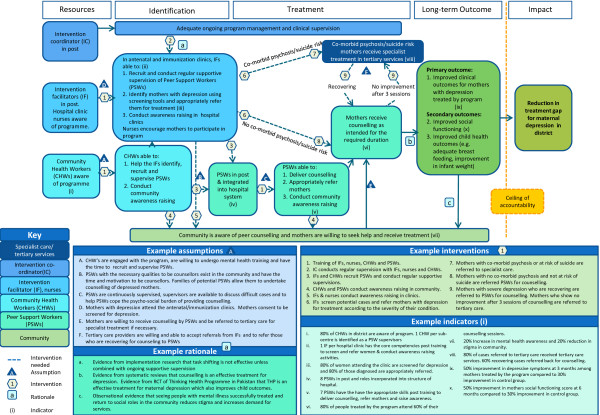
“Theories of change assist program planners and implementers in conceptualizing and understanding how elements of a program are related to one another and to the final desired outcomes; and they assist evaluators in identifying and mapping the constructs and indicators that should be measured to pre-specified component…”
BackgroundAbayneh, S., Lempp, H., Alem, A., Kohrt, B. A., Fekadu, A., & Hanlon, C. (2020) · International Journal of Mental Health Systems · doi:10.1186/s13033-020-00383-6 · Cited by 67
“interventions, assumptions and indicators to generate desired change [33].”
BackgroundRousseau, N. S., Turner, K. M., Duncan, E., O’Cathain, A., Croot, L., Yardley, L., & Hoddinott, P. (2019) · PLoS ONE · doi:10.1371/journal.pone.0223615 · Cited by 79
External Validity and Policy Adaptation: From Impact Evaluation to Policy Design
Williams, M. J. (2019) · The World Bank Research Observer · doi:10.1093/wbro/lky010 · Cited by 77
Digital health interventions for chronic diseases: a scoping review of evaluation frameworks
Bashi, N., Fatehi, F., Mosadeghi-Nik, M., Askari, M. S., & Karunanithi, M. (2020) · BMJ Health & Care Informatics · doi:10.1136/bmjhci-2019-100066 · Cited by 67
Trani, J., Ballard, E., Bakhshi, P., & Hovmand, P. S. (2016) · Conflict and Health · doi:10.1186/s13031-016-0089-2 · Cited by 81
“Like other participatory approaches such as Theory of Change (ToC) or Participatory Action Research (PAR) used to address public health issues [49 – 51], CBSD engages stakeholders who are embedded in a system to examine complex problems [52].”
Froggatt, K. A., Best, A., Bunn, F., Burnside, G., Coast, J., Dunleavy, L., Goodman, C. M., Hardwick, B., Jackson, C., Kinley, J., et al. (2020) · Health Technology Assessment · doi:10.3310/hta24060 · Cited by 76
Tanay, M. A., Armes, J., Moss-Morris, R. E., Rafferty, A. M., & Robert, G. (2021) · Journal of Cancer Survivorship · doi:10.1007/s11764-021-00997-w · Cited by 76
Refocusing cancer supportive care: a framework for integrated cancer care
Krishnasamy, M., Hyatt, A., Chung, H., Gough, K., & Fitch, M. I. (2022) · Supportive Care in Cancer · doi:10.1007/s00520-022-07501-9 · Cited by 81
Makleff, S., Garduño, J., Zavala, R. I., Barindelli, F., Valades, J., Billowitz, M., Márquez, V. I. S., & Marston, C. (2019) · Sexuality Research and Social Policy · doi:10.1007/s13178-019-00389-x · Cited by 77
Chibanda, D., Verhey, R., Munetsi, E., Cowan, F. M., & Lund, C. (2016) · International Journal of Mental Health Systems · doi:10.1186/s13033-016-0050-1 · Cited by 67
“Although the use of ToC in mental health programs is in it’s infancy [14, 16], it’s use in settings with complex bureaucratic procedures can be of great value as it brings together stakeholders, increasing the probability that such complex interventions will be more successful.”
BackgroundMethodInfluentialSelf-citationHanlon, C., Semrau, M., Alem, A., Abayneh, S., Abdulmalik, J., Docrat, S., Evans-Lacko, S., Gureje, O., Jordans, M., Lempp, H., et al. (2018) · Epidemiology and Psychiatric Sciences · doi:10.1017/s2045796017000440 · Cited by 58
“The Theory of Change approach might be particularly beneficial for evaluation of capacity-building for policy-makers and planners, where policy and service configurations take time to change and upstream indicators of success are needed, as well as for service users and caregivers (Table 3).”
MethodInfluentialPlanning the scale up of brief psychological interventions using theory of change
Fuhr, D. C., Acartürk, C., Sijbrandij, M., Brown, F. L., Jordans, M. J. D., Woodward, A., McGrath, M., Sondorp, E., Ventevogel, P., Ikkursun, Z., et al. (2020) · BMC Health Services Research · doi:10.1186/s12913-020-05677-6 · Cited by 55
“It has been used in mental health research as a tool to enhance stakeholder involvement in the implementation and evaluation of psychological interventions [38], and is a useful methodology to unpack complex interventions [40].”
BackgroundMethodSell, K., Oliver, K. A., & Meiksin, R. (2021) · Sexuality Research and Social Policy · doi:10.1007/s13178-021-00674-8 · Cited by 79
Gram, L., Fitchett, A., Ashraf, A., Daruwalla, N., & Osrin, D. (2019) · BMJ Global Health · doi:10.1136/bmjgh-2019-001972 · Cited by 66
“101 By moving beyond pure logic models as the theoretical basis for interventions, future researchers might develop evaluative frameworks that better capture complexity in community mobilisation.”
Aromatario, O., Van Hoye, A., Vuillemin, A., Foucaut, A.-M., Crozet, C., Pommier, J., & Cambon, L. (2019) · Public Health · doi:10.1016/j.puhe.2019.06.011 · Cited by 51
Vassall, A., Mangham‐Jefferies, L., Gomez, G. B., Pitt, C., & Foster, N. (2016) · Health Economics · doi:10.1002/hec.3306 · Cited by 52
Wilson, P. M., & Kislov, R. (2022) · Cambridge University Press eBooks · doi:10.1017/9781009237055 · Cited by 74
Apers, H., PRAAG, L. V., Nöstlinger, C., & Agyemang, C. O. (2023) · Cambridge Prisms Global Mental Health · doi:10.1017/gmh.2023.15 · Cited by 67
A guide to systems-level, participatory, theory-informed implementation research in global health
Seward, N., Hanlon, C., Hinrichs, S., Lund, C., Murdoch, J., Salisbury, T. T., Verhey, R., Shidhaye, R. R., Thornicroft, G., Araya, R., et al. (2021) · BMJ Global Health · doi:10.1136/bmjgh-2021-005365 · Cited by 68
Self-citationHargreaves, J., Goodman, C. A., Davey, C., Willey, B., Avan, B. I., & Schellenberg, J. (2016) · Health Policy and Planning · doi:10.1093/heapol/czw001 · Cited by 51
“Approaches such as theory of change (De Silva et al. 2014) may also be helpful and more amenable to reflecting complex feedback loops, as can consideration of health system building blocks and how they inter-relate in considering inputs and processes (WHO 2007; Adam and de Savigny 2012).”
BackgroundAsher, L., Silva, M. J. D., Hanlon, C., Weiss, H. A., Birhane, R., Ejigu, D. A., Medhin, G., Patel, V., & Fekadu, A. (2016) · Trials · doi:10.1186/s13063-016-1427-9 · Cited by 58
Self-citationSapkota, D., Baird, K. M., Saito, A., & Anderson, D. J. (2019) · Systematic Reviews · doi:10.1186/s13643-019-0998-4 · Cited by 59
“Some researchers suggest that understanding of interventions’ underlying Theory of Change (ToC) may improve their evaluation [28].”
BackgroundMethodDeveloping a mental health care plan in a low resource setting: the theory of change approach
Hailemariam, M., Fekadu, A., Selamu, M., Alem, A., Medhin, G., Giorgis, T. W., DeSilva, M., & Breuer, E. (2015) · BMC Health Services Research · doi:10.1186/s12913-015-1097-4 · Cited by 57
Self-citationVleminck, A. D., Houttekier, D., Deliëns, L., Stichele, R. V., & Pardon, K. (2016) · BMC Palliative Care · doi:10.1186/s12904-016-0091-x · Cited by 60
“Further research should now focus on testing the feasibility and acceptability of the intervention’s components and on explaining how the various components work together in a Phase II study [41, 42].”
BackgroundKohrt, B. A., Pedersen, G. A., Schafer, A., Carswell, K., Rupp, F., Jordans, M. J. D., West, E., Akellot, J., Collins, P. Y., Contreras, C. C., et al. (2024) · The Lancet Psychiatry · doi:10.1016/s2215-0366(24)00183-4 · Cited by 59
“37,38”
Paina, L., Wilkinson, A., Tetui, M., Kiracho, E. E., Barman, D., Ahmed, T., Mahmood, S. S., Bloom, G., Knezovich, J., George, A. S., et al. (2017) · Health Research Policy and Systems · doi:10.1186/s12961-017-0272-y · Cited by 55
Development of the REFOCUS intervention to increase mental health team support for personal recovery
Slade, M., Bird, V., Boutillier, C. L., Farkas, M., Grey, B., Larsen, J., Leamy, M., Oades, L., & Williams, J. (2015) · British Journal of Psychiatry · doi:10.1192/bjp.bp.114.155978 · Cited by 47
“However, a recent methodological extension of the framework identifies theory-driven approaches to evaluation.(31) The extension provides case studies relating to peer counselling for maternal depression, community-based rehabilitation for schizophrenia, and integration of mental health and primary care systems in low…”
BackgroundAdedeji, T., Fraser, H., & Scott, P. (2022) · JMIR Medical Informatics · doi:10.2196/33491 · Cited by 35
Cambon, L., & Alla, F. (2021) · Health Research Policy and Systems · doi:10.1186/s12961-021-00743-9 · Cited by 50
The health promoting sports club model: an intervention planning framework
Hoye, A. V., Johnson, S., Geidne, S., Donaldson, A., Rostan, F., Lemonnier, F., & Vuillemin, A. (2020) · Health Promotion International · doi:10.1093/heapro/daaa093 · Cited by 59
Sun, L., Booth, A., & Sworn, K. (2024) · Implementation Science · doi:10.1186/s13012-024-01375-7 · Cited by 42
Meyer, M. L., Louder, C. N., & Nicolas, G. (2021) · American Journal of Evaluation · doi:10.1177/10982140211016059 · Cited by 63
“However, theory of change models are unique in that the structure of this graphic representation is highly flexible and variable depending on unique program elements (De Silva et al., 2014).”
BackgroundNewbold, A., Warren, F. C., Taylor, R. S., Hulme, C. T., Burnett, S., Aas, B., Botella, C., Burkhardt, F., Ehring, T. W., Fontaine, J. R. J., et al. (2020) · BMC Psychiatry · doi:10.1186/s12888-020-02857-w · Cited by 49
“We will use a mixed methods approach, with quantitative and qualitative methods [100] combined with pragmatic measures, consistent with the MRC framework for developing and evaluating complex interventions [101, 102] and with constructs incorporating Theory of Change approaches [103].”
MethodHamdani, S. U., Huma, Z., Suleman, N., Warraitch, A., Muzzafar, N., Farzeen, M., Minhas, F. A., Rahman, A., & Wissow, L. S. (2021) · International Journal of Mental Health Systems · doi:10.1186/s13033-021-00435-5 · Cited by 52
Beresford, B., McDaid, C., Parker, A., Scantlebury, A., Spiers, G., Fairhurst, C. M., Hewitt, C. E., Wright, K. E., Dawson, V., Elphick, H., et al. (2018) · Health Technology Assessment · doi:10.3310/hta22600 · Cited by 43
Minckas, N., Shannon, G. D., & Mannell, J. (2020) · Global Health Action · doi:10.1080/16549716.2020.1775061 · Cited by 47
Hsueh, Y.-C., Batchelor, R., Liebmann, M., Dhanani, A., Vaughan, L., Fett, A.-K. J., Mann, F., & Pitman, A. (2022) · International Journal of Environmental Research and Public Health · doi:10.3390/ijerph19084766 · Cited by 49
“Medical Research Council (MRC) guidelines on the development of complex interventions advise that interventions specifying the underlying theory of change are more likely to be effective and sustainable because they consider local context and the stages of the causal pathway through which an intervention might achieve…”
BackgroundPringle, J., Doi, L., Jindal‐Snape, D., Jepson, R. G., & McAteer, J. (2018) · Pilot and Feasibility Studies · doi:10.1186/s40814-018-0259-7 · Cited by 53
“Identify how to bring about change: the change mechanism Step 3 acknowledges that linking and underpinning interventions to a relevant theory can assist in identifying how and why change can be influenced [13].”
BackgroundBemme, D. (2019) · Culture Medicine and Psychiatry · doi:10.1007/s11013-019-09637-6 · Cited by 44
“(De Silva et al. 2014:5).”
Amoah, J. O., Egala, S. B., Keelson, S. A., Bruce, E., Dziwornu, R. K., & Duah, F. A. (2023) · Cogent Business & Management · doi:10.1080/23311975.2022.2163796 · Cited by 56
“Following this, De Silva et al. (2014) argued that the TOC is neither a sociological nor psychological theory.”
BackgroundDesigning integrated interventions to improve nutrition and WASH behaviors in Kenya
Arriola, K. J., Ellis, A. S., Girard, A. W., Ogutu, E. A., McClintic, E. E., Caruso, B. A., & Freeman, M. C. (2020) · Pilot and Feasibility Studies · doi:10.1186/s40814-020-0555-x · Cited by 47
White, S., Schmidt, W., Sahanggamu, D., Fatmaningrum, D., van Liere, M. J., & Curtis, V. (2016) · Tropical Medicine & International Health · doi:10.1111/tmi.12660 · Cited by 55
Using discrete choice experiments to inform the design of complex interventions
The VMMC study team, Terris‐Prestholt, F., Neke, N. M., Grund, J. M., Plotkin, M., Kuringe, E., Osaki, H., Ong, J. J., Tucker, J. D., Mshana, G. H., et al. (2019) · Trials · doi:10.1186/s13063-019-3186-x · Cited by 44
A Theory of Change for Improving Children’s Perceptions, Aspirations and Uptake of STEM Careers
Davenport, C., Dele-Ajayi, O., Emembolu, I., Morton, R. J., Padwick, A., Portas, A., Sanderson, J., Shimwell, J., Stonehouse, J., Strachan, R., et al. (2020) · Research in Science Education · doi:10.1007/s11165-019-09909-6 · Cited by 45
Lin, C., Evans, C., Koffman, J., Chen, P., Hou, M., & Harding, R. (2020) · Palliative Medicine · doi:10.1177/0269216320902666 · Cited by 40
Dumont, A., Betrán, A. P., Kaboré, C., de Loenzien, M., Lumbiganon, P., Bohren, M. A., Mac, Q. N. H., Opiyo, N., Carroli, G., Annerstedt, K. S., et al. (2020) · Implementation Science · doi:10.1186/s13012-020-01029-4 · Cited by 44
Binfield, L., Britton, T. L., Dai, C., & Innes, J. L. (2022) · Environmental Evidence · doi:10.1186/s13750-022-00286-8 · Cited by 38
Curtis, V., Dreibelbis, R., Buxton, H., Izang, N., Adekunle, D., & Aunger, R. V. (2019) · Social Science & Medicine · doi:10.1016/j.socscimed.2019.112398 · Cited by 43
Current challenges in population health intervention research
Cambon, L., & Alla, F. (2019) · Journal of Epidemiology & Community Health · doi:10.1136/jech-2019-212225 · Cited by 49
The experience of mental health service users in health system strengthening: lessons from Uganda
Mugisha, J., Hanlon, C., Knizek, B. L., Ssebunnya, J., Vancampfort, D., Kinyanda, E., & Kigozi, F. N. (2019) · International Journal of Mental Health Systems · doi:10.1186/s13033-019-0316-5 · Cited by 40
Smith, J., Ali, P. A., Birks, Y. F., Curtis, P., Fairbrother, H., Kirk, S. A., Saltiel, D., Thompson, J., & Swallow, V. M. (2020) · Journal of Advanced Nursing · doi:10.1111/jan.14367 · Cited by 47
“Furthermore, the UK Medical Research Council guidelines on complex interventions development emphasize that interventions must be theory driven (Craig et al., 2008) to understand how interventions work and to achieve the best outcomes (De Silva et al., 2014).”
BackgroundSampson, E. L., Anderson, J. E., Candy, B., Davies, N., Ellis-Smith, C. I., Gola, A., Harding, R., Kenten, C., Kupeli, N., Mead, S., et al. (2020) · International Journal of Geriatric Psychiatry · doi:10.1002/gps.5251 · Cited by 39
Heikkilä, H., Maalouf, W. E., & Campello, G. (2020) · Prevention Science · doi:10.1007/s11121-020-01088-5 · Cited by 36
“Our analyses of the feasibility of this capacity building exercise are based on theory of change (De Silva et al. 2014) that takes as a starting point the barriers identified in the translational research and assumes that policymakers’ knowledge, attitudes, and intentions reflect their readiness to…”
BackgroundRyan, G. K., Bauer, A., Endale, T., Qureshi, O., Doukani, A., Pashoja, A. C., Brar, S. K., Eaton, J., & Bass, J. (2021) · Conflict and Health · doi:10.1186/s13031-021-00363-8 · Cited by 41
Metadata
- Authors
- De Silva, M. J., Breuer, E., Lee, L., Asher, L., Chowdhary, N., Lund, C., & Patel, V.
- Affiliations
- University of Cape Town (ZA)
- London School of Hygiene & Tropical Medicine (GB)
- Sangath (IN)
- Venue
- Trials
- Published
- 2014-07-05
- Volume
- 15
- Issue
- 1
- Pages
- 267-267
- ISSN
- 1745-6215 (ISSN-L)
- PMC
- PMC4227087
- OpenAlex
- W2168592755
- Cited by
- 738
- References
- 43
- Citations by year
- 2026: 57 · 2025: 74 · 2024: 108 · 2023: 98 · 2022: 87 · 2021: 93 · 2020: 58 · 2019: 55 · 2018: 41 · 2017: 21 · 2016: 30 · 2015: 15 · 2014: 1
- FWCI
- 28.63
- Type
- journal article
- Language
- en
- Open access
- gold
- doi.org
- Licence
- Locations
- Trials (publishedVersion, cc-by)
- Europe PMC (PubMed Central) (publishedVersion, cc-by)
- PubMed Central (publishedVersion, cc-by)
- PubMed (publishedVersion)
- LSHTM Research Online (London School of Hygiene and Tropical Medicine) (acceptedVersion)
- Open University of Cape Town (University of Cape Town) (submittedVersion, cc-by)
- Funders
- London School of Hygiene and Tropical Medicine
- Wellcome Trust (084674, 100142/Z/12/Z, 100714)
- Department for International Development (HRPC10)
- Grand Challenges Canada
- National Institute of Mental Health (U19MH095687, U19MH095699)
- Topics
- Social Sciences › Public Administration › Evaluation and Performance Assessment
- Health Sciences › Health Professions › General Health Professions › Health Policy Implementation Science
- Physical Sciences › Mathematics › Statistics and Probability › Advanced Causal Inference Techniques
- Keywords
- theory of change, complex interventions, MRC framework for complex interventions, theory-based evaluation, intervention design, stakeholder engagement, causal pathways, process evaluation, intervention effectiveness, knowledge gaps, health interventions
- MeSH terms
- Humans, Mental Health, Guidelines as Topic, Biomedical Research
About these checks
Registry, retraction, Cites and statistics results are computed, not judged, with one exception: a printed reference that no index lists is read once by a model before it counts as a citation error. Claims are extracted by a model and kept only when their quote appears verbatim in the text; each cited source is then checked, with a model’s help, for whether it says what the claim relies on. Those verdicts can be wrong — read the claim’s quote and the cited source before relying on one.
Statistics and arithmetic are recomputed, not judged.
Confidence bands are shown only for fields calibrated on our annotated test set. None is calibrated yet, so no band is shown.
What counts as a claim ›How we measure confidence ›How we check this ›
Are you an author, or do you see a problem with this page? Request a review
Data sources
Bibliographic data: Semantic Scholar, OpenAlex, Crossref.
Contains information from the Semantic Scholar Academic Graph Datasets, made available under the ODC Attribution License (ODC-BY 1.0).
Semantic Scholar’s data is described in: Kinney, R., et al. (2023). The Semantic Scholar Open Data Platform. arXiv:2301.10140.
