

Theory of Change: a theory-driven approach to enhance the Medical Research Council's framework for complex interventions
Open accessThe DOI matches its Crossref record; 43 of the 43 references it cites were found in a registry or an index.
Abstract
BACKGROUND: The Medical Research Councils' framework for complex interventions has been criticized for not including theory-driven approaches to evaluation. Although the framework does include broad guidance on the use of theory, it contains little practical guidance for implementers and there have been calls to develop a more comprehensive approach. A prospective, theory-driven process of intervention design and evaluation is required to develop complex healthcare interventions which are more likely to be effective, sustainable and scalable. METHODS: We propose a theory-driven approach to the design and evaluation of complex interventions by adapting and integrating a programmatic design and evaluation tool, Theory of Change (ToC), into the MRC framework for complex interventions. We provide a guide to what ToC is, how to construct one, and how to integrate its use into research projects seeking to design, implement and evaluate complex interventions using the MRC framework. We test this approach by using ToC within two randomized controlled trials and one non-randomized evaluation of complex interventions. RESULTS: Our application of ToC in three research projects has shown that ToC can strengthen key stages of the MRC framework. It can aid the development of interventions by providing a framework for enhanced stakeholder engagement and by explicitly designing an intervention that is embedded in the local context. For the feasibility and piloting stage, ToC enables the systematic identification of knowledge gaps to generate research questions that strengthen intervention design. ToC may improve the evaluation of interventions by providing a comprehensive set of indicators to evaluate all stages of the causal pathway through which an intervention achieves impact, combining evaluations of intervention effectiveness with detailed process evaluations into one theoretical framework. CONCLUSIONS: Incorporating a ToC approach into the MRC framework holds promise for improving the design and evaluation of complex interventions, thereby increasing the likelihood that the intervention will be ultimately effective, sustainable and scalable. We urge researchers developing and evaluating complex interventions to consider using this approach, to evaluate its usefulness and to build an evidence base to further refine the methodology. TRIAL REGISTRATION: Clinical trials.gov: NCT02160249.
Overview
The claims and statistics of this paper haven’t been checked yet.
Free: it reads the open-access text and checks the first 5 claims that cite a source we can check. Create a free account to check every claim.
Integrity signals
Registry
Cites
Statistics
Figures
Verification
Claims the paper makes
The claims and statistics of this paper haven’t been checked yet.
Free: it reads the open-access text and checks the first 5 claims that cite a source we can check. Create a free account to check every claim.
Claims other papers make about this one
Each is checked against this paper’s own text: does it say what the citing paper says it does?
The source backs part of the claim, not all of it — or backs it for a different population, condition or comparison.
In the citing paper
“This participatory process appears to have been crucial for building the shared ownership and the political will necessary to overcome implementation barriers, a finding consistent with literature emphasizing the importance of co-creation in settings where top-down approaches often fail [17].”
From Co-creating systems change for mental health: a theory of change approach from the MeHPriC initiative in Lagos, Nigeria (2025) · cites this paper as [17]
Experimental — accuracy not yet measuredThe source backs part of the claim, not all of it — or backs it for a different population, condition or comparison.
In the citing paper
“Existing guidance for developing public health interventions does not provide information for researchers about how to work with intervention providers to co-produce and prototype the content and delivery of new interventions prior to evaluation.”
From Development of a framework for the co-production and prototyping of public health interventions (2017) · cites this paper as [7]
Experimental — accuracy not yet measuredThe source backs part of the claim, not all of it — or backs it for a different population, condition or comparison.
In the citing paper
“These guidelines support development of a theoretical rationale for an intervention, but provide scant pragmatic instruction on how to develop intervention materials and delivery methods.”
From Development of a framework for the co-production and prototyping of public health interventions (2017) · cites this paper as [7]
Experimental — accuracy not yet measuredThe source backs part of the claim, not all of it — or backs it for a different population, condition or comparison.
In the citing paper
“It complements other intervention development guidance by providing more detail on the process of the early stages of intervention development and co-production that receives limited attention in existing guidance on intervention development [1–12].”
From Development of a framework for the co-production and prototyping of public health interventions (2017) · cites this paper as [7]
Experimental — accuracy not yet measuredThe cited source says what the claim attributes to it.
In the citing paper
“Theory of Change (ToC) has emerged as a key planning and evaluation tool suited to these demands.”
From Co-creating systems change for mental health: a theory of change approach from the MeHPriC initiative in Lagos, Nigeria (2025) · cites this paper as [17]
5 more claims about this paper
Create a free account to see every claim other papers make about this one.
Self-check
Percentages, sums and reported differences re-computed from the paper’s own numbers.
The self-check needs the paper’s full text.
Citations
Cites
The theory of planned behavior
Ajzen, I. (1991) · Organizational Behavior and Human Decision Processes · doi:10.1016/0749-5978(91)90020-t · Cited by 90,587
Developing and evaluating complex interventions: the new Medical Research Council guidance
Craig, P., Dieppe, P., Macintyre, S., Michie, S., Nazareth, I., & Petticrew, M. (2008) · BMJ · doi:10.1136/bmj.a1655 · Cited by 10,995 · cited 3×
“Background The updated Medical Research Council (MRC) framework for complex interventions [1] is a set of guidelines for designing and evaluating complex interventions which has been widely influential in the field [2].”
BackgroundAgent-based modeling: Methods and techniques for simulating human systems
Bonabeau, E. (2002) · Proceedings of the National Academy of Sciences · doi:10.1073/pnas.082080899 · Cited by 4,500
Specification, evaluation, and interpretation of structural equation models
Bagozzi, R. P., & Yi, Y. (2012) · Journal of the Academy of Marketing Science · doi:10.1007/s11747-011-0278-x · Cited by 3,735 · cited 1×
“In order for this to be achi eved, appropriate modelling techniques need to be applied, drawing on methods from other fields such as structural equation modelling [28], discrete-event simulation models [29], agent-base d modelling [30], and system dynamics modelling [31].”
MethodMurray, E., Treweek, S., Pope, C., MacFarlane, A., Ballini, L., Dowrick, C., Finch, T., Kennedy, A., Mair, F., O'Donnell, C., et al. (2010) · BMC Medicine · doi:10.1186/1741-7015-8-63 · Cited by 1,478
Designing and evaluating complex interventions to improve health care
Campbell, N. C., Murray, E., Darbyshire, J., Emery, J., Farmer, A., Griffiths, F., Guthrie, B., Lester, H., Wilson, P., & Kinmonth, A. L. (2007) · BMJ · doi:10.1136/bmj.39108.379965.be · Cited by 1,331 · cited 1×
“The MRC guidance calls for more detailed and standardized descriptions of complex interventions in published reports to facilitate exchange of knowledge and to encourage synthesis of results from similar studies [1,32].”
BackgroundTechniques for Evaluating Training Programs
Kirkpatrick, D. L. (1975) · Training and development journal · Cited by 1,234
Chen, H.-T. (1990) · Medical Entomology and Zoology · Cited by 1,227
System Dynamics Modeling: Tools for Learning in a Complex World
Sterman, J. D. (2001) · California Management Review · doi:10.2307/41166098 · Cited by 1,216
Rahman, A., Malik, A., Sikander, S., Roberts, C., & Creed, F. (2008) · The Lancet · doi:10.1016/s0140-6736(08)61400-2 · Cited by 993
Research works printed but not linked: 7
- James C Theory of Change Review: A report comissioned by Comic Relief 2011
- Weiss CH Connell JP, Kubisch AC, Schorr LB, Weiss CH Nothing As Practical As Good Theory: Exploring Theory-Based Evaluation For Comprehensive Community Initiatives For Children And Families New Approaches to Evaluating Community Initiatives Volume 1 Concepts, Methods and Contexts 1995 Washington DC: The Aspen Institute 65 92
- Anderson A The Community Builder’s Approach to Theory of Change. A Practical Guide to Theory Development 2005 New York: The Aspen Institute
- Department for International Development How to Note: Guidance on using revised Logical Framework 2011 London
- Clark H Andersen A Theories of Change and Logic Models: Telling Them Apart. 2004 Presented at the American Evaluation Association Conference 2004 Atlanta, Georgia
- Taplin D Rasic M Theory of Change Technical Papers: A series of papers to support development of theories of change based on practice in the field 2013 New York: ActKnowledge
- Taplin DH Rasic M Facilitator's Source Book: Source Book for facilitators leading Theory of Change development sessions 2012 New York: ActKnowledge
Cited by
Items 301–400 of 736
Gibbs, S., & Papps, I. (2016) · Educational Psychology in Practice · doi:10.1080/02667363.2016.1233489 · Cited by 15
“In developing the next phase of investigations the authors contend that the use of Theory of Change (see De Silva et al., 2014; Jackson, 2013) and/or Social Sequence Analysis (Andrew, 1995; Cornwell, 2015) to map the views of a much wider representation of this problem could be very helpful.”
BackgroundKeynejad, R. C., Mekonnen, F. D., Qabile, A., Handuleh, J. I. M., Dahir, M. A., Rabi, M. M. H., Read, C., & Ismail, E. A. (2018) · BMJ Global Health · doi:10.1136/bmjgh-2018-001073 · Cited by 9
Patil, M., Qureshi, A., Naydenova, E., Bang, A., Halbert, J., Vos, M. D., Nair, P., Patil, M., & Medvedev, M. M. (2023) · PLOS Digital Health · doi:10.1371/journal.pdig.0000363 · Cited by 8
“Described below are the stages of the SROI analysis: Stage 1—Boundary setting and impact mapping: The baseline study helped establish the scope, identify the stakeholders, and develop the theory of change (Fig 4) [15].”
BackgroundMuir, D., McLarty, L., Drinkwater, J., Bennett, C., Birks, Y. F., Broadway‐Parkinson, A., Cooksey, V., Gleeson, P., Holland, C., Ledger, L., et al. (2024) · Journal of Tissue Viability · doi:10.1016/j.jtv.2024.08.007 · Cited by 9
Sloan, E., Parry, S. M., da Silva, A. A., Granger, C. L., Fehlberg, Z., Gustafson, O. D., Voutier, C. R., Short, C. E., & Klaic, M. (2025) · CHEST Critical Care · doi:10.1016/j.chstcc.2025.100142 · Cited by 11
Wood, B., Attema, G., Ross, B. M., & Cameron, E. (2022) · The International Journal of Health Planning and Management · doi:10.1002/hpm.3555 · Cited by 8
Dale, S., Frost, M., & Ison, S. (2023) · Evaluation and Program Planning · doi:10.1016/j.evalprogplan.2023.102282 · Cited by 8
Brown, J. A., Harvey, C. L., Byrne, A., & Hegney, D. G. (2023) · Public Health Nursing · doi:10.1111/phn.13256 · Cited by 15
von Peter, S., Krämer, U. M., Cubellis, L., Fehler, G., Ruiz‐Pérez, G., Schmidt, D., Ziegenhagen, J., Kuesel, M., Ackers, S., Mahlke, C., et al. (2023) · Health Expectations · doi:10.1111/hex.13938 · Cited by 9
“62 During this process, a ToC workshop uses a reverse chronology: as starting point, it takes a previously defined desired impact (in the case of our study, this was ‘ PSW has been implemented sustainably in mental health care in Germany, and is always available for service users, without barriers…”
MethodStevens, M., Clark, M., Carlisle, J., Brimblecombe, N., & MacGill, M. (2024) · The British Journal of Social Work · doi:10.1093/bjsw/bcae055 · Cited by 8
Gallandat, K., Hutchins, C., Malembaka, E. B., Jeandron, A., Saidi, J. M., Rumedeka, B. B., Muhemeri, J. B., Bompangue, D. N., Sewa, G., Seon, A., et al. (2024) · PLOS Water · doi:10.1371/journal.pwat.0000185 · Cited by 8
Floate, H. J., Durham, J., & Marks, G. C. (2018) · Journal of Development Effectiveness · doi:10.1080/19439342.2018.1551921 · Cited by 12
“The approach has various definitions, but essentially aims to provide a ‘theory of how and why an initiative works’ that can be empirically tested through the measurement of indicators for each expected step along the causal pathway (De Silva et al. 2014).”
BackgroundMethodUrinary incontinence in stroke survivors – Development of a programme theory
Köhler, M., Mayer, H., Kesselring, J., & Saxer, S. (2020) · Journal of Clinical Nursing · doi:10.1111/jocn.15345 · Cited by 8
Ssebunnya, J., Mugisha, J., Mpango, R. S., Kyohangirwe, L., Taasi, G., Sentongo, H., Kaleebu, P., Patel, V., & Kinyanda, E. (2021) · PLoS ONE · doi:10.1371/journal.pone.0259425 · Cited by 9
“The approach was useful for this purpose, and has been recommended by several researchers [26, 39, 40].”
Self-citationA theory of change roadmap for universal health coverage in India
Chaudhuri, A., Biswas, N., Kumar, S., Jyothi, A., Gopinath, R., Mor, N., John, P., Narayan, T., Chatterjee, M., & Patel, V. (2022) · Frontiers in Public Health · doi:10.3389/fpubh.2022.1040913 · Cited by 10
Self-citationYang, K., Ding, Y., Xu, H., Lai, M., Xu, X., Yu, X., Deng, Q., & Jiang, L. (2023) · Journal of Orthopaedic Surgery and Research · doi:10.1186/s13018-023-04372-6 · Cited by 9
Barnhart, D. A., Semrau, K. E. A., Zigler, C. M., Molina, R. L., Delaney, M. M., Hirschhorn, L. R., & Spiegelman, D. L. (2020) · Implementation Science Communications · doi:10.1186/s43058-020-00014-8 · Cited by 13
Mixed Methods: A Paradigm for Holistic Evaluation of Health IT.
Scott, P. (2016) · PubMed · Cited by 14
White, M., & Adams, J. (2018) · PLoS Medicine · doi:10.1371/journal.pmed.1002639 · Cited by 9
Bartels, S. L., Stephens, N. A., D’Andrea, F., Handley, M., Markaryan, M., Bernal, A. N., den Block, L. V., de Bruin, S. R., Windle, K., Roes, M., et al. (2024) · Frontiers in Dementia · doi:10.3389/frdem.2024.1458023 · Cited by 10
Jensen, E., Noles, S., Reed, M. S., & Lang, P. (2025) · Environmental Science & Policy · doi:10.1016/j.envsci.2025.104182 · Cited by 9
Martin‐Fernandez, J., Affret, A., Martel, E., Gallard, R., Merchadou, L., Moinot, L., Termote, M., Dejarnac, V., Alla, F., & Cambon, L. (2020) · BMJ Open · doi:10.1136/bmjopen-2019-034530 · Cited by 7
Cambon, L. (2022) · Revue d Épidémiologie et de Santé Publique · doi:10.1016/j.respe.2022.08.006 · Cited by 12
Witzig-Brändli, V., Zech, L., Lange, C., Adlbrecht, L., Gschwend, S., Mayer, H., & Köhler, M. (2023) · Evaluation and Program Planning · doi:10.1016/j.evalprogplan.2023.102302 · Cited by 10
Pitaro, N. L., Herrera, M. M., Stern, B. Z., Russo, D. A., McLaughlin, J. A., Chen, D. D., Moucha, C. S., Hayden, B. L., & Poeran, J. (2023) · Journal of Evaluation in Clinical Practice · doi:10.1111/jep.13865 · Cited by 7
Devassy, S. M., Scaria, L., Metzger, J. W., Thampi, K., Jose, J., & Joseph, B. (2023) · Scientific Reports · doi:10.1038/s41598-023-45035-0 · Cited by 10
“The package was designed based on the Theory of Change model of developing complex interventions 32 .”
MethodStudying the context of psychoses to improve outcomes in Ethiopia (SCOPE): Protocol paper
Hanlon, C., Roberts, T., Misganaw, E., MALLA, A. K., Cohen, A., Shibre, T., Fekadu, W., Teferra, S., Kebede, D., Mulushoa, A., et al. (2024) · PLoS ONE · doi:10.1371/journal.pone.0293232 · Cited by 7
“This process will be informed by: (1) repeated Theory of Change workshops [120] with key stakeholders to harness local knowledge and (2) emerging findings from the epidemiological study, nested qualitative study, and community advisory group meetings, (3) the global evidence base through focused…”
Self-citationJones, B., Marangou, J., Yan, J., Ralph, A. P., Mitchell, A. G., Kaethner, A., Reményi, B., Wade, V., Katzenellenbogen, J. M., Monteiro, A. F., et al. (2024) · BMJ Open · doi:10.1136/bmjopen-2023-083467 · Cited by 10
Gomes, S., Lopes, J. M., & Trancoso, T. (2024) · Industry and Higher Education · doi:10.1177/09504222241297550 · Cited by 11
“In this way, it presupposes the de fi - nition of a standard structure that describes the process of change in organizations as a result of planned activities that will produce changes in response to the activities that the social mission intends to achieve (Silva et al., 2014; Mook et al., 2015).”
Karmacharya, B. M., Das, S., Shrestha, A., Shrestha, A., Karki, S., Shakya, R., Radovich, E., Penn‐Kekana, L., Calvert, C., Campell, O. M. R., et al. (2025) · Global Health Science and Practice · doi:10.9745/ghsp-d-23-00370 · Cited by 8
Johnson, H., Yorganci, E., Evans, C., Barclay, S. I. G., Murtagh, F. E., Yi, D., Gao, W., Sampson, E. L., Droney, J., Farquhar, M. C., et al. (2020) · PLoS ONE · doi:10.1371/journal.pone.0239181 · Cited by 8
Fusi‐Schmidhauser, T., Froggatt, K. A., & Preston, N. J. (2021) · Palliative Medicine · doi:10.1177/02692163211028972 · Cited by 7
Devries, K. M., Balliet, M., Thornhill, K., Knight, L., Procureur, F., N’djoré, Y. A. B., N’Guessan, D. G. F., Merrill, K. G., Dally, M., Allen, E., et al. (2021) · BMJ Open · doi:10.1136/bmjopen-2020-044645 · Cited by 10
Williams, K. M., Martín‐Raugh, M. P., & Lentini, J. E. (2022) · ETS Research Report Series · doi:10.1002/ets2.12346 · Cited by 7
Teoría del cambio aplicada al programa de promoción de la actividad física «La Ribera Camina»
Egea-Ronda, A., Niclos-Esteve, M., Ródenas, A., Gómez, M. V., Cassetti, V., Herrero, C., Soler-Torró, J. M., & Paredes-Carbonell, J. J. (2022) · Gaceta Sanitaria · doi:10.1016/j.gaceta.2022.02.012 · Cited by 15
Evaluating dermatology education and training
Byrne-Davis, L. M. T., Cohen, S. N., & Turner, R. R. (2022) · Clinical and Experimental Dermatology · doi:10.1111/ced.15398 · Cited by 8
van Rensburg, A. J., Petersen, I., Awotiwon, A., Bachmann, M. O., Curran, R., Murdoch, J., Ras, C., & Fairall, L. R. (2022) · BMJ Global Health · doi:10.1136/bmjgh-2022-009567 · Cited by 7
Naidoo, R., Lambert, B. C., Voysey, M., Shretta, R., Keene, C., Wanat, M., Andersen-Waine, B., Dahal, P., Stepniewska, K., Hounsell, R., et al. (2024) · BMJ Open · doi:10.1136/bmjopen-2023-077271 · Cited by 7
“27 The ToC approach 28 29 —a theory of how Table 1 Overview of the testing services of the COVID-19 testing programme identified as within scope for this evaluation”
Webber, M., Joubert, J., Fendt-Newlin, M., Devassy, S. M., Scaria, L., Benny, A. M., & Joubert, L. (2020) · International Journal of Environmental Research and Public Health · doi:10.3390/ijerph17228636 · Cited by 8
“Critiques of the MRC guidance emphasize shortcomings in its application within complex social systems [39], and advocate a greater role of theory in examining underlying mechanisms of change [40]; closer ties to actual ways of working and better articulation of how new research findings are sustained in practice after…”
Backgroundde Nooijer, K., Pivodic, L., Noortgate, N. J. V. D., Pype, P. F., & den Block, L. V. (2021) · BMJ Open · doi:10.1136/bmjopen-2020-043663 · Cited by 7
Mushi, D., Hanlon, C., Francis, J. M., & Teferra, S. (2020) · BMJ Open · doi:10.1136/bmjopen-2020-038615 · Cited by 8
Zhou, Y., Wang, A., Ellis-Smith, C. I., Braybrook, D. E., Feng, H., & Harding, R. (2025) · Health Expectations · doi:10.1111/hex.70291 · Cited by 6
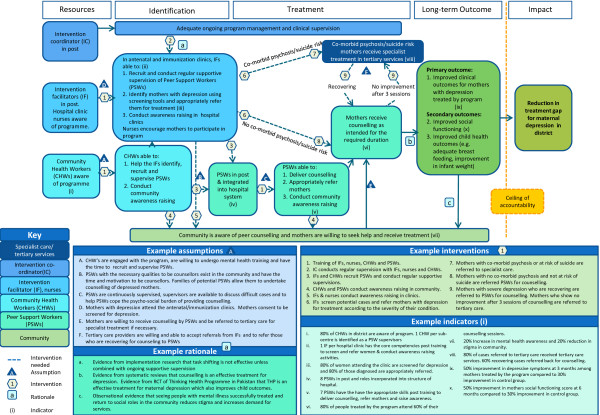
“These elements are integrated and displayed on a ToC map, which is a graphic depiction of the causal pathways through which an intervention is expected to achieve its impact [22].”
InfluentialArseneault, L., Bryan, B. T., Canning, T., Okundi, M., Stephens, A., Triantafillopoulou, E., Yu, D., Bolivar, M., Mansoori, P., Milligan, L., et al. (2025) · International Journal of Epidemiology · doi:10.1093/ije/dyaf128 · Cited by 8
Huang, X., Tan, H. Y., Er, P. L., Wong, A., Lim, S. Q., Tan, J. H., Yee, W. Q., Xin, X., & Low, L. L. (2025) · Frontiers in Public Health · doi:10.3389/fpubh.2025.1593490 · Cited by 6
Hertrampf, K., Schlattmann, P., Meyer, G., Gaßmann, G., Abraham, J., Hammen, V., & Schwendicke, F. (2020) · BMJ Open · doi:10.1136/bmjopen-2019-035999 · Cited by 7
Caperon, L., Ahern, S., Saville, F., & Better Start Bradford Community Reference Group (2023) · Gateways International Journal of Community Research and Engagement · doi:10.5130/ijcre.v16i1.8085 · Cited by 7
Using Theraplay® to support children and families: a scoping review
France, L.-A., McIntosh, S., & Woods, K. A. (2023) · Early Child Development and Care · doi:10.1080/03004430.2023.2227775 · Cited by 10
“ToC is described as a pragmatic framework which describes how the intervention e ff ects change by seeking to understand the theory which underpins it (De Silva et al., 2014).”
InfluentialTeoria da mudança para implementação de apoio matricial em saúde mental
Treichel, C. A. D. S., Silva, M. C., Presotto, R. F., Leme, K. E. F., dos Reis, M. F. L., Amorim, S. G. S., Lourencetti, A. L. S., Saidel, M. G. B., & Campos, R. T. O. (2023) · Acta Paulista de Enfermagem · doi:10.37689/acta-ape/2023aospe022473 · Cited by 9
Ojagbemi, A., Daley, S., Feeney, Y., Elugbadebo, O. O., Kola, L., & Gureje, O. (2023) · International Journal of Geriatric Psychiatry · doi:10.1002/gps.6019 · Cited by 6
“Theory of change is an exploration of the theory underlying an intervention to drive change(14).”
BackgroundMethodCleeve, A., Annerstedt, K. S., Betrán, A. P., Alvesson, H. M., Kaboré, C., Carroli, G., Lumbiganon, P., Hung, M. Q. N., Zamboni, K., Opiyo, N., et al. (2023) · Global Health Action · doi:10.1080/16549716.2023.2290636 · Cited by 8
Omar, F., McCluskey, K., Mashayo, E., Yong, A. C., Mulewa, D., Graham, C., Price-Sanchez, C., Othman, O. J., Graham, R., & Chan, V. F. (2024) · BMJ Open Ophthalmology · doi:10.1136/bmjophth-2023-001292 · Cited by 6
A theory of change driven approach to evaluating a multi-agency stalking intervention programme
Belur, J., Tompson, L., & Jerath, K. (2024) · Journal of Criminal Justice · doi:10.1016/j.jcrimjus.2024.102195 · Cited by 6
“A theory of change (ToC) is ‘a theory of how and why an initiative works ’ (Weiss, 1997) which ‘can be empirically tested by measuring indicators for every expected step on the hypothesized causal pathway to impact ’ (De Silva et al., 2014: 4).”
InfluentialHargreaves, J., Baptiste, S. L., Bhattacharjee, P., Cowan, F. M., Herce, M. E., Lauer, K., Sikazwe, I. T., & Geng, E. (2024) · Journal of the International AIDS Society · doi:10.1002/jia2.26283 · Cited by 6
Williams, K. N., Tenorio‐Mucha, J., Campos-Blanco, K., Underhill, L. J., Valdés‐Velásquez, A., Herbozo, A. F., Beres, L. K., Fuentes, L. D. L., Cordova-Ascona, L., Vela-Clavo, Z., et al. (2024) · PLOS Global Public Health · doi:10.1371/journal.pgph.0002404 · Cited by 12
McGovern, R., Balogun-Katung, A., Artis, B., Alderson, H., Brown, E. H., Diggle, T. T. J., Lingam, R., McArdle, P., Rankin, J. M., Thomason, P., et al. (2024) · BMC Public Health · doi:10.1186/s12889-024-19770-6 · Cited by 8
“Step 3: identify how to bring about change: the change mechanism Interventions are ‘theories incarnate’ [53] and may include implicit or explicit theory [33, 54].”
BackgroundManagement Accounting Professionals in the SMART Economy
Dobroszek, J., Paientko, T., & Walińska, E. (2024) · Central European Economic Journal · doi:10.2478/ceej-2024-0021 · Cited by 8
Naji, T. A., Abi, M., & Alemu, E. A. (2024) · GeoJournal · doi:10.1007/s10708-024-11223-2 · Cited by 6
“This perspective facilitates the design of monitoring and evaluation frameworks that track progress toward intended outcomes and allow for adaptive management based on empirical evidence (De Silva et al., 2014).”
Development of a psychological intervention for people with bipolar disorder in rural Ethiopia
Demissie, M., Hanlon, C., Ng, L. C., Mayston, R., Abayneh, S., & Fekadu, A. (2021) · BJPsych Open · doi:10.1192/bjo.2021.999 · Cited by 7
Livingston, B. A., Pichler, S. M., Kossek, E. E., Thompson, R. J., & Bodner, T. (2022) · Occupational Health Science · doi:10.1007/s41542-022-00122-y · Cited by 8
Blair, C., Slee, A., Davenport, A., Fouque, D. P., Johnston, W. C., Kalantar‐Zadeh, K., Maxwell, A. P., McKeaveney, C., Mullan, R. N., Noble, H. R., et al. (2022) · Healthcare · doi:10.3390/healthcare10122344 · Cited by 7
“Theories on change mechanisms acknowl‐ edge that underpinning and linking interventions to a relevant theory can help to identify how and why change can be influenced [33].”
BackgroundMethodInfluentialFaija, C., Connell, J., Gellatly, J. L., Rushton, K., Lovell, K., Brooks, H. L., Armitage, C. J., Bower, P., & Bee, P. (2023) · BMC Psychiatry · doi:10.1186/s12888-023-04829-2 · Cited by 9
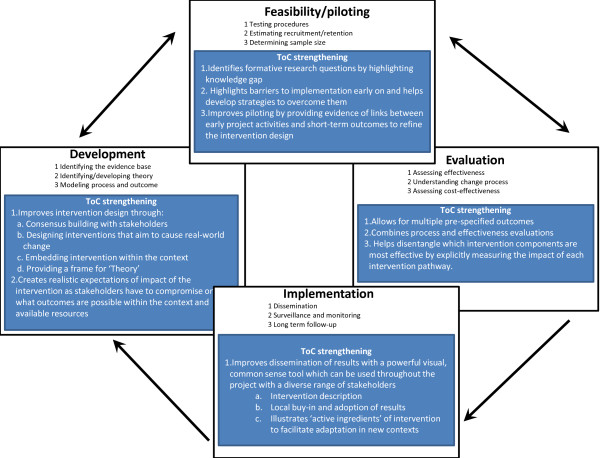
“According to the MRC framework, a ToC can be tested in the feasibility/piloting phase [20] and its use may help to increase implementation success [24].”
MethodEinem, C. K., Panter, J., Ogilvie, D., & Reid, A. (2024) · Health & Place · doi:10.1016/j.healthplace.2024.103254 · Cited by 7
“These considerations neatly align with the growing demand for robust theories of change, exploration of intervention mechanisms, and causal pathways (Cambon et al., 2019; Craig et al., 2008; De Silva et al., 2014; Moore et al., 2019; Panter et al., 2017).”
Yatirajula, S. K., Kallakuri, S., Paslawar, S., Mukherjee, A., Khan, N. A., Thornicroft, G., & Maulik, P. K. (2022) · SSM - Mental Health · doi:10.1016/j.ssmmh.2022.100149 · Cited by 6
Sandler, C. X., Spence, R. R., Obermair, A., Janda, M., Eakin, E., Beesley, V. L., Vegenas, D., Gordon, L. G., Webb, P. M., Williams, M., et al. (2022) · Asia-Pacific Journal of Clinical Oncology · doi:10.1111/ajco.13869 · Cited by 6
Shaw, A. (2018) · Social Marketing Quarterly · doi:10.1177/1524500418810713 · Cited by 7
“The theory of change (TOC) can be traced back to the 1930s (De Silva et al., 2014) but as with most academic terms, there is no agreed definition (Vogel, 2012).”
BackgroundWilliams, J., Sevdalis, N., & Gaughran, F. (2019) · Pilot and Feasibility Studies · doi:10.1186/s40814-019-0396-7 · Cited by 7
“Theory of Change A ToC is a way of representing visually both how an intervention is expected to have impact and the assumptions behind it, within a structured diagram [21].”
BackgroundBonney, T., Welter, C. R., Jarpe-Ratner, E. A., & Conroy, L. M. (2019) · International Journal of Environmental Research and Public Health · doi:10.3390/ijerph16203903 · Cited by 6
Balayah, Z., Khadjesari, Z., Keohane, A., To, W., Green, J. S. A., & Sevdalis, N. (2020) · The American Journal of Surgery · doi:10.1016/j.amjsurg.2020.12.007 · Cited by 6
Using technology to engage boys and men in the prevention of sexual assault
Oesterle, D. W., Schipani‐McLaughlin, A. M., Salazar, L. F., & Gilmore, A. K. (2022) · Elsevier eBooks · doi:10.1016/b978-0-12-819202-3.00006-7 · Cited by 7
Zapata, J. P., Rapoport, A., Wescott, A., Gandhi, S., Bergstrom, T., Avila, A. A., Kuhns, L. M., Garofalo, R., & Schleider, J. L. (2025) · AIDS and Behavior · doi:10.1007/s10461-025-04834-4 · Cited by 5
Chua, J. Y., Long, V. S., Yeo, P. M., Ding, J., Dua, J. P. L., Chandran, N. S., Lim, Q., Tow, H. X. S., Sim, W., Ing, C. W., et al. (2025) · JAAD International · doi:10.1016/j.jdin.2025.09.017 · Cited by 5
“Table I presents a Theory of Change Model 35 which details the inter-ventional content, showing how the proposed solutions attempt to solve the identified needs and the intended outcomes and measures for evaluation.”
Birken, M., Ikhtabi, S., Steare, T., Johnson, S., Benedetto, G., Lin, F., Scott, H. R., Harju‐Seppänen, J., McCloud, T. L., Shafran, R., et al. (2025) · BMC Psychology · doi:10.1186/s40359-025-03639-3 · Cited by 5
“Additionally, interventions that articulate the mechanisms involved in their ToC are more valuable in that this information can be used to underpin future intervention development [18].”
InfluentialDeveloping shared understanding of pre-eclampsia in Haiti and Zimbabwe using Theory of Change
Robbins, T., Musiyiwa, M., Gidiri, M. F., Mambo, V., Hill, C., Sandall, J., Hanlon, C., & Shennan, A. H. (2022) · PLOS Global Public Health · doi:10.1371/journal.pgph.0001352 · Cited by 6
Surendran, A., McSharry, J., Meredith, D., McNamara, J. G., Bligh, F., Meade, O., & O’Hora, D. P. (2023) · Pilot and Feasibility Studies · doi:10.1186/s40814-023-01319-w · Cited by 6
Armitt, H. A., Kingsley, E. N., Attwell, L., White, P. C. L., Woolley, K., Garside, M., Green, N., Lloyd, T., & Coventry, P. A. (2024) · Children and Youth Services Review · doi:10.1016/j.childyouth.2024.108042 · Cited by 6
Jones, B., Mitchell, A. G., Haynes, E., Howard, N. J., Wade, V., Pears, C., Rossingh, B., Gatti, J., Ramadani, S., Corpus, E., et al. (2025) · BMC Health Services Research · doi:10.1186/s12913-025-12255-1 · Cited by 8
Jiang, B., Li, B., He, S., Chen, L., Yang, S., Liu, J., Lou, W., Hu, Y., Jin, X., & Liu, C. (2025) · BMC Geriatrics · doi:10.1186/s12877-025-05956-z · Cited by 6
“Based on the results of qualitative interviews and the first workshop, a draft ToC was developed [20].”
Washington‐Nortey, M., Sullivan, T. N., Sutherland, K. S., Ahmed, R., Crosby, J., & Hitti, S. A. (2025) · School Mental Health · doi:10.1007/s12310-025-09765-y · Cited by 4
“Theory of change maps (De Silva et al., 2014) can also support such exercises by outlining the desired goals and important milestones that pre-empt their achievement.”
Clair, V., Atkinson, K., Musau, A., Mutiso, V., Bosire, E. N., Gitonga, I., Small, W., Ndetei, D. M., & Frank, E. (2022) · International Journal of Mental Health and Addiction · doi:10.1007/s11469-022-00781-6 · Cited by 5
“Consistent with evaluation methodologies, a theory of change (De Silva et al., 2014) was created through workshops in 2012–2013 in collaboration with Kenyan national, regional, and local decision-makers and researchers.”
MethodNjau, T., Ngakongwa, F., Sunguya, B. F., Kaaya, S., & Fekadu, A. (2022) · Healthcare · doi:10.3390/healthcare10122491 · Cited by 6
Improving child health service interventions through a Theory of Change: A scoping review
Jones, B., Paterson, A., English, M., & Nagraj, S. (2023) · Frontiers in Pediatrics · doi:10.3389/fped.2023.1037890 · Cited by 8
“Logic models, are, strictly speaking, more simple and linear than ToCs, that do not typically outline assumptions, measurement indicators or describe a consideration of the intervention’s causal relationships (9).”
BackgroundInfluentialCzerniewska, A., Mwambuli, K., Curtis, V., & Aunger, R. V. (2023) · Health Promotion International · doi:10.1093/heapro/daad064 · Cited by 8
Ashley, K., Tang, M. Y., Flynn, D., Cooper, M., Errington, L., & Avery, L. (2023) · Health Psychology Review · doi:10.1080/17437199.2023.2238811 · Cited by 6
“The use of appropriate frameworks for developing interventions emphasise the importance of using theory to inform and support decisions about design, however, some frameworks lack guidance on how to appropriately select and operationalise theory in practice (De Silva et al., 2014).”
BackgroundAmbong, R. M. A., & Gonzales, A. J. (2024) · Journal of Health Management · doi:10.1177/09720634231225014 · Cited by 5
“A theory of change is a method that explains how a given intervention, or set of interventions, is expected to lead to specific development change, drawing on a causal analysis based on available evidence (De Silva et al., 2014).”
MethodLangergaard, S., Evans, R., Andreasen, J., Petersen, K. S., & Overgaard, C. (2024) · Health Promotion International · doi:10.1093/heapro/daae032 · Cited by 6
Myers, A., Humphreys, L. J., Thelwell, M., Pickering, K., Frith, G., Phillips, G., Keen, C., Copeland, R. J., & _, _. (2024) · Journal of Physical Activity and Health · doi:10.1123/jpah.2023-0622 · Cited by 7
Massazza, A., Fuhr, D. C., Bogdanov, S., Tol, W. A., Roberts, B., Nadkarni, A., Akudrabo, G., Andersen, L. S., Dumchev, K. V., Karachevskyy, A., et al. (2021) · International Journal of Qualitative Methods · doi:10.1177/16094069211063031 · Cited by 5
“Understanding how PM+A should be implemented in the local contexts: Theory of Change (ToC) is a conceptual model that can aid in understanding “how and why an initiative works and how it should be implemented” (De Silva et al., 2014).”
BackgroundEliciting and reconstructing programme theory: An exercise in translating theory into practice
Siebert, P., & Myles, P. R. (2019) · Evaluation · doi:10.1177/1356389019870211 · Cited by 5
“In practice however, evaluation in the context of public health and healthcare is a complicated exercise, particularly when dealing with complex interventions involving multiple partners, multiple components and multiple outcomes (De Silva et al., 2014).”
BackgroundKirkwood, E. K., Dibley, M. J., Hoddinott, J. F., Huda, T. M., Laba, T., Tahsina, T., Hasan, M. M., Iqbal, A., Khan, J., Ali, N. B., et al. (2021) · BMJ Open · doi:10.1136/bmjopen-2020-044263 · Cited by 6
English, M. (2021) · Health Policy and Planning · doi:10.1093/heapol/czab128 · Cited by 5
“Logic models, theories of change and directed acyclic graphs may help and may be supported by other approaches for understanding implementation (Michie et al., 2011; Powell et al., 2015; De Silva et al., 2014).”
BackgroundDiscussion of “Evidence-based Health Informatics: How Do We Know What We Know?”
Al-Shorbaji, N., Hanmer, L. A., Hussein, R., Magrabi, F., Moen, A., Moura, L., Park, H., & Scott, P. (2015) · Methods of Information in Medicine · doi:10.3414/me14-02-0119 · Cited by 6
Briggs, A. H., & Nugent, R. A. (2016) · Health Economics · doi:10.1002/hec.3321 · Cited by 5
“For example, a team at LSHTM has already demonstrated how the UK Medical Research Council (MRC) complex interventions guidance (Craig et al ., 2008) could be adapted and given a theoretical basis within a theories of change framework (De Silva et al ., 2014).”
BackgroundGreenley, R., Tamambang, R. F., Koroma, A., Fasoranti, B., Munetsi, E., Chinoko, H., Stevens, N., Goba, N., Kinyabo, P. A., Bella-Awusah, T. T., et al. (2024) · Pilot and Feasibility Studies · doi:10.1186/s40814-024-01536-x · Cited by 4
“Used in concert with the MRC framework, ToC is an iterative process that emphasises the importance of stakeholder engagement and real-world experience in developing, testing and refining a complex intervention [27].”
MethodWu, L. T., Glass, G. F., Chew, E. Y. H., Ng, E. J. Y., & Chan, E. (2024) · BMC Health Services Research · doi:10.1186/s12913-024-11931-y · Cited by 5
Dymek, N. G., Jaschke, J., Stirner, A. K., Schwab, I., Ohnhäuser, T., Wiesen, D., Dresbach, T., Scholten, N., & Köberlein–Neu, J. (2025) · BMJ Open · doi:10.1136/bmjopen-2024-084746 · Cited by 4
Collin, C., Biran, A., Czerniewska, A., Legesse, D., Guye, M., Mume, A. A., Etu, E. S., Abashawl, A., Alemayehu, W., Dodson, S., et al. (2025) · Behavioral Sciences · doi:10.3390/bs15030355 · Cited by 4
Mapping multiple benefits in large-scale freshwater restoration: A theory of change approach
Pott, L., Hershkovitz, Y., & Birk, S. (2025) · Nature-Based Solutions · doi:10.1016/j.nbsj.2025.100240 · Cited by 4
Isaacs, D., Tirivanhu, P., Ramoroka, T. M., Makoae, M., & Maphosho, N. (2025) · African Journal of Disability · doi:10.4102/ajod.v14i0.1516 · Cited by 4
“According to De Silva et al. (2014) and Wu et al. (2024), a ToC-driven implementation process strengthens the development of interventions by providing a framework for enhanced stakeholder engagement and explicitly designing policies or programmes that are embedded in the local context.”
Almohammadi, A. A. (2025) · International Journal for Humanitarian Studies · doi:10.4103/jahs_20250604_25 · Cited by 6
Johnson, O., Bawoh, M., Begg, K., Bell, N. V. T., Jalloh, M., Gbao, D., N′jai, A. U., Sahr, F., Samai, M. H., Kelly, A. H., et al. (2023) · Global Public Health · doi:10.1080/17441692.2023.2222322 · Cited by 6
“This included the development of a theory of change, a visual diagram showing the LMP’s activities, outcomes and goal, while also identifying the risks and assumptions in this plan (Kahan et al., 2014; Maini et al., 2018).”
Method
Metadata
- Authors
- De Silva, M. J., Breuer, E., Lee, L., Asher, L., Chowdhary, N., Lund, C., & Patel, V.
- Affiliations
- University of Cape Town (ZA)
- London School of Hygiene & Tropical Medicine (GB)
- Sangath (IN)
- Venue
- Trials
- Published
- 2014-07-05
- Volume
- 15
- Issue
- 1
- Pages
- 267-267
- ISSN
- 1745-6215 (ISSN-L)
- PMC
- PMC4227087
- OpenAlex
- W2168592755
- Cited by
- 738
- References
- 43
- Citations by year
- 2026: 57 · 2025: 74 · 2024: 108 · 2023: 98 · 2022: 87 · 2021: 93 · 2020: 58 · 2019: 55 · 2018: 41 · 2017: 21 · 2016: 30 · 2015: 15 · 2014: 1
- FWCI
- 28.63
- Type
- journal article
- Language
- en
- Open access
- gold
- doi.org
- Licence
- Locations
- Trials (publishedVersion, cc-by)
- Europe PMC (PubMed Central) (publishedVersion, cc-by)
- PubMed Central (publishedVersion, cc-by)
- PubMed (publishedVersion)
- LSHTM Research Online (London School of Hygiene and Tropical Medicine) (acceptedVersion)
- Open University of Cape Town (University of Cape Town) (submittedVersion, cc-by)
- Funders
- London School of Hygiene and Tropical Medicine
- Wellcome Trust (084674, 100142/Z/12/Z, 100714)
- Department for International Development (HRPC10)
- Grand Challenges Canada
- National Institute of Mental Health (U19MH095687, U19MH095699)
- Topics
- Social Sciences › Public Administration › Evaluation and Performance Assessment
- Health Sciences › Health Professions › General Health Professions › Health Policy Implementation Science
- Physical Sciences › Mathematics › Statistics and Probability › Advanced Causal Inference Techniques
- Keywords
- theory of change, complex interventions, MRC framework for complex interventions, theory-based evaluation, intervention design, stakeholder engagement, causal pathways, process evaluation, intervention effectiveness, knowledge gaps, health interventions
- MeSH terms
- Humans, Mental Health, Guidelines as Topic, Biomedical Research
About these checks
Registry, retraction, Cites and statistics results are computed, not judged, with one exception: a printed reference that no index lists is read once by a model before it counts as a citation error. Claims are extracted by a model and kept only when their quote appears verbatim in the text; each cited source is then checked, with a model’s help, for whether it says what the claim relies on. Those verdicts can be wrong — read the claim’s quote and the cited source before relying on one.
Statistics and arithmetic are recomputed, not judged.
Confidence bands are shown only for fields calibrated on our annotated test set. None is calibrated yet, so no band is shown.
What counts as a claim ›How we measure confidence ›How we check this ›
Are you an author, or do you see a problem with this page? Request a review
Data sources
Bibliographic data: Semantic Scholar, OpenAlex, Crossref.
Contains information from the Semantic Scholar Academic Graph Datasets, made available under the ODC Attribution License (ODC-BY 1.0).
Semantic Scholar’s data is described in: Kinney, R., et al. (2023). The Semantic Scholar Open Data Platform. arXiv:2301.10140.
