

Theory of Change: a theory-driven approach to enhance the Medical Research Council's framework for complex interventions
Open accessThe DOI matches its Crossref record; 43 of the 43 references it cites were found in a registry or an index.
Abstract
BACKGROUND: The Medical Research Councils' framework for complex interventions has been criticized for not including theory-driven approaches to evaluation. Although the framework does include broad guidance on the use of theory, it contains little practical guidance for implementers and there have been calls to develop a more comprehensive approach. A prospective, theory-driven process of intervention design and evaluation is required to develop complex healthcare interventions which are more likely to be effective, sustainable and scalable. METHODS: We propose a theory-driven approach to the design and evaluation of complex interventions by adapting and integrating a programmatic design and evaluation tool, Theory of Change (ToC), into the MRC framework for complex interventions. We provide a guide to what ToC is, how to construct one, and how to integrate its use into research projects seeking to design, implement and evaluate complex interventions using the MRC framework. We test this approach by using ToC within two randomized controlled trials and one non-randomized evaluation of complex interventions. RESULTS: Our application of ToC in three research projects has shown that ToC can strengthen key stages of the MRC framework. It can aid the development of interventions by providing a framework for enhanced stakeholder engagement and by explicitly designing an intervention that is embedded in the local context. For the feasibility and piloting stage, ToC enables the systematic identification of knowledge gaps to generate research questions that strengthen intervention design. ToC may improve the evaluation of interventions by providing a comprehensive set of indicators to evaluate all stages of the causal pathway through which an intervention achieves impact, combining evaluations of intervention effectiveness with detailed process evaluations into one theoretical framework. CONCLUSIONS: Incorporating a ToC approach into the MRC framework holds promise for improving the design and evaluation of complex interventions, thereby increasing the likelihood that the intervention will be ultimately effective, sustainable and scalable. We urge researchers developing and evaluating complex interventions to consider using this approach, to evaluate its usefulness and to build an evidence base to further refine the methodology. TRIAL REGISTRATION: Clinical trials.gov: NCT02160249.
Overview
The claims and statistics of this paper haven’t been checked yet.
Free: it reads the open-access text and checks the first 5 claims that cite a source we can check. Create a free account to check every claim.
Integrity signals
Registry
Cites
Statistics
Figures
Verification
Claims the paper makes
The claims and statistics of this paper haven’t been checked yet.
Free: it reads the open-access text and checks the first 5 claims that cite a source we can check. Create a free account to check every claim.
Claims other papers make about this one
Each is checked against this paper’s own text: does it say what the citing paper says it does?
The source backs part of the claim, not all of it — or backs it for a different population, condition or comparison.
In the citing paper
“This participatory process appears to have been crucial for building the shared ownership and the political will necessary to overcome implementation barriers, a finding consistent with literature emphasizing the importance of co-creation in settings where top-down approaches often fail [17].”
From Co-creating systems change for mental health: a theory of change approach from the MeHPriC initiative in Lagos, Nigeria (2025) · cites this paper as [17]
Experimental — accuracy not yet measuredThe source backs part of the claim, not all of it — or backs it for a different population, condition or comparison.
In the citing paper
“Existing guidance for developing public health interventions does not provide information for researchers about how to work with intervention providers to co-produce and prototype the content and delivery of new interventions prior to evaluation.”
From Development of a framework for the co-production and prototyping of public health interventions (2017) · cites this paper as [7]
Experimental — accuracy not yet measuredThe source backs part of the claim, not all of it — or backs it for a different population, condition or comparison.
In the citing paper
“These guidelines support development of a theoretical rationale for an intervention, but provide scant pragmatic instruction on how to develop intervention materials and delivery methods.”
From Development of a framework for the co-production and prototyping of public health interventions (2017) · cites this paper as [7]
Experimental — accuracy not yet measuredThe source backs part of the claim, not all of it — or backs it for a different population, condition or comparison.
In the citing paper
“It complements other intervention development guidance by providing more detail on the process of the early stages of intervention development and co-production that receives limited attention in existing guidance on intervention development [1–12].”
From Development of a framework for the co-production and prototyping of public health interventions (2017) · cites this paper as [7]
Experimental — accuracy not yet measuredThe cited source says what the claim attributes to it.
In the citing paper
“Theory of Change (ToC) has emerged as a key planning and evaluation tool suited to these demands.”
From Co-creating systems change for mental health: a theory of change approach from the MeHPriC initiative in Lagos, Nigeria (2025) · cites this paper as [17]
5 more claims about this paper
Create a free account to see every claim other papers make about this one.
Self-check
Percentages, sums and reported differences re-computed from the paper’s own numbers.
The self-check needs the paper’s full text.
Citations
Cites
The theory of planned behavior
Ajzen, I. (1991) · Organizational Behavior and Human Decision Processes · doi:10.1016/0749-5978(91)90020-t · Cited by 90,587
Developing and evaluating complex interventions: the new Medical Research Council guidance
Craig, P., Dieppe, P., Macintyre, S., Michie, S., Nazareth, I., & Petticrew, M. (2008) · BMJ · doi:10.1136/bmj.a1655 · Cited by 10,995 · cited 3×
“Background The updated Medical Research Council (MRC) framework for complex interventions [1] is a set of guidelines for designing and evaluating complex interventions which has been widely influential in the field [2].”
BackgroundAgent-based modeling: Methods and techniques for simulating human systems
Bonabeau, E. (2002) · Proceedings of the National Academy of Sciences · doi:10.1073/pnas.082080899 · Cited by 4,500
Specification, evaluation, and interpretation of structural equation models
Bagozzi, R. P., & Yi, Y. (2012) · Journal of the Academy of Marketing Science · doi:10.1007/s11747-011-0278-x · Cited by 3,735 · cited 1×
“In order for this to be achi eved, appropriate modelling techniques need to be applied, drawing on methods from other fields such as structural equation modelling [28], discrete-event simulation models [29], agent-base d modelling [30], and system dynamics modelling [31].”
MethodMurray, E., Treweek, S., Pope, C., MacFarlane, A., Ballini, L., Dowrick, C., Finch, T., Kennedy, A., Mair, F., O'Donnell, C., et al. (2010) · BMC Medicine · doi:10.1186/1741-7015-8-63 · Cited by 1,478
Designing and evaluating complex interventions to improve health care
Campbell, N. C., Murray, E., Darbyshire, J., Emery, J., Farmer, A., Griffiths, F., Guthrie, B., Lester, H., Wilson, P., & Kinmonth, A. L. (2007) · BMJ · doi:10.1136/bmj.39108.379965.be · Cited by 1,331 · cited 1×
“The MRC guidance calls for more detailed and standardized descriptions of complex interventions in published reports to facilitate exchange of knowledge and to encourage synthesis of results from similar studies [1,32].”
BackgroundTechniques for Evaluating Training Programs
Kirkpatrick, D. L. (1975) · Training and development journal · Cited by 1,234
Chen, H.-T. (1990) · Medical Entomology and Zoology · Cited by 1,227
System Dynamics Modeling: Tools for Learning in a Complex World
Sterman, J. D. (2001) · California Management Review · doi:10.2307/41166098 · Cited by 1,216
Rahman, A., Malik, A., Sikander, S., Roberts, C., & Creed, F. (2008) · The Lancet · doi:10.1016/s0140-6736(08)61400-2 · Cited by 993
Research works printed but not linked: 7
- James C Theory of Change Review: A report comissioned by Comic Relief 2011
- Weiss CH Connell JP, Kubisch AC, Schorr LB, Weiss CH Nothing As Practical As Good Theory: Exploring Theory-Based Evaluation For Comprehensive Community Initiatives For Children And Families New Approaches to Evaluating Community Initiatives Volume 1 Concepts, Methods and Contexts 1995 Washington DC: The Aspen Institute 65 92
- Anderson A The Community Builder’s Approach to Theory of Change. A Practical Guide to Theory Development 2005 New York: The Aspen Institute
- Department for International Development How to Note: Guidance on using revised Logical Framework 2011 London
- Clark H Andersen A Theories of Change and Logic Models: Telling Them Apart. 2004 Presented at the American Evaluation Association Conference 2004 Atlanta, Georgia
- Taplin D Rasic M Theory of Change Technical Papers: A series of papers to support development of theories of change based on practice in the field 2013 New York: ActKnowledge
- Taplin DH Rasic M Facilitator's Source Book: Source Book for facilitators leading Theory of Change development sessions 2012 New York: ActKnowledge
Cited by
Items 501–600 of 736
Rohit, A., Yappo, L., Lalović, A., Dowden, G., Markey, L., Little, N., Basile, A., Mateo‐Arriero, I., Cox, K. L., Pestell, C., et al. (2025) · Qualitative Health Research · doi:10.1177/10497323251367657 · Cited by 1
Khan, N., Seferidi, P., Belesova, K., Chakma, N., Downey, L. E., Farzana, N., Garg, S. S., Ghosh‐Jerath, S., John, R., Khan, M., et al. (2025) · JMIR Research Protocols · doi:10.2196/80368 · Cited by 1
“Depicted as a causal diagram, the theory of change can be an effective tool to design and evaluate interventions by outlining pathways to achieve intended outcomes, underlying assumptions, and indicators to measure change [34].”
Rowe, H. J., Fisher, J., Meggetto, E., Lees, H., & Makleff, S. (2025) · BMC Health Services Research · doi:10.1186/s12913-025-13629-1 · Cited by 1
Raimi, L., & Khudoykulov, K. (2025) · Social enterprise journal · doi:10.1108/sej-09-2024-0146 · Cited by 1
Sturesson, S. J., Bejerholm, U., Knutagård, M., Denvall, V., & Stylianides, K. C. (2026) · Implementation Science Communications · doi:10.1186/s43058-026-00875-5 · Cited by 2
“Each organisation must identify the specific change outcomes required to deliver work support according to IPS [39].”
Depauw, J., Raeymaeckers, P., Hermans, K., Driessens, K., & Waele, E. D. (2026) · Human Services Organizations Management Leadership & Governance · doi:10.1080/23303131.2026.2629263 · Cited by 1
Training Charge Nurse to Lead Second Victim Support: Fostering a Culture of Safety Through Education
Fisher, S., Blau, A., & Gendler, Y. (2026) · SAGE Open Nursing · doi:10.1177/23779608261417012 · Cited by 1
“The program was developed using the Theory of Change (ToC) framework, mapping causal pathways from activities to outcomes while identifying key assumptions and contextual factors (Breuer et al., 2016; De Silva et al., 2014; Vogel, 2012).”
Kinfe, M., Semrau, M., Mengiste, A., Ali, O., Ajeme, T., Bremner, S. A., Hounsome, N., Anagnostopoulou, V., Brewster, M., Rugema, L., et al. (2026) · BMC Family Practice · doi:10.1186/s12875-026-03259-9 · Cited by 2
Noyek, S. E., Tomas, V., Hanson, J., Demers, C., Pace, N. L., Young, M. C., Bussières, A., Costello, C., Majnemer, A., Askin, N., et al. (2026) · BMJ Paediatrics Open · doi:10.1136/bmjpo-2025-003598 · Cited by 2
Aellah, G., Roemer-Mahler, A., & Zaman, S. (2026) · International Journal for Equity in Health · doi:10.1186/s12939-026-02823-0 · Cited by 1
Tay, L., Sum, G., Wang, S. Z., Ginting, M. L., Ng, Y. S., Ka, C. M. H., Chua, D. Q. L., Subramaniam, A., Chan, C., Seow, D. C. C., et al. (2026) · BMC Health Services Research · doi:10.1186/s12913-026-14510-5 · Cited by 1
RIASEC self-assessment tools as career interventions: theory and effectiveness
Wong, Z. Y., Quek, F. Y. X., & Yang, H. (2026) · Frontiers in Organizational Psychology · doi:10.3389/forgp.2026.1792707 · Cited by 1
Muir, D., McLarty, L., Drinkwater, J., Bennett, C., Birks, Y. F., Broadway‐Parkinson, A., Cooksey, V., Gleeson, P., Holland, C. R., Ledger, L., et al. (2026) · Health and Social Care Delivery Research · doi:10.3310/gjsc0721 · Cited by 1
Scott, P., de Keizer, N. F., Georgiou, A., Hyppönen, H., Craven, C. K., & Rigby, M. (2015) · Cited by 2
Drici, A., Eremugo, I., Akello, S., & Andinda, M. (2021) · International Journal of Health Medicine and Nursing Practice · doi:10.47941/ijhmnp.728 · Cited by 1
“This Theory has become one of the most widely used theories in project interventions although it has been criticized because it simplifies change by representing it as a linear pathway which is not always the case in real life (Armitage et al., 2019; de Silva et al., 2014; Reinholz & Andrews, 2020).”
MethodCambon, L., & Alla, F. (2023) · Springer eBooks · doi:10.1007/978-3-031-20401-2_15 · Cited by 1
Huy, S., Pheng, B., Borin, K., Chhay, T., Philp, J. N. M., & Hidano, A. (2023) · Veterinary Medicine and Science · doi:10.1002/vms3.1191 · Cited by 3
“The theory of change describes hypothesized causal pathways to impacts, F IGURE 1 Map of Cambodia and three intervention zones: EMR, EasternMekong River; NTSL, Northern Tonle Sap Lake; STSL, Southern Tonle Sap Lake. providing an account of ‘how and why’ an intervention works (De Silva et al., 2014).”
Regionalbudget oder Selektivvertrag?
Schwarz, J., Berghöfer, A., & von Peter, S. (2023) · Nervenheilkunde · doi:10.1055/a-2145-9136 · Cited by 1
Proceedings of the 6th UK and Ireland implementation science research conference
Brooks, C., Bridges, J., Frankland, J., & Myall, M. (2024) · Implementation Science · doi:10.1186/s13012-024-01341-3 · Cited by 4
Vadrevu, L., Jain, M., & Parsekar, S. S. (2024) · Journal of Health Population and Nutrition · doi:10.1186/s41043-024-00615-2 · Cited by 3
Patel, Y. N., Patel, R. J., Bates, L., Gertz, S., Hershberger, S. A. S., & Kovacic, M. B. (2024) · International Journal of Environmental Research and Public Health · doi:10.3390/ijerph21101387 · Cited by 1
Diez, S., Manzano, S. O., Comas‐Herrera, A., Breuer, E., Soler, A., & Jiménez, M. R. (2025) · Journal of Applied Gerontology · doi:10.1177/07334648251328113 · Cited by 1
“A Theory of Change approach can support long-term care policy and system change by offering a framework that promotes the engagement of stakeholders and interventions alignment to the local context (Breuer et al., 2016; De Silva et al., 2014).”
Self-citationMulti-Scale Theory of Change in Transition Design: A Case Study in Regenerative Agriculture
Miller, M., & Baumber, A. (2025) · World Futures Review · doi:10.1177/19467567251330208 · Cited by 3
“ToC can offer advantages over a “ log frame ” (logical framework) approach by more explicitly linking activities to outcomes and showing how various components work together in a causal pathway (De Silva et al. 2014).”
Kinfe, M., Semrau, M., Mengiste, A., Ali, O., Ajeme, T., Bremner, S., Hounsome, N., Anagnostopoulou, V., Brewster, M., Rugema, L., et al. (2024) · ASEAN Journal of Psychiatry · doi:10.54615/2231-7805.18.s11.001 · Cited by 2
Kasvun tuessa arvioitujen menetelmien teoriaperustaisuus
Backman, H., Seppälä, V., & Lampela, S. (2025) · Kasvun tuki -aikakauslehti · doi:10.61259/kt.162582 · Cited by 2
Demissie, M., Hanlon, C., Ng, L. C., Mayston, R., & Fekadu, A. (2025) · Pilot and Feasibility Studies · doi:10.1186/s40814-025-01683-9 · Cited by 1
“We used the Medical Research Council’s (MRC) framework for the Development and Evaluation of Complex Interventions integrated with a Theory of Change (ToC) approach to develop a manualized psychological intervention for people with bipolar disorder in rural Ethiopia [15, 20].”
A proposed program theory for a smoke-free hospital property
Luck, K. E. (2017) · Social Theory & Health · doi:10.1057/s41285-017-0031-8 · Cited by 1
“Developing a strong theory of change is a continual process where reflections and adaptations are made when new evidence is acquired or the realization of barriers to implementation is noted (De Silva et al, 2014).”
BackgroundThe contribution of a ‘synergic theory of change’ approach to democratising evaluation
Laing, K. (2022) · Research for All · doi:10.14324/rfa.06.1.08 · Cited by 3
Frederic, H., & Irechukwu, E. N. (2023) · Journal of Entrepreneurship & Project Management · doi:10.53819/81018102t5192 · Cited by 1
Enhancing mental health practice in Sierra Leone : a social intervention development study
Fendt-Newlin, M. (2018) · White Rose eTheses Online (University of Leeds, The University of Sheffield, University of York) · Cited by 2
Lennings, H. I. B., & Franks, R. P. (2017) · Wiley eBooks · doi:10.1002/9781119057574.whbva121 · Cited by 1
Johnston, A. (2018) · Ulster University Research Portal (Ulster University) · Cited by 2
OCCUPATIONAL THERAPY’S ROLE IN SPIRITUALITY: PARTNERING WITH A SPECIAL NEEDS MINISTRY
Weiss, M. C. (2020) · doi:10.46409/sr.vbdt6980 · Cited by 1
“Conceptual Framework The Theory of Change (ToC) is an approach to program development that examines the interconnected relationships between the desired change, domains of change, interventions, and the outcome (De Silva et al., 2014).”
BackgroundA model to facilitate research uptake in health care practice and policy development
Sigudla, J. (2020) · Unisa Institutional Repository (University of South Africa) · Cited by 1
Kinyanda, E., Kyohangirwe, L., Mpango, R. S., Tusiime, C., Ssebunnya, J., Katumba, K. R., Tenywa, P., Mugisha, J., Taasi, G., Sentongo, H., et al. (2021) · Research Square · doi:10.21203/rs.3.rs-144118/v1 · Cited by 1
“To adapt MANAS, we employed the Theory of Change (ToC) based approach (39), involving consultation with key stakeholders (district health managers and planners, health workers involved in HIV care,”
MethodSelf-citationCambon, L., & Alla, F. (2020) · Research Square · doi:10.21203/rs.3.rs-93699/v1 · Cited by 1
Process Outcome Integration with Theory (POInT): academic report
Juden, M., Mapuwei, T. W., Tietz, T., Sarguta, R. J., Medina, L., Prost, A., Humphreys, M., Jacobs, A., Allen, E., Mwambi, H. G., et al. (2023) · doi:10.51744/crpp5 · Cited by 1
Apers, H., Praag, L. V., Nöstlinger, C., et al. (2022) · Cambridge Prisms Global Mental Health · doi:10.1017/gmh.2023.15.pr3 · Cited by 1
Monbaliu, E. (2024) · Developmental Medicine & Child Neurology · doi:10.1111/dmcn.15894 · Cited by 1
Mee, P., Otambo, W. O., Skovdal, M., Harling, G., Pickles, M., Dobra, A., Hallett, T. B., Bärnighausen, T., McGowan, M., Inghels, M., et al. (2026) · Research Square · doi:10.21203/rs.3.rs-9814858/v1 · Cited by 1
“The intervention implementation considers feedback from participatory ‘theory-of-change’ workshops with key community stakeholders [24].”
Harnessing the power of emotional drivers to promote behaviour change – Authors' Reply
Greenland, K. (2017) · The Lancet Global Health · doi:10.1016/s2214-109x(17)30059-1
“7 Due to the convention of separating reports of process and outcome evaluations, the results are the subject of a second manuscript that will be published in due course.”
ResultPojam i ključna obilježja kompleksnih intervencija za populacije u riziku
Žižak, A., Vukadin, I. K., Nišević, A. J., Kranželić, V., & Novak, M. (2016) · Kriminologija & socijalna integracija : časopis za kriminologiju, penologiju i poremećaje u ponašanju · doi:10.31299/ksi.24.1.5
The multidimensional kidney transplant self-management scale : development and psychometric testing
Chung, S.-Y. (2018) · IUScholarWorks (Indiana University) · doi:10.7912/c24m2n
Chibanda, D. (2016) · Open University of Cape Town (University of Cape Town) · Cited by 1
Theory of Change: An Approach to Improve Access to Medicines in Low and Middle-Income Economies
Bashaar, M., & Hashemi, T. (2019) · Acta Scientific Medical Sciences · doi:10.31080/asms.2019.03.0420
A Generic Template for Implementing Mental Health Promotion
Barry, M. M. (2019) · Springer eBooks · doi:10.1007/978-3-030-23455-3_5 · Cited by 2
Commentary on Wicki et al. (2020): Strong effectiveness evidence—but what else do policymakers need?
Fitzgerald, N., & Lewsey, J. (2020) · Addiction · doi:10.1111/add.15074
Occupational Therapy’s Role in Spirituality: Partnering with a Special Needs Ministry
Stockton, K., Collins, K., & Shotwell, M. (2020)
Curran, R., Murdoch, J., Cornick, R. V., Picken, S., Bachmann, M. O., Bateman, E., Simelane, M. L., & Fairall, L. R. (2019) · doi:10.21203/rs.2.18890/v2
Hansen, S. (2020) · OPUS Publication Server of the University of Stuttgart (University of Stuttgart) · doi:10.18419/opus-11114
Developing healthcare professional training to promote exercise in prostate cancer patients
Turner, R. R. (2020) · Sheffield Hallam University · doi:10.7190/shu-thesis-00335 · Cited by 1
Yehualashet, Y. G. (2021) · Unisa Institutional Repository (University of South Africa) · Cited by 2
Guillaume, E. (2021) · Springer eBooks · doi:10.1007/978-3-030-69329-9_20
Liu, V. L.-X., Lin, S., & Harding, R. (2021) · Journal of Palliative Medicine · doi:10.1089/jpm.2021.0223
“25,26 A conceptual model identifies the interactions of key components.”
Patil, M., Qureshi, A., Naydenova, E., Medvedev, M. M., Halbert, J., Vos, M. D., Nair, P., Patil, M., & Bang, A. (2022) · SSRN Electronic Journal · doi:10.2139/ssrn.4016476
Primary care for chronic conditions in rural India: towards a person-centred model
Lall, D. (2022) · Research Publications (Maastricht University) · doi:10.26481/dis.20220309dl
(2022) · nternational Journal of Public Health Pharmacy and Pharmacology · doi:10.37745/ijphpp.15/vol7no1pp.41-57
Ponsford, R., Meiksin, R., Crichton, J., Bragg, S., Emmerson, L., Tancred, T., Tilouche, N., Morgan, G. S., Gee, P., Young, H., et al. (2019) · Research Square · doi:10.21203/rs.2.18606/v1 · Cited by 1
Caring for people with advanced dementia living in nursing homes
Froggatt, K. A. (2017) · http://isrctn.com/ · doi:10.1186/isrctn14948133
Curran, R., Murdoch, J., Cornick, R. V., Picken, S., Bachmann, M. O., Bateman, E. D., Simelane, M. L., & Fairall, L. R. (2019) · doi:10.21203/rs.2.18890/v1
“We used a linguistic ethnographic methodology,(13, 14) which provides theoretical and methodological tools for analysing social action within context.”
MethodTsemach, R., Enden‐Izhaki, A., & Aharon, A. A. (2022) · Nursing Open · doi:10.1002/nop2.1351
“The theoretical foundation of the guidance is the Theory of Change approach to designing, implementing and evaluating complex interventions (De Silva et al., 2014).”
BackgroundSinclair, D. L., Nkadimeng, S., Mochudi, M., Milovanovic, M., Seedat, M., & Eksteen, R. (2022) · Social and Health Sciences · doi:10.25159/2957-3645/10470
Protecting and Promoting the Wellbeing of High-Performance Swimmers
Uzzell, K. S. (2023) · Cronfa (Swansea University) · doi:10.23889/suthesis.62923
Apers, H., Praag, L. V., Nöstlinger, C., et al. (2023) · Cambridge Prisms Global Mental Health · doi:10.1017/gmh.2023.15.pr17
Apers, H., Praag, L. V., Nöstlinger, C., et al. (2023) · Cambridge Prisms Global Mental Health · doi:10.1017/gmh.2023.15.pr15
Apers, H., Praag, L. V., Nöstlinger, C., et al. (2023) · Cambridge Prisms Global Mental Health · doi:10.1017/gmh.2023.15.pr14
Apers, H., Praag, L. V., Nöstlinger, C., et al. (2023) · Cambridge Prisms Global Mental Health · doi:10.1017/gmh.2023.15.pr16
Apers, H. (2023) · Cambridge Prisms Global Mental Health · doi:10.1017/gmh.2023.15.pr13
Apers, H., Praag, L. V., Nöstlinger, C., et al. (2023) · Cambridge Prisms Global Mental Health · doi:10.1017/gmh.2023.15.pr12
Apers, H., Praag, L. V., Nöstlinger, C., et al. (2023) · Cambridge Prisms Global Mental Health · doi:10.1017/gmh.2023.15.pr9
Apers, H., Praag, L. V., Nöstlinger, C., et al. (2023) · Cambridge Prisms Global Mental Health · doi:10.1017/gmh.2023.15.pr10
Apers, H., Praag, L. V., Nöstlinger, C., et al. (2023) · Cambridge Prisms Global Mental Health · doi:10.1017/gmh.2023.15.pr8 · Cited by 1
Apers, H., Praag, L. V., Nöstlinger, C., et al. (2022) · Cambridge Prisms Global Mental Health · doi:10.1017/gmh.2023.15.pr11
Apers, H. (2022) · Cambridge Prisms Global Mental Health · doi:10.1017/gmh.2023.15.pr7
Apers, H., Praag, L. V., Nöstlinger, C., et al. (2022) · Cambridge Prisms Global Mental Health · doi:10.1017/gmh.2023.15.pr6
Apers, H., Praag, L. V., Nöstlinger, C., et al. (2022) · Cambridge Prisms Global Mental Health · doi:10.1017/gmh.2023.15.pr4
Apers, H., Praag, L. V., Nöstlinger, C., et al. (2022) · Cambridge Prisms Global Mental Health · doi:10.1017/gmh.2023.15.pr2
Apers, H. (2022) · Cambridge Prisms Global Mental Health · doi:10.1017/gmh.2023.15.pr1
Apers, H., Praag, L. V., Nöstlinger, C., et al. (2022) · Cambridge Prisms Global Mental Health · doi:10.1017/gmh.2023.15.pr5
Review: A theory of change for community-initiated mental health care in the United States — R0/PR3
(2023) · Cambridge Prisms Global Mental Health · doi:10.1017/gmh.2023.49.pr3
Patel, V. (2023) · Cambridge Prisms Global Mental Health · doi:10.1017/gmh.2023.49.pr12
Self-citationBreuer, E., Morris, A., Blanke, L., et al. (2023) · Cambridge Prisms Global Mental Health · doi:10.1017/gmh.2023.49.pr13
Breuer, E., Morris, A., Blanke, L., et al. (2023) · Cambridge Prisms Global Mental Health · doi:10.1017/gmh.2023.49.pr14
Innovations in measurement and evidence for healthy aging
Agudelo-Botero, M., Davila-Cervantes, C. A., & Giraldo-Rodríguez, L. (2024) · Frontiers research topics · doi:10.3389/978-2-8325-4210-1
Alla, F., Cambon, L., & Ridde, V. (2024) · IRD Éditions eBooks · doi:10.4000/books.irdeditions.48333
Alla, F., Cambon, L., & Ridde, V. (2023) · IRD Éditions eBooks · doi:10.4000/books.irdeditions.48412
GENDER DISCRIMINATION AMONG PHYSICIANS
BADRY, A. E., Allam, H., & Soliman, S. (2024) · Egyptian Journal of Occupational Medicine · doi:10.21608/ejom.2023.231755.1314 · Cited by 1
Planting Imagination: Community Co-Design for Toronto’s Chinatown West
Li, A., Wong, J. P.-H., Fung, K., Zhang, L., Vahabi, M., & Fox, T. (2024) · ACSA Annual Meeting · doi:10.35483/acsa.am.112.98
Ramadhenisa, S., & Famiola, M. (2024) · Journal of Business Management Review · doi:10.47153/jbmr.v5i7.1004
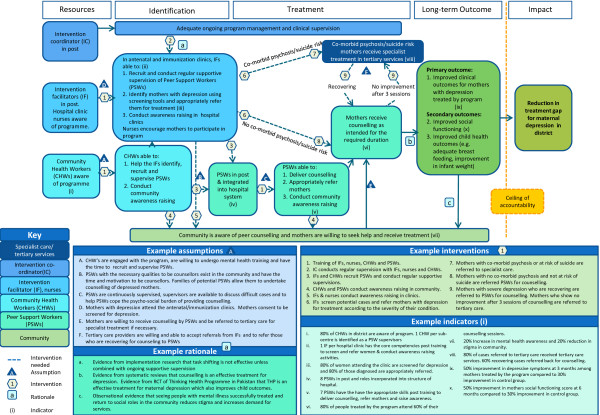
“Elements of ToC include impact, long-term outcome, precondition, interventions, indicators, ceiling of accountability, rationale, and assumptions (De Silva et al, 2014).”
BackgroundParsons, S. N., Kosnes, L., Anderson, P., Harris, S. R. S., Thatcher, R., Harrington, B., Davies, J., Fitzsimmons, D. F., & Luzio, S. D. (2024) · BMC Public Health · doi:10.1186/s12889-024-19946-0
Advancements and Challenges in Implementation Science: 2023
(2024) · Frontiers research topics · doi:10.3389/978-2-8325-5674-0
Sjöberg, V., Monnier, A., Tseli, E., LoMartire, R., Hagströmer, M., Björk, M., Äng, B. O., & Vixner, L. (2024) · Digital Health · doi:10.1177/20552076241299648
Walklett, J., Christensen, A., Grey, C. N. B., Barlow, R., McDonald, R., Davies, A. R., & Mugweni, E. (2024) · BMC Health Services Research · doi:10.1186/s12913-024-11964-3
Dawson, A. P., Warrior, E., Pearson, O. R., Boyd, M. A., Dwyer, J., Morey, K., Brodie, T., Towers, K., Waters, S., Avila, C., et al. (2025) · First Nations Health and Wellbeing - The Lowitja Journal · doi:10.1016/j.fnhli.2025.100043
Development and evaluation of complex interventions
Cardoso, C. S., & Gomes, B. (2025) · Oxford University Press eBooks · doi:10.1093/9780191924644.003.0010
Kusi-Mensah, I., Taksal, A., Akinyemi, J. O., Owoade, O., OlaOlorun, F. M., Adeniyi, A. F., Egbokhare, O. A., Taiwo, O., Adeoye, O., Tamambang, R. F., et al. (2025) · JMIR Research Protocols · doi:10.2196/69577
“This will facilitate the theory-driven design and evaluation of our proposed interventions and ensure their effectiveness and scalability [37].”
Metadata
- Authors
- De Silva, M. J., Breuer, E., Lee, L., Asher, L., Chowdhary, N., Lund, C., & Patel, V.
- Affiliations
- University of Cape Town (ZA)
- London School of Hygiene & Tropical Medicine (GB)
- Sangath (IN)
- Venue
- Trials
- Published
- 2014-07-05
- Volume
- 15
- Issue
- 1
- Pages
- 267-267
- ISSN
- 1745-6215 (ISSN-L)
- PMC
- PMC4227087
- OpenAlex
- W2168592755
- Cited by
- 738
- References
- 43
- Citations by year
- 2026: 57 · 2025: 74 · 2024: 108 · 2023: 98 · 2022: 87 · 2021: 93 · 2020: 58 · 2019: 55 · 2018: 41 · 2017: 21 · 2016: 30 · 2015: 15 · 2014: 1
- FWCI
- 28.63
- Type
- journal article
- Language
- en
- Open access
- gold
- doi.org
- Licence
- Locations
- Trials (publishedVersion, cc-by)
- Europe PMC (PubMed Central) (publishedVersion, cc-by)
- PubMed Central (publishedVersion, cc-by)
- PubMed (publishedVersion)
- LSHTM Research Online (London School of Hygiene and Tropical Medicine) (acceptedVersion)
- Open University of Cape Town (University of Cape Town) (submittedVersion, cc-by)
- Funders
- London School of Hygiene and Tropical Medicine
- Wellcome Trust (084674, 100142/Z/12/Z, 100714)
- Department for International Development (HRPC10)
- Grand Challenges Canada
- National Institute of Mental Health (U19MH095687, U19MH095699)
- Topics
- Social Sciences › Public Administration › Evaluation and Performance Assessment
- Health Sciences › Health Professions › General Health Professions › Health Policy Implementation Science
- Physical Sciences › Mathematics › Statistics and Probability › Advanced Causal Inference Techniques
- Keywords
- theory of change, complex interventions, MRC framework for complex interventions, theory-based evaluation, intervention design, stakeholder engagement, causal pathways, process evaluation, intervention effectiveness, knowledge gaps, health interventions
- MeSH terms
- Humans, Mental Health, Guidelines as Topic, Biomedical Research
About these checks
Registry, retraction, Cites and statistics results are computed, not judged, with one exception: a printed reference that no index lists is read once by a model before it counts as a citation error. Claims are extracted by a model and kept only when their quote appears verbatim in the text; each cited source is then checked, with a model’s help, for whether it says what the claim relies on. Those verdicts can be wrong — read the claim’s quote and the cited source before relying on one.
Statistics and arithmetic are recomputed, not judged.
Confidence bands are shown only for fields calibrated on our annotated test set. None is calibrated yet, so no band is shown.
What counts as a claim ›How we measure confidence ›How we check this ›
Are you an author, or do you see a problem with this page? Request a review
Data sources
Bibliographic data: Semantic Scholar, OpenAlex, Crossref.
Contains information from the Semantic Scholar Academic Graph Datasets, made available under the ODC Attribution License (ODC-BY 1.0).
Semantic Scholar’s data is described in: Kinney, R., et al. (2023). The Semantic Scholar Open Data Platform. arXiv:2301.10140.
