

Theory of Change: a theory-driven approach to enhance the Medical Research Council's framework for complex interventions
Open accessThe DOI matches its Crossref record; 43 of the 43 references it cites were found in a registry or an index.
Abstract
BACKGROUND: The Medical Research Councils' framework for complex interventions has been criticized for not including theory-driven approaches to evaluation. Although the framework does include broad guidance on the use of theory, it contains little practical guidance for implementers and there have been calls to develop a more comprehensive approach. A prospective, theory-driven process of intervention design and evaluation is required to develop complex healthcare interventions which are more likely to be effective, sustainable and scalable. METHODS: We propose a theory-driven approach to the design and evaluation of complex interventions by adapting and integrating a programmatic design and evaluation tool, Theory of Change (ToC), into the MRC framework for complex interventions. We provide a guide to what ToC is, how to construct one, and how to integrate its use into research projects seeking to design, implement and evaluate complex interventions using the MRC framework. We test this approach by using ToC within two randomized controlled trials and one non-randomized evaluation of complex interventions. RESULTS: Our application of ToC in three research projects has shown that ToC can strengthen key stages of the MRC framework. It can aid the development of interventions by providing a framework for enhanced stakeholder engagement and by explicitly designing an intervention that is embedded in the local context. For the feasibility and piloting stage, ToC enables the systematic identification of knowledge gaps to generate research questions that strengthen intervention design. ToC may improve the evaluation of interventions by providing a comprehensive set of indicators to evaluate all stages of the causal pathway through which an intervention achieves impact, combining evaluations of intervention effectiveness with detailed process evaluations into one theoretical framework. CONCLUSIONS: Incorporating a ToC approach into the MRC framework holds promise for improving the design and evaluation of complex interventions, thereby increasing the likelihood that the intervention will be ultimately effective, sustainable and scalable. We urge researchers developing and evaluating complex interventions to consider using this approach, to evaluate its usefulness and to build an evidence base to further refine the methodology. TRIAL REGISTRATION: Clinical trials.gov: NCT02160249.
Overview
The claims and statistics of this paper haven’t been checked yet.
Free: it reads the open-access text and checks the first 5 claims that cite a source we can check. Create a free account to check every claim.
Integrity signals
Registry
Cites
Statistics
Figures
Verification
Claims the paper makes
The claims and statistics of this paper haven’t been checked yet.
Free: it reads the open-access text and checks the first 5 claims that cite a source we can check. Create a free account to check every claim.
Claims other papers make about this one
Each is checked against this paper’s own text: does it say what the citing paper says it does?
The source backs part of the claim, not all of it — or backs it for a different population, condition or comparison.
In the citing paper
“This participatory process appears to have been crucial for building the shared ownership and the political will necessary to overcome implementation barriers, a finding consistent with literature emphasizing the importance of co-creation in settings where top-down approaches often fail [17].”
From Co-creating systems change for mental health: a theory of change approach from the MeHPriC initiative in Lagos, Nigeria (2025) · cites this paper as [17]
Experimental — accuracy not yet measuredThe source backs part of the claim, not all of it — or backs it for a different population, condition or comparison.
In the citing paper
“Existing guidance for developing public health interventions does not provide information for researchers about how to work with intervention providers to co-produce and prototype the content and delivery of new interventions prior to evaluation.”
From Development of a framework for the co-production and prototyping of public health interventions (2017) · cites this paper as [7]
Experimental — accuracy not yet measuredThe source backs part of the claim, not all of it — or backs it for a different population, condition or comparison.
In the citing paper
“These guidelines support development of a theoretical rationale for an intervention, but provide scant pragmatic instruction on how to develop intervention materials and delivery methods.”
From Development of a framework for the co-production and prototyping of public health interventions (2017) · cites this paper as [7]
Experimental — accuracy not yet measuredThe source backs part of the claim, not all of it — or backs it for a different population, condition or comparison.
In the citing paper
“It complements other intervention development guidance by providing more detail on the process of the early stages of intervention development and co-production that receives limited attention in existing guidance on intervention development [1–12].”
From Development of a framework for the co-production and prototyping of public health interventions (2017) · cites this paper as [7]
Experimental — accuracy not yet measuredThe cited source says what the claim attributes to it.
In the citing paper
“Theory of Change (ToC) has emerged as a key planning and evaluation tool suited to these demands.”
From Co-creating systems change for mental health: a theory of change approach from the MeHPriC initiative in Lagos, Nigeria (2025) · cites this paper as [17]
5 more claims about this paper
Create a free account to see every claim other papers make about this one.
Self-check
Percentages, sums and reported differences re-computed from the paper’s own numbers.
The self-check needs the paper’s full text.
Citations
Cites
The theory of planned behavior
Ajzen, I. (1991) · Organizational Behavior and Human Decision Processes · doi:10.1016/0749-5978(91)90020-t · Cited by 90,587
Developing and evaluating complex interventions: the new Medical Research Council guidance
Craig, P., Dieppe, P., Macintyre, S., Michie, S., Nazareth, I., & Petticrew, M. (2008) · BMJ · doi:10.1136/bmj.a1655 · Cited by 10,995 · cited 3×
“Background The updated Medical Research Council (MRC) framework for complex interventions [1] is a set of guidelines for designing and evaluating complex interventions which has been widely influential in the field [2].”
BackgroundAgent-based modeling: Methods and techniques for simulating human systems
Bonabeau, E. (2002) · Proceedings of the National Academy of Sciences · doi:10.1073/pnas.082080899 · Cited by 4,500
Specification, evaluation, and interpretation of structural equation models
Bagozzi, R. P., & Yi, Y. (2012) · Journal of the Academy of Marketing Science · doi:10.1007/s11747-011-0278-x · Cited by 3,735 · cited 1×
“In order for this to be achi eved, appropriate modelling techniques need to be applied, drawing on methods from other fields such as structural equation modelling [28], discrete-event simulation models [29], agent-base d modelling [30], and system dynamics modelling [31].”
MethodMurray, E., Treweek, S., Pope, C., MacFarlane, A., Ballini, L., Dowrick, C., Finch, T., Kennedy, A., Mair, F., O'Donnell, C., et al. (2010) · BMC Medicine · doi:10.1186/1741-7015-8-63 · Cited by 1,478
Designing and evaluating complex interventions to improve health care
Campbell, N. C., Murray, E., Darbyshire, J., Emery, J., Farmer, A., Griffiths, F., Guthrie, B., Lester, H., Wilson, P., & Kinmonth, A. L. (2007) · BMJ · doi:10.1136/bmj.39108.379965.be · Cited by 1,331 · cited 1×
“The MRC guidance calls for more detailed and standardized descriptions of complex interventions in published reports to facilitate exchange of knowledge and to encourage synthesis of results from similar studies [1,32].”
BackgroundTechniques for Evaluating Training Programs
Kirkpatrick, D. L. (1975) · Training and development journal · Cited by 1,234
Chen, H.-T. (1990) · Medical Entomology and Zoology · Cited by 1,227
System Dynamics Modeling: Tools for Learning in a Complex World
Sterman, J. D. (2001) · California Management Review · doi:10.2307/41166098 · Cited by 1,216
Rahman, A., Malik, A., Sikander, S., Roberts, C., & Creed, F. (2008) · The Lancet · doi:10.1016/s0140-6736(08)61400-2 · Cited by 993
Research works printed but not linked: 7
- James C Theory of Change Review: A report comissioned by Comic Relief 2011
- Weiss CH Connell JP, Kubisch AC, Schorr LB, Weiss CH Nothing As Practical As Good Theory: Exploring Theory-Based Evaluation For Comprehensive Community Initiatives For Children And Families New Approaches to Evaluating Community Initiatives Volume 1 Concepts, Methods and Contexts 1995 Washington DC: The Aspen Institute 65 92
- Anderson A The Community Builder’s Approach to Theory of Change. A Practical Guide to Theory Development 2005 New York: The Aspen Institute
- Department for International Development How to Note: Guidance on using revised Logical Framework 2011 London
- Clark H Andersen A Theories of Change and Logic Models: Telling Them Apart. 2004 Presented at the American Evaluation Association Conference 2004 Atlanta, Georgia
- Taplin D Rasic M Theory of Change Technical Papers: A series of papers to support development of theories of change based on practice in the field 2013 New York: ActKnowledge
- Taplin DH Rasic M Facilitator's Source Book: Source Book for facilitators leading Theory of Change development sessions 2012 New York: ActKnowledge
Cited by
Items 201–300 of 736
Mensah, K., Kaboré, C., Zeba, S., Bouchon, M., Duchesne, V., Pourette, D., Beaudrap, P. D., & Dumont, A. (2021) · BMC Women s Health · doi:10.1186/s12905-021-01392-4 · Cited by 18
“Following a baseline of formative research and using consultations with main stakeholders and researchers (see Additional file 1: Table S4), we defined a theory of change [20] (ToC, Fig.”
BackgroundFrench, C. M., Dowrick, A., Fudge, N., Pinnock, H., & Taylor, S. J. (2022) · BMC Medical Research Methodology · doi:10.1186/s12874-022-01767-7 · Cited by 17
Eaton, J., Afolaranmi, T., Tsaku, P. A., Nwefoh, E. C., Ode, P., Baird, T., Sunday, P. O., & Obindo, T. J. (2023) · International Health · doi:10.1093/inthealth/ihad074 · Cited by 15
Manyara, A. M., Mwaniki, E., Gill, J. M. R., & Gray, C. M. (2024) · PLoS ONE · doi:10.1371/journal.pone.0297779 · Cited by 17
“First, the fact that COVID-19 restrictions meant the author chose the intervention examples and was unable to co-create the theory of change with local residents (as had originally been planned) may have reduced context-specific input and community ownership [29, 47, 48].”
BackgroundMethodEvaluating the Potential Business Benefits of Ecodesign Implementation: A Logic Model Approach
Rodrigues, V. P., Pigosso, D. C. A., Andersen, J. W., & McAloone, T. C. (2018) · Sustainability · doi:10.3390/su10062011 · Cited by 21
“In the logic model, a set of resources (or inputs) activities are all the actions that are necessary to produce desired direct results, commonly named outputs [29,30,44].”
BackgroundOchieng, C., Haghparast‐Bidgoli, H., Batura, N., Odhiambo, A., Shannon, G. D., Copas, A. J., Palmer, T., Dickin, S., Noel, S., Fielding, M., et al. (2019) · Trials · doi:10.1186/s13063-019-3224-8 · Cited by 17
“The intervention’s theory of change [30] is described in Fig.”
BackgroundMental health intervention at the workplace: A psychosocial care model
Saju, M. D., P., R. S., Scaria, L., Benny, A. M., & Nannatt, A. (2019) · Cogent Psychology · doi:10.1080/23311908.2019.1601606 · Cited by 15
“…which looked into the pathway of change in a scientific manner, formulating the mission statement, setting objectives, identifying various domains of intervention, activities with clear indicators of its output and outcome (Schierhout et al., 2013; De Silva et al., 2014; Walker, 2015).”
BackgroundBitta, M. A., Kariuki, S. M., Omar, A., Nasoro, L., Njeri, M., Kiambu, C., Ongeri, L., & Newton, C. R. J. C. (2020) · Cambridge Prisms Global Mental Health · doi:10.1017/gmh.2020.6 · Cited by 20
Bacchus, L., Alkaiyat, A. S., Shaheen, A. A., Alkhayyat, A. S., Owda, H., Halaseh, R., Jeries, I., Feder, G. S., Sandouka, R., & Colombini, M. (2021) · BMC Family Practice · doi:10.1186/s12875-020-01338-z · Cited by 22
“The aim of the workshop was to refine the intervention pathway and gain consensus regarding the preconditions required to support implementation and achieve the intended long-term outcomes [29].”
BackgroundChidya, R. C. G., Kachuma, O., Thole, T., Banda, L., Loewenberger, M., & Nicholson, J. (2024) · BMC Public Health · doi:10.1186/s12889-024-18940-w · Cited by 25
Reale, S., Turner, R. R., Sutton, E., Taylor, S. J., Bourke, L., Morrissey, D., Brown, J. E., Rosario, D. J., Steed, L., & on behalf of the STAMINA co-investigators NA (2021) · BMC Health Services Research · doi:10.1186/s12913-021-06275-w · Cited by 15
“For example, most theories predict behaviour as opposed to providing clear instructions and techniques on how to change behaviour [52].”
BackgroundRao, S. R., Salins, N. S., Remawi, B. N., Rao, S., Shanbhag, V., Arjun, N. R., Bhat, N., Shetty, R., Karanth, S., Gupta, V., et al. (2023) · Journal of Critical Care · doi:10.1016/j.jcrc.2022.154244 · Cited by 16
El‐Jardali, F., Fadlallah, R., Bou-Karroum, L., & Akl, E. A. (2023) · Health Research Policy and Systems · doi:10.1186/s12961-023-00989-5 · Cited by 15
“Theory of change allows for multiple pathways, levels of interventions, and feedback loops that better reflect the reality of how complex interventions achieve their impact [33].”
BackgroundA Diagram of the Social-Ecological Conditions of Opioid Misuse and Overdose
Brady, B. R., Taj, E. A., Cameron, E., Yoder, A. M., & Rosa, J. S. D. L. (2023) · International Journal of Environmental Research and Public Health · doi:10.3390/ijerph20206950 · Cited by 18
Mulyani, E. Y., Rakhmawati, T., Damayanti, S., & Sumaedi, S. (2024) · Digital Health · doi:10.1177/20552076241304819 · Cited by 25
Naseralallah, L. M. A., Koraysh, S., Alasmar, M., & Aboujabal, B. (2025) · Systematic Reviews · doi:10.1186/s13643-024-02710-1 · Cited by 20
Scott, P. (2015) · Journal of Innovation in Health Informatics · doi:10.14236/jhi.v22i1.139 · Cited by 16
Evaluating Integrated Mental Health Care Programs for Children and Youth
Wissow, L. S., Brown, J. D., Hilt, R. J., & Sarvet, B. D. (2017) · Child and Adolescent Psychiatric Clinics of North America · doi:10.1016/j.chc.2017.06.005 · Cited by 15
Research made simple: developing complex interventions
Rodriguez, A., Smith, J., & Barrett, D. (2020) · Evidence-Based Nursing · doi:10.1136/ebnurs-2020-103261 · Cited by 21
A country-level national needs assessment of the Indonesian pharmacy workforce
Meilianti, S., Smith, F. J., Ernawati, D. K., Pratita, R. N., & Bates, I. P. (2021) · Research in Social and Administrative Pharmacy · doi:10.1016/j.sapharm.2021.03.003 · Cited by 14
Tama, E., Khayoni, I., Goodman, C. A., Ogira, D., Chege, T., Gitau, N., & Wafula, F. (2021) · International Journal of Health Policy and Management · doi:10.34172/ijhpm.2021.90 · Cited by 14
Murray, J., Baxter, R., Lawton, R., Hardicre, N., Shannon, R., Langley, J., Partridge, R., Moore, S. G., & O'Hara, J. K. (2023) · Health Expectations · doi:10.1111/hex.13682 · Cited by 15
Makleff, S., Garduño, J., Zavala, R. I., Valades, J., Barindelli, F., Cruz, M., & Marston, C. (2021) · Qualitative Health Research · doi:10.1177/10497323211002146 · Cited by 15
“Theory of change, which can be defined as an articulation of or set of hypotheses about why and how a program will work (Weiss, 1995), can bring a theory-based approach to the evaluation of complex interventions (Silva et al., 2014).”
BackgroundHealth solutions: theoretical foundations of the shift from sectoral to integrated systems
Kock, R. A., Queenan, K., Garnier, J., Nielsen, R. L., Buttiġieġ, S. C., Meneghi, D. D., Holmberg, M., Zinsstag, J., Rüegg, S. R., & Häsler, B. (2018) · Wageningen Academic Publishers eBooks · doi:10.3920/9789086868759_004 · Cited by 18
Theory-based Methodology: Using theories of change for development, research and evaluation
Laing, K., & Todd, L. (2015) · Newcastle University ePrints (Newcastle Univesity) · doi:10.25405/ncl.34260090 · Cited by 26
Mannell, J., Tevaga, P., Heinrich, S., Fruean, S., Chang, S. L., Lowe, H., Brown, L. J., Vaczy, C., Tanielu, H., Cowley-Malcolm, E. T., et al. (2023) · Global Public Health · doi:10.1080/17441692.2023.2201632 · Cited by 15
“Potential causal pathways between ‘ problems ’ and ‘ solutions ’ were then extracted from the data and themes were rearranged into a ToC visual map (Figure 2) highlighting potential intervention components which could address problems identi fi ed for this context (De Silva et al., 2014).”
BackgroundMethodEvaluating the design of the Integrated Care for Older People: a theory of change approach
Barreto, S. E. G., Tinoco, E., Rojas-Calixto, O., Deniss-Navarro, Z., Avila-Avila, A., & Gutiérrez, J. P. (2023) · Frontiers in Medicine · doi:10.3389/fmed.2023.1166196 · Cited by 13
Ceseracciu, C., Nguyen, T. P. L., Deriu, R., Branca, G., Vozinaki, A.-E. K., Karatzas, G. P., Mellah, T., Akrout, H., Yıldırım, Ü., Kurt, M. A., et al. (2025) · Environmental Science & Policy · doi:10.1016/j.envsci.2025.104038 · Cited by 18
Pals, R. A. S., Skinner, T. C., Velasco, E. R., & Grabowski, D. (2020) · Child Care Health and Development · doi:10.1111/cch.12730 · Cited by 15
Alex, J., Salamonson, Y., Ramjan, L. M., Montayre, J., Fitzsimons, J., & Ferguson, C. (2020) · Contemporary Nurse · doi:10.1080/10376178.2020.1835509 · Cited by 13
Building a Community Based Mental Health Program for Adolescents in Botswana: Stakeholder Feedback
Brooks, M. J., Phetogo, B., Schwennesen, H. T., Phoi, O., Tshume, O., Matshaba, M., & Lowenthal, E. D. (2021) · Community Mental Health Journal · doi:10.1007/s10597-021-00915-5 · Cited by 16
Guillaume, E., Rollet, Q., Launay, L., Beuriot, S., Dejardin, O., Notari, A., Crevel, E., Benhammouda, A., Verzaux, L., Quertier, M.-C., et al. (2022) · Trials · doi:10.1186/s13063-022-06480-w · Cited by 15
van Kleef, E., Dijkstra, S. C., Seidell, J. C., Vingerhoeds, M. H., Polet, I. A., & Zeinstra, G. G. (2022) · Journal of Health Population and Nutrition · doi:10.1186/s41043-022-00328-4 · Cited by 15
Truppa, C. T., Ansbro, É., Willis, R., Zmeter, C., Khatib, A. E., Roberts, B., Perone, S. A., & Perel, P. (2023) · Conflict and Health · doi:10.1186/s13031-023-00532-x · Cited by 13
Witte, H., & Handberg, C. (2019) · Journal of Clinical Nursing · doi:10.1111/jocn.14995 · Cited by 13
Ye, X., Zeng, F., Wang, Y., Ding, R., Zhao, M., Zhu, D., & He, P. (2023) · Psychiatric Quarterly · doi:10.1007/s11126-023-10029-8 · Cited by 15
Im, H., Verbillis-Kolp, S., Atiyeh, S., Bonz, A. G., Eadeh, S., George, N., & Wadu, A. M. (2023) · Health & Social Care in the Community · doi:10.1155/2023/6696415 · Cited by 16
Mukherjee, A., Yatirajula, S. K., Kallakuri, S., Paslawar, S., Lempp, H. K., Raman, U., Essue, B. M., Sagar, R., Singh, R., Peiris, D., et al. (2024) · Child and Adolescent Psychiatry and Mental Health · doi:10.1186/s13034-024-00704-4 · Cited by 17
“As part of the formative phase, a ToC [12] workshop was organised in three phases to help develop a programme theory for the intervention (Fig.”
BackgroundThomson, M., Henderson, G., Rogers, T., Locke, B., Vines, J., & MacBeth, A. M. (2024) · PLOS Digital Health · doi:10.1371/journal.pdig.0000522 · Cited by 16
Lalli, M., Ruysen, H., Blencowe, H. K., Yee, K., Clune, K., DeSilva, M., Leffler, M., Hillman, E., El-Noush, H., Mulligan, J., et al. (2018) · Globalization and Health · doi:10.1186/s12992-018-0327-z · Cited by 12
Self-citationKeefe‐Oates, B., Makleff, S., Sa, E., Forero, L. J., Mendoza, D. V., Olaya, M. A., Morales, F. A., Friedman, J., & Baum, S. E. (2019) · Culture Health & Sexuality · doi:10.1080/13691058.2019.1604995 · Cited by 14
“This process drew from academic literature and the clinical and programmatic experiences of Profamilia and Mexfam staff (Breuer et al. 2016; De Silva et al. 2014).”
MethodEgerton, T., Hinman, R. S., Hunter, D. J., Bowden, J. L., Nicolson, P. J. A., Atkins, L., Pirotta, M. V., & Bennell, K. L. (2020) · BMJ Open · doi:10.1136/bmjopen-2020-040423 · Cited by 16
Fox, S. T., Janda, M., & Hubbard, R. E. (2022) · Aging Clinical and Experimental Research · doi:10.1007/s40520-022-02305-7 · Cited by 14
Tsantila, F., Coppens, E., Witte, H. D., Abdulla, K., Amann, B. L., Arensman, E., Aust, B., Cresswell‐Smith, J., D’Alessandro, L., de Winter, L., et al. (2023) · BMC Public Health · doi:10.1186/s12889-023-16092-x · Cited by 21
Adlbrecht, L., Bartholomeyczik, S., & Mayer, H. (2018) · Pflege · doi:10.1024/1012-5302/a000610 · Cited by 13
Dhollander, N., Smets, T., Vleminck, A. D., Lapeire, L., Pardon, K., & Deliëns, L. (2020) · BMC Palliative Care · doi:10.1186/s12904-020-00673-3 · Cited by 16
Schweda, S., Müller, G., Munz, B., Sudeck, G., Martus, P., Dierkes, K., & Krauß, I. (2022) · BMC Public Health · doi:10.1186/s12889-022-13400-9 · Cited by 15
“Consequently, an accompanying process evaluation will be conducted with the aim of understanding not just if, but how and why an intervention has a particular effect, and which parts of a complex intervention have the greatest impact on outcomes [70, 71].”
Godoy, P. B. G., McWilliams, L., da Silveira, L. R., Revers, M. C., Pereira, F., Seda, L., Campoli, R. G., Liang, H., Divan, G., Leadbitter, K., et al. (2023) · Autism · doi:10.1177/13623613221144501 · Cited by 16
“This study follows implementation science guidelines for the use of qualitative methods in adapting interventions to new contexts (De Silva et al., 2014; Peters et al., 2013).”
MethodSurendran, A., McSharry, J., Meade, O., Bligh, F., McNamara, J. G., Meredith, D., & O’Hora, D. P. (2023) · International Journal of Environmental Research and Public Health · doi:10.3390/ijerph20075394 · Cited by 16
Improving paramedic responses for patients dying at home: a theory of change-based approach
Simpson, J., Remawi, B. N., Potts, K., Blackmore, T., French, M., Haydock, K., Peters, R., Hill, M., Tidball, O.-J., Parker, G., et al. (2023) · BMC Emergency Medicine · doi:10.1186/s12873-023-00848-0 · Cited by 13
Yamanie, N., Felistia, Y., Susanto, N. H., Lamuri, A., Sjaaf, A. C., Miftahussurur, M., & Santoso, A. (2024) · PLoS ONE · doi:10.1371/journal.pone.0305100 · Cited by 11
Bradshaw, A., Allsop, M. J., Birtwistle, J. C., Evans, C., Relton, S. D., Richards, S. H., Twiddy, M., Foy, R., Martin, P. M., Yardley, S. J., et al. (2024) · Palliative Medicine · doi:10.1177/02692163241280134 · Cited by 13
Timlin, D., McCormack, J. M., Kerr, M. A., Keaver, L., & Simpson, E. E. A. (2025) · BMC Nutrition · doi:10.1186/s40795-025-01020-6 · Cited by 14
“This can be achieved through a theoretical framework that guides intervention design and evaluation [24].”
Ansmann, L., Albert, U., Auer, R., Baumann, W., Bitzer, E. M., Bögel, M., Ernstmann, N., Gostomzyk, J. G., Goetz, K., Hahn, U., et al. (2019) · Das Gesundheitswesen · doi:10.1055/a-0862-0407 · Cited by 15
Evaluability assessment: An application in a complex community improvement setting
Brunner, R., Craig, P., & Watson, N. (2019) · Evaluation · doi:10.1177/1356389019852126 · Cited by 13
“In this case too, the theory of change is aimed to be both flexible and to enable the identification of multiple causal pathways (De Silva et al., 2014).”
BackgroundSteels, S., & van Staa, T. P. (2019) · BMJ Open · doi:10.1136/bmjopen-2018-025484 · Cited by 11
Apte, A. A., Lubree, H., Kapoor, M., Juvekar, S. K., Banerjee, R., & Bavdekar, A. (2021) · Frontiers in Public Health · doi:10.3389/fpubh.2020.567689 · Cited by 11
Ibabe, I., Arnoso, A., Astondoa, E. E., & Asla, N. (2021) · Journal of Family Studies · doi:10.1080/13229400.2021.1872404 · Cited by 27
“The theory of change has been used to design and evaluate development programmes and refine interventions, and allows for multiple outcomes of an intervention to be pre-specified within a theoretical framework (De Silva et al., 2014).”
MethodGágyor, I., Greser, A., Heuschmann, P. U., Rücker, V., Maun, A., Bleidorn, J., Heintze, C., Jede, F., Eckmanns, T., Klingeberg, A., et al. (2021) · BMC Infectious Diseases · doi:10.1186/s12879-021-06660-0 · Cited by 11
“The intervention will be evaluated throughout the study period to determine contextual factors necessary to achieve the outcomes and to identify the resources required to implement the intervention [22, 23].”
BackgroundNewbould, L., Tucker, S., & Wilberforce, M. (2021) · Health & Social Care in the Community · doi:10.1111/hsc.13648 · Cited by 15
Hearn, M., Fowler, M., Worley, S. C., & Moss, J. L. (2021) · The Journal of Rural Health · doi:10.1111/jrh.12634 · Cited by 11
Raimi, L., Dodo, F., & Sule, R. (2022) · Emerald Group Publishing Limited eBooks · doi:10.1108/s2043-052320220000018003 · Cited by 16
Fenta, T. B., Keynejad, R. C., MYERS, B. J., Honikman, S., Sorsdahl, K. R., & Hanlon, C. (2022) · Pilot and Feasibility Studies · doi:10.1186/s40814-022-01166-1 · Cited by 12
“To explore how brief psychological interventions could achieve the desired benefits for women and would fit into the antenatal care system, we employed a theory of change (ToC) approach [35].”
MethodDelivery strategies for malaria vaccination in areas with seasonal malaria transmission
Grant, J., Diawara, H., Traore, S., Koita, F., Myers, J., Sagara, I., Chandramohan, D., Dicko, A., Greenwood, B. M., & Webster, J. (2023) · BMJ Global Health · doi:10.1136/bmjgh-2023-011838 · Cited by 11
Hooker, L., & Taft, A. (2016) · Journal of research in nursing · doi:10.1177/1744987116649633 · Cited by 11
“Theory driven approaches are recommended in complex intervention research (De Silva et al., 2014).”
BackgroundMcGrattan, A., McEvoy, C. T., Vijayakumar, A., Moore, S. E., Neville, C. E., McGuinness, B., McKinley, M. C., & Woodside, J. V. (2021) · Pilot and Feasibility Studies · doi:10.1186/s40814-020-00738-3 · Cited by 12
“These data can be used to explain how the intervention works to achieve its outcomes or help to understand if outcomes cannot be met [67].”
BackgroundHanlon, C., Smartt, C., Mutiso, V. N., Yaro, P., Misganaw, E., Read, U., Mayston, R., Birhanu, R., Dako-Gyeke, P., Ndetei, D. M., et al. (2025) · Epidemiology and Psychiatric Sciences · doi:10.1017/s2045796025000186 · Cited by 11
“We will use ToC as a participatory tool to inform each aspect of the MRC/NIHR approach (De Silva et al. , 2014).”
Self-citationHanlon, C., Smartt, C., Mutiso, V., Yaro, P., Misganaw, E., Read, U., Mayston, R., Birhanu, R., Dako-Gyeke, P., Ndetei, D., et al. (2024) · doi:10.1101/2024.11.28.24318066 · Cited by 11
Self-citationLeadbitter, K., Harrison, L., Langhorne, S., Ellis, C., Smallman, R. P., Pearson, A., Hackett, L., Kroll, L., Dunkerley, A., Beach, H., et al. (2024) · Autism · doi:10.1177/13623613241274566 · Cited by 12
“Guided by established principles for developing complex interventions (O’Cathain et al., 2019; Skivington et al., 2021), we adopted Theory of Change (De Silva et al., 2014) as a framework to identify and articulate the background context and assumptions, interventional components, and theoretical…”
Miller, K., Koppenol‐Gonzalez, G. V., Ali, J., Steen, F., Sassine, M., & Jordans, M. J. D. (2020) · Intervention · doi:10.4103/intv.intv_4_20 · Cited by 14
“A well-developed ToC might have helped ensure that the intervention prioritised those themes and activities most clearly linked to positive outcomes in the life skills literature (Botvin & Kantor, 2000; De Silva et al., 2014).”
BackgroundKinyanda, E., Kyohangirwe, L., Mpango, R. S., Tusiime, C., Ssebunnya, J., Katumba, K. R., Tenywa, P., Mugisha, J., Taasi, G., Sentongo, H., et al. (2021) · International Journal of Mental Health Systems · doi:10.1186/s13033-021-00469-9 · Cited by 11
“To adapt MANAS, we employed the Theory of Change (ToC) based approach [39], involving consultation with key stakeholders (district health managers and planners, health workers involved in HIV care, representatives of PLWH, Mental health and HIV non-governmental organisations, Ministry of Health representatives from th…”
MethodSelf-citationBrima, N., Sevdalis, N., Daoh, K., Deen, B., Kamara, T. B., Wurie, H. R., Davies, J. I., & Leather, A. J. M. (2021) · Pilot and Feasibility Studies · doi:10.1186/s40814-021-00768-5 · Cited by 14
Transforming dementia research into policy change: A case study of the multi-country STRiDE project
Weidner, W. S., Amour, R., Breuer, E., Toit, P. D., Farres, R., Franzon, A. C. A., Astudillo‐García, C. I., Govia, I., Jacobs, R., Ortega, M. L., et al. (2023) · Dementia · doi:10.1177/14713012231176324 · Cited by 11
“ToC is a structured approach that clari fi es how a project, programme or policy is expected to achieve impact (De Silva et al., 2014).”
BackgroundSelf-citationKeynejad, R. C., Fenta, T. B., Sorsdahl, K. R., MYERS, B. J., Honikman, S., Mulushoa, A., Demissie, M., Deyessa, N., Howard, L. M., & Hanlon, C. (2023) · Psychotherapy Research · doi:10.1080/10503307.2023.2222899 · Cited by 14
“Desk review of each domain of context (Craig et al., 2018) Silva et al., 2014) .”
BackgroundMethodA theory of change for community-initiated mental health care in the United States
Breuer, E., Morris, A., Blanke, L., Pearsall, M., Rodriguez, R., Miller, B. F., Naslund, J. A., Saxena, S., Balsari, S., & Patel, V. (2023) · Cambridge Prisms Global Mental Health · doi:10.1017/gmh.2023.49 · Cited by 13
“For example, Black, Indigenous and people of color experience substantive additional barriers to both identification (Kato et al., 2018) and treatment of mental health problems (Derr, 2016) and health outcomes (Friedman and Hansen, 2022).”
Self-citationDeveloping a theory of change model for a learning and innovation network: A qualitative study
Albers, M., Reitsma, M., Benning, K., Gobbens, R. J. J., Timmermans, O., & Nies, H. L. G. R. (2024) · Nurse Education in Practice · doi:10.1016/j.nepr.2024.103954 · Cited by 11
Beynon, F., Langet, H., Bohle, L. F., Awasthi, S., Ndiaye, O. B., M’Imunya, J. M., Masanja, H., Horton, S., Ba, M., Cicconi, S., et al. (2024) · Global Health Action · doi:10.1080/16549716.2024.2326253 · Cited by 11
Roux, P., Passerieux, C., & Fleury, M. (2016) · The British Journal of Psychiatry · doi:10.1192/bjp.bp.116.184010 · Cited by 10
Hanson, C., Zamboni, K., Prabhakar, V., Sudke, A. K., Shukla, R., Tyagi, M., Singh, S., & Schellenberg, J. (2019) · Global Health Action · doi:10.1080/16549716.2019.1581466 · Cited by 11
Woodward, A., Dieleman, M. A., Sondorp, E., Roberts, B., Fuhr, D. C., Ventevogel, P., Sijbrandij, M., & Broerse, J. E. W. (2021) · Intervention · doi:10.4103/intv.intv_29_20 · Cited by 15
Chan, E., & Glass, G. F. (2022) · Journal of Advanced Nursing · doi:10.1111/jan.15210 · Cited by 10
Early evidence of the development of primary care networks in England: a rapid evaluation study
Smith, J., Parkinson, S., Harshfield, A., & Sidhu, M. S. (2022) · Health and Social Care Delivery Research · doi:10.3310/gbuo3259 · Cited by 11
Lear, R., Freise, L., Kybert, M., Darzi, A. W., Neves, A. L., & Mayer, E. K. (2022) · Journal of Medical Internet Research · doi:10.2196/39973 · Cited by 13
“Further evaluation of CIE should include developing and testing a “Theory of Change” to determine how and why portal use leads to greater satisfaction with care in some patient groups [51].”
Desch, A., Förstner, B. R., Artmann, J., Häusler, A., Hauptmann, M., Altin, S. V., Rapp, M. A., & Holmberg, C. (2022) · BMC Geriatrics · doi:10.1186/s12877-022-03462-0 · Cited by 16
A youth advisory group on health and health research in rural Cambodia
Ean, M., Tripura, R., Sothea, P., Savoeun, U., Peto, T. J., Bunthynn, S., Callery, J. J., Soviet, U., Lek, D., Cheah, P. Y., et al. (2024) · Global Bioethics · doi:10.1080/11287462.2024.2361968 · Cited by 11
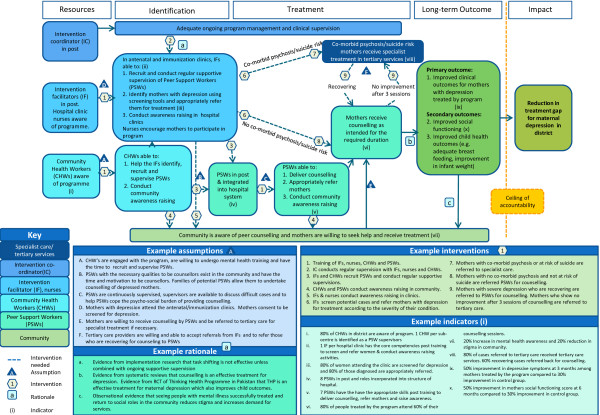
“The ceiling of accountability in theory of change refers to the high likelihood (strong degree of contributions by the input) of outputs triggered by the inputs (Bemme, 2019; De Silva, Lee et al., 2014; Gooding et al., 2018; Hailemariam et al., 2015; Taplin et al., 2013).”
BackgroundJewed, F., Abdullah, M. R., & Ishak, I. (2025) · Journal of Islamic Economics Lariba · doi:10.20885/jielariba.vol11.iss2.art16 · Cited by 14
“The Theory of Change (ToC) framework (Breuer et al., 2016; De Silva et al., 2014; Mackenzie & Blamey, 2005) complements CIPP by mapping causal pathways from inputs to outcomes, emphasizing the articulation of underlying assumptions (Botha et al., 2017).”
Yearwood, A. C. (2018) · Revista Panamericana de Salud Pública · doi:10.26633/rpsp.2018.91 · Cited by 9
Integrated care pathways in neurosurgery: A systematic review
Lee, K. S., Yordanov, S., Stubbs, D. J., Edlmann, E., Joannides, A. J., & Davies, B. M. (2021) · PLoS ONE · doi:10.1371/journal.pone.0255628 · Cited by 10
Clinical research in dementia: A perspective on implementing innovation
Boccardi, M., Handels, R. L. H., Gold, M., Grazia, A., Lutz, M. W., Martin, M., Nosheny, R. L., Robillard, J. M., Weidner, W. S., Alexandersson, J., et al. (2022) · Alzheimer s & Dementia · doi:10.1002/alz.12622 · Cited by 9
Babatunde, G. B., van Rensburg, A. J., Bhana, A., & Petersen, I. (2022) · Child and Adolescent Psychiatry and Mental Health · doi:10.1186/s13034-022-00484-9 · Cited by 11
Tsai, A. Y. J., & Tan, A. Y. K. (2022) · Energies · doi:10.3390/en15134853 · Cited by 11
Feasibility of a standard cognitive assessment in European academic memory clinics
Grazia, A., Altomare, D., Preis, L., Monsch, A. U., Cappa, S. F., Gauthier, S. G., Frölich, L., Winblad, B. G., Welsh-Bohmer, K. A., Teipel, S. J., et al. (2022) · Alzheimer s & Dementia · doi:10.1002/alz.12830 · Cited by 10
Bagaragaza, E., Colombet, I., Perineau, M., Aegerter, P., & Guirimand, F. (2023) · BMC Palliative Care · doi:10.1186/s12904-023-01157-w · Cited by 10
“The use of this theory-based evidencedriven approach should increase both intervention effectiveness and transferability [33].”
MethodWhat is an “early palliative care” intervention? A scoping review of controlled studies in oncology
Nadolny, S., Schildmann, E. K., Gaßmann, E. S., & Schildmann, J. (2023) · Cancer Medicine · doi:10.1002/cam4.6490 · Cited by 13
Salisbury, C., O’Cathain, A., Thomas, C., Edwards, L., Montgomery, A. A., Hollinghurst, S. P., Large, S., Nicholl, J. P., Pope, C. J., Rogers, A. E., et al. (2017) · Programme Grants for Applied Research · doi:10.3310/pgfar05010 · Cited by 9
Davies, B. S., Kinfe, M., Ali, O., Mengiste, A., Tesfaye, A., Tamiru, M., Davey, G., & Semrau, M. (2022) · PLoS neglected tropical diseases · doi:10.1371/journal.pntd.0010132 · Cited by 9
Assessment of COVID-19 Vaccine Acceptance and Willingness to Pay by Nigerians
Hassan, A. M., Hassan, Z., & Muhammad, H. M. (2022) · Health · doi:10.4236/health.2022.141011 · Cited by 12
“As such, several researchers proposed that understanding the public health interventions using ToC and its related uncertainties may improve the evaluation of complex health interventions [10] [11] [12] [13].”
BackgroundAsher, L., Rapiya, B., Repper, J., Reddy, T., MYERS, B. J., Hanlon, C., Petersen, I., & Brooke‐Sumner, C. (2023) · Pilot and Feasibility Studies · doi:10.1186/s40814-022-01232-8 · Cited by 12
Self-citationImpact evaluations of mental health programmes: the missing piece in global mental health
Silva, M. J. D. (2014) · Journal of Epidemiology & Community Health · doi:10.1136/jech-2014-203866 · Cited by 9
Conceptual and Methodological Issues in Evaluations of Road Safety Countermeasures
Vingilis, E. R. (2016) · Safety · doi:10.3390/safety2010008 · Cited by 9
Metadata
- Authors
- De Silva, M. J., Breuer, E., Lee, L., Asher, L., Chowdhary, N., Lund, C., & Patel, V.
- Affiliations
- University of Cape Town (ZA)
- London School of Hygiene & Tropical Medicine (GB)
- Sangath (IN)
- Venue
- Trials
- Published
- 2014-07-05
- Volume
- 15
- Issue
- 1
- Pages
- 267-267
- ISSN
- 1745-6215 (ISSN-L)
- PMC
- PMC4227087
- OpenAlex
- W2168592755
- Cited by
- 738
- References
- 43
- Citations by year
- 2026: 57 · 2025: 74 · 2024: 108 · 2023: 98 · 2022: 87 · 2021: 93 · 2020: 58 · 2019: 55 · 2018: 41 · 2017: 21 · 2016: 30 · 2015: 15 · 2014: 1
- FWCI
- 28.63
- Type
- journal article
- Language
- en
- Open access
- gold
- doi.org
- Licence
- Locations
- Trials (publishedVersion, cc-by)
- Europe PMC (PubMed Central) (publishedVersion, cc-by)
- PubMed Central (publishedVersion, cc-by)
- PubMed (publishedVersion)
- LSHTM Research Online (London School of Hygiene and Tropical Medicine) (acceptedVersion)
- Open University of Cape Town (University of Cape Town) (submittedVersion, cc-by)
- Funders
- London School of Hygiene and Tropical Medicine
- Wellcome Trust (084674, 100142/Z/12/Z, 100714)
- Department for International Development (HRPC10)
- Grand Challenges Canada
- National Institute of Mental Health (U19MH095687, U19MH095699)
- Topics
- Social Sciences › Public Administration › Evaluation and Performance Assessment
- Health Sciences › Health Professions › General Health Professions › Health Policy Implementation Science
- Physical Sciences › Mathematics › Statistics and Probability › Advanced Causal Inference Techniques
- Keywords
- theory of change, complex interventions, MRC framework for complex interventions, theory-based evaluation, intervention design, stakeholder engagement, causal pathways, process evaluation, intervention effectiveness, knowledge gaps, health interventions
- MeSH terms
- Humans, Mental Health, Guidelines as Topic, Biomedical Research
About these checks
Registry, retraction, Cites and statistics results are computed, not judged, with one exception: a printed reference that no index lists is read once by a model before it counts as a citation error. Claims are extracted by a model and kept only when their quote appears verbatim in the text; each cited source is then checked, with a model’s help, for whether it says what the claim relies on. Those verdicts can be wrong — read the claim’s quote and the cited source before relying on one.
Statistics and arithmetic are recomputed, not judged.
Confidence bands are shown only for fields calibrated on our annotated test set. None is calibrated yet, so no band is shown.
What counts as a claim ›How we measure confidence ›How we check this ›
Are you an author, or do you see a problem with this page? Request a review
Data sources
Bibliographic data: Semantic Scholar, OpenAlex, Crossref.
Contains information from the Semantic Scholar Academic Graph Datasets, made available under the ODC Attribution License (ODC-BY 1.0).
Semantic Scholar’s data is described in: Kinney, R., et al. (2023). The Semantic Scholar Open Data Platform. arXiv:2301.10140.
