

The DOI matches its Crossref record; 34 of the 34 references it cites were found in a registry or an index; none of the 34 sources its claims cite is checked for support yet.
The recording of adverse events from psychological treatments in clinical trials: evidence from a review of NIHR-funded trials
Open accessAbstract
BACKGROUND: There is a concern in the literature that harm from interventions is insufficiently documented in clinical trials in general, and in those assessing psychological treatments in particular. A recent decision by a trial steering committee to stop recruitment into a randomized controlled trial (RCT) of a psychological intervention for personality disorder led to an investigation of the recording of harm in trials funded by the National Institute for Health Research (NIHR). METHODS: The protocols and final reports of all 82 NIHR trials funded between 1995 and 2013 were examined for the reporting of adverse events. These were subdivided by category of intervention. RESULTS: None of the psychological intervention trials mentioned the occurrence of an adverse event in their final report. Trials of drug treatments were more likely to mention adverse events in their protocols compared with those using psychological treatments. When adverse events were mentioned, the protocols of psychological interventions relied heavily on severe adverse events guidelines from the National Research Ethics Service (NRES), which were developed for drug rather than psychological interventions and so may not be appropriate for the latter. CONCLUSIONS: This survey supported the belief that the reporting of adverse events in psychological treatments is weak and the criteria used may not be appropriate. Recommendations are made as to how current practice might be improved.
Overview
AI snapshot
Written from the paper’s full text.
TL;DR
In a review of 82 NIHR-funded trials, psychological intervention trials were far less likely than drug trials to specify or report adverse events, and none of the completed psychological trials mentioned adverse events in final reports. When psychological protocols did mention adverse events, they largely used NRES severe-adverse-event categories developed for drug trials, which may not fit psychological interventions.
Key findings
- None of the psychological intervention trials mentioned the occurrence of an adverse event in their final report; in completed studies using a psychological intervention, there was no mention of an adverse event in any of the 14 completed studies.
- Drug trials were more likely to mention adverse events in protocols than psychological trials: in incomplete studies with protocols only, 8/8 drug protocols (100%) and 2/2 combined protocols (100%) mentioned adverse events, compared with 17/28 psychological protocols (61%).
- When psychological protocols listed adverse events, they relied heavily on NRES severe-adverse-event definitions: death in 65%, hospitalization in 56%, persistent disability in 43%, and congenital abnormality or birth defect in 39%; events more relevant to psychological therapy, such as self-harm, symptom change, distress, or Accident & Emergency attendance, were mentioned in only a few trials.
- No trial was found to have been discontinued because of adverse event reports prior to the PEPS trial, and none of the trials using a psychological treatment were stopped because of an adverse event differential.
Methods
- Retrospective documentary review of protocols and final reports from all 82 NIHR trials funded between August 1995 and October 2013, subdivided into psychological only, drug only, combined psychological and drug, and other interventions.
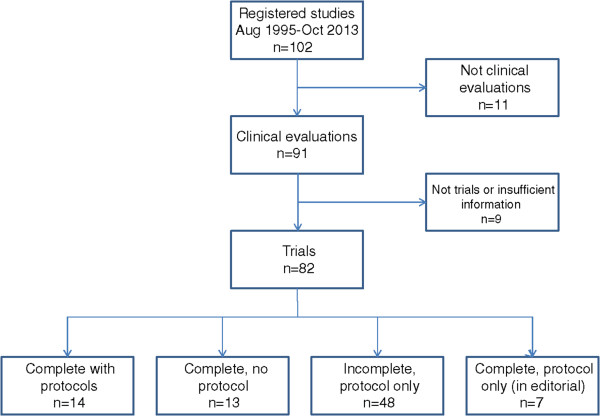
- Trials were categorized as completed with protocol, completed without protocol, incomplete with protocol only, or incomplete in editorial with protocol only; 44 interventions were psychological, 14 drug, 5 combined, and 19 other.
- The first author manually searched the reports and extracted any information on adverse events from protocols and/or final reports where available, summarized descriptively by intervention type and trial status.
Limitations
- The paper states that small numbers of trials in each group make it difficult to be confident that differences between psychological and pharmacological trials, or between earlier and later protocols, are robust; earlier trials often lacked accessible protocols because the funding agency did not insist on them.
- Evident from the text: adverse event information was extracted manually by the first author, and many incomplete trials had only protocols available, so final-report reporting could not be assessed for those trials.
- Evident from the text: the review reports descriptive counts and percentages without formal statistical testing of the differences between intervention categories.
Model-written summary. Check it against the paper before relying on it.
Integrity signals
Registry
Cites
Statistics
Figures
Verification
Claims the paper makes
33 Not checked yet · 22 Own result · 14 Own interpretation · 7 No basis given · 1 Own method
A result the paper reports from its own data — it cites no other source for it, so there is none to check. The quote shows it is in the paper.
In the paper
“To our knowledge, this was the first time recruitment to a UK trial of a psychological therapy had been stopped on the grounds of adverse events.”
- Also stated in: § Completed studies · plain
“We found no evidence of a trial having been discontinued because of adverse event reports prior to PEPS.”
§ The recording of adverse events from psychological treatments in clinical trials: evidence from a review of NIHR-funded trials > Background
plain- Asserted: passes — The authors put it forward as true.
- Checkable: passes — It can be checked against evidence.
- Load-bearing: passes — The paper’s conclusions depend on it.
- Based: passes — The paper gives a reason why it holds.
- Also stated in: § Completed studies · plain
A result the paper reports from its own data — it cites no other source for it, so there is none to check. The quote shows it is in the paper.
In the paper
“Specifically, none of the trials using a psychological treatment were stopped because of an adverse event differential.”
§ The recording of adverse events from psychological treatments in clinical trials: evidence from a review of NIHR-funded trials > Results > Completed studies
plain- Asserted: passes — The authors put it forward as true.
- Checkable: passes — It can be checked against evidence.
- Load-bearing: passes — The paper’s conclusions depend on it.
- Based: passes — The paper gives a reason why it holds.
A result the paper reports from its own data — it cites no other source for it, so there is none to check. The quote shows it is in the paper.
In the paper
“None of the psychological intervention trials mentioned the occurrence of an adverse event in their final report.”
- Also stated in: § Completed studies · plain
“In none of the 14 completed studies using a psychological intervention was there a mention of an adverse event.”
§ The recording of adverse events from psychological treatments in clinical trials: evidence from a review of NIHR-funded trials > Abstract > Results
plain- Asserted: passes — The authors put it forward as true.
- Checkable: passes — It can be checked against evidence.
- Load-bearing: passes — The paper’s conclusions depend on it.
- Based: passes — The paper gives a reason why it holds.
- Also stated in: § Completed studies · plain
A result the paper reports from its own data — it cites no other source for it, so there is none to check. The quote shows it is in the paper.
In the paper
“Conversely, there was some reporting of adverse events in the final reports of each of the other categories.”
§ The recording of adverse events from psychological treatments in clinical trials: evidence from a review of NIHR-funded trials > Results > Completed studies
plain- Asserted: passes — The authors put it forward as true.
- Checkable: passes — It can be checked against evidence.
- Load-bearing: passes — The paper’s conclusions depend on it.
- Based: passes — The paper gives a reason why it holds.
A result the paper reports from its own data — it cites no other source for it, so there is none to check. The quote shows it is in the paper.
In the paper
“Trials of drug treatments were more likely to mention adverse events in their protocols compared with those using psychological treatments.”
§ The recording of adverse events from psychological treatments in clinical trials: evidence from a review of NIHR-funded trials > Abstract > Results
plaincorrelational- Asserted: passes — The authors put it forward as true.
- Checkable: passes — It can be checked against evidence.
- Load-bearing: passes — The paper’s conclusions depend on it.
- Based: passes — The paper gives a reason why it holds.
A result the paper reports from its own data — it cites no other source for it, so there is none to check. The quote shows it is in the paper.
In the paper
“the protocols of psychological interventions relied heavily on severe adverse events guidelines from the National Research Ethics Service (NRES)”
§ The recording of adverse events from psychological treatments in clinical trials: evidence from a review of NIHR-funded trials > Abstract > Results
plain- Asserted: passes — The authors put it forward as true.
- Checkable: passes — It can be checked against evidence.
- Load-bearing: passes — The paper’s conclusions depend on it.
- Based: passes — The paper gives a reason why it holds.
A result the paper reports from its own data — it cites no other source for it, so there is none to check. The quote shows it is in the paper.
In the paper
“We noted, however, that in the more recently funded psychological studies that adverse events were more likely to be mentioned in their protocols.”
§ The recording of adverse events from psychological treatments in clinical trials: evidence from a review of NIHR-funded trials > Results > Incomplete studies
hedgedcorrelational- Asserted: passes — The authors put it forward as true.
- Checkable: passes — It can be checked against evidence.
- Load-bearing: passes — The paper’s conclusions depend on it.
- Based: passes — The paper gives a reason why it holds.
A result the paper reports from its own data — it cites no other source for it, so there is none to check. The quote shows it is in the paper.
In the paper
“and were less likely to list adverse events in their protocols compared with drug trials”
§ The recording of adverse events from psychological treatments in clinical trials: evidence from a review of NIHR-funded trials > Results > Incomplete studies
plaincorrelational- Asserted: passes — The authors put it forward as true.
- Checkable: passes — It can be checked against evidence.
- Load-bearing: passes — The paper’s conclusions depend on it.
- Based: passes — The paper gives a reason why it holds.
A result the paper reports from its own data — it cites no other source for it, so there is none to check. The quote shows it is in the paper.
In the paper
“for psychological therapies (such as self-harm, symptom change, distress or attendance at Accident & Emergency departments) were mentioned in only a few trials.”
§ The recording of adverse events from psychological treatments in clinical trials: evidence from a review of NIHR-funded trials > Results > Incomplete studies
plain- Asserted: passes — The authors put it forward as true.
- Checkable: passes — It can be checked against evidence.
- Load-bearing: passes — The paper’s conclusions depend on it.
- Based: passes — The paper gives a reason why it holds.
A result the paper reports from its own data — it cites no other source for it, so there is none to check. The quote shows it is in the paper.
In the paper
“Alternatively, when adverse events were reported there was a reliance on the definitions of severe adverse events from the safety reporting guidelines from the National Research Ethics Service (NRES).”
§ The recording of adverse events from psychological treatments in clinical trials: evidence from a review of NIHR-funded trials > Results > Incomplete studies
plaincorrelational- Asserted: passes — The authors put it forward as true.
- Checkable: passes — It can be checked against evidence.
- Load-bearing: passes — The paper’s conclusions depend on it.
- Based: passes — The paper gives a reason why it holds.
- It may state two separate claims as one. 19
- Probably not a substantial claim. 18
A result the paper reports from its own data — it cites no other source for it, so there is none to check. The quote shows it is in the paper.
In the paper
“A total of 44 of the interventions were psychological, 14 involved drugs, 5 were a combination of drugs and a psychological intervention and 19 were other (see Table 1).”
§ The recording of adverse events from psychological treatments in clinical trials: evidence from a review of NIHR-funded trials > Results
plain- Asserted: passes — The authors put it forward as true.
- Checkable: passes — It can be checked against evidence.
- Load-bearing: unclear — It is unclear whether the paper’s conclusions depend on it.
- Based: passes — The paper gives a reason why it holds.
It may state two separate claims as one.
A result the paper reports from its own data — it cites no other source for it, so there is none to check. The quote shows it is in the paper.
In the paper
“The first was for these not to be considered at all, or for the likelihood of their occurrence to be dismissed.”
§ The recording of adverse events from psychological treatments in clinical trials: evidence from a review of NIHR-funded trials > Results > Incomplete studies
plain- Asserted: passes — The authors put it forward as true.
- Checkable: passes — It can be checked against evidence.
- Load-bearing: passes — The paper’s conclusions depend on it.
- Based: passes — The paper gives a reason why it holds.
It may state two separate claims as one.
The paper states this without a source or data behind it here, so there is nothing to check it against. The quote shows it is in the paper.
In the paper
“When adverse events are listed in the protocols of psychological interventions, one can see the influence of NRES, with death occurring in 65%, hospitalization in 56%, persistent disability in 43%, and congenital abnormality or birth defect in 39%.”
§ The recording of adverse events from psychological treatments in clinical trials: evidence from a review of NIHR-funded trials > Results > Incomplete studies
plaincorrelational- Asserted: passes — The authors put it forward as true.
- Checkable: passes — It can be checked against evidence.
- Load-bearing: passes — The paper’s conclusions depend on it.
- Based: passes — The paper gives a reason why it holds.
It may state two separate claims as one.
The paper states this without a source or data behind it here, so there is nothing to check it against. The quote shows it is in the paper.
In the paper
“There was evidence of improvements over time, with more recent trials more likely to specify adverse events in protocols.”
§ The recording of adverse events from psychological treatments in clinical trials: evidence from a review of NIHR-funded trials > Discussion
plaincorrelational- Asserted: passes — The authors put it forward as true.
- Checkable: passes — It can be checked against evidence.
- Load-bearing: passes — The paper’s conclusions depend on it.
- Based: passes — The paper gives a reason why it holds.
It may state two separate claims as one.
In the paper
“Ethgen et al. [19] showed that in the reporting of harms, withdrawals due to adverse events and severity were more frequent in pharmacological compared with non-pharmacological treatments in rheumatoid arthritis and osteoarthritis.”
§ The recording of adverse events from psychological treatments in clinical trials: evidence from a review of NIHR-funded trials > Background > The reporting of adverse events in clinical trials of psychological interventions
What the sources say
- Not checked yetcites [19] Ethgen M, Boutron I, Baron G, Giraudeau B, Sibilia J, Ravaud P: Reporting of harm in randomized, controlled trials of nonpharmacologic treatment for rheumatic disease. Ann Intern Med. 2005, 143: 20-25. source
plaincorrelational- Asserted: passes — The authors put it forward as true.
- Checkable: passes — It can be checked against evidence.
- Load-bearing: fails — The paper’s conclusions may not depend on it.
- Based: passes — The paper gives a reason why it holds.
Probably not a substantial claim. The paper’s conclusions may not depend on it.
In the paper
“In mental health, the reporting of harm in drug trials was adequate in only 21.4% of the trials reviewed but none of the non-drug trials had adequate reporting of clinical adverse events [20].”
§ The recording of adverse events from psychological treatments in clinical trials: evidence from a review of NIHR-funded trials > Background > The reporting of adverse events in clinical trials of psychological interventions
What the sources say
- Not checked yetcites [20] Papanikolaou PN, Churchill R, Wahlbeck K, Ioannidis JP: Safety reporting in randomized trials of mental health interventions. Am J Psychiatry. 2004, 161: 1692-1697. source
plain- Asserted: passes — The authors put it forward as true.
- Checkable: passes — It can be checked against evidence.
- Load-bearing: passes — The paper’s conclusions depend on it.
- Based: passes — The paper gives a reason why it holds.
It may state two separate claims as one.
In the paper
“The TSC were unable to rule out the possibility that the intervention was instrumental in the excess of AEs and so the TSC issued an instruction to stop recruitment into the trial.”
§ The recording of adverse events from psychological treatments in clinical trials: evidence from a review of NIHR-funded trials > Background
What the sources say
- Not checked yetcites [1] McMurran M, Crawford MJ, Reilly JG, McCrone P, Moran P, Williams H, Adams CE, Duggan C, Delport J, Whitham D, Day F: Psycho-education with problem solving (PEPS) therapy for adults with personality disorder: a pragmatic multi-site community-based randomized clinical trial. Trials. 2011, 12: 198- source
plainconditional- Asserted: passes — The authors put it forward as true.
- Checkable: passes — It can be checked against evidence.
- Load-bearing: unclear — It is unclear whether the paper’s conclusions depend on it.
- Based: passes — The paper gives a reason why it holds.
It may state two separate claims as one.
In the paper
“In the PEPS trial, the TSC recommended that recruitment and treatment of participants should cease due to the excess number of adverse events relating to mental health in the active treatment arm of the trial, although the trial should continue to collect follow-up data on all of those who had already completed treatment.”
§ The recording of adverse events from psychological treatments in clinical trials: evidence from a review of NIHR-funded trials > Background > Adverse events in clinical trials
What the sources say
- Not checked yetcites [1] McMurran M, Crawford MJ, Reilly JG, McCrone P, Moran P, Williams H, Adams CE, Duggan C, Delport J, Whitham D, Day F: Psycho-education with problem solving (PEPS) therapy for adults with personality disorder: a pragmatic multi-site community-based randomized clinical trial. Trials. 2011, 12: 198- source
plaindirect- Asserted: passes — The authors put it forward as true.
- Checkable: passes — It can be checked against evidence.
- Load-bearing: unclear — It is unclear whether the paper’s conclusions depend on it.
- Based: passes — The paper gives a reason why it holds.
It may state two separate claims as one.
In the paper
“However, these decisions are rarely straightforward, and there is a different threshold for stopping a trial in the case of potential harm than in the case of benefit [17].”
§ The recording of adverse events from psychological treatments in clinical trials: evidence from a review of NIHR-funded trials > Background > Adverse events in clinical trials
What the sources say
- Not checked yetcites [17] Pocock SJ: When to stop a clinical trial. Br Med J. 1992, 305: 235-240. source
plain- Asserted: passes — The authors put it forward as true.
- Checkable: passes — It can be checked against evidence.
- Load-bearing: fails — The paper’s conclusions may not depend on it.
- Based: passes — The paper gives a reason why it holds.
Probably not a substantial claim. The paper’s conclusions may not depend on it.
In the paper
“Jonsson et al. [23], in a recent review, reported that only 21% of randomized controlled trials of psychological intervention had information suggesting that harm was monitored.”
§ The recording of adverse events from psychological treatments in clinical trials: evidence from a review of NIHR-funded trials > Background > The reporting of adverse events in clinical trials of psychological interventions
What the sources say
- Not checked yetcites [23] Jonsson U, Alaie I, Parling T, Arnberg FK: Reporting of harms in randomized controlled trials of psychological interventions for mental and behavioural disorders: a review of current practice. Contemp Clin Trials. 2014, 38: 1-8. source
plain- Asserted: passes — The authors put it forward as true.
- Checkable: passes — It can be checked against evidence.
- Load-bearing: passes — The paper’s conclusions depend on it.
- Based: passes — The paper gives a reason why it holds.
Probably not a substantial claim.
In the paper
“The reasons for dropping out are heterogeneous and some reviews have considered drop out as an adverse event [18].”
§ The recording of adverse events from psychological treatments in clinical trials: evidence from a review of NIHR-funded trials > Background > Adverse events in clinical trials
What the sources say
- Not checked yetcites [18] Jones C, Hacker D, Cormac I, Meaden A, Irving CB: Cognitive behavioural therapy versus other psychosocial treatments for schizophrenia. Cochrane Database Syst Rev. 2012, Art. No (4): CD008712-Doi: 10.1002/14651858.CD008712.pub2
plain- Asserted: passes — The authors put it forward as true.
- Checkable: passes — It can be checked against evidence.
- Load-bearing: fails — The paper’s conclusions may not depend on it.
- Based: passes — The paper gives a reason why it holds.
Probably not a substantial claim. The paper’s conclusions may not depend on it. It may state two separate claims as one.
None of the sources cited for this claim have been checked yet.
In the paper
“Despite these injunctions, there remain inadequacies of adverse event reporting in non-pharmacological interventions in general and particularly in mental health trials.”
§ The recording of adverse events from psychological treatments in clinical trials: evidence from a review of NIHR-funded trials > Background > The reporting of adverse events in clinical trials of psychological interventions
What the sources say
- Not checked yetcites [19] Ethgen M, Boutron I, Baron G, Giraudeau B, Sibilia J, Ravaud P: Reporting of harm in randomized, controlled trials of nonpharmacologic treatment for rheumatic disease. Ann Intern Med. 2005, 143: 20-25. source
- Not checked yetcites [20] Papanikolaou PN, Churchill R, Wahlbeck K, Ioannidis JP: Safety reporting in randomized trials of mental health interventions. Am J Psychiatry. 2004, 161: 1692-1697. source
plain- Asserted: passes — The authors put it forward as true.
- Checkable: passes — It can be checked against evidence.
- Load-bearing: passes — The paper’s conclusions depend on it.
- Based: passes — The paper gives a reason why it holds.
It may state two separate claims as one.
In the paper
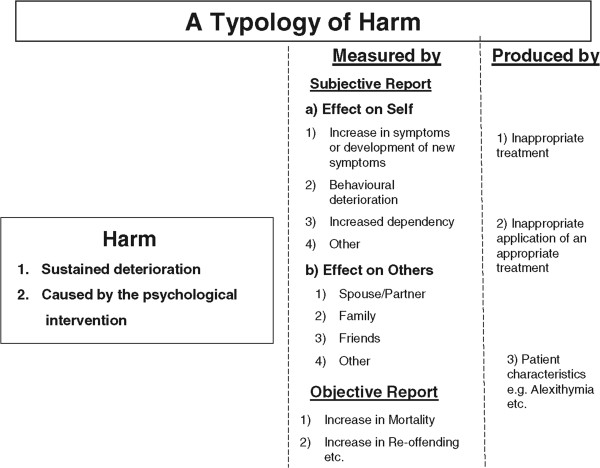
“The fact that the deterioration has to be sustained addresses the concern that some temporary discomfort is often a necessary part of the process of psychological change [9].”
§ The recording of adverse events from psychological treatments in clinical trials: evidence from a review of NIHR-funded trials > Background > Adverse events and harm
What the sources say
- Not checked yetcites [9] Crown S: Contraindications and dangers of psychotherapy. Br J Psychiatry. 1983, 148: 468-470.
plaindirect- Asserted: passes — The authors put it forward as true.
- Checkable: passes — It can be checked against evidence.
- Load-bearing: passes — The paper’s conclusions depend on it.
- Based: passes — The paper gives a reason why it holds.
Probably not a substantial claim.
In the paper
“For instance, it is recognized that while relaxation treatment may be helpful to some who suffer from panic attacks, for others, its focus on interoceptive stimuli can have the effect of precipitating attacks [11].”
§ The recording of adverse events from psychological treatments in clinical trials: evidence from a review of NIHR-funded trials > Background > Adverse events and harm
What the sources say
- Not checked yetcites [11] Adler CM, Craske MG, Barlow DH: Relaxation-induced panic (RIP): when resting isn’t peaceful. Integr Psychiatry. 1987, 5: 94-100.
plainconditional- Asserted: passes — The authors put it forward as true.
- Checkable: passes — It can be checked against evidence.
- Load-bearing: unclear — It is unclear whether the paper’s conclusions depend on it.
- Based: passes — The paper gives a reason why it holds.
It may state two separate claims as one.
In the paper
“This is especially important for psychological treatments where the competence and natural attributes of the therapist assume greater importance compared to those of a practitioner prescribing a drug [10].”
§ The recording of adverse events from psychological treatments in clinical trials: evidence from a review of NIHR-funded trials > Background > Adverse events and harm
What the sources say
- Not checked yetcites [10] Norrie I, Davidson K, Tata P, Gumley A: Influence of therapist competence and quantity of CBT on suicide behavious and in patient hospitalization in a randomized controlled trial in borderline personality disorder: further analysis of treatment effects in the BOSCOT study. Psychol Psychother Theory Res Pract. 2013, 86: 280-293. source
plaincorrelational- Asserted: passes — The authors put it forward as true.
- Checkable: passes — It can be checked against evidence.
- Load-bearing: fails — The paper’s conclusions may not depend on it.
- Based: passes — The paper gives a reason why it holds.
Probably not a substantial claim. The paper’s conclusions may not depend on it.
In the paper
“When those in the trial were followed up 30 years after its completion, it was found that while there was no benefit from the active treatment in 59% of the matched pairs, in the 41% where there were differences, those with the worse outcomes across a range of measures had been in the active treatment condition [13].”
§ The recording of adverse events from psychological treatments in clinical trials: evidence from a review of NIHR-funded trials > Background > Adverse events and harm
What the sources say
- Not checked yetcites [13] McCord J: Cures that harm: unanticipated outcomes of crime prevention programs. Ann Am Acad Pol Soc Sci. 2003, 587: 16-30. source
plaincorrelational- Asserted: passes — The authors put it forward as true.
- Checkable: passes — It can be checked against evidence.
- Load-bearing: passes — The paper’s conclusions depend on it.
- Based: passes — The paper gives a reason why it holds.
It may state two separate claims as one.
The paper states this without a source or data behind it here, so there is nothing to check it against. The quote shows it is in the paper.
In the paper
“the design of a randomized trial permits consideration of this possibility when there is a differential effect between the trial and the control condition.”
§ The recording of adverse events from psychological treatments in clinical trials: evidence from a review of NIHR-funded trials > Background > Adverse events and harm
plainconditional- Asserted: passes — The authors put it forward as true.
- Checkable: passes — It can be checked against evidence.
- Load-bearing: fails — The paper’s conclusions may not depend on it.
- Based: passes — The paper gives a reason why it holds.
Probably not a substantial claim. The paper’s conclusions may not depend on it.
In the paper
“In their trial of family therapy for drug abusing adolescents, for instance, they did not consider an increase in drug use to be an adverse event, arguing that drug use among adolescents is so erratic that any increased usage would be difficult to measure.”
§ The recording of adverse events from psychological treatments in clinical trials: evidence from a review of NIHR-funded trials > Discussion
What the sources say
- Not checked yetcites [26] Horigian VE, Robbins MS, Dominquez R, Ucha J, Rosa CL: Principles for defining adverse events in behavioural intervention research: lessons from a family-focused adolescent drug abuse trial. Clin Trials. 2010, 7: 58-68. source
plain- Asserted: passes — The authors put it forward as true.
- Checkable: passes — It can be checked against evidence.
- Load-bearing: fails — The paper’s conclusions may not depend on it.
- Based: passes — The paper gives a reason why it holds.
Probably not a substantial claim. The paper’s conclusions may not depend on it. It may state two separate claims as one.
A conclusion the paper draws from its own results — it cites no other source for it, so there is none to check. The quote shows it is in the paper.
In the paper
“This absence of reporting could mean that no adverse event occurred (a zero event), that it occurred but it was either not recognized or recorded, and finally, that it was recorded but not reported.”
§ The recording of adverse events from psychological treatments in clinical trials: evidence from a review of NIHR-funded trials > Discussion
hedged- Asserted: passes — The authors put it forward as true.
- Checkable: passes — It can be checked against evidence.
- Load-bearing: passes — The paper’s conclusions depend on it.
- Based: passes — The paper gives a reason why it holds.
Probably not a substantial claim. It may state two separate claims as one.
In the paper
“There is substantial evidence that some patients may be harmed by psychological therapy, although the prevalence and causes of harm have been inadequately researched ( [24], p. 206).”
§ The recording of adverse events from psychological treatments in clinical trials: evidence from a review of NIHR-funded trials > Discussion
What the sources say
- Not checked yetcites [24] Lambert MJ: The efficacy and effectiveness of psychotherapy. Chapter 6. Bergin & Garfield’s Handbook of Psychotherapy and Behavior Change Sixth Edition. Edited by: Lambert MJ. 2013, New Jersey: Wiley
plain- Asserted: passes — The authors put it forward as true.
- Checkable: passes — It can be checked against evidence.
- Load-bearing: passes — The paper’s conclusions depend on it.
- Based: passes — The paper gives a reason why it holds.
It may state two separate claims as one.
In the paper
“For example, people with borderline personality disorders may be at increased risk of negative outcomes from psychological therapy [25]”
§ The recording of adverse events from psychological treatments in clinical trials: evidence from a review of NIHR-funded trials > Discussion
What the sources say
- Not checked yetcites [25] Mohr D: Negative outcome in psychotherapy: a critical review. Clin Psychol Sci Pract. 1995, 2: 1-27. source
hedgedconditional- Asserted: passes — The authors put it forward as true.
- Checkable: passes — It can be checked against evidence.
- Load-bearing: fails — The paper’s conclusions may not depend on it.
- Based: passes — The paper gives a reason why it holds.
Probably not a substantial claim. The paper’s conclusions may not depend on it.
In the paper
“Hence, it was only when such increased drug use resulted in hospitalization that it was categorized as a severe adverse event.”
§ The recording of adverse events from psychological treatments in clinical trials: evidence from a review of NIHR-funded trials > Discussion
What the sources say
- Not checked yetcites [26] Horigian VE, Robbins MS, Dominquez R, Ucha J, Rosa CL: Principles for defining adverse events in behavioural intervention research: lessons from a family-focused adolescent drug abuse trial. Clin Trials. 2010, 7: 58-68. source
plaindirect- Asserted: passes — The authors put it forward as true.
- Checkable: passes — It can be checked against evidence.
- Load-bearing: fails — The paper’s conclusions may not depend on it.
- Based: passes — The paper gives a reason why it holds.
Probably not a substantial claim. The paper’s conclusions may not depend on it.
In the paper
“Horigian et al. [26] found that only 30% of adverse incidents were spontaneously reported to research assistants, but this increased to 70% when structured interviews were used.”
§ The recording of adverse events from psychological treatments in clinical trials: evidence from a review of NIHR-funded trials > Discussion
What the sources say
- Not checked yetcites [26] Horigian VE, Robbins MS, Dominquez R, Ucha J, Rosa CL: Principles for defining adverse events in behavioural intervention research: lessons from a family-focused adolescent drug abuse trial. Clin Trials. 2010, 7: 58-68. source
plaindirect- Asserted: passes — The authors put it forward as true.
- Checkable: passes — It can be checked against evidence.
- Load-bearing: passes — The paper’s conclusions depend on it.
- Based: passes — The paper gives a reason why it holds.
It may state two separate claims as one.
In the paper
“At an individual level, visual inspection of the outliers in the fourth quartile may identify those at risk of being harmed by the intervention [8].”
§ The recording of adverse events from psychological treatments in clinical trials: evidence from a review of NIHR-funded trials > Discussion
What the sources say
- Not checked yetcites [8] Dimidjian S, Hollon SD: How would we know if psychotherapy were harmful?. Am Psychol. 2010, 65: 21-33. source
hedgedconditional- Asserted: passes — The authors put it forward as true.
- Checkable: fails — It may be too vague to check against evidence.
- Load-bearing: fails — The paper’s conclusions may not depend on it.
- Based: passes — The paper gives a reason why it holds.
Probably not a substantial claim. It may be too vague to check against evidence. The paper’s conclusions may not depend on it.
In the paper
“Horigian et al. [26] also highlight a further issue which requires attention: only some adverse events are spontaneously reported, and accurate assessment requires systematic monitoring, with the use of structured interviews and records from other agencies.”
§ The recording of adverse events from psychological treatments in clinical trials: evidence from a review of NIHR-funded trials > Discussion
What the sources say
- Not checked yetcites [26] Horigian VE, Robbins MS, Dominquez R, Ucha J, Rosa CL: Principles for defining adverse events in behavioural intervention research: lessons from a family-focused adolescent drug abuse trial. Clin Trials. 2010, 7: 58-68. source
plaindirect- Asserted: passes — The authors put it forward as true.
- Checkable: passes — It can be checked against evidence.
- Load-bearing: passes — The paper’s conclusions depend on it.
- Based: passes — The paper gives a reason why it holds.
Probably not a substantial claim. It may state two separate claims as one.
In the paper
“In addition, they recommended systematic monitoring so that general and specific questions that target the relevant areas are asked throughout the study at specified intervals.”
§ The recording of adverse events from psychological treatments in clinical trials: evidence from a review of NIHR-funded trials > Discussion
What the sources say
- Not checked yetcites [26] Horigian VE, Robbins MS, Dominquez R, Ucha J, Rosa CL: Principles for defining adverse events in behavioural intervention research: lessons from a family-focused adolescent drug abuse trial. Clin Trials. 2010, 7: 58-68. source
plain- Asserted: passes — The authors put it forward as true.
- Checkable: passes — It can be checked against evidence.
- Load-bearing: fails — The paper’s conclusions may not depend on it.
- Based: passes — The paper gives a reason why it holds.
Probably not a substantial claim. The paper’s conclusions may not depend on it.
In the paper
“as it is likely that the active treatment will increase the variance compared to no treatment control [7].”
§ The recording of adverse events from psychological treatments in clinical trials: evidence from a review of NIHR-funded trials > Discussion
What the sources say
- Not checked yetcites [7] Lilienfeld SC: Psychological treatments that cause harm. Perspect Psychol Sci. 2007, 2: 53-70. source
hedgeddirect- Asserted: passes — The authors put it forward as true.
- Checkable: passes — It can be checked against evidence.
- Load-bearing: passes — The paper’s conclusions depend on it.
- Based: passes — The paper gives a reason why it holds.
Probably not a substantial claim.
In the paper
“This is consistent with findings that psychotherapy patients are likely to hide negative material in particular, and that even experienced therapists are rarely able to detect this [27].”
§ The recording of adverse events from psychological treatments in clinical trials: evidence from a review of NIHR-funded trials > Discussion
What the sources say
- Not checked yetcites [27] Hill CE, Thompson BJ, Cogar MC, Denman DW: Beneath the surface of long-term therapy: therapist and client report of their own and each other’s covert processes. J Couns Psychol. 1993, 40: 278-787. source
hedged- Asserted: passes — The authors put it forward as true.
- Checkable: passes — It can be checked against evidence.
- Load-bearing: unclear — It is unclear whether the paper’s conclusions depend on it.
- Based: passes — The paper gives a reason why it holds.
It may state two separate claims as one.
In the paper
“As Dimidjian and Hollon [8] point out, identification of a harmful effect is only the first step; what is then required is an understanding of the mechanism to explain such an effect”
§ The recording of adverse events from psychological treatments in clinical trials: evidence from a review of NIHR-funded trials > Discussion
What the sources say
- Not checked yetcites [8] Dimidjian S, Hollon SD: How would we know if psychotherapy were harmful?. Am Psychol. 2010, 65: 21-33. source
plain- Asserted: passes — The authors put it forward as true.
- Checkable: fails — It may be too vague to check against evidence.
- Load-bearing: fails — The paper’s conclusions may not depend on it.
- Based: passes — The paper gives a reason why it holds.
Probably not a substantial claim. It may be too vague to check against evidence. The paper’s conclusions may not depend on it. It may state two separate claims as one.
A conclusion the paper draws from its own results — it cites no other source for it, so there is none to check. The quote shows it is in the paper.
In the paper
“Such an understanding would not only lead to the avoidance of harmful interventions, but also contribute to identifying which psychological intervention works best for whom.”
§ The recording of adverse events from psychological treatments in clinical trials: evidence from a review of NIHR-funded trials > Discussion
hedgeddirect- Asserted: passes — The authors put it forward as true.
- Checkable: fails — It may be too vague to check against evidence.
- Load-bearing: passes — The paper’s conclusions depend on it.
- Based: passes — The paper gives a reason why it holds.
Probably not a substantial claim. It may be too vague to check against evidence. It may state two separate claims as one.
A conclusion the paper draws from its own results — it cites no other source for it, so there is none to check. The quote shows it is in the paper.
In the paper
“This recognition of an adverse effect of treatment at an individual level is important as it allows an identification of clinical deterioration in certain instances even when the intervention overall has been successful.”
§ The recording of adverse events from psychological treatments in clinical trials: evidence from a review of NIHR-funded trials > Discussion
plaindirect- Asserted: passes — The authors put it forward as true.
- Checkable: fails — It may be too vague to check against evidence.
- Load-bearing: passes — The paper’s conclusions depend on it.
- Based: passes — The paper gives a reason why it holds.
Probably not a substantial claim. It may be too vague to check against evidence.
The paper relies on this without support.
The NRES severe adverse events guidelines were developed for drug rather than psychological interventions.
“which were developed for drug rather than psychological interventions”
The paper relies on this without support.
The growing interest in the issue of harm from psychological interventions does not affect the recording of harm in clinical trials that assess psychological interventions.
“it nonetheless does not appear to affect the recording of harm (or lack thereof) in clinical trials that assess psychological interventions.”
The paper relies on this without support.
Indications of potential harm are adverse events, deterioration in mental state and the patient’s perceptions of having been adversely affected.
“Indications of potential harm are adverse events, deterioration in mental state and the patient’s perceptions of having been adversely affected.”
The paper relies on this without support.
Adverse events would be expected to be routinely recorded and reported in well-conducted randomized controlled trials.
“which one would expect to be routinely recorded and reported in well-conducted randomized controlled trials.”
Claims other papers make about this one
Each is checked against this paper’s own text: does it say what the citing paper says it does?
The source backs part of the claim, not all of it — or backs it for a different population, condition or comparison.
In the citing paper
“All serious adverse events (SAEs) that are reported spontaneously by the participants or observed by the investigators during the trial will be recorded by the research team and will be reported to the independent advisory board [46].”
From A brief transdiagnostic psychological intervention for Afghan asylum seekers and refugees in Austria: A randomized controlled trial (2020) · cites this paper as [46]
Experimental — accuracy not yet measuredThe cited source says what the claim attributes to it.
In the citing paper
“The criteria for the reporting of adverse advents in the current study are based on the recommendations of Duggan, Parry, McMurran, Davidson, and Dennis (2014).”
From Acceptance and Commitment Therapy for perinatal mood and anxiety disorders: A feasibility and proof of concept study. (2020) · cites this paper as Duggan, Parry, McMurran, Davidson, and Dennis (2014)
The cited source says what the claim attributes to it.
In the citing paper
“psychological interventions should be evaluated for negative effects [38]”
The cited source says what the claim attributes to it.
In the citing paper
“However, some studies listed ‘hospitalization’ as a reason for (iCBT) dropout (Dear et al., 2017; Trompetter et al., 2015), which can be classified as a serious adverse event (Duggan et al., 2014).”
From Guided internet-based cognitive-behavioral therapy for patients with chronic pain: A meta-analytic review (2022) · cites this paper as Duggan et al., 2014
The cited source says what the claim attributes to it.
In the citing paper
“In general, the reporting of adverse events in RCTs of psychological interventions has been identified as weak. [105]”
From Efficacy of psychological therapies for irritable bowel syndrome: systematic review and network meta-analysis (2020) · cites this paper as [105]
In the citing paper
“Finally, Duggan et al. (2014) noted that adverse events may not be spontaneously reported and will not come to light without systematic assessment methods.”
From Frequency of Self-reported Unpleasant Events and Harm in a Mindfulness-Based Program in Two General Population Samples (2021) · cites this paper as Duggan et al. 2014
In the citing paper
“Second, adverse effects are sometimes narrowly defined, drawing on definitions from medical research, such that general deterioration in mental state or the appearance of new psychological symptoms might not be included (Duggan et al. 2014).”
From Frequency of Self-reported Unpleasant Events and Harm in a Mindfulness-Based Program in Two General Population Samples (2021) · cites this paper as Duggan et al. 2014
In the citing paper
“A previous review of 82 National Institute for Health Research funded clinical trials investigating psychological interventions has found that adverse events are often assessed according to inappropriate criteria that are not therapy specific.125”
From Psychological interventions for chronic, non-specific low back pain: systematic review with network meta-analysis (2022) · cites this paper as [125]
Self-check
Percentages, sums and reported differences re-computed from the paper’s own numbers.
Each contradiction between two passages listed here was confirmed by an independent check.
Rated minor: it would not touch a result — a value no result rests on, a p-value that stays on the same side of the significance level, or a conflict that is clerical, resolved elsewhere in the paper, or outside its own findings.
In the paper
“| | Number with AEs | 4 (50%) | 0 | 1 (100%) | 0 | 3 (75%) |”
§ The recording of adverse events from psychological treatments in clinical trials: evidence from a review of NIHR-funded trials > Results
Reported 50 · recomputed 57.142857
Rated minor: it would not touch a result — a value no result rests on, a p-value that stays on the same side of the significance level, or a conflict that is clerical, resolved elsewhere in the paper, or outside its own findings.
In the paper
§ The recording of adverse events from psychological treatments in clinical trials: evidence from a review of NIHR-funded trials > Results
“Of the remaining 54 trials, 47 were still in progress and another 7 were in the process of being published”
§ The recording of adverse events from psychological treatments in clinical trials: evidence from a review of NIHR-funded trials > Results
“| Incomplete studies (protocols only) | Number of protocols | 48 | 28 | 8 | 2 | 10 |”
Rated minor: it would not touch a result — a value no result rests on, a p-value that stays on the same side of the significance level, or a conflict that is clerical, resolved elsewhere in the paper, or outside its own findings.
In the paper
§ The recording of adverse events from psychological treatments in clinical trials: evidence from a review of NIHR-funded trials > Results
“14 of these had protocols available but another 14 did not.”
§ The recording of adverse events from psychological treatments in clinical trials: evidence from a review of NIHR-funded trials > Results
“| Completed studies without protocols | Number of final reports | 13 | 7 | 2 | 1 | 3 |”
Rated minor: it would not touch a result — a value no result rests on, a p-value that stays on the same side of the significance level, or a conflict that is clerical, resolved elsewhere in the paper, or outside its own findings.
In the paper
§ The recording of adverse events from psychological treatments in clinical trials: evidence from a review of NIHR-funded trials > Discussion
“The failure to specify, record and report adverse events during psychological therapy was confirmed by our examination of 91 NIHR-funded trials.”
§ The recording of adverse events from psychological treatments in clinical trials: evidence from a review of NIHR-funded trials > Method
“Of these, nine were excluded, either because they were not trials (for example epidemiological surveys) or because there was insufficient information available for their inclusion. We divided these 82 trials into four groups:”
Rated minor: it would not touch a result — a value no result rests on, a p-value that stays on the same side of the significance level, or a conflict that is clerical, resolved elsewhere in the paper, or outside its own findings.
In the paper
“In contrast, drug interventions (together with drug and psychological interventions combined) mentioned adverse events in all of the 9 protocols examined.”
§ The recording of adverse events from psychological treatments in clinical trials: evidence from a review of NIHR-funded trials > Results > Incomplete studies
Reported 9 · recomputed 11
Rated minor: it would not touch a result — a value no result rests on, a p-value that stays on the same side of the significance level, or a conflict that is clerical, resolved elsewhere in the paper, or outside its own findings.
In the paper
“| | Number with AEs | 31 | 17 (61%) | 8 (100%) | 2 (100%) | 5 (50%) |”
§ The recording of adverse events from psychological treatments in clinical trials: evidence from a review of NIHR-funded trials > Results
Reported 31 · recomputed 32
Citations
Cites
1 retracted
Cognitive behaviour therapy versus other psychosocial treatments for schizophrenia
Jones, C. A., Hacker, D., Meaden, A., Cormac, I., & Irving, C. B. (2011) · Cochrane Database of Systematic Reviews · doi:10.1002/14651858.cd000524.pub3 · Cited by 97
RetractedWhen interventions harm: Peer groups and problem behavior.
Dishion, T. J., McCord, J., & Poulin, F. (1999) · American Psychologist · doi:10.1037/0003-066x.54.9.755 · Cited by 2,045 · cited 1×
“Although various possibilities were considered, such as the raising of expectations that were unsustained once the intervention was withdrawn, and ‘deviancy training’ where the more delinquent youth had a detrimental influence on their more vulnerable peers while they were together at summer camp [14], the cause of th…”
BackgroundWhy we need observational studies to evaluate the effectiveness of health care
Black, N. (1996) · BMJ · doi:10.1136/bmj.312.7040.1215 · Cited by 1,598 · cited 1×
“Although there are difficulties in studying rare events (such as harms) in trials with modest sample sizes and other methods such as large N observational studies and intensive process analysis are also required [31], only a properly randomized comparison allows conclusions to be drawn about the relative rates of adve…”
BackgroundBetter Reporting of Harms in Randomized Trials: An Extension of the CONSORT Statement
Ioannidis, J. P. A., Evans, S. J. W., Gøtzsche, P. C., O'Neill, R. T., Altman, D. G., Schulz, K., Moher, D., & for the CONSORT Group* (2004) · Annals of Internal Medicine · doi:10.7326/0003-4819-141-10-200411160-00009 · Cited by 1,593 · cited 3×
“[16] write: ‘In a typical randomized trial, it is difficult to know whether an observed event is partially or entirely due to the intervention or whether it is totally unrelated to the intervention.”
BackgroundInfluentialPsychological Treatments That Cause Harm
Lilienfeld, S. O. (2007) · Perspectives on Psychological Science · doi:10.1111/j.1745-6916.2007.00029.x · Cited by 959 · cited 3×
“Firstly, trialists could report on the full range of scores on the principal dependent variables distributed by quartile or, for dichotomous variables, the number needed to harm rather than the group mean, as it is likely that the active treatment will increase the variance compared to no treatment control [7].”
BackgroundPsychological therapies for people with borderline personality disorder.
Stoffers-Winterling, J. M., Völlm, B. A., Rücker, G., Timmer, A., Huband, N., & Lieb, K. (2012) · Cochrane Database of Systematic Reviews · doi:10.1002/14651858.cd005652.pub2 · Cited by 895
Negative effects from psychological treatments: a perspective
Barlow, D. H. (2010) · American Psychologist · doi:10.1037/a0015643 · Cited by 426 · cited 1×
“While there is recognition that harm might arise from psychological interventions in the training of those who provide psychological therapies [2] and in the theoretical psychotherapy literature [3], many believe that this is neglected in both research and the actual practice of psychotherapy.”
BackgroundCures That Harm: Unanticipated Outcomes of Crime Prevention Programs
McCord, J. (2003) · The ANNALS of the American Academy of Political and Social Science · doi:10.1177/0002716202250781 · Cited by 338 · cited 2×
“It was also argued that the deterioration had been caused by the intervention as those that fared worst had received the most help (there was a dose response relationship), and were children of the most compliant parents [13].”
BackgroundResultNegative outcome in psychotherapy: A critical review.
Mohr, D. C. (1995) · Clinical Psychology: Science and Practice · doi:10.1111/j.1468-2850.1995.tb00022.x · Cited by 330 · cited 1×
“For example, people with borderline personality disorders may be at increased risk of negative outcomes from psychological therapy [25] and whilst some hospital attendance for minor self-harm is characteristic of this population, life-threatening self-harm and relationship breakdown could be considered adverse events.”
BackgroundHow would we know if psychotherapy were harmful?
Dimidjian, S., & Hollon, S. D. (2010) · American Psychologist · doi:10.1037/a0017299 · Cited by 314 · cited 6×
“Dimidjian S, Hollon SD: How would we know if psychotherapy were harmful?”
BackgroundInfluential
Research works printed but not linked: 1
- Lambert MJ: The efficacy and effectiveness of psychotherapy. Chapter 6. Bergin & Garfield’s Handbook of Psychotherapy and Behavior Change Sixth Edition. Edited by: Lambert MJ. 2013, New Jersey: Wiley
Cited by
Sorted by citations
Appelbaum, M., Cooper, H., Kline, R. B., Mayo-Wilson, E., Nezu, A. M., & Rao, S. M. (2018) · American Psychologist · doi:10.1037/amp0000191 · Cited by 1,449
Cognitive behavioural therapy for anxiety disorders in children and adolescents
James, A. C., James, G., Cowdrey, F. A., Soler, A., & Choke, A. (2015) · Cochrane Database of Systematic Reviews · doi:10.1002/14651858.cd004690.pub4 · Cited by 876
Galante, J., Dufour, G., Vainre, M., Wagner, A. P., Stochl, J., Benton, A., Lathia, N., Howarth, E., & Jones, P. B. (2018) · The Lancet Public Health · doi:10.1016/s2468-2667(17)30231-1 · Cited by 516
“…collected information about process measures (eg, MSS attendance).17 During the study, we actively and systematically monitored for adverse events,23 using three different routes for identification, as detailed in the study protocol.17 Emergence of symptoms was recorded on a form sent to the…”
Cognitive behavioural therapy for anxiety disorders in children and adolescents
James, A. C., Reardon, T., Soler, A., James, G., & Creswell, C. (2020) · Cochrane Database of Systematic Reviews · doi:10.1002/14651858.cd013162.pub2 · Cited by 344
Foulkes, L., & Andrews, J. L. (2023) · New Ideas in Psychology · doi:10.1016/j.newideapsych.2023.101010 · Cited by 329
Metadata
- Authors
- Duggan, C., Parry, G., McMurran, M., Davidson, K., & Dennis, J.
- Affiliations
- University of Nottingham (GB)
- University of Sheffield (GB)
- University of Glasgow (GB)
- Campbell Collaboration (NO)
- Corresponding author
- Duggan, Conor
- Venue
- Trials
- Published
- 2014-08-27
- Volume
- 15
- Issue
- 1
- Pages
- 335-335
- ISSN
- 1745-6215 (ISSN-L)
- PMC
- PMC4152561
- OpenAlex
- W2107036532
- Semantic Scholar
- ab2ed8afea3c1750fffbbad056250b484b901147
- Cited by
- 165
- References
- 34
- Citations by year
- 2026: 9 · 2025: 10 · 2024: 20 · 2023: 20 · 2022: 11 · 2021: 21 · 2020: 21 · 2019: 12 · 2018: 13 · 2017: 12 · 2016: 11 · 2015: 4 · 2014: 1
- FWCI
- 9.10
- Type
- journal article
- Language
- en
- Open access
- gold
- doi.org
- Licence
- Locations
- Trials (publishedVersion, cc-by)
- Europe PMC (PubMed Central) (publishedVersion, cc-by)
- PubMed Central (publishedVersion, cc-by)
- PubMed (publishedVersion)
- ENLIGHTEN (Jurnal Bimbingan dan Konseling Islam) (acceptedVersion)
- White Rose Research Online (University of Leeds, The University of Sheffield, University of York) (acceptedVersion)
- Explore Bristol Research (submittedVersion)
- Funders
- National Institute for Health and Care Research (08/53/06, PB-PG-0408-15144)
- University of Southampton
- Topics
- Social Sciences › Decision Sciences › Statistics, Probability and Uncertainty › Meta-analysis and systematic reviews
- Health Sciences › Medicine › Public Health, Environmental and Occupational Health › Ethics in Clinical Research
- Physical Sciences › Mathematics › Statistics and Probability › Statistical Methods in Clinical Trials
- Keywords
- adverse events, harms reporting, psychological intervention, clinical trials, National Institute for Health Research, personality disorders, trial steering committee
- MeSH terms
- Clinical Protocols, Clinical Trials as Topic, Humans, Psychotherapy, Biomedical Technology
About these checks
Registry, retraction, Cites and statistics results are computed, not judged, with one exception: a printed reference that no index lists is read once by a model before it counts as a citation error. Claims are extracted by a model and kept only when their quote appears verbatim in the text; each cited source is then checked, with a model’s help, for whether it says what the claim relies on. Those verdicts can be wrong — read the claim’s quote and the cited source before relying on one.
A language model drew the claims from the paper on 2026-10-09, under version 3 of the claim definition (model deepseek-v4.1-flash, prompt extract-v3).
A second model labelled each claim on 2026-10-09 (model jev-1.13-20260917, definition revision gold-guideline-v0.2).
Statistics and arithmetic are recomputed, not judged.
Confidence bands are shown only for fields calibrated on our annotated test set. None is calibrated yet, so no band is shown.
What counts as a claim ›How we measure confidence ›How we check this ›
Are you an author, or do you see a problem with this page? Request a review
