

Toward a policy ecology of implementation of evidence-based practices in public mental health settings
Open accessThe DOI matches its Crossref record; 62 of the 63 references it cites were found in a registry or an index.
Abstract
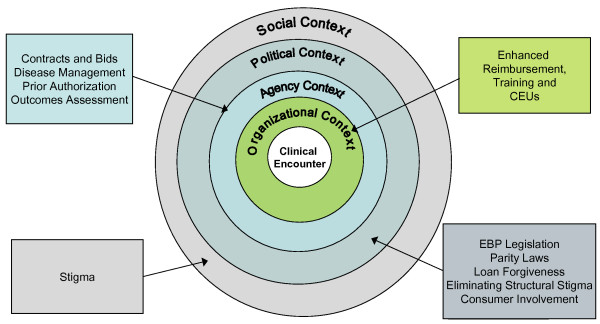
BACKGROUND: Mental health policymaking to support the implementation of evidence-based practices (EBPs) largely has been directed toward clinicians. However, implementation is known to be dependent upon a broader ecology of service delivery. Hence, focusing exclusively on individual clinicians as targets of implementation is unlikely to result in sustainable and widespread implementation of EBPs. DISCUSSION: Policymaking that is informed by the implementation literature requires that policymakers deploy strategies across multiple levels of the ecology of implementation. At the organizational level, policies are needed to resource the added marginal costs of EBPs, and to assist organizational learning by re-engineering continuing education units. At the payor and regulatory levels, policies are needed to creatively utilize contractual mechanisms, develop disease management programs and similar comprehensive care management approaches, carefully utilize provider and organizational profiling, and develop outcomes assessment. At the political level, legislation is required to promote mental health parity, reduce discrimination, and support loan forgiveness programs. Regulations are also needed to enhance consumer and family engagement in an EBP agenda. And at the social level, approaches to combat stigma are needed to ensure that individuals with mental health need access services. SUMMARY: The implementation literature suggests that a single policy decision, such as mandating a specific EBP, is unlikely to result in sustainable implementation. Policymaking that addresses in an integrated way the ecology of implementation at the levels of provider organizations, governmental regulatory agencies, and their surrounding political and societal milieu is required to successfully and sustainably implement EBPs over the long term.
Overview
The claims and statistics of this paper haven’t been checked yet.
Free: it reads the open-access text and checks the first 5 claims that cite a source we can check. Create a free account to check every claim.
Integrity signals
Registry
Cites
Statistics
Figures
Verification
Claims the paper makes
The claims and statistics of this paper haven’t been checked yet.
Free: it reads the open-access text and checks the first 5 claims that cite a source we can check. Create a free account to check every claim.
Claims other papers make about this one
Each is checked against this paper’s own text: does it say what the citing paper says it does?
The cited source says what the claim attributes to it.
In the citing paper
“Funding mechanisms significantly affect sustainability, due to costs associated with training, supervision, documentation, and regulatory compliance (Raghavan et al., 2008).”
From Bridging Traditions and Prevention: Insights into Implementing and Sustaining Substance Use Programs for Urban AI/AN Communities (2026) · cites this paper as Raghavan et al., 2008
The cited source says what the claim attributes to it.
In the citing paper
“Enhanced reimbursement models are essential for covering the increased marginal costs associated with implementing EBPs, which include expenses for training, supervision, productivity losses, and compliance with regulations (Raghavan et al., 2008).”
From Bridging Traditions and Prevention: Insights into Implementing and Sustaining Substance Use Programs for Urban AI/AN Communities (2026) · cites this paper as Raghavan et al., 2008
The cited source says what the claim attributes to it.
In the citing paper
“Expansion of the Outer Setting also brings the updated CFIR into closer alignment with other implementation and policy frameworks [18, 78–80].”
From The updated consolidated framework for implementation research based on user feedback (2022) · cites this paper as [79]
The check wasn’t confident either way, so it gives no verdict — never disputed.
In the citing paper
“To date there has been insufficient exploration of the barriers that communities face in adapting, implementing, and sustaining substance use prevention programs (Dickerson et al., 2020; Raghavan et al., 2008).”
From Bridging Traditions and Prevention: Insights into Implementing and Sustaining Substance Use Programs for Urban AI/AN Communities (2026) · cites this paper as Raghavan et al., 2008
Experimental — accuracy not yet measuredThe check wasn’t confident either way, so it gives no verdict — never disputed.
In the citing paper
“However, limited research has been conducted to understand program implementation and sustainability in AI/AN organizations and communities.”
From Bridging Traditions and Prevention: Insights into Implementing and Sustaining Substance Use Programs for Urban AI/AN Communities (2026) · cites this paper as Raghavan et al., 2008
Experimental — accuracy not yet measured
Self-check
Percentages, sums and reported differences re-computed from the paper’s own numbers.
The self-check needs the paper’s full text.
Citations
Cites
The fifth discipline, the art and practice of the learning organization
Senge, P. M. (1991) · Performance + Instruction · doi:10.1002/pfi.4170300510 · Cited by 20,060
Diffusion of Innovations in Service Organizations: Systematic Review and Recommendations
GREENHALGH, T., ROBERT, G., MACFARLANE, F., BATE, P., & KYRIAKIDOU, O. (2004) · The Milbank Quarterly · doi:10.1111/j.0887-378x.2004.00325.x · Cited by 7,448 · cited 1×
“This literature suggests that, although the clinical encounter is where EBPs are delivered, efforts to promote the implementation of such practices should focus on the wider context of service delivery [24,27,28].”
Evidence-Based Medicine: A New Approach to Teaching the Practice of Medicine
Guyatt, G. (1992) · JAMA · doi:10.1001/jama.1992.03490170092032 · Cited by 4,202
(2005) · Cited by 3,748
(1980) · Health Care Management Review · doi:10.1097/00004010-198005030-00017 · Cited by 2,504
(2001) · PubMed · Cited by 1,709
Ferlie, E. B., & Shortell, S. M. (2001) · The Milbank Quarterly · doi:10.1111/1468-0009.00206 · Cited by 1,335 · cited 1×
“Efforts by governmental agencies to improve quality in Britain [17], Brazil [18], and Germany [19], to name a few examples, have also been largely focused at the clinical level.”
Treating Trauma and Traumatic Grief in Children and Adolescents
Cohen, J. A., Mannarino, A. P., & Deblinger, E. (2006) · Cited by 1,199
Changing Provider Behavior: An Overview of Systematic Reviews of Interventions
Grimshaw, J. M., Shirran, L., Thomas, R., Mowatt, G., Fraser, C., Bero, L., Grilli, R., Harvey, E., Oxman, A., & O’Brien, M. A. (2001) · Medical Care · doi:10.1097/00005650-200108002-00002 · Cited by 778 · cited 1×
“Because single-shot training and didactic approaches are usually ineffective in shaping provider behavior, licensing boards will need to support quality improvement approaches that are rooted in the literature on provider behavioral change [35-38].”
Effectiveness, Transportability, and Dissemination of Interventions: What Matters When?
Schoenwald, S. K., & Hoagwood, K. (2001) · Psychiatric Services · doi:10.1176/appi.ps.52.9.1190 · Cited by 763 · cited 1×
“This shift in policy was to some degree influenced by the wealth of literature that has accumulated in recent years on institutional frameworks [22,23] and organizational factors that can guide implementation efforts [24-26].”
Research works printed but not linked: 15
- Ganju V Implementation of Evidence-Based Practices in State Mental Health Systems: Implications for Research and Effectiveness Studies Schizophrenia Bulletin 2003 29 125 131 12908667 · DOI · Paper page
- U.S. Department of Health and Human Services Substance Abuse and Mental Health Services Administration About Evidence-Based Practices: Shaping Mental Health Services Towards Recovery 2005 Rockville, MD: USDHHS, Substance Abuse and Mental Health Services Administration
- U.S. Department of Health and Human Services Agency for Health Care Policy and Research Using Clinical Practice Guidelines to Evaluate Quality of Care 1995 Rockville, MD: U.S. Department of Health and Human Services
- Oregon Office of Mental Health and Addiction Services Project Plan to Promote the Adoption of Evidence-Based Practices 2004
- U.S. Department of Health and Human Services Substance Abuse and Mental Health Services Administration FY 2005 SAMHSA Grant Awardees – CMHS 2005 Rockville, MD: USDHHS, Substance Abuse and Mental Health Services Administration
- U.S. Department of Health and Human Services Substance Abuse and Mental Health Services Administration FY 2006 SAMHSA Grant Awardees 2006 Rockville, MD: USDHHS, Substance Abuse and Mental Health Services Administration
- Necochea L Identifying State Purchasing Levers for Promoting the Use of Evidence-Based Practice in Substance Abuse Treatment (RWJF Research Meeting Highlight) 2007 Washington, DC: Robert Wood Johnson Foundation
- Brown R Chen A Disease Management Options: Issues for State Medicaid Programs to Consider (Issue Brief) 2004 Washington, DC: Mathematica Policy Research
- Cohen JA Mannarino AP Deblinger E Child and Parent Trauma-Focused Cognitive Behavioral Therapy Treatment Manual 2006 Philadelphia, PA: Drexel University College of Medicine
- Tilly J Elam L Prior Authorization for Medicaid Prescription Drugs in Five States: Lessons for Policy Makers 2003 Washington, DC: Kaiser Family Foundation
- Iowa Consortium for Mental Health Legislation Update 2006
- Youngclarke D Ramos K Evidence-Based Practice: What role should research play in our decision making? California Court Appointed Special Advocate Association 2006
- New Freedom Commission on Mental Health Achieving the Promise: Transforming Mental Health Care in America. Final Report 2003 Rockville, MD
- U.S. Department of Health and Human Services National Institutes of Health Reducing Mental Illness Stigma and Discrimination PAR-07-156 2006 Bethesda, MD: U.S. Department of Health and Human Services, National Institutes of Health
- World Health Organization Child and Adolescent Mental Health Initiatives of the Department of Mental Health and Substance Abuse 2003
Cited by
Items 201–205 of 205
Bullock, H. L., Lavis, J. N., Wilson, M. G., Mulvale, G. M., & Miatello, A. (2021) · Figshare · doi:10.6084/m9.figshare.14432336
Piper, K. N., Haardörfer, R., Escoffery, C., Sheth, A. N., & Sales, J. (2021) · Figshare · doi:10.6084/m9.figshare.14538705
Guérin, E., Garber, B. G., & Dowler, S. (2026) · Journal of Military Veteran and Family Health · doi:10.3138/jmvfh-2025-0002
Okamura, K. H., Cramer, M. A., Palafu, T., Helm, S., Dalisay, F. S., Primack, Z., Ching, D. L. C., Goshgarian-Miller, S., Liu, M., Chin, S. K., et al. (2026) · Substance Abuse Treatment Prevention and Policy · doi:10.1186/s13011-026-00715-8 · Cited by 1
Herting, J. R., Gubner, N. R., Palinkas, L., Lewis, W., Dean, T., Dreste, N., Vick, K., & Walker, S. (2023) · OSF Preprints (OSF Preprints)
Metadata
- Authors
- Raghavan, R., Bright, C. L., & Shadoin, A. L.
- Affiliations
- Washington University in St. Louis (US)
- Corresponding author
- Raghavan, Ramesh
- Venue
- Implementation Science
- Published
- 2008-05-16
- Volume
- 3
- Issue
- 1
- Pages
- 26-26
- ISSN
- 1748-5908 (ISSN-L)
- PMC
- PMC2396668
- OpenAlex
- W2032503405
- Cited by
- 205
- References
- 61
- Citations by year
- 2026: 4 · 2025: 8 · 2024: 18 · 2023: 24 · 2022: 18 · 2021: 23 · 2020: 13 · 2019: 10 · 2018: 13 · 2017: 15 · 2016: 9 · 2015: 12 · 2014: 9 · 2013: 9 · 2012: 12
- FWCI
- 5.16
- Type
- journal article
- Language
- en
- Open access
- gold
- doi.org
- Licence
- Locations
- Implementation Science (publishedVersion, cc-by)
- PubMed Central (publishedVersion, cc-by)
- PubMed (publishedVersion)
- Digital Commons@Becker (Washington University School of Medicine) (submittedVersion)
- DOAJ (DOAJ: Directory of Open Access Journals) (submittedVersion, cc-by-sa)
- Funders
- Washington University in St. Louis
- National Institutes of Health (5p30mh068579-05)
- National Institute of Mental Health (5 P30 MH068579, P30-MH-068579)
- Center for Mental Health Services
- Topics
- Health Sciences › Health Professions › General Health Professions › Health Policy Implementation Science
- Social Sciences › Psychology › Clinical Psychology › Psychiatric care and mental health services
- Health Sciences › Medicine › Psychiatry and Mental health › Mental Health Treatment and Access
- Keywords
- evidence-based practice, mental health policy, public mental health services, mental health parity, disease management programs, care management, mental health stigma, organizational learning, sustainable implementation, mental health law
About these checks
Registry, retraction, Cites and statistics results are computed, not judged, with one exception: a printed reference that no index lists is read once by a model before it counts as a citation error. Claims are extracted by a model and kept only when their quote appears verbatim in the text; each cited source is then checked, with a model’s help, for whether it says what the claim relies on. Those verdicts can be wrong — read the claim’s quote and the cited source before relying on one.
Statistics and arithmetic are recomputed, not judged.
Confidence bands are shown only for fields calibrated on our annotated test set. None is calibrated yet, so no band is shown.
What counts as a claim ›How we measure confidence ›How we check this ›
Are you an author, or do you see a problem with this page? Request a review
Data sources
Bibliographic data: Semantic Scholar, OpenAlex, Crossref.
Contains information from the Semantic Scholar Academic Graph Datasets, made available under the ODC Attribution License (ODC-BY 1.0).
Semantic Scholar’s data is described in: Kinney, R., et al. (2023). The Semantic Scholar Open Data Platform. arXiv:2301.10140.
