

Toward a policy ecology of implementation of evidence-based practices in public mental health settings
Open accessThe DOI matches its Crossref record; 62 of the 63 references it cites were found in a registry or an index.
Abstract
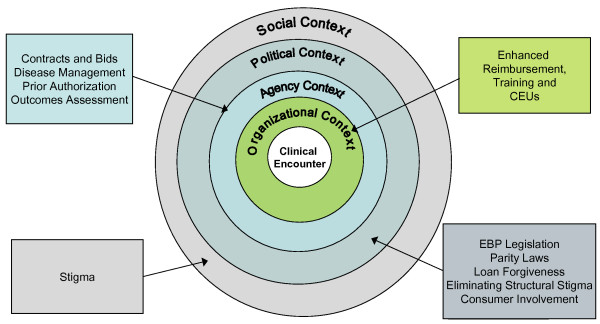
BACKGROUND: Mental health policymaking to support the implementation of evidence-based practices (EBPs) largely has been directed toward clinicians. However, implementation is known to be dependent upon a broader ecology of service delivery. Hence, focusing exclusively on individual clinicians as targets of implementation is unlikely to result in sustainable and widespread implementation of EBPs. DISCUSSION: Policymaking that is informed by the implementation literature requires that policymakers deploy strategies across multiple levels of the ecology of implementation. At the organizational level, policies are needed to resource the added marginal costs of EBPs, and to assist organizational learning by re-engineering continuing education units. At the payor and regulatory levels, policies are needed to creatively utilize contractual mechanisms, develop disease management programs and similar comprehensive care management approaches, carefully utilize provider and organizational profiling, and develop outcomes assessment. At the political level, legislation is required to promote mental health parity, reduce discrimination, and support loan forgiveness programs. Regulations are also needed to enhance consumer and family engagement in an EBP agenda. And at the social level, approaches to combat stigma are needed to ensure that individuals with mental health need access services. SUMMARY: The implementation literature suggests that a single policy decision, such as mandating a specific EBP, is unlikely to result in sustainable implementation. Policymaking that addresses in an integrated way the ecology of implementation at the levels of provider organizations, governmental regulatory agencies, and their surrounding political and societal milieu is required to successfully and sustainably implement EBPs over the long term.
Overview
The claims and statistics of this paper haven’t been checked yet.
Free: it reads the open-access text and checks the first 5 claims that cite a source we can check. Create a free account to check every claim.
Integrity signals
Registry
Cites
Statistics
Figures
Verification
Claims the paper makes
The claims and statistics of this paper haven’t been checked yet.
Free: it reads the open-access text and checks the first 5 claims that cite a source we can check. Create a free account to check every claim.
Claims other papers make about this one
Each is checked against this paper’s own text: does it say what the citing paper says it does?
The cited source says what the claim attributes to it.
In the citing paper
“Funding mechanisms significantly affect sustainability, due to costs associated with training, supervision, documentation, and regulatory compliance (Raghavan et al., 2008).”
From Bridging Traditions and Prevention: Insights into Implementing and Sustaining Substance Use Programs for Urban AI/AN Communities (2026) · cites this paper as Raghavan et al., 2008
The cited source says what the claim attributes to it.
In the citing paper
“Enhanced reimbursement models are essential for covering the increased marginal costs associated with implementing EBPs, which include expenses for training, supervision, productivity losses, and compliance with regulations (Raghavan et al., 2008).”
From Bridging Traditions and Prevention: Insights into Implementing and Sustaining Substance Use Programs for Urban AI/AN Communities (2026) · cites this paper as Raghavan et al., 2008
The cited source says what the claim attributes to it.
In the citing paper
“Expansion of the Outer Setting also brings the updated CFIR into closer alignment with other implementation and policy frameworks [18, 78–80].”
From The updated consolidated framework for implementation research based on user feedback (2022) · cites this paper as [79]
The check wasn’t confident either way, so it gives no verdict — never disputed.
In the citing paper
“To date there has been insufficient exploration of the barriers that communities face in adapting, implementing, and sustaining substance use prevention programs (Dickerson et al., 2020; Raghavan et al., 2008).”
From Bridging Traditions and Prevention: Insights into Implementing and Sustaining Substance Use Programs for Urban AI/AN Communities (2026) · cites this paper as Raghavan et al., 2008
Experimental — accuracy not yet measuredThe check wasn’t confident either way, so it gives no verdict — never disputed.
In the citing paper
“However, limited research has been conducted to understand program implementation and sustainability in AI/AN organizations and communities.”
From Bridging Traditions and Prevention: Insights into Implementing and Sustaining Substance Use Programs for Urban AI/AN Communities (2026) · cites this paper as Raghavan et al., 2008
Experimental — accuracy not yet measured
Self-check
Percentages, sums and reported differences re-computed from the paper’s own numbers.
The self-check needs the paper’s full text.
Citations
Cites
The fifth discipline, the art and practice of the learning organization
Senge, P. M. (1991) · Performance + Instruction · doi:10.1002/pfi.4170300510 · Cited by 20,060
Diffusion of Innovations in Service Organizations: Systematic Review and Recommendations
GREENHALGH, T., ROBERT, G., MACFARLANE, F., BATE, P., & KYRIAKIDOU, O. (2004) · The Milbank Quarterly · doi:10.1111/j.0887-378x.2004.00325.x · Cited by 7,448 · cited 1×
“This literature suggests that, although the clinical encounter is where EBPs are delivered, efforts to promote the implementation of such practices should focus on the wider context of service delivery [24,27,28].”
Evidence-Based Medicine: A New Approach to Teaching the Practice of Medicine
Guyatt, G. (1992) · JAMA · doi:10.1001/jama.1992.03490170092032 · Cited by 4,202
(2005) · Cited by 3,748
(1980) · Health Care Management Review · doi:10.1097/00004010-198005030-00017 · Cited by 2,504
(2001) · PubMed · Cited by 1,709
Ferlie, E. B., & Shortell, S. M. (2001) · The Milbank Quarterly · doi:10.1111/1468-0009.00206 · Cited by 1,335 · cited 1×
“Efforts by governmental agencies to improve quality in Britain [17], Brazil [18], and Germany [19], to name a few examples, have also been largely focused at the clinical level.”
Treating Trauma and Traumatic Grief in Children and Adolescents
Cohen, J. A., Mannarino, A. P., & Deblinger, E. (2006) · Cited by 1,199
Changing Provider Behavior: An Overview of Systematic Reviews of Interventions
Grimshaw, J. M., Shirran, L., Thomas, R., Mowatt, G., Fraser, C., Bero, L., Grilli, R., Harvey, E., Oxman, A., & O’Brien, M. A. (2001) · Medical Care · doi:10.1097/00005650-200108002-00002 · Cited by 778 · cited 1×
“Because single-shot training and didactic approaches are usually ineffective in shaping provider behavior, licensing boards will need to support quality improvement approaches that are rooted in the literature on provider behavioral change [35-38].”
Effectiveness, Transportability, and Dissemination of Interventions: What Matters When?
Schoenwald, S. K., & Hoagwood, K. (2001) · Psychiatric Services · doi:10.1176/appi.ps.52.9.1190 · Cited by 763 · cited 1×
“This shift in policy was to some degree influenced by the wealth of literature that has accumulated in recent years on institutional frameworks [22,23] and organizational factors that can guide implementation efforts [24-26].”
Research works printed but not linked: 15
- Ganju V Implementation of Evidence-Based Practices in State Mental Health Systems: Implications for Research and Effectiveness Studies Schizophrenia Bulletin 2003 29 125 131 12908667 · DOI · Paper page
- U.S. Department of Health and Human Services Substance Abuse and Mental Health Services Administration About Evidence-Based Practices: Shaping Mental Health Services Towards Recovery 2005 Rockville, MD: USDHHS, Substance Abuse and Mental Health Services Administration
- U.S. Department of Health and Human Services Agency for Health Care Policy and Research Using Clinical Practice Guidelines to Evaluate Quality of Care 1995 Rockville, MD: U.S. Department of Health and Human Services
- Oregon Office of Mental Health and Addiction Services Project Plan to Promote the Adoption of Evidence-Based Practices 2004
- U.S. Department of Health and Human Services Substance Abuse and Mental Health Services Administration FY 2005 SAMHSA Grant Awardees – CMHS 2005 Rockville, MD: USDHHS, Substance Abuse and Mental Health Services Administration
- U.S. Department of Health and Human Services Substance Abuse and Mental Health Services Administration FY 2006 SAMHSA Grant Awardees 2006 Rockville, MD: USDHHS, Substance Abuse and Mental Health Services Administration
- Necochea L Identifying State Purchasing Levers for Promoting the Use of Evidence-Based Practice in Substance Abuse Treatment (RWJF Research Meeting Highlight) 2007 Washington, DC: Robert Wood Johnson Foundation
- Brown R Chen A Disease Management Options: Issues for State Medicaid Programs to Consider (Issue Brief) 2004 Washington, DC: Mathematica Policy Research
- Cohen JA Mannarino AP Deblinger E Child and Parent Trauma-Focused Cognitive Behavioral Therapy Treatment Manual 2006 Philadelphia, PA: Drexel University College of Medicine
- Tilly J Elam L Prior Authorization for Medicaid Prescription Drugs in Five States: Lessons for Policy Makers 2003 Washington, DC: Kaiser Family Foundation
- Iowa Consortium for Mental Health Legislation Update 2006
- Youngclarke D Ramos K Evidence-Based Practice: What role should research play in our decision making? California Court Appointed Special Advocate Association 2006
- New Freedom Commission on Mental Health Achieving the Promise: Transforming Mental Health Care in America. Final Report 2003 Rockville, MD
- U.S. Department of Health and Human Services National Institutes of Health Reducing Mental Illness Stigma and Discrimination PAR-07-156 2006 Bethesda, MD: U.S. Department of Health and Human Services, National Institutes of Health
- World Health Organization Child and Adolescent Mental Health Initiatives of the Department of Mental Health and Substance Abuse 2003
Cited by
Items 101–200 of 205
Clinician-Reported Determinants of Evidence-Based Practice Use in Private Practice Mental Health
Milgram, L., Freeman, J. B., Benito, K., Elwy, A. R., & Frank, H. E. (2022) · Journal of Contemporary Psychotherapy · doi:10.1007/s10879-022-09551-w · Cited by 14
“Follow-up probes for each question were informed by the CFIR, as well as by the Policy Ecology Framework (Raghavan et al., 2008).”
MethodInfluentialCruden, G., Crable, E. L., Lengnick‐Hall, R., & Purtle, J. (2023) · Implementation Science Communications · doi:10.1186/s43058-023-00492-6 · Cited by 17
State Policies that Impact the Design of Children’s Mental Health Services: A Modified Delphi Study
Nelson, K. L., Powell, B. J., Langellier, B. A., Lê‐Scherban, F., Shattuck, P. T., Hoagwood, K., & Purtle, J. (2022) · Administration and Policy in Mental Health and Mental Health Services Research · doi:10.1007/s10488-022-01201-6 · Cited by 13
“, municipal, county, state, or federal) to influence use of psychological services (Raghavan et al., 2008), may restrict or facilitate the utilization of mental health services by children who need treatment (Ghandour et al.”
BackgroundFeasibility and Acceptability of a Toolkit to Facilitate Clinician Use of Exposure Therapy for Youth
Becker-Haimes, E. M., Franklin, M., Bodie, J., & Beidas, R. S. (2017) · Evidence-Based Practice in Child and Adolescent Mental Health · doi:10.1080/23794925.2017.1383867 · Cited by 12
Sabri, B., Young, N., Cardenas, I., Emezue, C., & Patch, M. (2024) · Trauma Violence & Abuse · doi:10.1177/15248380241305567 · Cited by 13
“Community settings foster community-wide change (e.g., addressing social norms related to violence and preventing the problem of gun violence) by implementing tailored evidence-based interventions aligned with local needs and cultural contexts (Raghavan et al., 2008).”
Advancing the state-level tracking of evidence-based practices: a case study
Walker, S. C., Sedlar, G. R., Berliner, L., Rodriguez, F. I., Davis, P. A., Johnson, S. L., & Leith, J. (2019) · International Journal of Mental Health Systems · doi:10.1186/s13033-019-0280-0 · Cited by 11
D'Angelo, G., Pullmann, M. D., & Lyon, A. R. (2015) · Administration and Policy in Mental Health and Mental Health Services Research · doi:10.1007/s10488-015-0664-7 · Cited by 13
“…addressing workforce concerns such as changing mental health professional licensing or credentialing requirements to include EBP training (e.g., Raghavan et al. 2008), accessing new funding to train and implement EBPs in less-densely-populated regions, and incentivizing EBP reimbursement by…”
BackgroundWilliams, C. R., Bogdewic, S., Owen, M. D., Srofenyoh, E. K., & Ramaswamy, R. (2020) · Implementation Science · doi:10.1186/s13012-020-00992-2 · Cited by 10
“Implementing evidence-based practices at scale requires simultaneous attention to systems change across multiple levels [14].”
BackgroundSun, J., Safdar, H., Jaffri, Z. U. A., Ibn-ul-Hassan, S., & Öztürk, İ. (2022) · Frontiers in Psychology · doi:10.3389/fpsyg.2022.908391 · Cited by 17
Tsui, J., Shin, M., Sloan, K., Mackie, T. I., García, S., Fehrenbacher, A. E., Crabtree, B. F., & Palinkas, L. A. (2024) · Implementation Science Communications · doi:10.1186/s43058-024-00607-7 · Cited by 11
“By providing strategies across internal and external contexts, opportunities exist to advance multi-level strategies posited widely in implementation science frameworks as critical to supporting the implementation and sustainment of evidence-based practices [44, 46].”
BackgroundCabassa, L. J., & Stefančić, A. (2018) · Translational Behavioral Medicine · doi:10.1093/tbm/iby034 · Cited by 11
“The outer setting includes a variety of system-level factors outside of the organization, such as legislations, reimbursement policies, market pressures for practice innovations, funding priorities, competition and collaborations between organizations, among many others [16].”
BackgroundFrank, H. E., Milgram, L., Freeman, J. B., & Benito, K. (2022) · Frontiers in Health Services · doi:10.3389/frhs.2022.892294 · Cited by 11
“The present study uses the policy ecology framework (33) to assess private practice therapists’ perceptions of multi-level contextual factors that influence their use of EBIs broadly, and exposure therapy specifically.”
BackgroundMethodInfluentialCole, A., Adams, D. R., Ben‐David, S., Sapiro, B., Villodas, M. L., Stanhope, V., Jaccard, J. J., & Munson, M. R. (2023) · Administration and Policy in Mental Health and Mental Health Services Research · doi:10.1007/s10488-023-01254-1 · Cited by 12
“Findings suggest that successful initial implementation and sustainability of a promising multi-component intervention such as Cornerstone needs to consider policymaking to support it on all levels of the ecology (Raghavan et al., 2008).”
BackgroundImplementing a trauma‐informed system of care: An analysis of learning collaborative outcomes
Bills, L. J., Hutchison, S. L., Snider, M. D. H., Skrzypek, B. E., Minnich, C. L., Korney, J. M., Taylor, R. M., & Herschell, A. D. (2023) · Journal of Traumatic Stress · doi:10.1002/jts.22931 · Cited by 17
Pilar, M. R., Purtle, J., Powell, B. J., Mazzucca, S., Eyler, A. A., & Brownson, R. C. (2022) · Community Mental Health Journal · doi:10.1007/s10597-022-00991-1 · Cited by 9
Cochrane Systematic Reviews for the Mental Health Field: Is the Gold Standard Tarnished?
Green‐Hennessy, S. (2013) · Psychiatric Services · doi:10.1176/appi.ps.001682012 · Cited by 10
Dopp, A. R., Hunter, S. B., Godley, M. D., González, I. E., Bongard, M., Han, B., Cantor, J., Hindmarch, G., Lindquist, K. M., Wright, B., et al. (2023) · Implementation Science · doi:10.1186/s13012-023-01305-z · Cited by 7
Stone, E. M., Jopson, A. D., German, D., McCourt, A. D., & McGinty, E. E. (2024) · Psychiatric Services · doi:10.1176/appi.ps.20230451 · Cited by 10
Elligson, R. L., Childs, K. K., & Gryglewicz, K. (2021) · The Journal of Primary Prevention · doi:10.1007/s10935-021-00645-0 · Cited by 13
“Several scholars have documented the challenges of implementing large-scale MH initiatives (e.g., Aarons et al., 2011; Powell et al., 2016; Raghavan et al., 2008).”
BackgroundMackie, T. I., Schaefer, A. J., Palatucci, J. S., Leslie, L. K., Crystal, S., Gusmano, M. K., & Karpman, H. E. (2022) · Administration and Policy in Mental Health and Mental Health Services Research · doi:10.1007/s10488-022-01212-3 · Cited by 7
“However, the absence of these procedural elements in many of the formal policies endorsing informed consent present represents a failure to leverage the potential of formal policies to facilitate compliance and accountability with standards of care (Noonan & Miller, 2013; Raghavan et al., 2008).”
BackgroundExploring How Service Setting Factors Influence Practice of Critical Time Intervention
Chen, F. (2012) · Journal of the Society for Social Work and Research · doi:10.5243/jsswr.2012.4 · Cited by 8
Molfenter, T. D., McCarty, D. W., Capoccia, V., & Gustafson, D. H. (2013) · Public Health Frontier · doi:10.5963/phf0201002 · Cited by 7
“For example, policy changes included a few state projects that held a clause in provider contracts specifying that EBPs be used ([28,29]).”
BackgroundA policy implementation study of earmarked taxes for mental health services: study protocol
Purtle, J., Stadnick, N. A., Wynecoop, M., Bruns, E. J., Crane, M. E., & Aarons, G. A. (2023) · Implementation Science Communications · doi:10.1186/s43058-023-00408-4 · Cited by 12
“The purpose of the interviews will be threefold: [1] to identify jurisdictions that have implemented taxes, [2] to inform the search strings used to identify additional jurisdictions through legal databases and other sources, and [3] to inform development of the policy coding instrument.”
BackgroundWilson, C. A. (2012) · Child Maltreatment · doi:10.1177/1077559512436680 · Cited by 11
Molfenter, T. D., Kim, J.-S., Quanbeck, A., Patel-Porter, T., Starr, S., & McCarty, D. W. (2013) · Implementation Science · doi:10.1186/1748-5908-8-50 · Cited by 8
“This trial is taking lessons from past implementation research through case examples from the Advancing Recovery pilot [33-39], and packages them into an implementation model [18].”
MethodMaxwell, C. A., Ehrhart, M. G., Williams, N. J., Moore, T. M., Kendall, P. C., & Beidas, R. S. (2021) · Administration and Policy in Mental Health and Mental Health Services Research · doi:10.1007/s10488-021-01128-4 · Cited by 8
Contextual Influences and Strategies for Dissemination and Implementation in Mental Health
Benjamin Wolk, C., Powell, B. J., & Beidas, R. S. (2015) · Oxford Handbook Topics in Psychology · doi:10.1093/oxfordhb/9780199935291.013.12 · Cited by 6
Netter, A.-L., Etzelmueller, A., Kircher, T. T. J., Rapley, T., Ebert, D. D., & Brakemeier, E. (2022) · Journal of Technology in Behavioral Science · doi:10.1007/s41347-021-00237-z · Cited by 8
Are we there yet? Evaluation and the knowledge translation journey.
Danseco, E. R., Sundar, P. D., Kasprzak, S., Witteveen, T., Woltman, H., & Manion, I. G. (2009) · PubMed Central · Cited by 10
Evaluating the Planning and Development Phase of a Demonstration Project: At Home / Chez Soi Moncton
Flowers, L., Gaucher, C., & Bourque, J. (2014) · Canadian Journal of Community Mental Health · doi:10.7870/cjcmh-2014-027 · Cited by 8
Stewart, R. E., Adams, D. R., Mandell, D. S., Nangia, G., Shaffer, L. R., Evans, A. C., Rubin, R. M., Weaver, S., Hadley, T. R., & Beidas, R. S. (2017) · Implementation Science · doi:10.1186/s13012-017-0598-4 · Cited by 7
“Policymakers in many large behavioral health systems including Philadelphia, Washington, New York, Hawaii, and Los Angeles County recently have invested significant resources in supporting EBP implementation [11, 12].”
BackgroundMehta, T. G., Atkins, M. S., Neal, J. W., & Walden, A. L. (2018) · Evidence-Based Practice in Child and Adolescent Mental Health · doi:10.1080/23794925.2018.1486687 · Cited by 7
Drysdale, K., Creagh, N., Nightingale, C., Whop, L., & Kelly-Hanku, A. (2025) · Health Promotion International · doi:10.1093/heapro/daaf058 · Cited by 5
“Policies directed towards clinicians only—and thus translated through clinical guidelines and protocols alone—is unlikely to be successful and sustainable (Raghavan et al. 2008, Wortham et al. 2023).”
Okamura, K. H., Palafu, T., An, K. J., Marshall, S. M., Chin, S. K., Stern, K. A., Powell, B. J., Becker, S. J., Mandell, D. S., & Okamoto, S. K. (2024) · School Mental Health · doi:10.1007/s12310-024-09660-y · Cited by 6
Seah, S. J., Tan, C. C. M., Chew, M. S.-L., Lim, J. R. N., Mahirah, D., Ho, Y.-C. L., Lee, S. A., Lee, E.-L., Yoon, S., Marimuttu, V. J., et al. (2025) · Frontiers in Public Health · doi:10.3389/fpubh.2025.1527521 · Cited by 8
Purtle, J., Stadnick, N. A., Wynecoop, M., Walker, S. C., Bruns, E. J., & Aarons, G. A. (2023) · Psychiatric Services · doi:10.1176/appi.ps.20230257 · Cited by 7
Kumar, J. K., Patthi, B., Singla, A., Gupta, R., Prasad, M., & Dhama, K. (2017) · Journal of Indian Association of Public Health Dentistry · doi:10.4103/jiaphd.jiaphd_206_16 · Cited by 7
Asgharzadeh, A., Shabaninejad, H., Aryankhesal, A., & Majdzadeh, R. (2019) · Evidence & Policy · doi:10.1332/174426419x15704986117256 · Cited by 7
Walker, S. C., Ahrens, K. R., Owens, M. D., Parnes, M. F., Langley, J., Ackerley, C. R., Purtle, J., Saldana, L., Aarons, G. A., Hogue, A., et al. (2024) · Implementation Science Communications · doi:10.1186/s43058-024-00583-y · Cited by 5
Evidence-Based Practices or Practice-Based Evidence: What Is the Future?
Horvitz-Lennon, M. V. (2019) · Springer eBooks · doi:10.1007/978-3-030-11908-9_21 · Cited by 9
Ownby, R. L., & Caballero, J. (2025) · Aging and Health Research · doi:10.1016/j.ahr.2025.100258 · Cited by 5
Blake, S., Song, M., Gaydos, L. M., & Cummings, J. R. (2019) · Administration and Policy in Mental Health and Mental Health Services Research · doi:10.1007/s10488-019-00937-y · Cited by 4
Measurement Issues in Dissemination and Implementation Research
Lewis, C. C., Mettert, K. D., Proctor, E. K., & Brownson, R. C. (2023) · Oxford University Press eBooks · doi:10.1093/oso/9780197660690.003.0015 · Cited by 6
Mikhalyuk, I., Stein, L. A. R., Yang, M., Lamoureux, B., Achin, D., & van den Berg, J. J. (2023) · Journal of Affective Disorders · doi:10.1016/j.jad.2023.10.077 · Cited by 6
Coverage of mental health and substance misuse topics in the Cochrane review system
Green‐Hennessy, S. (2012) · Epidemiology and Psychiatric Sciences · doi:10.1017/s2045796012000455 · Cited by 5
“EBP requires clinicians to understand the current research on treatment efficacy (Tanenbaum, 2005; Magnabosco, 2006; Isett et al. 2008; Raghavan et al. 2008; Cooper & Aratani, 2009; Slomski, 2012).”
BackgroundDanseco, E. R., Barber, A. M., Brown, K., & Carter, C. (2017) · Canadian Journal of Community Mental Health · doi:10.7870/cjcmh-2017-014 · Cited by 4
Lindquist, K. M., Mendon, S. J., Timmins, G. T., Dopp, A. R., & Hunter, S. B. (2024) · JAACAP Open · doi:10.1016/j.jaacop.2024.02.002 · Cited by 3
Aby, M., & Benson, O. G. (2021) · Human Services Organizations Management Leadership & Governance · doi:10.1080/23303131.2021.1894293 · Cited by 3
Becker‐Haimes, E. M., Schaechter, T., Green, K. L., Bridges, K., & Jager‐Hyman, S. (2023) · Community Mental Health Journal · doi:10.1007/s10597-023-01208-9 · Cited by 4
“Responses included 138 unique, varied challenges reflecting ten broad themes and spanning across ecological levels (Raghavan et al., 2008; Woodward et al., 2021 ), ranging from structural, policy, and societal factors to individual/intrapersonal factors.”
A Multilevel Framework for Local Policy Development and Implementation
Hodges, S., & Ferreira, K. (2013) · Issues in clinical child psychology · doi:10.1007/978-1-4614-7456-2_14 · Cited by 5
Toward a transformed system to address child abuse and family violence in New Zealand
Foote, J., Taylor, A., Nicholas, G., Carswell, S., Wood, D., Winstanley, A., & Hepi, M. (2014) · Cited by 8
Eiroá‐Orosa, F. J., & MacIntyre, G. (2023) · Frontiers in Psychology · doi:10.3389/fpsyg.2023.1169159 · Cited by 4
“The true integration between different ecological levels (individual practitioner, organizational, regulatory and social levels) of mental health practice evidence remains an ongoing task and there remains an implementation gap between mental health policy and practice (Raghavan et al., 2008; Collins et al., 2013; Bru…”
BackgroundCooper, H. L. F., Hall, K. S., Escoffery, C., Livingston, M. D., Sales, J. M., Mullany, A., Rice, W. S., Ibragimov, U., Kegler, M. C., Sterk, C. E., et al. (2025) · Social Science & Medicine · doi:10.1016/j.socscimed.2025.118344 · Cited by 4
Chaple, M., Kunins, H. V., Nass, M., Benjamin, A. C., Viel, C. R., Bertone, P., Marker, L., Warren, P., & Hartzler, B. J. (2023) · The Journal of Behavioral Health Services & Research · doi:10.1007/s11414-023-09871-2 · Cited by 3
Blossom, J. B., Jenness, J. L., Jungbluth, N. J., Jarvis, C. B., Green, A., Guajardo, K. B., & Schoenfelder, E. N. (2024) · Evidence-Based Practice in Child and Adolescent Mental Health · doi:10.1080/23794925.2024.2392243 · Cited by 3
“Training burden may also contribute to workforce burnout by requiring clinicians to devote time outside work to complete training or potentially experience failure in implementation of complex protocols (Raghavan et al., 2008).”
Walker, S. C., Vick, K., Gubner, N. R., Herting, J. R., & Palinkas, L. A. (2021) · Implementation Science Communications · doi:10.1186/s43058-021-00112-1 · Cited by 3
“In general, this type of evidence-based policymaking, in which decisions are rolled out without sufficient buy-in and understanding, is understood to be counter-productive [38].”
BackgroundFriedberg, R. D. (2015) · Child & Family Behavior Therapy · doi:10.1080/07317107.2015.1104782 · Cited by 3
Conley, C. C., Ryba, M. M., & Andersen, B. L. (2018) · Springer eBooks · doi:10.1007/978-3-319-93003-9_14 · Cited by 2
Lucey, T. K., & Grimm, K. E. (2021) · Journal of Political Ecology · doi:10.2458/jpe.2996 · Cited by 3
“The modified framework displays stigmatization embedded within the social context as in Raghavan et al. (2008); however, we placed individual perceptions of health, disease, and forest use at the center.”
BackgroundMethodInfluentialThe Implementation of Integrated Behavioral Health Models
Zerden, L. D. S., Cruden, G., Lombardi, B. M., Grove, L. R., Patel, S. V., & Powell, B. J. (2019) · Wiley eBooks · doi:10.1002/9781119420743.ch9 · Cited by 2
Exploring safety culture in two hospital emergency departments in Australia: A mixed methods study
Alshyyab, M. A. (2020) · Queensland University of Technology · doi:10.5204/thesis.eprints.174602 · Cited by 3
Palimaru, A. I., Malika, N., Brown, R. A., Holmes, P., Dickerson, D. L., Johnson, C. L., Sanchez, V. A., Schweigman, K., & D’Amico, E. J. (2026) · Journal of Substance Use and Addiction Treatment · doi:10.1016/j.josat.2026.209892 · Cited by 1
Milgram, L., Toranzo, T., Mathews, R. E., & Lewin, A. B. (2025) · Journal of Clinical Psychology · doi:10.1002/jclp.70025 · Cited by 1
Dissemination and Implementation in Social Service Settings
Bunger, A. C., Juckett, L., Lengnick‐Hall, R., Adams, D. R., & McMillen, J. C. (2023) · Oxford University Press eBooks · doi:10.1093/oso/9780197660690.003.0020 · Cited by 1
Korn, A. R., Cruz, J. L., Smith, N., Jacob, R. R., Carney, M., Slater, W., & Ramanadhan, S. (2024) · Journal of Clinical and Translational Science · doi:10.1017/cts.2024.614 · Cited by 2
Powell, B. J. (2014) · Open Scholarship Institutional Repository (Washington University in St. Louis) · doi:10.7936/k7571943 · Cited by 1
“265 opportunities and more closely orient CEU opportunities around evidence-based programs and practices (Raghavan et al., 2008).”
BackgroundPottick, K. J., Tian, X., Kirk, S. A., & Hsieh, D. K. (2017) · Journal of Psychopathology and Behavioral Assessment · doi:10.1007/s10862-017-9599-5 · Cited by 3
“Recent research has suggested that clinicians may be constrained in adopting best practices by the ecology of their organizations, and that our field has relied too heavily on assigning responsibilities to clinicians alone (Raghavan et al. 2008).”
BackgroundDorsey, S., Pullmann, M. D., Kerns, S. E. U., Deblinger, E., Lucid, L., Harrison, J. P., Thompson, K., & Berliner, L. (2018) · Implementation Science · doi:10.1186/s13012-018-0715-z · Cited by 2
Trauma- and Stressor-Related Disorders
Sherrill, A. M., & Rauch, S. A. M. (2018) · Cambridge University Press eBooks · doi:10.1017/9781108140416.031 · Cited by 3
Pervin, M. M. (2023) · eDiss (Georg-August-Universität Göttingen) · doi:10.53846/goediss-9684 · Cited by 1
Implementation Strategies & Outcomes: Methods advances & challenges
Proctor, E. K. (2014) · the Clinical Research Education Library · doi:10.1044/cred-pvid-implscid2p2
Walton, B. A. (2014) · Purdue University Indianapolis (Indiana University)
Geißler, S., & Hultberg, T. (2016) · Lund University Publications Student Papers (Lund University)
CochraneSystematicReviewsfortheMental HealthField:IstheGoldStandardTarnished?
Green‐Hennessy, S. (2013)
White, J. (2019) · Cronfa (Swansea University) · doi:10.23889/suthesis.51971 · Cited by 1
Implementing Research into Everyday Systemic Family Therapy Practice
Withers, M. C., & Duncan, J. M. (2020) · Wiley eBooks · doi:10.1002/9781119438519.ch22
Snider, M. D. H. (2021) · The Research Repository @ WVU (West Virginia University) · doi:10.33915/etd.8339
“Given the growing recognition of systems-level and ecological factors as being important for implementing and sustaining evidence-based practice (Raghavan et al., 2008), system-wide implementation research has been conducted to understand the naturalistic conditions and strategies through which…”
BackgroundImplementing Research into Everyday Systemic Family Therapy Practice
Withers, M. C., & Duncan, J. M. (2020) · Wiley eBooks · doi:10.1002/9781119790181.ch22
Applying implementation science in a clinical setting: A reflective discussion
Philip, S., & Whitnall, L. (2018) · FPOP Bulletin Psychology of Older People · doi:10.53841/bpsfpop.2018.1.142.10
O'BRIEN, A. (2023) · Cronfa (Swansea University) · doi:10.23889/suthesis.63004
Overview of Current Evidence and Practice
Eisenberg, D., & Raghavan, R. (2023) · Oxford University Press eBooks · doi:10.1093/oso/9780190942014.003.0003
Self-citationThe role of health administration technicians in public health policy implementation
Alsulaiman, A. L., Almzairie, K. A., & Alharbi, M. S. S. (2020) · International Journal of Health Sciences · doi:10.53730/ijhs.v4ns1.15278
Rahman, L. (2025) · Open Journal of Social Sciences · doi:10.4236/jss.2025.133042 · Cited by 2
“…such as an agency, nonprofit, school, or government such as municipal, county, state, or federal to influence the use of psychological services (Raghavan et al., 2008), may restrict or facilitate the utilization of mental health services by children who need treatment (Ghandour et al., 2012;…”
Palimaru, A. I., Malika, N. M., Brown, R. A., Holmes, P., Dickerson, D. L., Johnson, C. L., Arvizu-Sanchez, V., Schweigman, K., & D’Amico, E. J. (2025) · SSRN Electronic Journal · doi:10.2139/ssrn.5356994
Bevens, W., Stoeckl, S. E., Eikey, E. V., Schneider, M. L., Stadnick, N. A., Zheng, K., Mukamel, D. B., Sorkin, D. H., & Schueller, S. M. (2026) · Implementation Science Communications · doi:10.1186/s43058-026-01053-3
“This tension is common in multilevel projects where outer context priorities do not align with inner context capacity [23], and where the financial and governance model underpinning a project can unintentionally constrain local adaptation and create barriers to implementation [25].”
Piper, K. N., Haardörfer, R., Escoffery, C., Sheth, A. N., & Sales, J. (2021) · Figshare · doi:10.6084/m9.figshare.14538699
Harkko, J., Sipilä, N., Nordquist, H., Lallukka, T. M., Appelqvist‐Schmidlechner, K., Donnelly, M., & Kouvonen, A. M. (2024) · Figshare · doi:10.6084/m9.figshare.26637918
Wortham, W. K., Rodwin, A. H., Purtle, J., Munson, M. R., & Raghavan, R. (2024) · Figshare · doi:10.6084/m9.figshare.26636769
Self-citationDopp, A. R., Hunter, S. B., Godley, M. D., González, I., Bongard, M., Han, B., Cantor, J., Hindmarch, G., Lindquist, K. M., Wright, B., et al. (2024) · Figshare · doi:10.6084/m9.figshare.26626372
Purtle, J., Stadnick, N. A., Wynecoop, M., Bruns, E. J., Crane, M. E., & Aarons, G. (2023) · Figshare · doi:10.6084/m9.figshare.22618564
Dopp, A. R., Hunter, S. B., Godley, M. D., González, I., Bongard, M., Han, B., Cantor, J., Hindmarch, G., Lindquist, K. M., Wright, B., et al. (2024) · Figshare · doi:10.6084/m9.figshare.26626369
Harkko, J., Sipilä, N., Nordquist, H., Lallukka, T. M., Appelqvist‐Schmidlechner, K., Donnelly, M., & Kouvonen, A. M. (2024) · Figshare · doi:10.6084/m9.figshare.26637924
Dopp, A. R., Hunter, S. B., Godley, M. D., González, I., Bongard, M., Han, B., Cantor, J., Hindmarch, G., Lindquist, K. M., Wright, B., et al. (2024) · Figshare · doi:10.6084/m9.figshare.26626366
Lengnick‐Hall, R., Stadnick, N. A., Dickson, K. S., Moullin, J. C., & Aarons, G. A. (2021) · Figshare · doi:10.6084/m9.figshare.14361570
Purtle, J., Stadnick, N. A., Wynecoop, M., Bruns, E. J., Crane, M. E., & Aarons, G. A. (2023) · Figshare · doi:10.6084/m9.figshare.22618567
Harkko, J., Sipilä, N., Nordquist, H., Lallukka, T. M., Appelqvist‐Schmidlechner, K., Donnelly, M., & Kouvonen, A. M. (2024) · Figshare · doi:10.6084/m9.figshare.26637921
Piper, K. N., Haardörfer, R., Escoffery, C., Sheth, A. N., & Sales, J. (2021) · Figshare · doi:10.6084/m9.figshare.14538708
Piper, K. N., Haardörfer, R., Escoffery, C., Sheth, A. N., & Sales, J. (2021) · Figshare · doi:10.6084/m9.figshare.14538702
Dopp, A. R., Hunter, S. B., Godley, M. D., González, I., Bongard, M., Han, B., Cantor, J., Hindmarch, G., Lindquist, K. M., Wright, B., et al. (2024) · Figshare · doi:10.6084/m9.figshare.26626360
Dopp, A. R., Hunter, S. B., Godley, M. D., González, I., Bongard, M., Han, B., Cantor, J., Hindmarch, G., Lindquist, K. M., Wright, B., et al. (2024) · Figshare · doi:10.6084/m9.figshare.26626363
Metadata
- Authors
- Raghavan, R., Bright, C. L., & Shadoin, A. L.
- Affiliations
- Washington University in St. Louis (US)
- Corresponding author
- Raghavan, Ramesh
- Venue
- Implementation Science
- Published
- 2008-05-16
- Volume
- 3
- Issue
- 1
- Pages
- 26-26
- ISSN
- 1748-5908 (ISSN-L)
- PMC
- PMC2396668
- OpenAlex
- W2032503405
- Cited by
- 205
- References
- 61
- Citations by year
- 2026: 4 · 2025: 8 · 2024: 18 · 2023: 24 · 2022: 18 · 2021: 23 · 2020: 13 · 2019: 10 · 2018: 13 · 2017: 15 · 2016: 9 · 2015: 12 · 2014: 9 · 2013: 9 · 2012: 12
- FWCI
- 5.16
- Type
- journal article
- Language
- en
- Open access
- gold
- doi.org
- Licence
- Locations
- Implementation Science (publishedVersion, cc-by)
- PubMed Central (publishedVersion, cc-by)
- PubMed (publishedVersion)
- Digital Commons@Becker (Washington University School of Medicine) (submittedVersion)
- DOAJ (DOAJ: Directory of Open Access Journals) (submittedVersion, cc-by-sa)
- Funders
- Washington University in St. Louis
- National Institutes of Health (5p30mh068579-05)
- National Institute of Mental Health (5 P30 MH068579, P30-MH-068579)
- Center for Mental Health Services
- Topics
- Health Sciences › Health Professions › General Health Professions › Health Policy Implementation Science
- Social Sciences › Psychology › Clinical Psychology › Psychiatric care and mental health services
- Health Sciences › Medicine › Psychiatry and Mental health › Mental Health Treatment and Access
- Keywords
- evidence-based practice, mental health policy, public mental health services, mental health parity, disease management programs, care management, mental health stigma, organizational learning, sustainable implementation, mental health law
About these checks
Registry, retraction, Cites and statistics results are computed, not judged, with one exception: a printed reference that no index lists is read once by a model before it counts as a citation error. Claims are extracted by a model and kept only when their quote appears verbatim in the text; each cited source is then checked, with a model’s help, for whether it says what the claim relies on. Those verdicts can be wrong — read the claim’s quote and the cited source before relying on one.
Statistics and arithmetic are recomputed, not judged.
Confidence bands are shown only for fields calibrated on our annotated test set. None is calibrated yet, so no band is shown.
What counts as a claim ›How we measure confidence ›How we check this ›
Are you an author, or do you see a problem with this page? Request a review
Data sources
Bibliographic data: Semantic Scholar, OpenAlex, Crossref.
Contains information from the Semantic Scholar Academic Graph Datasets, made available under the ODC Attribution License (ODC-BY 1.0).
Semantic Scholar’s data is described in: Kinney, R., et al. (2023). The Semantic Scholar Open Data Platform. arXiv:2301.10140.
