

Toward a policy ecology of implementation of evidence-based practices in public mental health settings
Open accessThe DOI matches its Crossref record; 62 of the 63 references it cites were found in a registry or an index.
Abstract
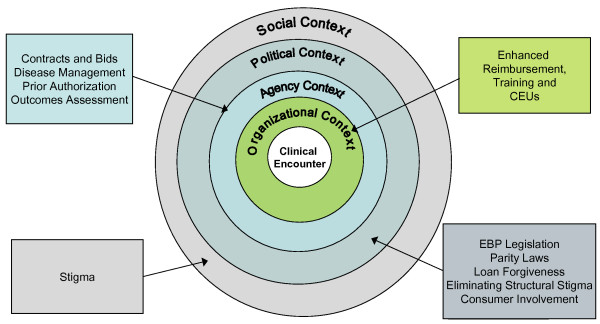
BACKGROUND: Mental health policymaking to support the implementation of evidence-based practices (EBPs) largely has been directed toward clinicians. However, implementation is known to be dependent upon a broader ecology of service delivery. Hence, focusing exclusively on individual clinicians as targets of implementation is unlikely to result in sustainable and widespread implementation of EBPs. DISCUSSION: Policymaking that is informed by the implementation literature requires that policymakers deploy strategies across multiple levels of the ecology of implementation. At the organizational level, policies are needed to resource the added marginal costs of EBPs, and to assist organizational learning by re-engineering continuing education units. At the payor and regulatory levels, policies are needed to creatively utilize contractual mechanisms, develop disease management programs and similar comprehensive care management approaches, carefully utilize provider and organizational profiling, and develop outcomes assessment. At the political level, legislation is required to promote mental health parity, reduce discrimination, and support loan forgiveness programs. Regulations are also needed to enhance consumer and family engagement in an EBP agenda. And at the social level, approaches to combat stigma are needed to ensure that individuals with mental health need access services. SUMMARY: The implementation literature suggests that a single policy decision, such as mandating a specific EBP, is unlikely to result in sustainable implementation. Policymaking that addresses in an integrated way the ecology of implementation at the levels of provider organizations, governmental regulatory agencies, and their surrounding political and societal milieu is required to successfully and sustainably implement EBPs over the long term.
Overview
The claims and statistics of this paper haven’t been checked yet.
Free: it reads the open-access text and checks the first 5 claims that cite a source we can check. Create a free account to check every claim.
Integrity signals
Registry
Cites
Statistics
Figures
Verification
Claims the paper makes
The claims and statistics of this paper haven’t been checked yet.
Free: it reads the open-access text and checks the first 5 claims that cite a source we can check. Create a free account to check every claim.
Claims other papers make about this one
Each is checked against this paper’s own text: does it say what the citing paper says it does?
The cited source says what the claim attributes to it.
In the citing paper
“Funding mechanisms significantly affect sustainability, due to costs associated with training, supervision, documentation, and regulatory compliance (Raghavan et al., 2008).”
From Bridging Traditions and Prevention: Insights into Implementing and Sustaining Substance Use Programs for Urban AI/AN Communities (2026) · cites this paper as Raghavan et al., 2008
The cited source says what the claim attributes to it.
In the citing paper
“Enhanced reimbursement models are essential for covering the increased marginal costs associated with implementing EBPs, which include expenses for training, supervision, productivity losses, and compliance with regulations (Raghavan et al., 2008).”
From Bridging Traditions and Prevention: Insights into Implementing and Sustaining Substance Use Programs for Urban AI/AN Communities (2026) · cites this paper as Raghavan et al., 2008
The cited source says what the claim attributes to it.
In the citing paper
“Expansion of the Outer Setting also brings the updated CFIR into closer alignment with other implementation and policy frameworks [18, 78–80].”
From The updated consolidated framework for implementation research based on user feedback (2022) · cites this paper as [79]
The check wasn’t confident either way, so it gives no verdict — never disputed.
In the citing paper
“To date there has been insufficient exploration of the barriers that communities face in adapting, implementing, and sustaining substance use prevention programs (Dickerson et al., 2020; Raghavan et al., 2008).”
From Bridging Traditions and Prevention: Insights into Implementing and Sustaining Substance Use Programs for Urban AI/AN Communities (2026) · cites this paper as Raghavan et al., 2008
Experimental — accuracy not yet measuredThe check wasn’t confident either way, so it gives no verdict — never disputed.
In the citing paper
“However, limited research has been conducted to understand program implementation and sustainability in AI/AN organizations and communities.”
From Bridging Traditions and Prevention: Insights into Implementing and Sustaining Substance Use Programs for Urban AI/AN Communities (2026) · cites this paper as Raghavan et al., 2008
Experimental — accuracy not yet measured
Self-check
Percentages, sums and reported differences re-computed from the paper’s own numbers.
The self-check needs the paper’s full text.
Citations
Cites
The fifth discipline, the art and practice of the learning organization
Senge, P. M. (1991) · Performance + Instruction · doi:10.1002/pfi.4170300510 · Cited by 20,060
Diffusion of Innovations in Service Organizations: Systematic Review and Recommendations
GREENHALGH, T., ROBERT, G., MACFARLANE, F., BATE, P., & KYRIAKIDOU, O. (2004) · The Milbank Quarterly · doi:10.1111/j.0887-378x.2004.00325.x · Cited by 7,448 · cited 1×
“This literature suggests that, although the clinical encounter is where EBPs are delivered, efforts to promote the implementation of such practices should focus on the wider context of service delivery [24,27,28].”
Evidence-Based Medicine: A New Approach to Teaching the Practice of Medicine
Guyatt, G. (1992) · JAMA · doi:10.1001/jama.1992.03490170092032 · Cited by 4,202
(2005) · Cited by 3,748
(1980) · Health Care Management Review · doi:10.1097/00004010-198005030-00017 · Cited by 2,504
(2001) · PubMed · Cited by 1,709
Ferlie, E. B., & Shortell, S. M. (2001) · The Milbank Quarterly · doi:10.1111/1468-0009.00206 · Cited by 1,335 · cited 1×
“Efforts by governmental agencies to improve quality in Britain [17], Brazil [18], and Germany [19], to name a few examples, have also been largely focused at the clinical level.”
Treating Trauma and Traumatic Grief in Children and Adolescents
Cohen, J. A., Mannarino, A. P., & Deblinger, E. (2006) · Cited by 1,199
Changing Provider Behavior: An Overview of Systematic Reviews of Interventions
Grimshaw, J. M., Shirran, L., Thomas, R., Mowatt, G., Fraser, C., Bero, L., Grilli, R., Harvey, E., Oxman, A., & O’Brien, M. A. (2001) · Medical Care · doi:10.1097/00005650-200108002-00002 · Cited by 778 · cited 1×
“Because single-shot training and didactic approaches are usually ineffective in shaping provider behavior, licensing boards will need to support quality improvement approaches that are rooted in the literature on provider behavioral change [35-38].”
Effectiveness, Transportability, and Dissemination of Interventions: What Matters When?
Schoenwald, S. K., & Hoagwood, K. (2001) · Psychiatric Services · doi:10.1176/appi.ps.52.9.1190 · Cited by 763 · cited 1×
“This shift in policy was to some degree influenced by the wealth of literature that has accumulated in recent years on institutional frameworks [22,23] and organizational factors that can guide implementation efforts [24-26].”
Research works printed but not linked: 15
- Ganju V Implementation of Evidence-Based Practices in State Mental Health Systems: Implications for Research and Effectiveness Studies Schizophrenia Bulletin 2003 29 125 131 12908667 · DOI · Paper page
- U.S. Department of Health and Human Services Substance Abuse and Mental Health Services Administration About Evidence-Based Practices: Shaping Mental Health Services Towards Recovery 2005 Rockville, MD: USDHHS, Substance Abuse and Mental Health Services Administration
- U.S. Department of Health and Human Services Agency for Health Care Policy and Research Using Clinical Practice Guidelines to Evaluate Quality of Care 1995 Rockville, MD: U.S. Department of Health and Human Services
- Oregon Office of Mental Health and Addiction Services Project Plan to Promote the Adoption of Evidence-Based Practices 2004
- U.S. Department of Health and Human Services Substance Abuse and Mental Health Services Administration FY 2005 SAMHSA Grant Awardees – CMHS 2005 Rockville, MD: USDHHS, Substance Abuse and Mental Health Services Administration
- U.S. Department of Health and Human Services Substance Abuse and Mental Health Services Administration FY 2006 SAMHSA Grant Awardees 2006 Rockville, MD: USDHHS, Substance Abuse and Mental Health Services Administration
- Necochea L Identifying State Purchasing Levers for Promoting the Use of Evidence-Based Practice in Substance Abuse Treatment (RWJF Research Meeting Highlight) 2007 Washington, DC: Robert Wood Johnson Foundation
- Brown R Chen A Disease Management Options: Issues for State Medicaid Programs to Consider (Issue Brief) 2004 Washington, DC: Mathematica Policy Research
- Cohen JA Mannarino AP Deblinger E Child and Parent Trauma-Focused Cognitive Behavioral Therapy Treatment Manual 2006 Philadelphia, PA: Drexel University College of Medicine
- Tilly J Elam L Prior Authorization for Medicaid Prescription Drugs in Five States: Lessons for Policy Makers 2003 Washington, DC: Kaiser Family Foundation
- Iowa Consortium for Mental Health Legislation Update 2006
- Youngclarke D Ramos K Evidence-Based Practice: What role should research play in our decision making? California Court Appointed Special Advocate Association 2006
- New Freedom Commission on Mental Health Achieving the Promise: Transforming Mental Health Care in America. Final Report 2003 Rockville, MD
- U.S. Department of Health and Human Services National Institutes of Health Reducing Mental Illness Stigma and Discrimination PAR-07-156 2006 Bethesda, MD: U.S. Department of Health and Human Services, National Institutes of Health
- World Health Organization Child and Adolescent Mental Health Initiatives of the Department of Mental Health and Substance Abuse 2003
Cited by
Proctor, E., Silmere, H., Raghavan, R., Hovmand, P., Aarons, G., Bunger, A., Griffey, R., & Hensley, M. (2011) · Administration and Policy in Mental Health and Mental Health Services Research · doi:10.1007/s10488-010-0319-7 · Cited by 8,721
“Level of Analysis for Outcomes Implementation of new treatments is an inherently multilevel enterprise, involving provider behavior, care organization, and policy (Proctor et al. 2009; Raghavan et al. 2008).”
BackgroundSelf-citationPowell, B. J., Waltz, T. J., Chinman, M. J., Damschroder, L. J., Smith, J. L., Matthieu, M. M., Proctor, E. K., & Kirchner, J. E. (2015) · Implementation Science · doi:10.1186/s13012-015-0209-1 · Cited by 4,963
“[24,31].”
The updated consolidated framework for implementation research based on user feedback
Damschroder, L. J., Reardon, C. M., Widerquist, M. A. O., & Lowery, J. (2022) · Implementation Science · doi:10.1186/s13012-022-01245-0 · Cited by 4,452
A compilation of strategies for implementing clinical innovations in health and mental health
Powell, B. J., McMillen, J. C., Proctor, E. K., Carpenter, C. R., Griffey, R. T., Bunger, A. C., Glass, J. E., & York, J. L. (2012) · Medical Care Research and Review · doi:10.1177/1077558711430690 · Cited by 1,069
“For example, the financial strategy “forgive loans” (Raghavan et al., 2008) is simply one type of financial inducement to adopt a clinical innovation; thus, it was subsumed under the strategy”
BackgroundMethods to Improve the Selection and Tailoring of Implementation Strategies
Powell, B. J., Beidas, R. S., Lewis, C. C., Aarons, G. A., McMillen, J. C., Proctor, E. K., & Mandell, D. S. (2017) · The Journal of Behavioral Health Services & Research · doi:10.1007/s11414-015-9475-6 · Cited by 967
Cabassa, L. J., & Baumann, A. A. (2013) · Implementation Science · doi:10.1186/1748-5908-8-90 · Cited by 290
“plementation and sustainment of EBTs [15,83].”
The Research Network on Youth Mental Health, Aarons, G. A., Glisson, C., Green, P. D., Hoagwood, K., Kelleher, K. J., & Landsverk, J. A. (2012) · Implementation Science · doi:10.1186/1748-5908-7-56 · Cited by 271
“Third, we know that the availability of clinical training and funding may be a necessary but not sufficient condition for successful EBP implementation and that successful implementation strategies must address the context in which EBPs are offered [1,4].”
A Systematic Review of Strategies for Implementing Empirically Supported Mental Health Interventions
Powell, B. J., Proctor, E. K., & Glass, J. E. (2014) · Research on Social Work Practice · doi:10.1177/1049731513505778 · Cited by 268
“First, a modified version of the Cochrane EPOC Data Abstraction Form (Cochrane EPOC Group, 2002b) was used to extract information about the clinical interventions, strategies, outcomes, and results. We created a checklist, guided by the conceptual model of Proctor and colleagues (2009), for extraction of implementatio…”
BackgroundMethodDisruptive innovations for designing and diffusing evidence-based interventions
Rotheram-Borus, M. J., Swendeman, D., & Chorpita, B. F. (2012) · American Psychologist · doi:10.1037/a0028180 · Cited by 210
Expert recommendations for implementing change (ERIC): protocol for a mixed methods study
Waltz, T. J., Powell, B. J., Chinman, M. J., Smith, J. L., Matthieu, M. M., Proctor, E. K., Damschroder, L. J., & Kirchner, J. E. (2014) · Implementation Science · doi:10.1186/1748-5908-9-39 · Cited by 202
“While this particular application of the ERIC process focuses on the implementation of EBPPs in mental health service settings within the VA, these methods are suitable for other practice areas.”
BackgroundInfluentialAarons, G. A., Fettes, D. L., Sommerfeld, D. H., & Palinkas, L. A. (2012) · Child Maltreatment · doi:10.1177/1077559511426908 · Cited by 194
“Thus, as service systems and organizations consider EBP implementation, it will be important to consider EBP fit with their expectations regarding what is acceptable and practical from system, organizational, and provider perspectives (Mendel et al., 2008; Raghavan, Bright, & Shadoin, 2008).”
Bullock, H. L., Lavis, J. N., Wilson, M. G., Mulvale, G., & Miatello, A. (2021) · Implementation Science · doi:10.1186/s13012-021-01082-7 · Cited by 166
Writing implementation research grant proposals: ten key ingredients
Proctor, E. K., Powell, B. J., Baumann, A. A., Hamilton, A. M., & Santens, R. L. (2012) · Implementation Science · doi:10.1186/1748-5908-7-96 · Cited by 169
“[119] discuss the policy ecology of implementation, and emphasize that greater attention should be paid to marginal costs associated with implementing evidencebased treatments, including expenses for provider training, supervision, and consultation.”
BackgroundQuantitative measures of health policy implementation determinants and outcomes: a systematic review
Allen, P., Pilar, M., Walsh-Bailey, C., Hooley, C., Mazzucca, S., Lewis, C. C., Mettert, K. D., Dorsey, C. N., Purtle, J., Kepper, M. M., et al. (2020) · Implementation Science · doi:10.1186/s13012-020-01007-w · Cited by 164
Organizational theory for dissemination and implementation research
Birken, S. A., Bunger, A. C., Powell, B. J., Turner, K., Clary, A. S., Klaman, S. L., Yu, Y., Whitaker, D. J., Self, S. R., Rostad, W. L., et al. (2017) · Implementation Science · doi:10.1186/s13012-017-0592-x · Cited by 156
WALSH, S. L., El‐Bassel, N., Jackson, R. D., Samet, J. H., Aggarwal, M., Aldridge, A., Baker, T. J., Barbosa, C., Barocas, J. A., Battaglia, T. A., et al. (2020) · Drug and Alcohol Dependence · doi:10.1016/j.drugalcdep.2020.108335 · Cited by 177
The Importance of Policy Change for Addressing Public Health Problems
Porter, K. M. P., Rutkow, L., & McGinty, E. E. (2018) · Public Health Reports · doi:10.1177/0033354918788880 · Cited by 184
Wang, D. Y., Wong, E. L., Nilsén, P., Chung, V. C., Tian, Y., & Yeoh, E. (2023) · Implementation Science · doi:10.1186/s13012-023-01296-x · Cited by 175
“However, evidence indicated that policymaking explicitly facilitated the adoption and implementation of evidence-based practices [132, 133].”
BackgroundChild and Family Therapy Process: Concordance of Therapist and Observational Perspectives
Hurlburt, M. S., Garland, A. F., Nguyen, K., & Brookman-Frazee, L. (2010) · Administration and Policy in Mental Health and Mental Health Services Research · doi:10.1007/s10488-009-0251-x · Cited by 124
“…practice is reflected in the number of unique organizations supporting collection, summary, and dissemination of information about scientific support for specific practices (Goldman and Azrin 2003), and in policies and legislation that have been adopted in some states (Raghavan et al. 2008).”
BackgroundLengnick-Hall, R., Stadnick, N. A., Dickson, K. S., Moullin, J. C., & Aarons, G. A. (2021) · Implementation Science · doi:10.1186/s13012-021-01099-y · Cited by 119
Advancing health equity through a theoretically critical implementation science
Snell‐Rood, C., Jaramillo, E. T., Hamilton, A. B., Raskin, S. E., Nicosia, F. M., & Willging, C. E. (2021) · Translational Behavioral Medicine · doi:10.1093/tbm/ibab008 · Cited by 132
“tion framework [75] to directly address power”
Practical Implementation Science: Developing and Piloting the Quality Implementation Tool
Meyers, D. C., Katz, J., Chien, V., Wandersman, A., Scaccia, J. P., & Wright, A. (2012) · American Journal of Community Psychology · doi:10.1007/s10464-012-9521-y · Cited by 111
Evidence-based practices in addiction treatment: Review and recommendations for public policy
Glasner-Edwards, S., & Rawson, R. (2010) · Health Policy · doi:10.1016/j.healthpol.2010.05.013 · Cited by 109
“System-level change has therefore been an emphasis of numerous discussions in recent years concerning EBP dissemination strategies [55–58].”
BackgroundAarons, G. A., Green, A. E., Willging, C. E., Ehrhart, M. G., Roesch, S. C., Hecht, D. B., & Chaffin, M. J. (2014) · Implementation Science · doi:10.1186/s13012-014-0183-z · Cited by 107
“Such a multifaceted approach is likely necessary to sustain EBIs on a large scale [19].”
BackgroundStirman, S. W., Gutner, C. A., Langdon, K., & Graham, J. R. (2016) · Behavior Therapy · doi:10.1016/j.beth.2015.12.001 · Cited by 103
Powell, B. J., Mandell, D. S., Hadley, T. R., Rubin, R. M., Evans, A. C., Hurford, M. O., & Beidas, R. S. (2017) · Implementation Science · doi:10.1186/s13012-017-0593-9 · Cited by 102
“[58] provide a broad overview of the effort by describing the aforementioned strategies (and more) and linking them to the policy ecology model of implementation [61].”
BackgroundStewart, R. E., Adams, D. R., Mandell, D. S., Hadley, T. R., Evans, A. C., Rubin, R., Erney, J., Neimark, G., Hurford, M. O., & Beidas, R. S. (2016) · Psychiatric Services · doi:10.1176/appi.ps.201500392 · Cited by 86
“More research is needed to identify and evaluate effective financial incentives (5).”
BackgroundApplying the Policy Ecology Framework to Philadelphia’s Behavioral Health Transformation Efforts
Powell, B. J., Beidas, R. S., Rubin, R. M., Stewart, R. E., Wolk, C. B., Matlin, S. L., Weaver, S., Hurford, M. O., Evans, A. C., Hadley, T. R., et al. (2016) · Administration and Policy in Mental Health and Mental Health Services Research · doi:10.1007/s10488-016-0733-6 · Cited by 82
“For instance, it may be useful to use a multi-level framework such as the policy ecology framework (Raghavan et al. 2008) or EPIS model (Aarons et al.”
BackgroundMethodInfluentialNelson, G. B., Stefančić, A., Rae, J., Townley, G., Tsemberis, S. J., Macnaughton, E., Aubry, T., Distasio, J., Hurtubise, R., Patterson, M., et al. (2013) · Evaluation and Program Planning · doi:10.1016/j.evalprogplan.2013.10.004 · Cited by 98
“…to the needs racialized groups), while support system factors include the training and technical assistance provided by MHCC. Bond (2009), Durlak and DuPre (2008), and Raghavan et al. (2008) have all noted the importance of systems level support for the implementation of evidence-based practices.”
BackgroundDopp, A. R., Narcisse, M.-R., Mundey, P., Silovsky, J. F., Smith, A. B., Mandell, D., Funderburk, B. W., Powell, B. J., Schmidt, S., Edwards, D., et al. (2020) · Implementation Research and Practice · doi:10.1177/2633489520939980 · Cited by 79
“…requires them to engage in many activities beyond typical service provision (Bruns et al., 2016; Chambers et al., 2013; McHugh & Barlow, 2010; Raghavan et al., 2008; Schoenwald et al., 2011), such as monitoring treatment outcomes, fidelity, and adaptations; delivery of non-routine services…”
BackgroundPurtle, J., Lê‐Scherban, F., Wang, X., Shattuck, P. T., Proctor, E. K., & Brownson, R. C. (2018) · Implementation Science · doi:10.1186/s13012-018-0816-8 · Cited by 82
Purtle, J., Nelson, K. L., Bruns, E. J., & Hoagwood, K. (2020) · Psychiatric Services · doi:10.1176/appi.ps.201900527 · Cited by 84
So, M., McCord, R. F., & Kaminski, J. W. (2019) · Administration and Policy in Mental Health and Mental Health Services Research · doi:10.1007/s10488-018-00916-9 · Cited by 73
“2013), and would be an important area for investigation now that certain states have recently begun to pass laws requiring the use of evidence-based therapies for publicly-funded children’s behavioral health services (Raghavan et al. 2008; Trupin and Kerns 2017).”
InfluentialA Concept Mapping Approach to Guide and Understand Dissemination and Implementation
Green, A. E., Fettes, D. L., & Aarons, G. A. (2012) · The Journal of Behavioral Health Services & Research · doi:10.1007/s11414-012-9291-1 · Cited by 83
Rana, K., Greenwood, J., & Fox-Turnbull, W. H. (2019) · The Electronic Journal of Information Systems in Developing Countries · doi:10.1002/isd2.12118 · Cited by 122
Nadeem, E., Saldana, L., Chapman, J. E., & Schaper, H. (2017) · Behavior Therapy · doi:10.1016/j.beth.2017.12.004 · Cited by 81
“, 2013), expert consultation for both clinicians and leadership that extended beyond the initial workshop training (Davis et al., 1995; Ferlie & Shortell, 2001; Nadeem et al., 2013; Raghavan et al., 2008), and ongoing engagement of the city leadership and the purveyors (Aarons et al.”
BackgroundCosts to Community Mental Health Agencies to Sustain an Evidence-Based Practice
Roundfield, K. D., & Lang, J. M. (2017) · Psychiatric Services · doi:10.1176/appi.ps.201600193 · Cited by 60
“Many of these implementation costs fall on the shoulders of the CMHA tasked with delivering the EBP (8).”
BackgroundFour very basic ways to think about policy in implementation science
Purtle, J., Moucheraud, C., Yang, L. H., & Shelley, D. (2023) · Implementation Science Communications · doi:10.1186/s43058-023-00497-1 · Cited by 68
“…change,” “change liability laws,” “change accreditation or membership require-ments”) [54], “policy categories” in the Behavior Change Wheel (e.g., “legislation, “regulation,” “fiscal measures”) [55], and the Policy Ecology Framework (e.g., “EBP legislation,” “parity laws,” loan forgiveness”) [56].”
Workforce Development and the Organization of Work: The Science We Need
Schoenwald, S. K., Hoagwood, K. E., Atkins, M. S., Evans, M. E., & Ringeisen, H. (2010) · Administration and Policy in Mental Health and Mental Health Services Research · doi:10.1007/s10488-010-0278-z · Cited by 54
“Numerous authors have proposed changes in policy needed to facilitate the broader deployment of effective services (see, e.g., Raghavan et al. 2008; Isett et al. 2007; Rossi 1978).”
Purtle, J., Dodson, E. A., Nelson, K. L., Meisel, Z. F., & Brownson, R. C. (2018) · Psychiatric Services · doi:10.1176/appi.ps.201800153 · Cited by 53
Nadeem, E., Weiss, D., Olin, S.-C. S., Hoagwood, K., & Horwitz, S. M. (2016) · Administration and Policy in Mental Health and Mental Health Services Research · doi:10.1007/s10488-016-0735-4 · Cited by 57
Evidence and Evidence-Based Practices: Are We There Yet?
Schalock, R. L., Gómez, L. E., Alonso, M. Á. V., & Claes, C. (2017) · Intellectual and developmental disabilities · doi:10.1352/1934-9556-55.2.112 · Cited by 72
Psychometric properties of the Dutch version of the Evidence-Based Practice Attitude Scale (EBPAS)
van Sonsbeek, M. A. M. S., Hutschemaekers, G. J. M., Veerman, J. W., Kleinjan, M., Aarons, G. A., & Tiemens, B. G. (2015) · Health Research Policy and Systems · doi:10.1186/s12961-015-0058-z · Cited by 60
“Multiple factors at community, organizational, and individual levels influence the dissemination and implementation of EBP in real-world mental healthcare settings [8-10].”
BackgroundThe Use of Quality of Life Scores for Monitoring and Reporting, Quality Improvement, and Research
Schalock, R. L., Baker, A., Claes, C., Gonzalez, J., Malatest, R., van Loon, J. H. M., Verdugo, M. A., & Wesley, G. (2018) · Journal of Policy and Practice in Intellectual Disabilities · doi:10.1111/jppi.12250 · Cited by 45
Damian, A. J., Gallo, J. J., Leaf, P. J., & Mendelson, T. (2017) · BMC Health Services Research · doi:10.1186/s12913-017-2695-0 · Cited by 70
The next phase in professional services research: From implementation to sustainability
Crespo-Gonzalez, C., Garcia-Cardenas, V., & Benrimoj, S. I. (2017) · Research in Social and Administrative Pharmacy · doi:10.1016/j.sapharm.2017.05.020 · Cited by 45
Strategies for enacting health policy codesign: a scoping review and direction for research
Walker, S. C., Baquero, B. I., Bekemeier, B., Parnes, M. F., & Arora, K. (2023) · Implementation Science · doi:10.1186/s13012-023-01295-y · Cited by 52
The Updated Consolidated Framework for Implementation Research: CFIR 2.0Preprint
Damschroder, L. J., Reardon, C. M., Widerquist, M. A. O., & Lowery, J. C. (2022) · Research Square · doi:10.21203/rs.3.rs-1581880/v1 · Cited by 42
Measuring Costs to Community-Based Agencies for Implementation of an Evidence-Based Practice
Lang, J. M., & Connell, C. M. (2017) · The Journal of Behavioral Health Services & Research · doi:10.1007/s11414-016-9541-8 · Cited by 41
“Many of the costs associated with implementation are borne by the clinics whose staff are trained to deliver the EBP.18 Yet it is notable that virtually none of the cost savings attributed to EBPs—future reductions in healthcare utilization, improved work productivity, and decreases in crime—are realized by the clinic…”
BackgroundInfluentialLewis, C. C., Darnell, D. A., Kerns, S. E. U., Monroe‐DeVita, M., Landes, S. J., Lyon, A. R., Stanick, C., Dorsey, S., Locke, J. J., Marriott, B. R., et al. (2016) · Implementation Science · doi:10.1186/s13012-016-0428-0 · Cited by 49
Purtle, J., Brownson, R. C., & Proctor, E. K. (2016) · Administration and Policy in Mental Health and Mental Health Services Research · doi:10.1007/s10488-016-0752-3 · Cited by 41
“, parity laws that ensure insurance coverage, loan repayment programs that address workforce shortages) (Raghavan et al. 2008).”
BackgroundInfluentialDissemination Science in School Mental Health: A Framework for Future Research
Baker, E. A., Brewer, S. K., Owens, J. S., Cook, C. R., & Lyon, A. R. (2021) · School Mental Health · doi:10.1007/s12310-021-09446-6 · Cited by 46
Park, A. L., Tsai, K. H., Guan, K., & Chorpita, B. F. (2018) · Administration and Policy in Mental Health and Mental Health Services Research · doi:10.1007/s10488-018-0853-2 · Cited by 41
Dopp, A. R., Manuel, J. K., Breslau, J., Lodge, B., Hurley, B., Kase, C., & Osilla, K. C. (2022) · Journal of Substance Abuse Treatment · doi:10.1016/j.jsat.2021.108652 · Cited by 38
Starin, A. C., Atkins, M. S., Wehrmann, K. C., Mehta, T. G., Hesson-McInnis, M. S., Maríñez-Lora, A. M., & Mehlinger, R. (2013) · Journal of Clinical Child & Adolescent Psychology · doi:10.1080/15374416.2013.848772 · Cited by 44
Beidas, R. S., Ahmedani, B. K., Linn, K. A., Marcus, S. C., Johnson, C., Maye, M. P., Westphal, J. A., Wright, L., Beck, A. L., Buttenheim, A. M., et al. (2021) · Implementation Science · doi:10.1186/s13012-021-01154-8 · Cited by 41
“Third, we will assess the costs of the implementation strategies, which have been understudied to date [109, 110].”
Stirman, S. W., Gutierrez‐Colina, A. M., Toder, K., Esposito, G., Barg, F. K., Castro, F., Beck, A. T., & Crits-Christoph, P. F. (2012) · Administration and Policy in Mental Health and Mental Health Services Research · doi:10.1007/s10488-012-0418-8 · Cited by 43
“…and systems, it is critical to capture indepth information on potential influences of success at multiple levels, including but not limited to the level of the provider, organization, and mental health system (Aarons et al. 2011; Mendel et al. 2008; Raghavan et al. 2008; Stetler et al. 2006a, b).”
BackgroundMcMillen, J. C., Hawley, K. M., & Proctor, E. K. (2015) · Administration and Policy in Mental Health and Mental Health Services Research · doi:10.1007/s10488-015-0645-x · Cited by 40
Wiltsey Stirman, S., Finley, E. P., Shields, N., Cook, J., Haine-Schlagel, R., Burgess, J. F., Dimeff, L., Koerner, K., Suvak, M., Gutner, C. A., et al. (2017) · Implementation Science · doi:10.1186/s13012-017-0544-5 · Cited by 35
Nelson, G. B., Macnaughton, E., Goering, P. N., Dudley, M. Q., O'Campo, P. J., Patterson, M., Piat, M., Prévost, N., Strehlau, V., & Vallée, C. (2012) · American Journal of Community Psychology · doi:10.1007/s10464-012-9554-2 · Cited by 36
Schmidt, L. A., Rieckmann, T. R., Abraham, A. J., Molfenter, T. D., Capoccia, V., Roman, P. M., Gustafson, D. H., & McCarty, D. W. (2012) · Journal of Studies on Alcohol and Drugs · doi:10.15288/jsad.2012.73.413 · Cited by 32
“Despite generally acknowledging that systems matter (Black, 2001; MarinelliCasey et al., 2002; Miller and Wilbourne, 2002), evidence about how they matter is largely anecdotal and confi ned to isolated case studies (Raghavan et al., 2008; Rapp et al., 2005).”
BackgroundInfluentialStewart, R. E., Mandell, D. S., & Beidas, R. S. (2021) · Psychiatric Services · doi:10.1176/appi.ps.202000209 · Cited by 31
Advancing Implementation Research and Practice in Behavioral Health Systems
Powell, B. J., & Beidas, R. S. (2016) · Administration and Policy in Mental Health and Mental Health Services Research · doi:10.1007/s10488-016-0762-1 · Cited by 34
“Powell and colleagues (this issue) describe the approach taken by the City of Philadelphia to implement four EBPs, using the policy ecology framework (Raghavan et al. 2008) to emphasize the multi-level implementation strategies used.”
BackgroundMethodInfluentialCocreating evidence‐informed health equity policy with community
Walker, S. C., White, J., Rodriguez, V., Turk, E., Gubner, N. R., Ngo, S., & Bekemeier, B. (2022) · Health Services Research · doi:10.1111/1475-6773.13940 · Cited by 30
Dopp, A. R., Hunter, S. B., Godley, M. D., Pham, C., Han, B., Smart, R., Cantor, J., Kilmer, B., Hindmarch, G., González, I. E., et al. (2022) · Implementation Science Communications · doi:10.1186/s43058-022-00298-y · Cited by 28
Purtle, J., Lê‐Scherban, F., WANG, X., Shattuck, P. T., Proctor, E. K., & Brownson, R. C. (2019) · Milbank Quarterly · doi:10.1111/1468-0009.12431 · Cited by 30
“The purpose of our study is (1) to describe the associations between legislators’ fixed and mutable characteristics, state-level contextual factors, and support for C-SBHPL; and (2) to identify the mutable characteristics of legislators independently associated with C-SBHPL support.”
BackgroundSimulating the role of knowledge brokers in policy making in state agencies: An agent‐based model
Combs, T., Nelson, K. L., Luke, D. A., McGuire, F. H., Cruden, G., Henson, R. M., Adams, D. R., Hoagwood, K., & Purtle, J. (2022) · Health Services Research · doi:10.1111/1475-6773.13916 · Cited by 29
Last, B. S., Schriger, S. H., Timon, C. E., Frank, H. E., Buttenheim, A. M., Rudd, B. N., Fernandez-Marcote, S., Comeau, C., Shoyinka, S. O., & Beidas, R. S. (2021) · Implementation Science Communications · doi:10.1186/s43058-020-00105-6 · Cited by 31
Harkko, J., Sipilä, N., Nordquist, H., Lallukka, T. M., Appelqvist‐Schmidlechner, K., Donnelly, M., & Kouvonen, A. M. (2023) · Implementation Science · doi:10.1186/s13012-023-01316-w · Cited by 35
Wasserman, D. (2024) · World Psychiatry · doi:10.1002/wps.21185 · Cited by 31
Policy Makers’ Priorities for Addressing Youth Substance Use and Factors That Influence Priorities
Purtle, J., Nelson, K. L., Henson, R. M., Horwitz, S. M., McKay, M. M., & Hoagwood, K. (2021) · Psychiatric Services · doi:10.1176/appi.ps.202000919 · Cited by 30
Go, V. F.-L., Morales, G., Mai, N. V. T., Brownson, R. C., Hà, T. V., & Miller, W. C. (2015) · Implementation Science · doi:10.1186/s13012-016-0420-8 · Cited by 28
“Service settings vary substantially with regard to contextual factors such as patient characteristics [19, 20], provider attitudes toward an EBI [21], organizational readiness [22], leadership [23], and policies [24].”
BackgroundState Adoption of Incentives to Promote Evidence-Based Practices in Behavioral Health Systems
Stewart, R. E., Marcus, S. C., Hadley, T. R., Hepburn, B. M., & Mandell, D. S. (2018) · Psychiatric Services · doi:10.1176/appi.ps.201700508 · Cited by 27
Piper, K. N., Haardörfer, R., Escoffery, C., Sheth, A. N., & Sales, J. M. (2021) · Implementation Science Communications · doi:10.1186/s43058-021-00148-3 · Cited by 25
“systems-level policies and funding structures [31, 32].”
McGinty, E. E., Seewald, N. J., Bandara, S. N., Cerdá, M., Daumit, G. L., Eisenberg, M. D., Griffin, B. A., Igusa, T., Jackson, J. W., Kennedy‐Hendricks, A., et al. (2022) · Prevention Science · doi:10.1007/s11121-022-01427-8 · Cited by 30
“…like the ACA Medicaid health home waiver, that is designed to prompt implementation of an evidence-based based practice, other related policies can also influence implementation of that practice, a concept exemplified by Raghavan and colleagues’ policy ecology framework (Raghavan et al., 2008).”
Synchronizing Watches: The Challenge of Aligning Implementation Science and Public Systems
Rubin, R. M., Hurford, M. O., Hadley, T. R., Matlin, S., Weaver, S., & Evans, A. C. (2016) · Administration and Policy in Mental Health and Mental Health Services Research · doi:10.1007/s10488-016-0759-9 · Cited by 31
“Implementation science frameworks include financing as a critical part of the outer context (Aarons et al. 2011; Damschroder et al. 2009; Raghavan et al. 2008) and it has been identified as a key facilitator and barrier for implementation (Beidas et al.”
BackgroundAn ecological framework for population health and well-being
Pronk, N. P., Woodard, C., Zimmerman, F. J., & Arena, R. A. (2025) · Progress in Cardiovascular Diseases · doi:10.1016/j.pcad.2025.03.013 · Cited by 31
A Primer for the Design of Practice Manuals: Four Stages of Development
Galinsky, M. J., Fräser, M. W., Day, S. H., & Richman, J. M. (2012) · Research on Social Work Practice · doi:10.1177/1049731512468957 · Cited by 30
Qiao, S., Li, X., Zhou, Y., Shen, Z., & STANTON, B. F. (2018) · PLoS ONE · doi:10.1371/journal.pone.0202166 · Cited by 29
Tiderington, E., Ikeda, J., & Lovell, A. (2020) · The Journal of Behavioral Health Services & Research · doi:10.1007/s11414-019-09680-6 · Cited by 21
Aarons, G. A., Sommerfeld, D. H., Chi, B. H., Ezeanolue, E. E., Sturke, R., Guay, L. A., & Siberry, G. K. (2016) · JAIDS Journal of Acquired Immune Deficiency Syndromes · doi:10.1097/qai.0000000000001064 · Cited by 22
Pilar, M. R., Jost, E., Walsh‐Bailey, C., Powell, B. J., Mazzucca, S., Eyler, A. A., Purtle, J., Allen, P. M., & Brownson, R. C. (2022) · Implementation Research and Practice · doi:10.1177/26334895221141116 · Cited by 30
“…determinants of health (SDOH; i.e., economic stability, built environment, health and healthcare, social context, and education) (Dawes, 2016; Rust et al., 2015), concepts such as a stigma and discrimination for those with mental illness, as well as healthcare infrastructure, housing,…”
BackgroundDopp, A. R., Gilbert, M., Silovsky, J. F., Ringel, J. S., Schmidt, S. R., Funderburk, B. W., Jorgensen, A. G., Powell, B. J., Luke, D. A., Mandell, D. S., et al. (2022) · Implementation Science Communications · doi:10.1186/s43058-021-00234-6 · Cited by 22
Skriner, L. C., Wolk, C. B., Stewart, R. E., Adams, D. R., Rubin, R. M., Evans, A. C., & Beidas, R. S. (2017) · The Journal of Behavioral Health Services & Research · doi:10.1007/s11414-017-9552-0 · Cited by 26
Sheldrick, R. C., Cruden, G., Schaefer, A. J., & Mackie, T. I. (2021) · Implementation Science Communications · doi:10.1186/s43058-021-00218-6 · Cited by 19
Wortham, W. K., Rodwin, A. H., Purtle, J., Munson, M. R., & Raghavan, R. (2023) · Implementation Science · doi:10.1186/s13012-023-01309-9 · Cited by 20
“The Policy Ecology Framework (PEF) [7] was developed as a tactical primer for state and local mental health regulators in the field of child mental health.”
BackgroundMethodInfluentialSelf-citationDissemination and Implementation Research
Proctor, E. K. (2014) · Oxford University Press eBooks · doi:10.1093/acrefore/9780199975839.013.900 · Cited by 16
Bunger, A. C., Nooraie, R. Y., Warren, K. L., Cao, Q., Dadgostar, P., & Bustos, T. E. (2023) · Implementation Science · doi:10.1186/s13012-023-01266-3 · Cited by 16
The Policy Ecology of Behavioral Health Homes: Case Study of Maryland’s Medicaid Health Home Program
Stone, E. M., Daumit, G. L., Kennedy‐Hendricks, A., & McGinty, E. E. (2019) · Administration and Policy in Mental Health and Mental Health Services Research · doi:10.1007/s10488-019-00973-8 · Cited by 16
En Route to Implementation Science 3.0
Albers, B., Shlonsky, A., & Mildon, R. L. (2020) · Springer eBooks · doi:10.1007/978-3-030-03874-8_1 · Cited by 30
Purtle, J., Nelson, K. L., Lengnick‐Hall, R., Horwitz, S. M., Palinkas, L. A., McKay, M. M., & Hoagwood, K. (2022) · Health Services Research · doi:10.1111/1475-6773.13955 · Cited by 16
Increasing Access to Organization Theories for Implementation Science
Birken, S. A., Ko, L. K., Wangen, M., Wagi, C. R., Bender, M., Nilsen, P., Choy-Brown, M., Peluso, A., & Leeman, J. (2022) · Frontiers in Health Services · doi:10.3389/frhs.2022.891507 · Cited by 19
Purtle, J., Borchers, B., Clement, T., & Mauri, A. I. (2017) · The Journal of Behavioral Health Services & Research · doi:10.1007/s11414-017-9581-8 · Cited by 16
Aby, M. (2020) · Administration and Policy in Mental Health and Mental Health Services Research · doi:10.1007/s10488-020-01033-2 · Cited by 14
“From the PEI Framework perspective, DHS (state government context) implemented legislation (political context) by funding mental health provider agencies (agency context) to supervise, train, and financially support licensure activities for clinical trainees of color (clinical trainee context), including but not limit…”
BackgroundMethodInfluentialGraaf, G., & Snowden, L. (2021) · Administration and Policy in Mental Health and Mental Health Services Research · doi:10.1007/s10488-020-01061-y · Cited by 14
Pervin, M. M., & Hagmayer, Y. (2022) · Administration and Policy in Mental Health and Mental Health Services Research · doi:10.1007/s10488-022-01205-2 · Cited by 23
Evidence-Based Programs in “Real World” Settings: Finding the Best Fit
Powell, B. J., Bosk, E. A., Wilen, J. S., Danko, C. M., Scoyoc, A. V., & Banman, A. (2015) · Child maltreatment · doi:10.1007/978-3-319-16327-7_7 · Cited by 16
Bright, C. L., Raghavan, R., Kliethermes, M. D., Juedemann, D., & Dunn, J. (2010) · Residential Treatment for Children & Youth · doi:10.1080/08865711003712485 · Cited by 17
Self-citationPrincipals’ Decisions: Implementing Response to Intervention
Printy, S. M., & Williams, S. M. (2014) · Educational Policy · doi:10.1177/0895904814556757 · Cited by 33
“At the center of an ecology is the point of service delivery; service delivery is enhanced by incentives extant at all levels of implementation, including the organization level, the agency level, the political level, and the social level (Raghavan et al., 2008).”
Background
Metadata
- Authors
- Raghavan, R., Bright, C. L., & Shadoin, A. L.
- Affiliations
- Washington University in St. Louis (US)
- Corresponding author
- Raghavan, Ramesh
- Venue
- Implementation Science
- Published
- 2008-05-16
- Volume
- 3
- Issue
- 1
- Pages
- 26-26
- ISSN
- 1748-5908 (ISSN-L)
- PMC
- PMC2396668
- OpenAlex
- W2032503405
- Cited by
- 205
- References
- 61
- Citations by year
- 2026: 4 · 2025: 8 · 2024: 18 · 2023: 24 · 2022: 18 · 2021: 23 · 2020: 13 · 2019: 10 · 2018: 13 · 2017: 15 · 2016: 9 · 2015: 12 · 2014: 9 · 2013: 9 · 2012: 12
- FWCI
- 5.16
- Type
- journal article
- Language
- en
- Open access
- gold
- doi.org
- Licence
- Locations
- Implementation Science (publishedVersion, cc-by)
- PubMed Central (publishedVersion, cc-by)
- PubMed (publishedVersion)
- Digital Commons@Becker (Washington University School of Medicine) (submittedVersion)
- DOAJ (DOAJ: Directory of Open Access Journals) (submittedVersion, cc-by-sa)
- Funders
- Washington University in St. Louis
- National Institutes of Health (5p30mh068579-05)
- National Institute of Mental Health (5 P30 MH068579, P30-MH-068579)
- Center for Mental Health Services
- Topics
- Health Sciences › Health Professions › General Health Professions › Health Policy Implementation Science
- Social Sciences › Psychology › Clinical Psychology › Psychiatric care and mental health services
- Health Sciences › Medicine › Psychiatry and Mental health › Mental Health Treatment and Access
- Keywords
- evidence-based practice, mental health policy, public mental health services, mental health parity, disease management programs, care management, mental health stigma, organizational learning, sustainable implementation, mental health law
About these checks
Registry, retraction, Cites and statistics results are computed, not judged, with one exception: a printed reference that no index lists is read once by a model before it counts as a citation error. Claims are extracted by a model and kept only when their quote appears verbatim in the text; each cited source is then checked, with a model’s help, for whether it says what the claim relies on. Those verdicts can be wrong — read the claim’s quote and the cited source before relying on one.
Statistics and arithmetic are recomputed, not judged.
Confidence bands are shown only for fields calibrated on our annotated test set. None is calibrated yet, so no band is shown.
What counts as a claim ›How we measure confidence ›How we check this ›
Are you an author, or do you see a problem with this page? Request a review
Data sources
Bibliographic data: Semantic Scholar, OpenAlex, Crossref.
Contains information from the Semantic Scholar Academic Graph Datasets, made available under the ODC Attribution License (ODC-BY 1.0).
Semantic Scholar’s data is described in: Kinney, R., et al. (2023). The Semantic Scholar Open Data Platform. arXiv:2301.10140.
