

Individual determinants of research utilization by nurses: a systematic review update
Open accessThe DOI matches its Crossref record; 81 of the 83 references it cites were found in a registry or an index.
Abstract
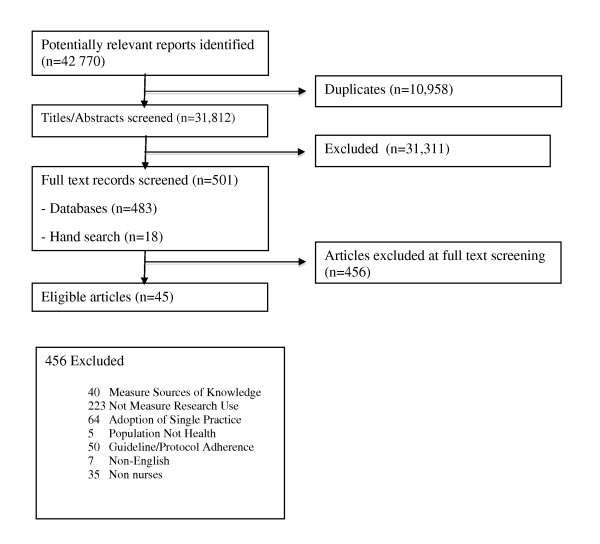
BACKGROUND: Interventions that have a better than random chance of increasing nurses' use of research are important to the delivery of quality patient care. However, few reports exist of successful research utilization in nursing interventions. Systematic identification and evaluation of individual characteristics associated with and predicting research utilization may inform the development of research utilization interventions. OBJECTIVE: To update the evidence published in a previous systematic review on individual characteristics influencing research utilization by nurses. METHODS: As part of a larger systematic review on research utilization instruments, 12 online bibliographic databases were searched. Hand searching of specialized journals and an ancestry search was also conducted. Randomized controlled trials, clinical trials, and observational study designs examining the association between individual characteristics and nurses' use of research were eligible for inclusion. Studies were limited to those published in the English, Danish, Swedish, and Norwegian languages. A vote counting approach to data synthesis was taken. RESULTS: A total of 42,770 titles were identified, of which 501 were retrieved. Of these 501 articles, 45 satisfied our inclusion criteria. Articles assessed research utilization in general (n = 39) or kinds of research utilization (n = 6) using self-report survey measures. Individual nurse characteristics were classified according to six categories: beliefs and attitudes, involvement in research activities, information seeking, education, professional characteristics, and socio-demographic/socio-economic characteristics. A seventh category, critical thinking, emerged in studies examining kinds of research utilization. Positive relationships, at statistically significant levels, for general research utilization were found in four categories: beliefs and attitudes, information seeking, education, and professional characteristics. The only characteristic assessed in a sufficient number of studies and with consistent findings for the kinds of research utilization was attitude towards research; this characteristic had a positive association with instrumental and overall research utilization. CONCLUSIONS: This review reinforced conclusions in the previous review with respect to positive relationships between general research utilization and: beliefs and attitudes, and current role. Furthermore, attending conferences/in-services, having a graduate degree in nursing, working in a specialty area, and job satisfaction were also identified as individual characteristics important to research utilization. While these findings hold promise as potential targets of future research utilization interventions, there were methodological problems inherent in many of the studies that necessitate their findings be replicated in further research using more robust study designs and multivariate assessment methods.
Overview
The claims and statistics of this paper haven’t been checked yet.
Free: it reads the open-access text and checks the first 5 claims that cite a source we can check. Create a free account to check every claim.
Integrity signals
Registry
Cites
Statistics
Figures
Verification
Claims the paper makes
The claims and statistics of this paper haven’t been checked yet.
Free: it reads the open-access text and checks the first 5 claims that cite a source we can check. Create a free account to check every claim.
Claims other papers make about this one
Each is checked against this paper’s own text: does it say what the citing paper says it does?
The source backs part of the claim, not all of it — or backs it for a different population, condition or comparison.
In the citing paper
“Evidence suggests that many individual level factors including beliefs, attitudes, motivations, values, skills, competence, behavior, and characteristics may be influential [40,41].”
From The role of evidence, context, and facilitation in an implementation trial: implications for the development of the PARIHS framework (2013) · cites this paper as [40]
Experimental — accuracy not yet measuredThe source backs part of the claim, not all of it — or backs it for a different population, condition or comparison.
In the citing paper
“we propose that the concept of the individual might incorporate: capability, capacity, motivation (including recognising a need for change), resilience, acceptability, feelings, knowledge and beliefs (including self efficacy) about the intervention/evidence, position and fit within the organization/social system, and approach to decision-making (e.g., experimentation, use of information).”
From The role of evidence, context, and facilitation in an implementation trial: implications for the development of the PARIHS framework (2013) · cites this paper as [40]
Experimental — accuracy not yet measuredThe source backs part of the claim, not all of it — or backs it for a different population, condition or comparison.
In the citing paper
“The selection of implementation strategies may be justified by prospective assessments that identify potential needs, barriers, or facilitators—sometimes termed ‘determinants of practice’ [43,55,85,86].”
From Implementation strategies: recommendations for specifying and reporting (2013) · cites this paper as [55]
Experimental — accuracy not yet measuredThe cited source says what the claim attributes to it.
In the citing paper
“While these determinants of practice could be identified through formal assessment processes, they could also be identified using theory or conceptual models e.g., [87], research literature e.g., [59,60,88-90], or more informal approaches such as brainstorming e.g., [55].”
From Implementation strategies: recommendations for specifying and reporting (2013) · cites this paper as [55]
In the citing paper
“Other systematic reviews and meta-analyses have focused on measures that assess provider-level constructs, such as behavioral intentions to implement evidence-based practices [38] and other research-related variables (e.g., attitudes toward and involvement in research activities) and demographic attributes (e.g., education [41]).”
Self-check
Percentages, sums and reported differences re-computed from the paper’s own numbers.
The self-check needs the paper’s full text.
Citations
Cites
The theory of planned behavior
Ajzen, I. (1991) · Organizational Behavior and Human Decision Processes · doi:10.1016/0749-5978(91)90020-t · Cited by 90,587
(2019) · doi:10.1188/19.onf · Cited by 3,217
Evaluating non-randomised intervention studies
Deeks, J., Dinnes, J., D'Amico, R., Sowden, A., Sakarovitch, C., Song, F., Petticrew, M., & Altman, D. (2003) · Health Technology Assessment · doi:10.3310/hta7270 · Cited by 2,907 · cited 1×
“The Quality Assessment Tool for Quantitative Studies Tool, developed for the Canadian Effective Public Health Practice Project, has been judged suitable to be used in systematic reviews of interventions [24,25].”
MethodStandard Quality Assessment Criteria for Evaluating Primary Research Papers from a Variety of Fields
Kmet, L. M., Cook, L. S., & Lee, R. C. (2004) · University of Alberta Library · doi:10.7939/r37m04f16 · Cited by 1,682 · cited 1×
“Estabrooks’ Quality Assessment and Validity Tool was developed based on the Cochrane Collaboration guidelines (in existence in 2001) and medical literature [22, 23 ].”
MethodAustralian Journal of Advanced Nursing
(2020) · Australian journal of advanced nursing · doi:10.37464/2020 · Cited by 1,596
Godin, G., Bélanger-Gravel, A., Eccles, M., & Grimshaw, J. (2008) · Implementation Science · doi:10.1186/1748-5908-3-36 · Cited by 1,096
Facione, N. C., Facione, P. A., & Sanchez, C. A. (1994) · Journal of Nursing Education · doi:10.3928/0148-4834-19941001-05 · Cited by 626
Criteria for the systematic review of health promotion and public health interventions
Jackson, N., & Waters, E. (2005) · Health Promotion International · doi:10.1093/heapro/dai022 · Cited by 572 · cited 1×
“The Quality Assessment Tool for Quantitative Studies Tool, developed for the Canadian Effective Public Health Practice Project, has been judged suitable to be used in systematic reviews of interventions [24,25].”
MethodIndividual determinants of research utilization: a systematic review
Estabrooks, C. A., Floyd, J. A., Scott‐Findlay, S., O'Leary, K. A., & Gushta, M. (2003) · Journal of Advanced Nursing · doi:10.1046/j.1365-2648.2003.02748.x · Cited by 490
Self-citation(2006) · Evidence‐based Medicine Toolkit · doi:10.1002/9780470750605.ch15 · Cited by 473
Research works printed but not linked: 7
- Dobbins M Ciliska D Mitchell A Dissemination and use of research evidence for policy and practice by nurses: A model of development and implementation strategies PhD Thesis 1998 University of Toronto: Faculty of Nursing
- Squires J Estabrooks C Wallin L Gustavsson P A systematic review of the psychometric properties of instruments used to measure knowledge translation in healthcare professionals technical report 2009 Edmonton, Alberta: Faculty of Nursing, University of Alberta
- Khan K Ter Riet G Popay J Nixon J Kleijnen J Satge I Conducting the review: Phase 5 study quality assessment Undertaking systematic reviews of research effectiveness CDC's guidance for those carrying out or commissioning reviews 2001 Centre of Reviews and Dissemination UoY 1 20
- McCloskey DJ The relationship between organizational factors and nurse factors affecting the conduct and utilization of nursing research PhD Thesis 2005 George Mason University
- Nash MA Research utilization among Idaho nurses PhD Thesis 2005 Gonzaga University
- Stiefel KA Career commitment, nursing unit culture, and nursing research utilization Dissertation/Thesis 1996 University of South Carolina
- Connor N The relationship between organizational culture and research utilization practices among nursing home departmental staff MN Thesis 2007 Dalhousie University (Canada)
Cited by
Items 601–700 of 796
Clinical Nurses’ Perception on Barriers to Research Utilization
Kang, Y., & Yang, I. (2015) · Journal of Korean Academy of Fundamentals of Nursing · doi:10.7739/jkafn.2015.22.2.198 · Cited by 9
Niu, Y., Lu, W., & Liu, D. (2017) · Springer eBooks · doi:10.1007/978-981-10-6190-5_110 · Cited by 5
Hall, J., Bingham, D. D., Seims, A., Dogra, S. A., Burkhardt, J., Nobles, J., McKenna, J., Bryant, M., Barber, S., & Daly-Smith, A. (2021) · medRxiv · doi:10.1101/2021.05.26.21257853 · Cited by 4
Gabriel, I. O., Creedy, D. K., McGuire, A., & Coyne, E. (2022) · Pilot and Feasibility Studies · doi:10.1186/s40814-022-01117-w · Cited by 6
Parents’ perceived barriers and enablers to providing optimal infant oral care
Walsh, O., Chauhan, A., Trinh, M., Lin, C., Marshall, S. K., Gray‐Burrows, K. A., & Silva, M. (2025) · BMC Public Health · doi:10.1186/s12889-025-22487-9 · Cited by 4
Härkönen, H., Hannila, H., Oikarinen, A., Kääriäinen, M., Ylimäki, S., Hietaniemi, A., Holopainen, A., Jansson, M. M., Pölkki, T., Kaakinen, P., et al. (2025) · Research in Nursing & Health · doi:10.1002/nur.70004 · Cited by 7
“Previous research have examined healthcare professional and nursing competence measurement in research utilization (Squires et al. 2011), clinical decision ‐ making (Belita et al. 2022), and EBP ‐ related knowledge, skills, and attitudes (Adombire et al. 2024; Haavisto et al. 2023; Landsverk et al.…”
Hawker, C., Courtenay, M., Chater, A., Gallagher, R., Lim, R. H. M., Reid, N., Thomas, N., & Williams, A. D. (2025) · BMC Health Services Research · doi:10.1186/s12913-025-13260-0 · Cited by 3
Improvement of nursing care by means of the evidence based practice process: The facilitator role
Bjuresäter, K., & Athlin, E. E. (2016) · Journal of Nursing Education and Practice · doi:10.5430/jnep.v6n11p61 · Cited by 4
Master student's application of evidence-based knowledge and skills in Swedish healthcare practice
Hansson, E. E., Carlsson, G., & Fänge, A. M. (2017) · International Journal of Evidence-Based Healthcare · doi:10.1097/xeb.0000000000000119 · Cited by 3
Changiz, T., Yousefy, A., & Fakhari, M. (2020) · PubMed Central · doi:10.34171/mjiri.34.79 · Cited by 3
Medley, N., Taylor, M., van Wyk, S. S., & Oliver, S. R. (2021) · Cochrane Database of Systematic Reviews · doi:10.1002/14651858.cd014756 · Cited by 4
Adopting Mixed Methods in Health Research: A Methodological Approach to Analyze HTA Development
Beretta, V. (2021) · Contributions to management science · doi:10.1007/978-3-030-70308-0_3 · Cited by 4
Huang, D., Lairson, D. R., Chung, T. H., Monahan, P. O., Rawl, S. M., & Champion, V. L. (2021) · Cancer Prevention Research · doi:10.1158/1940-6207.capr-21-0009 · Cited by 3
Rawas, H. O. (2023) · International Journal of Africa Nursing Sciences · doi:10.1016/j.ijans.2023.100609 · Cited by 3
Research utilization barriers for emergency medical technicians in Saudi Arabia
Samarkandi, O. A., Bashatah, A., Khan, A. A., Almobrad, A., Beovich, B., & Williams, B. A. (2018) · Advances in Medical Education and Practice · doi:10.2147/amep.s150604 · Cited by 5
“The barriers to research utilization have been studied extensively within the nursing profession.(12,18) However, there are far fewer studies within other health professions,(13) including the emerging profession of paramedicine.”
McKinlay, E. M., McDonald, J., Darlow, B. J. S., & Perry, M. (2018) · Health & Social Care in the Community · doi:10.1111/hsc.12657 · Cited by 4
Leitch, S. V., Dovey, S. M., Cunningham, W. K., Wallis, K. A., Eggleton, K. S., Lillis, S., McMenamin, A. W., Williamson, M. I., Reith, D. M., Samaranayaka, A., et al. (2021) · BMJ Open · doi:10.1136/bmjopen-2020-048316 · Cited by 6
Przybek-Mita, J. Z., Bazaliński, D., Sztembis, R., Kuberka, I., & Więch, P. (2022) · Frontiers in Public Health · doi:10.3389/fpubh.2022.1090677 · Cited by 3
Profetto‐McGrath, J., & Raymond, C. (2012) · Evidence-Based Nursing · doi:10.1136/ebnurs-2011-100413 · Cited by 3
Psychiatric Nurses’ Beliefs, Attitudes, and Perceived Barriers about Medical Emergency Teams
Herisko, C., Puskar, K. R., & Mitchell, A. M. (2013) · Issues in Mental Health Nursing · doi:10.3109/01612840.2013.823633 · Cited by 3
How changing attitudes can enhance compassionate care
McConnel, E. (2015) · Nursing and Residential Care · doi:10.12968/nrec.2015.17.7.385 · Cited by 3
Towards a Pathway-Based Clinical Cancer Registration in Hospital Information Systems
Heß, M., Kaczmarek, M., Frank, U., Podleska, L.-E., & Taeger, G. (2015) · Lecture notes in computer science · doi:10.1007/978-3-319-26585-8_6 · Cited by 3
How Can Nurses Improve Pain Management Within the Veterinary Clinic?
Malik, A., & Bradbury, A. G. (2016) · Veterinary Nursing Journal · doi:10.1080/17415349.2016.1153989 · Cited by 3
Neher, M. (2016) · Journal of Rheumatic Diseases and Treatment · doi:10.23937/2469-5726/1510039 · Cited by 5
Formal and informal governance networks: Diabetes care in Australia and India
Ugyel, L. (2019) · Australian Journal of Public Administration · doi:10.1111/1467-8500.12372 · Cited by 4
Molina, A. P., Palinkas, L. A., Monro, W. L., & Mennen, F. E. (2020) · Administration and Policy in Mental Health and Mental Health Services Research · doi:10.1007/s10488-020-01012-7 · Cited by 3
Feminist bioethics meets experimental philosophy: Embracing the qualitative and experiential
Womack, & Mulvaney-Day (2012) · International Journal of Feminist Approaches to Bioethics · doi:10.2979/intjfemappbio.5.1.113 · Cited by 3
Bölenius, K. (2014) · DiVA at Umeå University (Umeå University) · Cited by 7
Nielsen, B., Oddli, H. W., Slinning, K., & Drozd, F. (2024) · Children and Youth Services Review · doi:10.1016/j.childyouth.2024.108048 · Cited by 3
The Role of Processing-Related Labels in Consumer Identification and Choice of Ultra-Processed Foods
Gomez, P. (2025) · Journal of Consumer Policy · doi:10.1007/s10603-025-09595-0 · Cited by 3
Lunaria, L. J. E. (2025) · Journal of Advanced Nursing · doi:10.1111/jan.70161 · Cited by 3
Lei, Y., Yang, L., Liu, J., Ala, M. B. D., Aliswag, E. G., Zhang, R., Tan, J., Wang, L., & Salvador, J. T. (2025) · Journal of Clinical Nursing · doi:10.1111/jocn.70110 · Cited by 2
Embracing consumer minimalism: the path to sustainable consumer behavior among adolescents
Ježovit, M., & Lučić, A. (2025) · Journal of Marketing Analytics · doi:10.1057/s41270-025-00438-y · Cited by 5
Li, B., Xu, R., Cheng, S., Shen, M., Li, M., & Li, H. W. (2025) · Frontiers in Medicine · doi:10.3389/fmed.2025.1649858 · Cited by 2
Implementing a tobacco-free hospital campus in Ireland: lessons learned
McArdle, D., & Kabir, Z. (2017) · Irish Journal of Medical Science (1971 -) · doi:10.1007/s11845-017-1659-z · Cited by 2
Rees, G. H., Crampton, P., Gauld, R. D. C., & MacDonell, S. G. (2020) · Journal of Integrated Care · doi:10.1108/jica-08-2020-0052 · Cited by 2
Barriers, Facilitators, and Nurses' Attitude toward Nursing Research Utilization
Thabet, A. M., & Ali, G. (2016) · Egyptian Journal of Health Care · doi:10.21608/ejhc.2016.197435 · Cited by 3
Albayrak, S., Öntürk, Z. K., Türkmen, E., Göktepe, N., & Çağlayan, S. (2023) · Sağlık ve Hemşirelik Yönetimi Dergisi · doi:10.54304/shyd.2023.06978 · Cited by 4
Genetic association of MIR-449B, GCLC, eNOS, SORD, and ENPP1 with diabetic retinopathy
Xu, H., Fan, L., Luo, H., Ju, X., Li, H., Rong, S. S., Yuan, Y., Xiao, J., Zhang, R., Wang, K., et al. (2025) · Experimental Eye Research · doi:10.1016/j.exer.2025.110287 · Cited by 2
Dunphy, N., Flannery, S. M., & Kearney, S. (2025) · The Journal of Agricultural Education and Extension · doi:10.1080/1389224x.2025.2477450 · Cited by 3
Tayan, O., Hammouri, A. I., Askool, S., Aljohani, H., & Makrami, B. H. (2025) · TechTrends · doi:10.1007/s11528-025-01122-9 · Cited by 7
Elliott, M., Price, K.-M., Hewitt, R. M., Knowles, N., Ganesh, S., Baillie, J., & Jones, L. (2025) · BMC Nursing · doi:10.1186/s12912-025-03597-6 · Cited by 2
Lundberg, V., Boström, A., & Malinowsky, C. W. (2017) · Scandinavian Journal of Caring Sciences · doi:10.1111/scs.12482 · Cited by 2
Towards the Future: The Education of Nurses in Iceland Reconsidered
Sveinsdóttir, H., Gunnarsdóttir, Þ. J., & Björnsdóttir, K. (2019) · Springer eBooks · doi:10.1007/978-3-030-10964-6_12 · Cited by 2
Implementation of the Wolverine Mental Health Program, Part 3: Sustainment Phase
Lewis, C. C., Scott, K., Rodríguez‐Quintana, N., Hoffacker, C. P., Boys, C., & Hindman, R. K. (2021) · Cognitive and Behavioral Practice · doi:10.1016/j.cbpra.2021.06.010 · Cited by 1
Masso, M. R. (2011) · Research Online (University of Wollongong) · Cited by 3
Pearce, S., & Rogers-Clark, C. (2011) · JBI Library of Systematic Reviews · doi:10.11124/jbisrir-2011-343 · Cited by 3
Trevena, H., Thow, A. M., Dunford, E., Wu, J. H. Y., & Neal, B. C. (2015) · BMC Public Health · doi:10.1186/s12889-016-2743-4 · Cited by 3
Almaze, J.-P., & Emmamally, W. (2015) · Africa Journal of Nursing and Midwifery · doi:10.25159/2520-5293/76 · Cited by 2
Juul, J. S., Bro, F., Hornung, N., Andersen, B. S., Laurberg, S., Olesen, F., & Vedsted, P. (2016) · BMC Cancer · doi:10.1186/s12885-016-2477-9 · Cited by 2
New Technologies for Sustainable Health Care
Romanelli, M. (2016) · Lecture notes in business information processing · doi:10.1007/978-3-319-32689-4_51 · Cited by 7
Barriers to Research Utilization among Registered Nurses at Hamad Medical Corporation
Nashwan, A. J., Abujaber, A. A., & Mansour, D. B. (2016) · International Journal of Research in Nursing · doi:10.3844/ijrnsp.2016.41.48 · Cited by 3
Morrison, P., Gluyas, H., & Stomski, N. J. (2017) · Nurse Education in Practice · doi:10.1016/j.nepr.2017.06.011 · Cited by 4
Reinvigorating Evidence-Based Practice
Ydrogo, C., Magnan, M. A., & Fedoronko, K. (2020) · Journal for Nurses in Professional Development · doi:10.1097/nnd.0000000000000660 · Cited by 2
Knowledge Transfer and Exchange in Healthcare: A Literature Review
Beretta, V. (2021) · Contributions to management science · doi:10.1007/978-3-030-70308-0_2 · Cited by 4
HEMŞİRELERİN BİLİMSEL ARAŞTIRMA SÜRECİNE İLİŞKİN DENEYİMLERİ VE KARŞILAŞTIKLARI ENGELLER
Savcı, C., Şerbetçi, G., & Özel, H. (2021) · İnönü Üniversitesi Sağlık Hizmetleri Meslek Yüksek Okulu Dergisi · doi:10.33715/inonusaglik.845037 · Cited by 3
Knowledge translation strategies for mobilizing individuals to implement pain evidence to practice
Tutelman, P. R., Chambers, C. T., & Barwick, M. A. (2021) · Oxford University Press eBooks · doi:10.1093/med/9780198818762.003.0058 · Cited by 3
Changiz, T., Yousefy, A., & Fakhari, M. (2020) · Medical Journal of the Islamic Republic of Iran · doi:10.47176/mjiri.34.79 · Cited by 8
Lauber, R., Loosli, D., & Kiselev, N. (2022) · Sports Psychiatry · doi:10.1024/2674-0052/a000033 · Cited by 2
Ahuna, J. K., Becker, K. D., & Chorpita, B. F. (2023) · Administration and Policy in Mental Health and Mental Health Services Research · doi:10.1007/s10488-023-01295-6 · Cited by 2
Rong, S. S., & Yu, X. (2024) · Genes · doi:10.3390/genes15020161 · Cited by 2
A New Space for Patients – How Space Enters Innovation Translation Processes
Gorli, M., Mengis, J., & Liberati, E. G. (2017) · Palgrave Macmillan UK eBooks · doi:10.1057/978-1-137-55780-3_2 · Cited by 2
Nurses’ KAP related to research conduct and utilization: EBNP “are we ready yet.
Abouelfettoh, A., & Ateeq, E. A. (2018) · International Journal of Advanced Nursing Studies · doi:10.14419/ijans.v7i1.11814 · Cited by 2
Evidenzbasierung in den Gesundheitsberufen
Meyer, G., & Köpke, S. (2019) · Springer Reference Pflege, Therapie, Gesundheit · doi:10.1007/978-3-662-58314-2_61 · Cited by 2
eHealth for neonatal nurse education despite Covid-19
Cunningham, C., Moore, Z. E. H., Connor, T., Patton, D., Bux, D., & Nugent, L. (2020) · Journal of Neonatal Nursing · doi:10.1016/j.jnn.2020.11.002 · Cited by 2
Gerrish, K. (2011) · Worldviews on Evidence-Based Nursing · doi:10.1111/j.1741-6787.2011.00223.x · Cited by 2
McCord, H. C. (2011) · Library and Archives Canada (Government of Canada) · Cited by 4
Translating Evidence into Practice
Miller, E. T. (2016) · Rehabilitation Nursing · doi:10.1002/rnj.276 · Cited by 2
Bendall, E. R., Westgate, M. J., Haddaway, N., & Lindenmayer, D. B. (2022) · doi:10.22541/au.164410852.23208571/v1 · Cited by 2
Cinches, M. F. C., Estroga, I. J. N., & Polancos, D. T. (2019) · Liceo Journal of Higher Education Research · doi:10.7828/ljher.v15i1.1299 · Cited by 1
Thompson, L. M. (2022) · Nature Energy · doi:10.1038/s41560-022-01101-x · Cited by 1
Beliefs of public health nurses about solution-focused parenting support – A questionnaire study
Theuns‐Boumans, L., Mathijssen, J. J. P., Vries, C. R., & van de Goor, I. (2022) · Children and Youth Services Review · doi:10.1016/j.childyouth.2022.106693 · Cited by 2
Mathiasen, K., Holmberg, T. T., Skaarnes, H., Jensen, E. S., Vis, C., & Tarp, K. (2023) · Frontiers in Digital Health · doi:10.3389/fdgth.2023.1128893 · Cited by 2
Mackle, D., Nelson, K., Beasley, R. W., Eathorne, A., & Young, P. J. (2024) · Journal of Advanced Nursing · doi:10.1111/jan.16641 · Cited by 1
Gutema, H., Bulcha, G., Noll, J., Sori, D. A., & Birhanu, Z. (2025) · Pilot and Feasibility Studies · doi:10.1186/s40814-025-01632-6 · Cited by 3
Unlocking the promise of virtual care in hospitals: the Smarter Hospitals Project protocol
Harrison, R., Mitchell, R. J., Walsan, R., Sina, M., Clay‐Williams, R., Cardenas, A., Moscova, M., Baumgartner, D. D., Sarwar, M., Westbrook, J. I., et al. (2025) · BMC Health Services Research · doi:10.1186/s12913-025-13129-2 · Cited by 2
Li, Y., Chen, Y., Wei, G., Yan, H., Ma, F., Hu, Q., Wei, W., Ding, L., & Bai, Y. (2025) · BMC Health Services Research · doi:10.1186/s12913-025-13850-y · Cited by 1
Understanding Nurses' Knowledge Work
Siu, H. M. (2015) · Scholarship@Western (Western University) · Cited by 1
Clinicians' Commentary on You et al.
Reid, W. D., & Hoens, A. M. (2012) · Physiotherapy Canada · doi:10.3138/ptc.2011-01-cc · Cited by 1
Sweet, S. N., Latimer‐Cheung, A. E., Bourne, C., & Ginis, K. A. M. (2013) · Translational Behavioral Medicine · doi:10.1007/s13142-013-0231-2 · Cited by 1
Towards Meaningful Outcomes Assessment: Collaborative Efforts in Pediatric Medical Education
Burke, A. E., Hicks, P. J., & Carraccio, C. L. (2012) · Academic Pediatrics · doi:10.1016/j.acap.2012.01.006 · Cited by 1
How nurses behave online? Nurses’ online information needs and internet seeking behaviour.
Κωσταγιόλας, Π., Martzoukou, K., Intas, G., & Niakas, D. A. (2014) · Open Access Institutional Repository at Robert Gordon University (Robert Gordon University) · Cited by 4
Learning Challenges Associated with Evidence-Based Practice in Rheumatology
Neher, M. (2016) · Linköping University medical dissertations · doi:10.3384/diss.diva-127495 · Cited by 1
Collaborative Leadership for the Transformation of Health Systems
Brander, R., MacPhee, M., Careau, E., Tassone, M., Verma, S., Paterson, M., & Berry, S. (2015) · Palgrave Macmillan UK eBooks · doi:10.1057/9781137432094_10 · Cited by 1
Wat bevordert de deelname van niet-volksgezondheidssectoren aan intersectorale beleidsnetwerken?
Harting, J., Peters, D. T. J. M., & Stronks, K. (2016) · TSG - Tijdschrift voor gezondheidswetenschappen · doi:10.1007/s12508-016-0080-8 · Cited by 1
Reducing Surgery Scheduling Errors in Multihospital System
Watson, D. S., Corbett, C. F., Oneal, G. A., & Daratha, K. B. (2017) · Journal of Patient Safety · doi:10.1097/pts.0000000000000370 · Cited by 3
An Analysis on the Qualitative Evaluation and Implication
Oh, S., & 곽병훈 (2013) · Korean Comparative Government Review · doi:10.18397/kcgr.2013.17.3.273 · Cited by 1
Haora, P. J. (2020) · Springer eBooks · doi:10.1007/978-981-15-5362-2_17 · Cited by 1
Moon, D. J., Johnson‐Motoyama, M., & Nichols, C. B. (2021) · Global Implementation Research and Applications · doi:10.1007/s43477-021-00018-z · Cited by 1
Sjöberg, J., Enskär, K., & Wangel, A. (2022) · Perioperative Care and Operating Room Management · doi:10.1016/j.pcorm.2022.100293 · Cited by 1
Exploring ministries’ use of research in policymaking - knowledge stock, circulation, or routines?
Thune, T. M., Gulbrandsen, M., Reymert, I., & Tellmann, S. M. (2023) · International Conference on Science, Technology and Innovation Indicators (STI) · doi:10.55835/6442e1ea4e3daf2fc8306960 · Cited by 2
Tsukagoshi, N., Oka, M., Kyota, A., Senuma, M., Kondo, Y., Matsumoto, M., Nashiki, E., Fukasawa, T., Saito, A., Takahashi, S., et al. (2023) · Journal of Japan Academy of Nursing Science · doi:10.5630/jans.43.877 · Cited by 1
Indicators of rigor in dissertation research
Johnson, J. E., Goodman, P., & Robert, R. C. (2024) · Journal of Professional Nursing · doi:10.1016/j.profnurs.2024.07.011 · Cited by 3
Owusu, L. B., Scheepers, N., & Tenza, I. S. (2024) · Nurse Education Today · doi:10.1016/j.nedt.2024.106476 · Cited by 4
The timing of energy intake and its link to obesity
Tansey, R., & Donald, H. M. (2016) · Proceedings of The Nutrition Society · doi:10.1017/s0029665115004450 · Cited by 1
Flipped Classroom: Impact on Self-Efficacy and Evidence-Based Practice for Nursing Students
Harvey, L., Héon, M., Pépin, J., & Boyer, L. (2018) · Quality Advancement in Nursing Education - Avancées en formation infirmière · doi:10.17483/2368-6669.1136 · Cited by 1
Siantz, E., & Ostrow, L. (2019) · Community Mental Health Journal · doi:10.1007/s10597-019-00366-z · Cited by 1
Safety and Culture: Theory and Concept
Spurgeon, P. C., Sujan, M. A., Cross, S., & Flanagan, H. (2019) · Springer eBooks · doi:10.1007/978-3-030-18244-1_4 · Cited by 1
Hunter, C. L., Chróinín, D. N., McEvoy, L., & Chuan, A. (2021) · Australian Journal on Ageing · doi:10.1111/ajag.12991 · Cited by 2
The Effect of Research Project Course on Nursing Students’ Attitudes toward Research Process
Faris, S. H. (2020) · Indian Journal of Forensic Medicine & Toxicology · doi:10.37506/ijfmt.v14i3.10856 · Cited by 1
Metadata
- Authors
- Squires, J. E., Estabrooks, C. A., Gustavsson, P., & Wallin, L.
- Affiliations
- Ottawa Hospital Research Institute (CA)
- University of Alberta (CA)
- Karolinska Institutet (SE)
- Karolinska University Hospital (SE)
- Corresponding author
- Squires, Janet E
- Venue
- Implementation Science
- Published
- 2011-01-05
- Volume
- 6
- Issue
- 1
- Pages
- 1-1
- ISSN
- 1748-5908 (ISSN-L)
- PMC
- PMC3024963
- OpenAlex
- W2126717870
- Cited by
- 798
- References
- 83
- Citations by year
- 2026: 8 · 2025: 38 · 2024: 18 · 2023: 26 · 2022: 52 · 2021: 106 · 2020: 60 · 2019: 59 · 2018: 59 · 2017: 73 · 2016: 77 · 2015: 65 · 2014: 58 · 2013: 47 · 2012: 38
- FWCI
- 8.19
- Type
- journal article
- Language
- en
- Open access
- gold
- doi.org
- Licence
- Locations
- Implementation Science (publishedVersion, cc-by)
- PubMed Central (publishedVersion, cc-by)
- PubMed (publishedVersion)
- DOAJ (DOAJ: Directory of Open Access Journals) (submittedVersion)
- uO Research (University of Ottawa) (submittedVersion, public-domain)
- Funders
- AFA Försäkring
- Fondation pour la Recherche Médicale
- Alberta Heritage Foundation for Medical Research
- Karolinska Institutet
- Killam Trusts
- Canadian Institutes of Health Research
- Topics
- Health Sciences › Health Professions › General Health Professions › Health Sciences Research and Education
- Health Sciences › Health Professions › General Health Professions › Health Policy Implementation Science
- Health Sciences › Medicine › Public Health, Environmental and Occupational Health › Health and Medical Research Impacts
- Keywords
- research utilization, nurses, individual characteristics, attitudes toward research, information seeking, nursing education, critical thinking, job satisfaction
- MeSH terms
- Attitude of Health Personnel, Data Collection, Diffusion of Innovation, Humans, Research Design, Nursing Research, Evidence-Based Nursing
About these checks
Registry, retraction, Cites and statistics results are computed, not judged, with one exception: a printed reference that no index lists is read once by a model before it counts as a citation error. Claims are extracted by a model and kept only when their quote appears verbatim in the text; each cited source is then checked, with a model’s help, for whether it says what the claim relies on. Those verdicts can be wrong — read the claim’s quote and the cited source before relying on one.
Statistics and arithmetic are recomputed, not judged.
Confidence bands are shown only for fields calibrated on our annotated test set. None is calibrated yet, so no band is shown.
What counts as a claim ›How we measure confidence ›How we check this ›
Are you an author, or do you see a problem with this page? Request a review
Data sources
Bibliographic data: Semantic Scholar, OpenAlex, Crossref.
Contains information from the Semantic Scholar Academic Graph Datasets, made available under the ODC Attribution License (ODC-BY 1.0).
Semantic Scholar’s data is described in: Kinney, R., et al. (2023). The Semantic Scholar Open Data Platform. arXiv:2301.10140.
