

Individual determinants of research utilization by nurses: a systematic review update
Open accessThe DOI matches its Crossref record; 81 of the 83 references it cites were found in a registry or an index.
Abstract
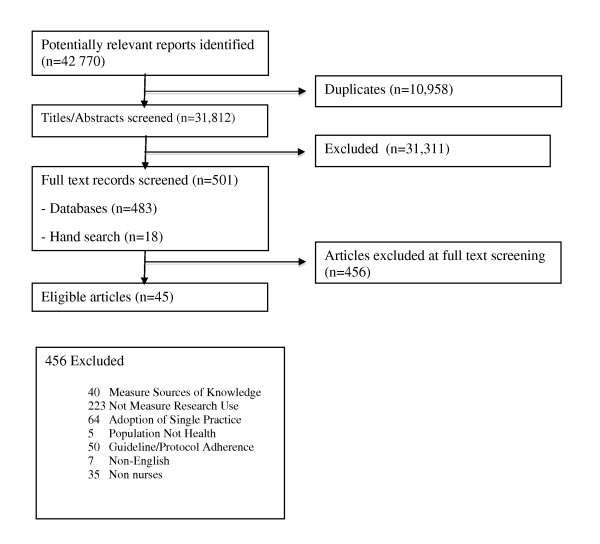
BACKGROUND: Interventions that have a better than random chance of increasing nurses' use of research are important to the delivery of quality patient care. However, few reports exist of successful research utilization in nursing interventions. Systematic identification and evaluation of individual characteristics associated with and predicting research utilization may inform the development of research utilization interventions. OBJECTIVE: To update the evidence published in a previous systematic review on individual characteristics influencing research utilization by nurses. METHODS: As part of a larger systematic review on research utilization instruments, 12 online bibliographic databases were searched. Hand searching of specialized journals and an ancestry search was also conducted. Randomized controlled trials, clinical trials, and observational study designs examining the association between individual characteristics and nurses' use of research were eligible for inclusion. Studies were limited to those published in the English, Danish, Swedish, and Norwegian languages. A vote counting approach to data synthesis was taken. RESULTS: A total of 42,770 titles were identified, of which 501 were retrieved. Of these 501 articles, 45 satisfied our inclusion criteria. Articles assessed research utilization in general (n = 39) or kinds of research utilization (n = 6) using self-report survey measures. Individual nurse characteristics were classified according to six categories: beliefs and attitudes, involvement in research activities, information seeking, education, professional characteristics, and socio-demographic/socio-economic characteristics. A seventh category, critical thinking, emerged in studies examining kinds of research utilization. Positive relationships, at statistically significant levels, for general research utilization were found in four categories: beliefs and attitudes, information seeking, education, and professional characteristics. The only characteristic assessed in a sufficient number of studies and with consistent findings for the kinds of research utilization was attitude towards research; this characteristic had a positive association with instrumental and overall research utilization. CONCLUSIONS: This review reinforced conclusions in the previous review with respect to positive relationships between general research utilization and: beliefs and attitudes, and current role. Furthermore, attending conferences/in-services, having a graduate degree in nursing, working in a specialty area, and job satisfaction were also identified as individual characteristics important to research utilization. While these findings hold promise as potential targets of future research utilization interventions, there were methodological problems inherent in many of the studies that necessitate their findings be replicated in further research using more robust study designs and multivariate assessment methods.
Overview
The claims and statistics of this paper haven’t been checked yet.
Free: it reads the open-access text and checks the first 5 claims that cite a source we can check. Create a free account to check every claim.
Integrity signals
Registry
Cites
Statistics
Figures
Verification
Claims the paper makes
The claims and statistics of this paper haven’t been checked yet.
Free: it reads the open-access text and checks the first 5 claims that cite a source we can check. Create a free account to check every claim.
Claims other papers make about this one
Each is checked against this paper’s own text: does it say what the citing paper says it does?
The source backs part of the claim, not all of it — or backs it for a different population, condition or comparison.
In the citing paper
“Evidence suggests that many individual level factors including beliefs, attitudes, motivations, values, skills, competence, behavior, and characteristics may be influential [40,41].”
From The role of evidence, context, and facilitation in an implementation trial: implications for the development of the PARIHS framework (2013) · cites this paper as [40]
Experimental — accuracy not yet measuredThe source backs part of the claim, not all of it — or backs it for a different population, condition or comparison.
In the citing paper
“we propose that the concept of the individual might incorporate: capability, capacity, motivation (including recognising a need for change), resilience, acceptability, feelings, knowledge and beliefs (including self efficacy) about the intervention/evidence, position and fit within the organization/social system, and approach to decision-making (e.g., experimentation, use of information).”
From The role of evidence, context, and facilitation in an implementation trial: implications for the development of the PARIHS framework (2013) · cites this paper as [40]
Experimental — accuracy not yet measuredThe source backs part of the claim, not all of it — or backs it for a different population, condition or comparison.
In the citing paper
“The selection of implementation strategies may be justified by prospective assessments that identify potential needs, barriers, or facilitators—sometimes termed ‘determinants of practice’ [43,55,85,86].”
From Implementation strategies: recommendations for specifying and reporting (2013) · cites this paper as [55]
Experimental — accuracy not yet measuredThe cited source says what the claim attributes to it.
In the citing paper
“While these determinants of practice could be identified through formal assessment processes, they could also be identified using theory or conceptual models e.g., [87], research literature e.g., [59,60,88-90], or more informal approaches such as brainstorming e.g., [55].”
From Implementation strategies: recommendations for specifying and reporting (2013) · cites this paper as [55]
In the citing paper
“Other systematic reviews and meta-analyses have focused on measures that assess provider-level constructs, such as behavioral intentions to implement evidence-based practices [38] and other research-related variables (e.g., attitudes toward and involvement in research activities) and demographic attributes (e.g., education [41]).”
Self-check
Percentages, sums and reported differences re-computed from the paper’s own numbers.
The self-check needs the paper’s full text.
Citations
Cites
The theory of planned behavior
Ajzen, I. (1991) · Organizational Behavior and Human Decision Processes · doi:10.1016/0749-5978(91)90020-t · Cited by 90,587
(2019) · doi:10.1188/19.onf · Cited by 3,217
Evaluating non-randomised intervention studies
Deeks, J., Dinnes, J., D'Amico, R., Sowden, A., Sakarovitch, C., Song, F., Petticrew, M., & Altman, D. (2003) · Health Technology Assessment · doi:10.3310/hta7270 · Cited by 2,907 · cited 1×
“The Quality Assessment Tool for Quantitative Studies Tool, developed for the Canadian Effective Public Health Practice Project, has been judged suitable to be used in systematic reviews of interventions [24,25].”
MethodStandard Quality Assessment Criteria for Evaluating Primary Research Papers from a Variety of Fields
Kmet, L. M., Cook, L. S., & Lee, R. C. (2004) · University of Alberta Library · doi:10.7939/r37m04f16 · Cited by 1,682 · cited 1×
“Estabrooks’ Quality Assessment and Validity Tool was developed based on the Cochrane Collaboration guidelines (in existence in 2001) and medical literature [22, 23 ].”
MethodAustralian Journal of Advanced Nursing
(2020) · Australian journal of advanced nursing · doi:10.37464/2020 · Cited by 1,596
Godin, G., Bélanger-Gravel, A., Eccles, M., & Grimshaw, J. (2008) · Implementation Science · doi:10.1186/1748-5908-3-36 · Cited by 1,096
Facione, N. C., Facione, P. A., & Sanchez, C. A. (1994) · Journal of Nursing Education · doi:10.3928/0148-4834-19941001-05 · Cited by 626
Criteria for the systematic review of health promotion and public health interventions
Jackson, N., & Waters, E. (2005) · Health Promotion International · doi:10.1093/heapro/dai022 · Cited by 572 · cited 1×
“The Quality Assessment Tool for Quantitative Studies Tool, developed for the Canadian Effective Public Health Practice Project, has been judged suitable to be used in systematic reviews of interventions [24,25].”
MethodIndividual determinants of research utilization: a systematic review
Estabrooks, C. A., Floyd, J. A., Scott‐Findlay, S., O'Leary, K. A., & Gushta, M. (2003) · Journal of Advanced Nursing · doi:10.1046/j.1365-2648.2003.02748.x · Cited by 490
Self-citation(2006) · Evidence‐based Medicine Toolkit · doi:10.1002/9780470750605.ch15 · Cited by 473
Research works printed but not linked: 7
- Dobbins M Ciliska D Mitchell A Dissemination and use of research evidence for policy and practice by nurses: A model of development and implementation strategies PhD Thesis 1998 University of Toronto: Faculty of Nursing
- Squires J Estabrooks C Wallin L Gustavsson P A systematic review of the psychometric properties of instruments used to measure knowledge translation in healthcare professionals technical report 2009 Edmonton, Alberta: Faculty of Nursing, University of Alberta
- Khan K Ter Riet G Popay J Nixon J Kleijnen J Satge I Conducting the review: Phase 5 study quality assessment Undertaking systematic reviews of research effectiveness CDC's guidance for those carrying out or commissioning reviews 2001 Centre of Reviews and Dissemination UoY 1 20
- McCloskey DJ The relationship between organizational factors and nurse factors affecting the conduct and utilization of nursing research PhD Thesis 2005 George Mason University
- Nash MA Research utilization among Idaho nurses PhD Thesis 2005 Gonzaga University
- Stiefel KA Career commitment, nursing unit culture, and nursing research utilization Dissertation/Thesis 1996 University of South Carolina
- Connor N The relationship between organizational culture and research utilization practices among nursing home departmental staff MN Thesis 2007 Dalhousie University (Canada)
Cited by
Implementation strategies: recommendations for specifying and reporting
Proctor, E. K., Powell, B. J., & McMillen, J. C. (2013) · Implementation Science · doi:10.1186/1748-5908-8-139 · Cited by 2,585
JAGOSH, J., MACAULAY, A. C., PLUYE, P., SALSBERG, J., BUSH, P. L., HENDERSON, J., SIRETT, E., WONG, G., CARGO, M., HERBERT, C. P., et al. (2012) · The Milbank Quarterly · doi:10.1111/j.1468-0009.2012.00665.x · Cited by 1,268
Waltz, T. J., Powell, B. J., Matthieu, M. M., Damschroder, L. J., Chinman, M. J., Smith, J. L., Proctor, E. K., & Kirchner, J. E. (2015) · Implementation Science · doi:10.1186/s13012-015-0295-0 · Cited by 1,108
Methods to Improve the Selection and Tailoring of Implementation Strategies
Powell, B. J., Beidas, R. S., Lewis, C. C., Aarons, G. A., McMillen, J. C., Proctor, E. K., & Mandell, D. S. (2017) · The Journal of Behavioral Health Services & Research · doi:10.1007/s11414-015-9475-6 · Cited by 967
Chaudoir, S. R., Dugan, A. G., & Barr, C. H. (2013) · Implementation Science · doi:10.1186/1748-5908-8-22 · Cited by 800
Enhancing the Impact of Implementation Strategies in Healthcare: A Research Agenda
Powell, B. J., Fernandez, M. E., Williams, N. J., Aarons, G. A., Beidas, R. S., Lewis, C. C., McHugh, S. M., & Weiner, B. J. (2019) · Frontiers in Public Health · doi:10.3389/fpubh.2019.00003 · Cited by 775
Association between organisational and workplace cultures, and patient outcomes: systematic review
Braithwaite, J., Herkes, J., Ludlow, K., Testa, L., & Lamprell, G. (2017) · BMJ Open · doi:10.1136/bmjopen-2017-017708 · Cited by 532
A meta-analysis of serious digital games for healthy lifestyle promotion
DeSmet, A., Van Ryckeghem, D., Compernolle, S., Baranowski, T., Thompson, D., Crombez, G., Poels, K., Van Lippevelde, W., Bastiaensens, S., Van Cleemput, K., et al. (2014) · Preventive Medicine · doi:10.1016/j.ypmed.2014.08.026 · Cited by 414
Murray, L. K., Dorsey, S., Haroz, E., Lee, C., Alsiary, M. M., Haydary, A., Weiss, W. M., & Bolton, P. (2014) · Cognitive and Behavioral Practice · doi:10.1016/j.cbpra.2013.06.005 · Cited by 403
A Review and Taxonomy of Choice Architecture Techniques
Münscher, R., Vetter, M., & Scheuerle, T. (2016) · Journal of Behavioral Decision Making · doi:10.1002/bdm.1897 · Cited by 348
Ames, H. M., Glenton, C., & Lewin, S. (2017) · Cochrane Database of Systematic Reviews · doi:10.1002/14651858.cd011787.pub2 · Cited by 348
Systematic review of knowledge translation strategies in the allied health professions
Scott, S. D., Albrecht, L., O’Leary, K., Ball, G. D., Hartling, L., Hofmeyer, A., Jones, C. A., Klassen, T. P., Burns, K. K., Newton, A. S., et al. (2012) · Implementation Science · doi:10.1186/1748-5908-7-70 · Cited by 331
Cook, C. R., Lyon, A. R., Locke, J., Waltz, T., & Powell, B. J. (2019) · Prevention Science · doi:10.1007/s11121-019-01017-1 · Cited by 336
Social Network Analysis for Program Implementation
Valente, T. W., Palinkas, L. A., Czaja, S., Chu, K.-H., & Brown, C. H. (2015) · PLOS ONE · doi:10.1371/journal.pone.0131712 · Cited by 332
Hoek, A. C., Pearson, D., James, S. W., Lawrence, M. A., & Friel, S. (2017) · Appetite · doi:10.1016/j.appet.2016.09.030 · Cited by 329
Rycroft-Malone, J., Seers, K., Chandler, J., Hawkes, C. A., Crichton, N., Allen, C., Bullock, I., & Strunin, L. (2013) · Implementation Science · doi:10.1186/1748-5908-8-28 · Cited by 303
The effectiveness of knowledge translation strategies used in public health: a systematic review
LaRocca, R., Yost, J., Dobbins, M., Ciliska, D., & Butt, M. (2012) · BMC Public Health · doi:10.1186/1471-2458-12-751 · Cited by 300
Cultural competence dimensions and outcomes: a systematic review of the literature
Alizadeh, S., & Chavan, M. (2016) · Health & Social Care in the Community · doi:10.1111/hsc.12293 · Cited by 283
Rudman, A., & Gustavsson, J. P. (2012) · International Journal of Nursing Studies · doi:10.1016/j.ijnurstu.2012.03.010 · Cited by 268
Self-citationJenkin, C. R., Eime, R. M., Westerbeek, H., O’Sullivan, G., & van Uffelen, J. G. Z. (2017) · BMC Public Health · doi:10.1186/s12889-017-4970-8 · Cited by 234
“This list has been cited extensively and used in numerous mixed methods systematic reviews [39 – 41].”
Evidence based practice beliefs and implementation among nurses: a cross-sectional study
Stokke, K., Olsen, N. R., Espehaug, B., & Nortvedt, M. W. (2014) · BMC Nursing · doi:10.1186/1472-6955-13-8 · Cited by 227
Braithwaite, J., Herkes, J., Ludlow, K., Lamprell, G., & Testa, L. (2016) · BMJ Open · doi:10.1136/bmjopen-2016-013758 · Cited by 225
Karami, A., Farokhzadian, J., & Foroughameri, G. (2017) · PLOS ONE · doi:10.1371/journal.pone.0187863 · Cited by 212
Harrison, R., Fischer, S., Walpola, R. L., Chauhan, A., Babalola, T., Mears, S., & Le-Dao, H. (2021) · Journal of Healthcare Leadership · doi:10.2147/jhl.s289176 · Cited by 204
Bunn, F., Goodman, C., Russell, B., Wilson, P., Manthorpe, J., Rait, G., Hodkinson, I., & Durand, M.-A. (2018) · BMC Geriatrics · doi:10.1186/s12877-018-0853-9 · Cited by 207
The effectiveness of champions in implementing innovations in health care: a systematic review
Santos, W. J., Graham, I. D., Lalonde, M., Demery Varin, M., & Squires, J. E. (2022) · Implementation Science Communications · doi:10.1186/s43058-022-00315-0 · Cited by 205
Self-citationExpert recommendations for implementing change (ERIC): protocol for a mixed methods study
Waltz, T. J., Powell, B. J., Chinman, M. J., Smith, J. L., Matthieu, M. M., Proctor, E. K., Damschroder, L. J., & Kirchner, J. E. (2014) · Implementation Science · doi:10.1186/1748-5908-9-39 · Cited by 202
AI-augmented HRM: Antecedents, assimilation and multilevel consequences
Prikshat, V., Malik, A., & Budhwar, P. (2023) · Human Resource Management Review · doi:10.1016/j.hrmr.2021.100860 · Cited by 200
Cranley, L. A., Cummings, G. G., Profetto-McGrath, J., Toth, F., & Estabrooks, C. A. (2017) · BMJ Open · doi:10.1136/bmjopen-2016-014384 · Cited by 193
Self-citationWriting implementation research grant proposals: ten key ingredients
Proctor, E. K., Powell, B. J., Baumann, A. A., Hamilton, A. M., & Santens, R. L. (2012) · Implementation Science · doi:10.1186/1748-5908-7-96 · Cited by 169
Bussières, A. E., Stewart, G., Al-Zoubi, F., Decina, P., Descarreaux, M., Hayden, J., Hendrickson, B., Hincapié, C., Pagé, I., Passmore, S., et al. (2016) · Journal of Manipulative and Physiological Therapeutics · doi:10.1016/j.jmpt.2016.08.007 · Cited by 183
Organizational readiness for digital financial innovation and financial resilience
Hussain, M., & Papastathopoulos, A. (2022) · International Journal of Production Economics · doi:10.1016/j.ijpe.2021.108326 · Cited by 182
Odendaal, W. A., Goudge, J., Griffiths, F., Tomlinson, M., Leon, N., & Daniels, K. (2015) · Cochrane Database of Systematic Reviews · doi:10.1002/14651858.cd011942 · Cited by 173
Factors influencing the development of evidence-based practice among nurses: a self-report survey
Dalheim, A., Harthug, S., Nilsen, R. M., & Nortvedt, M. W. (2012) · BMC Health Services Research · doi:10.1186/1472-6963-12-367 · Cited by 170
Hoben, M., Clarke, A., Huynh, K. T., Kobagi, N., Kent, A., Hu, H., Pereira, R. A. C., Xiong, T., Yu, K., Xiang, H., et al. (2017) · International Journal of Nursing Studies · doi:10.1016/j.ijnurstu.2017.05.003 · Cited by 166
Ogden, J. (2016) · Health Psychology Review · doi:10.1080/17437199.2016.1190291 · Cited by 161
Tools developed and disseminated by guideline producers to promote the uptake of their guidelines
Flodgren, G., Hall, A. M., Goulding, L., Eccles, M. P., Grimshaw, J. M., Leng, G. C., & Shepperd, S. (2016) · Cochrane Database of Systematic Reviews · doi:10.1002/14651858.cd010669.pub2 · Cited by 159
Tuti, T., Nzinga, J., Njoroge, M., Brown, B., Peek, N., English, M., Paton, C., & van der Veer, S. N. (2017) · Implementation Science · doi:10.1186/s13012-017-0590-z · Cited by 159
Moir, T. (2018) · Frontiers in Education · doi:10.3389/feduc.2018.00061 · Cited by 217
Weng, Y., Kuo, K. N., Yang, C., Lo, H.-L., Chen, C., & Chiu, Y.-W. (2013) · Implementation Science · doi:10.1186/1748-5908-8-112 · Cited by 188
Walker, M. F., Hoffmann, T. C., Brady, M. C., Dean, C. M., Eng, J. J., Farrin, A. J., Felix, C., Forster, A., Langhorne, P., Lynch, E. A., et al. (2017) · International Journal of Stroke · doi:10.1177/1747493017711815 · Cited by 154
Job satisfaction among critical care nurses: A systematic review
Dilig-Ruiz, A., MacDonald, I., Varin, M. D., Vandyk, A. D., Graham, I. D., & Squires, J. E. (2018) · International Journal of Nursing Studies · doi:10.1016/j.ijnurstu.2018.08.014 · Cited by 228
Self-citationBernhardsson, S., Johansson, K. M., Nilsén, P., Öberg, B. E., & Larsson, M. E. H. (2013) · Physical Therapy · doi:10.2522/ptj.20130147 · Cited by 164
Aloisio, L. D., Coughlin, M., & Squires, J. E. (2021) · International Journal of Nursing Studies · doi:10.1016/j.ijnurstu.2021.104073 · Cited by 198
Self-citationGifford, W. A., Squires, J. E., Angus, D. E., Ashley, L. A., Brosseau, L., Craik, J. M., Domecq, M.-C., Egan, M., Holyoke, P., Juergensen, L., et al. (2018) · Implementation Science · doi:10.1186/s13012-018-0817-7 · Cited by 148
Self-citationSquires, J. E., Hoben, M., Linklater, S., Carleton, H. L., Graham, N., & Estabrooks, C. A. (2015) · Nursing Research and Practice · doi:10.1155/2015/157924 · Cited by 143
“…Studies and the Quality Assessment and Validity Tool for Pre/Posttest Studies, were originally developed by members of our team based on Cochrane guidelines (in existence since 2001) and the medical literature [86, 87] and have been used in other published systematic reviews by our group [42–45].”
InfluentialSelf-citationPromoting Evidence-Based Practice Through a Research Training Program for Point-of-Care Clinicians
Black, A., Balneaves, L. G., Garossino, C., Puyat, J. H., & Qian, H. (2014) · JONA The Journal of Nursing Administration · doi:10.1097/nna.0000000000000151 · Cited by 199
Vaishnavi, V., Suresh, M., & Dutta, P. (2019) · Benchmarking An International Journal · doi:10.1108/bij-06-2018-0161 · Cited by 179
Lodenstein, E., Dieleman, M. A., Gerretsen, B., & Broerse, J. E. W. (2016) · Health Policy and Planning · doi:10.1093/heapol/czw089 · Cited by 173
Kohrt, B. A., Jordans, M. J. D., Turner, E. L., Sikkema, K. J., Luitel, N. P., Rai, S., Singla, D. R., Lamichhane, J., Lund, C., & Patel, V. (2018) · Pilot and Feasibility Studies · doi:10.1186/s40814-018-0234-3 · Cited by 141
Cleary, S. M., Molyneux, S., & Gilson, L. (2013) · BMC Health Services Research · doi:10.1186/1472-6963-13-320 · Cited by 141
Vickerman, P. T., Martin, N. K., Turner, K., & Hickman, M. (2012) · Addiction · doi:10.1111/j.1360-0443.2012.03932.x · Cited by 167
Flodgren, G., Conterno, L. D. O., Mayhew, A., Omar, O., Pereira, C. R., & Shepperd, S. (2013) · Cochrane Database of Systematic Reviews · doi:10.1002/14651858.cd006559.pub2 · Cited by 187
Leung, K., Trevena, L. J., & Waters, D. (2014) · Journal of Advanced Nursing · doi:10.1111/jan.12454 · Cited by 165
Boyd, M. R., Powell, B. J., Endicott, D., & Lewis, C. C. (2018) · Behavior Therapy · doi:10.1016/j.beth.2017.11.012 · Cited by 137
Invasive species management will benefit from social impact assessment
Crowley, S. L., Hinchliffe, S., & McDonald, R. A. (2017) · Journal of Applied Ecology · doi:10.1111/1365-2664.12817 · Cited by 130
Implementation of safety checklists in surgery: a realist synthesis of evidence
Gillespie, B. M., & Marshall, A. (2015) · Implementation Science · doi:10.1186/s13012-015-0319-9 · Cited by 130
Wolfenden, L., Goldman, S., Stacey, F. G., Grady, A., Kingsland, M., Williams, C. M., Wiggers, J., Milat, A., Rissel, C., Bauman, A., et al. (2018) · Cochrane Database of Systematic Reviews · doi:10.1002/14651858.cd012439.pub2 · Cited by 130
Lancker, A. V., Verhaeghe, S. T. L., Hecke, A. V., Vanderwee, K., Goossens, J., & Beeckman, D. (2012) · International Journal of Nursing Studies · doi:10.1016/j.ijnurstu.2012.04.001 · Cited by 149
Parker, S., Prince, A., Thomas, L., Song, H., Milosevic, D., & Harris, M. F. (2018) · BMJ Open · doi:10.1136/bmjopen-2017-019192 · Cited by 127
Simonetti, V., Comparcini, D., Flacco, M. E., Giovanni, P. D., & Cicolini, G. (2015) · Nurse Education Today · doi:10.1016/j.nedt.2014.12.020 · Cited by 157
Leadership in evidence-based practice: a systematic review
Reichenpfader, U., Carlfjord, S., & Nilsen, P. (2015) · Leadership in Health Services · doi:10.1108/lhs-08-2014-0061 · Cited by 122
Implementation support practitioners – a proposal for consolidating a diverse evidence base
Albers, B., Metz, A., & Burke, K. (2020) · BMC Health Services Research · doi:10.1186/s12913-020-05145-1 · Cited by 123
What supports physiotherapists’ use of research in clinical practice? A qualitative study in Sweden
Dannapfel, P., Peolsson, A. L. C., & Nilsén, P. (2013) · Implementation Science · doi:10.1186/1748-5908-8-31 · Cited by 141
Engagement in research: an innovative three-stage review of the benefits for health-care performance
Hanney, S. R., Boaz, A., Jones, T. H., & Soper, B. (2013) · Health Services and Delivery Research · doi:10.3310/hsdr01080 · Cited by 147
One-to-one dietary interventions undertaken in a dental setting to change dietary behaviour
Harris, R., Gamboa, A., Dailey, Y., & Ashcroft, A. (2012) · Cochrane Database of Systematic Reviews · doi:10.1002/14651858.cd006540.pub2 · Cited by 120
Audulv, Å. (2013) · BMC Public Health · doi:10.1186/1471-2458-13-452 · Cited by 119
Adler, P. S., & Kwon, S. (2013) · Journal of Management Studies · doi:10.1111/joms.12003 · Cited by 147
Clinton-McHarg, T., Yoong, S. L., Tzelepis, F., Regan, T., Fielding, A., Skelton, E., Kingsland, M., Ooi, J. Y., & Wolfenden, L. (2016) · Implementation Science · doi:10.1186/s13012-016-0512-5 · Cited by 116
Bu, F., Bone, J. K., Mitchell, J. J., Steptoe, A., & Fancourt, D. (2021) · Scientific Reports · doi:10.1038/s41598-021-97065-1 · Cited by 114
Lucas, B. R., Elliott, E. J., Coggan, S. E., Pinto, R. Z., Jirikowic, T., McCoy, S. W., & Latimer, J. (2016) · BMC Pediatrics · doi:10.1186/s12887-016-0731-6 · Cited by 163
Halpern, N., Mwesiumo, D., Suau-Sanchez, P., Budd, T., & Bråthen, S. (2021) · Journal of Air Transport Management · doi:10.1016/j.jairtraman.2020.101949 · Cited by 110
Cushing, C. C., Brannon, E. E., Suorsa, K. I., & Wilson, D. K. (2014) · Journal of Pediatric Psychology · doi:10.1093/jpepsy/jsu042 · Cited by 110
Moullin, J. C., Sabater-Hernández, D., & Benrimoj, S. I. (2016) · BMC Health Services Research · doi:10.1186/s12913-016-1689-7 · Cited by 108
Farr, M., Banks, J., Edwards, H. B., Northstone, K., Bernard, E., Salisbury, C., & Horwood, J. (2018) · BMJ Open · doi:10.1136/bmjopen-2017-019966 · Cited by 106
Boström, A., Rudman, A., Ehrenberg, A., Gustavsson, J. P., & Wallin, L. (2013) · BMC Health Services Research · doi:10.1186/1472-6963-13-165 · Cited by 129
Self-citationFactors impacting resilience as a result of exposure to COVID-19: The ecological resilience model
Panzeri, A., Bertamini, M., Butter, S., Levita, L., Gibson-Miller, J., Vidotto, G., Bentall, R. P., & Bennett, K. M. (2021) · PLoS ONE · doi:10.1371/journal.pone.0256041 · Cited by 99
Powell, B. J., Mandell, D. S., Hadley, T. R., Rubin, R. M., Evans, A. C., Hurford, M. O., & Beidas, R. S. (2017) · Implementation Science · doi:10.1186/s13012-017-0593-9 · Cited by 102
Squires, J. E., Estabrooks, C. A., O'Rourke, H. M., Gustavsson, P., Newburn-Cook, C. V., & Wallin, L. (2011) · Implementation Science · doi:10.1186/1748-5908-6-83 · Cited by 101
Self-citationIdentifying the domains of context important to implementation science: a study protocol
Squires, J. E., Graham, I. D., Hutchinson, A. M., Michie, S., Francis, J. J., Sales, A., Brehaut, J., Curran, J., Ivers, N., Lavis, J., et al. (2015) · Implementation Science · doi:10.1186/s13012-015-0325-y · Cited by 101
Self-citationPredictors of clinician use of exposure therapy in community mental health settings
Becker-Haimes, E. M., Okamura, K. H., Wolk, C. B., Rubin, R., Evans, A. C., & Beidas, R. S. (2017) · Journal of Anxiety Disorders · doi:10.1016/j.janxdis.2017.04.002 · Cited by 96
Applying behavioral theories to invasive animal management: Towards an integrated framework
McLeod, L. J., Hine, D. W., Please, P. M., & Driver, A. B. (2015) · Journal of Environmental Management · doi:10.1016/j.jenvman.2015.06.048 · Cited by 116
Dressler, J., Johnsen, A. T., Madsen, L. J., Rasmussen, M., & Jorgensen, L. N. (2021) · Public Health · doi:10.1016/j.puhe.2020.10.025 · Cited by 95
Penno, L. N., Davies, B., Graham, I. D., Backman, C., MacDonald, I., Bain, J., Johnson, A. M., Moore, J. E., & Squires, J. E. (2019) · Implementation Science · doi:10.1186/s13012-019-0952-9 · Cited by 109
Self-citationFrom novice to expert: a qualitative study of implementation facilitation skills
Ritchie, M. J., Parker, L. E., & Kirchner, J. E. (2020) · Implementation Science Communications · doi:10.1186/s43058-020-00006-8 · Cited by 116
Brown, C. H., Chamberlain, P., Saldana, L., Padgett, C., Wang, W., & Cruden, G. (2014) · Implementation Science · doi:10.1186/s13012-014-0134-8 · Cited by 89
Shared decision making in chronic care in the context of evidence based practice in nursing
Friesen-Storms, J. H. H. M., Bours, G. J. J. W., van der Weijden, T., & Beurskens, A. J. H. M. (2014) · International Journal of Nursing Studies · doi:10.1016/j.ijnurstu.2014.06.012 · Cited by 117
Making change last? Exploring the value of sustainability approaches in healthcare: a scoping review
Lennox, L., Linwood-Amor, A., Maher, L., & Reed, J. E. (2020) · Health Research Policy and Systems · doi:10.1186/s12961-020-00601-0 · Cited by 111
Jeffery, R., Iserman, E., Haynes, R. B., & the CDSS Systematic Review Team (2013) · Diabetic Medicine · doi:10.1111/dme.12087 · Cited by 89
Positive emotions explain increased intention to consume five types of alternative proteins
Onwezen, M. C., Verain, M. C. D., & Dagevos, H. (2021) · Food Quality and Preference · doi:10.1016/j.foodqual.2021.104446 · Cited by 103
Barends, E. G. R., Villanueva, J. C., Rousseau, D. M., Briner, R. B., Jepsen, D. M., Houghton, E. L., & ten Have, S. (2017) · PLoS ONE · doi:10.1371/journal.pone.0184594 · Cited by 126
Fudge, N., Sadler, E., Fisher, H. R., Maher, J. F., Wolfe, C. D. A., & McKevitt, C. (2016) · PLoS ONE · doi:10.1371/journal.pone.0160475 · Cited by 96
Thorsteinsson, H. S. (2012) · Worldviews on Evidence-Based Nursing · doi:10.1111/j.1741-6787.2012.00260.x · Cited by 105
Standardization Framework for Sustainability from Circular Economy 4.0
Ávila-Gutiérrez, M. J., Martín-Gómez, A. M., Aguayo-González, F., & Roldán, A. C. (2019) · Sustainability · doi:10.3390/su11226490 · Cited by 108
Chang, N., Hossain, M. U., Valencia, A., Qiu, J., & Kapucu, N. (2020) · Sustainable Cities and Society · doi:10.1016/j.scs.2020.102486 · Cited by 95
Potthoff, S., Presseau, J., Sniehotta, F. F., Johnston, M., Elovainio, M., & Avery, L. (2017) · Implementation Science · doi:10.1186/s13012-017-0551-6 · Cited by 82
Residents’ Self-Reported Quality of Life in Long-Term Care Facilities in Canada
Kehyayan, V., Hirdes, J. P., Tyas, S. L., & Stolee, P. (2015) · Canadian Journal on Aging / La Revue canadienne du vieillissement · doi:10.1017/s0714980814000579 · Cited by 105
Applying the Policy Ecology Framework to Philadelphia’s Behavioral Health Transformation Efforts
Powell, B. J., Beidas, R. S., Rubin, R. M., Stewart, R. E., Wolk, C. B., Matlin, S. L., Weaver, S., Hurford, M. O., Evans, A. C., Hadley, T. R., et al. (2016) · Administration and Policy in Mental Health and Mental Health Services Research · doi:10.1007/s10488-016-0733-6 · Cited by 82
Squires, J. E., Estabrooks, C. A., Newburn‐Cook, C. V., & Gierl, M. J. (2011) · BMC Health Services Research · doi:10.1186/1472-6963-11-107 · Cited by 107
“While the number of studies examining research utilization has increased significantly in the past decade, the majority continue to examine research utilization as a general construct or instrumentally [ 8 ].”
BackgroundSelf-citationBussières, A., Zoubi, F. A., Stuber, K. J., French, S. D., Boruff, J. T., Corrigan, J. T., & Thomas, A. (2016) · BMC Complementary and Alternative Medicine · doi:10.1186/s12906-016-1175-0 · Cited by 99
Metadata
- Authors
- Squires, J. E., Estabrooks, C. A., Gustavsson, P., & Wallin, L.
- Affiliations
- Ottawa Hospital Research Institute (CA)
- University of Alberta (CA)
- Karolinska Institutet (SE)
- Karolinska University Hospital (SE)
- Corresponding author
- Squires, Janet E
- Venue
- Implementation Science
- Published
- 2011-01-05
- Volume
- 6
- Issue
- 1
- Pages
- 1-1
- ISSN
- 1748-5908 (ISSN-L)
- PMC
- PMC3024963
- OpenAlex
- W2126717870
- Cited by
- 798
- References
- 83
- Citations by year
- 2026: 8 · 2025: 38 · 2024: 18 · 2023: 26 · 2022: 52 · 2021: 106 · 2020: 60 · 2019: 59 · 2018: 59 · 2017: 73 · 2016: 77 · 2015: 65 · 2014: 58 · 2013: 47 · 2012: 38
- FWCI
- 8.19
- Type
- journal article
- Language
- en
- Open access
- gold
- doi.org
- Licence
- Locations
- Implementation Science (publishedVersion, cc-by)
- PubMed Central (publishedVersion, cc-by)
- PubMed (publishedVersion)
- DOAJ (DOAJ: Directory of Open Access Journals) (submittedVersion)
- uO Research (University of Ottawa) (submittedVersion, public-domain)
- Funders
- AFA Försäkring
- Fondation pour la Recherche Médicale
- Alberta Heritage Foundation for Medical Research
- Karolinska Institutet
- Killam Trusts
- Canadian Institutes of Health Research
- Topics
- Health Sciences › Health Professions › General Health Professions › Health Sciences Research and Education
- Health Sciences › Health Professions › General Health Professions › Health Policy Implementation Science
- Health Sciences › Medicine › Public Health, Environmental and Occupational Health › Health and Medical Research Impacts
- Keywords
- research utilization, nurses, individual characteristics, attitudes toward research, information seeking, nursing education, critical thinking, job satisfaction
- MeSH terms
- Attitude of Health Personnel, Data Collection, Diffusion of Innovation, Humans, Research Design, Nursing Research, Evidence-Based Nursing
About these checks
Registry, retraction, Cites and statistics results are computed, not judged, with one exception: a printed reference that no index lists is read once by a model before it counts as a citation error. Claims are extracted by a model and kept only when their quote appears verbatim in the text; each cited source is then checked, with a model’s help, for whether it says what the claim relies on. Those verdicts can be wrong — read the claim’s quote and the cited source before relying on one.
Statistics and arithmetic are recomputed, not judged.
Confidence bands are shown only for fields calibrated on our annotated test set. None is calibrated yet, so no band is shown.
What counts as a claim ›How we measure confidence ›How we check this ›
Are you an author, or do you see a problem with this page? Request a review
Data sources
Bibliographic data: Semantic Scholar, OpenAlex, Crossref.
Contains information from the Semantic Scholar Academic Graph Datasets, made available under the ODC Attribution License (ODC-BY 1.0).
Semantic Scholar’s data is described in: Kinney, R., et al. (2023). The Semantic Scholar Open Data Platform. arXiv:2301.10140.
