

Individual determinants of research utilization by nurses: a systematic review update
Open accessThe DOI matches its Crossref record; 81 of the 83 references it cites were found in a registry or an index.
Abstract
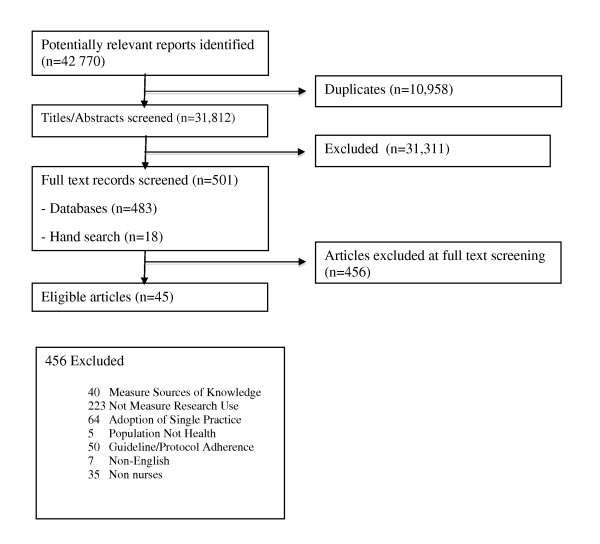
BACKGROUND: Interventions that have a better than random chance of increasing nurses' use of research are important to the delivery of quality patient care. However, few reports exist of successful research utilization in nursing interventions. Systematic identification and evaluation of individual characteristics associated with and predicting research utilization may inform the development of research utilization interventions. OBJECTIVE: To update the evidence published in a previous systematic review on individual characteristics influencing research utilization by nurses. METHODS: As part of a larger systematic review on research utilization instruments, 12 online bibliographic databases were searched. Hand searching of specialized journals and an ancestry search was also conducted. Randomized controlled trials, clinical trials, and observational study designs examining the association between individual characteristics and nurses' use of research were eligible for inclusion. Studies were limited to those published in the English, Danish, Swedish, and Norwegian languages. A vote counting approach to data synthesis was taken. RESULTS: A total of 42,770 titles were identified, of which 501 were retrieved. Of these 501 articles, 45 satisfied our inclusion criteria. Articles assessed research utilization in general (n = 39) or kinds of research utilization (n = 6) using self-report survey measures. Individual nurse characteristics were classified according to six categories: beliefs and attitudes, involvement in research activities, information seeking, education, professional characteristics, and socio-demographic/socio-economic characteristics. A seventh category, critical thinking, emerged in studies examining kinds of research utilization. Positive relationships, at statistically significant levels, for general research utilization were found in four categories: beliefs and attitudes, information seeking, education, and professional characteristics. The only characteristic assessed in a sufficient number of studies and with consistent findings for the kinds of research utilization was attitude towards research; this characteristic had a positive association with instrumental and overall research utilization. CONCLUSIONS: This review reinforced conclusions in the previous review with respect to positive relationships between general research utilization and: beliefs and attitudes, and current role. Furthermore, attending conferences/in-services, having a graduate degree in nursing, working in a specialty area, and job satisfaction were also identified as individual characteristics important to research utilization. While these findings hold promise as potential targets of future research utilization interventions, there were methodological problems inherent in many of the studies that necessitate their findings be replicated in further research using more robust study designs and multivariate assessment methods.
Overview
The claims and statistics of this paper haven’t been checked yet.
Free: it reads the open-access text and checks the first 5 claims that cite a source we can check. Create a free account to check every claim.
Integrity signals
Registry
Cites
Statistics
Figures
Verification
Claims the paper makes
The claims and statistics of this paper haven’t been checked yet.
Free: it reads the open-access text and checks the first 5 claims that cite a source we can check. Create a free account to check every claim.
Claims other papers make about this one
Each is checked against this paper’s own text: does it say what the citing paper says it does?
The source backs part of the claim, not all of it — or backs it for a different population, condition or comparison.
In the citing paper
“Evidence suggests that many individual level factors including beliefs, attitudes, motivations, values, skills, competence, behavior, and characteristics may be influential [40,41].”
From The role of evidence, context, and facilitation in an implementation trial: implications for the development of the PARIHS framework (2013) · cites this paper as [40]
Experimental — accuracy not yet measuredThe source backs part of the claim, not all of it — or backs it for a different population, condition or comparison.
In the citing paper
“we propose that the concept of the individual might incorporate: capability, capacity, motivation (including recognising a need for change), resilience, acceptability, feelings, knowledge and beliefs (including self efficacy) about the intervention/evidence, position and fit within the organization/social system, and approach to decision-making (e.g., experimentation, use of information).”
From The role of evidence, context, and facilitation in an implementation trial: implications for the development of the PARIHS framework (2013) · cites this paper as [40]
Experimental — accuracy not yet measuredThe source backs part of the claim, not all of it — or backs it for a different population, condition or comparison.
In the citing paper
“The selection of implementation strategies may be justified by prospective assessments that identify potential needs, barriers, or facilitators—sometimes termed ‘determinants of practice’ [43,55,85,86].”
From Implementation strategies: recommendations for specifying and reporting (2013) · cites this paper as [55]
Experimental — accuracy not yet measuredThe cited source says what the claim attributes to it.
In the citing paper
“While these determinants of practice could be identified through formal assessment processes, they could also be identified using theory or conceptual models e.g., [87], research literature e.g., [59,60,88-90], or more informal approaches such as brainstorming e.g., [55].”
From Implementation strategies: recommendations for specifying and reporting (2013) · cites this paper as [55]
In the citing paper
“Other systematic reviews and meta-analyses have focused on measures that assess provider-level constructs, such as behavioral intentions to implement evidence-based practices [38] and other research-related variables (e.g., attitudes toward and involvement in research activities) and demographic attributes (e.g., education [41]).”
Self-check
Percentages, sums and reported differences re-computed from the paper’s own numbers.
The self-check needs the paper’s full text.
Citations
Cites
The theory of planned behavior
Ajzen, I. (1991) · Organizational Behavior and Human Decision Processes · doi:10.1016/0749-5978(91)90020-t · Cited by 90,587
(2019) · doi:10.1188/19.onf · Cited by 3,217
Evaluating non-randomised intervention studies
Deeks, J., Dinnes, J., D'Amico, R., Sowden, A., Sakarovitch, C., Song, F., Petticrew, M., & Altman, D. (2003) · Health Technology Assessment · doi:10.3310/hta7270 · Cited by 2,907 · cited 1×
“The Quality Assessment Tool for Quantitative Studies Tool, developed for the Canadian Effective Public Health Practice Project, has been judged suitable to be used in systematic reviews of interventions [24,25].”
MethodStandard Quality Assessment Criteria for Evaluating Primary Research Papers from a Variety of Fields
Kmet, L. M., Cook, L. S., & Lee, R. C. (2004) · University of Alberta Library · doi:10.7939/r37m04f16 · Cited by 1,682 · cited 1×
“Estabrooks’ Quality Assessment and Validity Tool was developed based on the Cochrane Collaboration guidelines (in existence in 2001) and medical literature [22, 23 ].”
MethodAustralian Journal of Advanced Nursing
(2020) · Australian journal of advanced nursing · doi:10.37464/2020 · Cited by 1,596
Godin, G., Bélanger-Gravel, A., Eccles, M., & Grimshaw, J. (2008) · Implementation Science · doi:10.1186/1748-5908-3-36 · Cited by 1,096
Facione, N. C., Facione, P. A., & Sanchez, C. A. (1994) · Journal of Nursing Education · doi:10.3928/0148-4834-19941001-05 · Cited by 626
Criteria for the systematic review of health promotion and public health interventions
Jackson, N., & Waters, E. (2005) · Health Promotion International · doi:10.1093/heapro/dai022 · Cited by 572 · cited 1×
“The Quality Assessment Tool for Quantitative Studies Tool, developed for the Canadian Effective Public Health Practice Project, has been judged suitable to be used in systematic reviews of interventions [24,25].”
MethodIndividual determinants of research utilization: a systematic review
Estabrooks, C. A., Floyd, J. A., Scott‐Findlay, S., O'Leary, K. A., & Gushta, M. (2003) · Journal of Advanced Nursing · doi:10.1046/j.1365-2648.2003.02748.x · Cited by 490
Self-citation(2006) · Evidence‐based Medicine Toolkit · doi:10.1002/9780470750605.ch15 · Cited by 473
Research works printed but not linked: 7
- Dobbins M Ciliska D Mitchell A Dissemination and use of research evidence for policy and practice by nurses: A model of development and implementation strategies PhD Thesis 1998 University of Toronto: Faculty of Nursing
- Squires J Estabrooks C Wallin L Gustavsson P A systematic review of the psychometric properties of instruments used to measure knowledge translation in healthcare professionals technical report 2009 Edmonton, Alberta: Faculty of Nursing, University of Alberta
- Khan K Ter Riet G Popay J Nixon J Kleijnen J Satge I Conducting the review: Phase 5 study quality assessment Undertaking systematic reviews of research effectiveness CDC's guidance for those carrying out or commissioning reviews 2001 Centre of Reviews and Dissemination UoY 1 20
- McCloskey DJ The relationship between organizational factors and nurse factors affecting the conduct and utilization of nursing research PhD Thesis 2005 George Mason University
- Nash MA Research utilization among Idaho nurses PhD Thesis 2005 Gonzaga University
- Stiefel KA Career commitment, nursing unit culture, and nursing research utilization Dissertation/Thesis 1996 University of South Carolina
- Connor N The relationship between organizational culture and research utilization practices among nursing home departmental staff MN Thesis 2007 Dalhousie University (Canada)
Cited by
Items 301–400 of 796
Physician leadership in e-health? A systematic literature review
Keijser, W., Smits, J., Penterman, L., & Wilderom, C. P. M. (2016) · Leadership in health services · doi:10.1108/lhs-12-2015-0047 · Cited by 33
Adams, C., Dawson, A. J., & Foureur, M. J. (2016) · Women and Birth · doi:10.1016/j.wombi.2016.09.005 · Cited by 36
Valuing Healthcare Improvement: Implicit Norms, Explicit Normativity, and Human Agency
Carter, S. M. (2017) · Health Care Analysis · doi:10.1007/s10728-017-0350-x · Cited by 25
Research Use and Evidence-Based Practice Among Swedish Medical Social Workers: A Qualitative Study
Udo, C., Forsman, H., Jensfelt, M., & Flink, M. (2018) · Clinical Social Work Journal · doi:10.1007/s10615-018-0653-x · Cited by 37
Roles and functions in clinical care for registered nurses with a PhD—A systematic literature review
Orton, M., Follin, N. N., Dannapfel, P., & Wengström, Y. (2021) · Scandinavian Journal of Caring Sciences · doi:10.1111/scs.12979 · Cited by 30
Lapum, J. L., Liu, L. L., Church, K., Yau, T. M., Ruttonsha, P., David, A. M., & Retta, B. (2014) · SAGE Open · doi:10.1177/2158244014524211 · Cited by 40
Management Involvement-A Decisive Condition When Implementing Evidence-Based Practice
Aasekjær, K., Wæhle, H. V., Ciliska, D. K., Nortvedt, M. W., & Hjälmhult, E. (2016) · Worldviews on Evidence-Based Nursing · doi:10.1111/wvn.12141 · Cited by 37
Modifying researchers’ data management practices: A behavioural framework for library practitioners
Hickson, S., Poulton, K. A., Connor, M., Richardson, J., & Wolski, M. (2016) · IFLA Journal · doi:10.1177/0340035216673856 · Cited by 37
Achieving higher supply chain performance via business process orientation
Lavassani, K. M., & Movahedi, B. M. (2018) · Business Process Management Journal · doi:10.1108/bpmj-07-2016-0140 · Cited by 31
McLeod, L. J., & Hine, D. W. (2019) · Environmental Management · doi:10.1007/s00267-019-01176-5 · Cited by 25
Bar‐Zeev, Y., Bonevski, B., Bovill, M., Gruppetta, M., Oldmeadow, C. J., Palazzi, K. L., Atkins, L., Reath, J., & Gould, G. S. (2017) · BMJ Open · doi:10.1136/bmjopen-2017-016095 · Cited by 26
Hoben, M., Kent, A., Kobagi, N., & Yoon, M. N. (2016) · BMJ Open · doi:10.1136/bmjopen-2016-011159 · Cited by 25
Predicting Deviant Behaviors in Sports Using the Extended Theory of Planned Behavior
Kang, S., Kim, I., & Lee, K. (2021) · Frontiers in Psychology · doi:10.3389/fpsyg.2021.678948 · Cited by 28
Appleby, B. E., Roskell, C., & Daly, W. M. (2015) · Nursing Open · doi:10.1002/nop2.40 · Cited by 31
Taddio, A., MacDonald, N. E., Smart, S., Parikh, C., Allen, V. M., Halperin, B. A., & Shah, V. S. (2014) · Neonatal Network The Journal of Neonatal Nursing · doi:10.1891/0730-0832.33.2.74 · Cited by 22
Lockwood, R., Kable, A. K., & Hunter, S. (2017) · Journal of Clinical Nursing · doi:10.1111/jocn.14141 · Cited by 22
de Miranda, S. S.-F., Aguayo-González, F., Salguero, J., & Ávila-Gutiérrez, M. J. (2020) · Applied Sciences · doi:10.3390/app10134442 · Cited by 30
Kajermo, K. N., Alinaghizadeh, H., Falk, U., Wändell, P. E., & Törnkvist, L. (2013) · Scandinavian Journal of Caring Sciences · doi:10.1111/scs.12037 · Cited by 34
Scott, S. D., Rotter, T., Hartling, L., Chambers, T., & Bannar‐Martin, K. H. (2014) · Systematic Reviews · doi:10.1186/2046-4053-3-149 · Cited by 22
Purtle, J., Lê‐Scherban, F., Shattuck, P. T., Proctor, E. K., & Brownson, R. C. (2017) · Implementation Science · doi:10.1186/s13012-017-0613-9 · Cited by 22
Nylén, K., Karlberg, M., Klang, N., & Ogden, T. (2021) · Frontiers in Psychology · doi:10.3389/fpsyg.2021.618099 · Cited by 39
Innovations and eco-sustainability: exploring the role of organizational environment
Chaudhary, R., & Kumar, C. (2021) · Social Responsibility Journal · doi:10.1108/srj-12-2020-0497 · Cited by 29
Hines, S. J., Ramsbotham, J., & Coyer, F. M. (2022) · BMC Nursing · doi:10.1186/s12912-022-00877-3 · Cited by 31
The representation of vulnerable populations in quality improvement studies
Rolnitsky, A., Kirtsman, M., Goldberg, H. R., Dunn, M., & Bell, C. M. (2018) · International Journal for Quality in Health Care · doi:10.1093/intqhc/mzy016 · Cited by 22
Arthur, K., Christofides, N. J., & Nelson, G. (2020) · PLoS ONE · doi:10.1371/journal.pone.0227519 · Cited by 24
Melnyk, B. M. (2017) · Worldviews on Evidence-Based Nursing · doi:10.1111/wvn.12271 · Cited by 21
Vayro, C., & Hamilton, K. (2015) · Appetite · doi:10.1016/j.appet.2015.12.015 · Cited by 23
Lucci, V.-E. M., McKay, R. C., McBride, C. B., McGrath, M. S., Willms, R., Gainforth, H. L., & Claydon, V. E. (2022) · Spinal Cord · doi:10.1038/s41393-021-00743-0 · Cited by 22
Walugembe, D. R., Kiwanuka, S. N., Matovu, J. K. B., Rutebemberwa, E., & Reichenbach, L. (2015) · Health Research Policy and Systems · doi:10.1186/s12961-015-0015-x · Cited by 25
Empathic Avatars in Stroke Rehabilitation: A Co-designed mHealth Artifact for Stroke Survivors
Aljaroodi, H. M., Adam, M. T. P., Chiong, R., Cornforth, D. J., & Minichiello, M. (2017) · Lecture notes in computer science · doi:10.1007/978-3-319-59144-5_5 · Cited by 23
Beccaria, L., Beccaria, G., & McCosker, C. (2017) · Nurse Education Today · doi:10.1016/j.nedt.2017.12.010 · Cited by 26
Totura, C. M. W., Labouliere, C. D., Gryglewicz, K., & Karver, M. S. (2018) · Administration and Policy in Mental Health and Mental Health Services Research · doi:10.1007/s10488-018-0907-5 · Cited by 23
Puigdomènech, E., Martin, A., Lang, A. R., Adorni, F., Gómez, S. F., McKinstry, B., Prinelli, F., Condon, L. A., Rashid, R., Caon, M., et al. (2019) · BMC Medical Informatics and Decision Making · doi:10.1186/s12911-019-0958-x · Cited by 27
Individual level predictors of implementation climate in child welfare services
Engell, T., Kirkøen, B., Aarons, G. A., & Hagen, K. A. (2020) · Children and Youth Services Review · doi:10.1016/j.childyouth.2020.105509 · Cited by 23
Mannell, J., Cornish, F., & Russell, J. (2014) · Journal of the International AIDS Society · doi:10.7448/ias.17.1.19073 · Cited by 28
Gervais, M.-J., Marion, C., Dagenais, C., Chiocchio, F., & Houlfort, N. (2015) · Research Evaluation · doi:10.1093/reseval/rvv034 · Cited by 27
Wilson, A. M., Delbridge, R., & Palermo, C. E. (2016) · Nutrition & Dietetics · doi:10.1111/1747-0080.12309 · Cited by 20
Chen, S., Burström, B., Sparring, V., & Qian, D. (2018) · BMC Health Services Research · doi:10.1186/s12913-018-3355-8 · Cited by 21
Facilitators and barriers to social distancing for young people during the COVID-19 pandemic
Berry, E., Jenkins, C., & Allen, S. (2022) · BMC Public Health · doi:10.1186/s12889-022-13325-3 · Cited by 24
Ein, N., Gervasio, J., Cyr, K. S., Liu, J. J. W., Baker, C., Nazarov, A., & Richardson, J. D. (2024) · Frontiers in Health Services · doi:10.3389/frhs.2024.1426202 · Cited by 38
Song, Y., Hoben, M., Weeks, L. E., Boström, A., Goodarzi, Z., Squires, J. E., Doan, H., Wagg, A., Reid, R. C., & Estabrooks, C. A. (2019) · BMJ Open · doi:10.1136/bmjopen-2018-028416 · Cited by 24
Self-citationGrünwald, L. M., Duddy, C., Byng, R., Crellin, N. E., & Moncrieff, J. (2021) · BMC Psychiatry · doi:10.1186/s12888-021-03355-3 · Cited by 22
Nurses experience of using scientific knowledge in clinical practice: a grounded theory study
Renolen, Å., & Hjälmhult, E. (2015) · Scandinavian Journal of Caring Sciences · doi:10.1111/scs.12191 · Cited by 19
Reding, M. E. J., Guan, K., Regan, J., Palinkas, L. A., Lau, A. S., & Chorpita, B. F. (2017) · Cognitive and Behavioral Practice · doi:10.1016/j.cbpra.2017.05.005 · Cited by 22
Liu, W., Shi, L., Pong, R., Dong, H., Mao, Y., Tang, M., & Chen, Y. (2014) · International Journal of Technology Assessment in Health Care · doi:10.1017/s0266462314000737 · Cited by 18
Huey, S., Kavanagh, M., Regan, Á., Dean, M., McKernan, C., McCoy, F., Ryan, E. G., Caballero-Villalobos, J., & McAloon, C. I. (2021) · Irish Veterinary Journal · doi:10.1186/s13620-021-00207-0 · Cited by 18
Neonatal kangaroo care - What we know and how we can improve its practice: An evidence review
Cunningham, C., Patton, D., Moore, Z. E. H., O’Connor, T., Bux, D., & Nugent, L. (2021) · Journal of Neonatal Nursing · doi:10.1016/j.jnn.2021.10.004 · Cited by 21
Walker, T. J., Foster, M., Szeszulski, J., Craig, D. W., Mullen, P. D., & Fernández, M. E. (2022) · BMC Public Health · doi:10.1186/s12889-022-13692-x · Cited by 19
Genome-Wide Associations and Confirmatory Meta-Analyses in Diabetic Retinopathy
Yu, X., & Rong, S. S. (2023) · Genes · doi:10.3390/genes14030653 · Cited by 21
Individual determinants of research utilization by nurses: a systematic review update1)
Squires, J., Estabrooks, C., Gustavsson, P. J., Wallin, L., van Oostveen, C., Eskes, A. M., & Vermeulen, H. (2012) · Nederlands Tijdschrift voor Evidence Based Practice · doi:10.1007/s12468-012-0043-2 · Cited by 18
Self-citationPercepción de barreras para la utilización de la investigación en enfermeras de Osakidetza
Cidoncha-Moreno, M. Á., & de Retana, B. R. D. A. F. (2017) · Enfermería Clínica · doi:10.1016/j.enfcli.2017.03.015 · Cited by 29
Seacrist, M. J., Bingham, D., Scheich, B., & Byfield, R. (2017) · Journal of Obstetric, Gynecologic & Neonatal Nursing · doi:10.1016/j.jogn.2017.11.009 · Cited by 23
Mrklas, K., MacDonald, S. E., Shea-Budgell, M. A., Bedingfield, N., Ganshorn, H., Glaze, S., Bill, L., Healy, B. A., Healy, C., Guichon, J. R., et al. (2018) · Systematic Reviews · doi:10.1186/s13643-018-0692-y · Cited by 21
Cornes, M., Manthorpe, J., Hennessy, C., Anderson, S. E., Clark, M., & Scanlon, C. (2014) · Journal of Interprofessional Care · doi:10.3109/13561820.2014.917406 · Cited by 18
Friberger, M. G., & Falkman, G. (2011) · Behaviour and Information Technology · doi:10.1080/0144929x.2011.602426 · Cited by 22
Larue, C., Goulet, M., Prévost, M.-J., Dumais, A., & Bellavance, J. (2016) · Journal of Applied Research in Intellectual Disabilities · doi:10.1111/jar.12309 · Cited by 22
Kuk, N. O., den Ouden, M., Zijlstra, G. A. R., Hamers, J. P. H., Kempen, G. I. J. M., & Bours, G. J. J. W. (2017) · BMC Geriatrics · doi:10.1186/s12877-017-0412-9 · Cited by 24
Bunn, F., Goodman, C. M., Manthorpe, J., Durand, M., Hodkinson, I., Rait, G., Millac, P. A. H., Davies, S. L., Russell, B., & Wilson, P. M. (2017) · BMJ Open · doi:10.1136/bmjopen-2016-014026 · Cited by 21
Research Use of Nurses Working in the Critical Care Units: Barriers and Facilitators
Hweidi, I. M., Tawalbeh, L. I., Al-hassan, M. A., Alayadeh, R. M., & Al‐Smadi, A. M. (2017) · Dimensions of Critical Care Nursing · doi:10.1097/dcc.0000000000000255 · Cited by 22
Elvén, M., Hochwälder, J., Dean, E., & Söderlund, A. (2018) · Physiotherapy Theory and Practice · doi:10.1080/09593985.2017.1419521 · Cited by 17
Automatic classification of communication logs into implementation stages via text analysis
Wang, D., Ogihara, M., Gallo, C., Villamar, J. A., Smith, J. D., Vermeer, W., Cruden, G., Benbow, N., & Brown, C. H. (2015) · Implementation Science · doi:10.1186/s13012-016-0483-6 · Cited by 17
Ramsey, K. (2021) · Health Policy and Planning · doi:10.1093/heapol/czab135 · Cited by 20
Ziam, S., Lakhal, S., Laroche, É., Lane, J. M., Alderson, M., & Gagné, C. (2022) · Applied Ergonomics · doi:10.1016/j.apergo.2022.103895 · Cited by 14
Matthew, M., Bainbridge, D. B., Bishop, V. R., Sinding, C., Winemaker, S., Kilbertus, F., Kortes-Miller, K., & Seow, H. Y. (2023) · BMC Palliative Care · doi:10.1186/s12904-023-01265-7 · Cited by 20
Drury, P., McInnes, E., Hardy, J., Dale, S., & Middleton, S. (2015) · International Journal of Nursing Practice · doi:10.1111/ijn.12396 · Cited by 23
Bar‐Zeev, Y., Bovill, M., Bonevski, B., Gruppetta, M., Oldmeadow, C. J., Palazzi, K. L., Atkins, L., Reath, J., & Gould, G. S. (2019) · BMJ Open · doi:10.1136/bmjopen-2018-025293 · Cited by 17
Abamecha, F., Midaksa, G., Sudhakar, M., Abebe, L., Kebede, Y., Alemayehu, G., & Birhanu, Z. (2021) · BMC Public Health · doi:10.1186/s12889-021-11216-7 · Cited by 22
McDonnell, A., Gerrish, K., Kirshbaum, M. N., Nolan, M., Tod, A., & Preston, L. (2012) · Journal of research in nursing · doi:10.1177/1744987112446241 · Cited by 21
Conduct and utilization of research among nurses at federal capital territory, Abuja Nigeria
Oluwatosin, A. O. (2014) · Journal of Nursing Education and Practice · doi:10.5430/jnep.v4n7p139 · Cited by 24
Lorant, V., Grard, A., Audenhove, C. V., Helmer, E., Vanderhaegen, J., & Nicaise, P. (2016) · BMC Health Services Research · doi:10.1186/s12913-016-1434-2 · Cited by 23
Motivational, volitional and multiple goal predictors of walking in people with type 2 diabetes
Namadian, M., Presseau, J., Watson, M. C., Bond, C. M., & Sniehotta, F. F. (2016) · Psychology of sport and exercise · doi:10.1016/j.psychsport.2016.06.006 · Cited by 23
Tierney, E., McEvoy, R., Hannigan, A., & MacFarlane, A. E. (2018) · Health Expectations · doi:10.1111/hex.12692 · Cited by 23
Hillborg, H., Bergmark, M., & Bejerholm, U. (2020) · Social Policy and Administration · doi:10.1111/spol.12611 · Cited by 24
Understanding incentives for cybersecurity investments: Development and application of a typology
Wessels, M., van den Brink, P., Verburgh, T., Cadet, B., & van Ruijven, T. (2021) · Digital Business · doi:10.1016/j.digbus.2021.100014 · Cited by 32
McAlearney, A. S., Song, P. H., & Reiter, K. L. (2012) · Contemporary Clinical Trials · doi:10.1016/j.cct.2012.08.008 · Cited by 19
Henderson, J. L., Sword, W. A., Niccols, A., & Dobbins, M. (2014) · Substance Abuse Treatment Prevention and Policy · doi:10.1186/1747-597x-9-21 · Cited by 20
Evaluation of a Web Course to Increase Evidence-Based Practice Knowledge Among Nurses
Allen, N., Lubejko, B. G., Thompson, J. A., & Turner, B. S. (2015) · Clinical journal of oncology nursing · doi:10.1188/15.cjon.623-627 · Cited by 19
Rieckmann, T. R., Moore, L. A., Croy, C. D., Novins, D. K., & Aarons, G. A. (2016) · Journal of Substance Abuse Treatment · doi:10.1016/j.jsat.2016.05.007 · Cited by 21
Nurses' Perceived Skills and Attitudes About Updated Safety Concepts
Armstrong, G. E., Dietrich, M. S., Norman, L. D., Barnsteiner, J., & Mion, L. C. (2016) · Journal of Nursing Care Quality · doi:10.1097/ncq.0000000000000226 · Cited by 16
Exploring Effectiveness of Classroom Assessments for Students’ Learning in High School Chemistry
İzci, K., Muslu, N., Burcks, S. M., & Siegel, M. A. (2018) · Research in Science Education · doi:10.1007/s11165-018-9757-0 · Cited by 21
Croff, R. L., Rieckmann, T. R., & Spence, J. D. (2013) · The Journal of Behavioral Health Services & Research · doi:10.1007/s11414-013-9322-6 · Cited by 19
Hinojosa, J., Gisbert, J. P., Gomollón, F., & Román, A. L. S. (2012) · Journal of Crohn s and Colitis · doi:10.1016/j.crohns.2011.12.013 · Cited by 16
Hasche, L. K., Lenze, S. N., Brown, T., Lawrence, L., Nickel, M., Morrow-Howell, N. L., & Proctor, E. K. (2013) · Administration and Policy in Mental Health and Mental Health Services Research · doi:10.1007/s10488-013-0519-z · Cited by 19
Moya‐Suárez, A. B., Morales‐Asencio, J. M., Aranda‐Gallardo, M., de Luna-Rodríguez, M. E., & Canca‐Sánchez, J. C. (2017) · Journal of Tissue Viability · doi:10.1016/j.jtv.2017.09.003 · Cited by 18
Brierley, M. L., Smith, L. R., Bailey, D. P., Every, S. A., Staines, T. A., & Chater, A. (2021) · BMC Public Health · doi:10.1186/s12889-021-12019-6 · Cited by 24
Getting over the shock: taking action on Indigenous maternal smoking
Gould, G. S., Cadet‐James, Y., & CLOUGH, A. R. (2016) · Australian Journal of Primary Health · doi:10.1071/py15066 · Cited by 15
How are leaders using benchmarking information in occupational health and safety decision-making?
Yanar, B., Amick, B. C., Lambraki, I. A., D’Elia, T., Severin, C. N., & Eerd, D. V. (2019) · Safety Science · doi:10.1016/j.ssci.2019.03.016 · Cited by 19
Bench, S. D., Dowie-Baker, J.-A., & Fish, P. (2019) · International Journal of Orthopaedic and Trauma Nursing · doi:10.1016/j.ijotn.2019.04.002 · Cited by 15
Social Media for ImpLementing Evidence (SMILE): Conceptual Framework
Zhao, J.-Q., Harvey, G., Vandyk, A., & Gifford, W. A. (2022) · JMIR Formative Research · doi:10.2196/29891 · Cited by 14
Research utilization and evidence-based practice among Saskatchewan massage therapists
Gowan-Moody, D., Leis, A. M., Abonyi, S., Epstein, M., & Premkumar, K. (2013) · Journal of Complementary and Integrative Medicine · doi:10.1515/jcim-2012-0044 · Cited by 15
“Consistent with the results of other studies involving MTs, nurses, and PTs [13, 18, 28] number of years of practice experience was not a significant predictor of use of research.”
InfluentialHoben, M., Hu, H., Xiong, T., Kent, A., Kobagi, N., & Yoon, M. N. (2016) · Systematic Reviews · doi:10.1186/s13643-016-0231-7 · Cited by 17
“To evaluate study quality, we will use four validated checklists as appropriate to each study’s design, all of which were used and described in detail in previous systematic reviews [11, 59–62].”
Czaja, S. J., Valente, T. W., Nair, S. N., Villamar, J. A., & Brown, C. H. (2015) · Implementation Science · doi:10.1186/s13012-016-0433-3 · Cited by 15
Evidenzbasierte Pflegepraxis–Diskussionsbeitrag zum Status quo
Meyer, G., Balzer, K., & Köpke, S. (2013) · Zeitschrift für Evidenz Fortbildung und Qualität im Gesundheitswesen · doi:10.1016/j.zefq.2012.12.001 · Cited by 18
Stamatakis, K. A., Hino, A. A. F., Allen, P. M., McQueen, A., Jacob, R. R., Baker, E. A., & Brownson, R. C. (2016) · Evaluation and Program Planning · doi:10.1016/j.evalprogplan.2016.08.002 · Cited by 18
Toye, C. M., Slatyer, S., Quested, E., Bronson, M., Hill, A., Fountaine, J., Uren, H. V., Troeung, L., & Maher, S. (2019) · International Journal of Older People Nursing · doi:10.1111/opn.12219 · Cited by 15
Djukic, M., Jun, J., & Fletcher, J. (2021) · Worldviews on Evidence-Based Nursing · doi:10.1111/wvn.12497 · Cited by 15
Guo, L., & Hariharan, S. L. (2012) · Knowledge and Process Management · doi:10.1002/kpm.1386 · Cited by 19
Meis‐Harris, J., & Kashima, Y. (2020) · Asian Journal Of Social Psychology · doi:10.1111/ajsp.12411 · Cited by 14
Poiroux, L., Bruyneel, A., Larcin, L., Fossat, G., Kamel, T., Labro, G., Goursaud, S., Rouzé, A., Heming, N., & Hermann, B. (2024) · Intensive and Critical Care Nursing · doi:10.1016/j.iccn.2023.103610 · Cited by 16
Gonçalves, P. D., Hagenbeek, M. L., & Vissers, J. (2013) · BMC Health Services Research · doi:10.1186/1472-6963-13-475 · Cited by 20
Metadata
- Authors
- Squires, J. E., Estabrooks, C. A., Gustavsson, P., & Wallin, L.
- Affiliations
- Ottawa Hospital Research Institute (CA)
- University of Alberta (CA)
- Karolinska Institutet (SE)
- Karolinska University Hospital (SE)
- Corresponding author
- Squires, Janet E
- Venue
- Implementation Science
- Published
- 2011-01-05
- Volume
- 6
- Issue
- 1
- Pages
- 1-1
- ISSN
- 1748-5908 (ISSN-L)
- PMC
- PMC3024963
- OpenAlex
- W2126717870
- Cited by
- 798
- References
- 83
- Citations by year
- 2026: 8 · 2025: 38 · 2024: 18 · 2023: 26 · 2022: 52 · 2021: 106 · 2020: 60 · 2019: 59 · 2018: 59 · 2017: 73 · 2016: 77 · 2015: 65 · 2014: 58 · 2013: 47 · 2012: 38
- FWCI
- 8.19
- Type
- journal article
- Language
- en
- Open access
- gold
- doi.org
- Licence
- Locations
- Implementation Science (publishedVersion, cc-by)
- PubMed Central (publishedVersion, cc-by)
- PubMed (publishedVersion)
- DOAJ (DOAJ: Directory of Open Access Journals) (submittedVersion)
- uO Research (University of Ottawa) (submittedVersion, public-domain)
- Funders
- AFA Försäkring
- Fondation pour la Recherche Médicale
- Alberta Heritage Foundation for Medical Research
- Karolinska Institutet
- Killam Trusts
- Canadian Institutes of Health Research
- Topics
- Health Sciences › Health Professions › General Health Professions › Health Sciences Research and Education
- Health Sciences › Health Professions › General Health Professions › Health Policy Implementation Science
- Health Sciences › Medicine › Public Health, Environmental and Occupational Health › Health and Medical Research Impacts
- Keywords
- research utilization, nurses, individual characteristics, attitudes toward research, information seeking, nursing education, critical thinking, job satisfaction
- MeSH terms
- Attitude of Health Personnel, Data Collection, Diffusion of Innovation, Humans, Research Design, Nursing Research, Evidence-Based Nursing
About these checks
Registry, retraction, Cites and statistics results are computed, not judged, with one exception: a printed reference that no index lists is read once by a model before it counts as a citation error. Claims are extracted by a model and kept only when their quote appears verbatim in the text; each cited source is then checked, with a model’s help, for whether it says what the claim relies on. Those verdicts can be wrong — read the claim’s quote and the cited source before relying on one.
Statistics and arithmetic are recomputed, not judged.
Confidence bands are shown only for fields calibrated on our annotated test set. None is calibrated yet, so no band is shown.
What counts as a claim ›How we measure confidence ›How we check this ›
Are you an author, or do you see a problem with this page? Request a review
Data sources
Bibliographic data: Semantic Scholar, OpenAlex, Crossref.
Contains information from the Semantic Scholar Academic Graph Datasets, made available under the ODC Attribution License (ODC-BY 1.0).
Semantic Scholar’s data is described in: Kinney, R., et al. (2023). The Semantic Scholar Open Data Platform. arXiv:2301.10140.
