

A systematic review of the psychometric properties of self-report research utilization measures used in healthcare
Open accessThe DOI matches its Crossref record; 148 of the 151 references it cites were found in a registry or an index.
Abstract
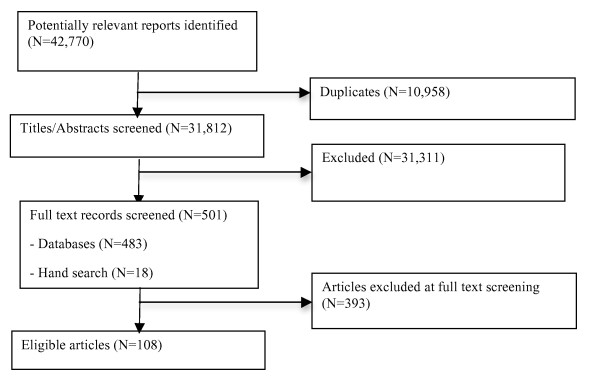
BACKGROUND: In healthcare, a gap exists between what is known from research and what is practiced. Understanding this gap depends upon our ability to robustly measure research utilization. OBJECTIVES: The objectives of this systematic review were: to identify self-report measures of research utilization used in healthcare, and to assess the psychometric properties (acceptability, reliability, and validity) of these measures. METHODS: We conducted a systematic review of literature reporting use or development of self-report research utilization measures. Our search included: multiple databases, ancestry searches, and a hand search. Acceptability was assessed by examining time to complete the measure and missing data rates. Our approach to reliability and validity assessment followed that outlined in the Standards for Educational and Psychological Testing. RESULTS: Of 42,770 titles screened, 97 original studies (108 articles) were included in this review. The 97 studies reported on the use or development of 60 unique self-report research utilization measures. Seven of the measures were assessed in more than one study. Study samples consisted of healthcare providers (92 studies) and healthcare decision makers (5 studies). No studies reported data on acceptability of the measures. Reliability was reported in 32 (33%) of the studies, representing 13 of the 60 measures. Internal consistency (Cronbach's Alpha) reliability was reported in 31 studies; values exceeded 0.70 in 29 studies. Test-retest reliability was reported in 3 studies with Pearson's r coefficients > 0.80. No validity information was reported for 12 of the 60 measures. The remaining 48 measures were classified into a three-level validity hierarchy according to the number of validity sources reported in 50% or more of the studies using the measure. Level one measures (n = 6) reported evidence from any three (out of four possible) Standards validity sources (which, in the case of single item measures, was all applicable validity sources). Level two measures (n = 16) had evidence from any two validity sources, and level three measures (n = 26) from only one validity source. CONCLUSIONS: This review reveals significant underdevelopment in the measurement of research utilization. Substantial methodological advances with respect to construct clarity, use of research utilization and related theory, use of measurement theory, and psychometric assessment are required. Also needed are improved reporting practices and the adoption of a more contemporary view of validity (i.e., the Standards) in future research utilization measurement studies.
Overview
The claims and statistics of this paper haven’t been checked yet.
Free: it reads the open-access text and checks the first 5 claims that cite a source we can check. Create a free account to check every claim.
Integrity signals
Registry
Cites
Statistics
Figures
Verification
Claims the paper makes
The claims and statistics of this paper haven’t been checked yet.
Free: it reads the open-access text and checks the first 5 claims that cite a source we can check. Create a free account to check every claim.
Claims other papers make about this one
Each is checked against this paper’s own text: does it say what the citing paper says it does?
The cited source says what the claim attributes to it.
In the citing paper
“And, the measures used to assess these constructs are frequently developed without direct connection to substantive theory or guiding frameworks and with minimal analysis of psychometric properties, such as internal reliability and construct validity [12].”
The cited source says what the claim attributes to it.
In the citing paper
“As Squires et al.[12] recently discussed in their review of measures assessing research utilization, a large majority of these existing measures demonstrate weak psychometric properties.”
In the citing paper
“At present, constructs that have been hypothesized to affect implementation outcomes are often poorly defined within studies [11,12].”
In the citing paper
“Finally, it is important to note that other previous reviews have focused on the conceptualization [6] and evaluation [12] of implementation outcomes, including the psychometric properties of research utilization measures [12].”
Self-check
Percentages, sums and reported differences re-computed from the paper’s own numbers.
The self-check needs the paper’s full text.
Citations
Cites
Rogers, E. M., Singhal, A., & Quinlan, M. M. (2019) · An Integrated Approach to Communication Theory and Research · doi:10.4324/9780203710753-35 · Cited by 37,322
The Structure of Scientific Revolutions
Kuhn, T. S., & Schlegel, R. (1963) · Physics Today · doi:10.1063/1.3050879 · Cited by 35,538
Construct validity in psychological tests.
Cronbach, L. J., & Meehl, P. E. (1955) · Psychological Bulletin · doi:10.1037/h0040957 · Cited by 11,195 · cited 1×
“According to Cronbach and Meehl [113], construct validity rests in a nomological network that generates testable propositions that relate scores obtained with self-report measures (as representations of a construct) to other constructs, in order to better understand the nature of the construct being measured [113].”
BackgroundHealth Measurement Scales: A Practical Guide to Their Development and Use
Streiner, D. L., Norman, G. R., & Cairney, J. (1989) · Cited by 9,595
The Structure of Scientific Revolutions.
Bohm, D., & Kuhn, T. S. (1964) · The Philosophical Quarterly · doi:10.2307/2217783 · Cited by 9,130
Bulletin of the World Health Organization
van der Sande, M. A. B., Walraven, G. E. L., Milligan, P. J., BANYA, W. A. S., CEESAY, S. M., Nyan, O. A., & McAdam, K. P. W. J. (2001) · Bulletin of the World Health Organization · Cited by 7,097
The diffusion of innovations: Some examples of finnish civil servant's professional tours in Europe
Hietala, M. (1983) · Scandinavian Journal of History · doi:10.1080/03468758308579015 · Cited by 6,162
Fundamentals of item response theory
(1992) · Choice Reviews Online · doi:10.5860/choice.29-4185 · Cited by 3,414
(2019) · doi:10.1188/19.onf · Cited by 3,217
Gluesing, J. C. (2012) · Leadership in Science and Technology: A Reference Handbook · doi:10.4135/9781412994231.n14 · Cited by 3,210
Research works printed but not linked: 14
- Nunnally J Bernstein I Psychometric Theory 1994 3 New York: McGraw-Hill
- Thompson CJ Extent and factors influencing research utilization among critical care nurses Thesis 1997 Texas Woman's University, College of Nursing
- Stiefel KA Career commitment, nursing unit culture, and nursing research utilization Thesis 1996 University of South Carolina
- Kelly KA Translating research into practice: The physicians' perspective Thesis 2008 State University of New York at Albany
- Linde BJ The effectiveness of three interventions to increase research utilization among practicing nurses Thesis 1989 The University of Michigan
- Connor N The relationship between organizational culture and research utilization practices among nursing home departmental staff Thesis 2007 Dalhousie University
- McCloskey DJ The relationship between organizational factors and nurse factors affecting the conduct and utilization of nursing research Thesis 2005 George Mason University
- Nash MA Research utilization among Idaho nurses Thesis 2005 Gonzaga University
- Rogers EM Diffusion of Innovations 1983 3 New York: The Free Press
- Rardin DK The Mesh of research Tand practice: The effect of cognitive style on the use of research in practice of psychotherapy Thesis 1986 University of Maryland College Park
- Pain K Hagler P Warren S Development of an instrument to evaluate the research orientation of clinical professionals Canadian Journal of Rehabilitation 1996 9 2 93 100
- Aron J The utilization of psychotherapy research on depression by clinical psychologists Thesis 1990 Auburn University
- Miller JP Speech-language pathologists' use of evidence-based practice in assessing children and adolescents with cognitive-communicative disabilities: a survey Thesis 2007 Eastern Washington University
- Wood CK Adoption of innovations in a medical community: The case of evidence-based medicine Thesis 1996 University of Hawaii
Cited by
Items 101–107 of 107
McNamara, L., Scott, K., Boyd, R., Farmer, E., Webb, A., & Novak, I. (2023) · Figshare · doi:10.6084/m9.figshare.24143790
Exploring the use of self-report behavioural science questionnaires in sub-Saharan African countries
Weir, C. (2023) · Stirling Online Research Repository (University of Stirling) · Cited by 2
Hamzeh, J. (2018) · eScholarship@McGill (McGill) · doi:10.82308/19379
Ayhanci, N. N., Özer, Z. P., Can, F., Şahin, Ş. S., Karatoprak, E., & Hıdır, A. P. A. K. (2026) · BMC Neurology · doi:10.1186/s12883-026-05067-1
“Since values above 0.70 are generally considered acceptable for internal consistency [29], this result indicates that the Turkish-PedMIDAS has good reliability.”
InfluentialHerting, J. R., Gubner, N. R., Palinkas, L., Lewis, W., Dean, T., Dreste, N., Vick, K., & Walker, S. (2023) · OSF Preprints (OSF Preprints)
Ciampa, M. A. (2026) · Revista Argentina de Terapia Ocupacional
Xiang, L., & Kikuchi, H. (2026) · Frontiers in Robotics and AI · doi:10.3389/frobt.2026.1866995
“Each has trade-offs: questionnaires are convenient but subject to recall bias (Squires et al., 2011); diaries risk inconsistent compliance (Squires et al., 2011); and ESM is precise but may disrupt daily life (Stieger and Reips, 2019).”
Metadata
- Authors
- Squires, J. E., Estabrooks, C. A., O'Rourke, H. M., Gustavsson, P., Newburn-Cook, C. V., & Wallin, L.
- Affiliations
- Ottawa Hospital Research Institute (CA)
- University of Alberta (CA)
- Karolinska Institutet (SE)
- Corresponding author
- Squires, Janet E
- Venue
- Implementation Science
- Published
- 2011-07-27
- Volume
- 6
- Issue
- 1
- Pages
- 83-83
- ISSN
- 1748-5908 (ISSN-L)
- PMC
- PMC3169486
- OpenAlex
- W2145549051
- Cited by
- 101
- References
- 151
- Citations by year
- 2026: 3 · 2025: 3 · 2024: 3 · 2023: 8 · 2022: 5 · 2021: 7 · 2020: 6 · 2019: 3 · 2018: 11 · 2017: 6 · 2016: 11 · 2015: 14 · 2014: 7 · 2013: 5 · 2012: 7
- FWCI
- 1.11
- Type
- journal article
- Language
- en
- Open access
- gold
- doi.org
- Licence
- Locations
- Implementation Science (publishedVersion, cc-by)
- PubMed Central (publishedVersion, cc-by)
- PubMed (publishedVersion)
- Adelaide Research & Scholarship (AR&S) (University of Adelaide) (submittedVersion, cc-by)
- DOAJ (DOAJ: Directory of Open Access Journals) (submittedVersion, cc-by-sa)
- uO Research (University of Ottawa) (submittedVersion, public-domain)
- Funders
- Canadian Institutes of Health Research (86255_1)
- Topics
- Health Sciences › Health Professions › General Health Professions › Health Sciences Research and Education
- Health Sciences › Nursing › Research and Theory › Health Education and Validation
- Health Sciences › Health Professions › General Health Professions › Health Policy Implementation Science
- Keywords
- research utilization, self-report measures, psychometric properties, reliability statistics, validity, internal consistency, test-retest reliability, healthcare workers, healthcare decision-makers, research-practice gap, measurement theory, construct clarity, Standards for Educational and Psychological Testing
- MeSH terms
- Health Services Research, Humans, Psychometrics, Global Health, Reproducibility of Results, Evidence-Based Medicine, Self Report
About these checks
Registry, retraction, Cites and statistics results are computed, not judged, with one exception: a printed reference that no index lists is read once by a model before it counts as a citation error. Claims are extracted by a model and kept only when their quote appears verbatim in the text; each cited source is then checked, with a model’s help, for whether it says what the claim relies on. Those verdicts can be wrong — read the claim’s quote and the cited source before relying on one.
Statistics and arithmetic are recomputed, not judged.
Confidence bands are shown only for fields calibrated on our annotated test set. None is calibrated yet, so no band is shown.
What counts as a claim ›How we measure confidence ›How we check this ›
Are you an author, or do you see a problem with this page? Request a review
Data sources
Bibliographic data: Semantic Scholar, OpenAlex, Crossref.
Contains information from the Semantic Scholar Academic Graph Datasets, made available under the ODC Attribution License (ODC-BY 1.0).
Semantic Scholar’s data is described in: Kinney, R., et al. (2023). The Semantic Scholar Open Data Platform. arXiv:2301.10140.
