

Development of a theory-based instrument to identify barriers and levers to best hand hygiene practice among healthcare practitioners
Open accessThe DOI matches its Crossref record; 34 of the 35 references it cites were found in a registry or an index, and 1 are not checked yet.
Abstract
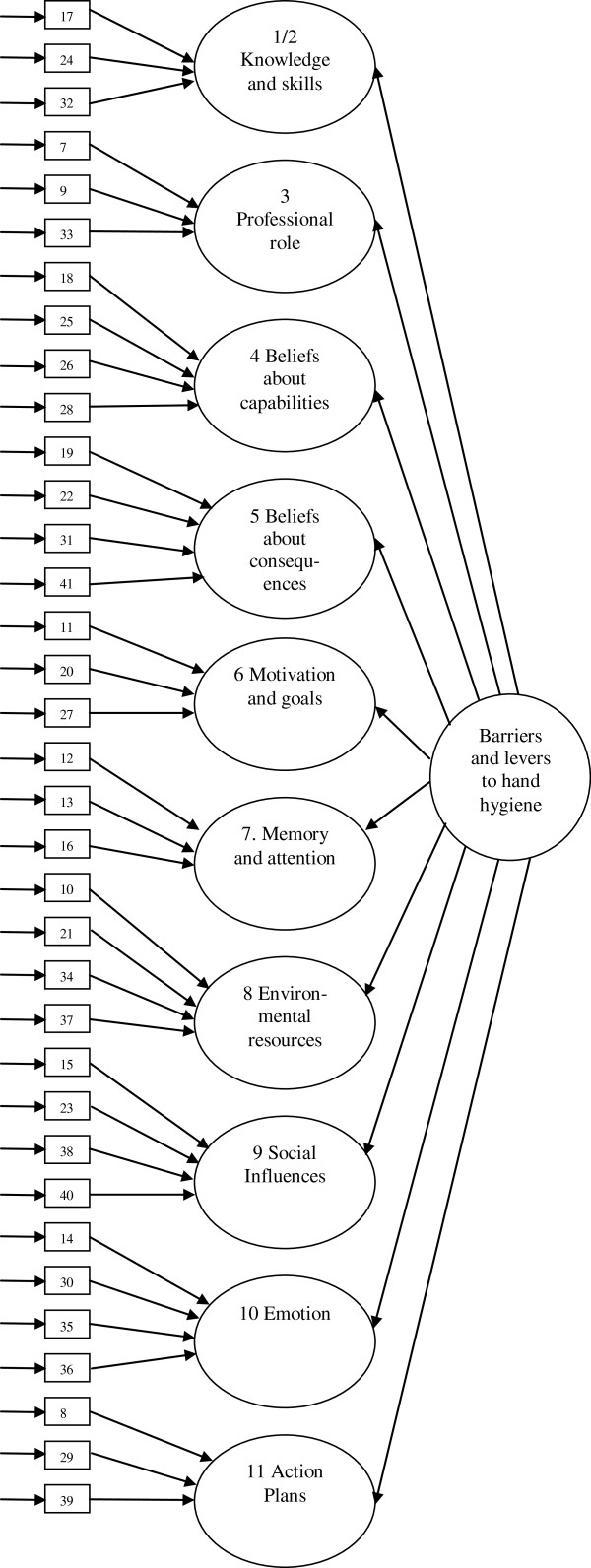
BACKGROUND: A theoretical approach to assessing the barriers and levers to evidence-based practice (EBP) with subsequent tailoring of theoretically informed strategies to address these may go some way to positively influencing the delay in implementing research findings into practice. Hand hygiene is one such example of EBP, chosen for this study due to its importance in preventing death through healthcare associated infections (HCAI). The development of an instrument to assess barriers and levers to hand hygiene and to allow the subsequent tailoring of theoretically informed implementation strategies is reported here. METHODS: A comprehensive list of barriers and levers to hand hygiene were categorised to the Theoretical Domains Framework (TDF) in a Delphi survey. These items formed the basis of an instrument that was tested to establish validity and reliability. The relationship between self-reported compliance with hand hygiene and barriers and levers to hand hygiene was also examined along with compliance according to where the barriers and levers fit within the domains of the TDF framework. RESULTS: A 33-item instrument that tested well for internal consistency (α = 0.84) and construct validity (χ²/df = 1.9 [p < 0.01], RMSEA = 0.05 and CFA = 0.84) was developed. The relationship between self-reported compliance with hand hygiene moderately correlated with barriers identified by participants (total barrier score) (r = 0.41, n = 276, p <0.001). The greater the number of barriers reported, the lower the level of compliance. A one-way between groups multivariate analysis of variance was performed to investigate differences between those adopting high or low compliance with hand hygiene. Compliance was highest for this sample of participants among practitioners with high levels of motivation, strong beliefs about capabilities, when there were positive social influences, when hand hygiene was central to participants' sense of professional identity and was easier to remember to do. CONCLUSIONS: This study has produced encouraging findings suggesting the potential for improved hand hygiene and resulting effects on the human and financial costs of healthcare associated infection. This study identifies a further potential use for the TDF.
Overview
The claims and statistics of this paper haven’t been checked yet.
Free: it reads the open-access text and checks the first 5 claims that cite a source we can check. Create a free account to check every claim.
Integrity signals
Registry
Cites
Statistics
Figures
Verification
Claims the paper makes
The claims and statistics of this paper haven’t been checked yet.
Free: it reads the open-access text and checks the first 5 claims that cite a source we can check. Create a free account to check every claim.
Claims other papers make about this one
Each is checked against this paper’s own text: does it say what the citing paper says it does?
The cited source says what the claim attributes to it.
In the citing paper
“Furthermore, many theories, models and frameworks have spawned instruments that serve evaluation purposes, e.g. tools linked to PARIHS [132,133], CFIR [134] and Theoretical Domains Framework [135].”
From Making sense of implementation theories, models and frameworks (2015) · cites this paper as [135]
In the citing paper
“items assessing emotions in relation to performing a specific behavior should also be taken into account as these have been found to be linked to implementation behaviors in previous research [65-67]”
From Discriminant content validity of a theoretical domains framework questionnaire for use in implementation research (2014) · cites this paper as [66]
Self-check
Percentages, sums and reported differences re-computed from the paper’s own numbers.
The self-check needs the paper’s full text.
Citations
Cites
Tabachnick, B. G., & Fidell, L. S. (1983) · Cited by 80,058
Discovering Statistics Using SPSS
Field, A. P., & Miles, J. N. V. (2000) · Medical Entomology and Zoology · Cited by 28,294
Confirmatory factor analysis for applied research
(2007) · Choice Reviews Online · doi:10.5860/choice.44-2769 · Cited by 15,614
Health Measurement Scales: A Practical Guide to Their Development and Use
Streiner, D. L., Norman, G. R., & Cairney, J. (1989) · Cited by 9,595
Cane, J., O’Connor, D., & Michie, S. (2012) · Implementation Science · doi:10.1186/1748-5908-7-37 · Cited by 4,888
Structural Equation Modeling With AMOS: Basic Concepts, Applications, and Programming, Third Edition
Byrne, B. M. (2016) · doi:10.4324/9781315757421 · Cited by 4,653
Byrne, B. M. (2013) · doi:10.4324/9780203805534 · Cited by 4,016
Making psychological theory useful for implementing evidence based practice: a consensus approach
Michie, S. (2005) · Quality and Safety in Health Care · doi:10.1136/qshc.2004.011155 · Cited by 3,440
Effectiveness and efficiency of guideline dissemination and implementation strategies
Grimshaw, J., Thomas, R., MacLennan, G., Fraser, C., Ramsay, C., Vale, L., Whitty, P., Eccles, M., Matowe, L., Shirran, L., et al. (2004) · Health Technology Assessment · doi:10.3310/hta8060 · Cited by 3,044
Streiner, D. L., & Norman, G. R. (2008) · doi:10.1093/acprof:oso/9780199231881.001.0001 · Cited by 2,631
Research works printed but not linked: 3
- Peters MAJ Harmsen M Laurant MGH Wensing M Ruimte voor verandering Knelpunten en mogelijkheden voor verbetering in de patiëntenzorg. Nijmegen: Centre for Quality of Care Research (WOK), UMC StRadboud 2003 Nijmengen, The Netherlands: UMC St Radboud
- Oppenheim AN Questonnaire Design, Interviewing and Attitude Measurement 1992 London: Continuum
- Institute of Healthcare Improvement How-to Guide, Improving Hand Hygiene 2009 http://www.shea-online.org/Assets/files/IHI_Hand_Hygiene.pdf
Cited by
Making sense of implementation theories, models and frameworks
Nilsen, P. (2015) · Implementation Science · doi:10.1186/s13012-015-0242-0 · Cited by 4,447
“Furthermore, many theories, models and frameworks have spawned instruments that serve evaluation purposes, e.g. tools linked to PARIHS [132,133], CFIR [134] and Theoretical Domains Framework [135].”
InfluentialHuijg, J. M., Gebhardt, W. A., Crone, M. R., Dusseldorp, E., & Presseau, J. (2014) · Implementation Science · doi:10.1186/1748-5908-9-11 · Cited by 385
“Yet, when investigating determinants of healthcare professionals’ implementation behaviors, items assessing emotions in relation to performing a specific behavior should also be taken into account as these have been found to be linked to implementation behaviors in previous research [65-67].”
Finch, T. L., Girling, M., May, C. R., Mair, F. S., Murray, E., Treweek, S., McColl, E., Steen, I. N., Cook, C., Vernazza, C. R., et al. (2018) · BMC Medical Research Methodology · doi:10.1186/s12874-018-0591-x · Cited by 337
Making Sense of Implementation Theories, Models, and Frameworks
Nilsen, P. (2020) · Implementation Science 3.0 · doi:10.1007/978-3-030-03874-8_3 · Cited by 322
Wilkinson, S., Thomas, S., Phillips, C. J., Marshall, A. P., Chaves, N. J., Jankelowitz, S. K., Lin, I., Loy, C. T., Rees, G., Sakzewski, L., et al. (2015) · Journal of Multidisciplinary Healthcare · doi:10.2147/jmdh.s78458 · Cited by 223
“11 The TDF has been used prospectively to facilitate implementation of health care interventions 14–16 and retrospectively in theory-based process evaluation.”
Rapley, T., Girling, M., Mair, F. S., Murray, E., Treweek, S., McColl, E., Steen, I. N., May, C. R., & Finch, T. L. (2018) · BMC Medical Research Methodology · doi:10.1186/s12874-018-0590-y · Cited by 193
Kronish, I. M., Kent, S., Moise, N., Shimbo, D., Safford, M. M., Kynerd, R. E., O'Beirne, R., Sullivan, A., & Muntner, P. (2017) · Journal of the American Society of Hypertension · doi:10.1016/j.jash.2017.06.012 · Cited by 145
“, education, persuasion, incentivization, enablement, modeling, environmental restructuring) and policy recommendations that can increase the adoption of evidence-based recommendations.(29-31) Policy changes that increase incentives for out-of-office testing may be needed, especially for ABPM which is not currently ac…”
BackgroundCraig, L. E., McInnes, E., Taylor, N., Grimley, R., Cadilhac, D. A., Considine, J., & Middleton, S. (2016) · Implementation Science · doi:10.1186/s13012-016-0524-1 · Cited by 87
“It has been demonstrated that a theoretical approach to assessing barriers and enablers can effectively be used for developing tailored informed strategies to support the effective implementation of evidence-based practices, such as hand hygiene [7].”
BackgroundSmith, J., Corace, K., MacDonald, T. K., Fabrigar, L. R., Saedi, A., Chaplin, A., MacFarlane, S., Valickis, D., & Garber, G. E. (2018) · Journal of Hospital Infection · doi:10.1016/j.jhin.2018.12.014 · Cited by 69
Implementation of sustainable complex interventions in health care services: the triple C model
Khalil, H., & Kynoch, K. (2021) · BMC Health Services Research · doi:10.1186/s12913-021-06115-x · Cited by 79
Seward, K., Wolfenden, L., Finch, M., Wiggers, J., Wyse, R., Jones, J. Z., & Yoong, S. L. (2017) · Public Health Nutrition · doi:10.1017/s1368980017003366 · Cited by 70
Portela, M. C., Lima, S. M. L., Martins, M. S., & Travassos, C. (2016) · Cadernos de Saúde Pública · doi:10.1590/0102-311x00105815 · Cited by 56
“Considering the incipience of the debate and scientific production on Improvement Science in Brazil, this article aims to address its principal characteristics, based on a review of the international literature, with a focus on three central themes: (1) articulation of different disciplines; (2) recognition of the rol…”
BackgroundGreene, C., & Wilson, J. A. (2022) · Journal of Infection Prevention · doi:10.1177/17571774211066779 · Cited by 68
“Only three of the studies (Dyson et al., 2013; Chambers et al., 2019; Smith et al., 2019) described an intervention or development of a tool which targeted the behavioural determinants identified.”
BackgroundMethodInfluentialOverview of theories, models and frameworks in implementation science
Nilsen, P. (2020) · Edward Elgar Publishing eBooks · doi:10.4337/9781788975995.00008 · Cited by 76
“The Theoretical Domains Framework does not specify the causal mechanisms found in the original theories, thus sharing many characteristics with determinant frameworks.”
BackgroundInfluentialJimmieson, N. L., Tucker, M. K., White, K. M., Liao, J., Campbell, M., Brain, D., Page, K., Barnett, A. G., & Graves, N. (2015) · Safety Science · doi:10.1016/j.ssci.2015.08.015 · Cited by 48
Lydon, S., Greally, C., Tujjar, O., Reddy, K., Lambe, K., Madden, C., Walsh, C., Fox, S., & O'Connor, P. E. (2019) · Journal of Hospital Infection · doi:10.1016/j.jhin.2019.02.003 · Cited by 46
“A frequently used strategy of interventions to improve HH compliance is to use a bundled intervention whereby several strategies are used together [4,5].”
BackgroundMethodLambe, K. A., Lydon, S., Madden, C., McSharry, J., Marshall, R., Boylan, R., Hehir, A., Byrne, M., Tujjar, O., & O'Connor, P. E. (2020) · BMC Health Services Research · doi:10.1186/s12913-020-05215-4 · Cited by 52
“Nevertheless, there is some support for the generalisability of the findings as they are in broad agreement with other studies of HH in hospital settings [2, 3, 38].”
BackgroundMethodResultInfluentialArnold, H. S., Wallace, S. J., Ryan, B., Finch, E., & Shrubsole, K. (2019) · Aphasiology · doi:10.1080/02687038.2019.1678090 · Cited by 37
Gaube, S., Fischer, P., & Lermer, E. (2021) · PLoS ONE · doi:10.1371/journal.pone.0245543 · Cited by 45
“Beliefs about consequences ns ns 2/3 [48, 49]”
BackgroundMethodInfluentialTaylor, M. J., Alsina, D. A., Vlaev, I., Taylor, D., Gately, P., & Darzi, A. W. (2015) · International Journal of Obesity · doi:10.1038/ijo.2015.210 · Cited by 36
Young, L. J., Shrubsole, K., Worrall, L. E., & Power, E. (2018) · Aphasiology · doi:10.1080/02687038.2018.1443201 · Cited by 32
“behaviour change and in designing successful behaviour change (Duncan et al., 2012; Dyson et al., 2013).”
BackgroundMethodResultInfluentialToomey, M., Gyawali, R., Stapleton, F. J., Ho, K. C., Keay, L. J., & Jalbert, I. (2021) · Ophthalmic and Physiological Optics · doi:10.1111/opo.12801 · Cited by 35
Searle, K., Blashki, G. A., Kakuma, R., Yang, H. M., Zhao, Y., & Minas, H. (2019) · International Journal of Mental Health Systems · doi:10.1186/s13033-019-0300-0 · Cited by 29
Wu, Z., Song, B., Liu, Y., Zhai, Y., Chen, S., & Lin, F. F. (2023) · Journal of Tissue Viability · doi:10.1016/j.jtv.2023.04.009 · Cited by 36
Seward, K., Wolfenden, L., Finch, M., Wiggers, J., Wyse, R., Jones, J. Z., Gillham, K. E., & Yoong, S. L. (2016) · BMJ Open · doi:10.1136/bmjopen-2015-010786 · Cited by 28
Skolarus, T. A., Hawley, S. T., Wittmann, D. A., Forman, J. H., Metreger, T., Sparks, J. B., Zhu, K., Caram, M. E. V., Hollenbeck, B. K., Makarov, D. V., et al. (2018) · Implementation Science · doi:10.1186/s13012-018-0833-7 · Cited by 29
Saronga, N., Burrows, T. L., Collins, C. E., Mosha, I. H., Sunguya, B. F., & Rollo, M. E. (2020) · Midwifery · doi:10.1016/j.midw.2020.102783 · Cited by 24
Agomo, C. O., Ogunleye, J., & Portlock, J. C. (2020) · INNOVATIONS in pharmacy · doi:10.24926/iip.v11i4.3393 · Cited by 34
Yang, Q., Wang, X., Zhou, Q., Tan, L., Zhang, X., & Lai, X. (2021) · Archives of Public Health · doi:10.1186/s13690-021-00641-0 · Cited by 25
“In this study, the environmental context and resources domain was identified as a significant determinant of hand hygiene behaviors, consistent with previous studies [13, 16].”
BackgroundMethodResultInfluentialAppleby, B. E., Roskell, C., & Daly, W. M. (2015) · Nursing Open · doi:10.1002/nop2.40 · Cited by 31
Smith, L. A., Dyson, J., Watson, J., & Schölin, L. (2021) · BMC Pregnancy and Childbirth · doi:10.1186/s12884-021-03583-1 · Cited by 24
“We did not include the domain ‘nature of behaviour’ here as it is not a behavioural determinant but more a set of characteristics than can be used to describe a behaviour [42].”
BackgroundSelf-citationZheng, S., Yang, Q., Wang, X., Zhang, X., & Zhou, Q. (2022) · Psychology Research and Behavior Management · doi:10.2147/prbm.s373287 · Cited by 29
“Firstly, the questionnaire items from previous studies on hand hygiene were collected.(8,10,16,21,31) Then, items with the same or similar meaning were merged, and 45 items were retained.”
MethodJeanes, A., Coen, P. G., Drey, N., & Gould, D. J. (2019) · American Journal of Infection Control · doi:10.1016/j.ajic.2019.06.014 · Cited by 24
“a) Knowledge, education, and training Improving infection control knowledge, education, and training can enhance compliance and potentially reduce infection acquisition, [21] [22] [23] although its impact and value is disputed.”
BackgroundWallace, S. J., Sullivan, B., Rose, T., Worrall, L. E., Dorze, G. L., & Shrubsole, K. (2021) · Journal of Speech Language and Hearing Research · doi:10.1044/2021_jslhr-20-00683 · Cited by 19
Barker, A., Doeltgen, S., Lynch, E. A., & Murray, J. (2019) · International Journal of Speech-Language Pathology · doi:10.1080/17549507.2019.1595145 · Cited by 17
Zhen, X., Wang, L., Yan, H., Tao, H., Cai, Y., Wang, J., Chen, H., & Ge, C. (2020) · BMJ Open · doi:10.1136/bmjopen-2019-034500 · Cited by 13
“30 In this study, we will rely on Theoretical Domains Framework (TDF) to classify facilitators and barriers to exercise adherence for older adults with MCI/dementia.”
MethodAntimicrobial drug resistance and infection prevention/control: lessons from tuberculosis
Cegielski, J. P., Tudor, C., Volchenkov, G. V., & Jensen, P. A. (2021) · International journal of infection control · doi:10.3396/ijic.v17.20840 · Cited by 10
Yehouenou, C. L., Abedinzadeh, A., Houngnihin, R. A., Baxerres, C., Dossou, F. M., Simon, A., & Dalleur, O. (2022) · Healthcare · doi:10.3390/healthcare10101924 · Cited by 12
“By providing a common language for characterizing contexts [13], targeted problems and interventions in generalizable terms, it also guides the adaptation of implementation strategies [14].”
BackgroundSchmidtke, K. A., Aujla, N., Marshall, T. P., Hussain, A., Hodgkinson, G. P., Arheart, K. L., Birnbach, D. J., Kudrna, L., & Vlaev, I. (2022) · Frontiers in Public Health · doi:10.3389/fpubh.2021.781359 · Cited by 11
von Auer, C., Probst, M., Schneider-Bachart, W., & Gaube, S. (2024) · PLoS ONE · doi:10.1371/journal.pone.0315456 · Cited by 12
Cowdell, F., Heague, M., & Dyson, J. (2023) · International Journal of Older People Nursing · doi:10.1111/opn.12550 · Cited by 7
Self-citationFahim, C., Hylton, D. A., Simunovic, M. R. I., Agzarian, J., Finley, C., Hanna, W. C., & Shargall, Y. (2019) · Trials · doi:10.1186/s13063-019-3536-8 · Cited by 9
Lohiniva, A., Lehtinen, J.-M., Arifulla, D., Ollgren, J. P., Nuorti, P., & Lyytikäinen, O. (2025) · PLoS ONE · doi:10.1371/journal.pone.0321851 · Cited by 14
Lambe, K. A., Lydon, S., McSharry, J., Byrne, M., Squires, J. E., Power, M., Domegan, C. T., & O'Connor, P. E. (2021) · HRB Open Research · doi:10.12688/hrbopenres.13296.1 · Cited by 6
Shrubsole, K., Wallace, S. J., Isaksen, J., Copland, D. A., & Power, E. (2025) · Topics in Stroke Rehabilitation · doi:10.1080/10749357.2025.2532412 · Cited by 6
“Total barrier scores were calculated for each respondent as per Dyson et al. 32 Kruskal-Wallis and Mann-Whitney-U tests ( p ≤0.05) were used in SPSS 33 to analyze group differences between total barrier scores according to demographic factors (e.g. discipline, years of experience, setting) as normality was violated.”
InfluentialTakhtinejad, N. J., Stewart, D. C., Nazar, Z. J., Hamad, A. A., & Hadi, M. A. (2024) · Expert Opinion on Drug Safety · doi:10.1080/14740338.2024.2396397 · Cited by 6
“The Theoretical Domains Framework (TDF) is a theory that has been widely used for intervention development in a range of fields of professional practice, including hand hygiene and management of back pain and brain injury [27–29].”
Garcia, A. K. A., Conchon, M. F., Pierotti, I., Zampar, E. F., & Fonseca, L. F. (2021) · Revista da Escola de Enfermagem da USP · doi:10.1590/s1980-220x2020039803764 · Cited by 5
“Recognizing barriers and facilitators as the main elements during the stage for knowledge transfer planning can be the key to effectively adopting the recommendations validated by research results in the provision of care(14-16).”
BackgroundMethodInfluentialHarlan, M. D., Kennell, J. S., Lucas, W., Ren, D., & Tuite, P. K. (2022) · Clinical Nurse Specialist · doi:10.1097/nur.0000000000000657 · Cited by 5
Gaube, S., Fischer, P. A., & Lermer, E. (2020) · Research Square · doi:10.21203/rs.3.rs-21893/v1 · Cited by 5
Corker, E., Lorencatto, F., Anderson, N., Gobin, M., Scott, S., Michie, S., & Angel, G. (2021) · HIV Medicine · doi:10.1111/hiv.13187 · Cited by 6
Gorman, A., Rankin, A., Hughes, C. M., O’Dwyer, M., & Ryan, C. A. (2022) · Exploratory Research in Clinical and Social Pharmacy · doi:10.1016/j.rcsop.2022.100166 · Cited by 8
“Interventions that have used the TDF in their development include interventions to improve the management of acute low back pain in general practice,(57) the management of mild traumatic brain injury in the emergency department,(58) best hand hygiene practices amongst healthcare practitioners(59) and interventions to…”
MethodNursing Executive Administration, H. H. C., Alrimali, A. M., Alreshidi, N. M., Nursing Executive Administration, H. H. C., Alenizi, A., Alrashidi, S., Nursing Executive Administration, H. H. C., Alshammari, W. D., Nursing Executive Administration, H. H. C., & Llego, J. H. (2023) · International Journal of ADVANCED AND APPLIED SCIENCES · doi:10.21833/ijaas.2023.03.006 · Cited by 6
Shrubsole, K., Pitt, R., Till, K., Finch, E., & Ryan, B. (2020) · Brain Impairment · doi:10.1017/brimp.2020.11 · Cited by 3
Evaluation of Implementation: A Taxonomy of Implementation Science Theories, Models, and Frameworks
Nilsén, P. (2025) · Springer eBooks · doi:10.1007/978-3-031-87869-5_9 · Cited by 4
Dyson, J., Westoby, C., Collins, T., Vakaj, E., Millman, C., Akinbobola, Y., Skinner, J. L., III, Windsor, E., & Cowdell, F. (2024) · The International Journal for Academic Development · doi:10.1080/1360144x.2023.2293873 · Cited by 4
“We therefore developed a pre-programme barriers survey as per precedent (Dyson & Cowdell, 2014; Dyson et al., 2013).”
MethodSelf-citationModeling the Dynamic Outcomes of Infection Prevention Behaviors in an ICU Environment
Platt, L. S., & Zeinali, A. (2025) · HERD Health Environments Research & Design Journal · doi:10.1177/19375867251317234 · Cited by 5
“…in Bene fi ts, (Gould et al., 2018) ” “ Peer In fl uence (Asudani, 2017; Monsalve et al., 2014; Sands & Aunger, 2020), “ and “ Capability ” (Bandura, 1977) and “ Access ” (Dyson et al., 2013; Sadule-Rios & Aguilera, 2017) as antecedents to “ Attitude, ” “ Subjective Norm, ” and “ Perceived…”
InfluentialThe Australian National Hand Hygiene Initiative: framework for future research
Gould, D. J., Moralejo, D. G., Chudleigh, J. H., & Drey, N. (2018) · The Lancet Infectious Diseases · doi:10.1016/s1473-3099(18)30598-x · Cited by 2
Gould, D. J., McKnight, J., Leaver, M., Keene, C., Gaze, S., & Purssell, E. (2020) · American Journal of Infection Control · doi:10.1016/j.ajic.2020.02.005 · Cited by 6
Watson, J., Jordan, R., Adab, P., Vlaev, I., Enocson, A., & Greenfield, S. (2022) · BMJ Open · doi:10.1136/bmjopen-2020-046875 · Cited by 27
Understanding hand hygiene adherence in neonatology: a qualitative study of behavioral determinants
Bopp, T. C., Strässle, Y., Wyler, C., Meier, M.-T., Clack, L., Zingg, W., Fontijn, J. R., & Wolfensberger, A. (2025) · Infection Control and Hospital Epidemiology · doi:10.1017/ice.2025.82 · Cited by 1
Gaube, S., Walton, K., Kleine, A.-K., Däumling, S., Rohrmeier, C., Müller, S., Bonrath, E., & Schneider‐Brachert, W. (2023) · Journal of Hospital Infection · doi:10.1016/j.jhin.2023.08.013 · Cited by 5
“This questionnaire combined knowledge and skills and excluded the ‘nature of behaviour’ domain (see also [32] for the validation of the instrument).”
BackgroundTranslational Research in Hand Hygiene Compliance
Moura, M. L., Fenley, J. C., Baraldi, M. M., & Boszczowski, Í. (2015) · Current treatment options in infectious diseases/Current treatment options in infectious disease · doi:10.1007/s40506-015-0041-9 · Cited by 1
Study of Hand Hygiene Awareness among Doctors and Nurses in King Abdulaziz Specialist Hospital
Alzahrani, W. A., Alkuwaykibi, M. K., Alruwili, A. A., Almaziad, A. Z., & Hasn, S. M. A. E. (2018) · The Egyptian Journal of Hospital Medicine · doi:10.21608/ejhm.2018.11460 · Cited by 1
Rees, L. (2016) · Open Access Victoria University of Wellington | Te Herenga Waka (Figshare) · doi:10.26686/wgtn.17057921 · Cited by 2
“The purpose of these two questions in the original tool (Dyson et al., 2013) was to estimate respondents perceived frequency of performing HH i.”
BackgroundMethodInfluentialSöderström, F. (2014) · DiVA (University of Gävle)
Gate, L. (2015) · UWE Research Repository (UWE Bristol)
DETERMINANTS OF EFFECTIVE STRATEGY IMPLEMENTATION AMONG PRIVATE HOSPITALS IN MOMBASA COUNTY, KENYA
MWATSUMA, D. P. (2017) · Strategic Journal of Business & Change Management · doi:10.61426/sjbcm.v4i4.602 · Cited by 3
da Silva, L. M., Abib, A. D. C. V., Silveira, S. Q., Nersessian, R. S. F., de Queiroz, R. M., Aranha, A. B., & NUNES, W. P. M. (2020) · Mathews Journal of Emergency Medicine · doi:10.30654/mjem.10036
“Actions designed to develop changes to address such matters in healthcare institutes are still poorly fomented and divulged as validated tools to improve health processes [1].”
BackgroundWatson, J. S., Jordan, R. E., Adab, P., Vlaev, I., Enocson, A., & Greenfield, S. (2020) · doi:10.21203/rs.3.rs-87076/v1
“These ndings informed a second quantitative phase, where we tested themes for generalisability using a nationwide survey of PHCP, to highlight the most relevant factors in uencing referral (17-19).”
MethodGaube, S., Walton, K., Kleine, A., Däumling, S., Rohrmeier, C., Müller, S., Bonrath, E. M., & Schneider‐Brachert, W. (2023) · doi:10.31219/osf.io/wrzfa
Wu, X., Yang, Y., Li, Y., Li, Y., Li, H.-X., Lyu, Y., Liu, K. N., Liu, T. X., Hou, Z., Zhang, K., et al. (2025) · Journal of Medical Internet Research · doi:10.2196/73412 · Cited by 4
“The TDF has been used to inform implementing clinical guidelines [26], infection prevention [27,28], and medication adherence [29].”
Smith, L. A., Dyson, J., Watson, J., & Schölin, L. (2021) · Figshare · doi:10.6084/m9.figshare.14037634
Self-citationYang, Q., Wang, X., Zhou, Q., Tan, L., Zhang, X., & 赖晓全 (2021) · Figshare · doi:10.6084/m9.figshare.14889793
Yang, Q., Wang, X., Zhou, Q., Tan, L., Zhang, X., & 赖晓全 (2021) · Figshare · doi:10.6084/m9.figshare.14889790
Yang, Q., Wang, X., Zhou, Q., Tan, L., Zhang, X., & 赖晓全 (2021) · Figshare · doi:10.6084/m9.figshare.14889796
Smith, L. A., Dyson, J., Watson, J., & Schölin, L. (2021) · Figshare · doi:10.6084/m9.figshare.14037637
Self-citationSmith, L. A., Dyson, J., Watson, J., & Schölin, L. (2021) · Figshare · doi:10.6084/m9.figshare.14037631
Self-citationLee, S. M., & Lee, G. E. (2026) · BMC Nursing · doi:10.1186/s12912-026-05034-8
“The original instrument underwent initial psychometric testing and showed acceptable over-all internal consistency (Cronbach’s α = 0.84), evidence of construct validity based on confirmatory factor analysis, and test–retest reliability [33].”
InfluentialPrevention and control of vascular catheter-related infections: Evidence-based nursing interventions
Ai, X., Ma, S., Zhang, N., Zhang, P., Liang, T., Chen, H., Wang, L., & Wang, Y. (2026) · The Journal of Vascular Access · doi:10.1177/11297298261466313
Metadata
- Authors
- Dyson, J., Lawton, R., Jackson, C., & Cheater, F.
- Affiliations
- University of Hull (GB)
- University of Leeds (GB)
- University of York (GB)
- University of East Anglia (GB)
- Corresponding author
- Dyson, Judith
- Venue
- Implementation Science
- Published
- 2013-09-23
- Volume
- 8
- Issue
- 1
- Pages
- 111-111
- ISSN
- 1748-5908 (ISSN-L)
- PMC
- PMC3850814
- OpenAlex
- W2095750987
- Cited by
- 81
- References
- 34
- Citations by year
- 2026: 2 · 2025: 6 · 2024: 3 · 2023: 6 · 2022: 8 · 2021: 16 · 2020: 11 · 2019: 6 · 2018: 7 · 2017: 3 · 2016: 4 · 2015: 7 · 2014: 2
- FWCI
- 3.15
- Type
- journal article
- Language
- en
- Open access
- gold
- doi.org
- Licence
- Locations
- Implementation Science (publishedVersion, cc-by)
- Europe PMC (PubMed Central) (publishedVersion, cc-by)
- PubMed Central (publishedVersion, cc-by)
- PubMed (publishedVersion)
- Repository@Hull (Worktribe) (University of Hull) (submittedVersion, cc-by)
- UEA Digital Repository (University of East Anglia) (submittedVersion)
- Funders
- Medical Research Council
- Topics
- Health Sciences › Medicine › Infectious Diseases › Infection Control in Healthcare
- Health Sciences › Health Professions › General Health Professions › Health Policy Implementation Science
- Health Sciences › Health Professions › General Health Professions › Health Sciences Research and Education
- Keywords
- hand hygiene, nosocomial infections, barriers to hand hygiene, Theoretical Domains Framework, implementation strategies, evidence-based practice, healthcare practitioners, hand hygiene compliance, instrument development, motivation, social influence, professional identity, theory-based intervention
- MeSH terms
- Delphi Technique, Health Personnel, Humans, Models, Theoretical, Pilot Projects, Surveys and Questionnaires, Guideline Adherence, Evidence-Based Practice, Hand Hygiene
About these checks
Registry, retraction, Cites and statistics results are computed, not judged, with one exception: a printed reference that no index lists is read once by a model before it counts as a citation error. Claims are extracted by a model and kept only when their quote appears verbatim in the text; each cited source is then checked, with a model’s help, for whether it says what the claim relies on. Those verdicts can be wrong — read the claim’s quote and the cited source before relying on one.
Statistics and arithmetic are recomputed, not judged.
Confidence bands are shown only for fields calibrated on our annotated test set. None is calibrated yet, so no band is shown.
What counts as a claim ›How we measure confidence ›How we check this ›
Are you an author, or do you see a problem with this page? Request a review
Data sources
Bibliographic data: Semantic Scholar, OpenAlex, Crossref.
Contains information from the Semantic Scholar Academic Graph Datasets, made available under the ODC Attribution License (ODC-BY 1.0).
Semantic Scholar’s data is described in: Kinney, R., et al. (2023). The Semantic Scholar Open Data Platform. arXiv:2301.10140.
