

The DOI matches its Crossref record; 21 of the 22 references it cites were found in a registry or an index.
Oxytocin may be useful to increase trust in others and decrease disruptive behaviours in patients with Prader–Willi syndrome: a randomised placebo-controlled trial in 24 patients
Open accessAbstract
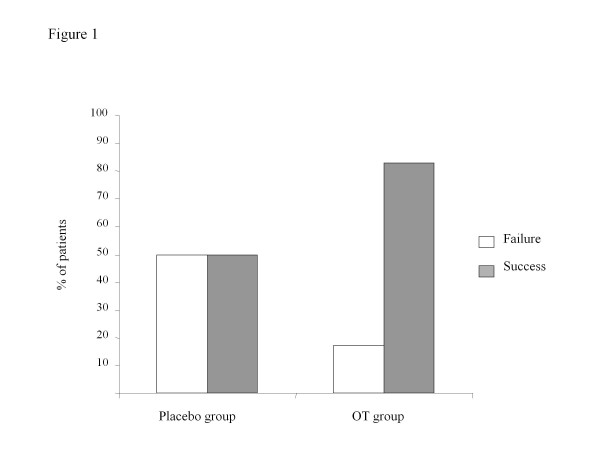
BACKGROUND: Prader-Willi syndrome (PWS) is a complex neurodevelopmental genetic disorder with hypothalamic dysfunction, early morbid obesity with hyperphagia, and specific psychiatric phenotypes including cognitive and behavioural problems, particularly disruptive behaviours and frequent temper outbursts that preclude socialization. A deficit in oxytocin (OT)-producing neurons of the hypothalamic paraventricular nucleus has been reported in these patients. METHODS: In a double-blind, randomised, placebo-controlled study, 24 adult patients with PWS received a single intranasal administration of 24 IU of OT or placebo and were tested 45 min later on social skills. Behaviours were carefully monitored and scored using an in-house grid as follows: over the two days before drug administration, on the half-day following administration, and over the subsequent two days. All patients were in a dedicated PWS centre with more than ten years of experience. Patients are regularly admitted to this controlled environment. RESULTS: Patients with PWS who received a single intranasal administration of OT displayed significantly increased trust in others (P = 0.02) and decreased sadness tendencies (P = 0.02) with less disruptive behaviour (P = 0.03) in the two days following administration than did patients who received placebo. In the half-day following administration, we observed a trend towards less conflict with others (p = 0.07) in the OT group compared with the placebo group. Scores in tests assessing social skills were not significantly different between the two groups. CONCLUSIONS: This study needs to be reproduced and adapted. It nevertheless opens new perspectives for patients with PWS and perhaps other syndromes with behavioural disturbances and obesity. TRIAL REGISTRATION NUMBER: ClinicalTrials.gov: NCT01038570.
Overview
The claims and statistics of this paper haven’t been checked yet.
Run the check — free, no account needed. It reads the open-access text and checks the sources it cites.
Integrity signals
Registry
Cites
Statistics
Figures
Verification
Claims the paper makes
The claims and statistics of this paper haven’t been checked yet.
Run the check — free, no account needed. It reads the open-access text and checks the sources it cites.
Claims other papers make about this one
Each is checked against this paper’s own text: does it say what the citing paper says it does?
In the citing paper
“IN-OT administration increases trust in others and decreases disruptive behavior in individuals with PWS (Tauber et al., 2011).”
From Oxytocin and vasopressin systems in genetic syndromes and neurodevelopmental disorders (2014) · cites this paper as Tauber et al., 2011
Self-check
Percentages, sums and reported differences re-computed from the paper’s own numbers.
The self-check needs the paper’s full text.
Citations
Cites
Does the autistic child have a “theory of mind” ?
Baron-Cohen, S., Leslie, A. M., & Frith, U. (1985) · Cognition · doi:10.1016/0010-0277(85)90022-8 · Cited by 8,599 · cited 1×
“The Sally and Ann test assesses one’s ability to understand simple situations by story-telling and pictures [19].”
BackgroundBaron‐Cohen, S., Wheelwright, S., Hill, J., Raste, Y., & Plumb, I. (2001) · Journal of Child Psychology and Psychiatry · doi:10.1111/1469-7610.00715 · Cited by 4,555 · cited 1×
“A shortened test with 19 images from the 36-item revised version [20] was chosen by the team psychologist.”
MethodBaron‐Cohen, S., Wheelwright, S. J., Hill, J., Raste, Y., & Plumb, I. (2001) · PubMed · Cited by 4,313
Frith, C., & Frith, U. (2005) · Current Biology · doi:10.1016/j.cub.2005.08.041 · Cited by 3,561
Oxytocin, vasopressin, and the neurogenetics of sociality
Donaldson, Z. R., & Young, L. J. (2008) · Science · doi:10.1126/science.1158668 · Cited by 1,645 · cited 1×
“OT was identified as a key neuropeptide involved in social interactions by enhancing peer recognition and bonding behaviour in numerous species [7].”
BackgroundOxytocin improves “mind-reading” in humans
Domes, G., Heinrichs, M., Michel, A., Berger, C., & Herpertz, S. C. (2007) · Biological Psychiatry · doi:10.1016/j.biopsych.2006.07.015 · Cited by 1,298
Intranasal oxytocin improves emotion recognition for youth with autism spectrum disorders.
Guastella, A. J., Einfeld, S. L., Gray, K. M., Rinehart, N. J., Tonge, B. J., Lambert, T. J., & Hickie, I. B. (2010) · Biological Psychiatry · doi:10.1016/j.biopsych.2009.09.020 · Cited by 962 · cited 3×
“OT appears to be the main neurohormone to explain empathy and theory of mind (TOM) [8-14].”
BackgroundDitzen, B., Schaer, M., Gabriel, B., Bodenmann, G., Ehlert, U., & Heinrichs, M. (2009) · Biological Psychiatry · doi:10.1016/j.biopsych.2008.10.011 · Cited by 805 · cited 3×
“OT appears to be the main neurohormone to explain empathy and theory of mind (TOM) [8-14].”
BackgroundOxytocin increases gaze to the eye region of human faces
Guastella, A. J., Mitchell, P. B., & Dadds, M. R. (2008) · Biological Psychiatry · doi:10.1016/j.biopsych.2007.06.026 · Cited by 798
Oxytocin Increases Retention of Social Cognition in Autism
Hollander, E., Bartz, J., Chaplin, W., Phillips, A., Sumner, J., Soorya, L., Anagnostou, E., & Wasserman, S. (2007) · Biological Psychiatry · doi:10.1016/j.biopsych.2006.05.030 · Cited by 693 · cited 3×
“OT appears to be the main neurohormone to explain empathy and theory of mind (TOM) [8-14].”
Background
Research works printed but not linked: 1
- 10.1210/jc.80.2.573 · DOI
Cited by
Sorted by citations
Bakermans-Kranenburg, M. J., & van IJzendoorn, M. H. (2013) · Translational Psychiatry · doi:10.1038/tp.2013.34 · Cited by 383
“Twenty-four Prader–Willi syndrome patients (8 males) were tested with a single dose of 24 IU OT (n1⁄4 12) or placebo (n1⁄4 12).(99) Patients were observed in their daily routines and scored by trained staff on behavioral scales before and immediately after treatment and during two days following treatment.”
BackgroundMethodMicrobial Reprogramming Inhibits Western Diet-Associated Obesity
Poutahidis, T., Kleinewietfeld, M., Smillie, C., Levkovich, T., Perrotta, A., Bhela, S., Varian, B. J., Ibrahim, Y. M., Lakritz, J. R., Kearney, S. M., et al. (2013) · PLoS ONE · doi:10.1371/journal.pone.0068596 · Cited by 164
“Oxytocin, a neuropeptide hormone associated with reproduction and social bonding, has also been linked with dietary satiety [53–54].”
BackgroundIntranasal oxytocin, social cognition and neurodevelopmental disorders: A meta-analysis
Keech, B., Crowe, S., & Hocking, D. R. (2018) · Psychoneuroendocrinology · doi:10.1016/j.psyneuen.2017.09.022 · Cited by 145
Miller, J. L., Tamura, R., Butler, M. G., Kimonis, V. E., Sulsona, C. R., Gold, J., & Driscoll, D. J. (2017) · American Journal of Medical Genetics Part A · doi:10.1002/ajmg.a.38160 · Cited by 149
“In a double blind placebo study of adults with PWS, a single dose of IN-OT significantly decreased depressive mood tendencies and tantrums while increasing trust in others, with supportive data to decrease appetite with higher satiety (Tauber et al., 2011).”
BackgroundResultInfluentialMüller, H. L., Tauber, M., Lawson, E. A., Özyurt, J., Bison, B., Martinez-Barbera, J.-P., Puget, S., Merchant, T. E., & van Santen, H. M. (2022) · Nature Reviews Disease Primers · doi:10.1038/s41572-022-00351-z · Cited by 144
Self-citation
Metadata
- Authors
- Tauber, M., Mantoulan, C., Copet, P., Jauregui, J., Demeer, G., Diene, G., Rogé, B., Laurier, V., Ehlinger, V., Arnaud, C., Molinas, C., & Thuilleaux, D.
- Affiliations
- Hôpital des Enfants (FR)
- Hôpital Marin de Hendaye (FR)
- Université Toulouse III - Paul Sabatier (FR)
- Corresponding author
- Tauber, Maïthe
- Venue
- Orphanet Journal of Rare Diseases
- Published
- 2011
- Volume
- 6
- Issue
- 1
- Pages
- 47
- ISSN
- 1750-1172 (ISSN-L)
- PMC
- PMC3141367
- OpenAlex
- W2169805657
- Cited by
- 117
- References
- 22
- Citations by year
- 2026: 4 · 2025: 5 · 2024: 5 · 2023: 10 · 2022: 8 · 2021: 10 · 2020: 8 · 2019: 12 · 2018: 7 · 2017: 10 · 2016: 11 · 2015: 11 · 2014: 9 · 2013: 3 · 2012: 3
- FWCI
- 6.96
- Type
- journal article
- Language
- en
- Open access
- gold
- doi.org
- Licence
- cc-by
- Locations
- Orphanet Journal of Rare Diseases (publishedVersion, cc-by)
- PubMed Central (publishedVersion, cc-by)
- PubMed (publishedVersion)
- HAL (submittedVersion, other-oa)
- DOAJ (DOAJ: Directory of Open Access Journals) (submittedVersion)
- Topics
- Life Sciences › Neuroscience › Endocrine and Autonomic Systems › Neuroendocrine regulation and behavior
- Life Sciences › Biochemistry, Genetics and Molecular Biology › Genetics › Genetic Syndromes and Imprinting
- Health Sciences › Medicine › Reproductive Medicine › Hypothalamic control of reproductive hormones
- Keywords
- Prader-Willi syndrome, oxytocin, intranasal administration, interpersonal trust, disruptive behavior, temper outbursts, social skills, hypothalamic dysfunction, paraventricular nucleus, obesity, hyperphagia
- MeSH terms
- Adolescent, Adult, Double-Blind Method, Female, Humans, Male, Oxytocin, Placebos, Prader-Willi Syndrome, Young Adult
About these checks
Registry, retraction, Cites and statistics results are computed, not judged, with one exception: a printed reference that no index lists is read once by a model before it counts as a citation error. Claims are extracted by a model and kept only when their quote appears verbatim in the text; each cited source is then checked, with a model’s help, for whether it says what the claim relies on. Those verdicts can be wrong — read the claim’s quote and the cited source before relying on one.
Statistics and arithmetic are recomputed, not judged.
Confidence bands are shown only for fields calibrated on our annotated test set. None is calibrated yet, so no band is shown.
What counts as a claim ›How we measure confidence ›How we check this ›
Are you an author, or do you see a problem with this page? Request a review
