

An iterative identification procedure for dynamic modeling of biochemical networks
Open accessThe DOI matches its Crossref record; 50 of the 50 references it cites were found in a registry or an index.
Abstract
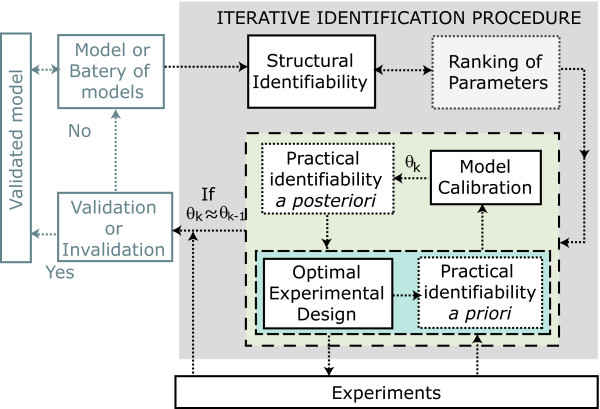
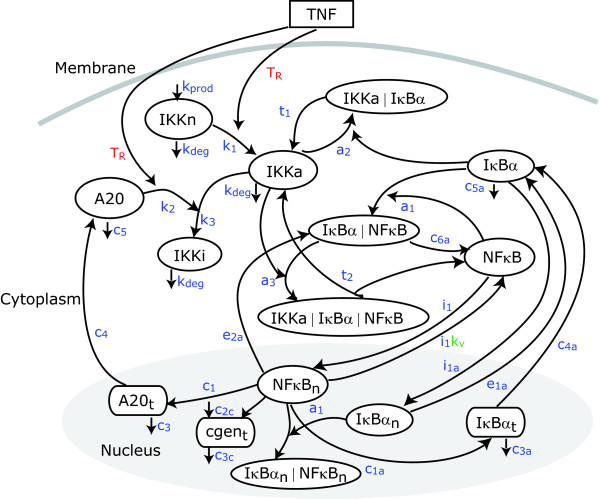
BACKGROUND: Mathematical models provide abstract representations of the information gained from experimental observations on the structure and function of a particular biological system. Conferring a predictive character on a given mathematical formulation often relies on determining a number of non-measurable parameters that largely condition the model's response. These parameters can be identified by fitting the model to experimental data. However, this fit can only be accomplished when identifiability can be guaranteed. RESULTS: We propose a novel iterative identification procedure for detecting and dealing with the lack of identifiability. The procedure involves the following steps: 1) performing a structural identifiability analysis to detect identifiable parameters; 2) globally ranking the parameters to assist in the selection of the most relevant parameters; 3) calibrating the model using global optimization methods; 4) conducting a practical identifiability analysis consisting of two (a priori and a posteriori) phases aimed at evaluating the quality of given experimental designs and of the parameter estimates, respectively and 5) optimal experimental design so as to compute the scheme of experiments that maximizes the quality and quantity of information for fitting the model. CONCLUSIONS: The presented procedure was used to iteratively identify a mathematical model that describes the NF-kappaB regulatory module involving several unknown parameters. We demonstrated the lack of identifiability of the model under typical experimental conditions and computed optimal dynamic experiments that largely improved identifiability properties.
Overview
The claims and statistics of this paper haven’t been checked yet.
Free: it reads the open-access text and checks the first 5 claims that cite a source we can check. Create a free account to check every claim.
Integrity signals
Registry
Cites
Statistics
Figures
Verification
Claims the paper makes
The claims and statistics of this paper haven’t been checked yet.
Free: it reads the open-access text and checks the first 5 claims that cite a source we can check. Create a free account to check every claim.
Claims other papers make about this one
Each is checked against this paper’s own text: does it say what the citing paper says it does?
The cited source says what the claim attributes to it.
In the citing paper
“Fortunately, recent literature is correcting this (e.g. [129–140]).”
From Reverse engineering and identification in systems biology: strategies, perspectives and challenges (2014) · cites this paper as [135]
Self-check
Percentages, sums and reported differences re-computed from the paper’s own numbers.
The self-check needs the paper’s full text.
Citations
Cites
System Identification: Theory for the User
Lennart Ljung, A. (1987) · Cited by 17,690
Systems biology: a brief overview
Kitano, H. (2002) · Science · doi:10.1126/science.1069492 · Cited by 4,265 · cited 1×
“Systems biology aims at understanding how such systems are organized by combining experimental data with mathematical modeling and computer-aided analysis techniques [1,2].”
BackgroundLjung, L. (1999) · Wiley Encyclopedia of Electrical and Electronics Engineering · doi:10.1002/047134608x.w1046 · Cited by 3,778
The IκB-NF-κB Signaling Module: Temporal Control and Selective Gene Activation
Hoffmann, A., Levchenko, A., Scott, M. L., & Baltimore, D. (2002) · Science · doi:10.1126/science.1071914 · Cited by 1,858
A N EW A PPROACH TO D ECODING L IFE : Systems Biology
Ideker, T., Galitski, T., & Hood, L. (2001) · Annual Review of Genomics and Human Genetics · doi:10.1146/annurev.genom.2.1.343 · Cited by 1,664 · cited 2×
“Biological systems are mainly composed of genes that encode the molecular machines that execute the functions of life and networks of regulatory interactions specifying how genes are expressed, with both operating on multiple, hierarchical levels of organization [ 1 ].”
BackgroundFailure to Regulate TNF-Induced NF-κB and Cell Death Responses in A20-Deficient Mice
Lee, E. G., Boone, D. L., Chai, S., Libby, S. L., Chien, M., Lodolce, J. P., & Ma, A. (2000) · Science · doi:10.1126/science.289.5488.2350 · Cited by 1,409 · cited 4×
“The following is assumed: (cid:129) Only the concentrations measured by Lee et al. [50] and Hoffman et al. [47] are at our disposal.”
BackgroundMethodInfluentialIdentification of parametric models : from experimental data
Walter, É., & Pronzato, L. (1997) · Cited by 1,197
Nuclear factor-?B: its role in health and disease
Kumar, A., Takada, Y., Boriek, A., & Aggarwal, B. (2004) · Journal of Molecular Medicine · doi:10.1007/s00109-004-0555-y · Cited by 933
Parameter estimation in biochemical pathways: a comparison of global optimization methods
Moles, C. G., Mendes, P., & Banga, J. R. (2003) · Genome Research · doi:10.1101/gr.1262503 · Cited by 858 · cited 1×
“To deal with first difficulty several authors have proposed the use of global optimization methods [31-34], since most of the model calibration problems related to biological models have several sub-optimal solutions.”
BackgroundSelf-citationOn global identifiability for arbitrary model parametrizations
Ljung, L., & Glad, T. (1994) · Automatica · doi:10.1016/0005-1098(94)90029-9 · Cited by 643 · cited 2×
“Alternatively one may consider fixing some parameters [ 21 ] or to reformulate the model.”
BackgroundMethod
Research works printed but not linked: 2
- Balsa-Canto E Banga JR Alonso AA Allgöwer F, Reuss M An optimal identification procedure for model development ins systems biology: Applications in Cell Signalling Foundations of Systems Biology in Engineering 2007 51 56
- Balsa-Canto E Rodriguez-Fernandez M Alonso AA Banga JR Cánovas M, Iborra J, Manjón A Computational design of optimal dynamic experiments in systems biology: a case study in cell signaling Understanding and Exploiting Systems Biology in Bioprocesses and Biomedicine 2006 Fundación CajaMurcia 103 117
Cited by
Items 201–205 of 205
Carlozo, M. N., Wang, N., Dowling, A. W., & Maginn, E. J. (2026) · Digital Discovery · doi:10.1039/d5dd00537j
Ajuzie, D. C., Arshad, S. A., Rasaputra, K. S., Debusschere, B., & May, E. E. (2026) · bioRxiv (Cold Spring Harbor Laboratory) · doi:10.64898/2026.02.04.703689
State and parameter estimation, and identi ability of quasi-LPV models
Srinivasarengan, K. (2018) · theses.fr (ABES) · doi:10.70675/d58b4787zbb8cz48ffzabbbzf3ca46fb4cb9 · Cited by 1
Farias, L., Martínez‐López, N., Garcia, M. R., Rode, M., Schäfer, R. B., & Le, T. T. Y. (2026) · Hydrology research · doi:10.2166/nh.2026.074
Tukrul, M., Gulhane, P., & Singh, S. (2026) · npj Systems Biology and Applications · doi:10.1038/s41540-026-00740-0
Metadata
- Authors
- Balsa-Canto, E., Alonso, A. A., & Banga, J. R.
- Affiliations
- Consejo Superior de Investigaciones Científicas (ES)
- Venue
- BMC Systems Biology
- Published
- 2010-02-17
- Volume
- 4
- Issue
- 1
- Pages
- 11-11
- ISSN
- 1752-0509 (ISSN-L)
- PMC
- PMC2838808
- OpenAlex
- W2088383307
- Cited by
- 202
- References
- 50
- Citations by year
- 2026: 4 · 2025: 13 · 2024: 9 · 2023: 15 · 2022: 13 · 2021: 17 · 2020: 8 · 2019: 16 · 2018: 21 · 2017: 8 · 2016: 11 · 2015: 8 · 2014: 17 · 2013: 10 · 2012: 13
- FWCI
- 5.48
- Type
- journal article
- Language
- en
- Open access
- gold
- doi.org
- Licence
- cc-by
- creativecommons.org/licenses/by/2.0 (tdm)
- Locations
- BMC Systems Biology (publishedVersion, cc-by)
- PubMed Central (publishedVersion, cc-by)
- PubMed (publishedVersion)
- DIGITAL.CSIC (Spanish National Research Council (CSIC)) (submittedVersion)
- Hispana (submittedVersion, other-oa)
- Funders
- Ministerio de Ciencia e Innovación
- Topics
- Life Sciences › Biochemistry, Genetics and Molecular Biology › Molecular Biology › Gene Regulatory Network Analysis
- Physical Sciences › Engineering › Control and Systems Engineering › Control Systems and Identification
- Social Sciences › Decision Sciences › Management Science and Operations Research › Optimal Experimental Design Methods
- Keywords
- parameter identifiability, iterative identification, practical identifiability, parameter ranking, global optimization, model calibration, optimal experimental design, NF-κB signaling, dynamic modeling
- MeSH terms
- Algorithms, Computer Simulation, Gene Expression Regulation, Models, Biological, Signal Transduction, NF-kappa B
About these checks
Registry, retraction, Cites and statistics results are computed, not judged, with one exception: a printed reference that no index lists is read once by a model before it counts as a citation error. Claims are extracted by a model and kept only when their quote appears verbatim in the text; each cited source is then checked, with a model’s help, for whether it says what the claim relies on. Those verdicts can be wrong — read the claim’s quote and the cited source before relying on one.
Statistics and arithmetic are recomputed, not judged.
Confidence bands are shown only for fields calibrated on our annotated test set. None is calibrated yet, so no band is shown.
What counts as a claim ›How we measure confidence ›How we check this ›
Are you an author, or do you see a problem with this page? Request a review
Data sources
Bibliographic data: Semantic Scholar, OpenAlex, Crossref.
Contains information from the Semantic Scholar Academic Graph Datasets, made available under the ODC Attribution License (ODC-BY 1.0).
Semantic Scholar’s data is described in: Kinney, R., et al. (2023). The Semantic Scholar Open Data Platform. arXiv:2301.10140.
