

An iterative identification procedure for dynamic modeling of biochemical networks
Open accessThe DOI matches its Crossref record; 50 of the 50 references it cites were found in a registry or an index.
Abstract
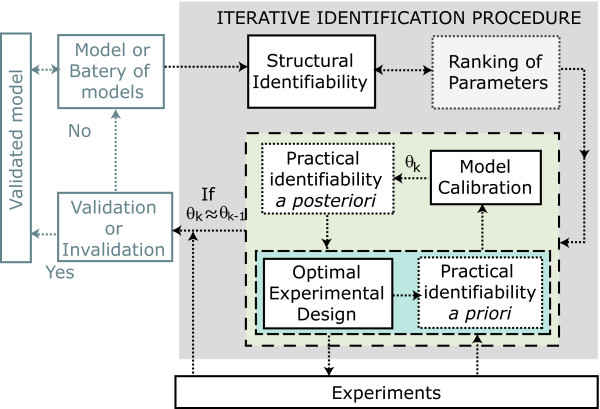
BACKGROUND: Mathematical models provide abstract representations of the information gained from experimental observations on the structure and function of a particular biological system. Conferring a predictive character on a given mathematical formulation often relies on determining a number of non-measurable parameters that largely condition the model's response. These parameters can be identified by fitting the model to experimental data. However, this fit can only be accomplished when identifiability can be guaranteed. RESULTS: We propose a novel iterative identification procedure for detecting and dealing with the lack of identifiability. The procedure involves the following steps: 1) performing a structural identifiability analysis to detect identifiable parameters; 2) globally ranking the parameters to assist in the selection of the most relevant parameters; 3) calibrating the model using global optimization methods; 4) conducting a practical identifiability analysis consisting of two (a priori and a posteriori) phases aimed at evaluating the quality of given experimental designs and of the parameter estimates, respectively and 5) optimal experimental design so as to compute the scheme of experiments that maximizes the quality and quantity of information for fitting the model. CONCLUSIONS: The presented procedure was used to iteratively identify a mathematical model that describes the NF-kappaB regulatory module involving several unknown parameters. We demonstrated the lack of identifiability of the model under typical experimental conditions and computed optimal dynamic experiments that largely improved identifiability properties.
Overview
The claims and statistics of this paper haven’t been checked yet.
Free: it reads the open-access text and checks the first 5 claims that cite a source we can check. Create a free account to check every claim.
Integrity signals
Registry
Cites
Statistics
Figures
Verification
Claims the paper makes
The claims and statistics of this paper haven’t been checked yet.
Free: it reads the open-access text and checks the first 5 claims that cite a source we can check. Create a free account to check every claim.
Claims other papers make about this one
Each is checked against this paper’s own text: does it say what the citing paper says it does?
The cited source says what the claim attributes to it.
In the citing paper
“Fortunately, recent literature is correcting this (e.g. [129–140]).”
From Reverse engineering and identification in systems biology: strategies, perspectives and challenges (2014) · cites this paper as [135]
Self-check
Percentages, sums and reported differences re-computed from the paper’s own numbers.
The self-check needs the paper’s full text.
Citations
Cites
System Identification: Theory for the User
Lennart Ljung, A. (1987) · Cited by 17,690
Systems biology: a brief overview
Kitano, H. (2002) · Science · doi:10.1126/science.1069492 · Cited by 4,265 · cited 1×
“Systems biology aims at understanding how such systems are organized by combining experimental data with mathematical modeling and computer-aided analysis techniques [1,2].”
BackgroundLjung, L. (1999) · Wiley Encyclopedia of Electrical and Electronics Engineering · doi:10.1002/047134608x.w1046 · Cited by 3,778
The IκB-NF-κB Signaling Module: Temporal Control and Selective Gene Activation
Hoffmann, A., Levchenko, A., Scott, M. L., & Baltimore, D. (2002) · Science · doi:10.1126/science.1071914 · Cited by 1,858
A N EW A PPROACH TO D ECODING L IFE : Systems Biology
Ideker, T., Galitski, T., & Hood, L. (2001) · Annual Review of Genomics and Human Genetics · doi:10.1146/annurev.genom.2.1.343 · Cited by 1,664 · cited 2×
“Biological systems are mainly composed of genes that encode the molecular machines that execute the functions of life and networks of regulatory interactions specifying how genes are expressed, with both operating on multiple, hierarchical levels of organization [ 1 ].”
BackgroundFailure to Regulate TNF-Induced NF-κB and Cell Death Responses in A20-Deficient Mice
Lee, E. G., Boone, D. L., Chai, S., Libby, S. L., Chien, M., Lodolce, J. P., & Ma, A. (2000) · Science · doi:10.1126/science.289.5488.2350 · Cited by 1,409 · cited 4×
“The following is assumed: (cid:129) Only the concentrations measured by Lee et al. [50] and Hoffman et al. [47] are at our disposal.”
BackgroundMethodInfluentialIdentification of parametric models : from experimental data
Walter, É., & Pronzato, L. (1997) · Cited by 1,197
Nuclear factor-?B: its role in health and disease
Kumar, A., Takada, Y., Boriek, A., & Aggarwal, B. (2004) · Journal of Molecular Medicine · doi:10.1007/s00109-004-0555-y · Cited by 933
Parameter estimation in biochemical pathways: a comparison of global optimization methods
Moles, C. G., Mendes, P., & Banga, J. R. (2003) · Genome Research · doi:10.1101/gr.1262503 · Cited by 858 · cited 1×
“To deal with first difficulty several authors have proposed the use of global optimization methods [31-34], since most of the model calibration problems related to biological models have several sub-optimal solutions.”
BackgroundSelf-citationOn global identifiability for arbitrary model parametrizations
Ljung, L., & Glad, T. (1994) · Automatica · doi:10.1016/0005-1098(94)90029-9 · Cited by 643 · cited 2×
“Alternatively one may consider fixing some parameters [ 21 ] or to reformulate the model.”
BackgroundMethodPractical identifiability analysis of large environmental simulation models
Brun, R., Reichert, P., & Künsch, H. R. (2001) · Water Resources Research · doi:10.1029/2000wr900350 · Cited by 604 · cited 1×
“Brun and Reichert (2001) [29] suggested several importance factors, that may be generalized for the case of having several observables and experiments [16].”
BackgroundPhysicochemical modelling of cell signalling pathways
Aldridge, B. B., Burke, J. M., Lauffenburger, D. A., & Sorger, P. K. (2006) · Nature Cell Biology · doi:10.1038/ncb1497 · Cited by 592 · cited 1×
“[4,6] organized the models in terms of three main groups, depending on their level of detail: deterministic, probabilistic and statistical.”
BackgroundDAISY: A new software tool to test global identifiability of biological and physiological systems
Bellu, G., Saccomani, M. P., Audoly, S., & D’Angiò, L. (2007) · Computer Methods and Programs in Biomedicine · doi:10.1016/j.cmpb.2007.07.002 · Cited by 452 · cited 1×
“There are a few methods for testing the structural identifiability of nonlinear models [18,19]: the similarity transformation approach [20], differential algebra methods [21,22] and power series approaches [23,24].”
MethodSystem identifiability based on the power series expansion of the solution
Pohjanpalo, H. (1978) · Mathematical Biosciences · doi:10.1016/0025-5564(78)90063-9 · Cited by 440 · cited 2×
“There are a few methods for testing the structural identifiability of nonlinear models [18,19]: the similarity transformation approach [20], differential algebra methods [21,22] and power series approaches [ 23 ,24].”
MethodA hybrid approach for efficient and robust parameter estimation in biochemical pathways
Rodriguez-Fernandez, M., Mendes, P., & Banga, J. R. (2006) · Biosystems · doi:10.1016/j.biosystems.2005.06.016 · Cited by 304 · cited 1×
“Recently suggested, in addition, was the use of sequential hybrid global-local methods [35,36] to enhance efficiency, particularly for highly multimodal and large scale systems.”
BackgroundSelf-citationMathematical model of NF-κB regulatory module
Lipniacki, T., Paszek, P., Brasier, A. R., Luxon, B., & Kimmel, M. (2004) · Journal of Theoretical Biology · doi:10.1016/j.jtbi.2004.01.001 · Cited by 290 · cited 9×
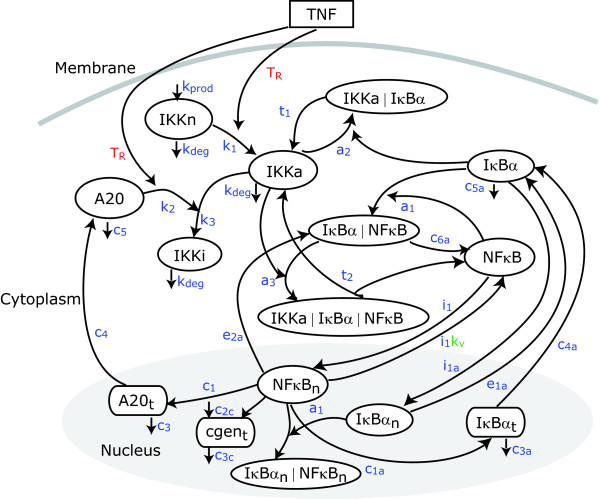
“The corresponding mathematical model consists of 15 non-linear ordinary differential equations with 30 parameters as follows [ 9 ]: IKKn IKKn IKKn”
BackgroundMethodResultInfluentialNovel metaheuristic for parameter estimation in nonlinear dynamic biological systems
Rodriguez-Fernandez, M., Egea, J. A., & Banga, J. R. (2006) · BMC Bioinformatics · doi:10.1186/1471-2105-7-483 · Cited by 278
Self-citationThe statistical mechanics of complex signaling networks: Nerve growth factor signaling.
Brown, K. S., Hill, C. C., Calero, G. A., Myers, C. R., Lee, K. H., Sethna, J. P., & Cerione, R. A. (2004) · Physical Biology · doi:10.1088/1478-3967/1/3/006 · Cited by 265
Systems biology: experimental design
Kreutz, C., & Timmer, J. (2009) · The FEBS Journal · doi:10.1111/j.1742-4658.2008.06843.x · Cited by 257 · cited 1×
“In addition, the use of model-based (in silico) experimentation can greatly reduce the effort and cost of biological experiments, and simultaneously facilitate the understanding of complex biological systems [41-44].”
Methodvan Riel, N. A. W. (2006) · Briefings in Bioinformatics · doi:10.1093/bib/bbl040 · Cited by 254 · cited 1×
“In addition, the use of model-based ( in silico ) experimentation can greatly reduce the effort and cost of biological experiments, and simultaneously facilitate the understanding of complex biological systems [41-44].”
MethodComplex Parameter Landscape for a Complex Neuron Model
Achard, P., & De Schutter, E. (2006) · PLoS Computational Biology · doi:10.1371/journal.pcbi.0020094 · Cited by 249 · cited 1×
“In fact, several authors have reported difficulties in assessing unique and meaningful values for the parameters from given sets of experimental data since broad ranges of parameter values result in similar model predictions (see for example, [9-12]).”
BackgroundLinking data to models: data regression
Jaqaman, K., & Danuser, G. (2006) · Nature Reviews Molecular Cell Biology · doi:10.1038/nrm2030 · Cited by 243 · cited 1×
“Jaqaman and Danuser presented a guide for model calibration in the context of biological systems [30] noting that there are two major issues in minimizing 13: first, the presence of local minima and second, the lack of practical identifiability.”
BackgroundIdentifiability of nonlinear systems with application to HIV/AIDS models
Xia, X., & Moog, C. H. (2003) · IEEE Transactions on Automatic Control · doi:10.1109/tac.2002.808494 · Cited by 242
Similarity transformation approach to identifiability analysis of nonlinear compartmental models
Vajda, S., Godfrey, K. R., & Rabitz, H. (1989) · Mathematical Biosciences · doi:10.1016/0025-5564(89)90024-2 · Cited by 225 · cited 1×
“There are a few methods for testing the structural identifiability of nonlinear models [18,19]: the similarity transformation approach [20], differential algebra methods [21,22] and power series approaches [23,24].”
MethodExploiting the bootstrap method for quantifying parameter confidence intervals in dynamical systems
Joshi, M., Seidel-Morgenstern, A., & Kremling, A. (2006) · Metabolic Engineering · doi:10.1016/j.ymben.2006.04.003 · Cited by 190 · cited 1×
“To quantify the expected uncertainty of the parameters and/or the confidence region, we rely on a Monte Carlo-based sampling method [38-40].”
MethodGlobal approaches to identifiability testing for linear and nonlinear state space models
Walter, E., & Lecourtier, Y. (1982) · Mathematics and Computers in Simulation · doi:10.1016/0378-4754(82)90645-0 · Cited by 184 · cited 2×
“The generating series approach [24] allows to extend the analysis to the entire class of bounded and measurable stimuli.”
BackgroundMethodUnderstanding NF‐κB signaling via mathematical modeling
Cheong, R., Hoffmann, A., & Levchenko, A. (2008) · Molecular Systems Biology · doi:10.1038/msb.2008.30 · Cited by 172 · cited 1×
“Commencing with the original model proposed by Hoffmann et al. [47], several models have been proposed that include additional feedback loops, cross-talk with other pathways and NF-B oscillations, as detailed in the recent reviews by Lipniacki and Kimmel, [48] and Cheong et al., [ 49 ].”
MethodScatter search for chemical and bio-process optimization
Egea, J. A., Rodríguez-Fernández, M., Banga, J. R., & Martí, R. (2007) · Journal of Global Optimization · doi:10.1007/s10898-006-9075-3 · Cited by 171
Self-citationMathematical modeling of intracellular signaling pathways
Klipp, E., & Liebermeister, W. (2006) · BMC Neuroscience · doi:10.1186/1471-2202-7-s1-s10 · Cited by 161
Iterative approach to model identification of biological networks
Gadkar, K. G., Gunawan, R., & Doyle, F. J. (2005) · BMC Bioinformatics · doi:10.1186/1471-2105-6-155 · Cited by 156
Parameter estimation and optimal experimental design
Banga, J. R., & Balsa-Canto, E. (2008) · Essays in Biochemistry · doi:10.1042/bse0450195 · Cited by 141
Self-citationKremling, A., Fischer, S., Gadkar, K., Doyle, F. J., Sauter, T., Bullinger, E., Allgöwer, F., & Gilles, E. D. (2004) · Genome Research · doi:10.1101/gr.1226004 · Cited by 127 · cited 1×
“Kremling et al. [14] and Gadkar et al. [15] suggested alternative identification procedures that involve some type of experimental design, to either calculate stimuli profiles or to select species whose concentration measurements would maximally benefit model calibration and/or model discrimination.”
BackgroundModeling and Simulation of Intracellular Dynamics: Choosing an Appropriate Framework
Wolkenhauer, O., Ullah, M., Kolch, W., & Cho, K.-H. (2004) · IEEE Transactions on Nanobioscience · doi:10.1109/tnb.2004.833694 · Cited by 125 · cited 1×
“Currently, the most typical approach to representing biochemical networks is through a set of coupled deterministic ordinary differential equations intended to describe the network and the production and consumption rates for the individual species involved in the network [7].”
BackgroundA biological approach to computational models of proteomic networks
Janes, K. A., & Lauffenburger, D. A. (2006) · Current Opinion in Chemical Biology · doi:10.1016/j.cbpa.2005.12.016 · Cited by 125 · cited 2×
“[4,6] organized the models in terms of three main groups, depending on their level of detail: deterministic, probabilistic and statistical.”
BackgroundComputational procedures for optimal experimental design in biological systems
Balsa-Canto, E., Alonso, A. A., & Banga, J. R. (2008) · IET Systems Biology · doi:10.1049/iet-syb:20070069 · Cited by 124 · cited 4×
“To quantify the expected uncertainty of the parameters and/or the confidence region, we rely on a Monte Carlo-based sampling method [38-40].”
BackgroundMethodInfluentialSelf-citationHybrid optimization method with general switching strategy for parameter estimation.
Balsa-Canto, E., Peifer, M., Banga, J. R., Timmer, J., & Fleck, C. (2008) · BMC Systems Biology · doi:10.1186/1752-0509-2-26 · Cited by 105 · cited 1×
“Recently suggested, in addition, was the use of sequential hybrid global-local methods [35,36] to enhance efficiency, particularly for highly multimodal and large scale systems.”
BackgroundSelf-citationMargaria, G., Riccomagno, E., Chappell, M. J., & Wynn, H. P. (2001) · Mathematical Biosciences · doi:10.1016/s0025-5564(01)00079-7 · Cited by 102 · cited 2×
“(2001) [27] showed that for the combination of the Taylor series and the differential algebra approaches, nx + 1 derivatives are sufficient for the case of rational systems with one observable.”
BackgroundIdentification of metabolic system parameters using global optimization methods
Polisetty, P. K., Voit, E. O., & Gatzke, E. P. (2006) · Theoretical Biology and Medical Modelling · doi:10.1186/1742-4682-3-4 · Cited by 93
Power-law models of signal transduction pathways
Vera, J., Balsa‐Canto, E., Wellstead, P. E., Banga, J. R., & Wolkenhauer, O. (2007) · Cellular Signalling · doi:10.1016/j.cellsig.2007.01.029 · Cited by 82 · cited 1×
“The conceptual framework selected for the construction of rate equations enables models to be further classified as generalized mass-action-based models and power-law models [8].”
MethodSelf-citationStimulus Design for Model Selection and Validation in Cell Signaling
Apgar, J. F., Toettcher, J. E., Endy, D., White, F. M., & Tidor, B. (2008) · PLoS Computational Biology · doi:10.1371/journal.pcbi.0040030 · Cited by 79 · cited 1×
“If there are several model candidates two extra steps should be included in the loop, one to analyze structural distinguishability among candidates and the other to design experiments for model discrimination [17].”
BackgroundSystems biology—an engineering perspective
Kremling, A., & Saez-Rodriguez, J. (2007) · Journal of Biotechnology · doi:10.1016/j.jbiotec.2007.02.009 · Cited by 76 · cited 1×
“In addition, the use of model-based (in silico) experimentation can greatly reduce the effort and cost of biological experiments, and simultaneously facilitate the understanding of complex biological systems [41-44].”
MethodSensitivity analysis of systems of differential and algebraic equations
Leis, J. R., & Kramer, M. A. (1985) · Computers & Chemical Engineering · doi:10.1016/0098-1354(85)87008-3 · Cited by 73 · cited 1×
“Local They may be numerically computed by using the direct decoupled method within a backward differentiation formulae (BDF) based approach, as implemented in e.g. ODESSA [28].”
MethodAnalysis and modelling of signal transduction pathways in systems biology
Cho, K.-H., & Wolkenhauer, O. (2003) · Biochemical Society Transactions · doi:10.1042/bst0311503 · Cited by 61 · cited 1×
“metabolic or signaling pathways) has recently received a great deal of attention [3-5].”
BackgroundOptimal Identification of Biochemical Reaction Networks
Feng, X.-J., & Rabitz, H. (2004) · Biophysical Journal · doi:10.1016/s0006-3495(04)74201-0 · Cited by 58 · cited 2×
“This problem has motivated the development of iterative procedures for model identification, such as those proposed by Feng and Rabitz [13], who, using a closedloop strategy, attempted to estimate how to stimulate and how to observe a system for identification purposes.”
MethodGlobally optimised parameters for a model of mitotic control in frog egg extracts.
Zwolak, J. W., Tyson, J. J., & Watson, L. T. (2005) · IEE Proceedings - Systems Biology · doi:10.1049/ip-syb:20045032 · Cited by 49 · cited 1×
“To deal with first difficulty several authors have proposed the use of global optimization methods [31-34], since most of the model calibration problems related to biological models have several sub-optimal solutions.”
BackgroundChapman, M. J., Godfrey, K. R., Chappell, M. J., & Evans, N. D. (2003) · Mathematical Biosciences · doi:10.1016/s0025-5564(02)00223-7 · Cited by 36 · cited 1×
“There are a few methods for testing the structural identifiability of nonlinear models [18,19]: the similarity transformation approach [20], differential algebra methods [21,22] and power series approaches [23,24].”
MethodStructural identifiability of dynamical systems
Vajda, S. (1983) · International Journal of Systems Science · doi:10.1080/00207728308926526 · Cited by 31 · cited 1×
“For the Taylor series approach an upper limit has been shown for bilinear and polynomial systems [25,26].”
BackgroundDiverse metabolic model parameters generate similar methionine cycle dynamics
Piazza, M., Feng, X.-J., Rabinowitz, J. D., & Rabitz, H. (2008) · Journal of Theoretical Biology · doi:10.1016/j.jtbi.2007.12.009 · Cited by 24 · cited 1×
“In fact, several authors have reported difficulties in assessing unique and meaningful values for the parameters from given sets of experimental data since broad ranges of parameter values result in similar model predictions (see for example, [9-12]).”
BackgroundDeterministic and Stochastic Models of NFκB Pathway
Lipniacki, T., & Kimmel, M. (2007) · Cardiovascular Toxicology · doi:10.1007/s12012-007-9003-x · Cited by 23
Deterministic identifiability and algebraic invariants for polynomial systems
Vajda, S. (1987) · IEEE Transactions on Automatic Control · doi:10.1109/tac.1987.1104546 · Cited by 14 · cited 1×
“For the Taylor series approach an upper limit has been shown for bilinear and polynomial systems [25,26].”
Background
Research works printed but not linked: 2
- Balsa-Canto E Banga JR Alonso AA Allgöwer F, Reuss M An optimal identification procedure for model development ins systems biology: Applications in Cell Signalling Foundations of Systems Biology in Engineering 2007 51 56
- Balsa-Canto E Rodriguez-Fernandez M Alonso AA Banga JR Cánovas M, Iborra J, Manjón A Computational design of optimal dynamic experiments in systems biology: a case study in cell signaling Understanding and Exploiting Systems Biology in Bioprocesses and Biomedicine 2006 Fundación CajaMurcia 103 117
Cited by
Structural identifiability of systems biology models: a critical comparison of methods
Chis, O.-T., Banga, J. R., & Balsa-Canto, E. (2011) · PLoS ONE · doi:10.1371/journal.pone.0027755 · Cited by 448
“GenSSI implements the combination of the generating series approach with the identifiability tableaus[17].”
BackgroundMethodResultSelf-citationReverse engineering and identification in systems biology: strategies, perspectives and challenges
Villaverde, A. F., & Banga, J. R. (2014) · Journal of The Royal Society Interface · doi:10.1098/rsif.2013.0505 · Cited by 229
Self-citationEgea, J. A., Henriques, D., Cokelaer, T., Villaverde, A. F., MacNamara, A., Danciu, D.-P., Banga, J. R., & Saez-Rodriguez, J. (2014) · BMC Bioinformatics · doi:10.1186/1471-2105-15-136 · Cited by 176
“Some recent successful applications of eSS in the field of systems biology can be found in [15-26].”
BackgroundSelf-citationRobust and efficient parameter estimation in dynamic models of biological systems
Gábor, A., & Banga, J. R. (2015) · BMC Systems Biology · doi:10.1186/s12918-015-0219-2 · Cited by 175
“Similarly, the computation of the covariance and correlation of the parameters ([59, 60]) and the computation of confidence regions of the model predictions [48] are usually performed based on the Fisher information matrix (FIM).”
BackgroundMethodSelf-citationA kinetic model of Escherichia coli core metabolism satisfying multiple sets of mutant flux data
Khodayari, A., Zomorrodi, A. R., Liao, J. C., & Maranas, C. D. (2014) · Metabolic Engineering · doi:10.1016/j.ymben.2014.05.014 · Cited by 176
“Formal model parameterization involves solving an optimization problem minimizing the deviation of model predictions (e.g., for reaction fluxes) from experimental measurements (Costa et al., 2010; Tohsato et al., 2013; Balsa-Canto et al., 2010).”
Background
Metadata
- Authors
- Balsa-Canto, E., Alonso, A. A., & Banga, J. R.
- Affiliations
- Consejo Superior de Investigaciones Científicas (ES)
- Venue
- BMC Systems Biology
- Published
- 2010-02-17
- Volume
- 4
- Issue
- 1
- Pages
- 11-11
- ISSN
- 1752-0509 (ISSN-L)
- PMC
- PMC2838808
- OpenAlex
- W2088383307
- Cited by
- 202
- References
- 50
- Citations by year
- 2026: 4 · 2025: 13 · 2024: 9 · 2023: 15 · 2022: 13 · 2021: 17 · 2020: 8 · 2019: 16 · 2018: 21 · 2017: 8 · 2016: 11 · 2015: 8 · 2014: 17 · 2013: 10 · 2012: 13
- FWCI
- 5.48
- Type
- journal article
- Language
- en
- Open access
- gold
- doi.org
- Licence
- cc-by
- creativecommons.org/licenses/by/2.0 (tdm)
- Locations
- BMC Systems Biology (publishedVersion, cc-by)
- PubMed Central (publishedVersion, cc-by)
- PubMed (publishedVersion)
- DIGITAL.CSIC (Spanish National Research Council (CSIC)) (submittedVersion)
- Hispana (submittedVersion, other-oa)
- Funders
- Ministerio de Ciencia e Innovación
- Topics
- Life Sciences › Biochemistry, Genetics and Molecular Biology › Molecular Biology › Gene Regulatory Network Analysis
- Physical Sciences › Engineering › Control and Systems Engineering › Control Systems and Identification
- Social Sciences › Decision Sciences › Management Science and Operations Research › Optimal Experimental Design Methods
- Keywords
- parameter identifiability, iterative identification, practical identifiability, parameter ranking, global optimization, model calibration, optimal experimental design, NF-κB signaling, dynamic modeling
- MeSH terms
- Algorithms, Computer Simulation, Gene Expression Regulation, Models, Biological, Signal Transduction, NF-kappa B
About these checks
Registry, retraction, Cites and statistics results are computed, not judged, with one exception: a printed reference that no index lists is read once by a model before it counts as a citation error. Claims are extracted by a model and kept only when their quote appears verbatim in the text; each cited source is then checked, with a model’s help, for whether it says what the claim relies on. Those verdicts can be wrong — read the claim’s quote and the cited source before relying on one.
Statistics and arithmetic are recomputed, not judged.
Confidence bands are shown only for fields calibrated on our annotated test set. None is calibrated yet, so no band is shown.
What counts as a claim ›How we measure confidence ›How we check this ›
Are you an author, or do you see a problem with this page? Request a review
Data sources
Bibliographic data: Semantic Scholar, OpenAlex, Crossref.
Contains information from the Semantic Scholar Academic Graph Datasets, made available under the ODC Attribution License (ODC-BY 1.0).
Semantic Scholar’s data is described in: Kinney, R., et al. (2023). The Semantic Scholar Open Data Platform. arXiv:2301.10140.
