

An iterative identification procedure for dynamic modeling of biochemical networks
Open accessThe DOI matches its Crossref record; 50 of the 50 references it cites were found in a registry or an index.
Abstract
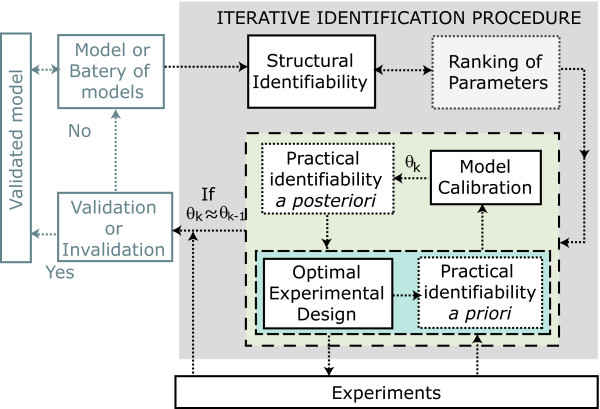
BACKGROUND: Mathematical models provide abstract representations of the information gained from experimental observations on the structure and function of a particular biological system. Conferring a predictive character on a given mathematical formulation often relies on determining a number of non-measurable parameters that largely condition the model's response. These parameters can be identified by fitting the model to experimental data. However, this fit can only be accomplished when identifiability can be guaranteed. RESULTS: We propose a novel iterative identification procedure for detecting and dealing with the lack of identifiability. The procedure involves the following steps: 1) performing a structural identifiability analysis to detect identifiable parameters; 2) globally ranking the parameters to assist in the selection of the most relevant parameters; 3) calibrating the model using global optimization methods; 4) conducting a practical identifiability analysis consisting of two (a priori and a posteriori) phases aimed at evaluating the quality of given experimental designs and of the parameter estimates, respectively and 5) optimal experimental design so as to compute the scheme of experiments that maximizes the quality and quantity of information for fitting the model. CONCLUSIONS: The presented procedure was used to iteratively identify a mathematical model that describes the NF-kappaB regulatory module involving several unknown parameters. We demonstrated the lack of identifiability of the model under typical experimental conditions and computed optimal dynamic experiments that largely improved identifiability properties.
Overview
The claims and statistics of this paper haven’t been checked yet.
Free: it reads the open-access text and checks the first 5 claims that cite a source we can check. Create a free account to check every claim.
Integrity signals
Registry
Cites
Statistics
Figures
Verification
Claims the paper makes
The claims and statistics of this paper haven’t been checked yet.
Free: it reads the open-access text and checks the first 5 claims that cite a source we can check. Create a free account to check every claim.
Claims other papers make about this one
Each is checked against this paper’s own text: does it say what the citing paper says it does?
The cited source says what the claim attributes to it.
In the citing paper
“Fortunately, recent literature is correcting this (e.g. [129–140]).”
From Reverse engineering and identification in systems biology: strategies, perspectives and challenges (2014) · cites this paper as [135]
Self-check
Percentages, sums and reported differences re-computed from the paper’s own numbers.
The self-check needs the paper’s full text.
Citations
Cites
System Identification: Theory for the User
Lennart Ljung, A. (1987) · Cited by 17,690
Systems biology: a brief overview
Kitano, H. (2002) · Science · doi:10.1126/science.1069492 · Cited by 4,265 · cited 1×
“Systems biology aims at understanding how such systems are organized by combining experimental data with mathematical modeling and computer-aided analysis techniques [1,2].”
BackgroundLjung, L. (1999) · Wiley Encyclopedia of Electrical and Electronics Engineering · doi:10.1002/047134608x.w1046 · Cited by 3,778
The IκB-NF-κB Signaling Module: Temporal Control and Selective Gene Activation
Hoffmann, A., Levchenko, A., Scott, M. L., & Baltimore, D. (2002) · Science · doi:10.1126/science.1071914 · Cited by 1,858
A N EW A PPROACH TO D ECODING L IFE : Systems Biology
Ideker, T., Galitski, T., & Hood, L. (2001) · Annual Review of Genomics and Human Genetics · doi:10.1146/annurev.genom.2.1.343 · Cited by 1,664 · cited 2×
“Biological systems are mainly composed of genes that encode the molecular machines that execute the functions of life and networks of regulatory interactions specifying how genes are expressed, with both operating on multiple, hierarchical levels of organization [ 1 ].”
BackgroundFailure to Regulate TNF-Induced NF-κB and Cell Death Responses in A20-Deficient Mice
Lee, E. G., Boone, D. L., Chai, S., Libby, S. L., Chien, M., Lodolce, J. P., & Ma, A. (2000) · Science · doi:10.1126/science.289.5488.2350 · Cited by 1,409 · cited 4×
“The following is assumed: (cid:129) Only the concentrations measured by Lee et al. [50] and Hoffman et al. [47] are at our disposal.”
BackgroundMethodInfluentialIdentification of parametric models : from experimental data
Walter, É., & Pronzato, L. (1997) · Cited by 1,197
Nuclear factor-?B: its role in health and disease
Kumar, A., Takada, Y., Boriek, A., & Aggarwal, B. (2004) · Journal of Molecular Medicine · doi:10.1007/s00109-004-0555-y · Cited by 933
Parameter estimation in biochemical pathways: a comparison of global optimization methods
Moles, C. G., Mendes, P., & Banga, J. R. (2003) · Genome Research · doi:10.1101/gr.1262503 · Cited by 858 · cited 1×
“To deal with first difficulty several authors have proposed the use of global optimization methods [31-34], since most of the model calibration problems related to biological models have several sub-optimal solutions.”
BackgroundSelf-citationOn global identifiability for arbitrary model parametrizations
Ljung, L., & Glad, T. (1994) · Automatica · doi:10.1016/0005-1098(94)90029-9 · Cited by 643 · cited 2×
“Alternatively one may consider fixing some parameters [ 21 ] or to reformulate the model.”
BackgroundMethod
Research works printed but not linked: 2
- Balsa-Canto E Banga JR Alonso AA Allgöwer F, Reuss M An optimal identification procedure for model development ins systems biology: Applications in Cell Signalling Foundations of Systems Biology in Engineering 2007 51 56
- Balsa-Canto E Rodriguez-Fernandez M Alonso AA Banga JR Cánovas M, Iborra J, Manjón A Computational design of optimal dynamic experiments in systems biology: a case study in cell signaling Understanding and Exploiting Systems Biology in Bioprocesses and Biomedicine 2006 Fundación CajaMurcia 103 117
Cited by
Structural identifiability of systems biology models: a critical comparison of methods
Chis, O.-T., Banga, J. R., & Balsa-Canto, E. (2011) · PLoS ONE · doi:10.1371/journal.pone.0027755 · Cited by 448
“GenSSI implements the combination of the generating series approach with the identifiability tableaus[17].”
BackgroundMethodResultSelf-citationReverse engineering and identification in systems biology: strategies, perspectives and challenges
Villaverde, A. F., & Banga, J. R. (2014) · Journal of The Royal Society Interface · doi:10.1098/rsif.2013.0505 · Cited by 229
Self-citationEgea, J. A., Henriques, D., Cokelaer, T., Villaverde, A. F., MacNamara, A., Danciu, D.-P., Banga, J. R., & Saez-Rodriguez, J. (2014) · BMC Bioinformatics · doi:10.1186/1471-2105-15-136 · Cited by 176
“Some recent successful applications of eSS in the field of systems biology can be found in [15-26].”
BackgroundSelf-citationRobust and efficient parameter estimation in dynamic models of biological systems
Gábor, A., & Banga, J. R. (2015) · BMC Systems Biology · doi:10.1186/s12918-015-0219-2 · Cited by 175
“Similarly, the computation of the covariance and correlation of the parameters ([59, 60]) and the computation of confidence regions of the model predictions [48] are usually performed based on the Fisher information matrix (FIM).”
BackgroundMethodSelf-citationA kinetic model of Escherichia coli core metabolism satisfying multiple sets of mutant flux data
Khodayari, A., Zomorrodi, A. R., Liao, J. C., & Maranas, C. D. (2014) · Metabolic Engineering · doi:10.1016/j.ymben.2014.05.014 · Cited by 176
“Formal model parameterization involves solving an optimization problem minimizing the deviation of model predictions (e.g., for reaction fluxes) from experimental measurements (Costa et al., 2010; Tohsato et al., 2013; Balsa-Canto et al., 2010).”
BackgroundAMIGO2, a toolbox for dynamic modeling, optimization and control in systems biology
Balsa-Canto, E., Henriques, D., Gábor, A., & Banga, J. R. (2016) · Bioinformatics · doi:10.1093/bioinformatics/btw411 · Cited by 168
Self-citationThe basis of cellular and regional vulnerability in Alzheimer’s disease
Mrdjen, D., Fox, E. J., Bukhari, S. A., Montine, K. S., Bendall, S. C., & Montine, T. J. (2019) · Acta Neuropathologica · doi:10.1007/s00401-019-02054-4 · Cited by 160
A protocol for dynamic model calibration
Villaverde, A. F., Pathirana, D., Fröhlich, F., Hasenauer, J., & Banga, J. R. (2022) · Briefings in Bioinformatics · doi:10.1093/bib/bbab387 · Cited by 137
“Model calibration is a process composed of a sequence of steps, which usually need to be iterated [5] until a satisfactory result is found.”
BackgroundSelf-citationGenSSI: a software toolbox for structural identifiability analysis of biological models
Chiş, O., Banga, J. R., & Balsa-Canto, E. (2011) · Bioinformatics · doi:10.1093/bioinformatics/btr431 · Cited by 125
Self-citationSIAN: software for structural identifiability analysis of ODE models
Hong, H., Ovchinnikov, A., Pogudin, G., & Yap, C. K. (2018) · Bioinformatics · doi:10.1093/bioinformatics/bty1069 · Cited by 127
Determining identifiable parameter combinations using subset profiling
Eisenberg, M. C., & Hayashi, M. A. L. (2014) · Mathematical Biosciences · doi:10.1016/j.mbs.2014.08.008 · Cited by 130
A Chaotic Levy Flight Bat Algorithm for Parameter Estimation in Nonlinear Dynamic Biological Systems
Lin, J.-H., Chou, C.-W., Yang, C.-H., & Tsai, H.-L. (2012) · Cited by 107
Global Identifiability of Differential Models
Hong, H., Ovchinnikov, A., Pogudin, G., & Yap, C. (2020) · Communications on Pure and Applied Mathematics · doi:10.1002/cpa.21921 · Cited by 122
“0 (see [4, 8, 26]) has returned that θ1 is locally identifiable and is not able to conclude the global identifiability because of limitations of the method that is used in the software.”
MethodComputational analysis of target hub gene repression regulated by multiple and cooperative miRNAs
Lai, X., Schmitz, U., Gupta, S. K., Bhattacharya, A., Kunz, M., Wolkenhauer, O., & Vera, J. (2012) · Nucleic Acids Research · doi:10.1093/nar/gks657 · Cited by 99
On the relationship between sloppiness and identifiability
Chis, O.-T., Villaverde, A. F., Banga, J. R., & Balsa-Canto, E. (2016) · Mathematical Biosciences · doi:10.1016/j.mbs.2016.10.009 · Cited by 84
“The identifiability tableaus correspond to the Jacobian of the Lie derivatives with respect to the model parameters, and help to decide on global or local structural identifiability of the model [5].”
Self-citationAMIGO, a toolbox for advanced model identification in systems biology using global optimization
Balsa-Canto, E., & Banga, J. R. (2011) · Bioinformatics · doi:10.1093/bioinformatics/btr370 · Cited by 80
Self-citationBioPreDyn-bench: a suite of benchmark problems for dynamic modelling in systems biology
Villaverde, A. F., Henriques, D., Smallbone, K., Bongard, S., Schmid, J., Cicin-Sain, D., Crombach, A., Sáez-Rodríguez, J., Mauch, K., Balsa‐Canto, E., et al. (2015) · BMC Systems Biology · doi:10.1186/s12918-015-0144-4 · Cited by 88
“Hence it is needed to use global optimization methods that provide more guarantees of converging to the globally optimal solution [11,35].”
MethodSelf-citationMechanistic modeling and applications for CHO cell culture development and production
Sha, S., Huang, Z., Wang, Z., & Yoon, S. (2018) · Current Opinion in Chemical Engineering · doi:10.1016/j.coche.2018.08.010 · Cited by 61
Kao, Y.-H., & Eisenberg, M. C. (2018) · Epidemics · doi:10.1016/j.epidem.2018.05.010 · Cited by 80
Benchmarking tools for a priori identifiability analysis
Barreiro, X. R., & Villaverde, A. F. (2023) · Bioinformatics · doi:10.1093/bioinformatics/btad065 · Cited by 73
Fröhlich, F., Theis, F. J., & Hasenauer, J. (2014) · Lecture notes in computer science · doi:10.1007/978-3-319-12982-2_5 · Cited by 71
A cooperative strategy for parameter estimation in large scale systems biology models
Villaverde, A. F., Egea, J. A., & Banga, J. R. (2012) · BMC Systems Biology · doi:10.1186/1752-0509-6-75 · Cited by 56
Self-citationKinetic modeling of cell metabolism for microbial production
Costa, R. S., Hartmann, A., & Vinga, S. (2015) · Journal of Biotechnology · doi:10.1016/j.jbiotec.2015.12.023 · Cited by 60
Smart sensor to predict retail fresh fish quality under ice storage
Garcia, M. R., Cabo, M. L., Herrera, J. R., Ramilo-Fernández, G., Alonso, A. A., & Balsa‐Canto, E. (2016) · Journal of Food Engineering · doi:10.1016/j.jfoodeng.2016.11.006 · Cited by 60
“(1) gives us the most probable set of parameter values, different realizations of the experimental data within the experimental noise distribution can be used to determine the parameter confidence intervals (Balsa-Canto et al., 2010).”
Self-citationModel‐based design of experiments for cellular processes
Chakrabarty, A., Buzzard, G. T., & Rundell, A. E. (2013) · WIREs Systems Biology and Medicine · doi:10.1002/wsbm.1204 · Cited by 56
Comprehensive benchmarking of Markov chain Monte Carlo methods for dynamical systems
Ballnus, B., Hug, S., Hatz, K., Görlitz, L., Hasenauer, J., & Theis, F. J. (2017) · BMC Systems Biology · doi:10.1186/s12918-017-0433-1 · Cited by 74
Toward predictive food process models: A protocol for parameter estimation
Vilas, C., Arias-Méndez, A., Garcia, M. R., Alonso, A. A., & Balsa‐Canto, E. (2016) · Critical Reviews in Food Science and Nutrition · doi:10.1080/10408398.2016.1186591 · Cited by 59
“Remarkably, power series coefficients can be obtained using symbolic manipulation tools, and their uniqueness can be assessed by solving a system of nonlinear equations using the so-called identifiability tableaus – for details see Balsa-Canto et al. (2010).”
MethodSelf-citationHenriques, D., Minebois, R., Mendoza, S. N., Macías, L. G., Pérez-Torrado, R., Barrio, E., Teusink, B., Querol, A., & Balsa-Canto, E. (2021) · mSystems · doi:10.1128/msystems.00260-21 · Cited by 47
“, parameters are affected by some uncertainty (64).”
BackgroundSelf-citationReverse-Engineering Post-Transcriptional Regulation of Gap Genes in Drosophila melanogaster
Becker, K., Balsa‐Canto, E., Cicin-Sain, D., Hoermann, A., Janssens, H., Banga, J. R., & Jaeger, J. (2013) · PLoS Computational Biology · doi:10.1371/journal.pcbi.1003281 · Cited by 50
“Therefore, we validated its results by using the computationally much more expensive approach of bootstrapping [31,71– 73].”
BackgroundMethodSelf-citationC., D. C. L., Barz, T., Peñuela, M., Quiceno, A. P. V., Ochoa, S., & Wozny, G. (2013) · Biotechnology Progress · doi:10.1002/btpr.1753 · Cited by 51
The Impact of Global Sensitivities and Design Measures in Model-Based Optimal Experimental Design
Schenkendorf, R., Xie, X., Rehbein, M. C., Scholl, S., & Krewer, U. (2018) · Processes · doi:10.3390/pr6040027 · Cited by 49
“In addition to a proper model structure determining the interconnection of involved quantities and species, the most critical part is to identify related model parameters [12,13].”
BackgroundGarre, A., Clemente-Carazo, M., Fernández, P. S., Lindqvist, R., & Egea, J. A. (2018) · Food Research International · doi:10.1016/j.foodres.2018.06.057 · Cited by 43
Real time optimization for quality control of batch thermal sterilization of prepackaged foods
Alonso, A. A., Arias-Méndez, A., Balsa‐Canto, E., Garcia, M. R., Molina, J. I., Vilas, C., & Villafín, M. (2013) · Food Control · doi:10.1016/j.foodcont.2013.01.002 · Cited by 44
Self-citationSimultaneous model discrimination and parameter estimation in dynamic models of cellular systems
Rodriguez-Fernández, M., Rehberg, M., Kremling, A., & Banga, J. R. (2013) · BMC Systems Biology · doi:10.1186/1752-0509-7-76 · Cited by 50
Self-citationTaškova, K., Korošec, P., Šilc, J., Todorovski, L., & Džeroski, S. (2011) · BMC Systems Biology · doi:10.1186/1752-0509-5-159 · Cited by 44
“We are going to assess the practical identifiability of the parameters in the endocytosis model using the Monte Carlo-based sampling approach [3,41].”
BackgroundMethodLebedeva, G., Sorokin, A., Faratian, D., Mullen, P., Goltsov, A., Langdon, S. P., Harrison, D. J., & Goryanin, I. (2012) · European Journal of Pharmaceutical Sciences · doi:10.1016/j.ejps.2011.10.026 · Cited by 39
“The most commonly used sampling methods are pure MonteCarlo (MC), when points are taken randomly from multi-dimensional distribution (Balsa-Canto et al., 2010; Yoon and Deisboeck, 2009) and Latin Hypercube Sampling (LHS) (Jia et al.”
InfluentialParameter estimation for dynamical systems with discrete events and logical operations
Fröhlich, F., Theis, F. J., Rädler, J. O., & Hasenauer, J. (2016) · Bioinformatics · doi:10.1093/bioinformatics/btw764 · Cited by 46
“…sensitivity equations can be used to gain insight into model properties (Dai et al. , 2014; Schilling et al. , 2009), to guide experimental design (Balsa-Canto et al. , 2010; Raue et al. , 2011; Vanlier et al. , 2012) and to accelerate uncertainty analysis (Girolami and Calderhead, 2011; Raue et…”
BackgroundShahmohammadi, A., & McAuley, K. B. (2018) · Industrial & Engineering Chemistry Research · doi:10.1021/acs.iecr.8b03047 · Cited by 39
Sánchez, B. J., Pérez‐Correa, J. R., & Agosin, E. E. (2014) · Metabolic Engineering · doi:10.1016/j.ymben.2014.07.004 · Cited by 43
“Alternatively, one could use global tools such as structural identifiability analysis (Balsa-Canto et al., 2010), global sensitivity analysis using Monte Carlo simulations (Di Maggio et al.”
BackgroundMethodInfluentialLimits of epidemic prediction using SIR models
Melikechi, O., Young, A. L., Tang, T., Bowman, T., Dunson, D. B., & Johndrow, J. E. (2022) · Journal of Mathematical Biology · doi:10.1007/s00285-022-01804-5 · Cited by 42
“Despite considerable recent attention [1, 2, 9, 26], far less is known about practical identifiability.”
BackgroundDankwa, E. A., Brouwer, A. F., & Donnelly, C. A. (2022) · Epidemics · doi:10.1016/j.epidem.2022.100643 · Cited by 47
“on the other hand, is related to the adequacy of the available observed data for the estimation problem at hand (Balsa-Canto et al., 2010; Brouwer et al., 2017; Kao and Eisenberg, 2018; Miao et al., 2011; Raue et al., 2009; Tuncer et al., 2016; Tuncer and Le, 2018).”
BackgroundIdentifiability Analysis of Three Control-Oriented Models for Use in Artificial Pancreas Systems
Garcia‐Tirado, J., Zuluaga-Bedoya, C. C., & Breton, M. D. (2018) · Journal of Diabetes Science and Technology · doi:10.1177/1932296818788873 · Cited by 39
Taškova, K., Šilc, J., Atanasova, N., & Džeroski, S. (2011) · Ecological Modelling · doi:10.1016/j.ecolmodel.2011.11.029 · Cited by 39
“For further details on this topic, we refer the reader to the work by Marsili-Libelli et al. (2003) that addresses this for ecological models, or the work by Balsa-Canto and Banga (2010) that formalizes parameter identification for biological models.”
MethodVillaverde, A. F., & Banga, J. R. (2017) · Processes · doi:10.3390/pr5020029 · Cited by 34
Self-citationOguz, C., Laomettachit, T., Chen, K. C., Watson, L. T., Baumann, W. T., & Tyson, J. J. (2013) · BMC Systems Biology · doi:10.1186/1752-0509-7-53 · Cited by 32
“Relevant recent work regarding identifiability and model reduction in systems biology includes implementations of singular value decomposition to reduce models where parameter estimation is posed as a linear regression problem [18,19], computation of confidence intervals by extensive parameter sampling to detect non–i…”
Learning (from) the errors of a systems biology model
Engelhardt, B., Fröhlich, H., & Kschischo, M. (2016) · Scientific Reports · doi:10.1038/srep20772 · Cited by 36
“Parameter estimation algorithms 4,10,26 applied to the nominal model using the experimental data (Fig.”
MethodIntracellular Hepatitis C Virus Modeling Predicts Infection Dynamics and Viral Protein Mechanisms
Aunins, T. R., Marsh, K. A., Subramanya, G., Uprichard, S. L., Perelson, A. S., & Chatterjee, A. (2018) · Journal of Virology · doi:10.1128/jvi.02098-17 · Cited by 31
Global Optimization in Systems Biology: Stochastic Methods and Their Applications
Balsa‐Canto, E., Banga, J. R., Egea, J. A., Villaverde, A. F., & Hijas-Liste, G. M. (2011) · Advances in experimental medicine and biology · doi:10.1007/978-1-4419-7210-1_24 · Cited by 35
“es/ amigo, [2]) is a multi-platform toolbox which apart from covering model simulation, local and global sensitivity analysis, parameter estimation, and identifiability analysis, incorporates the optimal experimental design as a general DO problem.”
MethodSelf-citationScott, W. T., Henriques, D., Smid, E. J., Notebaart, R. A., & Balsa‐Canto, E. (2023) · Biotechnology and Bioengineering · doi:10.1002/bit.28421 · Cited by 31
“Parameters are estimated by solving a nonlinear optimization problem where the aim is to find the unknown parameter values (θ) to minimize subject to the system dynamics - the model- and parameter bounds (Balsa-Canto et al., 2010).”
BackgroundSelf-citationA global parallel model based design of experiments method to minimize model output uncertainty
Bazil, J. N., Buzzard, G. T., & Rundell, A. E. (2012) · Bulletin of Mathematical Biology · doi:10.1007/s11538-011-9686-9 · Cited by 28
“Global methods are emerging to circumvent this limitation and are under active investigation (Cho et al. 2003; Joshi et al. 2006; Donahue et al. 2010; Balsa-Canto et al. 2010; Chu and Hahn 2010).”
MethodPitt, J. A., & Banga, J. R. (2019) · BMC Bioinformatics · doi:10.1186/s12859-019-2630-y · Cited by 31
Self-citationRay, S., Hossain, S. M. M., Khatun, L., & Mukhopadhyay, A. (2017) · BMC Bioinformatics · doi:10.1186/s12859-017-1946-8 · Cited by 29
New opportunities for optimal design of dynamic experiments in systems and synthetic biology
Braniff, N., & Ingalls, B. (2018) · Current Opinion in Systems Biology · doi:10.1016/j.coisb.2018.02.005 · Cited by 31
Sensor fusion based on Extended and Unscented Kalman Filter for bioprocess monitoring
Tuveri, A., Pérez‐García, F., Lira-Parada, P. A., Imsland, L., & Bar, N. (2021) · Journal of Process Control · doi:10.1016/j.jprocont.2021.09.005 · Cited by 30
An economic objective for the optimal experiment design of nonlinear dynamic processes
Houska, B., Telen, D., Logist, F., Diehl, M., & van Impe, J. F. M. (2014) · Automatica · doi:10.1016/j.automatica.2014.10.100 · Cited by 29
“With respect to numerical implementations, state-of-the-art methods are described in Balsa-Canto, Alonso, and Banga (2010), Hoang, Barz, Merchan, Biegler, and Arellano-Garcia (2013), Körkel, Kostina, Bock, and Schlöder (2004), Schenkendorf, Kremling, and Mangold (2009) and Telen et al. (2013).”
MethodMapping data to virtual patients in type 1 diabetes
Colmegna, P. H., Wang, K., Garcia‐Tirado, J., & Breton, M. D. (2020) · Control Engineering Practice · doi:10.1016/j.conengprac.2020.104605 · Cited by 26
Gallaher, J. A., Larripa, K., Renardy, M., Shtylla, B., Tania, N., White, D., Wood, K., Zhu, L., Passey, C., Robbins, M. D. H., et al. (2018) · Journal of Theoretical Biology · doi:10.1016/j.jtbi.2018.08.037 · Cited by 26
Shahmohammadi, A., & McAuley, K. B. (2019) · Computers & Chemical Engineering · doi:10.1016/j.compchemeng.2019.06.029 · Cited by 26
Leedale, J., Herrmann, A., Bagnall, J., Fercher, A., Papkovsky, D. B., Sée, V., & Bearon, R. N. (2014) · Mathematical Biosciences · doi:10.1016/j.mbs.2014.09.007 · Cited by 28
Network Analysis of Neurodegenerative Disease Highlights a Role of Toll-Like Receptor Signaling
Nguyen, T.-P., Caberlotto, L., Morine, M. J., & Priami, C. (2014) · BioMed Research International · doi:10.1155/2014/686505 · Cited by 25
Investigating dynamics of inhibitory and feedback loops in ERK signalling using power-law models
Vera, J., Rath, O., Balsa‐Canto, E., Banga, J. R., Kölch, W., & Wolkenhauer, O. (2010) · Molecular BioSystems · doi:10.1039/c0mb00018c · Cited by 28
“The Latin Hypercube Sampling was used to sample the hyperrectangle for the purpose of the global sensitivity analysis (see further details in [41]), for each vector of unknowns, ODESSA [53] was used to numerically obtain the parametric sensitivities.”
BackgroundMethodSelf-citationKong, W., Mou, X., Zhang, N., Zeng, W., Li, S., & Yang, Y. (2015) · BioMed Research International · doi:10.1155/2015/394260 · Cited by 25
Optimal characterization of thermal microbial inactivation simulating non-isothermal processes
Garre, A., González-Tejedor, G. A., Peñalver-Soto, J. L., Escámez, P. S. F., & Egea, J. A. (2018) · Food Research International · doi:10.1016/j.foodres.2018.02.040 · Cited by 23
Biochemical Pathway Modeling Tools for Drug Target Detection in Cancer and Other Complex Diseases
Marín-Sanguino, A., Gupta, S. K., Voit, E. O., & Vera, J. (2010) · Methods in enzymology on CD-ROM/Methods in enzymology · doi:10.1016/b978-0-12-381270-4.00011-1 · Cited by 21
“The literature contains some papers with excellent discussions on how to integrate both analyses (e.g., Balsa-Canto et al., 2010; Srinath and Gunawan, 2010).”
BackgroundGarre, A., Peñalver-Soto, J. L., Esnoz, A., Iguaz, A., Escámez, P. S. F., & Egea, J. A. (2019) · PLoS ONE · doi:10.1371/journal.pone.0220683 · Cited by 20
Cho, H., Lewis, A., Storey, K. M., & Byrne, H. M. (2022) · Journal of Theoretical Biology · doi:10.1016/j.jtbi.2022.111377 · Cited by 23
“It employs the generating series approach and produces identifiability tableaux, which can be used to determine how to handle parameters classified as non-identifiable [2].”
MethodPantano, N., Fernández, M. C., Serrano, M. E., Ortiz, O. A., & Scaglia, G. J. E. (2018) · Industrial & Engineering Chemistry Research · doi:10.1021/acs.iecr.8b01791 · Cited by 19
Lee, D., Jayaraman, A., & Kwon, J. S. (2019) · IET Systems Biology · doi:10.1049/iet-syb.2018.5079 · Cited by 19
“Second, the aforementioned iterative approach between modelling and experiments can be implemented to improve the model gradually [2, 10, 11].”
MethodOliveira, R. H. D. M., Annex, B. H., & Popel, A. S. (2024) · Frontiers in Physiology · doi:10.3389/fphys.2024.1351753 · Cited by 19
Algebraic tools for the analysis of state space models
Meshkat, N., Rosen, Z., & Sullivant, S. (2019) · Advanced studies in pure mathematics · doi:10.2969/aspm/07710171 · Cited by 27
“…identifiability, including the Taylor series method [53], the generating series method [70] (with implementations involving identifiability tableaus [4] and exact arithmetic rank [38]), a method based on the implicit function theorem [73, 74], a test for reaction networks [17, 18], and a profile…”
MethodZuluaga-Bedoya, C. C., Ruiz-Botero, M., Alarcón, M. A. O., & Garcia‐Tirado, J. (2018) · Computers & Chemical Engineering · doi:10.1016/j.compchemeng.2018.07.008 · Cited by 18
Identifiability of Control-Oriented Glucose-Insulin Linear Models: Review and Analysis
Hoyos, J. D., Villa-Tamayo, M. F., Builes-Montaño, C. E., Rincón, A. R., Godoy, J. L., Garcia‐Tirado, J., & Rivadeneira, P. S. (2021) · IEEE Access · doi:10.1109/access.2021.3076405 · Cited by 18
“As presented in [13], [26], parameters can be ranked in terms of an importance factor, e.”
BackgroundMethodImplications of dimensional analysis in bioreactor models: Parameter estimation and identifiability
Lira-Parada, P. A., Pettersen, E., Biegler, L. T., & Bar, N. (2021) · Chemical Engineering Journal · doi:10.1016/j.cej.2021.129220 · Cited by 16
Le, T. T. Y., Nachev, M., Grabner, D. S., Garcia, M. R., Balsa‐Canto, E., Hendriks, A. J., Peijnenburg, W. J. G. M., & Sures, B. (2021) · Environmental Pollution · doi:10.1016/j.envpol.2021.117645 · Cited by 17
Self-citationParameter estimation of a meal glucose–insulin model for TIDM patients from therapy historical data
Sánchez, O. D., Ruiz-Velazquez, E., Alanís, A. Y., Quiroz, G., & Torres‐Treviño, L. (2018) · IET Systems Biology · doi:10.1049/iet-syb.2018.5038 · Cited by 17
“This software is based upon the generating series approach coupled to the use of identifiability tableaus [34].”
BackgroundMethodCampo-Manzanares, N., Moimenta, A. R., & Balsa‐Canto, E. (2026) · Food Research International · doi:10.1016/j.foodres.2026.118403 · Cited by 15
Self-citationSánchez, B. J., Soto, D. C., Jorquera, H., Gelmi, C. A., & Pérez‐Correa, J. R. (2014) · Industrial & Engineering Chemistry Research · doi:10.1021/ie501298b · Cited by 15
Quantifying and managing uncertainty in systems biology: Mechanistic and data-driven models
Balsa‐Canto, E., Campo-Manzanares, N., Moimenta, A. R., Roudaut, G., & Troitiño-Jordedo, D. (2025) · Current Opinion in Systems Biology · doi:10.1016/j.coisb.2025.100557 · Cited by 24
Self-citationZou, J., Luo, S., Wei, Y.-Q., & Yang, S. (2010) · Molecular BioSystems · doi:10.1039/c0mb00004c · Cited by 15
Yu, H., Yue, H., & Halling, P. J. (2018) · Chemical Engineering Science · doi:10.1016/j.ces.2018.05.047 · Cited by 13
A Tutorial on Numerical Methods for State and Parameter Estimation in Nonlinear Dynamic Systems
Houska, B., Logist, F., Diehl, M., & van Impe, J. F. M. (2011) · Lecture notes in control and information sciences · doi:10.1007/978-1-4471-2221-0_5 · Cited by 13
“Again, the resulting optimization problems are non-convex, but in some cases it is enough to find locally optimal inputs which can lead to solutions that work well in applications [3, 4, 17, 22].”
BackgroundMethodYuan, X., Nagy, Z. K., & Benyahia, B. (2025) · Chemical Engineering Journal Advances · doi:10.1016/j.ceja.2025.100823 · Cited by 13
Optimal experiment design for dynamic processes
Bhonsale, S. S., Nimmegeers, P., Akkermans, S., Telen, D., Stamati, I., Logist, F., & van Impe, J. F. M. (2022) · Elsevier eBooks · doi:10.1016/b978-0-323-85043-8.00010-6 · Cited by 17
Balsa‐Canto, E., Alonso, A. A., Arias-Méndez, A., Garcia, M. R., López‐Núñez, A., Mosquera-Fernández, M., Vázquez, C., & Vilas, C. (2016) · SEMA SIMAI Springer series · doi:10.1007/978-3-319-32146-2_4 · Cited by 12
“Monte-Carlo based approaches allow to compute robust uncertainty regions [9].”
BackgroundSelf-citationUse of a Generalized Fisher Equation for Global Optimization in Chemical Kinetics
Villaverde, A. F., Ross, J., Morán, F., Balsa‐Canto, E., & Banga, J. R. (2011) · The Journal of Physical Chemistry A · doi:10.1021/jp203158r · Cited by 11
Self-citationJavaheri, N., Dries, R., & Kaandorp, J. A. (2014) · PLoS Computational Biology · doi:10.1371/journal.pcbi.1003687 · Cited by 11
“We tested our model’s identifiability with GenSSI, which is a software system available for structural identifiability and is based on the generating series approach [72],[73].”
MethodA Framework for Performing Data-Driven Modeling of Tumor Growth with Radiotherapy Treatment
Cho, H., Lewis, A., Storey, K. M., Jennings, R., Shtylla, B., Reynolds, A., & Byrne, H. M. (2020) · Association for Women in Mathematics series · doi:10.1007/978-3-030-57129-0_8 · Cited by 13
Simulation-driven optimization of insulin therapy profiles in a commercial hybrid closed-loop system
C., J. L. D., Villa-Tamayo, M. F., Moscoso-Vásquez, M., & Colmegna, P. H. (2023) · Computer Methods and Programs in Biomedicine · doi:10.1016/j.cmpb.2023.107830 · Cited by 12
Optimal design of dynamic experiments in the development of cybernetic models for bioreactors
Luna, M. F., & Martínez, E. (2018) · Chemical Engineering Research and Design · doi:10.1016/j.cherd.2018.05.036 · Cited by 11
Andres, C., Hasenauer, J., Allgöwer, F., & Hucho, T. B. (2012) · PLoS ONE · doi:10.1371/journal.pone.0034257 · Cited by 12
“During recent years, model-based experimental planning became more and more common in experimental studies as a tool to reduce the overall number of required experiments [28–32].”
MethodRobust Optimal Experiment Design: A Multi-Objective Approach
Telen, D., Logist, F., Derlinden, E. V., & van Impe, J. F. M. (2012) · IFAC Proceedings Volumes · doi:10.3182/20120215-3-at-3016.00122 · Cited by 10
“Applications in (bio)chemical engineering have been presented in, e.g., Balsa-Canto et al. (2008, 2010); Van Derlinden et al. (2010).”
A novel strategy for dynamic modeling of genome-scale interaction networks
Borzou, P., Ghaisari, J., Izadi, I., Eshraghi, Y., & Gheisari, Y. (2023) · Bioinformatics · doi:10.1093/bioinformatics/btad079 · Cited by 9
“The parameter estimation procedure is performed by minimizing the differences between trajectories of model outputs and time-course experimental measurements (Balsa-Canto et al. , 2010).”
Balsa‐Canto, E., Vilas, C., López‐Núñez, A., Mosquera-Fernández, M., Briandet, R., Cabo, M. L., & Vázquez, C. (2017) · Frontiers in Microbiology · doi:10.3389/fmicb.2017.02118 · Cited by 9
“Besides, this type of models can be solved with advanced numerical techniques to guarantee the computational efficiency required for model identification through optimization based techniques (Balsa-Canto et al., 2010; Vilas et al., 2017).”
MethodSelf-citationDynamic Modeling of the Angiogenic Switch and Its Inhibition by Bevacizumab
Csercsik, D., & Kovács, L. (2019) · Complexity · doi:10.1155/2019/9079104 · Cited by 9
Strouwen, A., Nicolaï, B. M., & Goos, P. (2022) · PLoS Computational Biology · doi:10.1371/journal.pcbi.1009610 · Cited by 10
“This method has already been used to construct informative time-varying inputs in chemical engineering [3] and in biological fields such as systems biology [4], predictive microbiology [5, 6], food engineering [7, 8] and synthetic biology [9].”
MethodGulhane, P., & Singh, S. (2022) · Journal of Cellular Biochemistry · doi:10.1002/jcb.30319 · Cited by 9
“A mathematical model serves three purposes: first, it aids in the comprehension of the biological phenomenon being studied; second, it allows experiments to be specifically designed to make predictions of certain biological system characteristics that can then be experimentally verified; and third, it summarizes the c…”
BackgroundA differentiable reformulation for E-optimal design of experiments in nonlinear dynamic biosystems
Telen, D., Riet, N. V., Logist, F., & van Impe, J. F. M. (2015) · Mathematical Biosciences · doi:10.1016/j.mbs.2015.02.006 · Cited by 12
Abbiati, R. A., Pourdehnad, M., Carrancio, S., Pierce, D. W., Kasibhatla, S., McConnell, M. T., Trotter, M. W. B., Loos, R., Santini, C. C., & Ratushny, A. V. (2021) · The AAPS Journal · doi:10.1208/s12248-021-00623-8 · Cited by 8
First principle-based models in plant suspension cell cultures: a review
Quiceno, A. P. V., Arias, J. P., Aragón, D., Ochoa, S., & Arias, M. (2017) · Critical Reviews in Biotechnology · doi:10.1080/07388551.2017.1304891 · Cited by 11
Buldum, G., Tsipa, A., & Mantalaris, A. (2020) · Industrial & Engineering Chemistry Research · doi:10.1021/acs.iecr.9b05847 · Cited by 8
Metadata
- Authors
- Balsa-Canto, E., Alonso, A. A., & Banga, J. R.
- Affiliations
- Consejo Superior de Investigaciones Científicas (ES)
- Venue
- BMC Systems Biology
- Published
- 2010-02-17
- Volume
- 4
- Issue
- 1
- Pages
- 11-11
- ISSN
- 1752-0509 (ISSN-L)
- PMC
- PMC2838808
- OpenAlex
- W2088383307
- Cited by
- 202
- References
- 50
- Citations by year
- 2026: 4 · 2025: 13 · 2024: 9 · 2023: 15 · 2022: 13 · 2021: 17 · 2020: 8 · 2019: 16 · 2018: 21 · 2017: 8 · 2016: 11 · 2015: 8 · 2014: 17 · 2013: 10 · 2012: 13
- FWCI
- 5.48
- Type
- journal article
- Language
- en
- Open access
- gold
- doi.org
- Licence
- cc-by
- creativecommons.org/licenses/by/2.0 (tdm)
- Locations
- BMC Systems Biology (publishedVersion, cc-by)
- PubMed Central (publishedVersion, cc-by)
- PubMed (publishedVersion)
- DIGITAL.CSIC (Spanish National Research Council (CSIC)) (submittedVersion)
- Hispana (submittedVersion, other-oa)
- Funders
- Ministerio de Ciencia e Innovación
- Topics
- Life Sciences › Biochemistry, Genetics and Molecular Biology › Molecular Biology › Gene Regulatory Network Analysis
- Physical Sciences › Engineering › Control and Systems Engineering › Control Systems and Identification
- Social Sciences › Decision Sciences › Management Science and Operations Research › Optimal Experimental Design Methods
- Keywords
- parameter identifiability, iterative identification, practical identifiability, parameter ranking, global optimization, model calibration, optimal experimental design, NF-κB signaling, dynamic modeling
- MeSH terms
- Algorithms, Computer Simulation, Gene Expression Regulation, Models, Biological, Signal Transduction, NF-kappa B
About these checks
Registry, retraction, Cites and statistics results are computed, not judged, with one exception: a printed reference that no index lists is read once by a model before it counts as a citation error. Claims are extracted by a model and kept only when their quote appears verbatim in the text; each cited source is then checked, with a model’s help, for whether it says what the claim relies on. Those verdicts can be wrong — read the claim’s quote and the cited source before relying on one.
Statistics and arithmetic are recomputed, not judged.
Confidence bands are shown only for fields calibrated on our annotated test set. None is calibrated yet, so no band is shown.
What counts as a claim ›How we measure confidence ›How we check this ›
Are you an author, or do you see a problem with this page? Request a review
Data sources
Bibliographic data: Semantic Scholar, OpenAlex, Crossref.
Contains information from the Semantic Scholar Academic Graph Datasets, made available under the ODC Attribution License (ODC-BY 1.0).
Semantic Scholar’s data is described in: Kinney, R., et al. (2023). The Semantic Scholar Open Data Platform. arXiv:2301.10140.
