

A cooperative strategy for parameter estimation in large scale systems biology models
Open accessThe DOI matches its Crossref record; 38 of the 38 references it cites were found in a registry or an index.
Abstract
Background: Mathematical models play a key role in systems biology: they summarize the currently available knowledge in a way that allows to make experimentally verifiable predictions. Model calibration consists of finding the parameters that give the best fit to a set of experimental data, which entails minimizing a cost function that measures the goodness of this fit. Most mathematical models in systems biology present three characteristics which make this problem very difficult to solve: they are highly non-linear, they have a large number of parameters to be estimated, and the information content of the available experimental data is frequently scarce. Hence, there is a need for global optimization methods capable of solving this problem efficiently. Results: A new approach for parameter estimation of large scale models, called Cooperative Enhanced Scatter Search (CeSS), is presented. Its key feature is the cooperation between different programs (“threads”) that run in parallel in different processors. Each thread implements a state of the art metaheuristic, the enhanced Scatter Search algorithm (eSS). Cooperation, meaning information sharing between threads, modifies the systemic properties of the algorithm and allows to speed up performance. Two parameter estimation problems involving models related with the central carbon metabolism of E. coli which include different regulatory levels (metabolic and transcriptional) are used as case studies. The performance and capabilities of the method are also evaluated using benchmark problems of large-scale global optimization, with excellent results. Conclusions: The cooperative CeSS strategy is a general purpose technique that can be applied to any model calibration problem. Its capability has been demonstrated by calibrating two large-scale models of different characteristics, improving the performance of previously existing methods in both cases. The cooperative metaheuristic presented here can be easily extended to incorporate other global and local search solvers and specific structural information for particular classes of problems.
Overview
The claims and statistics of this paper haven’t been checked yet.
Free: it reads the open-access text and checks the first 5 claims that cite a source we can check. Create a free account to check every claim.
Integrity signals
Registry
Cites
Statistics
Figures
Verification
Claims the paper makes
The claims and statistics of this paper haven’t been checked yet.
Free: it reads the open-access text and checks the first 5 claims that cite a source we can check. Create a free account to check every claim.
Claims other papers make about this one
Each is checked against this paper’s own text: does it say what the citing paper says it does?
The cited source says what the claim attributes to it.
In the citing paper
“For example, scatter search has proved to be a very efficient method when the local search phase is performed by a specialized local method [114,116].”
From Reverse engineering and identification in systems biology: strategies, perspectives and challenges (2014) · cites this paper as [116]
In the citing paper
“Moreover, they can be parallelized, so their application to large-scale kinetic models is feasible [116].”
From Reverse engineering and identification in systems biology: strategies, perspectives and challenges (2014) · cites this paper as [116]
Self-check
Percentages, sums and reported differences re-computed from the paper’s own numbers.
The self-check needs the paper’s full text.
Citations
Cites
KEGG: Kyoto Encyclopedia of Genes and Genomes
Kanehisa, M. (2000) · Nucleic Acids Research · doi:10.1093/nar/28.1.27 · Cited by 37,077 · cited 1×
“Reactions and metabolites are taken from the Kyoto Encyclopedia of Genes and Genomes database ID [35]; see Additional file 2 for a list of their names and KEGG IDs.”
KEGG: Kyoto Encyclopedia of Genes and Genomes
Ogata, H., Goto, S., Sato, K., Fujibuchi, W., Bono, H., & Kanehisa, M. (1999) · Nucleic Acids Research · doi:10.1093/nar/27.1.29 · Cited by 31,232
Evolution strategies – A comprehensive introduction
Beyer, H.-G., & Schwefel, H.-P. (2002) · Natural Computing · doi:10.1023/a:1015059928466 · Cited by 2,790
Large scale evolutionary optimization using cooperative coevolution
Yang, Z., Tang, K., & Yao, X. (2008) · Information Sciences · doi:10.1016/j.ins.2008.02.017 · Cited by 1,026 · cited 1×
“zip) [38,39].”
Fundamentals of Scatter Search and Path Relinking
Glover, F., Laguna, M., & Martí, R. (2000) · Control and Cybernetics · Cited by 931
LSODE and LSODI, two new initial value ordinary differential equation solvers
Hindmarsh, A. C. (1980) · ACM SIGNUM Newsletter · doi:10.1145/1218052.1218054 · Cited by 907
Integrating high-throughput and computational data elucidates bacterial networks
Covert, M. W., Knight, E. M., Reed, J. L., Herrgard, M. J., & Palsson, B. O. (2004) · Nature · doi:10.1038/nature02456 · Cited by 792 · cited 1×
“In [13] it was extended in order to incorporate transcriptional regulation (regulatory FBA, or rFBA); further developments included also signal transduction networks (integrated FBA or iFBA [14], and integrated dynamic FBA or idFBA [15]).”
Improved evolutionary optimization from genetically adaptive multimethod search
Vrugt, J. A., & Robinson, B. A. (2007) · Proceedings of the National Academy of Sciences · doi:10.1073/pnas.0610471104 · Cited by 614 · cited 2×
“More recently [31] a more ambitious approach was presented, where different kinds of metaheuristics were combined in order to profit from their complementary advantages.”
Chen, W. W., Schoeberl, B., Jasper, P. J., Niepel, M., Nielsen, U. B., Lauffenburger, D. A., & Sorger, P. K. (2009) · Molecular Systems Biology · doi:10.1038/msb.2008.74 · Cited by 391 · cited 2×
“Another interesting contribution to the problem of building large-scale mathematical models of biological systems can be found in [19].”
BackgroundResultSystems biology: parameter estimation for biochemical models
Ashyraliyev, M., Fomekong‐Nanfack, Y., Kaandorp, J. A., & Blom, J. G. (2009) · The FEBS Journal · doi:10.1111/j.1742-4658.2008.06844.x · Cited by 323 · cited 1×
“Model building is a complex task that usually follows an iterative process [1-7].”
Multilevel cooperative coevolution for large scale optimization
Yang, Z., Tang, K., & Yao, X. (2008) · 2008 IEEE Congress on Evolutionary Computation (IEEE World Congress on Computational Intelligence) · doi:10.1109/cec.2008.4631014 · Cited by 322
Integrating metabolic, transcriptional regulatory and signal transduction models in Escherichia coli
Covert, M. W., Xiao, N., Chen, T. J., & Karr, J. R. (2008) · Bioinformatics · doi:10.1093/bioinformatics/btn352 · Cited by 316 · cited 1×
“In [13] it was extended in order to incorporate transcriptional regulation (regulatory FBA, or rFBA); further developments included also signal transduction networks (integrated FBA or iFBA [14], and integrated dynamic FBA or idFBA [15]).”
Novel metaheuristic for parameter estimation in nonlinear dynamic biological systems
Rodriguez-Fernandez, M., Egea, J. A., & Banga, J. R. (2006) · BMC Bioinformatics · doi:10.1186/1471-2105-7-483 · Cited by 278 · cited 3×
“• The use of an efficient global optimization method for solving large-scale parameter estimation problems, based on extensions of the scatter search metaheuristic [22-25].”
Self-citationOptimization in computational systems biology
Banga, J. R. (2008) · BMC Systems Biology · doi:10.1186/1752-0509-2-47 · Cited by 278
Self-citationBacterial adaptation through distributed sensing of metabolic fluxes
Kotte, O., Zaugg, J. B., & Heinemann, M. (2010) · Molecular Systems Biology · doi:10.1038/msb.2010.10 · Cited by 260 · cited 10×
“It must be noted that in [18] a divide-and-conquer approach was adopted for estimating the parameter values of the rate equations.”
BackgroundMethodResultInfluentialvan Riel, N. A. W. (2006) · Briefings in Bioinformatics · doi:10.1093/bib/bbl040 · Cited by 254
Ensemble Modeling of Metabolic Networks
Tran, L. M., Rizk, M. L., & Liao, J. C. (2008) · Biophysical Journal · doi:10.1529/biophysj.108.135442 · Cited by 249 · cited 1×
“Tran et al [12] advocated the use of an ensemble of dynamic models.”
Bringing metabolic networks to life: convenience rate law and thermodynamic constraints
Liebermeister, W., & Klipp, E. (2006) · Theoretical Biology and Medical Modelling · doi:10.1186/1742-4682-3-41 · Cited by 246
Linking data to models: data regression
Jaqaman, K., & Danuser, G. (2006) · Nature Reviews Molecular Cell Biology · doi:10.1038/nrm2030 · Cited by 243
Dynamic Analysis of Integrated Signaling, Metabolic, and Regulatory Networks
Min Lee, J., Gianchandani, E. P., Eddy, J. A., & Papin, J. A. (2008) · PLoS Computational Biology · doi:10.1371/journal.pcbi.1000086 · Cited by 225 · cited 1×
“In [13] it was extended in order to incorporate transcriptional regulation (regulatory FBA, or rFBA); further developments included also signal transduction networks (integrated FBA or iFBA [14], and integrated dynamic FBA or idFBA [15]).”
An iterative identification procedure for dynamic modeling of biochemical networks
Balsa-Canto, E., Alonso, A. A., & Banga, J. R. (2010) · BMC Systems Biology · doi:10.1186/1752-0509-4-11 · Cited by 202
Self-citationScatter search for chemical and bio-process optimization
Egea, J. A., Rodríguez-Fernández, M., Banga, J. R., & Martí, R. (2007) · Journal of Global Optimization · doi:10.1007/s10898-006-9075-3 · Cited by 171 · cited 2×
“• The use of an efficient global optimization method for solving large-scale parameter estimation problems, based on extensions of the scatter search metaheuristic [22-25].”
Self-citationTowards a genome-scale kinetic model of cellular metabolism
Smallbone, K., Simeonidis, E., Swainston, N., & Mendes, P. (2010) · BMC Systems Biology · doi:10.1186/1752-0509-4-6 · Cited by 170 · cited 1×
“This method was applied [17] to a model of S.”
Parallel Strategies for Meta-Heuristics
Crainic, T. G., & Toulouse, M. (2006) · International Series in Operations Research & Management Science · doi:10.1007/0-306-48056-5_17 · Cited by 166 · cited 1×
“For a detailed review of the state of the art in parallelization of metaheuristics, see [32].”
Mathematical models in microbial systems biology
Stelling, J. (2004) · Current Opinion in Microbiology · doi:10.1016/j.mib.2004.08.004 · Cited by 164 · cited 1×
“Model building is a complex task that usually follows an iterative process [1-7].”
Jamshidi, N., & Palsson, B. Ø. (2010) · Biophysical Journal · doi:10.1016/j.bpj.2009.09.064 · Cited by 146 · cited 1×
“Jamshidi and Palsson [8] presented a procedure to construct dynamic network models in a scalable way using metabolomic data mapped onto existing stoichiometric models, thus incorporating kinetics and regulation into those stoichiometric models.”
MethodModular rate laws for enzymatic reactions: thermodynamics, elasticities and implementation
Liebermeister, W., Uhlendorf, J., & Klipp, E. (2010) · Bioinformatics · doi:10.1093/bioinformatics/btq141 · Cited by 146 · cited 8×
“The capabilities of these novel methods are illustrated considering two case studies based on E. coli: • Model 1: a model of E. coli 's central carbon metabolism (CCM) [11].”
BackgroundMethodInfluentialParameter estimation and optimal experimental design
Banga, J. R., & Balsa-Canto, E. (2008) · Essays in Biochemistry · doi:10.1042/bse0450195 · Cited by 141 · cited 2×
“The practical identifiability problems are a consequence of lack of information in the considered data set and can be surmounted by proper design of additional experiments [4].”
Self-citationGenome‐scale metabolic networks
Terzer, M., Maynard, N. D., Covert, M. W., & Stelling, J. (2009) · WIREs Systems Biology and Medicine · doi:10.1002/wsbm.37 · Cited by 140 · cited 1×
“Model building is a complex task that usually follows an iterative process [1-7].”
An evolutionary method for complex-process optimization
Egea, J. A., Martı́, R., & Banga, J. R. (2009) · Computers & Operations Research · doi:10.1016/j.cor.2009.05.003 · Cited by 135 · cited 4×
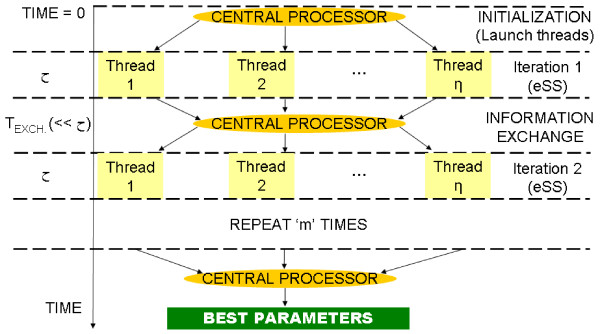
“Each of the processors executes a program (or “thread”) which implements the enhanced Scatter Search (eSS) algorithm [24,25].”
InfluentialSelf-citationDynamic Optimization of Nonlinear Processes with an Enhanced Scatter Search Method
Egea, J. A., Balsa‐Canto, E., García, M.-S. G., & Banga, J. R. (2009) · Industrial & Engineering Chemistry Research · doi:10.1021/ie801717t · Cited by 132 · cited 4×
“Each of the processors executes a program (or “thread”) which implements the enhanced Scatter Search (eSS) algorithm [24,25].”
InfluentialSelf-citationCrainic, T. G., & Toulouse, M. (2010) · International series in management science/operations research/International series in operations research & management science · doi:10.1007/978-1-4419-1665-5_17 · Cited by 115
Something from nothing − bridging the gap between constraint‐based and kinetic modelling
Smallbone, K., Simeonidis, E., Broomhead, D. S., & Kell, D. B. (2007) · The FEBS Journal · doi:10.1111/j.1742-4658.2007.06076.x · Cited by 99 · cited 1×
“In [16] they presented a method for building a parameterized genome-scale kinetic model of a metabolic network, based solely on the knowledge of reaction stoichiometries.”
Parallelization of the scatter search for the p-median problem
López, F. G., Melián-Batista, B., Pérez, J. A. M., & Moreno-Vega, J. M. (2003) · Parallel Computing · doi:10.1016/s0167-8191(03)00043-7 · Cited by 82 · cited 2×
“In [30] three different parallelizations of the scatter search were proposed and compared.”
BackgroundResultBringing metabolic networks to life: integration of kinetic, metabolic, and proteomic data
Liebermeister, W., & Klipp, E. (2006) · Theoretical Biology and Medical Modelling · doi:10.1186/1742-4682-3-42 · Cited by 82
Global Optimization of Bioprocesses using Stochastic and Hybrid Methods
Banga, J. R., Moles, C. G., & Alonso, A. A. (2004) · Nonconvex optimization and its applications · doi:10.1007/978-1-4613-0251-3_3 · Cited by 63
Self-citationReverse engineering a gene network using an asynchronous parallel evolution strategy
Jostins, L., & Jaeger, J. (2010) · BMC Systems Biology · doi:10.1186/1752-0509-4-17 · Cited by 42
Systemic behavior of cooperative search algorithms
Toulouse, M., Crainic, T. G., & Sansò, B. (2003) · Parallel Computing · doi:10.1016/j.parco.2002.07.001 · Cited by 40 · cited 2×
“This was acknowledged in [33], where four parameters that may affect this behaviour were identified: (i) information gathered and made available for sharing; (ii) identification of programs that share information; (iii) the frequency of information sharing among the sequential programs; and (iv) the number of concurre…”
Research works printed but not linked: 2
- De La Maza M Yuret D Dynamic hill climbing AI EXPERT 1994 9 26 26
- IEEE World Congress on Computational Intelligence (CEC@WCCI-2012) Competition on Large Scale Global Optimization 2012 [ http://staff.ustc.edu.cn/~ketang/cec2012/lsgo_competition.htm]
Cited by
Metaheuristics in large-scale global continues optimization: A survey
Mahdavi, S., Shiri, M. E., & Rahnamayan, S. (2015) · Information Sciences · doi:10.1016/j.ins.2014.10.042 · Cited by 465
“Cooperative Enhanced Scatter Search (CeSS) [175] Parameter estimation in large scale systems biology models”
BackgroundPenas, D. R., González, P., Egea, J. A., Doallo, R., & Banga, J. R. (2017) · BMC Bioinformatics · doi:10.1186/s12859-016-1452-4 · Cited by 385
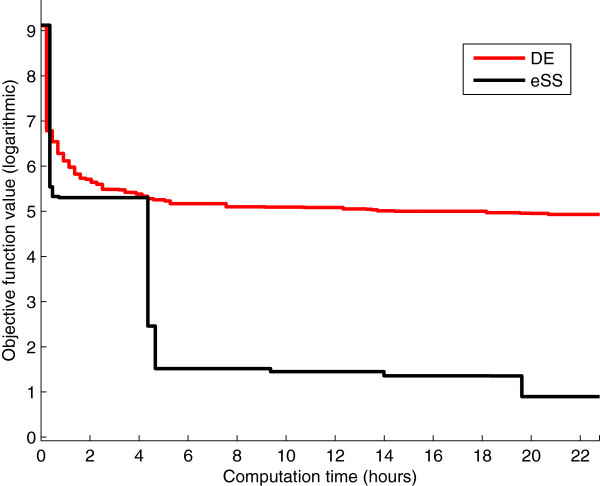
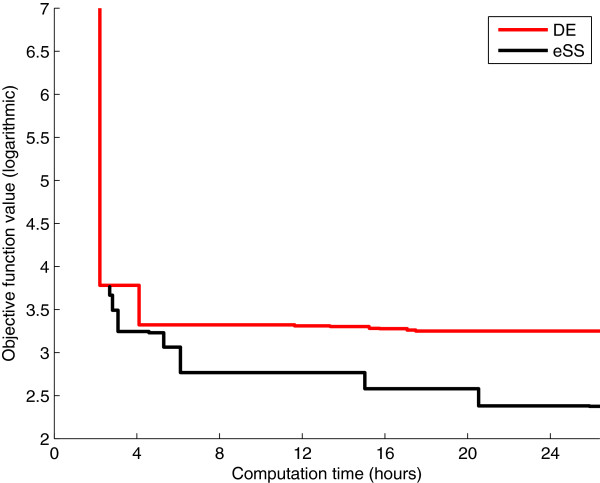
“Previous works in the literature have already pointed out that, for sequential implementations, eSS performs better than DE in those problems where local searches are instrumental in refining the solution [51].”
BackgroundMethodInfluentialSelf-citationReverse engineering and identification in systems biology: strategies, perspectives and challenges
Villaverde, A. F., & Banga, J. R. (2014) · Journal of The Royal Society Interface · doi:10.1098/rsif.2013.0505 · Cited by 229
Self-citationEgea, J. A., Henriques, D., Cokelaer, T., Villaverde, A. F., MacNamara, A., Danciu, D.-P., Banga, J. R., & Saez-Rodriguez, J. (2014) · BMC Bioinformatics · doi:10.1186/1471-2105-15-136 · Cited by 176
“The convergence curves for the solution of these benchmark functions in R are coherent with those presented in [10], which were solved with Matlab, and the results are also competitive with the reference results for these functions presented in http://staff.”
BackgroundMethodResultInfluentialSelf-citationKell, D. B., & Goodacre, R. (2014) · Drug Discovery Today · doi:10.1016/j.drudis.2013.07.014 · Cited by 169
Metadata
- Authors
- Villaverde, A. F., Egea, J. A., & Banga, J. R.
- Affiliations
- Consejo Superior de Investigaciones Científicas (ES)
- Corresponding author
- Banga, Julio R
- Venue
- BMC Systems Biology
- Published
- 2012-06-22
- Volume
- 6
- Issue
- 1
- Pages
- 75-75
- ISSN
- 1752-0509 (ISSN-L)
- PMC
- PMC3512509
- OpenAlex
- W2090517830
- Cited by
- 56
- References
- 38
- Citations by year
- 2024: 4 · 2023: 3 · 2022: 2 · 2021: 1 · 2020: 3 · 2019: 6 · 2018: 6 · 2017: 5 · 2016: 2 · 2015: 11 · 2014: 6 · 2013: 7
- FWCI
- 7.56
- Type
- journal article
- Language
- en
- Open access
- gold
- doi.org
- Licence
- cc-by
- Locations
- BMC Systems Biology (publishedVersion, cc-by)
- PubMed Central (publishedVersion, cc-by)
- PubMed (publishedVersion)
- DIGITAL.CSIC (Spanish National Research Council (CSIC)) (submittedVersion)
- DOAJ (DOAJ: Directory of Open Access Journals) (submittedVersion)
- Funders
- European Commission (289434)
- Ministerio de Economía y Competitividad (DPI2011-28112-C04-04, DPI2011-28112-C04-03, C04-04)
- FP7 Food, Agriculture and Fisheries, Biotechnology
- Topics
- Physical Sciences › Computer Science › Artificial Intelligence › Metaheuristic Optimization Algorithms Research
- Life Sciences › Biochemistry, Genetics and Molecular Biology › Molecular Biology › Gene Regulatory Network Analysis
- Life Sciences › Biochemistry, Genetics and Molecular Biology › Molecular Biology › Microbial Metabolic Engineering and Bioproduction
- Keywords
- parameter estimation, model calibration, systems biology models, cooperative metaheuristics, global optimization, parallel threads, information sharing, central carbon metabolism, Escherichia coli, transcriptional regulation, metabolic regulation, large-scale optimization
- MeSH terms
- Algorithms, Calibration, Carbon, Escherichia coli, Models, Biological, Time Factors, Transcription, Genetic, Gene Expression Regulation, Bacterial, Systems Biology
About these checks
Registry, retraction, Cites and statistics results are computed, not judged, with one exception: a printed reference that no index lists is read once by a model before it counts as a citation error. Claims are extracted by a model and kept only when their quote appears verbatim in the text; each cited source is then checked, with a model’s help, for whether it says what the claim relies on. Those verdicts can be wrong — read the claim’s quote and the cited source before relying on one.
Statistics and arithmetic are recomputed, not judged.
Confidence bands are shown only for fields calibrated on our annotated test set. None is calibrated yet, so no band is shown.
What counts as a claim ›How we measure confidence ›How we check this ›
Are you an author, or do you see a problem with this page? Request a review
Data sources
Bibliographic data: Semantic Scholar, OpenAlex, Crossref.
Contains information from the Semantic Scholar Academic Graph Datasets, made available under the ODC Attribution License (ODC-BY 1.0).
Semantic Scholar’s data is described in: Kinney, R., et al. (2023). The Semantic Scholar Open Data Platform. arXiv:2301.10140.
