

The DOI matches its Crossref record; 75 of the 75 references it cites were found in a registry or an index.
A systematic review of resilience and mental health outcomes of conflict-driven adult forced migrants
Open accessAbstract
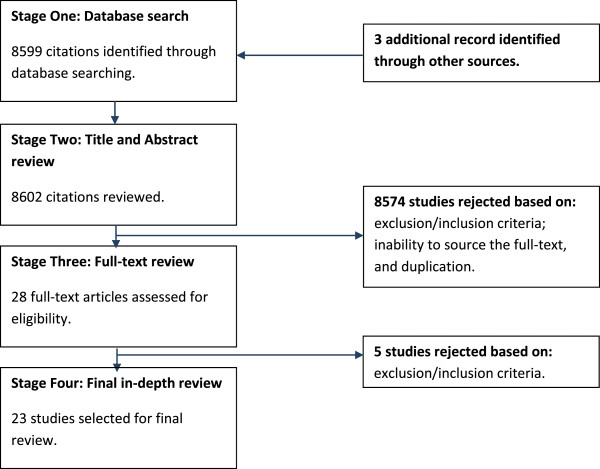
BACKGROUND: The rising global burden of forced migration due to armed conflict is increasingly recognised as an important issue in global health. Forced migrants are at a greater risk of developing mental disorders. However, resilience, defined as the ability of a person to successfully adapt to or recover from stressful and traumatic experiences, has been highlighted as a key potential protective factor. This study aimed to review systematically the global literature on the impact of resilience on the mental health of adult conflict-driven forced migrants. METHODOLOGY: Both quantitative and qualitative studies that reported resilience and mental health outcomes among forcibly displaced persons (aged 18+) by way of exploring associations, links, pathways and causative mechanisms were included. Fourteen bibliographic databases and seven humanitarian study databases/websites were searched and a four stage screening process was followed. RESULTS: Twenty three studies were included in the final review. Ten qualitative studies identified highlighted family and community cohesion, family and community support, individual personal qualities, collective identity, supportive primary relationships and religion. Thirteen quantitative studies were identified, but only two attempted to link resilience with mental disorders, and three used a specific resilience measure. Over-reliance on cross-sectional designs was noted. Resilience was generally shown to be associated with better mental health in displaced populations, but the evidence on this and underlying mechanisms was limited. DISCUSSION: The review highlights the need for more epidemiological and qualitative evidence on resilience in forcibly displaced persons as a potential avenue for intervention development, particularly in resource-poor settings.
Overview
The claims and statistics of this paper haven’t been checked yet.
Run the check — free, no account needed. It reads the open-access text and checks the sources it cites.
Integrity signals
Registry
Cites
Statistics
Figures
Verification
Claims the paper makes
The claims and statistics of this paper haven’t been checked yet.
Run the check — free, no account needed. It reads the open-access text and checks the sources it cites.
Claims other papers make about this one
Each is checked against this paper’s own text: does it say what the citing paper says it does?
The source backs part of the claim, not all of it — or backs it for a different population, condition or comparison.
In the citing paper
“Although successful adaptation to adverse circumstances occurs for most people (e.g. through employing positive coping strategies to target stressors or their psychological consequences), others may develop mental health disorders and pre-existing mental illness may go untreated [4, 5].”
From Mental health and psychosocial support for South Sudanese refugees in northern Uganda: a needs and resource assessment (2016) · cites this paper as [5]
Experimental — accuracy not yet measuredThe source backs part of the claim, not all of it — or backs it for a different population, condition or comparison.
In the citing paper
“Similar to other research on migrants and resilience, family and community support, maintenance of language, religion and culture as well learning new languages and ways of doing, fueled resilience”
From Refugees, asylum-seekers and undocumented migrants and the experience of parenthood: a synthesis of the qualitative literature (2017) · cites this paper as [169]
Experimental — accuracy not yet measured
Self-check
Percentages, sums and reported differences re-computed from the paper’s own numbers.
The self-check needs the paper’s full text.
Citations
Cites
Preferred Reporting Items for Systematic Reviews and Meta-Analyses: the PRISMA statement
Moher, D., Liberati, A., Tetzlaff, J., Altman, D. G., & for the PRISMA Group (2009) · BMJ · doi:10.1136/bmj.b2535 · Cited by 83,823
Preferred reporting items for systematic reviews and meta-analyses: the PRISMA Statement.
(2009) · PubMed Central · Cited by 44,859
Preferred reporting items for systematic reviews and meta-analyses: The PRISMA statement
Moher, D., Liberati, A., Tetzlaff, J., Altman, D. G., & the PRISMA Group* (2009) · Annals of Internal Medicine · doi:10.7326/0003-4819-151-4-200908180-00135 · Cited by 37,554
Preferred Reporting Items for Systematic Reviews and Meta-Analyses: The PRISMA Statement
Moher, D., Liberati, A., Tetzlaff, J., & Altman, D. G. (2009) · Journal of Clinical Epidemiology · doi:10.1016/j.jclinepi.2009.06.005 · Cited by 19,575
Development of a new resilience scale: The Connor-Davidson Resilience Scale (CD-RISC)
Connor, K. M., & Davidson, J. R. T. (2003) · Depression and Anxiety · doi:10.1002/da.10113 · Cited by 11,793
Community Resilience as a Metaphor, Theory, Set of Capacities, and Strategy for Disaster Readiness
Norris, F. H., Stevens, S. P., Pfefferbaum, B., Wyche, K. F., & Pfefferbaum, R. L. (2008) · American Journal of Community Psychology · doi:10.1007/s10464-007-9156-6 · Cited by 5,476
Social and ecological resilience: are they related?
Adger, W. N. (2000) · Progress in Human Geography · doi:10.1191/030913200701540465 · Cited by 4,844
Steel, Z., Chey, T., Silove, D., Marnane, C., Bryant, R. A., & van Ommeren, M. (2009) · JAMA · doi:10.1001/jama.2009.1132 · Cited by 2,246
Ungar, M. T. (2006) · The British Journal of Social Work · doi:10.1093/bjsw/bcl343 · Cited by 2,206
A methodological review of resilience measurement scales
Windle, G., Bennett, K. M., & Noyes, J. (2011) · Health and Quality of Life Outcomes · doi:10.1186/1477-7525-9-8 · Cited by 2,079
Research works printed but not linked: 4
- UNHCR: Facts and Figures about Refugees. 2011, http://www.unhcr.org.uk/about-us/key-facts-and-figures.html .
- Internal Displacement Monitoring Centre (IDMC): Global Conflict Displacement at 18 year High. 2013, Geneva: IDMC
- Rolfe RE, Social cohesion and community resilience: A Multidisciplinary Review of Literature for Rural Health Research. 2006, Halifax: Department of International Development Studies Faculty of Graduate Studies and Research Saint Mary’s University
- Blanchet K, Roberts B: Evidence Review on Research for Health in Humanitarian Crises. 2013, http://www.elrha.org/r2hc/evidence-review .
Cited by
Sorted by citations
Items 101–200 of 297
Ezell, J. M., Pho, M. T., Ajayi, B. P., Simek, E., Shetty, N., Goddard‐Eckrich, D., & Bluthenthal, R. N. (2024) · Drug and Alcohol Review · doi:10.1111/dar.13832 · Cited by 15
Feeling Community During War: Community Resilience of Ukrainian Women Refugees in Italy
Olcese, M., Cardinali, P., Camilleri, A. P., & Migliorini, L. (2024) · Journal of International Migration and Integration / Revue de l integration et de la migration internationale · doi:10.1007/s12134-024-01147-8 · Cited by 14
Repatriation is associated with isthmus cingulate cortex reduction in community-dwelling elderly
Calati, R., Maller, J. J., Meslin, C., López‐Castromán, J., Ritchie, K. A., Courtet, P., & Artéro, S. (2016) · The World Journal of Biological Psychiatry · doi:10.1080/15622975.2016.1258490 · Cited by 15
Psychodynamic and sociopolitical predictors of COVID Distress and Gravity
Wagerman, S. A., Bedikian, A., & Ross, B. S. (2020) · Personality and Individual Differences · doi:10.1016/j.paid.2020.110506 · Cited by 18
Problem gambling during Covid-19
Frisone, F., Alibrandi, A., & Settineri, S. (2020) · Mediterranean Journal of Clinical Psychology · doi:10.6092/2282-1619/mjcp-2457 · Cited by 30
Hawkes, C., Norris, K., Joyce, J., & Paton, D. (2021) · Frontiers in Psychology · doi:10.3389/fpsyg.2021.704570 · Cited by 14
Kovalenko, G., Yakovleva, A., Smyrnov, P., Redlinger, M., Tymets, O., Korobchuk, A., Kolodiazieva, A., Podolina, A., Cherniavska, S., Skaathun, B., et al. (2023) · PNAS Nexus · doi:10.1093/pnasnexus/pgad008 · Cited by 14
Colucci, E., Valibhoy, M., Szwarc, J., Kaplan, I., & Minas, H. (2017) · International Journal of Culture and Mental Health · doi:10.1080/17542863.2017.1279674 · Cited by 14
Meanings of Resilience and Mental Health in a Refugee Context: Voices of Syrian Refugees
Yalim, A. C., & Chapple, R. L. (2023) · Journal of Ethnic & Cultural Diversity in Social Work · doi:10.1080/15313204.2023.2173694 · Cited by 13
El‐Khoury, J., McMahon, A., Kazem, F., Atoui, M., Castaldelli-Maia, J. M., Narvaez, J. C. D. M., Torales, J. C., Lashley, M., Campbell, M., Liebrenz, M., et al. (2024) · PLOS mental health. · doi:10.1371/journal.pmen.0000094 · Cited by 15
Collective Violence, Strengths, and Perceived Posttraumatic Growth: A Scoping Review
Brooks, M., O’Brien, R. O., Livanou, M., Turner, M. J., & Whittenbury, K. (2025) · Trauma Violence & Abuse · doi:10.1177/15248380241309383 · Cited by 13
Shankar, S., Gogosis, E., Palepu, A., Gadermann, A., & Hwang, S. W. (2018) · Qualitative Health Research · doi:10.1177/1049732318798353 · Cited by 13
Rawers, C., Redican, E., Alpay, E. H., McElroy, E., & Shevlin, M. E. (2024) · Acta Psychologica · doi:10.1016/j.actpsy.2024.104220 · Cited by 12
Ghafoori, B., Triliva, S., Chrysikopoulou, P., & Vavvos, A. (2024) · Behavioral Sciences · doi:10.3390/bs14060509 · Cited by 13
Yun, S., Ahmed, S. R., Hauson, A. O., & Al‐Delaimy, W. K. (2021) · Community Mental Health Journal · doi:10.1007/s10597-020-00739-9 · Cited by 12
Papola, D., Prina, E., Ceccarelli, C., Cadorin, C., Gastaldon, C., Ferreira, M. C., Tol, W. A., van Ommeren, M., Barbui, C., & Purgato, M. (2024) · Cochrane Database of Systematic Reviews · doi:10.1002/14651858.cd014300.pub2 · Cited by 18
Purgato, M., Tedeschi, F., Turrini, G., Acartürk, C., Anttila, M., Augustinavicious, J., Baumgartner, J. S., Bryant, R. A., Churchill, R. C., İlkkurşun, Z., et al. (2022) · European Journal of Psychotraumatology · doi:10.1080/20008066.2022.2128270 · Cited by 13
Andrushko, Y., & Lanza, S. T. (2024) · International Journal of Environmental Research and Public Health · doi:10.3390/ijerph21111409 · Cited by 11
Immigrants’ Pathways to Outpatient Mental Health: Are there Differences with the Native Population?
Gramaglia, C. M., Gambaro, E., Rossi, A., Toso, A., Feggi, A., Cattaneo, C. I., Castignoli, G., Mainini, P., Tarricone, I., Torre, E., et al. (2015) · Journal of Immigrant and Minority Health · doi:10.1007/s10903-015-0336-4 · Cited by 11
Mytsyk, H., Попова, А. С., & BOHDANOVA, M. (2024) · Journal of Education for Students Placed at Risk (JESPAR) · doi:10.1080/10824669.2024.2309359 · Cited by 10
Kovalenko, J. (2024) · Journal of Health Psychology · doi:10.1177/13591053241274464 · Cited by 10
The Assessment of Multisystemic Resilience in Conflict-Affected Populations
Lordos, A., & Hyslop, D. (2021) · doi:10.1093/oso/9780190095888.003.0023 · Cited by 10
Examining post-conflict stressors in northern Sri Lanka: A qualitative study
Thomas, F. C., D’souza, M., Magwood, O., Thilakanathan, D., Sukumar, V., Doherty, S., Dass, G., Hart, T. L., Sivayokan, S., Wickramage, K. P., et al. (2022) · PLoS ONE · doi:10.1371/journal.pone.0267018 · Cited by 10
Weise, C., Grupp, F., Reese, J., Schade‐Brittinger, C., Ehring, T. W., Nexhmedin Morina, B., Stangier, U., Steil, R., Johow, J., & Mewes, R. (2021) · BMJ Open · doi:10.1136/bmjopen-2020-047385 · Cited by 10
Thomas, F. C., Coulombe, S., Girard, T. A., Hart, T. L., Doherty, S., Dass, G., Wickramage, K. P., Siriwardhana, C., Surenthirakumaran, R., & McShane, K. (2022) · SSM - Mental Health · doi:10.1016/j.ssmmh.2022.100129 · Cited by 10
Self-citationYitageasu, G., Adane, K. C., Tesfaye, A. H., Enawugaw, T., & Demoze, L. (2025) · BMC Public Health · doi:10.1186/s12889-025-24166-1 · Cited by 11
Yitageasu, G., Asnake, A. A., Gebrehana, A. K., Kase, B. F., Asebe, H. A., Tigabie, M., & Demoze, L. (2025) · PLoS neglected tropical diseases · doi:10.1371/journal.pntd.0013853 · Cited by 9
Clinical Correlates of Deliberate Self-Harm Among Migrant Trauma-Affected Subgroups
Baralla, F., Ventura, M., Negay, N., Napoli, A. D., Petrelli, A., Mirisola, C., & Sarchiapone, M. (2021) · Frontiers in Psychiatry · doi:10.3389/fpsyt.2021.529361 · Cited by 9
Resilience and Hope Among Yazidi Women Released From ISIS Enslavement
Taha, P. H., Nguyen, T. P., & Slewa‐Younan, S. (2021) · The Journal of Nervous and Mental Disease · doi:10.1097/nmd.0000000000001400 · Cited by 9
Yimer, S., Girma, Z., Mengistu, N., & Shumye, S. (2021) · HIV/AIDS - Research and Palliative Care · doi:10.2147/hiv.s329256 · Cited by 10
Jafree, S. R., Nadir, S. M. H., Mahmood, Q. K., & Burhan, S. K. (2023) · Journal of Migration and Health · doi:10.1016/j.jmh.2023.100166 · Cited by 9
Amede, E. S., Tesfaye, E., & Ahmed, G. (2024) · Frontiers in Psychiatry · doi:10.3389/fpsyt.2024.1505876 · Cited by 8
Walker, R., Vearey, J., Bile, A. S., & Lobukulu, G. L. (2025) · International Journal of Environmental Research and Public Health · doi:10.3390/ijerph22071042 · Cited by 9
Considerations in designing trauma-focused interventions for displaced Afghan women
Ramos, A. A. (2023) · Frontiers in Global Women s Health · doi:10.3389/fgwh.2022.893957 · Cited by 10
Slater, R. (2022) · doi:10.19088/basic.2022.014 · Cited by 8
Farid, D., Li, P., Costa, D. D., Afif, W., Szabo, J., Dasgupta, K., & Rahme, E. (2022) · CMAJ Open · doi:10.9778/cmajo.20210019 · Cited by 7
Bergmann, J. (2023) · Studien zur Migrations- und Integrationspolitik · doi:10.1007/978-3-658-42298-1 · Cited by 10
Mylord, M., Moran, J. K., Özler, G., Nassar, R., Anwarzay, S., Hintz, S.-J., & Schouler‐Ocak, M. (2023) · International Review of Psychiatry · doi:10.1080/09540261.2023.2190409 · Cited by 8
The burden of substance use and (mental) distress among asylum seekers: a cross sectional study
Solfrank, M., Nikendei, C., Zehetmair, C., Friederich, H., & Nagy, E. (2023) · Frontiers in Psychiatry · doi:10.3389/fpsyt.2023.1258140 · Cited by 11
Andersson, J., Kankaanpää, R., Peltonen, K., Münger, A.-C., & Korhonen, L. (2024) · Comprehensive Psychiatry · doi:10.1016/j.comppsych.2024.152522 · Cited by 10
Christy, S., Siriwardhana, C., Lohmann, J., Roberts, B., & Smith, S. C. (2021) · Journal of Migration and Health · doi:10.1016/j.jmh.2021.100068 · Cited by 7
Self-citationLancaster, S. L., & Gaede, C. (2020) · Anxiety Stress & Coping · doi:10.1080/10615806.2020.1773446 · Cited by 7
A multilayered, dynamic model of refugee resilience: A grounded theory
Kondili, E., Interiano‐Shiverdecker, C. G., & Sabah, M. (2023) · Journal of Counseling & Development · doi:10.1002/jcad.12496 · Cited by 8
Respuestas ante la ausencia familiar en la migración de adolescentes no acompañados en México
Maioli, S. C., de León, A. D., Machado-Núñez, S., Gómez-Juárez, J. E., & Berenzon, S. (2023) · Salud Pública de México · doi:10.21149/15278 · Cited by 6
Understanding the pathology of psychiatric disorders in refugees
Bartlett, R., Sarnyai, Z., Momartin, S., Ooi, L., Schwab, S. G., & Matosin, N. (2020) · Psychiatry Research · doi:10.1016/j.psychres.2020.113661 · Cited by 7
Wenning, B. (2021) · Social Sciences · doi:10.3390/socsci10090324 · Cited by 6
Hagues, R. J., & Helms, S. E. (2022) · Journal of Religion & Spirituality in Social Work Social Thought · doi:10.1080/15426432.2022.2120447 · Cited by 6
Dhungana, S., Koirala, R., Ojha, S. P., & Thapa, S. B. (2022) · PLoS ONE · doi:10.1371/journal.pone.0275637 · Cited by 6
Rasheed, O. S., López‐Rodríguez, L., & Navas, M. (2022) · BMC Psychology · doi:10.1186/s40359-022-00973-8 · Cited by 8
Social Support and Resilience: Impact on Mental Health
Emmelkamp, P. M. G. (2023) · Springer eBooks · doi:10.1007/978-3-031-34078-9_3 · Cited by 7
Schieß-Jokanovic, J., Gösling-Steirer, C., Kantor, V., Knefel, M., Weindl, D., & Lueger‐Schuster, B. (2023) · PLoS ONE · doi:10.1371/journal.pone.0288691 · Cited by 6
Deb, A. (2018) · Springer eBooks · doi:10.1007/978-81-322-3782-2_4 · Cited by 6
Acker, K. V., Groeninck, M., Geldof, D., Meurs, P., & Wiewauters, C. (2022) · European Journal of Social Work · doi:10.1080/13691457.2022.2063808 · Cited by 8
Public policy, mental health and a public health approach to violence
Bhavsar, V., Bhugra, D., & Persaud, A. (2020) · International Journal of Social Psychiatry · doi:10.1177/0020764020915236 · Cited by 7
Younes, R. S., Moukarzel, C., Ibrahim, C. D., & Mzawak, M. A. (2025) · Social Sciences · doi:10.3390/socsci14110626 · Cited by 7
Moving Forward in Mental Health Care for Refugee, Asylum-Seeking, and Undocumented Children
Lee, K., Kronick, R., Miconi, D., & Rousseau, C. (2023) · Child and Adolescent Psychiatric Clinics of North America · doi:10.1016/j.chc.2023.09.007 · Cited by 5
Tesfai, A. H., Captari, L. E., Meyer‐Weitz, A., & Cowden, R. G. (2023) · International Journal of Environmental Research and Public Health · doi:10.3390/ijerph21010050 · Cited by 11
Psychological adaptation among health care workers who work with trauma‐exposed refugees in Greece
Ghafoori, B., Triliva, S., Chrysikopoulou, P., & Vavvos, A. (2024) · Journal of Traumatic Stress · doi:10.1002/jts.23022 · Cited by 5
Zelis, T., & Shapira, S. (2025) · Midwifery · doi:10.1016/j.midw.2025.104425 · Cited by 5
The plights of Eritrean refugees in the Shimelba Refugee Camp, Ethiopia
Arega, N. T. (2017) · International Journal of Migration Health and Social Care · doi:10.1108/ijmhsc-02-2016-0007 · Cited by 6
Meadows, S. O., Holliday, S. B., Chan, W. Y., Wrabel, S. L., Tankard, M. E., Schultz, D. J., Busque, C. M., Knutson, F., Payne, L., & Miller, L. L. (2019) · RAND Corporation eBooks · doi:10.7249/rr2670 · Cited by 5
Ubels, T., Kinsbergen, S., Koch, D., & Tolsma, J. (2023) · Journal of Immigrant & Refugee Studies · doi:10.1080/15562948.2023.2235674 · Cited by 7
Rasul, M. M., Chowdhury, A. H., Romel, M. S. H., Sadat, F. M., & Hoque, B. S. (2020) · Journal of Armed Forces Medical College Bangladesh · doi:10.3329/jafmc.v15i2.50831 · Cited by 5
Emery, E., Maju, M., Coursey, K., Brandt, C., Ko, J. S., Hampton, K., & Richards, A. (2021) · Journal of Immigrant and Minority Health · doi:10.1007/s10903-021-01324-2 · Cited by 6
Murakami, N. J., & Chen, H. (2019) · Groupwork · doi:10.1921/gpwk.v28i1.1109 · Cited by 5
Bhatla, R., & Singh, R. (2025) · Pure and Applied Geophysics · doi:10.1007/s00024-025-03836-6 · Cited by 4
Springer, P. R., Franzen-Castle, L. D., Gratopp, E., & Schmader, B. (2022) · International Journal of Systemic Therapy · doi:10.1080/2692398x.2022.2135344 · Cited by 6
“You Needed to Accept the Situation”: Resilience of Nursing Home Residents in Times of COVID-19
Witte, J. D., Noten, S., Vinckers, F., Stoop, A., Hovenga, N., Landeweer, E. G. M., & Regenmortel, T. V. (2023) · Canadian Journal on Aging / La Revue canadienne du vieillissement · doi:10.1017/s0714980823000399 · Cited by 4
DiClemente-Bosco, K., Binyungu, A., Shabani, C., Pellowski, J. A., Operario, D., Nugent, N. R., & Harrison, A. D. (2024) · Global Public Health · doi:10.1080/17441692.2024.2314106 · Cited by 5
Mediated communication and refugee resilience: A social psychological model
Pochwatko, G., & Naydonova, L. A. (2023) · Scientific Studios on Social and Political Psychology · doi:10.61727/sssppj/1.2023.28 · Cited by 4
Duque, M., Vos, S. R., García, M. F., Brown, E. C., Perrino, T., Mejía‐Trujillo, J., Pérez‐Gómez, A., Salas‐Wright, C. P., & Schwartz, S. J. (2025) · Journal of Cross-Cultural Psychology · doi:10.1177/00220221251327966 · Cited by 4
Daniels, A. D., Bryan, J. A., Liles, S., & Carney, J. V. (2022) · The Family Journal · doi:10.1177/10664807221104115 · Cited by 4
Predicting Psychological Well-being in Survivors of Armed Conflict in Colombia
Picón, W. M. S., Prieto, B. L. A., & González-Méndez, R. (2022) · Journal of Aggression Maltreatment & Trauma · doi:10.1080/10926771.2022.2112342 · Cited by 4
Women's experiences of trauma-informed care for forced migrants: A qualitative interview study
Jolof, L., Rocca, P., & Carlsson, T. (2024) · Heliyon · doi:10.1016/j.heliyon.2024.e28866 · Cited by 4
Tangelder, Y., Johansen, J. D., & Abebe, D. (2025) · Children and Youth Services Review · doi:10.1016/j.childyouth.2025.108499 · Cited by 3
Henrekson, E., & Lundåsen, S. W. (2025) · Risk Analysis · doi:10.1111/risa.70155 · Cited by 3
Akombi-Inyang, B. J., Byaruhanga, J., Boamah, S. A., Allotey, J., & Atorkey, P. (2024) · International Journal of Environmental Research and Public Health · doi:10.3390/ijerph21091127 · Cited by 4
Greene, M. C., Andersen, L. S., Leku, M. R., Au, T. M., Akellot, J., Upadhaya, N., Odokonyero, R. F., White, R. G., Ventevogel, P., García‐Moreno, C., et al. (2024) · Cambridge Prisms Global Mental Health · doi:10.1017/gmh.2024.103 · Cited by 3
Papathanasiou, C., Georgiou, K., Barbaresos, F., Kougioumtzi, A., & Stylianidis, S. (2025) · International Journal of Migration Health and Social Care · doi:10.1108/ijmhsc-02-2025-0014 · Cited by 3
Hapunda, G. (2015) · International Journal of Emergency Mental Health and Human Resilience · doi:10.4172/1522-4821.1000291 · Cited by 4
Purba, E. J., & Abdullah, S. M. S. (2017) · Journal of Business and Social Review in Emerging Economies · doi:10.26710/jbsee.v3i2.188 · Cited by 3
Gartland, D., Riggs, E., Giallo, R., Glover, K., Stowe, M., Mongta, S., Weetra, D., & Brown, S. (2022) · BMJ Open · doi:10.1136/bmjopen-2021-060229 · Cited by 3
Practical advice for refugees aspiring to become registered nurses in Australia
Chok, H. N., Lewis, P., Mannix, J., & Wilkes, L. (2022) · Journal of Advanced Nursing · doi:10.1111/jan.15472 · Cited by 3
Culture, Trauma, and Loss: Integrative Social Work Practice with Refugees and Asylum Seekers
Bunn, M., Murakami, N. J., & Haidar, A. (2022) · Essential clinical social work series · doi:10.1007/978-3-031-12600-0_12 · Cited by 3
English-Speaking Immigrants in Israel During the Pandemic: Challenges and Pathways to Resilience
Dryjańska, L., Zlotnick, C., & Suckerman, S. (2022) · The Counseling Psychologist · doi:10.1177/00110000221138270 · Cited by 3
Agha, E., Cuddeback, G. S., & Crowder, J. C. (2023) · Social Work in Mental Health · doi:10.1080/15332985.2023.2285256 · Cited by 3
Acculturative Challenges and Opportunities Among Arab-Speaking MENA Refugees in the United States
Childress, S., Shrestha, N., Seff, I., Hagedorn, A., McKay, M. M., & Stark, L. (2024) · Families in Society The Journal of Contemporary Social Services · doi:10.1177/10443894241236885 · Cited by 3
Springer, P. R., Kang, J. S., Gratopp, E., & Franzen-Castle, L. D. (2024) · International Journal of Migration Health and Social Care · doi:10.1108/ijmhsc-05-2023-0041 · Cited by 7
Psychiatric symptom profiles of inpatient refugees in Egypt: insights from a single center study
Soliman, M., El‐Gabry, D. A., Assaf, M., Meshreky, K. M., & Elsaadouni, N. (2024) · Middle East Current Psychiatry · doi:10.1186/s43045-024-00480-z · Cited by 3
Badawy, W., Mdawi, A. M. M. A., Melweth, H. M. A., & Shaban, M. (2025) · Geriatric Nursing · doi:10.1016/j.gerinurse.2025.05.006 · Cited by 3
Systematic review on chronic non-communicable disease in disaster settingsPreprint
Ngaruiya, C., Bernstein, R., Leff, R., Wallace, L., Agrawal, P., Selvam, A., Hersey, D., & Hayward, A. S. (2022) · Research Square · doi:10.21203/rs.3.rs-798853/v1 · Cited by 3
Current Mental Health and Psychosocial Support Policies and Frameworks in Humanitarian Settings
Kan, M. (2022) · Essential clinical social work series · doi:10.1007/978-3-031-12600-0_5 · Cited by 2
Ekren, E., Tomasso, M. E., & Villagran, M. M. (2024) · Sustainability · doi:10.3390/su162310333 · Cited by 4
Lardier, D. T., Blackwell, M. A., & Goodkind, J. R. (2025) · International Journal of Social Psychiatry · doi:10.1177/00207640251339842 · Cited by 3
Sherally, J., Dnestrianschii, F., Alshamari, Z., Beshir, E., Jafari, H., Jafari, M., Mohamed, K., Mohammadyasin, S., van den Muijsenbergh, M. E. T. C., van den Akker, T., et al. (2025) · BJOG An International Journal of Obstetrics & Gynaecology · doi:10.1111/1471-0528.18328 · Cited by 2
Frounfelker, R. L., Thapa, P., & Mishra, T. (2025) · International Journal of Environmental Research and Public Health · doi:10.3390/ijerph22081303 · Cited by 2
Chipalo, E. (2025) · Journal of Public Health · doi:10.1007/s10389-025-02631-w · Cited by 2
Elshahat, S., Moffat, T., Newbold, K. B., Samhat, A., Gehani, M., Jafri, Y., Oghli, Z. S., Kanaa, N., Shafiq, B., Zaidi, A., et al. (2026) · Social Science & Medicine · doi:10.1016/j.socscimed.2026.118955 · Cited by 2
Parkinson's Disease in Times of War: Gaps in Knowledge and Emerging Controversies
Salari, M., Etemadifar, M., & Soleimani, S. (2026) · Movement Disorders · doi:10.1002/mds.70272 · Cited by 3
Resilience and coping behavior among war refugees from diverse ethnic backgrounds
Kovalenko, J., Mahgoub, E. A. M., & Nasr, R. A. (2026) · Discover Psychology · doi:10.1007/s44202-026-00698-4 · Cited by 2
Metadata
- Authors
- Siriwardhana, C., Ali, S. S., Roberts, B., & Stewart, R.
- Affiliations
- King's College London (GB)
- London School of Hygiene & Tropical Medicine (GB)
- Corresponding author
- Siriwardhana, Chesmal
- Venue
- Conflict and Health
- Published
- 2014-08-20
- Volume
- 8
- Issue
- 1
- Pages
- 13-13
- ISSN
- 1752-1505 (ISSN-L)
- PMC
- PMC4149800
- OpenAlex
- W2145950737
- Cited by
- 299
- References
- 75
- Citations by year
- 2026: 25 · 2025: 36 · 2024: 37 · 2023: 35 · 2022: 43 · 2021: 36 · 2020: 25 · 2019: 19 · 2018: 11 · 2017: 12 · 2016: 14 · 2015: 6
- FWCI
- 1.61
- Type
- journal article
- Language
- en
- Open access
- gold
- doi.org
- Licence
- cc-by
- Locations
- Conflict and Health (publishedVersion, cc-by)
- Europe PMC (PubMed Central) (publishedVersion, cc-by)
- PubMed Central (publishedVersion, cc-by)
- PubMed (publishedVersion)
- LSHTM Research Online (London School of Hygiene and Tropical Medicine) (acceptedVersion)
- Research Portal (King's College London) (submittedVersion, cc-by)
- Funders
- South London and Maudsley NHS Foundation Trust
- National Institute for Health and Care Research
- King's College London
- Topics
- Social Sciences › Psychology › Clinical Psychology › Migration, Health and Trauma
- Social Sciences › Psychology › Clinical Psychology › Resilience and Mental Health
- Health Sciences › Medicine › Public Health, Environmental and Occupational Health › Maternal Mental Health During Pregnancy and Postpartum
- Keywords
- resilience, mental health, forced migration, armed conflict, displaced persons, protective factors, social support, collective identity, mental illness, humanitarian settings
About these checks
Registry, retraction, Cites and statistics results are computed, not judged, with one exception: a printed reference that no index lists is read once by a model before it counts as a citation error. Claims are extracted by a model and kept only when their quote appears verbatim in the text; each cited source is then checked, with a model’s help, for whether it says what the claim relies on. Those verdicts can be wrong — read the claim’s quote and the cited source before relying on one.
Statistics and arithmetic are recomputed, not judged.
Confidence bands are shown only for fields calibrated on our annotated test set. None is calibrated yet, so no band is shown.
What counts as a claim ›How we measure confidence ›How we check this ›
Are you an author, or do you see a problem with this page? Request a review
