

The DOI matches its Crossref record; 17 of the 17 references it cites were found in a registry or an index.
The validation of Fitbit Zip™ physical activity monitor as a measure of free-living physical activity
Open accessAbstract
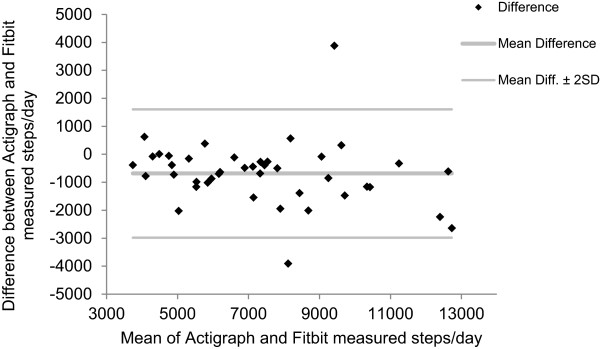
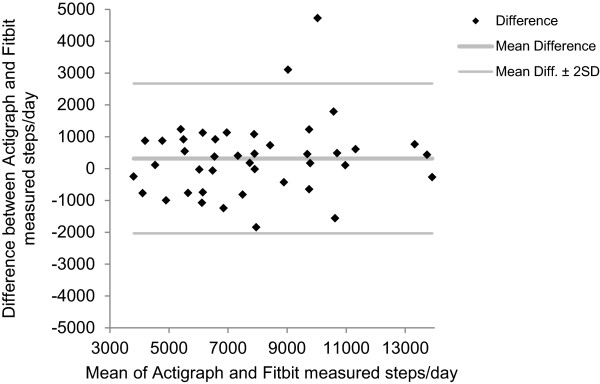
BACKGROUND: The new generation of activity monitors allow users to upload their data to the internet and review progress. The aim of this study is to validate the Fitbit Zip as a measure of free-living physical activity. FINDINGS: Participants wore a Fitbit Zip, ActiGraph GT3X accelerometer and a Yamax CW700 pedometer for seven days. Participants were asked their opinion on the utility of the Fitbit Zip. Validity was assessed by comparing the output using Spearman's rank correlation coefficients, Wilcoxon signed rank tests and Bland-Altman plots. 59.5% (25/47) of the cohort were female. There was a high correlation in steps/day between the Fitbit Zip and the two reference devices (r = 0.91, p < 0.001). No statistically significant difference between the Fitbit and Yamax steps/day was observed (Median (IQR) 7477 (3597) vs 6774 (3851); p = 0.11). The Fitbit measured significantly more steps/day than the Actigraph (7477 (3597) vs 6774 (3851); p < 0.001). Bland-Altman plots revealed no systematic differences between the devices. CONCLUSIONS: Given the high level of correlation and no apparent systematic biases in the Bland Altman plots, the use of Fitbit Zip as a measure of physical activity. However the Fitbit Zip recorded a significantly higher number of steps per day than the Actigraph.
Overview
The claims and statistics of this paper haven’t been checked yet.
Run the check — free, no account needed. It reads the open-access text and checks the sources it cites.
Integrity signals
Registry
Cites
Statistics
Figures
Verification
Claims the paper makes
The claims and statistics of this paper haven’t been checked yet.
Run the check — free, no account needed. It reads the open-access text and checks the sources it cites.
Claims other papers make about this one
Each is checked against this paper’s own text: does it say what the citing paper says it does?
The cited source says what the claim attributes to it.
In the citing paper
“The Fitbit ZipTM has been found to be a valid measure of free-living physical activity in healthy adults [60].”
Self-check
Percentages, sums and reported differences re-computed from the paper’s own numbers.
The self-check needs the paper’s full text.
Citations
Cites
Measuring agreement in method comparison studies
Bland, J. M., & Altman, D. G. (1999) · Statistical Methods in Medical Research · doi:10.1177/096228029900800204 · Cited by 9,619
Measuring agreement in method comparison studies
Bland, J. M., & Altman, D. G. (1999) · Statistical Methods in Medical Research · doi:10.1191/096228099673819272 · Cited by 9,619
Calibration of the Computer Science and Applications, Inc. accelerometer
FREEDSON, P. S., MELANSON, E., & SIRARD, J. (1998) · Medicine & Science in Sports & Exercise · doi:10.1097/00005768-199805000-00021 · Cited by 3,825
Evidence-based intervention in physical activity: lessons from around the world
Heath, G. W., Parra, D. C., Sarmiento, O. L., Andersen, L. B., Owen, N., Goenka, S., Montes, F., & Brownson, R. C. (2012) · The Lancet · doi:10.1016/s0140-6736(12)60816-2 · Cited by 1,199
Meta-analysis of internet-delivered interventions to increase physical activity levels
Davies, C. A., Spence, J. C., Vandelanotte, C., Caperchione, C. M., & Mummery, W. (2012) · International Journal of Behavioral Nutrition and Physical Activity · doi:10.1186/1479-5868-9-52 · Cited by 488
Comparison of pedometer and accelerometer measures of free-living physical activity
Tudor-Locke, C. E., Ainsworth, B. E., Thompson, R. W., & Matthews, C. E. (2002) · Medicine & Science in Sports & Exercise · doi:10.1097/00005768-200212000-00027 · Cited by 387
Validation of the Fitbit One activity monitor device during treadmill walking
Takacs, J., Pollock, C. L., Guenther, J. R., Bahar, M., Napier, C., & Hunt, M. A. (2013) · Journal of science and medicine in sport · doi:10.1016/j.jsams.2013.10.241 · Cited by 336
Adam Noah, J., Spierer, D. K., Gu, J., & Bronner, S. (2013) · Journal of Medical Engineering & Technology · doi:10.3109/03091902.2013.831135 · Cited by 202
Dowd, K., Harrington, D. M., & Donnelly, A. (2012) · PLoS ONE · doi:10.1371/journal.pone.0047633 · Cited by 136
A Comparison of Energy Expenditure Estimation of Several Physical Activity Monitors
Dannecker, K. L., Sazonova, N. A., Melanson, E. L., Sazonov, E. E., & Browning, R. C. (2013) · Medicine & Science in Sports & Exercise · doi:10.1249/mss.0b013e318299d2eb · Cited by 124
Cited by
Sorted by citations
Systematic review of the validity and reliability of consumer-wearable activity trackers
Evenson, K. R., Goto, M. M., & Furberg, R. D. (2015) · International Journal of Behavioral Nutrition and Physical Activity · doi:10.1186/s12966-015-0314-1 · Cited by 1,232
Fuller, D., Colwell, E., Low, J., Orychock, K., Tobin, M. A., Simango, B., Buote, R., Van Heerden, D., Luan, H., Cullen, K., et al. (2020) · JMIR mHealth and uHealth · doi:10.2196/18694 · Cited by 715
Accuracy of Fitbit Devices: Systematic Review and Narrative Syntheses of Quantitative Data
Feehan, L. M., Geldman, J., Sayre, E. C., Park, C., Ezzat, A. M., Yoo, J. Y., Hamilton, C. B., & Li, L. C. (2018) · JMIR mHealth and uHealth · doi:10.2196/10527 · Cited by 616
Sullivan, A. N., & Lachman, M. E. (2017) · Frontiers in Public Health · doi:10.3389/fpubh.2016.00289 · Cited by 458
Lobelo, F., Rohm Young, D., Sallis, R., Garber, M. D., Billinger, S. A., Duperly, J., Hutber, A., Pate, R. R., Thomas, R. J., Widlansky, M. E., et al. (2018) · Circulation · doi:10.1161/cir.0000000000000559 · Cited by 402
Metadata
- Authors
- Tully, M. A., McBride, C., Heron, L., & Hunter, R. F.
- Affiliations
- Queen's University Belfast (GB)
- Corresponding author
- Tully, Mark A
- Venue
- BMC Research Notes
- Published
- 2014
- Volume
- 7
- Issue
- 1
- Pages
- 952
- ISSN
- 1756-0500 (ISSN-L)
- PMC
- PMC4307145
- OpenAlex
- W2102760209
- Cited by
- 172
- References
- 16
- Citations by year
- 2026: 2 · 2025: 6 · 2024: 9 · 2023: 6 · 2022: 8 · 2021: 16 · 2020: 25 · 2019: 19 · 2018: 19 · 2017: 26 · 2016: 24 · 2015: 11
- FWCI
- 13.56
- Type
- journal article
- Language
- en
- Open access
- gold
- doi.org
- Licence
- cc-by
- Locations
- BMC Research Notes (publishedVersion, cc-by)
- Europe PMC (PubMed Central) (publishedVersion, cc-by)
- PubMed Central (publishedVersion, cc-by)
- PubMed (publishedVersion)
- Research Portal (Queen's University Belfast) (acceptedVersion, other-oa)
- Funders
- Wellcome Trust
- United Kingdom Clinical Research Collaboration
- Alzheimer's Society
- Alzheimer's Research Trust
- Cancer Research UK
- National Institute for Health and Care Research
- British Heart Foundation
- Diabetes UK
- Stroke Association
- Public Health Agency
- Directorate for Biological Sciences
- Medical Research Council (MR/K023241/1)
- Engineering and Physical Sciences Research Council
- Economic and Social Research Council
- World Cancer Research Fund
- Health and Social Care Research and Development Division
- Topics
- Health Sciences › Medicine › Public Health, Environmental and Occupational Health › Physical Activity and Health
- Physical Sciences › Computer Science › Computer Vision and Pattern Recognition › Context-Aware Activity Recognition Systems
- Health Sciences › Health Professions › General Health Professions › Mobile Health and mHealth Applications
- Keywords
- wearable activity trackers, accelerometer, pedometers, free-living physical activity, step count, device validation, ActiGraph GT3X+
- MeSH terms
- Adult, Female, Humans, Male, Physical Fitness, Telemetry, Reproducibility of Results, Cohort Studies, Walking, Monitoring, Ambulatory, Young Adult, Actigraphy, Independent Living, Accelerometry
About these checks
Registry, retraction, Cites and statistics results are computed, not judged, with one exception: a printed reference that no index lists is read once by a model before it counts as a citation error. Claims are extracted by a model and kept only when their quote appears verbatim in the text; each cited source is then checked, with a model’s help, for whether it says what the claim relies on. Those verdicts can be wrong — read the claim’s quote and the cited source before relying on one.
Statistics and arithmetic are recomputed, not judged.
Confidence bands are shown only for fields calibrated on our annotated test set. None is calibrated yet, so no band is shown.
What counts as a claim ›How we measure confidence ›How we check this ›
Are you an author, or do you see a problem with this page? Request a review
