

The DOI matches its Crossref record; 105 of the 105 references it cites were found in a registry or an index.
Fleas as parasites of the family Canidae
Open accessAbstract
Historically, flea-borne diseases are among the most important medical diseases of humans. Plague and murine typhus are known for centuries while the last years brought some new flea-transmitted pathogens, like R. felis and Bartonella henselae. Dogs may play an essential or an accidental role in the natural transmission cycle of flea-borne pathogens. They support the growth of some of the pathogens or they serve as transport vehicles for infected fleas between their natural reservoirs and humans. More than 15 different flea species have been described in domestic dogs thus far. Several other species have been found to be associated with wild canids. Fleas found on dogs originate from rodents, birds, insectivores and from other Carnivora. Dogs therefore may serve as ideal bridging hosts for the introduction of flea-borne diseases from nature to home. In addition to their role as ectoparasites they cause nuisance for humans and animals and may be the cause for severe allergic reactions.
Overview
The claims and statistics of this paper haven’t been checked yet.
Run the check — free, no account needed. It reads the open-access text and checks the sources it cites.
Integrity signals
Registry
Cites
Statistics
Figures
Verification
Claims the paper makes
The claims and statistics of this paper haven’t been checked yet.
Run the check — free, no account needed. It reads the open-access text and checks the sources it cites.
Claims other papers make about this one
Each is checked against this paper’s own text: does it say what the citing paper says it does?
In the citing paper
“These fleas have a low degree of species-specificity, being able to infest companion animals, humans and wildlife.”
From Fleas infesting pets in the era of emerging extra-intestinal nematodes (2013) · cites this paper as [9]
In the citing paper
“Canine and feline pulicosis is characterized by high infection rates everywhere [7,9,11-14], thus treatment and prevention are a priority in veterinary medicine.”
From Fleas infesting pets in the era of emerging extra-intestinal nematodes (2013) · cites this paper as [9]
In the citing paper
“Also the dog flea Ctenocephalides canis (Figure 2) and the human flea Pulex irritans (Figure 3) are globally distributed, although with lower rates [9,10].”
From Fleas infesting pets in the era of emerging extra-intestinal nematodes (2013) · cites this paper as [9]
In the citing paper
“The most widespread is the cat flea Ctenocephalides felis (Figure 1), which is highly prevalent in both dogs and cats in all corners of the world.”
From Fleas infesting pets in the era of emerging extra-intestinal nematodes (2013) · cites this paper as [9]
In the citing paper
“Cats are a potential source of plague, while dogs appear to be less susceptible to Y. pestis[9,21].”
From Fleas infesting pets in the era of emerging extra-intestinal nematodes (2013) · cites this paper as [9]
In the citing paper
“The plague-causing bacterium Yersinia pestis circulates in rodent populations mainly through bites of the “oriental rat flea” Xenopsilla cheopis, which may also feed on pets and human beings.”
From Fleas infesting pets in the era of emerging extra-intestinal nematodes (2013) · cites this paper as [9]
In the citing paper
“Animals and humans become infected by accidentally ingesting residues or whole fleas containing the infectious cysticercoid.”
From Fleas infesting pets in the era of emerging extra-intestinal nematodes (2013) · cites this paper as [9]
In the citing paper
“This zoonotic cestode is the most prevalent in dogs and cats and is often associated with pulicosis in pets, stray animals, kenneled dogs and cats in colonies.”
From Fleas infesting pets in the era of emerging extra-intestinal nematodes (2013) · cites this paper as [9]
In the citing paper
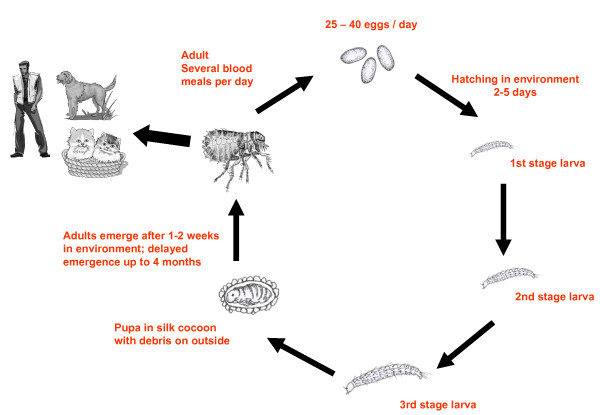
“Fleas are ectothermic arthropods susceptible to fluctuations of temperatures, especially because immature stages live outside the host.”
From Fleas infesting pets in the era of emerging extra-intestinal nematodes (2013) · cites this paper as [9]
In the citing paper
“Fleas of pets are competent intermediate hosts of the tapeworm Dipylidium caninum.”
From Fleas infesting pets in the era of emerging extra-intestinal nematodes (2013) · cites this paper as [9]
In the citing paper
“The speed of juvenile flea development depends on the environment, in that higher temperatures may increase the number of generations and colder temperatures and higher humidity has an effect on the longevity of fleas in the absence of available hosts [9].”
From Fleas infesting pets in the era of emerging extra-intestinal nematodes (2013) · cites this paper as [9]
In the citing paper
“Indeed, D. caninum may cause disease especially in children with low hygiene standards [9,15].”
From Fleas infesting pets in the era of emerging extra-intestinal nematodes (2013) · cites this paper as [9]
Self-check
Percentages, sums and reported differences re-computed from the paper’s own numbers.
The self-check needs the paper’s full text.
Citations
Cites
(2019) · The Southwestern Naturalist · doi:10.1894/swna · Cited by 693
Bartonella Spp. in Pets and Effect on Human Health
Chomel, B. B., Boulouis, H.-J., Maruyama, S., & Breitschwerdt, E. B. (2006) · Emerging Infectious Diseases · doi:10.3201/eid1203.050931 · Cited by 458
Breitschwerdt, E. B., & Kordick, D. L. (2000) · Clinical Microbiology Reviews · doi:10.1128/cmr.13.3.428-438.2000 · Cited by 457
Evolution and diversity of Rickettsiabacteria
Weinert, L. A., Werren, J. H., Aebi, A., Stone, G. N., & Jiggins, F. M. (2009) · BMC Biology · doi:10.1186/1741-7007-7-6 · Cited by 414
Factors associated with the rapid emergence of zoonotic Bartonella infections
Boulouis, H.-J., Chao-chin, C., Henn, J. B., Kasten, R. W., & Chomel, B. B. (2005) · Veterinary Research · doi:10.1051/vetres:2005009 · Cited by 371
Flea-borne Rickettsioses: Ecologic Considerations
Azad, A. F., Radulović, S., Higgins, J. A., Noden, B. H., & Troyer, J. M. (1997) · Emerging infectious diseases · doi:10.3201/eid0303.970308 · Cited by 343
Intraspecific Diversity ofYersinia pestis
Anisimov, A. P., Lindler, L. E., & Pier, G. B. (2004) · Clinical Microbiology Reviews · doi:10.1128/cmr.17.2.434-464.2004 · Cited by 317
Plague manual--epidemiology, distribution, surveillance and control.
Dt, D., Gage, K. L., Gratz, N. G., Jd, P., & Tikhomirov, E. (1999) · PubMed · Cited by 310
Eisele, M., Heukelbach, J., Marck, E. V., Mehlhorn, H., Meckes, O., Franck, S. G. V., & Feldmeier, H. (2003) · Parasitology Research · doi:10.1007/s00436-002-0817-y · Cited by 276
Azad, A. F. (1990) · Annual Review of Entomology · doi:10.1146/annurev.en.35.010190.003005 · Cited by 265
Research works printed but not linked: 10
- Prosl H, Lassnig H, Mramor C: Zur Siphonaptera-Fauna des Rotfuchses (Vulpes vulpes) in Österreich. Denisia. 2004, 13: 493-489.
- Lassnig H, Prosl H, Hinterdorfer F: Zur Parasitenfauna des Rotfuchses (Vulpes vulpes) in der Steiermark. Wien Tieräztl Mschr. 1998, 85: 116-122.
- Prosl H, Heid K, Mramor C, Lassnig H: Zur Ektoparasitenfauna des Rotfuchses (Vulpes vulpes) in Ostösterreich. Entomol Austriaca. 2001, 2: 9-10.
- Muller S, Boulouis HJ, Viallard J, Beugnet F: Epidemiological survey of canine bartonellosis to Bartonella vinsonii subsp. berkhoffii and canine monocytic ehrlichiosis in dogs on the island of Reunion. Rev Med Vet. 2004, 155: 377-380.
- Supperer R, Wenzel B: Zum Endoparasitenbefall von Stadt- und Landhunden. Wien Tierärztl Monatsschr. 1967, 54: 182-185.
- Supperer R, Hinaidy HK: Ein Beitrag zum Parasitenbefall der Hunde und Katzen in Österreich. Dtsch Tierätztl Wschr. 1986, 93: 383-386.
- Haarlov N, Kristensen S: Beiträge zur Dermatologie von Hund und Katze. 3. Flöhe von Hunden und Katzen in Dänemark. Tierärztl Praxis. 1977, 5: 507-511.
- Müller J, Kutschmann K: Flohnachweise auf Hunden im Einzugsgebiet der Magdeburger Poliklinik für kleine Haus- und Zootiere. Angew Parasitol. 1985, 26: 197-203.
- Kalvelage H, Münster M: Die Ctenocephalides canis und Ctenocephalides felis-Infestation von Hund und Katze. Tierärztl Praxis. 1991, 19: 200-206.
- Varagnol M, Parola P, Jouan R, Beaucournu J-C, Rolain j-M, Raoult D: First detection of Rickettsia felis and Bartonella clarridgeiae in fleas from Laos. Clin Microbiol Infect. 2009, 15 (suppl 2): 334-335. · DOI
Cited by
Sorted by citations
Insecticide/acaricide resistance in fleas and ticks infesting dogs and cats
Coles, T. B., & Dryden, M. W. (2014) · Parasites & Vectors · doi:10.1186/1756-3305-7-8 · Cited by 181
The Biology and Ecology of Cat Fleas and Advancements in Their Pest Management: A Review
Rust, M. Κ. (2017) · Insects · doi:10.3390/insects8040118 · Cited by 164
Clark, N. J., Seddon, J. M., Šlapeta, J. R., & Wells, K. (2018) · Parasites & Vectors · doi:10.1186/s13071-017-2564-z · Cited by 106
Fleas infesting pets in the era of emerging extra-intestinal nematodes
Traversa, D. (2013) · Parasites & Vectors · doi:10.1186/1756-3305-6-59 · Cited by 53
Karunamoorthi, K. (2013) · Parasitology Research · doi:10.1007/s00436-013-3551-8 · Cited by 42
Kumsa, B. E., Parola, P., Raoult, D., & Socolovschi, C. (2014) · American Journal of Tropical Medicine and Hygiene · doi:10.4269/ajtmh.13-0010 · Cited by 41
Marrugal, Á., Callejón, R., de Rojas, M., Halajian, A., & Cutillas, C. (2013) · Parasitology Research · doi:10.1007/s00436-013-3391-6 · Cited by 41
Fleas and flea-borne diseases of North Africa
Hamzaoui, B. E., Zurita, A., Cutillas, C., & Parola, P. (2020) · Acta Tropica · doi:10.1016/j.actatropica.2020.105627 · Cited by 38
Hii, S. F., Abdad, M. Y., Kopp, S. R., Stenos, J., Rees, R. L., & Traub, R. J. (2013) · Parasites & Vectors · doi:10.1186/1756-3305-6-159 · Cited by 33
Poo-Muñoz, D. A., Elizondo-Patrone, C., Escobar, L. E., Astorga, F., Bermúdez, S. E., Martínez-Valdebenito, C., Abarca, K., V, & Medina‐Vogel, G. (2016) · Journal of Medical Entomology · doi:10.1093/jme/tjw124 · Cited by 33
López‐Pérez, A. M., Sánchez‐Montes, S., Foley, J. E., Guzmán‐Cornejo, C., Colunga‐Salas, P., Pascoe, E. L., Becker, I., la Mora, J. D.-D., Licona-Enríquez, J. D., & Suzán, G. (2019) · Ticks and Tick-borne Diseases · doi:10.1016/j.ttbdis.2019.05.018 · Cited by 33
Tick-, Flea-, and Louse-Borne Diseases of Public Health and Veterinary Significance in Nigeria
Oguntomole, O., Nwaeze, U., & Eremeeva, M. E. (2018) · Tropical Medicine and Infectious Disease · doi:10.3390/tropicalmed3010003 · Cited by 33
Ectoparasites infesting dogs and cats in Bishoftu, central Oromia, Ethiopia
Kumsa, B. E., Abiy, Y., & Abunna, F. (2019) · Veterinary Parasitology Regional Studies and Reports · doi:10.1016/j.vprsr.2019.100263 · Cited by 29
Omitola, O. O., & Taylor-Robinson, A. W. (2020) · Heliyon · doi:10.1016/j.heliyon.2020.e04095 · Cited by 30
Víchová, B., Bona, M., Miterpáková, M., Kraljik, J., Čabanová, V., Nemčíková, G., Hurníková, Z., & Oravec, M. (2018) · Vector-Borne and Zoonotic Diseases · doi:10.1089/vbz.2018.2314 · Cited by 29
Liénard, E., Bouhsira, É., Jacquiet, P., Warin, S., Kaltsatos, V., & Franc, M. (2013) · Parasitology Research · doi:10.1007/s00436-013-3568-z · Cited by 28
López‐Pérez, A. M., Gage, K. L., Rubio, A. V., Montenieri, J. A., Orozco, L., & Suzán, G. (2018) · Journal of Vector Ecology · doi:10.1111/jvec.12278 · Cited by 24
Sofer, S., Gutiérrez, R., Morick, D., Mumcuoğlu, K. Y., & Harrus, S. (2015) · Medical and Veterinary Entomology · doi:10.1111/mve.12116 · Cited by 23
Akhoundi, M., Séréno, D., Marteau, A., Bruel, C., & Izri, A. (2020) · Diagnostics · doi:10.3390/diagnostics10050308 · Cited by 23
Shukullari, E., Rapti, D., Visser, M., Pfister, K., & Rehbein, S. (2016) · Parasitology Research · doi:10.1007/s00436-016-5302-0 · Cited by 24
Cooper, A., Nixon, E. J., Vineer, H. R., Abdullah, S., Newbury, H., & Wall, R. L. (2020) · Medical and Veterinary Entomology · doi:10.1111/mve.12462 · Cited by 22
Dryden, M. W., Payne, P. A., Smith, V., Berg, T. C., & Lane, M. (2013) · Parasites & Vectors · doi:10.1186/1756-3305-6-80 · Cited by 21
Zhang, Y., Nie, Y., Deng, Y., Liu, G., & Fu, Y.-T. (2021) · Acta Tropica · doi:10.1016/j.actatropica.2021.105880 · Cited by 21
Azrizal-Wahid, N., Sofian‐Azirun, M., & Low, V. L. (2020) · Veterinary Parasitology · doi:10.1016/j.vetpar.2020.109102 · Cited by 19
Urdapilleta, M., Pech‐May, A., Lamattina, D., BURGOS, E. F., Balcazar, D., Ferrari, W., Lareschi, M., & Salomón, O. D. (2021) · Medical and Veterinary Entomology · doi:10.1111/mve.12546 · Cited by 18
Proteases and pseudoproteases in parasitic arthropods of clinical importance
Fernando, D. D., & Fischer, K. (2020) · FEBS Journal · doi:10.1111/febs.15546 · Cited by 17
Ctenocephalides felis and Ctenocephalides canis : introgressive hybridization?
Zurita, A., Callejón, R., de Rojas, M., Halajian, A., & Cutillas, C. (2016) · Systematic Entomology · doi:10.1111/syen.12174 · Cited by 17
Haule, M. (2013) · Journal of Entomology and Nematology · doi:10.5897/jen2013.0083 · Cited by 16
Murine typhus: a re-emerging rickettsial zoonotic disease
Snellgrove, A. N., & Goddard, J. (2024) · Journal of Vector Ecology · doi:10.52707/1081-1710-50.1-1 · Cited by 15
Gray fox (Urocyon cinereoargenteus) parasite diversity in central Mexico
Hernández‐Camacho, N., Pineda-López, R. F., Guerrero-Carrillo, M. D. J., Cantó-Alarcón, G. J., Jones, R. W., Moreno-Pérez, M. A., Mosqueda, J., Zamora-Ledesma, S., & Camacho-Macías, B. (2016) · International Journal for Parasitology Parasites and Wildlife · doi:10.1016/j.ijppaw.2016.06.003 · Cited by 14
Fleas of wild carnivores in Romania: diversity, distribution, and host-associations
Deak, G., Ionică, A. M., Péter, Á., Sándor, A. D., Matei, I. A., D’Amico, G., Liénard, E., Gherman, C. M., Mihalca, A. D., & Bouhsira, É. (2024) · Parasites & Vectors · doi:10.1186/s13071-024-06235-3 · Cited by 13
Milstein, M. S., Shaffer, C. A., Suse, P., Marawanaru, A., Heinrich, D. A., Larsen, P. A., & Wolf, T. M. (2022) · PLoS neglected tropical diseases · doi:10.1371/journal.pntd.0010469 · Cited by 13
García‐Sánchez, Á. M., Zurita, A., & Cutillas, C. (2022) · Insects · doi:10.3390/insects13080707 · Cited by 13
Cevidanes, A., Ulloa‐Contreras, C., Cataldo, S. D., Latrofa, M. S., González‐Acuña, D., Otranto, D., & Millán, J. (2021) · Medical and Veterinary Entomology · doi:10.1111/mve.12515 · Cited by 12
Dendoncker, P.-A., Moons, C., Sarrazin, S., Diederich, C., Thiry, E., de Keuster, T., & Dewulf, J. (2018) · The Veterinary Record · doi:10.1136/vr.104996 · Cited by 10
Pawełczyk, O., Asman, M., & Solarz, K. (2019) · Folia Parasitologica · doi:10.14411/fp.2019.020 · Cited by 11
The Discovery of Zoonotic Protozoans in Fleas Parasitizing on Pets as a Potential Infection Threat
Pawełczyk, O., Asman, M., & Solarz, K. (2020) · Acta Parasitologica · doi:10.2478/s11686-020-00221-2 · Cited by 10
Yevstafieva, V., Horb, K. O., MELNYCHUK, V. V., Bakhur, T., & Feshchenko, D. V. (2020) · Folia veterinaria · doi:10.2478/fv-2020-0026 · Cited by 10
Kessy, S. T., Makundi, R. H., Sabuni, C., Massawe, A. W., & Rija, A. A. (2023) · Mammalia · doi:10.1515/mammalia-2023-0012 · Cited by 12
Chotelersak, K., Puttikamonkul, S., Samung, Y., Chaiphongpachara, T., Dujardin, J., & Sumruayphol, S. (2024) · Medical and Veterinary Entomology · doi:10.1111/mve.12707 · Cited by 8
First Molecular Evidence of Pathogens in Fleas Collected from Dogs in Northern Vietnam
Do, T., Inpankaew, T., Dương, Đ. H., & Bui, K. L. (2021) · Pathogens · doi:10.3390/pathogens10091185 · Cited by 8
Seidi, S., Raz, A., Maleki‐Ravasan, N., Forouzan, E., Karimian, F., Sebbane, F., Sohrabi, A., Esmaeili, S., & Mostafavi, E. (2025) · Frontiers in Cellular and Infection Microbiology · doi:10.3389/fcimb.2025.1568103 · Cited by 7
Chatzis, M. K., Psemmas, D., Papadopoulos, E., Navarro, C., & Saridomichelakis, M. N. (2017) · Parasites & Vectors · doi:10.1186/s13071-017-2145-1 · Cited by 7
Keçi ve Koyun Yetiştiriciliğinde Pirenin Önemi ve Mücadele Şekilleri
Kandemir, Ç., Taşkın, T., Koşum, N., & Ün, C. (2019) · Hayvansal Üretim · doi:10.29185/hayuretim.511108 · Cited by 6
Azrizal-Wahid, N., Sofian‐Azirun, M., Low, V. L., Chen, C. D., & Shohaimi, S. (2021) · Journal of Applied Animal Welfare Science · doi:10.1080/10888705.2021.1975539 · Cited by 6
Riner, A., Rudd, J. L., Clifford, D., Cypher, B., Foley, J., & Foley, P. (2018) · Journal of medical entomology · doi:10.1093/jme/tjy031 · Cited by 6
Hernández-Urbina, C. F., Vital‐García, C., Ávila, A. M. E., Gatica-Colima, A., Olivas-Sánchez, M. P., & Clemente-Sánchez, F. (2020) · Veterinary Parasitology Regional Studies and Reports · doi:10.1016/j.vprsr.2020.100379 · Cited by 6
Saridomichelakis, M. N., Chatzis, M. K., Petanides, T. A., & Papadopoulos, E. (2015) · Parasites & Vectors · doi:10.1186/s13071-015-0945-8 · Cited by 6
Barghash, S. M., Yassin, S., Sadek, A.-S. M., Mahmoud, D., & Salama, M. (2024) · Scientific Reports · doi:10.1038/s41598-024-64881-0 · Cited by 7
Does hair coat length affect flea infestation in naturally infested dogs?
da Silva, G. A. C., Lins, L. A., Irala, M. J. C., Cárcamo, M. C., & Ribeiro, P. B. (2016) · Revista Brasileira de Parasitologia Veterinária/Brazilian Journal of Veterinary Parasitology · doi:10.1590/s1984-29612016070 · Cited by 5
White, W. H., Riggs, K. L., Totten, M., Snyder, D. E., McCoy, C. M., & Young, D. R. (2016) · Veterinary Parasitology · doi:10.1016/j.vetpar.2016.11.018 · Cited by 5
Siagian, T. B., & Siregar, E. R. (2022) · Jurnal Ternak · doi:10.30736/jt.v12i2.114 · Cited by 5
Essential Oils and Bioproducts for Flea Control: A Critical Review
Campos, D. R., de Jesus, I. L. R., Scott, F. B., Correia, T. R., & Cid, Y. P. (2025) · Insects · doi:10.3390/insects16121276 · Cited by 4
Pérez, R. S., Pérez‐Cutillas, P., Gonzálvez, M., Muñoz-Hernández, C., Arcenillas‐Hernández, I., de Ybáñez, R. R., Escribano, F., & Martínez‐Carrasco, C. (2022) · Medical and Veterinary Entomology · doi:10.1111/mve.12611 · Cited by 4
Flea parasitism in wild mammals in the metropolitan region of Sorocaba, São Paulo, Brazil
Teixeira, R. H. F., da Costa, A. L. M., Gonzaga, C. R. R., Matos, F. N., de Medeiros, M. A., Leandro, S. D. F. S., Ferreira, R. V. M., Belloti, M. A., de Lima, B. F., Sakamoto, C. A. M., et al. (2023) · Brazilian Journal of Veterinary Medicine/Revista Brasileira de Medicina Veterinária · doi:10.29374/2527-2179.bjvm003523 · Cited by 4
Azarm, A., Saghafipour, A., Yousefi, S., Shahidi, F., & Zahraei-Ramazani, A. (2023) · Psyche A Journal of Entomology · doi:10.1155/2023/2514681 · Cited by 4
Laboratory and field tests of Carbaryl 5% against fleas in Lushoto district, Tanzania.
Katakweba, A. A. S., Mhamphi, G. G., Mwalimu, C. D., Mchau, G., Mbise, T. J., Lugendo, R. M., Borremans, B., & Kilonzo, B. S. (2015) · doi:10.4314/thrb.v17i2xx · Cited by 4
Lestari, E., Rahmawati, R., & Ningsih, D. P. (2020) · BALABA JURNAL LITBANG PENGENDALIAN PENYAKIT BERSUMBER BINATANG BANJARNEGARA · doi:10.22435/blb.v16i2.3169 · Cited by 5
Nyema, J., Nath, T. C., Bhuiyan, M. J. U., Islam, S., Islam, K. M., Basir, S., Dey, N., Bhattacharjee, T., & Lee, D. (2023) · Veterinary Parasitology Regional Studies and Reports · doi:10.1016/j.vprsr.2023.100953 · Cited by 3
Pathogen Transmission and the Risk of Spillover for Wild Carnivores in the Neotropics
Acosta‐Jamett, G., Napolitano, C., López‐Pérez, A. M., & Hernández, F. (2024) · Springer eBooks · doi:10.1007/978-3-031-50531-7_10 · Cited by 4
Tufan-Çetin, Ö., & Çetin, H. (2024) · Heliyon · doi:10.1016/j.heliyon.2024.e39958 · Cited by 3
Pereira, A. B., Cruz, A., Novo, T., FleaPT group, Cardoso, A., Oliva, A., Rõis, A. S., Saragoça, A., Silva, A., Pinto, A., et al. (2025) · Parasites & Vectors · doi:10.1186/s13071-025-06904-x · Cited by 3
Hernández‐Camacho, N., Moreno-Pérez, M. A., Acosta, R., Guzmán-Cornejo, M. D. C., Pineda‐López, R., Jones, R. W., Zamora-Ledesma, S., Camacho-Macías, B., & Vergara-Pineda, S. (2019) · Southwestern Entomologist · doi:10.3958/059.044.0130 · Cited by 3
Seidi, S., Tavassoli, M., Malekifard, F., & Saïd, M. B. (2024) · Acta Parasitologica · doi:10.1007/s11686-024-00846-7 · Cited by 3
Kessy, S. T., & Rija, A. A. (2024) · PLoS neglected tropical diseases · doi:10.1371/journal.pntd.0012202 · Cited by 4
Urdapilleta, M., Lamattina, D., BURGOS, E. F., Salomón, O. D., & Lareschi, M. (2024) · Anais da Academia Brasileira de Ciências · doi:10.1590/0001-3765202420240352 · Cited by 3
Parasites of poultry in Nigeria from 1980 to 2022: a review
Midala, C. A., Kyari, F., Thekisoe, O. M. M., & Onyiche, T. E. (2025) · Journal of Parasitic Diseases · doi:10.1007/s12639-025-01792-5 · Cited by 3
ВПЛИВ ЕКТОПАРАЗИТІВ РОДУ CTENOCEPHALIDES НА ГЕМАТОЛОГІЧНІ ПОКАЗНИКИ ІНВАЗОВАНИХ СОБАК
Євстаф’єва, В. О., & Horb, K. O. (2019) · Вісник Полтавської державної аграрної академії · doi:10.31210/visnyk2019.03.29 · Cited by 3
Ojo, G. A., Adekeye, T. A., & Awobode, H. O. (2020) · Sokoto Journal of Veterinary Sciences · doi:10.4314/sokjvs.v17i4.4 · Cited by 3
Englar, D. R. E. (2019) · Common Clinical Presentations in Dogs and Cats · doi:10.1002/9781119414612.ch51
Özdemir, İ. Y., Arslanhan, B. A., & Önder, Z. (2025) · Acta Tropica · doi:10.1016/j.actatropica.2025.107729 · Cited by 2
Highlighting zoonotic importance of synanthropic fleas through microbiome analysis
Cutillas, C., Trujillo, I., Zurita, A., & García‐Sánchez, Á. M. (2025) · Scientific Reports · doi:10.1038/s41598-025-21396-6 · Cited by 2
Morales, A. I. O. (2018) · Journal of Dairy Veterinary & Animal Research · doi:10.15406/jdvar.2018.07.00207 · Cited by 2
The Prevalence of Ectoparasites of Livestock and Dogs in Edo State (South-South), Nigeria
Isaac, C., Ohiolei, J. A., Igbinosa, I. B., & Nmorsi, O. P. G. (2019) · Nigerian Veterinary Journal · doi:10.4314/nvj.v40i1.6 · Cited by 2
Riabi, H. R. A., & Atarodi, A. (2015) · Zahedan Journal of Research in Medical Sciences · doi:10.17795/zjrms998 · Cited by 2
Canine flea control: too much choice?
Paterson, S. (2019) · Companion animal · doi:10.12968/coan.2019.0041 · Cited by 2
UK parasite risk factors and control challenges
Bagster, A., & Elsheikha, H. M. (2022) · Companion animal · doi:10.12968/coan.2022.0006 · Cited by 2
Zoonosis of Public Health Interest
Bastidas, G. (2022) · IntechOpen eBooks · doi:10.5772/intechopen.100934 · Cited by 2
Influence of Ctenocephalides felis on biochemical indicators of blood serum of infested cats
Havryk, B., & Мельничук, В. В. (2025) · Scientific Progress & Innovations · doi:10.31210/spi2025.28.01.19 · Cited by 1
Patel, R., Chauhan, T., Srivastava, S., Mishra, P., & Jain, P. (2025) · Fungal biology · doi:10.1007/978-3-031-90994-8_1 · Cited by 1
Khan, M., Ali, Y., Khan, R., Aljasham, A. T., & Ali, A. (2026) · Journal of Medical Entomology · doi:10.1093/jme/tjag091 · Cited by 1
Comparison of Two Techniques for the Detection of Flea Faeces in Canine and Feline Coat Brushings
Cadiergues, M., Mandin, C., & Solatges, C. (2014) · The Scientific World JOURNAL · doi:10.1155/2014/292085 · Cited by 1
da Silva, G. A. C., Lins, L. A., Irala, M. J. C., Cárcamo, M. C., & Ribeiro, P. B. (2018) · SCIENCE AND ANIMAL HEALTH · doi:10.15210/sah.v6i1.11806 · Cited by 1
Status of Jackals and Foxes (Family: Canidae) From Selected Hill Areas of Pakistan
Batool, A., Gondal, A., Malik, I. U., & Shah, S. A. (2018) · Journal of Bioresource Management · doi:10.35691/jbm.8102.0093 · Cited by 1
ГЕМАТОЛОГІЧНІ ТА БІОХІМІЧНІ ПОКАЗНИКИ В КОТІВ І СОБАК ЗА НАЯВНОСТІ КТЕНОЦЕФАЛЬОЗУ
Кручиненко, О. В., & Бридихіна, А. Ю. (2020) · Вісник Полтавської державної аграрної академії · doi:10.31210/visnyk2020.04.27 · Cited by 1
Prevalence of some ectoparasites infesting different breeds of dogs in Qalyubia governorate, Egypt.
Zeiada, F., Ramadan, M., & Elmadawy, R. (2023) · Benha Veterinary Medical Journal · doi:10.21608/bvmj.2023.248760.1751 · Cited by 1
Records of fleas (Siphonaptera) from Delaware
Kennedy, A. C., Winter, W. S., Gardner, A. L., Woodman, N., Shifflett, S. A., Redus, S., Newcomer, J. R., & Eckerlin, R. P. (2024) · Journal of Medical Entomology · doi:10.1093/jme/tjae069 · Cited by 1
Yersinia pestis - old and new challenges in humans and in animals.
Mladenova-Hristova, I., & Tsachev, I. (2014) · Trakia Journal of Sciences · Cited by 1
Wheeler, D. W., Trout, C. M., Thompson, C. M., Winkle, J. R., & White, W. H. (2018) · Veterinary Parasitology · doi:10.1016/j.vetpar.2018.05.018 · Cited by 1
Asare, K. K., Opoku, Y. K., Anning, A. S., Afrifa, J., & Ofori, E. G. (2019) · F1000Research · doi:10.12688/f1000research.19081.1 · Cited by 1
A survey of Ectoparasites Infestation in Stray Dogs in Basrah Province / Iraq
Thamer, N. K., & Faraj, K. B. (2019) · IOP Conference Series Materials Science and Engineering · doi:10.1088/1757-899x/571/1/012062 · Cited by 1
Horb, K. O. (2020) · Вісник Полтавської державної аграрної академії · doi:10.31210/visnyk2020.02.20 · Cited by 1
ОСОБЛИВОСТІ ЛОКАЛІЗАЦІЇ БЛІХ РОДУ CTENOCEPHALIDES НА ТІЛІ СОБАК
Horb, K. O. (2020) · Вісник Полтавської державної аграрної академії · doi:10.31210/visnyk2020.04.22 · Cited by 1
Burrowing owls as potential phoretic hosts of ground squirrel fleas during a plague epizootic
Belthoff, J. R., Elgin, A. A., Navock, K. A., & Bernhardt, S. A. (2021) · Journal of Vector Ecology · doi:10.52707/1081-1710-46.1.48 · Cited by 1
Uşak İli küçükbaş hayvancılık işletmelerinde pire zararlarını belirlemeye yönelik bir ön çalışma
Sezer, S., Kandemir, Ç., Akgül, G., Karakaya, E., Ün, C., & Taşkın, T. (2021) · Ege Üniversitesi Ziraat Fakültesi Dergisi · doi:10.20289/zfdergi.745545 · Cited by 1
معدلات إصابة الحيوانات المستأنسة بالبراغيث بجبل نفوسة، شمال غرب ليبيا
Aboulqassim, W. Y. M., Ghana, S., & Shaibi, T. (2022) · AL-MUKHTAR JOURNAL OF SCIENCES · doi:10.54172/mjsc.v37i2.645 · Cited by 1
Flea-borne Mycobacterium and Mycoplasma in Small Ruminants on the Northern West Coast of Egypt
(2023) · International Journal of Veterinary Science · doi:10.47278/journal.ijvs/2023.011 · Cited by 1
Cadiergues, M. (2013) · doi:10.1002/9781118738818.ch20 · Cited by 1
Clinical and public health risks associated with feline fleas
Elsheikha, H. M., & David, P. V. (2014) · Companion animal · doi:10.12968/coan.2014.19.4.177
Metadata
- Authors
- Dobler, G., & Pfeffer, M.
- Affiliations
- Institut für Mikrobiologie der Bundeswehr (DE)
- Leipzig University (DE)
- Corresponding author
- Dobler, Gerhard
- Venue
- Parasites & Vectors
- Published
- 2011-07-18
- Volume
- 4
- Issue
- 1
- Pages
- 139-139
- ISSN
- 1756-3305 (ISSN-L)
- PMC
- PMC3160944
- OpenAlex
- W1990750506
- Cited by
- 116
- References
- 105
- Citations by year
- 2026: 3 · 2025: 9 · 2024: 12 · 2023: 8 · 2022: 10 · 2021: 10 · 2020: 14 · 2019: 13 · 2018: 11 · 2017: 2 · 2016: 6 · 2015: 5 · 2014: 5 · 2013: 8
- FWCI
- 0.44
- Type
- journal article
- Language
- en
- Open access
- gold
- doi.org
- Licence
- Locations
- Parasites & Vectors (publishedVersion, cc-by)
- Europe PMC (PubMed Central) (publishedVersion, cc-by)
- PubMed Central (publishedVersion, cc-by)
- PubMed (publishedVersion)
- DOAJ (DOAJ: Directory of Open Access Journals) (submittedVersion)
- Topics
- Health Sciences › Medicine › Infectious Diseases › Yersinia bacterium, plague, ectoparasites research
- Health Sciences › Medicine › Infectious Diseases › Bartonella species infections research
- Life Sciences › Immunology and Microbiology › Parasitology › Vector-borne infectious diseases
- Keywords
- fleas, Canidae, flea-borne diseases, dogs, wild canids, plague, murine typhus, Rickettsia felis, Bartonella henselae, zoonotic transmission, allergic reactions, ectoparasites
- MeSH terms
- Animals, Ectoparasitic Infestations, Siphonaptera, Insect Vectors, Canidae
About these checks
Registry, retraction, Cites and statistics results are computed, not judged, with one exception: a printed reference that no index lists is read once by a model before it counts as a citation error. Claims are extracted by a model and kept only when their quote appears verbatim in the text; each cited source is then checked, with a model’s help, for whether it says what the claim relies on. Those verdicts can be wrong — read the claim’s quote and the cited source before relying on one.
Statistics and arithmetic are recomputed, not judged.
Confidence bands are shown only for fields calibrated on our annotated test set. None is calibrated yet, so no band is shown.
What counts as a claim ›How we measure confidence ›How we check this ›
Are you an author, or do you see a problem with this page? Request a review
