

The DOI matches its Crossref record; 94 of the 94 references it cites were found in a registry or an index.
Driving forces for changes in geographical distribution of Ixodes ricinus ticks in Europe
Open accessAbstract
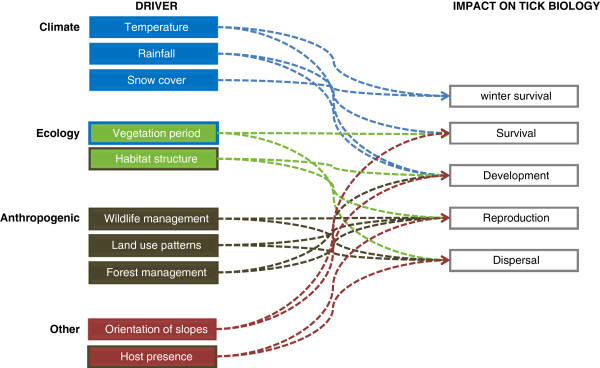
Many factors are involved in determining the latitudinal and altitudinal spread of the important tick vector Ixodes ricinus (Acari: Ixodidae) in Europe, as well as in changes in the distribution within its prior endemic zones. This paper builds on published literature and unpublished expert opinion from the VBORNET network with the aim of reviewing the evidence for these changes in Europe and discusses the many climatic, ecological, landscape and anthropogenic drivers. These can be divided into those directly related to climatic change, contributing to an expansion in the tick's geographic range at extremes of altitude in central Europe, and at extremes of latitude in Scandinavia; those related to changes in the distribution of tick hosts, particularly roe deer and other cervids; other ecological changes such as habitat connectivity and changes in land management; and finally, anthropogenically induced changes. These factors are strongly interlinked and often not well quantified. Although a change in climate plays an important role in certain geographic regions, for much of Europe it is non-climatic factors that are becoming increasingly important. How we manage habitats on a landscape scale, and the changes in the distribution and abundance of tick hosts are important considerations during our assessment and management of the public health risks associated with ticks and tick-borne disease issues in 21(st) century Europe. Better understanding and mapping of the spread of I. ricinus (and changes in its abundance) is, however, essential to assess the risk of the spread of infections transmitted by this vector species. Enhanced tick surveillance with harmonized approaches for comparison of data enabling the follow-up of trends at EU level will improve the messages on risk related to tick-borne diseases to policy makers, other stake holders and to the general public.
Overview
The claims and statistics of this paper haven’t been checked yet.
Run the check — free, no account needed. It reads the open-access text and checks the sources it cites.
Integrity signals
Registry
Cites
Statistics
Figures
Verification
Claims the paper makes
The claims and statistics of this paper haven’t been checked yet.
Run the check — free, no account needed. It reads the open-access text and checks the sources it cites.
Claims other papers make about this one
Each is checked against this paper’s own text: does it say what the citing paper says it does?
In the citing paper
“This could explain the result of five positive dogs (6%) that were microfilariae-positive and antigen-negative [35–37].”
From Prevalence of canine heartworm ( Dirofilaria immitis ) disease in dogs of central Portugal (2014) · cites this paper as [35]
Self-check
Percentages, sums and reported differences re-computed from the paper’s own numbers.
The self-check needs the paper’s full text.
Citations
Cites
Lindgren, E., Tälleklint, L., & Polfeldt, T. (2000) · Environmental Health Perspectives · doi:10.1289/ehp.00108119 · Cited by 558
Randolph, S. (2004) · Parasitology · doi:10.1017/s0031182004004925 · Cited by 509
Self-citationRizzoli, A. P., Hauffe, H. C., Carpi, G., Vourc’h, G., Neteler, M., & Rosà, R. (2011) · Eurosurveillance · doi:10.2807/ese.16.27.19906-en · Cited by 501
Self-citationJaenson, T. G. T., Jaenson, D. G. E., Eisen, L., Petersson, E., & Lindgren, E. (2012) · Parasites & Vectors · doi:10.1186/1756-3305-5-8 · Cited by 442
Self-citationAn empirical quantitative framework for the seasonal population dynamics of the tick Ixodes ricinus
Randolph, S., Green, R. M., Hoodless, A. N., & Peacey, M. (2002) · International Journal for Parasitology · doi:10.1016/s0020-7519(02)00030-9 · Cited by 332
Self-citationPerret, J.-L., Guigoz, E., Rais, O., & Gern, L. (2000) · Parasitology Research · doi:10.1007/s004360000209 · Cited by 301
Tick-borne bacterial diseases emerging in Europe
Parola, P., & Raoult, D. (2001) · Clinical Microbiology and Infection · doi:10.1046/j.1469-0691.2001.00200.x · Cited by 270
Cagnacci, F., Focardi, S., Heurich, M., Stache, A., Hewison, A. J. M., Morellet, N., Kjellander, P., Linnell, J. D. C., Mysterud, A., Neteler, M., et al. (2011) · Oikos · doi:10.1111/j.1600-0706.2011.19441.x · Cited by 250
Lindgren, E., & Jaenson, T. G. T. (2006) · Cited by 248
Self-citationGilbert, L. (2009) · Oecologia · doi:10.1007/s00442-009-1430-x · Cited by 247
Research works printed but not linked: 3
- Bullová M, Lukáň B, Peťko : Zmeny rozšírenia kliešťa obyčajného Ixodes ricinus v Západných Karpatoch Slovenska pod vplyvom klimatických zmien. Ecology and Veterinary medicine VII. 7th International Scientific Conference. 2008, Univerzita veterinarskeho lekarstva v Košiciach, 82-88.
- Hrkľová G, Nováková M, Chytra M, Kostova C, Petko B: Monitoring the distribution and abundance of Ixodes ricinus ticks in relevance of climate change and prevalence of Borrelia burgdorferi sensu lato in Northern Slovakia (Liptovska valley). Folia Veterinaria. 2008, 52 (2): 62-63.
- Santos-Silva MM, De Sousa R, Lopes De Carvalho I, Santos A, Nuncio S: Revive: A Portuguese networking program for the surveillance of ticks and tick-borne diseases. International Conference on Ticks and Tick-borne diseases, TTP 8. 2011b, Poster presentation, CD, Zaragoza, Spain
Cited by
Sorted by citations
Items 901–1,000 of 1,000
Social media and the arab spring
Ahmad, F., Samsudin, D., Ibrahim, F., Ahmad, A. L., Redzuan, B., Mustaffa, N., Abdullah, M. Y., & Kee, C. P. (2015) · Journal of Asian Pacific Communication · doi:10.1075/japc.25.2.05ahm · Cited by 3
26. From guessing to GIS-ing: empowering land managers
Mulder, A. C., Snabilie, M., & Braks, M. A. H. (2016) · Wageningen Academic Publishers eBooks · doi:10.3920/978-90-8686-838-4_26 · Cited by 3
Asymal, A., Astuti, E. R., & Ridwаn, R. D. (2018) · Dental Journal (Majalah Kedokteran Gigi) · doi:10.20473/j.djmkg.v51.i2.p99-103 · Cited by 3
Gillingham, E. L., Hall, J. L., Birtles, R. J., Bown, K. J., Medlock, J. M., Smith, R. M. M., Hansford, K. M., Warner, J. C., Dryden, M., & Pietzsch, M. E. (2020) · Zoonoses and Public Health · doi:10.1111/zph.12694 · Cited by 3
Self-citationTarnowska, E., Niedziałkowska, M., Stojak, J., & Jędrzejewska, B. (2020) · Mammal Research · doi:10.1007/s13364-020-00518-7 · Cited by 3
Sampaio, J. R., Soares, R. P., Barral, T. D., Porfírio-Passos, G., Fonseca, M. S., Meyer, R., Barrouin‐Melo, S. M., & Portela, R. W. (2021) · Frontiers in Veterinary Science · doi:10.3389/fvets.2021.581148 · Cited by 3
Grimaud, Y., Tran, A., Benkimoun, S., Boucher, F., Esnault, O., Cêtre-Sossah, C. B., Cardinale, É., Garros, C., & Guis, H. (2021) · Parasites & Vectors · doi:10.1186/s13071-021-04780-9 · Cited by 3
Molecular Characterization and Gene Expression Analysis of Aquaporin in Haemaphysalis qinghaiensis
Niu, Q., Hao, R., Pan, Y., Liu, Z., Yang, J., Guan, G., Luo, J., & Yin, H. (2022) · Frontiers in Physiology · doi:10.3389/fphys.2022.811628 · Cited by 3
Er‐Rguibi, O., Laghzaoui, E.-M., Aglagane, A., Kimdil, L., Stekolnikov, A. A., Abbad, A., & Mouden, E. H. E. (2023) · Acarologia · doi:10.24349/j4lz-jxdk · Cited by 3
Holt, J. R., Bernaola, L., Britt, K. E., McCullough, C., Roth, M., Wagner, J., Ragozzino, M., Aviles, L., Li, Z., Huval, F. B., et al. (2020) · Journal of Insect Science · doi:10.1093/jisesa/ieaa077 · Cited by 3
Abd-Ellatieff, H. A., Bazh, E. K., Hussin, S. M., Yamamoto, I., Yanai, T., & Abou-Rawash, A.-R. (2021) · Journal of Parasitic Diseases · doi:10.1007/s12639-021-01453-3 · Cited by 3
Vectors of Malaria and Filariasis in Southeast Asia: A Changing Scenario
Vythilingam, I., Sulaiman, W. Y. W., & Jeffery, J. (2013) · Springer eBooks · doi:10.1007/978-3-7091-1553-4_4 · Cited by 3
8. Modification et modélisation du risque de maladies transmises par les tiques
Marsot, M., Hoch, T., Perez, G., Léger, E., Verheyden, H., Richomme, C., & Vourc’h, G. (2015) · IRD Éditions eBooks · doi:10.4000/books.irdeditions.9056 · Cited by 3
Bahrami, S., Hamidinejat, H., HAJIKOLAEI, M. H., & KAVIANIFAR, S. (2020) · Journal of the Hellenic Veterinary Medical Society · doi:10.12681/jhvms.25076 · Cited by 3
Govindaraju, M., Banu, J. F., Sridhar, K., Vignesh, P. P., & Rangarajan, K. (2021) · Springer eBooks · doi:10.1007/978-981-16-2964-8_20 · Cited by 3
Human Biometeorological Models: Existing and Future Reflections for Lisbon
Nouri, A. S., & Matzarakis, A. (2021) · Springer eBooks · doi:10.1007/978-3-030-65421-4_21 · Cited by 3
Questing microbioticks : Interactions of microbes, ticks, vertebrates, and the environment
Krawczyk, A. I. (2021) · doi:10.18174/542129 · Cited by 3
Tytar, V., Kozynenko, I., Pupiņš, M., Škute, A., Čeirāns, A., & Nekrasova, O. (2024) · bioRxiv (Cold Spring Harbor Laboratory) · doi:10.1101/2024.07.03.602006 · Cited by 3
Spatial distribution of Culex mosquitoes across England and Wales, July 2023Preprint
Widlake, E., Wilson, R. S. E., Pilgrim, J., Vaux, A. G. C., Tanianis-Hughes, J., Haziqah-Rashid, A., Sherlock, K., Delnicka, A., Simpson, A., Abbott, A. J., et al. (2025) · medRxiv · doi:10.1101/2025.02.28.25322982 · Cited by 3
Self-citationHuxley, P. J., Brown, J. J., Laurent, B. S., Johnson, B., Cheung, O. Y., Asamoah, A., Hollingsworth, B., Bump, E. R., Wimberly, M. C., Pascual, M., et al. (2025) · bioRxiv (Cold Spring Harbor Laboratory) · doi:10.1101/2025.05.30.656372 · Cited by 3
Bakterielle Infektionen der Haut im Kontext von Klimawandel und Migration
Klapproth, H., Klapproth, L., Ruegamer, T., Uhl, F., Jantsch, J., & Fabri, M. (2023) · Die Dermatologie · doi:10.1007/s00105-023-05231-5 · Cited by 2
Lansdell, S., Zorto, A. D., Seto, M., Negera, E., Sharif, M. S., & Cutler, S. J. (2025) · Ticks and Tick-borne Diseases · doi:10.1016/j.ttbdis.2025.102437 · Cited by 2
Pena, M. V., Abreu, I., Bautista-García, G. A., Pichel, E. Í., Cazapal-Monteiro, C. F., Hernández, J. Á., Paz-Silva, A., Fernández, R. S.-A., & Arias, M. (2025) · Current Research in Parasitology and Vector-Borne Diseases · doi:10.1016/j.crpvbd.2025.100254 · Cited by 2
Detection of Borrelia burgdorferi (s.l.) in Ixodes ricinus ticks collected in Iceland
Alfreðsson, M., Hansford, K. M., Carter, D. P., Sigurðardóttir, H., Björnsdóttir, Þ. S., Pétursson, H. S., Pálsdóttir, G. R., & Medlock, J. M. (2025) · Parasites & Vectors · doi:10.1186/s13071-025-06809-9 · Cited by 2
Self-citationFirst Molecular Identification of Zoonotic Babesia odocoilei in Ticks from Romania
Dreghiciu, I. C., Hoffman, D. F., Dumitru, S., Oprescu, I., Imre, M., Florea, T., Plesko, A., Iorgoni, V., Morariu, S., Dărăbuş, G., et al. (2025) · Microorganisms · doi:10.3390/microorganisms13061182 · Cited by 2
Can Ixodes trianguliceps sustain a transmission cycle of tick-borne encephalitis virus?
Sprong, H., Holding, M. L., Brila, I., Cayol, C., de Vries, A., Henttonen, H. A., Koskela, E., Mappes, T., Sipari, S., & Kallio, E. R. K. (2025) · The Microbe · doi:10.1016/j.microb.2025.100467 · Cited by 2
Self-citationReal-time malaria detection in the Amazon rainforest via drone-collected eDNA and portable qPCR
Ip, Y. C. A., Montemartini, L., Chang, J. J. M., Desiderato, A., Franco‐Sierra, N. D., Geckeler, C., Gonzalez, M. A., Gregorini, M., Jucker, M., Kirchgeorg, S., et al. (2025) · One Health · doi:10.1016/j.onehlt.2025.101167 · Cited by 2
Exploring temperature effects on tick population dynamics: What are agent-based models saying?
Chenaoui, C., Louhichi, A., Darghouth, M. A., Marilleau, N., & Miled, S. B. (2025) · PLOS complex systems. · doi:10.1371/journal.pcsy.0000065 · Cited by 2
Diversity of Hard Ticks (Acari: Ixodidae) Fauna on Green Habitats of Urban Areas in Eastern Croatia
Krčmar, S., Matak, P., Krčmar, L., & Nikolić, K. (2025) · Pathogens · doi:10.3390/pathogens14101010 · Cited by 2
The role and effects of climate change on malaria incidence in southeastern Iran from 2019 to 2023
Aminafshar, A., Sartipi, M., Sakeni, M., & Farahmandnia, H. (2025) · Discover Social Science and Health · doi:10.1007/s44155-025-00349-4 · Cited by 2
Ronai, I., Baptista, R. P., Paulat, N. S., Frederick, J. C., Azagi, T., Bakker, J. W., Dillon, K. C., Sprong, H., Ray, D. A., & Glenn, T. C. (2026) · Genome biology · doi:10.1186/s13059-025-03909-8 · Cited by 11
Self-citationHeat hardening enhances mosquito heat tolerance in a species-specific and assay-specific manner
Warusawithana, A. L., van Heerwaarden, B., Hoffmann, A., & Ross, P. A. (2026) · Journal of Thermal Biology · doi:10.1016/j.jtherbio.2026.104394 · Cited by 2
First Record of Ixodes ariadnae (Acari: Ixodidae) in Slovakia
Lipinský, J., Petroušková, P., Drážovská, M., Vasilová, E., Halán, M., Hajdová, B., Ondrejková, A., Vojtek, B., Prokeš, M., Gogoľová, L., et al. (2026) · Animals · doi:10.3390/ani16030391 · Cited by 2
Zając, Z., Woźniak, A., & Kulisz, J. (2026) · Biology · doi:10.3390/biology15030252 · Cited by 2
Ajileye, O. D., Hamer, G. L., Hamer, S. A., Verocai, G. G., & Light, J. E. (2026) · Biological reviews/Biological reviews of the Cambridge Philosophical Society · doi:10.1002/brv.70146 · Cited by 2
Chen, S.-P., Bian, X.-K., Xue, H., Xu, A.-L., Xu, J.-Y., Song, S.-J., Wang, F., Tian, N., Ding, H.-R., Feng, J.-H., et al. (2026) · Acta Tropica · doi:10.1016/j.actatropica.2026.108196 · Cited by 2
Borrelia burgdorferi: Cell Biology and Clinical Manifestations in Latent Chronic Lyme
Smith, A., Oertle, J. C., III, & Prato, D. (2014) · Open Journal of Medical Microbiology · doi:10.4236/ojmm.2014.44023 · Cited by 2
Jaume-Ramis, S., & Martínez-ortí, A. (2021) · Acta Parasitologica · doi:10.1007/s11686-021-00390-8 · Cited by 2
Confirmed cases of human Onchocerca lupi infection: a systematic review of an emerging threat
Asghari, A., Adhami, G., Shariatzadeh, S. A., Kordi, B., Anvari, D., Shams, M., Majidiani, H., & Darvishi, M. M. (2021) · Parasitology Research · doi:10.1007/s00436-021-07309-2 · Cited by 4
Porrini, L. P., Brasesco, C., Maggi, M., Eguaras, M. J., & Quintana, S. (2021) · Genetica · doi:10.1007/s10709-021-00139-1 · Cited by 2
Semi-Domesticated Reindeer, Health, and Animal Welfare
Tryland, M. (2022) · Springer eBooks · doi:10.1007/978-3-030-87853-5_25 · Cited by 2
Kim, K., Wang, H., Cha, J., & Wang, X. (2023) · Transboundary and Emerging Diseases · doi:10.1155/2023/5598142 · Cited by 2
Panteleienko, O. V., Garcia-Ibilcieta, D., Bilyk, S., Довгаль, О. В., & Tsarenko, T. M. (2023) · Regulatory Mechanisms in Biosystems · doi:10.15421/10.15421/022373 · Cited by 2
Boonyuan, W., Panthawong, A., Thannarin, T., Kongratarporn, T., Khamvarn, V., Chareonviriyaphap, T., & Nararak, J. (2024) · PeerJ · doi:10.7717/peerj.17038 · Cited by 2
Kim, K., Kim, K., Yoon, K.-B., & Park, Y. (2024) · Animals · doi:10.3390/ani14081153 · Cited by 2
Lakshminarayana, S. B., Guthrie, A. L., Blake, D. P., Harley, J., MacKintosh, A., Lait, P. J. P., Bacon, A., & Milnes, E. L. (2024) · Journal of Zoo and Wildlife Medicine · doi:10.1638/2023-0140 · Cited by 2
Relating Wildlife Camera Trap Data to Tick Abundance: Testing the Relationship in Different Habitats
Vada, R., Zanet, S., Occhibove, F., Fantini, E., Palencia, P., & Ferroglio, E. (2024) · Animals · doi:10.3390/ani14182749 · Cited by 2
Global risk dynamics of Borrelia miyamotoi in the context of climate change
Tang, T., Ge, H., Ma, T., Hao, M., Chen, S., Lv, C., Qiu, Y., Wang, Y., Tian, Y., Chen, J., et al. (2024) · Environmental Microbiology · doi:10.1111/1462-2920.70000 · Cited by 2
Kim, K., Hwang, J., Kim, K., Yoon, K.-B., Oh, D., & Park, Y. C. (2024) · Animals · doi:10.3390/ani14233433 · Cited by 2
Wężyk, D., Dwużnik-Szarek, D., Kowalec, M., Biela, S., Biernacki, K., Macion, A., Mencwel, Z., Safarzynska, N., Sajnok, L., Słomka, W., et al. (2025) · Parasites & Vectors · doi:10.1186/s13071-025-06793-0 · Cited by 2
On the Economics of Climate Change and Health: An Overview
Popescu, C. G., & Raluca, I. A. (2018) · Springer eBooks · doi:10.1007/978-981-10-7748-7_4 · Cited by 2
de Oliveira, J. C. P., Oliveira, W. S. M., Brito, R. S., Lima, T. A. R. F., Giannelli, A., de Carvalho, G. A., & Ramos, R. A. N. (2021) · Arquivo Brasileiro de Medicina Veterinária e Zootecnia · doi:10.1590/1678-4162-12084 · Cited by 2
Fei, H., Naqvi, M. A., Naqvi, S. Z., Xu, L., Song, X., Li, X., & Yan, R. (2021) · PLoS neglected tropical diseases · doi:10.1371/journal.pntd.0009958 · Cited by 2
Zoonoses and Wildlife: One Health Approach
González‐Barrio, D. (2022) · MDPI eBooks · doi:10.3390/books978-3-0365-3735-1 · Cited by 2
An extensive review of Ixodes ricinus in European France
Santos, A. S. (2023) · Peer Community In Infections · doi:10.24072/pci.infections.100076 · Cited by 2
Fernández, S. (2023) · Biomedical Journal of Scientific & Technical Research · doi:10.26717/bjstr.2023.49.007835 · Cited by 2
15. Modelling the ecological dynamics of tick borne pathogens in a risk assessment perspective
Mannelli, A., Estrada‐Peña, A., & Bisanzio, D. (2016) · Wageningen Academic Publishers eBooks · doi:10.3920/978-90-8686-838-4_15 · Cited by 2
Self-citationÇakır-Koç, R., & Budama‐Kilinc, Y. (2017) · Turkish Journal of Biochemistry · doi:10.1515/tjb-2016-0158 · Cited by 2
Chohan, S., Akram, S., Tariq, A., Shah, R. M., Binyameen, M., Shad, S. A., & Abid, M. A. (2018) · International Microbiology · doi:10.1007/s10123-018-0007-0 · Cited by 2
Batista, M. L., Behrens, C., & Castell, S. (2021) · Medizinisch Wissenschaftliche Verlagsgesellschaft eBooks · doi:10.32745/9783954666270-11 · Cited by 2
Murgia, M. V., Kaur, J., Widder, L., & Hill, C. A. (2021) · Current Research in Parasitology and Vector-Borne Diseases · doi:10.1016/j.crpvbd.2021.100070 · Cited by 2
Tick-Born Relapsing Fever and Genespecies Diversity of Borrelia: Current Status
Chekanova, T. A., & Manzeniuk, I. N. (2022) · Epidemiology and Vaccinal Prevention · doi:10.31631/2073-3046-2021-20-6-108-116 · Cited by 2
Eren, G., Ozturk, M., Koc, O., & AÇICI, M. (2022) · Veterinarska stanica · doi:10.46419/vs.54.2.4 · Cited by 2
Panteleienko, O. V., & Tsarenko, T. M. (2022) · Naukovij vìsnik veterinarnoï medicini · doi:10.33245/2310-4902-2022-173-1-63-71 · Cited by 2
Borrelia Ecology, Evolution, and Human Disease: A Mosaic of Life
Margos, G., Henningsson, A. J., Hepner, S., Markowicz, M., Sing, A., & Fingerle, V. (2023) · Springer eBooks · doi:10.1007/978-3-030-85877-3_49-1 · Cited by 3
Метод епізоотичної оцінки місцевості щодо іксодових кліщів
Gazzavi-Rogozinа, L. V., Tkachev, A. V., Філіпцова, О. В., Набока, О. И., Бурлака, І. С., Dyomina, Y. V., & Підгайна, В. В. (2018) · Науковий вісник Львівського національного університету ветеринарної медицини та біотехнологій імені С.З. Ґжицького · doi:10.15421/nvlvet8307 · Cited by 2
Baines, D., Becker, M., & Hart, S. (2019) · Medical and Veterinary Entomology · doi:10.1111/mve.12368 · Cited by 2
Qiu, T., Zhu, W., Liu, S., Chen, K., Liang, S., & Feng, Q. (2019) · Journal of materials research/Pratt's guide to venture capital sources · doi:10.1557/jmr.2019.153 · Cited by 2
Intensified fragmentation and shrinkage of the polar climate zone in the Arctic
Guan, Y., Lu, H., He, L., Kang, Y., Adhikari, H., Zhang, J., & Pellikka, P. (2020) · International Journal of Climatology · doi:10.1002/joc.6899 · Cited by 2
Prevalence of Borrelia burgdorferi sensu lato in Ixodes ricinus ticks in Scandinavia.
Rollum, R. (2014) · NORA - Norwegian Open Research Archives · Cited by 2
Roquis, D., Picart-Picolo, A., Brener-Raffalli, K., Romans, P., Masanet, P., Cosseau, C., Mitta, G., Grunau, C., & Vidal‐Dupiol, J. (2019) · bioRxiv (Cold Spring Harbor Laboratory) · doi:10.1101/722322 · Cited by 2
Albsheer, M. M. A., Gebremeskel, E. I., Kepple, D., Lo, E. Y. Y., Rougeron, V., Ibrahim, M. E., & Hamid, M. M. A. (2020) · bioRxiv (Cold Spring Harbor Laboratory) · doi:10.1101/2020.06.01.127423 · Cited by 2
Audino, T., Pautasso, A., Bellavia, V., Carta, V., Ferrari, A., Verna, F., Grattarola, C., Iulini, B., PINTORE, M., Bardelli, M., et al. (2020) · doi:10.21203/rs.3.rs-28440/v1 · Cited by 2
Esser, H. J., Takumi, K., Holding, M. L., & Sprong, H. (2022) · Research Square · doi:10.21203/rs.3.rs-2368686/v1 · Cited by 2
Self-citationKhaluhi, L. M., Mungube, E. O., Wanjohi, J. M., & Waruri, S. K. (2021) · Advances in environmental engineering and green technologies book series · doi:10.4018/978-1-7998-6433-2.ch012 · Cited by 1
Frątczak, M., Peťko, B., Sliwowska, J. H., Szeptycki, J., & Tryjanowski, P. (2021) · Frontiers in Cellular and Infection Microbiology · doi:10.3389/fcimb.2021.790938 · Cited by 1
Kauer, L., Dobler, G., Schmuck, H. M., Chitimia‐Dobler, L., Pfeffer, M., & Kühn, R. (2024) · Ecology and Evolution · doi:10.1002/ece3.70163 · Cited by 1
Laatamna, A., Rollins, R. E., Reghaissia, N., Chelia, H., Rubel, F., & Chitimia‐Dobler, L. (2025) · Veterinary Parasitology Regional Studies and Reports · doi:10.1016/j.vprsr.2025.101248 · Cited by 1
Non-smooth dynamics of a tick-borne disease model with two-threshold control strategies
Yu, N., & Zhang, X. (2025) · Nonlinear Dynamics · doi:10.1007/s11071-025-11237-6 · Cited by 1
Taylor, A. D., Trzebny, A., Łośko, M., Michalik, J., & Dabert, M. (2025) · Pathogens · doi:10.3390/pathogens14050506 · Cited by 1
Blažeková, V., Stanko, M., Zubríková, D., Vargová, L., Švirlochová, K. M., & Víchová, B. (2025) · Pathogens · doi:10.3390/pathogens14070652 · Cited by 1
Khalil, N., Sandland, L., & Molaei, G. (2025) · iScience · doi:10.1016/j.isci.2025.113223 · Cited by 1
Soliman, A. M., Mahmoud, H. Y. A. H., Amer, M. M., Mohamed, S., Hifumi, T., Tsukiyama–Kohara, K., & Tanaka, T. (2025) · Medical and Veterinary Entomology · doi:10.1111/mve.70013 · Cited by 1
Asaaga, F. A., Tomude, E. S., Kam, H., Hassall, R. M. J., Hansford, K. M., Venkatesan, S., Holding, M. L., Brass, D. P., Millins, C., Gilbert, L., et al. (2025) · BMC Public Health · doi:10.1186/s12889-025-24500-7 · Cited by 1
Self-citationKoch, A., Andersen-Ranberg, E., Søborg, B., Evengård, B., Andersson, M., Ocias, L. F., Sonne, C., Dietz, R., Bonefeld‐Jørgensen, E. C., Søndergaard, J., et al. (2025) · One Health · doi:10.1016/j.onehlt.2025.101244 · Cited by 1
Deer migration, deer density, tick distribution and incidence of a tick‐borne zoonosis
Mysterud, A., Rivrud, I. M., Meisingset, E. L., Jore, S., & Viljugrein, H. (2025) · Journal of Animal Ecology · doi:10.1111/1365-2656.70163 · Cited by 1
Tick-Borne Diseases in a Warming World: A Global Prospective
Munir, M., Usman, M., Maqsood, A., & Imeri, M. (2026) · Biometeorology · doi:10.1007/978-3-032-12259-9_8 · Cited by 1
Spatial Dynamics of Tick-Borne Diseases Under Climate Change
Ahmad, M., Muzaffar, H. A., Khan, S., Ghazanfer, S., Raza, F. A., & Duarte, P. M. (2026) · Biometeorology · doi:10.1007/978-3-032-12259-9_3 · Cited by 1
Adaptations Strategies for Tick Control in the Face of Climate Change
Butt, A., Sajid, M. S., Sparagano, O. A. E., Bajwa, M. H., & Kamran, M. (2026) · Biometeorology · doi:10.1007/978-3-032-12259-9_10 · Cited by 1
Gervas, H. E., Mayengo, M. M., Chacky, F., Mlacha, Y. P., Ngowo, H. S., Okumu, F. O., & Selvaraj, P. (2026) · Parasites & Vectors · doi:10.1186/s13071-026-07611-x · Cited by 1
A nationwide seroprevalence study of Francisella tularensis in Denmark
Gustafsson, F., Fjordside, L., Harritshøj, L. H., Jensen, B. A., Erikstrup, C., Holm, D. K., Sækmose, S. G., Krogfelt, K. A., Jørgensen, C. S., Mens, H., et al. (2026) · Ticks and Tick-borne Diseases · doi:10.1016/j.ttbdis.2026.102625 · Cited by 1
Habitat-Specific Patterns of Tick-Borne Pathogens in Urban and Suburban Landscapes
Radzijevskaja, J., Snegiriovaitė, J., Aleksandravičienė, A., Bernotas, S., Lipatova, I., Mardosaitė-Busaitienė, D., Razgūnaitė, M., & Paulauskas, A. (2026) · Pathogens · doi:10.3390/pathogens15040376 · Cited by 1
Tick Microbiome and Its Role in Emerging Zoonotic Diseases and Transmissibility
Youn, S. Y., Lee, H.-S., Yoo, M.-S., & Cho, Y. S. (2026) · Microorganisms · doi:10.3390/microorganisms14061281 · Cited by 1
Italiya, J., Hrazdilová, K., Celina, S. S., Nekudová, P., Tekkara, A. O., Robaj, A., Černý, J., Modrý, D., Hensley, L. E., Rimoin, A. W., et al. (2026) · Frontiers in Veterinary Science · doi:10.3389/fvets.2026.1888406 · Cited by 1
Ma, R., Yu, X., Huang, C., Xue, F., Zhou, Y., Liu, J., Hou, R., Bi, W., Gu, J., Zhang, L., et al. (2026) · Animals · doi:10.3390/ani16193050 · Cited by 1
Kanoua, W., & Merkel, B. J. (2015) · Geosciences Journal · doi:10.1007/s12303-015-0020-7 · Cited by 1
Loof, G. D. (2015) · Huisarts Nu · doi:10.1007/s40954-015-0056-y · Cited by 1
Direct and Indirect Mechanisms for Climate Change to Impact Vector-Borne Disease
Foley, J. E. (2018) · Elsevier eBooks · doi:10.1016/b978-0-12-409548-9.11034-6 · Cited by 1
Wang, G., Guo, X., Song, F., Zheng, W. H., Tan, W., Huang, E., Wu, J., Wang, C., Yang, Q., Li, C.-X., et al. (2019) · Journal of Medical Entomology · doi:10.1093/jme/tjz049 · Cited by 1
Credelio® Plus: a novel oral endectocide for dogs
Traversa, D. (2021) · Parasites & Vectors · doi:10.1186/s13071-021-04774-7 · Cited by 1
Metadata
- Authors
- Medlock, J. M., Hansford, K. M., Bormane, A., Derdakova, M., Estrada-Peña, A., George, J.-C., Golovljova, I., Jaenson, T. G. T., Jensen, J.-K., Jensen, P. M., Kazimirova, M., Oteo, J. A., Papa, A., Pfister, K., Plantard, O., Randolph, S. E., Rizzoli, A., Santos-Silva, M. M., Sprong, H., Vial, L., Hendrickx, G., Zeller, H., & Van Bortel, W.
- Affiliations
- Health Protection Agency (GB)
- National Institute for Health Development (EE)
- Uppsala University (SE)
- University of Copenhagen (DK)
- Hospital San Pedro (ES)
- Aristotle University of Thessaloniki (GR)
- Ludwig-Maximilians-Universität München (DE)
- Oniris (FR)
- University of Oxford (GB)
- Fondazione Edmund Mach (IT)
- National Institute for Public Health and the Environment (NL)
- Centre de Coopération Internationale en Recherche Agronomique pour le Développement (FR)
- Avia-GIS (Belgium) (BE)
- European Centre for Disease Prevention and Control (SE)
- Corresponding author
- Medlock, Jolyon M
- ORCID
- Venue
- Parasites & Vectors
- Published
- 2013-01-02
- Volume
- 6
- Issue
- 1
- Pages
- 1-1
- ISSN
- 1756-3305 (ISSN-L)
- PMC
- PMC3549795
- OpenAlex
- W2145987003
- Cited by
- 1,215
- References
- 94
- Citations by year
- 2026: 60 · 2025: 74 · 2024: 84 · 2023: 83 · 2022: 94 · 2021: 170 · 2020: 109 · 2019: 96 · 2018: 86 · 2017: 107 · 2016: 80 · 2015: 75 · 2014: 62 · 2013: 35
- FWCI
- 10.52
- Type
- journal article
- Language
- en
- Open access
- gold
- doi.org
- Licence
- Locations
- Parasites & Vectors (publishedVersion, cc-by)
- Europe PMC (PubMed Central) (publishedVersion, cc-by)
- PubMed Central (publishedVersion, cc-by)
- PubMed (publishedVersion)
- Research at the University of Copenhagen (University of Copenhagen) (publishedVersion, cc-by)
- CINECA IRIS Institutional Research Information System (Fondazione Edmund Mach) (submittedVersion, cc-by-nc-nd)
- Uppsala University Publications (Uppsala University) (submittedVersion, other-oa)
- HAL (submittedVersion, cc-by)
- Agritrop (Cirad) (submittedVersion)
- DOAJ (DOAJ: Directory of Open Access Journals) (submittedVersion)
- Open access LMU (Ludwid Maxmilian's Universitat Munchen) (submittedVersion)
- Portuguese National Funding Agency for Science, Research and Technology (RCAAP Project by FCT) (submittedVersion, other-oa)
- Rivm (National Institute for Public Health and the Environment) (submittedVersion)
- Funders
- European Commission (261504)
- European Centre for Disease Prevention and Control
- Topics
- Life Sciences › Immunology and Microbiology › Parasitology › Vector-borne infectious diseases
- Health Sciences › Medicine › Infectious Diseases › Viral Infections and Vectors
- Life Sciences › Agricultural and Biological Sciences › Ecology, Evolution, Behavior and Systematics › Study of Mite Species
- Keywords
- Ixodes ricinus, tick-borne diseases, climate change, roe deer, deer, habitat connectivity, land management, anthropogenic factors, tick surveillance, public health risk
- MeSH terms
- Animals, Europe, Ruminants, Ecosystem, Ixodes, Climate Change, Phylogeography
About these checks
Registry, retraction, Cites and statistics results are computed, not judged, with one exception: a printed reference that no index lists is read once by a model before it counts as a citation error. Claims are extracted by a model and kept only when their quote appears verbatim in the text; each cited source is then checked, with a model’s help, for whether it says what the claim relies on. Those verdicts can be wrong — read the claim’s quote and the cited source before relying on one.
Statistics and arithmetic are recomputed, not judged.
Confidence bands are shown only for fields calibrated on our annotated test set. None is calibrated yet, so no band is shown.
What counts as a claim ›How we measure confidence ›How we check this ›
Are you an author, or do you see a problem with this page? Request a review
