

The DOI matches its Crossref record; 94 of the 94 references it cites were found in a registry or an index.
Driving forces for changes in geographical distribution of Ixodes ricinus ticks in Europe
Open accessAbstract
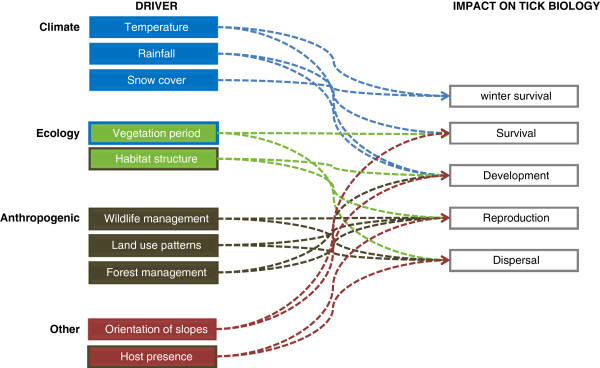
Many factors are involved in determining the latitudinal and altitudinal spread of the important tick vector Ixodes ricinus (Acari: Ixodidae) in Europe, as well as in changes in the distribution within its prior endemic zones. This paper builds on published literature and unpublished expert opinion from the VBORNET network with the aim of reviewing the evidence for these changes in Europe and discusses the many climatic, ecological, landscape and anthropogenic drivers. These can be divided into those directly related to climatic change, contributing to an expansion in the tick's geographic range at extremes of altitude in central Europe, and at extremes of latitude in Scandinavia; those related to changes in the distribution of tick hosts, particularly roe deer and other cervids; other ecological changes such as habitat connectivity and changes in land management; and finally, anthropogenically induced changes. These factors are strongly interlinked and often not well quantified. Although a change in climate plays an important role in certain geographic regions, for much of Europe it is non-climatic factors that are becoming increasingly important. How we manage habitats on a landscape scale, and the changes in the distribution and abundance of tick hosts are important considerations during our assessment and management of the public health risks associated with ticks and tick-borne disease issues in 21(st) century Europe. Better understanding and mapping of the spread of I. ricinus (and changes in its abundance) is, however, essential to assess the risk of the spread of infections transmitted by this vector species. Enhanced tick surveillance with harmonized approaches for comparison of data enabling the follow-up of trends at EU level will improve the messages on risk related to tick-borne diseases to policy makers, other stake holders and to the general public.
Overview
The claims and statistics of this paper haven’t been checked yet.
Run the check — free, no account needed. It reads the open-access text and checks the sources it cites.
Integrity signals
Registry
Cites
Statistics
Figures
Verification
Claims the paper makes
The claims and statistics of this paper haven’t been checked yet.
Run the check — free, no account needed. It reads the open-access text and checks the sources it cites.
Claims other papers make about this one
Each is checked against this paper’s own text: does it say what the citing paper says it does?
In the citing paper
“This could explain the result of five positive dogs (6%) that were microfilariae-positive and antigen-negative [35–37].”
From Prevalence of canine heartworm ( Dirofilaria immitis ) disease in dogs of central Portugal (2014) · cites this paper as [35]
Self-check
Percentages, sums and reported differences re-computed from the paper’s own numbers.
The self-check needs the paper’s full text.
Citations
Cites
Lindgren, E., Tälleklint, L., & Polfeldt, T. (2000) · Environmental Health Perspectives · doi:10.1289/ehp.00108119 · Cited by 558
Randolph, S. (2004) · Parasitology · doi:10.1017/s0031182004004925 · Cited by 509
Self-citationRizzoli, A. P., Hauffe, H. C., Carpi, G., Vourc’h, G., Neteler, M., & Rosà, R. (2011) · Eurosurveillance · doi:10.2807/ese.16.27.19906-en · Cited by 501
Self-citationJaenson, T. G. T., Jaenson, D. G. E., Eisen, L., Petersson, E., & Lindgren, E. (2012) · Parasites & Vectors · doi:10.1186/1756-3305-5-8 · Cited by 442
Self-citationAn empirical quantitative framework for the seasonal population dynamics of the tick Ixodes ricinus
Randolph, S., Green, R. M., Hoodless, A. N., & Peacey, M. (2002) · International Journal for Parasitology · doi:10.1016/s0020-7519(02)00030-9 · Cited by 332
Self-citationPerret, J.-L., Guigoz, E., Rais, O., & Gern, L. (2000) · Parasitology Research · doi:10.1007/s004360000209 · Cited by 301
Tick-borne bacterial diseases emerging in Europe
Parola, P., & Raoult, D. (2001) · Clinical Microbiology and Infection · doi:10.1046/j.1469-0691.2001.00200.x · Cited by 270
Cagnacci, F., Focardi, S., Heurich, M., Stache, A., Hewison, A. J. M., Morellet, N., Kjellander, P., Linnell, J. D. C., Mysterud, A., Neteler, M., et al. (2011) · Oikos · doi:10.1111/j.1600-0706.2011.19441.x · Cited by 250
Lindgren, E., & Jaenson, T. G. T. (2006) · Cited by 248
Self-citationGilbert, L. (2009) · Oecologia · doi:10.1007/s00442-009-1430-x · Cited by 247
Research works printed but not linked: 3
- Bullová M, Lukáň B, Peťko : Zmeny rozšírenia kliešťa obyčajného Ixodes ricinus v Západných Karpatoch Slovenska pod vplyvom klimatických zmien. Ecology and Veterinary medicine VII. 7th International Scientific Conference. 2008, Univerzita veterinarskeho lekarstva v Košiciach, 82-88.
- Hrkľová G, Nováková M, Chytra M, Kostova C, Petko B: Monitoring the distribution and abundance of Ixodes ricinus ticks in relevance of climate change and prevalence of Borrelia burgdorferi sensu lato in Northern Slovakia (Liptovska valley). Folia Veterinaria. 2008, 52 (2): 62-63.
- Santos-Silva MM, De Sousa R, Lopes De Carvalho I, Santos A, Nuncio S: Revive: A Portuguese networking program for the surveillance of ticks and tick-borne diseases. International Conference on Ticks and Tick-borne diseases, TTP 8. 2011b, Poster presentation, CD, Zaragoza, Spain
Cited by
Sorted by citations
Items 401–500 of 1,000
Anti-Toxoplasma antibodies prevalence and associated risk factors among HIV patients
Tegegne, D., Abdurahaman, M., Ejeta, T. M., & Yohannes, M. (2016) · Asian Pacific Journal of Tropical Medicine · doi:10.1016/j.apjtm.2016.03.034 · Cited by 26
Molecular evidence of Sarcocystis nesbitti in water samples of Tioman Island, Malaysia
Shahari, S., Tengku‐Idris, T. I. N., Fong, M. Y., & Lau, Y. L. (2016) · Parasites & Vectors · doi:10.1186/s13071-016-1883-9 · Cited by 26
Johansson, M., Manfredsson, L., Wistedt, A. C., Serrander, L., & Tjernberg, I. (2017) · Apmis · doi:10.1111/apm.12664 · Cited by 26
Paranaíba, L. F., Pinheiro, L. J., Macedo, D. H., Menezes‐Neto, A., Torrecilhas, A. C., Tafuri, W. L., & Soares, R. P. (2017) · Parasitology · doi:10.1017/s0031182017001810 · Cited by 25
Tick-borne zoonoses in the Order Rickettsiales and Legionellales in Iran: A systematic review
Khamesipour, F., Dida, G. O., Anyona, D. N., Razavi, S. M., & Rakhshandehroo, E. (2018) · PLoS neglected tropical diseases · doi:10.1371/journal.pntd.0006722 · Cited by 26
Vieira, T. D. S., Rugani, J. M. N., Nogueira, P. M., Torrecilhas, A. C., Gontijo, C. M. F., Descoteaux, A., & Soares, R. P. (2019) · Frontiers in Cellular and Infection Microbiology · doi:10.3389/fcimb.2019.00240 · Cited by 26
Ixodid ticks in the megapolis of Kyiv, Ukraine
Rogovskyy, A. S., Nebogatkin, I. V., & Scoles, G. A. (2016) · Ticks and Tick-borne Diseases · doi:10.1016/j.ttbdis.2016.10.004 · Cited by 25
Spatial risk analysis for the introduction and circulation of six arboviruses in the Netherlands
Esser, H. J., Liefting, Y., Ibáñez‐Justicia, A., van der Jeugd, H. P., van Turnhout, C. A. M., Stroo, A., Reusken, C. B. E. M., Koopmans, M., & de Boer, W. F. (2020) · Parasites & Vectors · doi:10.1186/s13071-020-04339-0 · Cited by 25
Interferon receptor-deficient mice are susceptible to eschar-associated rickettsiosis
Burke, T., Engström, P., Tran, C. J., Langohr, I. M., Glasner, D. R., Espinosa, D. A., Harris, E., & Welch, M. D. (2021) · eLife · doi:10.7554/elife.67029 · Cited by 25
Ung, L., Stothard, J. R., Phalkey, R. K., Azman, A. S., Chodosh, J., Hanage, W. P., & Standley, C. J. (2021) · Advances in Parasitology/Advances in parasitology · doi:10.1016/bs.apar.2021.08.007 · Cited by 25
Raccoons contraband – The metazoan parasite fauna of free-ranging raccoons in central Europe
Peter, N., Dörge, D. D., Cunze, S., Schantz, A. V., Skaljic, A., Rueckert, S., & Klimpel, S. (2023) · International Journal for Parasitology Parasites and Wildlife · doi:10.1016/j.ijppaw.2023.01.003 · Cited by 25
Ockenfels, B., Michael, E., & McDowell, M. A. (2014) · PLoS neglected tropical diseases · doi:10.1371/journal.pntd.0003197 · Cited by 25
The microbiota of hematophagous ectoparasites collected from migratory birds
Cerutti, F., Modesto, P., Rizzo, F., Cravero, A., Jurman, I., Costa, S., Giammarino, M., Mandola, M. L., Goria, M., Radović, S., et al. (2018) · PLoS ONE · doi:10.1371/journal.pone.0202270 · Cited by 25
Protective practices against tick bites in Denmark, Norway and Sweden: a questionnaire-based study
Jepsen, M. T., Jokelainen, P., Jore, S., Boman, A., Slunge, D., & Krogfelt, K. A. (2019) · BMC Public Health · doi:10.1186/s12889-019-7613-4 · Cited by 25
Krawczyk, A. I., Bakker, J. W., Koenraadt, C. J. M., Fonville, M., Takumi, K., Sprong, H., & Demir, S. (2020) · Pathogens · doi:10.3390/pathogens9050339 · Cited by 25
Self-citationLocal landscape effects on population dynamics of Ixodes ricinus
Asghar, N., Petersson, M., Johansson, M., & Dinnétz, P. (2016) · Geospatial health · doi:10.4081/gh.2016.487 · Cited by 24
Han, T., Wang, M., Zhang, G., Han, D., Li, X., Liu, G., Li, X., & Wang, Z. (2017) · Acta Parasitologica · doi:10.1515/ap-2017-0098 · Cited by 24
Vector-Borne Zoonotic Pathogens in Eurasian Moose ( Alces alces alces )
Malmsten, J., Dalin, A., Moutailler, S., Devillers, E., Gondard, M., & Felton, A. M. (2018) · Vector-Borne and Zoonotic Diseases · doi:10.1089/vbz.2018.2277 · Cited by 24
Vaculová, T., Derdáková, M., Špitalská, E., Václav, R., Chvostáč, M., & Tarageľová, V. R. (2019) · Acta Parasitologica · doi:10.2478/s11686-018-00004-w · Cited by 23
Hartemink, N., van Vliet, A. J. H., Sprong, H., Jacobs, F. H. H., Garcia‐Martí, I., Zurita‐Milla, R., & Takken, W. (2019) · Vector-Borne and Zoonotic Diseases · doi:10.1089/vbz.2018.2369 · Cited by 24
Self-citationKeokenchanh, S., Kounnavong, S., Midorikawa, K., Ikeda, W., Morita, A., Kitajima, T., & Sokejima, S. (2021) · PLoS ONE · doi:10.1371/journal.pone.0248969 · Cited by 27
Batool, M., Blazier, J. C., Rogovska, Y. V., Wang, J., Liu, S., Nebogatkin, I. V., & Rogovskyy, A. S. (2021) · Ticks and Tick-borne Diseases · doi:10.1016/j.ttbdis.2021.101768 · Cited by 24
Ticks (Acari: Ixodidae) parasitizing migrating and local breeding birds in Finland
Sormunen, J. J., Klemola, T., & Vesterinen, E. J. (2021) · Experimental and Applied Acarology · doi:10.1007/s10493-021-00679-3 · Cited by 24
Nolzen, H., Brugger, K., Reichold, A., Brock, J., Lange, M., & Thulke, H. (2022) · PLoS ONE · doi:10.1371/journal.pone.0267196 · Cited by 24
Virome of Ixodes ricinus, Dermacentor reticulatus, and Haemaphysalis concinna Ticks from Croatia
Sameroff, S. C., Tokarz, R., Vucelja, M., Jain, K., Oleynik, A., Boljfetić, M., Bjedov, L., Yates, R. A., Margaletić, J., Oura, C. A. L., et al. (2022) · Viruses · doi:10.3390/v14050929 · Cited by 24
The Risk of Exposure to Ticks and Tick-Borne Pathogens in a Spa Town in Northern Poland
Kubiak, K., Dmitryjuk, M., Dziekońska-Rynko, J., Siejwa, P., & Dzika, E. (2022) · Pathogens · doi:10.3390/pathogens11050542 · Cited by 24
Alkishe, A., Cobos, M. E., Osorio‐Olvera, L., & Peterson, A. T. (2022) · Web Ecology · doi:10.5194/we-22-33-2022 · Cited by 24
Factors responsible for Ixodes ricinus presence and abundance across a natural-urban gradient
Janzén, T., Hammer, M., Petersson, M., & Dinnétz, P. (2023) · PLoS ONE · doi:10.1371/journal.pone.0285841 · Cited by 24
Zając, Z., Obregón, D., Foucault‐Simonin, A., Chuang, A. W., Moutailler, S., Galon, C., Kulisz, J., Woźniak, A., Bartosik, K., & Cabezas‐Cruz, A. (2023) · Scientific Reports · doi:10.1038/s41598-023-37748-z · Cited by 24
Levanov, L., Vera, C. P., & Vapalahti, O. P. (2016) · Ticks and Tick-borne Diseases · doi:10.1016/j.ttbdis.2016.05.002 · Cited by 24
Molecular identification of Borrelia spirochetes in questing Ixodes ricinus from northwestern Spain
Díaz, P., Arnal, J. L., Remesar, S., Pérez-Creo, A., Venzal, J. M., Vázquez-López, M. E., Prieto, A., Fernández, G., López, C. M., Fontán, R. P., et al. (2017) · Parasites & Vectors · doi:10.1186/s13071-017-2574-x · Cited by 24
Spatial tick bite exposure and associated risk factors in Scandinavia
Jore, S., Vanwambeke, S., Slunge, D., Boman, A., Krogfelt, K. A., Jepsen, M. T., & Vold, L. (2020) · Infection Ecology & Epidemiology · doi:10.1080/20008686.2020.1764693 · Cited by 25
Hai, V. V., Pagès, F., Boulanger, N., Audebert, S., Parola, P., & Alméras, L. (2013) · Ticks and Tick-borne Diseases · doi:10.1016/j.ttbdis.2013.06.001 · Cited by 24
Abundance and distribution of immature mosquitoes in urban rivers proximate to their larval habitats
Ma, M., Huang, M., & Leng, P. (2016) · Acta Tropica · doi:10.1016/j.actatropica.2016.08.010 · Cited by 23
Pennington, M. J., Rothman, J. A., Jones, M. B., McFrederick, Q. S., Gan, J. J., & Trumble, J. T. (2017) · Scientific Reports · doi:10.1038/s41598-017-08683-7 · Cited by 23
Evidence for host specificity of Theileria capreoli genotypes in cervids
Hornok, S., Sugár, L., Horváth, G., Kovács, T., Micsutka, A., Gönczi, E., Flaisz, B., Takács, N., Farkas, R., Meli, M. L., et al. (2017) · Parasites & Vectors · doi:10.1186/s13071-017-2403-2 · Cited by 23
Grimaud, Y., Guis, H., Chiroleu, F., Boucher, F., Tran, A., Rakotoarivony, I., Duhayon, M., Cêtre-Sossah, C. B., Esnault, O., Cardinale, É., et al. (2019) · Parasites & Vectors · doi:10.1186/s13071-019-3812-1 · Cited by 23
Medkour, H., Laidoudi, Y., Athias, E., Bouam, A., Dizoé, S., Davoust, B., & Mediannikov, O. (2020) · Comparative Immunology Microbiology and Infectious Diseases · doi:10.1016/j.cimid.2019.101412 · Cited by 23
Cotes-Perdomo, A. P., Oviedo, Á., & Castro, L. R. (2020) · Experimental and Applied Acarology · doi:10.1007/s10493-020-00531-0 · Cited by 23
Liebig, K., Boelke, M., Grund, D., Schicht, S., Springer, A., Strübe, C., Chitimia‐Dobler, L., Dobler, G., Jung, K., & Becker, S. C. (2020) · Scientific Reports · doi:10.1038/s41598-020-71920-z · Cited by 23
Owino, B. O., Mwangi, M., Kiplagat, S., Mwangi, H. N., Ingonga, J., Chebet, A., Ngumbi, P. M., Villinger, J., Masiga, D. K., & Matoke-Muhia, D. (2021) · Parasites & Vectors · doi:10.1186/s13071-020-04517-0 · Cited by 23
Bregnard, C., Rais, O., Herrmann, C., Kahl, O., Brugger, K., & Voordouw, M. J. (2021) · Parasites & Vectors · doi:10.1186/s13071-021-05076-8 · Cited by 23
Kwak, M. L., & Ng, A. (2022) · Acarologia · doi:10.24349/fz2l-kg9r · Cited by 23
Prevalence of Toxoplasma gondii in pet dogs in mainland China: A meta-analysis
Gao, Y., Ding, H., Lamberton, P. H. L., & Lu, D. (2016) · Veterinary Parasitology · doi:10.1016/j.vetpar.2016.10.009 · Cited by 23
Bajer, A., Rodo, A., Alsarraf, M., Dwużnik-Szarek, D., Behnke, J. M., & Mierzejewska, E. J. (2017) · Veterinary Parasitology · doi:10.1016/j.vetpar.2017.09.004 · Cited by 23
Artrópodos vectores en España y sus enfermedades transmisibles
Portillo, A., Arrondo, I. R., & Oteo, J. A. (2018) · Medicina Clínica · doi:10.1016/j.medcli.2018.06.021 · Cited by 23
Self-citationGambian human African trypanosomiasis in North West Uganda. Are we on course for the 2020 target?
Selby, R., Wamboga, C., Erphas, O., Mugenyi, A., Jamonneau, V., Waiswa, C., Torr, S. J., & Lehane, M. J. (2019) · PLoS neglected tropical diseases · doi:10.1371/journal.pntd.0007550 · Cited by 21
Zeleke, A. J., & Melsew, Y. A. (2017) · BMC Research Notes · doi:10.1186/s13104-017-2390-6 · Cited by 22
Lotilaner - a novel systemic tick and flea control product for dogs
Little, S. E. (2017) · Parasites & Vectors · doi:10.1186/s13071-017-2471-3 · Cited by 22
Cornetti, L., Hilfiker, D., Lemoine, M., & Tschirren, B. (2018) · Molecular Ecology · doi:10.1111/mec.14812 · Cited by 22
Benítez, D., Dibello, E., Bonilla, M., & Comini, M. A. (2020) · Drug Development Research · doi:10.1002/ddr.21634 · Cited by 22
Chepkwony, R. K. T., van Bommel, S., & van Langevelde, F. (2021) · Parasites & Vectors · doi:10.1186/s13071-021-04683-9 · Cited by 23
Prevalence and predictors of vector-borne pathogens in Dutch roe deer
Wijburg, S. R., Fonville, M., de Bruin, A., van Rijn, P. A., Montizaan, M., van den Broek, J., Sprong, H., & Rijks, J. M. (2022) · Parasites & Vectors · doi:10.1186/s13071-022-05195-w · Cited by 22
Self-citationCastillo-Morales, R. M., Serrano, S. O., Villamizar, A. L. R., Méndez‐Sánchez, S. C., & Duque, J. E. (2021) · Scientific Reports · doi:10.1038/s41598-021-03819-2 · Cited by 24
Abdishu, M., Gobena, T., Damena, M., Abdi, H., & Birhanu, A. (2022) · Pediatric Health Medicine and Therapeutics · doi:10.2147/phmt.s347621 · Cited by 22
Hansford, K. M., Gandy, S. L., Gillingham, E. L., McGinley, L., Cull, B., Johnston, C. J., Catton, M., & Medlock, J. M. (2022) · Medical and Veterinary Entomology · doi:10.1111/mve.12621 · Cited by 22
Self-citationKeskin, A., & Erciyas‐Yavuz, K. (2015) · Journal of Medical Entomology · doi:10.1093/jme/tjv149 · Cited by 22
Forest classes and tree cover gradient: tick habitat in encroached areas of southern Norway
Vanwambeke, S., doninck, J. V., Artois, J., Davidson, R. K., Meyfroidt, P., & Jore, S. (2015) · Experimental and Applied Acarology · doi:10.1007/s10493-015-0007-0 · Cited by 22
Garcia‐Martí, I., Zurita‐Milla, R., Swart, A., van den Wijngaard, K. C., van Vliet, A. J. H., Bennema, S. C., & Harms, M. G. (2016) · Transactions in GIS · doi:10.1111/tgis.12211 · Cited by 22
Busso, J. P., Blanckenhorn, W. U., & González‐Tokman, D. (2017) · Ecological Entomology · doi:10.1111/een.12413 · Cited by 22
Mogaji, H. O., Dedeke, G. A., Jayeola, O. A., Adeniran, A. A., Olabinke, D. B., Oluwole, A. S., Abe, E. M., Adeaga, D. O., Yusuff, Q., Yusuff, H. A., et al. (2017) · Parasitology Open · doi:10.1017/pao.2017.18 · Cited by 22
Serological detection and molecular characterization of piroplasmids in equids in Brazil
Vieira, M. I. B., Costa, M. M., de Oliveira, M. T., Gonçalves, L. R., André, M. R., & Machado, R. Z. (2017) · Acta Tropica · doi:10.1016/j.actatropica.2017.12.028 · Cited by 22
Kueneman, J. G., Esser, H. J., Weiss, S. J., Jansen, P. A., & Foley, J. E. (2021) · Applied and Environmental Microbiology · doi:10.1128/aem.02668-20 · Cited by 20
Dautel, H., Kämmer, D., & Kahl, O. (2016) · Wageningen Academic Publishers eBooks · doi:10.3920/978-90-8686-838-4_24 · Cited by 22
Li, S., Juhász-Horváth, L., Trájer, A. J., Pintér, L., Rounsevell, M., & Harrison, P. A. (2017) · Zoonoses and Public Health · doi:10.1111/zph.12413 · Cited by 21
Lyme neuroborreliosis and bird populations in northern Europe
Mysterud, A., Heylen, D., Matthysen, E., García, A. L., Jore, S., & Viljugrein, H. (2019) · Proceedings of the Royal Society B Biological Sciences · doi:10.1098/rspb.2019.0759 · Cited by 21
Bartonella spp. detection in ticks, Culicoides biting midges and wild cervids from Norway
Sacristán, C., das Neves, C. G., Suhel, F., Sacristán, I., Tengs, T., Hamnes, I. S., & Madslien, K. (2020) · Transboundary and Emerging Diseases · doi:10.1111/tbed.13762 · Cited by 21
Silaghi, C., Fröhlich, J., Reindl, H., Hamel, D., & Rehbein, S. (2020) · Pathogens · doi:10.3390/pathogens9110968 · Cited by 21
Tick bite risk resulting from spatially heterogeneous hazard, exposure and coping capacity
Vanwambeke, S., & Schimit, P. H. T. (2021) · Ecological Complexity · doi:10.1016/j.ecocom.2021.100967 · Cited by 24
Kulha, N., Ruokolainen, K., Vesterinen, E. J., Lamppu, M., Klemola, T., & Sormunen, J. J. (2022) · Ecology and Evolution · doi:10.1002/ece3.9538 · Cited by 21
Perez, G., Bournez, L., Boulanger, N., Fite, J., Livoreil, B., McCoy, K. D., Quillery, E., René‐Martellet, M., & Bonnet, S. I. (2023) · Peer Community Journal · doi:10.24072/pcjournal.291 · Cited by 25
Parham, P. E., & Hughes, D. A. (2015) · Philosophical Transactions of the Royal Society B Biological Sciences · doi:10.1098/rstb.2013.0557 · Cited by 21
Camargo‐Mathias, M. I., Pereira, N. R. C., Reis, C. D. S., de Almeida, C. R., Mendes, D. R. S., de Araújo, G. B., Postali, L., Figueroa, T., Ferreira, A. R. F., Santos, J. P., et al. (2017) · Experimental and Applied Acarology · doi:10.1007/s10493-017-0144-8 · Cited by 21
Caetano, R. L., Vizzoni, V. F., Bitencourth, K., Carriço, C., Sato, T. P., Pinto, Z. T., de Oliveira, S. V., Amorim, M., Voloch, C. M., & Gazêta, G. S. (2017) · Journal of Medical Entomology · doi:10.1093/jme/tjx066 · Cited by 21
Nested Species Distribution Models of Chlamydiales in Ixodes ricinus (Tick) Hosts in Switzerland
Rochat, E., Vuilleumier, S., Aeby, S., Greub, G., & Joost, S. (2020) · Applied and Environmental Microbiology · doi:10.1128/aem.01237-20 · Cited by 21
Habitat and occurrence of ixodid ticks in the Liguria region, northwest Italy
Ceballos, L. A., Pintore, M. D., Tomassone, L., Pautasso, A., Bisanzio, D., Mignone, W., Casalone, C., & Mannelli, A. (2014) · Experimental and Applied Acarology · doi:10.1007/s10493-014-9794-y · Cited by 21
Re, D. D., Clercq, E. M. D., Tordoni, E., Madder, M., Rousseau, R., & Vanwambeke, S. (2019) · Remote Sensing · doi:10.3390/rs11070770 · Cited by 20
Zoonotic Rickettsia Species in Small Ruminant Ticks From Tunisia
Belkahia, H., Selmi, R., Zamiti, S., Dâaloul-Jedidi, M., Messadi, L., & Saïd, M. B. (2021) · Frontiers in Veterinary Science · doi:10.3389/fvets.2021.676896 · Cited by 20
Dietary and Plasmodium challenge effects on the cuticular hydrocarbon profile of Anopheles albimanus
Claudio-Piedras, F., Recio-Tótoro, B., Cime‐Castillo, J., Condé, R., Maffei, M. E., & Lanz‐Mendoza, H. (2021) · Scientific Reports · doi:10.1038/s41598-021-90673-x · Cited by 20
Gillis-Germitsch, N., Kockmann, T., Asmis, L. M., Tritten, L., & Schnyder, M. (2021) · Frontiers in Cellular and Infection Microbiology · doi:10.3389/fcimb.2021.753320 · Cited by 22
Tick-borne encephalitis among US travellers, 2010–20
Hills, S. L., Broussard, K. R., Broyhill, J., Shastry, L. G., Cossaboom, C. M., White, J. L., Machesky, K. D., Kosoy, O. L., Girone, K., Klena, J. D., et al. (2021) · Journal of Travel Medicine · doi:10.1093/jtm/taab167 · Cited by 20
Bharathithasan, M., Ravindran, D. R., Rajendran, D., Chun, S. K., Abbas, S. A., Sugathan, S., Yahaya, Z. S., Said, A. R., Oh, W., Kotra, V., et al. (2021) · PLoS ONE · doi:10.1371/journal.pone.0260281 · Cited by 20
Rispe, C., Hervet, C., de la Cotte, N., Daveu, R., Labadie, K., Noël, B., Aury, J., Thany, S. H., Taillebois, E., Cartereau, A., et al. (2022) · BMC Genomics · doi:10.1186/s12864-022-08669-4 · Cited by 20
Self-citationGarcia‐Vozmediano, A., Meneghi, D. D., Sprong, H., Portillo, A., Oteo, J. A., & Tomassone, L. (2022) · Veterinary Sciences · doi:10.3390/vetsci9090504 · Cited by 20
Self-citationEpidemiological situation of Lyme borreliosis in Belgium, 2003 to 2012
Bleyenheuft, C., Lernout, T., Berger, N., Rebolledo, J., Leroy, M., Robert, A. R., & Quoilin, S. (2015) · Archives of Public Health · doi:10.1186/s13690-015-0079-7 · Cited by 20
Tick Saliva and Its Role in Pathogen Transmission
Bonnet, S. I., Kazimírová, M., Richardson, J. P., & Šimo, L. (2018) · Elsevier eBooks · doi:10.1016/b978-0-12-811436-0.00005-8 · Cited by 20
Buendía‐Abad, M., Higes, M., Martín‐Hernández, R., Barrios, L., Meana, A., Fernández, A., Osuna, A., & Pablos, L. M. D. (2020) · International Journal for Parasitology Parasites and Wildlife · doi:10.1016/j.ijppaw.2020.12.003 · Cited by 20
Acheson, E. S., Plowright, A., & Kerr, J. T. (2015) · Malaria Journal · doi:10.1186/s12936-015-0841-x · Cited by 21
First record of Tetramicra brevifilum in lumpfish (Cyclopterus lumpus, L.)
Scholz, F., Fringuelli, E., Bolton‐Warberg, M., Marcos‐López, M., Mitchell, S. O., Prodhol, P., Moffet, D., Savage, P., O'Sullivan, S. M., O’Connor, I., et al. (2016) · Journal of Fish Diseases · doi:10.1111/jfd.12554 · Cited by 19
13. Greener cities, a wild card for ticks?
Gassner, F., Hansford, K. M., & Medlock, J. M. (2016) · Wageningen Academic Publishers eBooks · doi:10.3920/978-90-8686-838-4_13 · Cited by 19
Self-citationA new focus of the tick Haemaphysalis concinna in Western Poland
Dwużnik-Szarek, D., Mierzejewska, E. J., Alsarraf, M., & Bajer, A. (2019) · Experimental and Applied Acarology · doi:10.1007/s10493-019-00371-7 · Cited by 19
Zouré, A. A., Sare, A. R., Yameogo, F., Somda, Z., Massart, S., Badolo, A., & Francis, F. (2019) · Molecular Biology Reports · doi:10.1007/s11033-019-05121-x · Cited by 18
The non-invasive measurement of faecal immunoglobulin in African equids
Tombak, K. J., Budischak, S. A., Hauck, S., Martinez, L. A., & Rubenstein, D. I. (2020) · International Journal for Parasitology Parasites and Wildlife · doi:10.1016/j.ijppaw.2020.05.005 · Cited by 19
Morakinyo, O. M., Adebowale, A. S., Obembe, T. A., & Oloruntoba, E. O. (2020) · PLoS ONE · doi:10.1371/journal.pone.0243356 · Cited by 21
Predicting spatio‐temporal population patterns of Borrelia burgdorferi, the Lyme disease pathogen
Tran, T., Prusinski, M. A., White, J. L., Falco, R. C., Kokas, J., Vinci, V. C., Gall, W. K., Tober, K. J., Haight, J., Oliver, J., et al. (2022) · Journal of Applied Ecology · doi:10.1111/1365-2664.14274 · Cited by 19
Dumitrache, M. O., Botond, K. J., Dantas‐Torres, F., Latrofa, M. S., D’Amico, G., Sándor, A. D., & Mihalca, A. D. (2014) · Parasites & Vectors · doi:10.1186/1756-3305-7-97 · Cited by 18
Garrido, M., Adler, V. H., Pnini, M., Abramsky, Z., Krasnov, B. R., Gutman, R., Kronfeld‐Schor, N., & Hawlena, H. (2016) · Parasites & Vectors · doi:10.1186/s13071-016-1407-7 · Cited by 19
Ragagli, C., Mannelli, A., Ambrogi, C., Bisanzio, D., Ceballos, L. A., Grego, E., Martello, E., Selmi, M., & Tomassone, L. (2016) · Experimental and Applied Acarology · doi:10.1007/s10493-016-0030-9 · Cited by 19
Hassan, A., Al-Zanbagi, N., & Al-Nabati, E. (2016) · The Journal of Basic and Applied Zoology · doi:10.1016/j.jobaz.2016.09.001 · Cited by 19
Kumar, P., Vatsa, R., Sarthi, P. P., Kumar, M. S., & Gangare, V. (2020) · Journal of Parasitic Diseases · doi:10.1007/s12639-020-01210-y · Cited by 19
Metadata
- Authors
- Medlock, J. M., Hansford, K. M., Bormane, A., Derdakova, M., Estrada-Peña, A., George, J.-C., Golovljova, I., Jaenson, T. G. T., Jensen, J.-K., Jensen, P. M., Kazimirova, M., Oteo, J. A., Papa, A., Pfister, K., Plantard, O., Randolph, S. E., Rizzoli, A., Santos-Silva, M. M., Sprong, H., Vial, L., Hendrickx, G., Zeller, H., & Van Bortel, W.
- Affiliations
- Health Protection Agency (GB)
- National Institute for Health Development (EE)
- Uppsala University (SE)
- University of Copenhagen (DK)
- Hospital San Pedro (ES)
- Aristotle University of Thessaloniki (GR)
- Ludwig-Maximilians-Universität München (DE)
- Oniris (FR)
- University of Oxford (GB)
- Fondazione Edmund Mach (IT)
- National Institute for Public Health and the Environment (NL)
- Centre de Coopération Internationale en Recherche Agronomique pour le Développement (FR)
- Avia-GIS (Belgium) (BE)
- European Centre for Disease Prevention and Control (SE)
- Corresponding author
- Medlock, Jolyon M
- ORCID
- Venue
- Parasites & Vectors
- Published
- 2013-01-02
- Volume
- 6
- Issue
- 1
- Pages
- 1-1
- ISSN
- 1756-3305 (ISSN-L)
- PMC
- PMC3549795
- OpenAlex
- W2145987003
- Cited by
- 1,215
- References
- 94
- Citations by year
- 2026: 60 · 2025: 74 · 2024: 84 · 2023: 83 · 2022: 94 · 2021: 170 · 2020: 109 · 2019: 96 · 2018: 86 · 2017: 107 · 2016: 80 · 2015: 75 · 2014: 62 · 2013: 35
- FWCI
- 10.52
- Type
- journal article
- Language
- en
- Open access
- gold
- doi.org
- Licence
- Locations
- Parasites & Vectors (publishedVersion, cc-by)
- Europe PMC (PubMed Central) (publishedVersion, cc-by)
- PubMed Central (publishedVersion, cc-by)
- PubMed (publishedVersion)
- Research at the University of Copenhagen (University of Copenhagen) (publishedVersion, cc-by)
- CINECA IRIS Institutional Research Information System (Fondazione Edmund Mach) (submittedVersion, cc-by-nc-nd)
- Uppsala University Publications (Uppsala University) (submittedVersion, other-oa)
- HAL (submittedVersion, cc-by)
- Agritrop (Cirad) (submittedVersion)
- DOAJ (DOAJ: Directory of Open Access Journals) (submittedVersion)
- Open access LMU (Ludwid Maxmilian's Universitat Munchen) (submittedVersion)
- Portuguese National Funding Agency for Science, Research and Technology (RCAAP Project by FCT) (submittedVersion, other-oa)
- Rivm (National Institute for Public Health and the Environment) (submittedVersion)
- Funders
- European Commission (261504)
- European Centre for Disease Prevention and Control
- Topics
- Life Sciences › Immunology and Microbiology › Parasitology › Vector-borne infectious diseases
- Health Sciences › Medicine › Infectious Diseases › Viral Infections and Vectors
- Life Sciences › Agricultural and Biological Sciences › Ecology, Evolution, Behavior and Systematics › Study of Mite Species
- Keywords
- Ixodes ricinus, tick-borne diseases, climate change, roe deer, deer, habitat connectivity, land management, anthropogenic factors, tick surveillance, public health risk
- MeSH terms
- Animals, Europe, Ruminants, Ecosystem, Ixodes, Climate Change, Phylogeography
About these checks
Registry, retraction, Cites and statistics results are computed, not judged, with one exception: a printed reference that no index lists is read once by a model before it counts as a citation error. Claims are extracted by a model and kept only when their quote appears verbatim in the text; each cited source is then checked, with a model’s help, for whether it says what the claim relies on. Those verdicts can be wrong — read the claim’s quote and the cited source before relying on one.
Statistics and arithmetic are recomputed, not judged.
Confidence bands are shown only for fields calibrated on our annotated test set. None is calibrated yet, so no band is shown.
What counts as a claim ›How we measure confidence ›How we check this ›
Are you an author, or do you see a problem with this page? Request a review
