

The DOI matches its Crossref record; 94 of the 94 references it cites were found in a registry or an index.
Driving forces for changes in geographical distribution of Ixodes ricinus ticks in Europe
Open accessAbstract
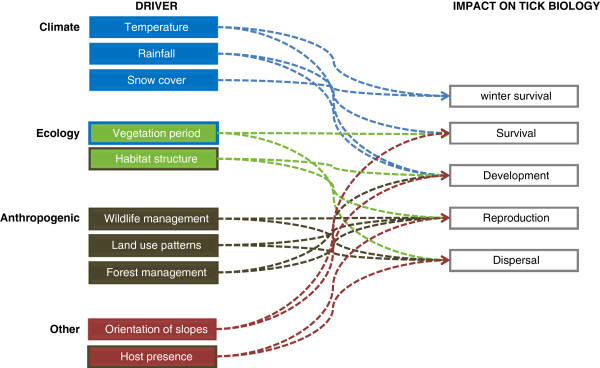
Many factors are involved in determining the latitudinal and altitudinal spread of the important tick vector Ixodes ricinus (Acari: Ixodidae) in Europe, as well as in changes in the distribution within its prior endemic zones. This paper builds on published literature and unpublished expert opinion from the VBORNET network with the aim of reviewing the evidence for these changes in Europe and discusses the many climatic, ecological, landscape and anthropogenic drivers. These can be divided into those directly related to climatic change, contributing to an expansion in the tick's geographic range at extremes of altitude in central Europe, and at extremes of latitude in Scandinavia; those related to changes in the distribution of tick hosts, particularly roe deer and other cervids; other ecological changes such as habitat connectivity and changes in land management; and finally, anthropogenically induced changes. These factors are strongly interlinked and often not well quantified. Although a change in climate plays an important role in certain geographic regions, for much of Europe it is non-climatic factors that are becoming increasingly important. How we manage habitats on a landscape scale, and the changes in the distribution and abundance of tick hosts are important considerations during our assessment and management of the public health risks associated with ticks and tick-borne disease issues in 21(st) century Europe. Better understanding and mapping of the spread of I. ricinus (and changes in its abundance) is, however, essential to assess the risk of the spread of infections transmitted by this vector species. Enhanced tick surveillance with harmonized approaches for comparison of data enabling the follow-up of trends at EU level will improve the messages on risk related to tick-borne diseases to policy makers, other stake holders and to the general public.
Overview
The claims and statistics of this paper haven’t been checked yet.
Run the check — free, no account needed. It reads the open-access text and checks the sources it cites.
Integrity signals
Registry
Cites
Statistics
Figures
Verification
Claims the paper makes
The claims and statistics of this paper haven’t been checked yet.
Run the check — free, no account needed. It reads the open-access text and checks the sources it cites.
Claims other papers make about this one
Each is checked against this paper’s own text: does it say what the citing paper says it does?
In the citing paper
“This could explain the result of five positive dogs (6%) that were microfilariae-positive and antigen-negative [35–37].”
From Prevalence of canine heartworm ( Dirofilaria immitis ) disease in dogs of central Portugal (2014) · cites this paper as [35]
Self-check
Percentages, sums and reported differences re-computed from the paper’s own numbers.
The self-check needs the paper’s full text.
Citations
Cites
Lindgren, E., Tälleklint, L., & Polfeldt, T. (2000) · Environmental Health Perspectives · doi:10.1289/ehp.00108119 · Cited by 558
Randolph, S. (2004) · Parasitology · doi:10.1017/s0031182004004925 · Cited by 509
Self-citationRizzoli, A. P., Hauffe, H. C., Carpi, G., Vourc’h, G., Neteler, M., & Rosà, R. (2011) · Eurosurveillance · doi:10.2807/ese.16.27.19906-en · Cited by 501
Self-citationJaenson, T. G. T., Jaenson, D. G. E., Eisen, L., Petersson, E., & Lindgren, E. (2012) · Parasites & Vectors · doi:10.1186/1756-3305-5-8 · Cited by 442
Self-citationAn empirical quantitative framework for the seasonal population dynamics of the tick Ixodes ricinus
Randolph, S., Green, R. M., Hoodless, A. N., & Peacey, M. (2002) · International Journal for Parasitology · doi:10.1016/s0020-7519(02)00030-9 · Cited by 332
Self-citationPerret, J.-L., Guigoz, E., Rais, O., & Gern, L. (2000) · Parasitology Research · doi:10.1007/s004360000209 · Cited by 301
Tick-borne bacterial diseases emerging in Europe
Parola, P., & Raoult, D. (2001) · Clinical Microbiology and Infection · doi:10.1046/j.1469-0691.2001.00200.x · Cited by 270
Cagnacci, F., Focardi, S., Heurich, M., Stache, A., Hewison, A. J. M., Morellet, N., Kjellander, P., Linnell, J. D. C., Mysterud, A., Neteler, M., et al. (2011) · Oikos · doi:10.1111/j.1600-0706.2011.19441.x · Cited by 250
Lindgren, E., & Jaenson, T. G. T. (2006) · Cited by 248
Self-citationGilbert, L. (2009) · Oecologia · doi:10.1007/s00442-009-1430-x · Cited by 247
Research works printed but not linked: 3
- Bullová M, Lukáň B, Peťko : Zmeny rozšírenia kliešťa obyčajného Ixodes ricinus v Západných Karpatoch Slovenska pod vplyvom klimatických zmien. Ecology and Veterinary medicine VII. 7th International Scientific Conference. 2008, Univerzita veterinarskeho lekarstva v Košiciach, 82-88.
- Hrkľová G, Nováková M, Chytra M, Kostova C, Petko B: Monitoring the distribution and abundance of Ixodes ricinus ticks in relevance of climate change and prevalence of Borrelia burgdorferi sensu lato in Northern Slovakia (Liptovska valley). Folia Veterinaria. 2008, 52 (2): 62-63.
- Santos-Silva MM, De Sousa R, Lopes De Carvalho I, Santos A, Nuncio S: Revive: A Portuguese networking program for the surveillance of ticks and tick-borne diseases. International Conference on Ticks and Tick-borne diseases, TTP 8. 2011b, Poster presentation, CD, Zaragoza, Spain
Cited by
Sorted by citations
Items 601–700 of 1,000
Pattnaik, S., Agrawal, R., Murmu, J., Kanungo, S., & Pati, S. (2023) · IJID Regions · doi:10.1016/j.ijregi.2023.02.003 · Cited by 13
Zortman, I., Garine-Wichatitsky, M. D., Arsevska, E., Dub, T., Bortel, W. V., Lefrançois, E., Vial, L., Pollet, T., & Binot, A. (2023) · One Health · doi:10.1016/j.onehlt.2023.100630 · Cited by 13
Self-citationLeth-Møller, K., van Hage, M., Apostolović, D., Sørensen, J. A., Vestergaard, C., Madsen, F., Kjær, L. J., Hansen, T. F., Jonsson, A. E., Thomsen, S. F., et al. (2024) · Allergy · doi:10.1111/all.16360 · Cited by 13
Molecular identification of novel phlebovirus sequences in European ticks
Prinz, M., Fuchs, J., Ehrmann, S., Scherer‐Lorenzen, M., Kochs, G., & Panning, M. (2017) · Ticks and Tick-borne Diseases · doi:10.1016/j.ttbdis.2017.06.005 · Cited by 13
Genetic diversity of Haemaphysalis longicornis from China and molecular detection of Rickettsia
Liu, T., Feng, X., Zhang, Y., Liu, J., & Bao, R. (2019) · Experimental and Applied Acarology · doi:10.1007/s10493-019-00423-y · Cited by 13
Hauser, G., Thiévent, K., & Koella, J. C. (2020) · Parasites & Vectors · doi:10.1186/s13071-020-3983-9 · Cited by 14
First Detection of Mukawa Virus in Ixodes persulcatus and Haemaphysalis concinna in China
Wang, Y., Jiang, R.-R., Ding, H., Zhang, X., Wang, N., Zhang, Y.-F., Li, Y., Chen, J., Zhang, P., Li, H., et al. (2022) · Frontiers in Microbiology · doi:10.3389/fmicb.2022.791563 · Cited by 13
Guillot, C., Bouchard, C., Buhler, K. J., Dumas, A., Milord, F., Ripoche, M., Pelletier, R., & Leighton, P. A. (2022) · Pathogens · doi:10.3390/pathogens11050531 · Cited by 13
Pereira, V. V., Conceição, A. D. S., Maximiano, L. H. S., Belligoli, L. D. Q. G., & da Silva, E. S. (2014) · Revista da Sociedade Brasileira de Medicina Tropical · doi:10.1590/0037-8682-0214-2013 · Cited by 13
Ferrell, A. M., Brinkerhoff, R. J., Bernal, J., & Bermúdez, S. E. (2017) · Experimental and Applied Acarology · doi:10.1007/s10493-017-0116-z · Cited by 15
Rivero, M. R., Salas, M., Valente, R., Nores, M. J., Angelo, C. D., Arrabal, J. P., Costa, S. A., & Salomón, O. D. (2017) · Zoonoses and Public Health · doi:10.1111/zph.12365 · Cited by 13
Obiegala, A., & Silaghi, C. (2018) · Current Clinical Microbiology Reports · doi:10.1007/s40588-018-0085-y · Cited by 13
A community approach to the Neotropical ticks-hosts interactions
Estrada‐Peña, A., Nava, S., Tarragona, E. L., de la Fuente, J., & Guglielmone, A. A. (2020) · Scientific Reports · doi:10.1038/s41598-020-66400-3 · Cited by 13
Self-citationTicks on game animals in the fragmented agricultural landscape of western Poland
Ciebiera, O., Łopińska, A., & Gabryś, G. (2021) · Parasitology Research · doi:10.1007/s00436-021-07132-9 · Cited by 13
Sharifdini, M., Karimi, M., Ashrafi, K., Soleimani, M., & Mirjalali, H. (2022) · BMC Veterinary Research · doi:10.1186/s12917-022-03270-z · Cited by 15
Alasmari, S., Tu, C., Khan, M., Javed, B., Liaqat, I., Bahadar, S., Altwaim, S. A., Chen, C., Vaz, I. D. S., & Ali, A. (2025) · Revista Brasileira de Parasitologia Veterinária/Brazilian Journal of Veterinary Parasitology · doi:10.1590/s1984-29612025062 · Cited by 13
Bona, M., Blaňarová, L., Stanko, M., Mošanský, L., Čepčeková, E., & Víchová, B. (2021) · Biologia · doi:10.1007/s11756-021-00902-x · Cited by 12
Phlebovirus diversity in ticks from livestock in arid ecologies in Kenya
Ogola, E. O., Kopp, A., Bastos, A. D. S., Slothouwer, I., Omoga, D. C. A., Osalla, J., Sang, R. C., Torto, B., Junglen, S., & Tchouassi, D. P. (2022) · Ticks and Tick-borne Diseases · doi:10.1016/j.ttbdis.2022.102087 · Cited by 12
Malahlela, O. E., Olwoch, J. M., & Adjorlolo, C. (2018) · EcoHealth · doi:10.1007/s10393-017-1307-0 · Cited by 13
Janzén, T., Petersson, M., Hammer, M., Aspán, A., & Dinnétz, P. (2019) · Agriculture Ecosystems & Environment · doi:10.1016/j.agee.2019.106626 · Cited by 12
Dwużnik-Szarek, D., Mierzejewska, E. J., & Bajer, A. (2021) · Parasites & Vectors · doi:10.1186/s13071-021-05039-z · Cited by 12
Ferrari, G., Girardi, M., Cagnacci, F., Devineau, O., & Tagliapietra, V. (2022) · Microorganisms · doi:10.3390/microorganisms10040712 · Cited by 12
Jaenson, T. G. T., Gray, J., Lindgren, P., & Wilhelmsson, P. (2024) · Pathogens · doi:10.3390/pathogens13010081 · Cited by 12
Self-citationHadgu, M., Menghistu, H. T., Girma, A., Abrha, H., & Hagos, H. (2019) · Journal of Ecology and Environment · doi:10.1186/s41610-019-0137-0 · Cited by 12
Development of an Alternative Low‐Cost Larval Diet for Mass Rearing of Aedes aegypti Mosquitoes
Senevirathna, U., Udayanga, L., Ganehiarachchi, G. A. S. M., Hapugoda, M. D., Ranathunge, T., & Gunawardene, N. S. (2020) · BioMed Research International · doi:10.1155/2020/1053818 · Cited by 11
Habitat suitability map of Ixodes ricinus tick in France using multi-criteria analysis
Lebert, I., Bord, S., Saint‐Andrieux, C., Cassar, E., Gasqui, P., Beugnet, F., Chalvet‐Monfray, K., Vanwambeke, S., Vourc’h, G., & René‐Martellet, M. (2022) · Geospatial health · doi:10.4081/gh.2022.1058 · Cited by 11
Diversity of Viruses in Ixodes ricinus in Europe including Novel and Potential Arboviruses
Bratuleanu, B. E., Răileanu, C., Bennouna, A., Chrétien, D., Bigot, T., Guardado‐Calvo, P., Săvuţă, G., Moutailler, S., Éloit, M., & Temmam, S. (2023) · Transboundary and Emerging Diseases · doi:10.1155/2023/6661723 · Cited by 11
Vindenes, Y., & Mysterud, A. (2025) · Ecology · doi:10.1002/ecy.4511 · Cited by 11
Mihaljica, D., Marković, D. C., Radulović, Ž. M., Mulenga, A., Ćakić, S., Sukara, R., Samardžić, J. T., & Tomanović, S. (2017) · Ticks and Tick-borne Diseases · doi:10.1016/j.ttbdis.2017.01.001 · Cited by 11
Buczek, A. M., Bartosik, K., Buczek, W., Buczek, A. M., & Kuczyński, P. (2019) · Experimental and Applied Acarology · doi:10.1007/s10493-019-00381-5 · Cited by 11
Ribeiro, R., Eze, J. I., Gilbert, L., Wint, W., Gunn, G. J., Macrae, A., Medlock, J. M., & Auty, H. K. (2019) · Parasites & Vectors · doi:10.1186/s13071-019-3784-1 · Cited by 14
Self-citationIdentifying correlates of Guinea worm (Dracunculus medinensis) infection in domestic dog populations
Richards, R. L., Cleveland, C. A., Hall, R. J., Ouakou, P. T., PARK, A. W., Ruiz‐Tiben, E., Weiss, A., Yabsley, M. J., & Ezenwa, V. O. (2020) · PLoS neglected tropical diseases · doi:10.1371/journal.pntd.0008620 · Cited by 11
May-Júnior, J. A., Fagundes‐Moreira, R., Baggio-Souza, V., de Almeida, B. A., Haberfeld, M. B., Sartorello, L. R., Rampim, L. E., Fragoso, C. E., & Soares, J. F. (2021) · Revista Brasileira de Parasitologia Veterinária/Brazilian Journal of Veterinary Parasitology · doi:10.1590/s1984-29612021003 · Cited by 11
Pryce, J., Unnasch, T. R., & Reimer, L. J. (2021) · PLoS neglected tropical diseases · doi:10.1371/journal.pntd.0009812 · Cited by 9
Chitosan-coated poly (Ɛ-caprolactone) nanoparticles as acaricide carriers
Berni, E., Barbosa, R. D. M., & Durán, N. (2021) · Ticks and Tick-borne Diseases · doi:10.1016/j.ttbdis.2021.101849 · Cited by 11
Parsaei, M., Spotin, A., Matini, M., Mahjub, H., Aghazadeh, M. H., Ghahremani, G., & Taherkhani, H. (2021) · Comparative Immunology Microbiology and Infectious Diseases · doi:10.1016/j.cimid.2021.101720 · Cited by 11
High genetic diversity of Anaplasma marginale infecting dairy cattle in northeastern Brazil
Pereira, J. G., Garcia, A. B., Gonçalves, L. R., Ramos, I. A. D. S., Braga, M. D. S. C. O., Ribeiro, L. S. D. S., Melo, F. A., Santos, H. P., Neta, A. V. D. C., do Rosário, C. J. R. M., et al. (2021) · Revista Brasileira de Parasitologia Veterinária/Brazilian Journal of Veterinary Parasitology · doi:10.1590/s1984-29612021097 · Cited by 11
Ode, S. A., Adamu, M., Taioe, M. O., Thekisoe, O. M. M., Adamu, S., & Saror, D. I. (2017) · Veterinary Parasitology · doi:10.1016/j.vetpar.2017.05.018 · Cited by 11
Genetic structure and phenotypic variation of Anopheles darlingi in northwest Colombia
Altamiranda‐Saavedra, M., Conn, J. E., & Correa, M. M. (2017) · Infection Genetics and Evolution · doi:10.1016/j.meegid.2017.11.011 · Cited by 11
Downscaling incidence risk mapping for a Colombian malaria endemic region
Altamiranda‐Saavedra, M., Porcasi, X., Scavuzzo, C. M., & Correa, M. M. (2018) · Tropical Medicine & International Health · doi:10.1111/tmi.13128 · Cited by 11
Leite, L. A. R., Januário, F. F., Padilha, P. D. M., do Livramento, E. T. C., de Azevedo, R. K., & Abdallah, V. D. (2019) · Bulletin of Environmental Contamination and Toxicology · doi:10.1007/s00128-019-02704-z · Cited by 11
Saïd, M. B., Belkahia, H., Selmi, R., & Messadi, L. (2019) · Molecular and Cellular Probes · doi:10.1016/j.mcp.2019.101467 · Cited by 11
Verma, P. K., Rohilla, R., Natarajan, V., & Gupta, P. K. (2020) · BMJ Case Reports · doi:10.1136/bcr-2020-235301 · Cited by 11
Molecular detection of Theileria equi in horses from Veracruz, Mexico
Salas, D. R., Solís‐Cortés, M., Zazueta‐Islas, H. M., Flores-Vásquez, F., Romero, A. C., Aguilar‐Domínguez, M., Salguero-Romero, J. L., de León, A. A. P., Fernández-Figueroa, E. A., Lammoglia-Villagómez, M. Á., et al. (2021) · Ticks and Tick-borne Diseases · doi:10.1016/j.ttbdis.2021.101671 · Cited by 11
Keskin, A., & Selçuk, A. Y. (2021) · Systematic and Applied Acarology · doi:10.11158/saa.26.12.1 · Cited by 11
Liquid Biopsy for Promising Non-invasive Diagnostic Biomarkers in Parasitic Infections
Öztürk, E. A., & Caner, A. (2021) · Acta Parasitologica · doi:10.1007/s11686-021-00444-x · Cited by 10
Dyczko, D., Kiewra, D., Kolanek, A., & Błażej, P. (2022) · Parasitology Research · doi:10.1007/s00436-022-07493-9 · Cited by 10
Ishaq, M., Ijaz, M. U., Lateef, M., Ahmed, A., Muzammil, I., Javed, M. U., Raza, A., & Ghumman, N. Z. (2022) · Small Ruminant Research · doi:10.1016/j.smallrumres.2022.106837 · Cited by 10
Lamsal, A., Edgar, K. S., Jenkins, A., Renssen, H., Kjær, L. J., Alfsnes, K., Bastakoti, S., Dieseth, M. S., Schou, K. K., Lindstedt, H. E. H., et al. (2023) · Zoonoses and Public Health · doi:10.1111/zph.13049 · Cited by 10
Dyczko, D., Błażej, P., & Kiewra, D. (2024) · Current Research in Parasitology and Vector-Borne Diseases · doi:10.1016/j.crpvbd.2024.100200 · Cited by 10
Baafi, J., & Hurford, A. (2025) · Bulletin of Mathematical Biology · doi:10.1007/s11538-024-01409-7 · Cited by 13
Abdel‐Gaber, R., Abdel‐Ghaffar, F., Shazly, M. A., Morsy, K., Al‐Quraishy, S., Mohamed, S., & Mehlhorn, H. (2017) · Acta Parasitologica · doi:10.1515/ap-2017-0040 · Cited by 10
Evaluation of cytochrome b sequence to identify Leishmania species and variants: the case of Panama
Davila, M., Pineda, V. J., Calzada, J. E., Saldaña, A., & Samudio, F. E. (2021) · Memórias do Instituto Oswaldo Cruz · doi:10.1590/0074-02760200572 · Cited by 10
Morgan, J., Salcedo-Sora, J. E., Triana‐Chávez, O., & Strode, C. (2021) · Journal of Medical Entomology · doi:10.1093/jme/tjab179 · Cited by 11
Vacek, Z., Cukor, J., Vacek, S., Václavík, T., Kybicová, K., Bartoška, J., Mahlerová, K., & Montoya-Molina, S. (2022) · Forest Ecology and Management · doi:10.1016/j.foreco.2022.120676 · Cited by 9
Intestinal parasites in children and soil from Turbaco, Bolívar and associated risk factors
Ferrer, L. V., & Pérez, M. P. (2016) · Revista de Salud Pública · doi:10.15446/rsap.v18n1.42471 · Cited by 10
Zeineldin, M. M., Sabek, A., Barakat, R., Elghandour, M. M. M. Y., Salem, A. Z. M., & Jiménez, R. M. D. O. (2018) · Agroforestry Systems · doi:10.1007/s10457-018-0295-6 · Cited by 10
Hijawi, K. J. F., Hijjawi, N., & Ibbini, J. H. (2019) · Parasitology Research · doi:10.1007/s00436-019-06222-z · Cited by 10
Teixeira, D., Carrilho, M., Silva, M., Nunes, M., Vieira, M. L., Novo, M. T., Santos‐Reis, M., & Rosalino, L. M. (2019) · Ecological Research · doi:10.1111/1440-1703.12003 · Cited by 10
Grzelak, S., Stachyra, A., & Bień, J. (2020) · Veterinary Parasitology · doi:10.1016/j.vetpar.2020.109096 · Cited by 10
A one health investigation of pathogenic trypanosomes of cattle in Malawi
Chimera, E. T., Fosgate, G. T., Etter, É., Boulangé, A. F., Vorster, I., & Neves, L. (2021) · Preventive Veterinary Medicine · doi:10.1016/j.prevetmed.2020.105255 · Cited by 12
Musilová, L., Kybicová, K., Fialová, A., Richtrová, E., & Kulma, M. (2021) · Ticks and Tick-borne Diseases · doi:10.1016/j.ttbdis.2021.101887 · Cited by 10
Pelsmaeker, N. D., Korslund, L., & Steifetten, Ø. (2022) · Ecology and Evolution · doi:10.1002/ece3.8776 · Cited by 10
Blazhev, A. B., Stanilov, I., Miteva, L. D., Atanasova, M., Blazheva, S. O., & Stanilova, S. A. (2022) · Microorganisms · doi:10.3390/microorganisms10040772 · Cited by 10
In vitro bioassay methods for laboratory screening of novel mosquito repellents
Deng, W., Zhu, N., & Mo, J. (2014) · Entomological Science · doi:10.1111/ens.12071 · Cited by 11
Serological signature of tick-borne pathogens in Scandinavian brown bears over two decades
Paillard, L., Jones, K. L., Evans, A. L., Berret, J., Jacquet, M., Lienhard, R., Bouzelboudjen, M., Arnemo, J. M., Swenson, J. E., & Voordouw, M. J. (2015) · Parasites & Vectors · doi:10.1186/s13071-015-0967-2 · Cited by 10
Paulauskas, A., Galdikaitė, E., Radzijevskaja, J., Aleksandravičienė, A., & Galdikas, M. (2016) · Journal of Vector Ecology · doi:10.1111/jvec.12219 · Cited by 10
First report of Lyme borreliosis leading to cardiac bradydysrhythmia in two cats
Tørnqvist‐Johnsen, C., Dickson, S.-A., Rolph, K. E., Palermo, V., Hodgkiss‐Geere, H., Gilmore, P., & Gunn-Moore, D. A. (2020) · Journal of Feline Medicine and Surgery Open Reports · doi:10.1177/2055116919898292 · Cited by 10
Kjær, L. J., Schou, K. K., Soleng, A., Edgar, K. S., Lindstedt, H. E. H., Paulsen, K. M., Andreassen, Å. K., Korslund, L., Kjelland, V., Slettan, A., et al. (2020) · Scientific Data · doi:10.1038/s41597-020-00579-y · Cited by 10
Ixodid Ticks (Ixodoidea: Ixodidae) Infesting Wild Animals in Hatay, Türkiye
Zerek, A., Erdem, İ., Yaman, M., Altuğ, M. E., & Orkun, Ö. (2023) · Kafkas Universitesi Veteriner Fakultesi Dergisi · doi:10.9775/kvfd.2023.30132 · Cited by 9
Guardone, L., Nogarol, C., Accorsi, A., Vitale, N., Listorti, V., Scala, S., Brusadore, S., Miceli, I., Wolfsgruber, L., Guercio, A., et al. (2024) · Animals · doi:10.3390/ani14162377 · Cited by 9
Hartemink, N., Gort, G., Krawczyk, A. I., Fonville, M., van Vliet, A. J. H., Takken, W., & Sprong, H. (2024) · Current Research in Parasitology and Vector-Borne Diseases · doi:10.1016/j.crpvbd.2024.100209 · Cited by 9
Self-citationDetection of multiple novel viruses in argasid and ixodid ticks in Mexico
Laredo-Tiscareño, S. V., Garza-Hernández, J. A., Tangudu, C. S., Dankaona, W., Rodríguez-Alarcón, C. A., González-Peña, R., Adame-Gallegos, J. R., Beristain-Ruiz, D. M., Barajas-López, I. N., Hargett, A. M., et al. (2025) · Ticks and Tick-borne Diseases · doi:10.1016/j.ttbdis.2025.102455 · Cited by 9
Automated tick classification using deep learning and its associated challenges in citizen science
Omazic, A., Grandi, G., Widgrén, S., Rocklöv, J., Wallin, J., Semenza, J. C., & Abiri, N. (2025) · Scientific Reports · doi:10.1038/s41598-025-10265-x · Cited by 9
Reduction of Mosquito Abundance Via Indoor Wall Treatments: A Mathematical Model
Ratti, V., Rheingold, E., & Wallace, D. I. (2018) · Journal of Medical Entomology · doi:10.1093/jme/tjy021 · Cited by 10
Signorini, M., Stensgaard, A., Drigo, M., Simonato, G., Marcer, F., Montarsi, F., Martini, M., & Cassini, R. (2019) · Geospatial health · doi:10.4081/gh.2019.745 · Cited by 9
The clinical spectrum of tularemia—Two cases
Ørbæk, M., Lebech, A., & Helleberg, M. (2020) · IDCases · doi:10.1016/j.idcr.2020.e00890 · Cited by 9
Rolandsen, C. M., Madslien, K., Ytrehus, B., Hamnes, I. S., Solberg, E. J., Mysterud, A., Vikøren, T., Våge, J., Hanssen, O., & Miller, A. L. (2021) · International Journal for Parasitology Parasites and Wildlife · doi:10.1016/j.ijppaw.2021.04.012 · Cited by 9
Willen, L., Basáñez, M.-G., Dvořák, V., Veriegh, F. B. D., Aboagye, F. T., Idun, B. K., Osman, M. E., Osei-Atweneboana, M. Y., Courtenay, O., & Volf, P. (2021) · PLoS neglected tropical diseases · doi:10.1371/journal.pntd.0009512 · Cited by 9
Phylogenetic analysis of kinetoplast DNA: kDNA of Leishmania tropica in Thi-Qar province, Iraq
Flaih, M. H., Al-Abady, F. A., & Hussein, K. R. (2021) · Comparative Immunology Microbiology and Infectious Diseases · doi:10.1016/j.cimid.2021.101696 · Cited by 9
Witmer, F. D. W., Nawrocki, T. W., & Hahn, M. B. (2022) · Journal of Medical Entomology · doi:10.1093/jme/tjac001 · Cited by 9
Low Genetic Polymorphism in the Immunogenic Sequences of Rhipicephalus microplus Clade C
Zeb, I., Almutairi, M. M., Alouffi, A., Islam, N., Parizi, L. F., Safi, S. Z., Tanaka, T., Vaz, I. D. S., & Ali, A. (2022) · Vaccines · doi:10.3390/vaccines10111909 · Cited by 9
The effect of sheep (Ovis aries) presence on the abundance of ticks (Ixodes ricinus)
Steigedal, H. H., Loe, L. E., Grøva, L., & Mysterud, A. (2013) · Acta Agriculturae Scandinavica Section A – Animal Science · doi:10.1080/09064702.2013.823236 · Cited by 9
Crainey, J. L., da Silva, T. R. R., & Luz, S. L. B. (2016) · Asian Pacific Journal of Tropical Medicine · doi:10.1016/j.apjtm.2016.01.040 · Cited by 9
Rahim, J., Ahmad, A. H., & Maimusa, A. H. (2017) · Revista Brasileira de Entomologia · doi:10.1016/j.rbe.2017.08.001 · Cited by 9
Wang, G., Wang, Q., Xu, Z.-C., Wang, Y., & Li, J. (2017) · Gene · doi:10.1016/j.gene.2017.08.031 · Cited by 9
Keskin, A., Selçuk, A. Y., & Kefelioğlu, H. (2017) · Experimental and Applied Acarology · doi:10.1007/s10493-017-0182-2 · Cited by 9
Fratini, S., Natali, C., Zanet, S., Iannucci, A., Capizzi, D., Sinibaldi, I., Sposimo, P., & Ciofi, C. (2020) · Biological Invasions · doi:10.1007/s10530-019-02189-1 · Cited by 9
Olbamo, T., Esayas, E., Gebre, T., & Massebo, F. (2021) · Parasites & Vectors · doi:10.1186/s13071-021-04694-6 · Cited by 9
Echodu, D. C., Yeka, A., Eganyu, T., Odude, W., Bukenya, F., Amoah, B., Wanzira, H., Colborn, K. L., Elliott, R. C., Powell, S. E., et al. (2023) · BMC Infectious Diseases · doi:10.1186/s12879-023-07991-w · Cited by 9
3. Dynamique des populations de tiques et liaison avec les facteurs environnementaux
Agoulon, A., Butet, A., Hoch, T., Perez, G., Plantard, O., Verheyden, H., & Vourc’h, G. (2015) · IRD Éditions eBooks · doi:10.4000/books.irdeditions.9027 · Cited by 9
Self-citationReduction in human Lyme neuroborreliosis associated with a major epidemic among roe deer
Andersen, N. S., Skarphéðinsson, S., Knudtzen, F. C., Olesen, C. R., Jensen, T. G., & Jensen, P. (2017) · Ticks and Tick-borne Diseases · doi:10.1016/j.ttbdis.2017.12.002 · Cited by 9
Self-citationKinzner, M., Krapf, P., Nindl, M., Heussler, C. D., Eisenkölbl, S., Hoffmann, A. A., Seeber, J., Arthofer, W., Schlick-Steiner, B. C., & Steiner, F. M. (2018) · Ecology and Evolution · doi:10.1002/ece3.3810 · Cited by 8
Lee, J. K., Moraru, G. M., Stokes, J. V., Benton, A. N., Wills, R. W., Nabors, H. P., Smith, C. L., Lawrence, A. M., Willeford, B. V., & Varela‐Stokes, A. S. (2019) · Experimental and Applied Acarology · doi:10.1007/s10493-019-00343-x · Cited by 9
Can Protected Areas Mitigate Lyme Disease Risk in Fennoscandia?
Terraube, J. (2019) · EcoHealth · doi:10.1007/s10393-019-01408-4 · Cited by 9
MacDonald, A. J., Weinstein, S. B., O'Connor, K. E., & Swei, A. (2020) · Journal of Medical Entomology · doi:10.1093/jme/tjz253 · Cited by 9
Lemoine, M., Cornetti, L., & Tschirren, B. (2018) · bioRxiv (Cold Spring Harbor Laboratory) · doi:10.1101/273490 · Cited by 9
Sawadogo, S. P., Niang, A., Wu, S. L., Millogo, A. A., Bonds, J. A. S., Latham, M. D., Dabiré, R. K., Tatarsky, A., Tripet, F., & Diabaté, A. (2022) · Scientific Reports · doi:10.1038/s41598-022-16649-7 · Cited by 8
Buczek, W., Buczek, A. M., Witecka, J., & Asman, M. (2023) · Annals of Agricultural and Environmental Medicine · doi:10.26444/aaem/167427 · Cited by 8
Brown, T. L., & Morgan, E. R. (2024) · Pathogens · doi:10.3390/pathogens13050378 · Cited by 11
Metadata
- Authors
- Medlock, J. M., Hansford, K. M., Bormane, A., Derdakova, M., Estrada-Peña, A., George, J.-C., Golovljova, I., Jaenson, T. G. T., Jensen, J.-K., Jensen, P. M., Kazimirova, M., Oteo, J. A., Papa, A., Pfister, K., Plantard, O., Randolph, S. E., Rizzoli, A., Santos-Silva, M. M., Sprong, H., Vial, L., Hendrickx, G., Zeller, H., & Van Bortel, W.
- Affiliations
- Health Protection Agency (GB)
- National Institute for Health Development (EE)
- Uppsala University (SE)
- University of Copenhagen (DK)
- Hospital San Pedro (ES)
- Aristotle University of Thessaloniki (GR)
- Ludwig-Maximilians-Universität München (DE)
- Oniris (FR)
- University of Oxford (GB)
- Fondazione Edmund Mach (IT)
- National Institute for Public Health and the Environment (NL)
- Centre de Coopération Internationale en Recherche Agronomique pour le Développement (FR)
- Avia-GIS (Belgium) (BE)
- European Centre for Disease Prevention and Control (SE)
- Corresponding author
- Medlock, Jolyon M
- ORCID
- Venue
- Parasites & Vectors
- Published
- 2013-01-02
- Volume
- 6
- Issue
- 1
- Pages
- 1-1
- ISSN
- 1756-3305 (ISSN-L)
- PMC
- PMC3549795
- OpenAlex
- W2145987003
- Cited by
- 1,215
- References
- 94
- Citations by year
- 2026: 60 · 2025: 74 · 2024: 84 · 2023: 83 · 2022: 94 · 2021: 170 · 2020: 109 · 2019: 96 · 2018: 86 · 2017: 107 · 2016: 80 · 2015: 75 · 2014: 62 · 2013: 35
- FWCI
- 10.52
- Type
- journal article
- Language
- en
- Open access
- gold
- doi.org
- Licence
- Locations
- Parasites & Vectors (publishedVersion, cc-by)
- Europe PMC (PubMed Central) (publishedVersion, cc-by)
- PubMed Central (publishedVersion, cc-by)
- PubMed (publishedVersion)
- Research at the University of Copenhagen (University of Copenhagen) (publishedVersion, cc-by)
- CINECA IRIS Institutional Research Information System (Fondazione Edmund Mach) (submittedVersion, cc-by-nc-nd)
- Uppsala University Publications (Uppsala University) (submittedVersion, other-oa)
- HAL (submittedVersion, cc-by)
- Agritrop (Cirad) (submittedVersion)
- DOAJ (DOAJ: Directory of Open Access Journals) (submittedVersion)
- Open access LMU (Ludwid Maxmilian's Universitat Munchen) (submittedVersion)
- Portuguese National Funding Agency for Science, Research and Technology (RCAAP Project by FCT) (submittedVersion, other-oa)
- Rivm (National Institute for Public Health and the Environment) (submittedVersion)
- Funders
- European Commission (261504)
- European Centre for Disease Prevention and Control
- Topics
- Life Sciences › Immunology and Microbiology › Parasitology › Vector-borne infectious diseases
- Health Sciences › Medicine › Infectious Diseases › Viral Infections and Vectors
- Life Sciences › Agricultural and Biological Sciences › Ecology, Evolution, Behavior and Systematics › Study of Mite Species
- Keywords
- Ixodes ricinus, tick-borne diseases, climate change, roe deer, deer, habitat connectivity, land management, anthropogenic factors, tick surveillance, public health risk
- MeSH terms
- Animals, Europe, Ruminants, Ecosystem, Ixodes, Climate Change, Phylogeography
About these checks
Registry, retraction, Cites and statistics results are computed, not judged, with one exception: a printed reference that no index lists is read once by a model before it counts as a citation error. Claims are extracted by a model and kept only when their quote appears verbatim in the text; each cited source is then checked, with a model’s help, for whether it says what the claim relies on. Those verdicts can be wrong — read the claim’s quote and the cited source before relying on one.
Statistics and arithmetic are recomputed, not judged.
Confidence bands are shown only for fields calibrated on our annotated test set. None is calibrated yet, so no band is shown.
What counts as a claim ›How we measure confidence ›How we check this ›
Are you an author, or do you see a problem with this page? Request a review
