

The DOI matches its Crossref record; 94 of the 94 references it cites were found in a registry or an index.
Driving forces for changes in geographical distribution of Ixodes ricinus ticks in Europe
Open accessAbstract
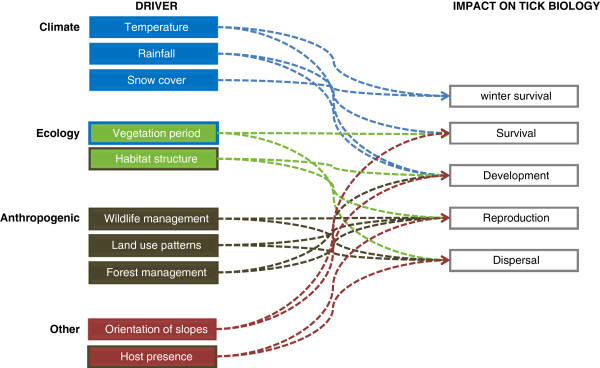
Many factors are involved in determining the latitudinal and altitudinal spread of the important tick vector Ixodes ricinus (Acari: Ixodidae) in Europe, as well as in changes in the distribution within its prior endemic zones. This paper builds on published literature and unpublished expert opinion from the VBORNET network with the aim of reviewing the evidence for these changes in Europe and discusses the many climatic, ecological, landscape and anthropogenic drivers. These can be divided into those directly related to climatic change, contributing to an expansion in the tick's geographic range at extremes of altitude in central Europe, and at extremes of latitude in Scandinavia; those related to changes in the distribution of tick hosts, particularly roe deer and other cervids; other ecological changes such as habitat connectivity and changes in land management; and finally, anthropogenically induced changes. These factors are strongly interlinked and often not well quantified. Although a change in climate plays an important role in certain geographic regions, for much of Europe it is non-climatic factors that are becoming increasingly important. How we manage habitats on a landscape scale, and the changes in the distribution and abundance of tick hosts are important considerations during our assessment and management of the public health risks associated with ticks and tick-borne disease issues in 21(st) century Europe. Better understanding and mapping of the spread of I. ricinus (and changes in its abundance) is, however, essential to assess the risk of the spread of infections transmitted by this vector species. Enhanced tick surveillance with harmonized approaches for comparison of data enabling the follow-up of trends at EU level will improve the messages on risk related to tick-borne diseases to policy makers, other stake holders and to the general public.
Overview
The claims and statistics of this paper haven’t been checked yet.
Run the check — free, no account needed. It reads the open-access text and checks the sources it cites.
Integrity signals
Registry
Cites
Statistics
Figures
Verification
Claims the paper makes
The claims and statistics of this paper haven’t been checked yet.
Run the check — free, no account needed. It reads the open-access text and checks the sources it cites.
Claims other papers make about this one
Each is checked against this paper’s own text: does it say what the citing paper says it does?
In the citing paper
“This could explain the result of five positive dogs (6%) that were microfilariae-positive and antigen-negative [35–37].”
From Prevalence of canine heartworm ( Dirofilaria immitis ) disease in dogs of central Portugal (2014) · cites this paper as [35]
Self-check
Percentages, sums and reported differences re-computed from the paper’s own numbers.
The self-check needs the paper’s full text.
Citations
Cites
Lindgren, E., Tälleklint, L., & Polfeldt, T. (2000) · Environmental Health Perspectives · doi:10.1289/ehp.00108119 · Cited by 558
Randolph, S. (2004) · Parasitology · doi:10.1017/s0031182004004925 · Cited by 509
Self-citationRizzoli, A. P., Hauffe, H. C., Carpi, G., Vourc’h, G., Neteler, M., & Rosà, R. (2011) · Eurosurveillance · doi:10.2807/ese.16.27.19906-en · Cited by 501
Self-citationJaenson, T. G. T., Jaenson, D. G. E., Eisen, L., Petersson, E., & Lindgren, E. (2012) · Parasites & Vectors · doi:10.1186/1756-3305-5-8 · Cited by 442
Self-citationAn empirical quantitative framework for the seasonal population dynamics of the tick Ixodes ricinus
Randolph, S., Green, R. M., Hoodless, A. N., & Peacey, M. (2002) · International Journal for Parasitology · doi:10.1016/s0020-7519(02)00030-9 · Cited by 332
Self-citationPerret, J.-L., Guigoz, E., Rais, O., & Gern, L. (2000) · Parasitology Research · doi:10.1007/s004360000209 · Cited by 301
Tick-borne bacterial diseases emerging in Europe
Parola, P., & Raoult, D. (2001) · Clinical Microbiology and Infection · doi:10.1046/j.1469-0691.2001.00200.x · Cited by 270
Cagnacci, F., Focardi, S., Heurich, M., Stache, A., Hewison, A. J. M., Morellet, N., Kjellander, P., Linnell, J. D. C., Mysterud, A., Neteler, M., et al. (2011) · Oikos · doi:10.1111/j.1600-0706.2011.19441.x · Cited by 250
Lindgren, E., & Jaenson, T. G. T. (2006) · Cited by 248
Self-citationGilbert, L. (2009) · Oecologia · doi:10.1007/s00442-009-1430-x · Cited by 247
Research works printed but not linked: 3
- Bullová M, Lukáň B, Peťko : Zmeny rozšírenia kliešťa obyčajného Ixodes ricinus v Západných Karpatoch Slovenska pod vplyvom klimatických zmien. Ecology and Veterinary medicine VII. 7th International Scientific Conference. 2008, Univerzita veterinarskeho lekarstva v Košiciach, 82-88.
- Hrkľová G, Nováková M, Chytra M, Kostova C, Petko B: Monitoring the distribution and abundance of Ixodes ricinus ticks in relevance of climate change and prevalence of Borrelia burgdorferi sensu lato in Northern Slovakia (Liptovska valley). Folia Veterinaria. 2008, 52 (2): 62-63.
- Santos-Silva MM, De Sousa R, Lopes De Carvalho I, Santos A, Nuncio S: Revive: A Portuguese networking program for the surveillance of ticks and tick-borne diseases. International Conference on Ticks and Tick-borne diseases, TTP 8. 2011b, Poster presentation, CD, Zaragoza, Spain
Cited by
Sorted by citations
Items 201–300 of 1,000
Zeimes, C., Olsson, G. E., Hjertqvist, M., & Vanwambeke, S. (2014) · Parasites & Vectors · doi:10.1186/1756-3305-7-370 · Cited by 48
Johnson, B. J., Mitchell, S. N., Paton, C. J., Stevenson, J., Staunton, K. M., Snoad, N., Beebe, N. W., White, B. J., & Ritchie, S. A. (2017) · PLoS neglected tropical diseases · doi:10.1371/journal.pntd.0005902 · Cited by 48
Hauck, D., Springer, A., Chitimia‐Dobler, L., & Strübe, C. (2020) · Ticks and Tick-borne Diseases · doi:10.1016/j.ttbdis.2020.101464 · Cited by 48
Fanelli, A. (2021) · Veterinary Parasitology · doi:10.1016/j.vetpar.2021.109433 · Cited by 48
Szekeres, S., Coipan, C. E., Rigó, K., Majoros, G., Jahfari, S., Sprong, H., & Földvári, G. (2014) · Ticks and Tick-borne Diseases · doi:10.1016/j.ttbdis.2014.10.004 · Cited by 47
Self-citationBlazejak, K., Raulf, M., Janecek, E., Jordan, D., Fingerle, V., & Strübe, C. (2018) · Parasites & Vectors · doi:10.1186/s13071-018-2882-9 · Cited by 47
How a Multidisciplinary ‘One Health’ Approach can Combat the Tick-Borne Pathogen Threat in Europe
Vayssier‐Taussat, M., Cosson, J., Degeilh, B., Éloit, M., Fontanet, A. L., Moutailler, S., Raoult, D., Sellal, E., Ungeheuer, M., & Zylbermann, P. (2015) · Future Microbiology · doi:10.2217/fmb.15.15 · Cited by 46
High prevalence of Borrelia burgdorferi s.l. in the European red squirrel Sciurus vulgaris in France
Pisanu, B., Chapuis, J., Dozières, A., Basset, F., Poux, V., & Vourc’h, G. (2013) · Ticks and Tick-borne Diseases · doi:10.1016/j.ttbdis.2013.07.007 · Cited by 52
Ethnoveterinary medicinal plants used by the Maale and Ari ethnic communities in southern Ethiopia
Kidane, B., van der Maesen, L. J. G., van Andel, T., & Asfaw, Z. (2014) · Journal of Ethnopharmacology · doi:10.1016/j.jep.2014.02.031 · Cited by 46
Rickettsial infection in Ixodes ricinus ticks in urban and natural habitats of Slovakia
Špitalská, E., Boldiš, V., Derdáková, M., Selyemová, D., & Tarageľová, V. R. (2013) · Ticks and Tick-borne Diseases · doi:10.1016/j.ttbdis.2013.10.002 · Cited by 46
Serologic screening for 13 infectious agents in roe deer (Capreolus capreolus) in Flanders
Tavernier, P., Sys, S. U., Clercq, K. D., Leeuw, I. D., Caij, A. B., Baere, M. D., Regge, N. D., Frétin, D., Roupie, V., Govaerts, M., et al. (2015) · Infection Ecology & Epidemiology · doi:10.3402/iee.v5.29862 · Cited by 46
Zavadska, D., Odzelevica, Z., Karelis, G., Liepiņa, L., Litauniece, Z. A., Bormane, A., Lucenko, I., Perevoščikovs, J., Brīdiņa, L., Veide, L., et al. (2018) · PLoS ONE · doi:10.1371/journal.pone.0204844 · Cited by 46
Self-citationMacDonald, A. J., McComb, S., O’Neill, C. A., Padgett, K. A., & Larsen, A. (2020) · Global Change Biology · doi:10.1111/gcb.15269 · Cited by 44
Assessing the effects of variables and background selection on the capture of the tick climate niche
Estrada‐Peña, A., Estrada-Sánchez, A., Estrada-Sánchez, D., & de la Fuente, J. (2013) · International Journal of Health Geographics · doi:10.1186/1476-072x-12-43 · Cited by 45
Self-citationRaghavan, R. K., Goodin, D. G., Hanzlicek, G., Zolnerowich, G., Dryden, M. W., Anderson, G. A., & Ganta, R. R. (2016) · Vector-Borne and Zoonotic Diseases · doi:10.1089/vbz.2015.1837 · Cited by 45
Sapp, S. G. H., Gupta, P., Martin, M. K., Murray, M. H., Niedringhaus, K. D., Pfaff, M. A., & Yabsley, M. J. (2017) · International Journal for Parasitology Parasites and Wildlife · doi:10.1016/j.ijppaw.2017.04.003 · Cited by 45
Ražanskė, I., Rosef, O., Radzijevskaja, J., Bratchikov, M., Griciuvienė, L., & Paulauskas, A. (2019) · International Journal for Parasitology Parasites and Wildlife · doi:10.1016/j.ijppaw.2019.01.003 · Cited by 45
Reiner, R. C., Stoddard, S. T., Vazquez‐Prokopec, G. M., Astete, H., Perkins, T. A., Sihuincha, M. G., Stancil, J. D., Smith, D. L., Kochel, T. J., Halsey, E. S., et al. (2019) · PLoS neglected tropical diseases · doi:10.1371/journal.pntd.0007255 · Cited by 45
Increased temperatures reduce the vectorial capacity of Aedes mosquitoes for Zika virus
Onyango, M. G., Bialosuknia, S. M., Payne, A. F., Mathias, N., Kuo, L., Vigneron, A., DeGennaro, M., Ciota, A. T., & Kramer, L. D. (2020) · Emerging Microbes & Infections · doi:10.1080/22221751.2019.1707125 · Cited by 45
Toxicity of 25 synthetic insecticides to the field population of Culex quinquefasciatus Say
Shah, R. M., Alam, M., Ahmad, D., Waqas, M., Ali, Q., Binyamin, M., & Shad, S. A. (2016) · Parasitology Research · doi:10.1007/s00436-016-5218-8 · Cited by 44
Global Spread of Hemorrhagic Fever Viruses: Predicting Pandemics
Gonzalez, J., Souris, M., & Valdivia-Granda, W. (2017) · Methods in molecular biology · doi:10.1007/978-1-4939-6981-4_1 · Cited by 44
Kubiak, K., Dziekońska-Rynko, J., Szymańska, H., Kubiak, D., Dmitryjuk, M., & Dzika, E. (2019) · Experimental and Applied Acarology · doi:10.1007/s10493-019-00379-z · Cited by 44
Milali, M. P., Sikulu-Lord, M. T., Kiware, S. S., Dowell, F. E., Corliss, G. F., & Povinelli, R. J. (2019) · PLoS ONE · doi:10.1371/journal.pone.0209451 · Cited by 46
Pawełczyk, A., Bednarska, M., Hamera, A., Religa, E., Poryszewska, M., Mierzejewska, E. J., & Welc-Falęciak, R. (2021) · Parasites & Vectors · doi:10.1186/s13071-021-04849-5 · Cited by 44
First isolation of Rickettsia monacensis from a patient in South Korea
Kim, Y., Choi, Y., Lee, K., Ahn, K., Kim, H., Klein, T., Jiang, J., Richards, A., Park, K., & Jang, W. (2017) · Microbiology and Immunology · doi:10.1111/1348-0421.12496 · Cited by 48
Tick-Borne Bacterial Diseases in Europe: Threats to public health
Pustijanac, E., Buršić, M., Millotti, G., Paliaga, P., Iveša, N., & Cvek, M. (2024) · European Journal of Clinical Microbiology & Infectious Diseases · doi:10.1007/s10096-024-04836-5 · Cited by 43
Ixodes ricinus and Borrelia prevalence at the Arctic Circle in Norway
Hvidsten, D., Stuen, S., Jenkins, A., Dienus, O., Olsen, R. S., Kristiansen, B., Mehl, R., & Matussek, A. (2013) · Ticks and Tick-borne Diseases · doi:10.1016/j.ttbdis.2013.09.003 · Cited by 43
Projecting the potential distribution of ticks in China under climate and land use change
Yang, X. Y., Gao, Z., Wang, L., Xiao, L., Dong, N., Wu, H., & Li, S. (2021) · International Journal for Parasitology · doi:10.1016/j.ijpara.2021.01.004 · Cited by 43
Resistance to Ticks and the Path to Anti-Tick and Transmission Blocking Vaccines
van Oosterwijk, J. G., & Wikel, S. K. (2021) · Vaccines · doi:10.3390/vaccines9070725 · Cited by 43
Food-Borne Transmission of Tick-Borne Encephalitis Virus—Spread, Consequences, and Prophylaxis
Buczek, A. M., Buczek, W., Buczek, A. M., & Wysokińska‐Miszczuk, J. (2022) · International Journal of Environmental Research and Public Health · doi:10.3390/ijerph19031812 · Cited by 43
Integrated surveillance for prevention and control of emerging vector-borne diseases in Europe
Semenza, J. C., & Zeller, H. G. (2014) · Eurosurveillance · doi:10.2807/1560-7917.es2014.19.13.20757 · Cited by 42
Self-citationSpringer, Y. P., Hoekman, D. A., Johnson, P. T. J., Duffy, P. A., Hufft, R. A., Barnett, D. T., Allan, B. F., Amman, B. R., Barker, C. M., Barrera, R., et al. (2016) · Ecosphere · doi:10.1002/ecs2.1271 · Cited by 44
García-Sánchez, D., Agudelo, G. A. P., & Quintero, J. (2017) · Journal of Vector Ecology · doi:10.1111/jvec.12269 · Cited by 41
Mysterud, A., Stigum, V. M., Seland, I. V., Herland, A., Easterday, W. R., Jore, S., Østerås, O., & Viljugrein, H. (2018) · Parasites & Vectors · doi:10.1186/s13071-018-2890-9 · Cited by 42
Maaz, D., Krücken, J., Blümke, J., Richter, D., McKay-Demeler, J., Matuschka, F., Hartmann, S., & von Samson‐Himmelstjerna, G. (2018) · PLoS ONE · doi:10.1371/journal.pone.0199385 · Cited by 42
Chavy, A., Nabet, C., Normand, A., Kocher, A., Ginouvès, M., Prévot, G., dos Santos, T. V., Demar, M., Piarroux, R., & de Thoisy, B. (2019) · PLoS neglected tropical diseases · doi:10.1371/journal.pntd.0007031 · Cited by 42
Diversity of Borrelia burgdorferi sensu lato in ticks and small mammals from different habitats
Król, N., Obiegala, A., Imholt, C., Arz, C., Schmidt, E. M., Jeske, K., Ulrich, R. G., Rentería-Solís, Z. M., Jacob, J., & Pfeffer, M. (2022) · Parasites & Vectors · doi:10.1186/s13071-022-05326-3 · Cited by 42
Impact of climate change on vector- and rodent-borne infectious diseases
Beermann, S., Dobler, G., Faber, M. S., Frank, C., Habedank, B., Hagedorn, P., Kampen, H., Kuhn, C., Nygren, T. M., Schmidt‐Chanasit, J., et al. (2023) · PubMed Central · doi:10.25646/11401 · Cited by 41
Okoyo, C. O., Simiyu, E. W., Njenga, S. M., & Mwandawiro, C. S. (2018) · BMC Public Health · doi:10.1186/s12889-018-5414-9 · Cited by 41
Circumpolar diversification of the Ixodes uriae tick virome
Pettersson, J. H. ‐., Ellström, P., Ling, J., Nilsson, I., Bergström, S., González‐Acuña, D., Olsén, B., & Holmes, E. C. (2020) · PLoS Pathogens · doi:10.1371/journal.ppat.1008759 · Cited by 41
Guidolin, A. S., & Cônsoli, F. L. (2016) · Microbial Ecology · doi:10.1007/s00248-016-0892-8 · Cited by 40
Kada, S., McCoy, K. D., & Boulinier, T. (2017) · Parasites & Vectors · doi:10.1186/s13071-017-2261-y · Cited by 39
Yang, L., Turo, K. J., Riley, C. B., Inocente, E. A., Tian, J., Hoekstra, N. C., Piermarini, P. M., & Gardiner, M. M. (2019) · Urban Ecosystems · doi:10.1007/s11252-019-00857-7 · Cited by 42
Gupta, P., Vishnudas, C. K., Robin, V. V., & Dharmarajan, G. (2020) · Parasites & Vectors · doi:10.1186/s13071-020-04404-8 · Cited by 40
High Aedes spp. larval indices in Kinshasa, Democratic Republic of Congo
Wat’senga, F., Sylvie, F., Manzambi, E. Z., Marquetti, M. D. C., Mbuka, G. B., Ilombe, G., Takasongo, R. M., Smitz, N., Bisset, J. A., Bortel, W. V., et al. (2021) · Parasites & Vectors · doi:10.1186/s13071-021-04588-7 · Cited by 40
Climate change accelerates winter transmission of a zoonotic pathogen
Sipari, S., Khalil, H., Magnusson, M., Evander, M., Hörnfeldt, B., & Ecke, F. (2021) · AMBIO · doi:10.1007/s13280-021-01594-y · Cited by 45
Singh, A., Banerjee, T., Khan, U., & Shukla, S. K. (2021) · PLoS neglected tropical diseases · doi:10.1371/journal.pntd.0009762 · Cited by 40
Boehnke, D., Gebhardt, R., Petney, T. N., & Norra, S. (2017) · Parasites & Vectors · doi:10.1186/s13071-017-2498-5 · Cited by 40
Factors affecting the ecology of tick-borne encephalitis in Slovenia
Knap, N., & Avšič‐Županc, T. (2015) · Epidemiology and Infection · doi:10.1017/s0950268815000485 · Cited by 39
The influence of natural factors on the spatio-temporal distribution of Oncomelania hupensis
Cheng, G., Li, D., Zhuang, D., & Wang, Y. (2016) · Acta Tropica · doi:10.1016/j.actatropica.2016.09.017 · Cited by 38
A Mini-Review of Ixodes Ticks Climate Sensitive Infection Dispersion Risk in the Nordic Region
van Oort, B., Hovelsrud, G. K., Risvoll, C., Mohr, C. W., & Jore, S. (2020) · International Journal of Environmental Research and Public Health · doi:10.3390/ijerph17155387 · Cited by 39
Ticks and their epidemiological role in Slovakia: from the past till present
Stanko, M., Derdáková, M., Špitalská, E., & Kazimírová, M. (2021) · Biologia · doi:10.1007/s11756-021-00845-3 · Cited by 39
Epidemiological Trends of Trans-Boundary Tick-Borne Encephalitis in Europe, 2000–2019
Wondim, M. A., Czupryna, P., Pancewicz, S. A., Kruszewska, E., Groth, M., & Moniuszko-Malinowska, A. M. (2022) · Pathogens · doi:10.3390/pathogens11060704 · Cited by 39
Raghavan, R. K., Goodin, D. G., Neises, D. J., Anderson, G. A., & Ganta, R. R. (2016) · PLoS ONE · doi:10.1371/journal.pone.0150180 · Cited by 39
Kjær, L. J., Schou, K. K., Soleng, A., Edgar, K. S., Lindstedt, H. E. H., Paulsen, K. M., Andreassen, Å. K., Korslund, L., Kjelland, V., Slettan, A., et al. (2020) · Scientific Reports · doi:10.1038/s41598-020-76334-5 · Cited by 38
Svitálková, Z., Haruštiaková, D., Mahríková, L., Mojšová, M., Berthová, L., Slovák, M., Kocianová, E., Vayssier‐Taussat, M., & Kazimírová, M. (2016) · Parasites & Vectors · doi:10.1186/s13071-015-1287-2 · Cited by 38
Bartley, P. M., Hamilton, C. M., Wilson, C., Innes, E. A., & Katzer, F. (2016) · Parasites & Vectors · doi:10.1186/s13071-016-1364-1 · Cited by 38
Surveillance of Ixodes ricinus ticks (Acari: Ixodidae) in Iceland
Alfreðsson, M., Ólafsson, E., Eydal, M., Unnsteinsdóttir, E. R., Hansford, K. M., Wint, W., Alexander, N. S., & Medlock, J. M. (2017) · Parasites & Vectors · doi:10.1186/s13071-017-2375-2 · Cited by 38
Self-citationHansford, K. M., Pietzsch, M. E., Cull, B., Gillingham, E. L., & Medlock, J. M. (2017) · Veterinary Record · doi:10.1136/vr.104263 · Cited by 38
Self-citationWang, Y., Casajus, N., Buddle, C. M., Berteaux, D., & Larrivée, M. (2018) · PLoS ONE · doi:10.1371/journal.pone.0201094 · Cited by 38
Cafiso, A., Sassera, D., Romeo, C., Serra, V., Hervet, C., Bandi, C., Plantard, O., & Bazzocchi, C. (2018) · Ticks and Tick-borne Diseases · doi:10.1016/j.ttbdis.2018.08.008 · Cited by 38
Self-citationAll Roads Lead to Cytosol: Trypanosoma cruzi Multi-Strategic Approach to Invasion
Ferri, G., & Edreira, M. M. (2021) · Frontiers in Cellular and Infection Microbiology · doi:10.3389/fcimb.2021.634793 · Cited by 38
Hönig, V., Švec, P., Halas, P., Vavrušková, Z., Tykalová, H., Kilián, P., Vetiskova, V., Dorňáková, V., Sterbova, J., Šimonová, Z., et al. (2015) · Ticks and Tick-borne Diseases · doi:10.1016/j.ttbdis.2015.04.010 · Cited by 38
Pelsmaeker, N. D., Korslund, L., & Steifetten, Ø. (2021) · Parasites & Vectors · doi:10.1186/s13071-021-04604-w · Cited by 37
Risk of tick-borne zoonoses in urban green areas: A case study from Turin, northwestern Italy
Bellato, A., Pintore, M. D., Catelan, D., Pautasso, A., Torina, A., Rizzo, F., Mandola, M. L., Mannelli, A., Casalone, C., & Tomassone, L. (2021) · Urban forestry & urban greening · doi:10.1016/j.ufug.2021.127297 · Cited by 37
Transovarial transmission of pathogenic protozoa and rickettsial organisms in ticks
Ravindran, R., Hembram, P. K., Kumar, G. S., Kumar, K. G. A., Deepa, C. K., & Varghese, A. (2023) · Parasitology Research · doi:10.1007/s00436-023-07792-9 · Cited by 37
Probst, J., Springer, A., & Strübe, C. (2023) · Parasites & Vectors · doi:10.1186/s13071-023-05693-5 · Cited by 37
Biological control of Ixodes ricinus larvae and nymphs with Metarhizium anisopliae blastospores
Wassermann, M., Selzer, P., Steidle, J. L. M., & Ute Mackenstedt, A. (2016) · Ticks and Tick-borne Diseases · doi:10.1016/j.ttbdis.2016.03.010 · Cited by 37
Fikrig, K., Johnson, B. J., Fish, D., & Ritchie, S. A. (2017) · Parasites & Vectors · doi:10.1186/s13071-016-1946-y · Cited by 37
Kocher, A., Valière, S., Bañuls, A., & Murienne, J. (2017) · Parasitology · doi:10.1017/s0031182017002013 · Cited by 37
Andersen, N. S., Larsen, S. L., Olesen, C. R., Stiasny, K., Kolmos, H. J., Jensen, P., & Skarphéðinsson, S. (2018) · Ticks and Tick-borne Diseases · doi:10.1016/j.ttbdis.2018.09.007 · Cited by 37
Self-citationTrypanosoma sp. diversity in Amazonian bats (Chiroptera; Mammalia) from Acre State, Brazil
Santos, F. C. B. D., Lisboa, C. V., Xavier, S. C. D. C., Dario, M. A., Verde, R. D. S., Calouro, A. M., Roque, A. L. R., & Jansen, A. M. (2017) · Parasitology · doi:10.1017/s0031182017001834 · Cited by 37
Hills, S. L., Poehling, K. A., Chen, W. H., & Staples, J. E. (2023) · MMWR Recommendations and Reports · doi:10.15585/mmwr.rr7205a1 · Cited by 36
Eisen, R. J., & Eisen, L. (2023) · Ticks and Tick-borne Diseases · doi:10.1016/j.ttbdis.2023.102286 · Cited by 36
Boulanger, N., Aran, D., Maul, A., Camara, B. I., Barthel, C., Zaffino, M., Lett, M.-C., Schnitzler, A., & Bauda, P. (2024) · Scientific Reports · doi:10.1038/s41598-024-59867-x · Cited by 36
Сироткин, М. Б., & Коренберг, Э. И. (2018) · Entomological Review · doi:10.1134/s0013873818040115 · Cited by 36
Hofmeester, T. R., Krawczyk, A. I., van Leeuwen, A. D., Fonville, M., Montizaan, M., Berge, K. V. D., Gouwy, J., Ruyts, S. C., Verheyen, K., & Sprong, H. (2018) · Parasites & Vectors · doi:10.1186/s13071-018-3126-8 · Cited by 36
Self-citationSpatial overlaps in the distribution of HIV/AIDS and malaria in Zimbabwe
Gwitira, I., Murwira, A., Mberikunashe, J., & Masocha, M. (2018) · BMC Infectious Diseases · doi:10.1186/s12879-018-3513-y · Cited by 36
Cella, W., Baía-da-Silva, D. C., de Melo, G. C., Tadei, W. P., Sampaio, V. D. S., Pimenta, P. F. P., Lacerda, M., & Monteiro, W. M. (2019) · Revista da Sociedade Brasileira de Medicina Tropical · doi:10.1590/0037-8682-0308-2019 · Cited by 38
Entomopathogenic Fungi: A Potential Source for Biological Control of Insect Pests
Sharma, A., Srivastava, A., Shukla, A. K., Srivastava, K., Srivastava, A. K., & Saxena, A. K. (2020) · Springer eBooks · doi:10.1007/978-981-15-3151-4_9 · Cited by 36
Víchová, B., Miterpáková, M., & Iglódyová, A. (2014) · Veterinary Parasitology · doi:10.1016/j.vetpar.2014.01.022 · Cited by 36
Mkenda, P. A., Stevenson, P. C., Ndakidemi, P. A., Farman, D. I., & Belmain, S. R. (2015) · International Journal of Tropical Insect Science · doi:10.1017/s174275841500017x · Cited by 36
Danger on the track? Tick densities near recreation infrastructures in forests
Gestel, M. V., Verheyen, K., Matthysen, E., & Heylen, D. (2021) · Urban forestry & urban greening · doi:10.1016/j.ufug.2021.126994 · Cited by 35
Hansford, K. M., Gillingham, E. L., Vaux, A. G. C., Cull, B., McGinley, L., Catton, M., Wheeler, B. W., Tschirren, B., & Medlock, J. M. (2022) · Ticks and Tick-borne Diseases · doi:10.1016/j.ttbdis.2022.102103 · Cited by 35
Self-citationMartello, E., Mannelli, A., Ragagli, C., Ambrogi, C., Selmi, M., Ceballos, L. A., & Tomassone, L. (2014) · Ticks and Tick-borne Diseases · doi:10.1016/j.ttbdis.2014.07.021 · Cited by 35
Public Health and Vector‐Borne Diseases – A New Concept for Risk Governance
Schmidt, K., Dressel, K., Niedrig, M., Mertens, M., Schüle, S. A., & Groschup, M. H. (2013) · Zoonoses and Public Health · doi:10.1111/zph.12045 · Cited by 35
Survey of selected tick-borne diseases in dogs in Finland
Vera, C. P., Kapiainen, S., Junnikkala, S., Aaltonen, K., Spillmann, T., & Vapalahti, O. P. (2014) · Parasites & Vectors · doi:10.1186/1756-3305-7-285 · Cited by 35
Pennington, M. J., Prager, S. M., Walton, W. E., & Trumble, J. T. (2016) · Scientific Reports · doi:10.1038/srep21969 · Cited by 35
de Castro, D. S. B., Silva, D. B., Tibúrcio, J. D., Sobral, M. E. G., Ferraz, V. P., Taranto, A. G., Serrão, J. É., de Siqueira, J. M., & Alves, S. N. (2016) · Experimental Parasitology · doi:10.1016/j.exppara.2016.10.008 · Cited by 34
Estrada‐Peña, A., & de la Fuente, J. (2017) · Frontiers in Cellular and Infection Microbiology · doi:10.3389/fcimb.2017.00405 · Cited by 35
Self-citationModelling and mapping tick dynamics using volunteered observations
Garcia‐Martí, I., Zurita‐Milla, R., van Vliet, A. J. H., & Takken, W. (2017) · International Journal of Health Geographics · doi:10.1186/s12942-017-0114-8 · Cited by 35
Prevalence and distribution of Babesia and Theileria species in roe deer from Spain
Remesar, S., Díaz, P., Prieto, A., Markina, F., Cao, J. M. D., López‐Lorenzo, G., Fernández, G., López, C. M., Fontán, R. P., Díez-Baños, P., et al. (2019) · International Journal for Parasitology Parasites and Wildlife · doi:10.1016/j.ijppaw.2019.05.005 · Cited by 35
Modelling habitat suitability for occurrence of human tick-borne encephalitis (TBE) cases in Finland
Uusitalo, R., Siljander, M., Dub, T., Sane, J., Sormunen, J. J., Pellikka, P., & Vapalahti, O. P. (2020) · Ticks and Tick-borne Diseases · doi:10.1016/j.ttbdis.2020.101457 · Cited by 35
Ahmed, T. H., Saunders, T. R., Mullins, D. E., Rahman, M. Z., & Zhu, J. (2020) · PLoS neglected tropical diseases · doi:10.1371/journal.pntd.0008669 · Cited by 37
Norte, A. C., Boyer, P., Castillo‐Ramírez, S., Chvostáč, M., Brahami, M. O., Rollins, R. E., Woudenberg, T., Didyk, Y. M., Derdáková, M., Núncio, M. S., et al. (2021) · Microorganisms · doi:10.3390/microorganisms9050933 · Cited by 35
Environmental Factors Driving Fine-Scale Ixodid Tick Abundance Patterns
Peralbo‐Moreno, A., Baz‐Flores, S., Cuadrado‐Matías, R., Barroso, P., Triguero‐Ocaña, R., Jiménez‐Ruiz, S., Herraiz, C., Ruiz‐Rodríguez, C., Acevedo, P., & Ruiz‐Fons, F. (2022) · The Science of The Total Environment · doi:10.1016/j.scitotenv.2022.158633 · Cited by 35
Wint, W., Balenghien, T., Berriatua, E., Braks, M. A. H., Marsboom, C., Medlock, J. M., Schaffner, F., Bortel, W. V., Alexander, N. S., Alten, B., et al. (2023) · Eurosurveillance · doi:10.2807/1560-7917.es.2023.28.26.2200666 · Cited by 35
Self-citationAl-Khafaji, A. M., Clegg, S. R., Pinder, A. C., Luu, L., Hansford, K. M., Seelig, F., Dinnis, R. E., Margos, G., Medlock, J. M., Feil, E. J., et al. (2018) · Ticks and Tick-borne Diseases · doi:10.1016/j.ttbdis.2018.08.016 · Cited by 35
Self-citationDubey, S., Shrinet, J., Jain, J., Ali, S., & Sunil, S. (2017) · Scientific Reports · doi:10.1038/s41598-017-18043-0 · Cited by 35
Răileanu, C., Tauchmann, O., Vasić, A., Wöhnke, E., & Silaghi, C. (2020) · Parasites & Vectors · doi:10.1186/s13071-020-3969-7 · Cited by 34
Metadata
- Authors
- Medlock, J. M., Hansford, K. M., Bormane, A., Derdakova, M., Estrada-Peña, A., George, J.-C., Golovljova, I., Jaenson, T. G. T., Jensen, J.-K., Jensen, P. M., Kazimirova, M., Oteo, J. A., Papa, A., Pfister, K., Plantard, O., Randolph, S. E., Rizzoli, A., Santos-Silva, M. M., Sprong, H., Vial, L., Hendrickx, G., Zeller, H., & Van Bortel, W.
- Affiliations
- Health Protection Agency (GB)
- National Institute for Health Development (EE)
- Uppsala University (SE)
- University of Copenhagen (DK)
- Hospital San Pedro (ES)
- Aristotle University of Thessaloniki (GR)
- Ludwig-Maximilians-Universität München (DE)
- Oniris (FR)
- University of Oxford (GB)
- Fondazione Edmund Mach (IT)
- National Institute for Public Health and the Environment (NL)
- Centre de Coopération Internationale en Recherche Agronomique pour le Développement (FR)
- Avia-GIS (Belgium) (BE)
- European Centre for Disease Prevention and Control (SE)
- Corresponding author
- Medlock, Jolyon M
- ORCID
- Venue
- Parasites & Vectors
- Published
- 2013-01-02
- Volume
- 6
- Issue
- 1
- Pages
- 1-1
- ISSN
- 1756-3305 (ISSN-L)
- PMC
- PMC3549795
- OpenAlex
- W2145987003
- Cited by
- 1,215
- References
- 94
- Citations by year
- 2026: 60 · 2025: 74 · 2024: 84 · 2023: 83 · 2022: 94 · 2021: 170 · 2020: 109 · 2019: 96 · 2018: 86 · 2017: 107 · 2016: 80 · 2015: 75 · 2014: 62 · 2013: 35
- FWCI
- 10.52
- Type
- journal article
- Language
- en
- Open access
- gold
- doi.org
- Licence
- Locations
- Parasites & Vectors (publishedVersion, cc-by)
- Europe PMC (PubMed Central) (publishedVersion, cc-by)
- PubMed Central (publishedVersion, cc-by)
- PubMed (publishedVersion)
- Research at the University of Copenhagen (University of Copenhagen) (publishedVersion, cc-by)
- CINECA IRIS Institutional Research Information System (Fondazione Edmund Mach) (submittedVersion, cc-by-nc-nd)
- Uppsala University Publications (Uppsala University) (submittedVersion, other-oa)
- HAL (submittedVersion, cc-by)
- Agritrop (Cirad) (submittedVersion)
- DOAJ (DOAJ: Directory of Open Access Journals) (submittedVersion)
- Open access LMU (Ludwid Maxmilian's Universitat Munchen) (submittedVersion)
- Portuguese National Funding Agency for Science, Research and Technology (RCAAP Project by FCT) (submittedVersion, other-oa)
- Rivm (National Institute for Public Health and the Environment) (submittedVersion)
- Funders
- European Commission (261504)
- European Centre for Disease Prevention and Control
- Topics
- Life Sciences › Immunology and Microbiology › Parasitology › Vector-borne infectious diseases
- Health Sciences › Medicine › Infectious Diseases › Viral Infections and Vectors
- Life Sciences › Agricultural and Biological Sciences › Ecology, Evolution, Behavior and Systematics › Study of Mite Species
- Keywords
- Ixodes ricinus, tick-borne diseases, climate change, roe deer, deer, habitat connectivity, land management, anthropogenic factors, tick surveillance, public health risk
- MeSH terms
- Animals, Europe, Ruminants, Ecosystem, Ixodes, Climate Change, Phylogeography
About these checks
Registry, retraction, Cites and statistics results are computed, not judged, with one exception: a printed reference that no index lists is read once by a model before it counts as a citation error. Claims are extracted by a model and kept only when their quote appears verbatim in the text; each cited source is then checked, with a model’s help, for whether it says what the claim relies on. Those verdicts can be wrong — read the claim’s quote and the cited source before relying on one.
Statistics and arithmetic are recomputed, not judged.
Confidence bands are shown only for fields calibrated on our annotated test set. None is calibrated yet, so no band is shown.
What counts as a claim ›How we measure confidence ›How we check this ›
Are you an author, or do you see a problem with this page? Request a review
