

EEG hyper-connectivity in high-risk infants is associated with later autism
Open accessThe DOI matches its Crossref record; 79 of the 79 references it cites were found in a registry or an index.
Abstract
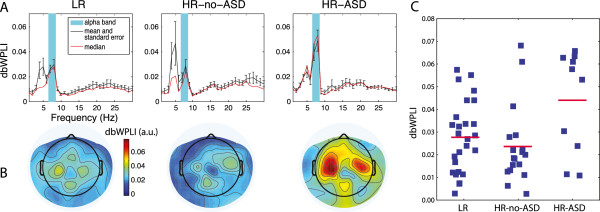
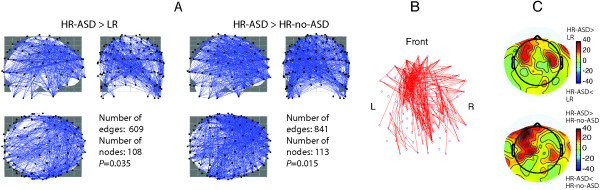
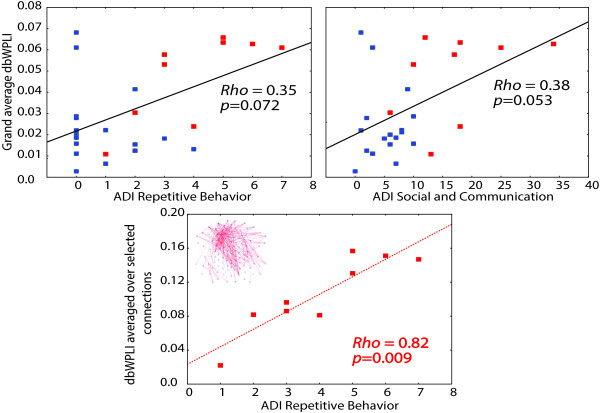
BACKGROUND: It has been previously reported that structural and functional brain connectivity in individuals with autism spectrum disorders (ASD) is atypical and may vary with age. However, to date, no measures of functional connectivity measured within the first 2 years have specifically associated with a later ASD diagnosis. METHODS: In the present study, we analyzed functional brain connectivity in 14-month-old infants at high and low familial risk for ASD using electroencephalography (EEG). EEG was recorded while infants attended to videos. Connectivity was assessed using debiased weighted phase lag index (dbWPLI). At 36 months, the high-risk infants were assessed for symptoms of ASD. RESULTS: As a group, high-risk infants who were later diagnosed with ASD demonstrated elevated phase-lagged alpha-range connectivity as compared to both low-risk infants and high-risk infants who did not go on to ASD. Hyper-connectivity was most prominent over frontal and central areas. The degree of hyper-connectivity at 14 months strongly correlated with the severity of restricted and repetitive behaviors in participants with ASD at 3 years. These effects were not attributable to differences in behavior during the EEG session or to differences in spectral power. CONCLUSIONS: The results suggest that early hyper-connectivity in the alpha frequency range is an important feature of the ASD neurophysiological phenotype.
Overview
The claims and statistics of this paper haven’t been checked yet.
Free: it reads the open-access text and checks the first 5 claims that cite a source we can check. Create a free account to check every claim.
Integrity signals
Registry
Cites
Statistics
Figures
Verification
Claims the paper makes
The claims and statistics of this paper haven’t been checked yet.
Free: it reads the open-access text and checks the first 5 claims that cite a source we can check. Create a free account to check every claim.
Claims other papers make about this one
Each is checked against this paper’s own text: does it say what the citing paper says it does?
The source backs part of the claim, not all of it — or backs it for a different population, condition or comparison.
In the citing paper
“our findings corroborate evidence for atypical oculomotor behavior [14] and increased frontal-occipital functional connectivity [17] during the first year of life of those infants that later develop autism symptoms, by suggesting that perturbations in general processes, such as perception or attention, are more important than previously believed in the developmental pathway to this disorder [18].”
From Enhanced Visual Search in Infancy Predicts Emerging Autism Symptoms (2015) · cites this paper as [17]
Experimental — accuracy not yet measured
Self-check
Percentages, sums and reported differences re-computed from the paper’s own numbers.
The self-check needs the paper’s full text.
Citations
Cites
Diagnostic and Statistical Manual of Mental Disorders
American Psychiatric Association (2013) · doi:10.1176/appi.books.9780890425596 · Cited by 116,369
Power, J. D., Barnes, K. A., Snyder, A. Z., Schlaggar, B. L., & Petersen, S. E. (2012) · NeuroImage · doi:10.1016/j.neuroimage.2011.10.018 · Cited by 7,429
EEG alpha oscillations: The inhibition–timing hypothesis
Klimesch, W., Sauseng, P., & Hanslmayr, S. (2007) · Brain Research Reviews · doi:10.1016/j.brainresrev.2006.06.003 · Cited by 3,891
Network-based statistic: identifying differences in brain networks
Zalesky, A., Fornito, A., & Bullmore, E. T. (2010) · NeuroImage · doi:10.1016/j.neuroimage.2010.06.041 · Cited by 2,750
Neocortical excitation/inhibition balance in information processing and social dysfunction
Yizhar, O., Fenno, L. E., Prigge, M., Schneider, F., Davidson, T. J., O’Shea, D. J., Sohal, V. S., Goshen, I., Finkelstein, J., Paz, J. T., et al. (2011) · Nature · doi:10.1038/nature10360 · Cited by 2,454
Stam, C. J., Nolte, G., & Daffertshofer, A. (2007) · Human Brain Mapping · doi:10.1002/hbm.20346 · Cited by 2,018
Identifying true brain interaction from EEG data using the imaginary part of coherency
Nolte, G., Bai, O., Wheaton, L., Mari, Z., Vorbach, S., & Hallett, M. (2004) · Clinical Neurophysiology · doi:10.1016/j.clinph.2004.04.029 · Cited by 1,756
Vinck, M., Oostenveld, R., van Wingerden, M., Battaglia, F., & Pennartz, C. M. A. (2011) · NeuroImage · doi:10.1016/j.neuroimage.2011.01.055 · Cited by 1,753
Just, M. A. (2004) · Brain · doi:10.1093/brain/awh199 · Cited by 1,589
New vistas for α-frequency band oscillations
Palva, S., & Palva, J. M. (2007) · Trends in Neurosciences · doi:10.1016/j.tins.2007.02.001 · Cited by 1,336
Cited by
Items 201–239 of 239
Automatic Detection and Assessment of Autism Spectrum Disorder: A Systematic Review
Manoharan, T. A., Menaka, R., & Karthik, R. (2021) · Advances in early childhood and K-12 education · doi:10.4018/978-1-7998-7630-4.ch020
Sharpley, C. F., Sarmukadam, K., Bitsika, V., McMillan, M., & Agnew, L. L. (2021) · Journal of Developmental and Physical Disabilities · doi:10.1007/s10882-021-09799-5
Artifact Removal of Visual Evoked Potentials in Autism Spectrum Disorders
Puthankattil, S. D., & Sheela, P. (2021) · Lecture notes in networks and systems · doi:10.1007/978-981-16-5120-5_17
Lockman, J. J., & Tamis‐LeMonda, C. S. (2020) · Cambridge University Press eBooks · doi:10.1017/9781108351959.031
EEG Connectivity During Social Engagement in Autism
Jaime, M. (2019) · Springer eBooks · doi:10.1007/978-1-4614-6435-8_102401-1
Lockman, J. J., & Tamis‐LeMonda, C. S. (2020) · Cambridge University Press eBooks · doi:10.1017/9781108351959.030
EEG Connectivity During Social Engagement in Autism
Jaime, M. (2021) · Springer eBooks · doi:10.1007/978-3-319-91280-6_102401
Savelyeva, N., Palchik, A. B., Kalashnikova, T. P., & Anisimov, G. V. (2022) · S S Korsakov Journal of Neurology and Psychiatry · doi:10.17116/jnevro202212209274
Sheela, P., & Puthankattil, S. D. (2022) · IEEE India Conference · doi:10.1109/indicon56171.2022.10040186
Eeg and Eye Tracking Multimodality Approach for Early Diagnosis of Autism Spectrum DisorderPreprint
Sun, B., Calvert, E. I., Wang, R., Wei, Z., Wu, Z.-L., Wang, X., & Kong, X. (2023) · SSRN Electronic Journal · doi:10.2139/ssrn.4510913
Bortfeld, H., & Bunge, S. A. (2024) · Cambridge University Press eBooks · doi:10.1017/9781108595827.008
Early screening of autism spectrum disorders: from cellular pathway to neural marker
Zhao, W., & Li, J. (2024) · Scientia Sinica Vitae · doi:10.1360/ssv-2023-0217
The Impact of Covid-19 Pandemic on Infants' Functional Brain Network DevelopmentPreprint
van der Velde, B., & Kemner, C. (2024) · SSRN Electronic Journal · doi:10.2139/ssrn.4852836
Haresign, I. M., Charman, T., Johnson, M. H., Mason, L., Bazelmans, T., Ali, J. B., Jones, E. J. H., & Wass, S. V. (2025) · bioRxiv (Cold Spring Harbor Laboratory) · doi:10.1101/2025.02.27.639836
Self-citationComparison of EEG pre-processing pipelines for spontaneous EEG data in a large neurodivergent cohort
Haartsen, R., Mason, L., Garcés, P., Bomatter, P., Hipp, J., Johnson, M. H., Buitelaar, J. K., Loth, E., Murphy, D., Jones, E. J. H., et al. (2025) · Open Research Europe · doi:10.12688/openreseurope.19664.1
Self-citationProceedings of the 2025 ISNR Annual Conference: Poster Presentations
International Society for Neuroregulation and Research (ISNR) (2025) · NeuroRegulation · doi:10.15540/nr.12.4.295
O’Reilly, C., Huberty, S., van Noordt, S. J. R., Desjardins, J. A., Wright, N., Scorah, J., Webb, S. J., & Elsabbagh, M. (2023) · Figshare · doi:10.6084/m9.figshare.24266051
Self-citationPapageorgopoulou, E. (2025) · BIROn (Birkbeck, University of London) · doi:10.18743/pub.00055026
Garcés, P., Baumeister, S., Mason, L., Chatham, C. H., Holiga, Š., Dukart, J., Jones, E. J. H., Banaschewski, T., Baron‐Cohen, S., Bölte, S., et al. (2022) · Figshare · doi:10.6084/m9.figshare.19793415
Self-citationvan Noordt, S. J. R., Desjardins, J. A., Huberty, S., Abou-Abbas, L., Webb, S. J., Levin, A. R., Segalowitz, S. J., Evans, A. C., & Elsabbagh, M. (2020) · Figshare · doi:10.6084/m9.figshare.12270278
Self-citationGurau, O. (2017) · Oxford University Research Archive (ORA) (University of Oxford) · doi:10.5287/ora-j0vb2dbe4
Language Development in Emerging Autism: Neural and Behavioral Mechanisms of Risk and Resilience
Cohenour, T. (2024) · eScholarship (California Digital Library)
Huberty, S. (2021) · eScholarship@McGill (McGill) · doi:10.82308/24361
Complex approach to assessment of neural and cognitive functions in children with risk for asd
Киселев, С. Ю., Львова, О. А., & Бакушкина, Н. И. (2016) · Electronic scientific archive of UrFU (Ural Federal University)
Functional connectivity in infants’ visual cortex and its links to motion processing and autism
Hardiansyah, I., Bussu, G., Bölte, S., Jones, E. J. H., & Falck‐Ytter, T. (2026) · Scientific Reports · doi:10.1038/s41598-026-42048-3
Self-citationD’Abate, L. (2021) · TSpace (University of Toronto)
Face processing in infants at elevated likelihood for autism: A systematic review and meta-analysis
Fico, K., Krol, M. A., Bussu, G., Gosling, C. J., Tye, C., Hunnius, S., & Buitelaar, J. K. (2026) · Research in Autism · doi:10.1016/j.reia.2026.202874
Deep learning for neurodevelopmental and psychiatric disorders
Massoud, Y. M., Kuhlmann, L., & Ghany, M. A. A. E. (2026) · Elsevier eBooks · doi:10.1016/b978-0-443-41459-6.00003-1
Network Analysis of Baseline EEG in 6- to 12-Month-Old Infants: Relations with Age and Temperament
Perone, S., & Gartstein, M. A. (2026) · Developmental Neuropsychology · doi:10.1080/87565641.2026.2651898
La mémoire chez l’adolescent avec autisme : électrophysiologie, cognition et prise en charge
Wantzen, P. (2019) · theses.fr (ABES) · doi:10.70675/14f5cf3dz8c44z4e1ezb486z5ecae3619a17
Conti, E., Ieri, F., Calderoni, S., Apicella, F., Chericoni, N., Costanzo, V., Marchi, V., Guzzetta, A., & Colombi, C. (2026) · Frontiers in Psychiatry · doi:10.3389/fpsyt.2026.1676968
Integrating EEG microstate dynamics in a stacked ensemble for neurodiagnostic ASD assessment
Kuriyakose, D., & Gowsalya, M. (2026) · Behavioural Brain Research · doi:10.1016/j.bbr.2026.116220
Thesis: Comparing Functional and Effective Brain Connectivity Metrics for EEG
Srishyla, D. (2025) · Scholar Commons (University of South Carolina)
Mandl, S., Chung, H., An, W. W., Thomas, R. P., Bose, A., Faja, S., & Wilkinson, C. L. (2026) · medRxiv · doi:10.64898/2026.06.03.26354124
Bertaccini, R. (2026) · AMS Dottorato Institutional Doctoral Theses Repository (University of Bologna) · doi:10.48676/unibo/amsdottorato/13177
Tanasache, V. N. (2023) · New Trends in Psychology
da Costa, M. F. R. L. M. (2020) · Portuguese National Funding Agency for Science, Research and Technology (RCAAP Project by FCT)
Ke, S. Y., Wu, H., Sun, H., Zhou, A., Liu, J., Zheng, X., Liu, K., Westover, M. B., Xu, H., & Kong, X.-J. (2024) · doi:10.3389/fnins.2024.1330556.s004
Metadata
- Authors
- The BASIS Team, Orekhova, E. V., Elsabbagh, M., Jones, E. J., Dawson, G., Charman, T., & Johnson, M. H.
- Affiliations
- Birkbeck, University of London (GB)
- McGill University (CA)
- Duke University (US)
- King's College London (GB)
- Corresponding author
- Orekhova, Elena V
- Venue
- Journal of Neurodevelopmental Disorders
- Published
- 2014-11-07
- Volume
- 6
- Issue
- 1
- Pages
- 40-40
- ISSN
- 1866-1947 (ISSN-L)
- 1866-1955
- PMC
- PMC4232695
- OpenAlex
- W2154205996
- Cited by
- 210
- References
- 79
- Citations by year
- 2026: 10 · 2025: 22 · 2024: 12 · 2023: 17 · 2022: 22 · 2021: 17 · 2020: 51 · 2019: 16 · 2018: 9 · 2017: 11 · 2016: 16 · 2015: 7
- FWCI
- 6.32
- Type
- journal article
- Language
- en
- Open access
- gold
- doi.org
- Licence
- cc-by
- Locations
- Journal of Neurodevelopmental Disorders (publishedVersion, cc-by)
- Europe PMC (PubMed Central) (publishedVersion, cc-by)
- PubMed Central (publishedVersion, cc-by)
- PubMed (publishedVersion)
- Research Explorer (The University of Manchester) (publishedVersion)
- BIROn (Birkbeck, University of London) (acceptedVersion)
- Research Portal (King's College London) (submittedVersion, public-domain)
- Funders
- Autism Speaks
- European Federation of Pharmaceutical Industries and Associations (FP7/20072013)
- National Institute for Health and Care Research (NF-SI-0510-10268)
- European Commission (2007–2013, FP7 2007-2013, 115300, FP7/2007)
- Innovative Medicines Initiative (FP7/2007‐2013, 115300)
- Medical Research Council (115300, MR/K021389/1, G0701484)
- Topics
- Life Sciences › Neuroscience › Cognitive Neuroscience › Autism Spectrum Disorder Research
- Life Sciences › Neuroscience › Cognitive Neuroscience › Functional Brain Connectivity Studies
- Life Sciences › Biochemistry, Genetics and Molecular Biology › Genetics › Genetics and Neurodevelopmental Disorders
- Keywords
- autism spectrum disorder, brain functional connectivity, familial risk, infants, restricted and repetitive behaviors, early biomarkers
About these checks
Registry, retraction, Cites and statistics results are computed, not judged, with one exception: a printed reference that no index lists is read once by a model before it counts as a citation error. Claims are extracted by a model and kept only when their quote appears verbatim in the text; each cited source is then checked, with a model’s help, for whether it says what the claim relies on. Those verdicts can be wrong — read the claim’s quote and the cited source before relying on one.
Statistics and arithmetic are recomputed, not judged.
Confidence bands are shown only for fields calibrated on our annotated test set. None is calibrated yet, so no band is shown.
What counts as a claim ›How we measure confidence ›How we check this ›
Are you an author, or do you see a problem with this page? Request a review
Data sources
Bibliographic data: Semantic Scholar, OpenAlex, Crossref.
Contains information from the Semantic Scholar Academic Graph Datasets, made available under the ODC Attribution License (ODC-BY 1.0).
Semantic Scholar’s data is described in: Kinney, R., et al. (2023). The Semantic Scholar Open Data Platform. arXiv:2301.10140.
