

The DOI matches its Crossref record; 40 of the 40 references it cites were found in a registry or an index.
Intranasal oxytocin versus placebo in the treatment of adults with autism spectrum disorders: a randomized controlled trial
Open accessAbstract
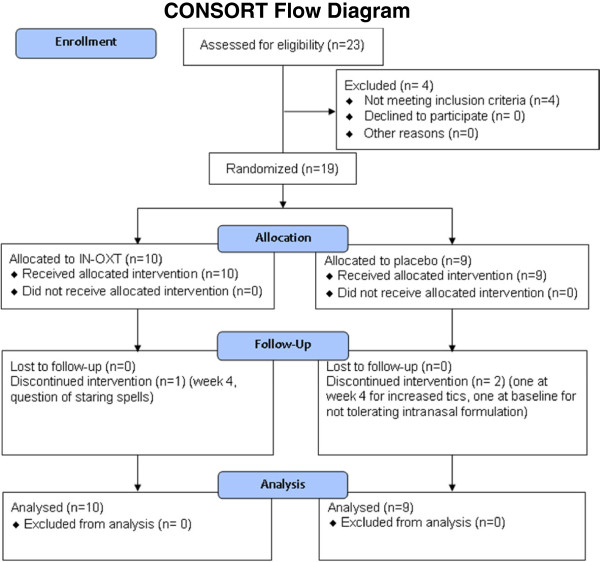
BACKGROUND: There are no effective medications for the treatment of social cognition/function deficits in autism spectrum disorder (ASD), and adult intervention literature in this area is sparse. Emerging data from animal models and genetic association studies as well as early, single-dose intervention studies suggest that the oxytocin system may be a potential therapeutic target for social cognition/function deficits in ASD. The primary aim of this study was to examine the safety/therapeutic effects of intranasal oxytocin versus placebo in adults with ASD, with respect to the two core symptom domains of social cognition/functioning and repetitive behaviors. METHODS: This was a pilot, randomized, double-blind, placebo-controlled, parallel design trial of intranasal oxytocin versus placebo in 19 adults with ASD (16 males; 33.20 ± 13.29 years). Subjects were randomized to 24 IU intranasal oxytocin or placebo in the morning and afternoon for 6 weeks. Measures of social function/cognition (the Diagnostic Analysis of Nonverbal Accuracy) and repetitive behaviors (Repetitive Behavior Scale Revised) were administered. Secondary measures included the Social Responsiveness Scale, Reading-the-Mind-in-the-Eyes Test and the Yale Brown Obsessive Compulsive Scale - compulsion subscale and quality of life (World Health Organization Quality of Life Questionnaire - emotional/social subscales). Full-information maximum-likelihood parameter estimates were obtained and tested using mixed-effects regression analyses. RESULTS: Although no significant changes were detected in the primary outcome measures after correcting for baseline differences, results suggested improvements after 6 weeks in measures of social cognition (Reading-the-Mind-in-the-Eyes Test, p = 0.002, d = 1.2), and quality of life (World Health Organization Quality of Life Questionnaire - emotion, p = 0.031, d = 0.84), both secondary measures. Oxytocin was well tolerated and no serious adverse effects were reported. CONCLUSIONS: This pilot study suggests that there is therapeutic potential to daily administration of intranasal oxytocin in adults with ASD and that larger and longer studies are warranted. TRIAL REGISTRATION: NCT00490802.
Overview
The claims and statistics of this paper haven’t been checked yet.
Run the check — free, no account needed. It reads the open-access text and checks the sources it cites.
Integrity signals
Registry
Cites
Statistics
Figures
Verification
Claims the paper makes
The claims and statistics of this paper haven’t been checked yet.
Run the check — free, no account needed. It reads the open-access text and checks the sources it cites.
Claims other papers make about this one
Each is checked against this paper’s own text: does it say what the citing paper says it does?
The source backs part of the claim, not all of it — or backs it for a different population, condition or comparison.
In the citing paper
“Recent studies have suggested that long-term oxytocin administration can alleviate the symptoms of autism spectrum disorder (ASD)”
From Oxytocin efficacy is modulated by dosage and oxytocin receptor genotype in young adults with high-functioning autism: a 24-week randomized clinical trial (2016) · cites this paper as [4]
Experimental — accuracy not yet measuredThe cited source says what the claim attributes to it.
In the citing paper
“Small, randomized, controlled trials of intranasal oxytocin administered for 4 to 24 weeks in persons with autism spectrum disorder have had equivocal results with regard to oxytocin-associated improvements in social functioning, social cognition, or social attention.18–21”
From Intranasal Oxytocin in Children and Adolescents with Autism Spectrum Disorder (2021) · cites this paper as [21]
In the citing paper
“Multiple lines of evidence suggest an involvement of dysregulated neurotransmitter systems (serotonergic, oxytocinergic and dopaminergic systems) in autism.”
From Vitamin D and Autism Spectrum Disorder: A Literature Review (2016) · cites this paper as [181]
In the citing paper
“These systems play key roles in neurotransmission, brain maturation, cortical organisation and behaviours (including social behaviour and repetitive behaviour) [180,181,182,183,184].”
From Vitamin D and Autism Spectrum Disorder: A Literature Review (2016) · cites this paper as [181]
In the citing paper
“Clinical trials of OT in autistic patients are ongoing, yet several studies have produced inconclusive results (4–8)”
From Oxytocin under opioid antagonism leads to supralinear enhancement of social attention (2017) · cites this paper as [6]
In the citing paper
“This route of administration has been validated for both OT (6, 71) and NAL (72–74) in previous human studies”
From Oxytocin under opioid antagonism leads to supralinear enhancement of social attention (2017) · cites this paper as [6]
In the citing paper
“Clinical trials examining core symptoms of ASD have failed to consistently demonstrate efficacy of intranasal OT treatment (Anagnostou et al., 2012; Dadds et al., 2014; Guastella et al., 2015; Hollander et al., 2007)”
From Parallel social information processing circuits are differentially impacted in autism (2020) · cites this paper as Anagnostou et al., 2012
In the citing paper
“There have been generally positive results of OXT in adults with ASD, with trials showing improvements in repetitive behaviors, social reciprocity, and emotion recognition [75–77].”
From An Update on Psychopharmacological Treatment of Autism Spectrum Disorder (2022) · cites this paper as [75]
In the citing paper
“However, all these trials studied only short-term benefits (within a few weeks) of OXT administration.”
From An Update on Psychopharmacological Treatment of Autism Spectrum Disorder (2022) · cites this paper as [75]
In the citing paper
“For example, oxytocin has been shown to increase gazing time on the eye region33, and to improve performance on the Reading the Mind in the Eyes Task in adults and adolescents with ASD48,49.”
From Randomized clinical trial shows no substantial modulation of empathy-related neural activation by intranasal oxytocin in autism (2021) · cites this paper as [49]
In the citing paper
“This pilot study suggested therapeutic potential with daily administration of IN-OT in this population of adults with ASD. This six-week study noted improvements in social cognition, quality of life, RRB, and some measures of emotional well-being with IN-OT, in essence, improvement in the core domains of ASD.”
From Oxytocin and vasopressin systems in genetic syndromes and neurodevelopmental disorders (2014) · cites this paper as Anagnostou et al., 2012
In the citing paper
“Taken together, findings of these initial multiple-dose trials provided indications for a more consistent (positive) pattern of results for OT trials with adults with ASD [8–10], compared to trials with children with ASD [11–14].”
From Behavioral effects of multiple-dose oxytocin treatment in autism: a randomized, placebo-controlled trial with long-term follow-up (2020) · cites this paper as [8]
In the citing paper
“Anagnostou et al. [8] assessed the safety and efficacy of 6 weeks of intranasal OT treatment on core autism symptom domains (social cognition/function and repetitive behaviors) in 19 adults with ASD (16 men, three women), and showed improved emotion recognition, quality of life, and tentative improvements in repetitive behaviors after OT treatment.”
From Behavioral effects of multiple-dose oxytocin treatment in autism: a randomized, placebo-controlled trial with long-term follow-up (2020) · cites this paper as [8]
In the citing paper
“The initial sample size (n = 40) was set to be comparable to three prior studies showing significant effects of multiple-dose OT treatment on similar outcome measures [8, 9, 17].”
From Behavioral effects of multiple-dose oxytocin treatment in autism: a randomized, placebo-controlled trial with long-term follow-up (2020) · cites this paper as [8]
In the citing paper
“In this view, it appears that beneficial effects of OT treatment on repetitive behaviors were mostly demonstrated in studies that adopted assessments based on self-reports (current study, [4, 8]), whereas no beneficial effects were evident in studies adopting informant-based reports of repetitive behavior [9–14].”
From Behavioral effects of multiple-dose oxytocin treatment in autism: a randomized, placebo-controlled trial with long-term follow-up (2020) · cites this paper as [8]
In the citing paper
“Overall, these observed effects on repetitive behaviors are in line with previous trials with adult men with ASD showing beneficial effects of OT on repetitive behaviors after 4 h of intravenous OT administration [4] and after 6 weeks of daily administrations [8, 10].”
From Behavioral effects of multiple-dose oxytocin treatment in autism: a randomized, placebo-controlled trial with long-term follow-up (2020) · cites this paper as [8]
In the citing paper
“Contrary to our findings, Anagnostou et al. [8] reported an OT-specific improvement in quality of life (socio-emotional section) after a 6-week treatment in adult men with ASD.”
From Behavioral effects of multiple-dose oxytocin treatment in autism: a randomized, placebo-controlled trial with long-term follow-up (2020) · cites this paper as [8]
In the citing paper
“Second, in the current study, participants administered the OT nasal spray once a day (in the morning) while the majority of prior multiple-dose OT studies administered two doses/day (one in the morning and one in the afternoon) ([8–10, 12–14], but see [11]).”
From Behavioral effects of multiple-dose oxytocin treatment in autism: a randomized, placebo-controlled trial with long-term follow-up (2020) · cites this paper as [8]
Self-check
Percentages, sums and reported differences re-computed from the paper’s own numbers.
The self-check needs the paper’s full text.
Citations
Cites
Lord, C., Rutter, M., & Le Couteur, A. (1994) · Journal of Autism and Developmental Disorders · doi:10.1007/bf02172145 · Cited by 9,065
The Yale-Brown Obsessive Compulsive Scale: I. Development, Use, and Reliability
Goodman, W. K. (1989) · Archives of General Psychiatry · doi:10.1001/archpsyc.1989.01810110048007 · Cited by 7,712
Lord, C., Risi, S., Lambrecht, L., Cook, E. H., Leventhal, B. L., DiLavore, P. C., Pickles, A., & Rutter, M. (2000) · Journal of Autism and Developmental Disorders · doi:10.1023/a:1005592401947 · Cited by 7,520
Skevington, S. M., Lotfy, M., & O'Connell, K. A. (2004) · Quality of Life Research · doi:10.1023/b:qure.0000018486.91360.00 · Cited by 4,686
Baron‐Cohen, S., Wheelwright, S., Hill, J., Raste, Y., & Plumb, I. (2001) · Journal of Child Psychology and Psychiatry · doi:10.1111/1469-7610.00715 · Cited by 4,555 · cited 2×
“In the analysis of secondary measures, significant improvements were noted on the RMET – Revised (t = 3.91, df = 9.01, p = 0.004, Cohen’s d effect size = 1.2) and the WHOQOL – emotional (t = 2.42, df = 10.89, p = 0.034, Cohen’s d effect size = 0.84) (Table 2).”
MethodInfluentialBaron‐Cohen, S., Wheelwright, S. J., Hill, J., Raste, Y., & Plumb, I. (2001) · PubMed · Cited by 4,313
Oxytocin increases trust in humans
Kosfeld, M., Heinrichs, M., Zak, P. J., Fischbacher, U., & Fehr, E. (2005) · Nature · doi:10.1038/nature03701 · Cited by 3,690
Strong association of de novo copy number mutations with autism
Sebat, J., Lakshmi, B., Malhotra, D., Troge, J., Lese-Martin, C., Walsh, T., Yamrom, B., Yoon, S., Krasnitz, A., Kendall, J., et al. (2007) · Science · doi:10.1126/science.1138659 · Cited by 2,795
The Yale-Brown Obsessive-Compulsive Scale: measures of internal consistency.
Kim, S.-W., Dysken, M., Pheley, A., & Hoover, K. M. (1994) · Psychiatry Research · doi:10.1016/0165-1781(94)90039-6 · Cited by 2,333
Oxytocin Modulates Neural Circuitry for Social Cognition and Fear in Humans
Kirsch, P., Esslinger, C., Chen, Q., Mier, D., Lis, S., Siddhanti, S., Gruppe, H., Mattay, V. S., Gallhofer, B., & Meyer-Lindenberg, A. (2005) · The Journal of Neuroscience · doi:10.1523/jneurosci.3984-05.2005 · Cited by 1,639
Research works printed but not linked: 1
- 10.1176/appi.neuropsych.23.3.332 · DOI
Cited by
Sorted by citations
Items 201–300 of 359
Friedman, N. D. B., Politte, L. C., Nowinski, L. A., & McDougle, C. J. (2015) · Wiley eBooks · doi:10.1002/9781118753378.ch44 · Cited by 17
The need for a comprehensive molecular characterization of autism spectrum disorders
Broek, J. A. C., Brombacher, E., Stelzhammer, V., Guest, P. C., Rahmoune, H., & Bahn, S. (2013) · The International Journal of Neuropsychopharmacology · doi:10.1017/s146114571300117x · Cited by 17
Targeted Biomedical Treatment for Autism Spectrum Disorders
Pacheva, I. H., & Ivanov, I. S. (2019) · Current Pharmaceutical Design · doi:10.2174/1381612825666191205091312 · Cited by 17
Pedersen, C. A., Chang, S. W. C., & Williams, C. L. (2014) · Brain Research · doi:10.1016/j.brainres.2014.07.033 · Cited by 17
Complexity of the Hypothalamic Oxytocin System and its Involvement in Brain Functions and Diseases
Cui, X., & Xiao, L. (2025) · Neuroscience Bulletin · doi:10.1007/s12264-025-01424-1 · Cited by 17
Oxytocin Receptor in Cerebellar Purkinje Cells Does Not Engage in Autism-Related Behaviors
Shen, L.-P., Li, W., Pei, L.-Z., Yin, J., Xie, S.-T., Li, H.-Z., Yan, C., Wang, J., Zhang, Q., Zhang, X., et al. (2022) · The Cerebellum · doi:10.1007/s12311-022-01466-5 · Cited by 16
Demartini, B., Nisticò, V., Limonta, S., Tarantino, V., Stefanelli, G., Calistro, F., Giambanco, L., Faggioli, R., Gambini, O., & Turriziani, P. (2023) · Journal of Autism and Developmental Disorders · doi:10.1007/s10803-023-06189-y · Cited by 16
An Update on Psychopharmacological Treatment of Autism Spectrum Disorder
Aishworiya, R., Valica, T., Hagerman, R. J., & Restrepo, B. (2024) · FOCUS The Journal of Lifelong Learning in Psychiatry · doi:10.1176/appi.focus.24022006 · Cited by 16
Oxytocin in neurodevelopmental disorders: Autism spectrum disorder and Prader-Willi syndrome
Josselsohn, A., Zhao, Y., Espinoza, D., & Hollander, E. (2024) · Pharmacology & Therapeutics · doi:10.1016/j.pharmthera.2024.108734 · Cited by 16
Self-citationKiani, Z., Farkhondeh, T., Aramjoo, H., Aschner, M., Beydokhti, H., Esmaeili, A., Arab‐Zozani, M., & Samarghandian, S. (2022) · CNS & Neurological Disorders - Drug Targets · doi:10.2174/1871527321666220517112612 · Cited by 16
Marazziti, D., Diep, P.-T., Carter, C. S., & Carbone, M. G. (2022) · Current Medicinal Chemistry · doi:10.2174/0929867329666220727120646 · Cited by 16
The neurobiological impact of oxytocin in mental health disorders: a comprehensive review
Chaulagain, R. P., Shrestha, Y., Shrestha, H., Bhandari, R., & Gurung, P. (2025) · Annals of Medicine and Surgery · doi:10.1097/ms9.0000000000003015 · Cited by 15
Fukai, M., Hirosawa, T., Kikuchi, M., Ouchi, Y., Takahashi, T., Yoshimura, Y., Miyagishi, Y., Kosaka, H., Yokokura, M., Yoshikawa, E., et al. (2017) · Psychiatry Research Neuroimaging · doi:10.1016/j.pscychresns.2017.06.015 · Cited by 15
Are there new advances in the pharmacotherapy of autism spectrum disorders?
Hollander, E., & Uzunova, G. (2017) · World Psychiatry · doi:10.1002/wps.20398 · Cited by 15
Self-citationMarsillo, A., David, L., Gerges, B. F. N., Kerr, D. J., Sadek, R., Lasiychuk, V., Salame, D., Soliman, Y., Menkes, S., Chatterjee, A., et al. (2020) · Biochimica et Biophysica Acta (BBA) - Molecular Basis of Disease · doi:10.1016/j.bbadis.2020.166048 · Cited by 15
Corbett, B. A., Bales, K. L., Swain, D. M., Sanders, K. B., Weinstein, T. A. R., & Muglia, L. J. (2016) · Journal of Neurodevelopmental Disorders · doi:10.1186/s11689-016-9165-6 · Cited by 14
Yoshimura, Y., Kikuchi, M., Hiraishi, H., Hasegawa, C., Hirosawa, T., Takahashi, T., Munesue, T., Kosaka, H., Hiagashida, H., & Minabe, Y. (2018) · Psychiatry Research Neuroimaging · doi:10.1016/j.pscychresns.2018.05.003 · Cited by 14
Wang, Y., Zhao, S., Wu, Z., Feng, Y., Zhao, C., & Zhang, C. (2015) · Clinical and Experimental Pharmacology and Physiology · doi:10.1111/1440-1681.12378 · Cited by 13
Is ‘bench-to-bedside’ realistic for autism? An integrative neuroscience approach
Bauman, M. D., & Schumann, C. M. (2013) · Neuropsychiatry · doi:10.2217/npy.13.18 · Cited by 13
Brain Mechanisms of Plasticity in Response to Treatments for Core Deficits in Autism
Ventola, P. E., Oosting, D., Anderson, L. C., & Pelphrey, K. A. (2013) · Progress in brain research · doi:10.1016/b978-0-444-63327-9.00007-2 · Cited by 13
Involvement of oxytocin receptor deficiency in psychiatric disorders and behavioral abnormalities
Wei, J., Zheng, H., Li, G., Chen, Z., Fang, G., & Yan, J. (2023) · Frontiers in Cellular Neuroscience · doi:10.3389/fncel.2023.1164796 · Cited by 13
Freitag, C. M., & Jarczok, T. A. (2014) · Springer eBooks · doi:10.1007/978-3-7091-1501-5_13 · Cited by 13
Chan, A. S.-Y., Sze, S. L., & Han, Y. M. Y. (2014) · Research in Autism · doi:10.1016/j.rasd.2014.03.007 · Cited by 13
Pierce, M. L., Mehrotra, S., Mustoe, A. C., French, J. A., & Murray, T. F. (2019) · Molecular Pharmacology · doi:10.1124/mol.118.114744 · Cited by 12
Lindenmaier, Z., Ellegood, J., Stuive, M., Easson, K., Yee, Y., Fernandes, D., Foster, J. A., Anagnostou, E. A., & Lerch, J. P. (2022) · NeuroImage · doi:10.1016/j.neuroimage.2022.119243 · Cited by 12
Self-citationThe effects of oxytocin administration on individuals with ASD: Neuroimaging and behavioral evidence
Baker, E. J., & Stavropoulos, K. K. M. (2020) · Progress in molecular biology and translational science · doi:10.1016/bs.pmbts.2020.04.009 · Cited by 12
Pantouli, F., Pujol, C., Derieux, C., Fonteneau, M., Pellissier, L. P., MARSOL, C., Karpenko, J., Bonnet, D., Hibert, M., Bailey, A., et al. (2024) · Neuropsychopharmacology · doi:10.1038/s41386-024-01915-1 · Cited by 11
Kong, X., Kang, J., & Liu, K. (2023) · Journal of Psychiatric Research · doi:10.1016/j.jpsychires.2023.08.006 · Cited by 11
Intranasal oxytocin as a treatment for anxiety and autism: From subclinical to clinical applications
Yin, H., Jiang, M., Han, T., & Xu, X. (2024) · Peptides · doi:10.1016/j.peptides.2024.171211 · Cited by 11
Therapeutic potential of CBD in Autism Spectrum Disorder
Pedrazzi, J. F. C., Hassib, L., Ferreira, F. R., Hallak, J. E. C., Del-Bel, E., & Crippa, J. A. S. (2024) · International review of neurobiology · doi:10.1016/bs.irn.2024.05.002 · Cited by 12
Current status of biological treatment options in Autism Spectrum Disorder
Eapen, V., Nicholls, L. E., Spagnol, V., & Mathew, N. E. (2017) · Asian Journal of Psychiatry · doi:10.1016/j.ajp.2017.07.025 · Cited by 11
Bhamidimarri, P. M., Alhosani, K., Cai, H., Al-Ali, H., Abukhaled, Y. M., Tawamie, H., Abdelaziz, S., Fawaz, M., Kashir, J., Sajjad, Y., et al. (2026) · Neurobiology of Disease · doi:10.1016/j.nbd.2025.107227 · Cited by 10
Ameringen, M. V., Fineberg, N. A., Ravindran, A. V., Arnold, P. D., Beaulieu, S., Brakoulias, V., Brietzke, E. M., Dowlati, Y., Drummond, L. M., Ferretti, C. J., et al. (2026) · Journal of Psychiatric Research · doi:10.1016/j.jpsychires.2025.12.039 · Cited by 12
Self-citationEffects of intranasal oxytocin on tactile perception
Silva, J. U., Galhardoni, R., de Andrade, D. C., & Brito, I. (2018) · Neuroscience Letters · doi:10.1016/j.neulet.2018.12.032 · Cited by 10
Placebo Effects in the Neuroendocrine System: Conditioning of the Oxytocin Responses
Skvortsova, A., Veldhuijzen, D. S., Pacheco‐López, G., Bakermans‐Kranenburg, M. J., van IJzendoorn, M. H., Smeets, M. A. M., Wilderjans, T. F., Dahan, A., den Bergh, O. V., Chavannes, N. H., et al. (2019) · Psychosomatic Medicine · doi:10.1097/psy.0000000000000759 · Cited by 10
A review of prevalence studies of Autism Spectrum Disorder by latitude and solar irradiance impact
Syed, S., Moore, K., & March, E. (2017) · Medical Hypotheses · doi:10.1016/j.mehy.2017.09.012 · Cited by 10
Oxytocin for the treatment of autism spectrum disorder in children
Griffiths, J. L., Mishaal, R. A., Nabetani, M., & Goldman, R. D. (2022) · Canadian Family Physician · doi:10.46747/cfp.6802103 · Cited by 8
Ricchiuti, G., Tuerlinckx, E., Taillieu, A., Prinsen, J., Steyaert, J. G., Boets, B., & Alaerts, K. (2025) · Journal of Psychopharmacology · doi:10.1177/02698811241309621 · Cited by 8
Pharmacology of Autism Spectrum Disorder
Greydanus, D. E., Kaplan, G., & Patel, D. R. (2015) · Contemporary clinical neuroscience · doi:10.1007/978-1-4939-2190-4_9 · Cited by 8
Mulryan, C. (2012) · Independent Nurse · doi:10.12968/indn.2012.16.4.91038 · Cited by 8
Mahmuda, N. A., Yokoyama, S., Munesue, T., Hayashi, K., Yagi, K., Tsuji, C., & Higashida, H. (2020) · Diseases · doi:10.3390/diseases8010004 · Cited by 8
Purushotham, S. S., Reddy, N. M. N., D’Souza, M. N., Choudhury, N. R., Ganguly, A., Gopalakrishna, N., Muddashetty, R. S., & Clement, J. P. (2022) · Experimental Brain Research · doi:10.1007/s00221-022-06448-x · Cited by 8
Gauthier, C., Doyen, C., Amado, I., Lôo, H., & Gaillard, R. (2016) · L Encéphale · doi:10.1016/j.encep.2015.07.006 · Cited by 8
Shyman, E. (2017) · Brain Sciences · doi:10.3390/brainsci7110153 · Cited by 8
Neurodevelopmental Disorders: Autism Spectrum Disorder
Thom, R. P., Friedman, N. D. B., Nasir, R. H., Politte, L. C., Nowinski, L. A., & McDougle, C. J. (2023) · Springer eBooks · doi:10.1007/978-3-030-42825-9_36-1 · Cited by 8
A Systematic Review of the MDMA Model to Address Social Impairment in Autism
Chaliha, D. R., Mamo, J. C. L., Albrecht, M. A., Lam, V., Takechi, R., & Vaccarezza, M. (2021) · Current Neuropharmacology · doi:10.2174/1570159x19666210101130258 · Cited by 7
Rahim, F., Qasim, N. H., Karlygash, T., Khozhamkul, F., Dzhusupov, K. O., Tekmanova, A. K., & Kussaiynova, E. (2024) · Review Journal of Autism and Developmental Disorders · doi:10.1007/s40489-024-00428-3 · Cited by 7
Brewe, A. M., Antezana, L., Carlton, C. N., Gračanin, D., Richey, J. A., Kim, I., & White, S. W. (2024) · Journal of Autism and Developmental Disorders · doi:10.1007/s10803-024-06436-w · Cited by 7
Piotrowska, D., Potasiewicz, A., Popik, P., & Nikiforuk, A. (2023) · European Neuropsychopharmacology · doi:10.1016/j.euroneuro.2023.09.005 · Cited by 7
Breastfeeding and Autism Spectrum Disorders
Hong, L., Ziegler, J., & Brody, R. A. (2014) · Topics in Clinical Nutrition · doi:10.1097/tin.0000000000000005 · Cited by 7
Artık, A., Kültür, S. E. Ç., Portakal, O., & Karaboncuk, A. Y. (2022) · International Journal of Developmental Neuroscience · doi:10.1002/jdn.10241 · Cited by 6
Neurodevelopmental Disorders: Autism Spectrum Disorder
Thom, R. P., Friedman, N. D. B., Nasir, R. H., Politte, L. C., Nowinski, L. A., & McDougle, C. J. (2024) · Springer eBooks · doi:10.1007/978-3-030-51366-5_36 · Cited by 6
Association with Autism of Two Polymorphisms in Gene Encoding Oxytocin Receptors in Slovakia
Lakatošová, S. (2013) · Autism - Open Access · doi:10.4172/2165-7890.1000121 · Cited by 6
Potential for limited reinforcing and abuse-related subjective effects of intranasal oxytocin
Dolan, S. B., Berry, M. S., Johnson, P. S., & Johnson, M. W. (2019) · Journal of Psychopharmacology · doi:10.1177/0269881119867607 · Cited by 6
Combinatorial approaches for treating neuropsychiatric social impairment
Don, W., Tsheringla, S., McPartland, J. C., & Allsop, S. A. (2022) · Philosophical Transactions of the Royal Society B Biological Sciences · doi:10.1098/rstb.2021.0051 · Cited by 6
Karbasi, A., Isfahani, S. S., Maracy, M. R., & Sabzghabaee, A. M. (2023) · Middle East Current Psychiatry · doi:10.1186/s43045-023-00300-w · Cited by 6
Oxytocin: an expansive review of its mechanisms, functions, and therapeutic potential
Ueda, Y. (2023) · World Journal of Advanced Research and Reviews · doi:10.30574/wjarr.2023.19.1.1499 · Cited by 5
Pérez-Arqueros, V., Soler, J., Schmidt, C., Vega, D., & Pascual, J. C. (2024) · Psychoneuroendocrinology · doi:10.1016/j.psyneuen.2024.107206 · Cited by 5
Zhang, Y., Zhang, X., & Huang, L. (2025) · Frontiers in Psychiatry · doi:10.3389/fpsyt.2024.1477076 · Cited by 5
Oxytocin and Gynecomastia: Correlation or Causality?
Amorim, L., Gouveia, F. V., Germann, J., Zambori, D., Morais, R. M. C. B., Sato, F. M., Fongaro, C., Portolese, J., Brentani, H., & Martinez, R. C. R. (2018) · Cureus · doi:10.7759/cureus.2661 · Cited by 5
Oksitosin ve Psikiyatrik Bozukluklar
Say, G. N., & Müjdeci, M. (2016) · Psikiyatride Guncel Yaklasimlar - Current Approaches in Psychiatry · doi:10.18863/pgy.17749 · Cited by 5
Evidence-Based Pharmacotherapy for Autism Spectrum Disorders
McClellan, L., Pedapati, E. V., Wink, L. K., & Erickson, C. A. (2016) · Current Treatment Options in Psychiatry · doi:10.1007/s40501-016-0077-6 · Cited by 5
Drug Treatments for Core Symptoms of Autism Spectrum Disorder: Unmet Needs and Future Directions
Giovagnoli, G., Siracusano, M., Postorino, V., Curatolo, P., & Mazzone, L. (2017) · Journal of Pediatric Neurology · doi:10.1055/s-0037-1602823 · Cited by 5
Becker, B., & Montag, C. (2017) · Studies in neuroscience, psychology and behavioral economics · doi:10.1007/978-3-319-46276-9_18 · Cited by 5
Editorial: Oxytocin's routes in social behavior: into the 21st century
Andari, E. (2015) · Frontiers in Behavioral Neuroscience · doi:10.3389/fnbeh.2015.00224 · Cited by 5
Lai, M., Anagnostou, E. A., Wiznitzer, M., Allison, C. L., & Baron‐Cohen, S. (2018) · OSF Preprints (OSF Preprints) · doi:10.31219/osf.io/8z5rv · Cited by 6
Self-citationPlasma oxytocin levels are reduced in Slovak autistic boys
Lakatošová, S., Bakoš, J., Pivovarciova, A., Husarova, V. M., Durdiaková, J., Bačová, Z., Kubranská, A., Babinská, K., & Ostatníková, D. (2015) · Bratislavské lekárske listy/Bratislava medical journal · doi:10.4149/bll_2015_127 · Cited by 4
Shariatpanahi, M., Sojoudi, Z., Khodagholi, F., Rahmati, H., Jameie, S. B., Eftekharzadeh, M., Karizmeh, M. S., Shabani, M., & Zamani, E. (2023) · International Journal of Developmental Neuroscience · doi:10.1002/jdn.10286 · Cited by 4
Heralding a new era of oxytocinergic research: New tools, new problems?
Althammer, F. (2023) · Journal of Neuroendocrinology · doi:10.1111/jne.13333 · Cited by 4
Ford, C. L., McDonough, A. A., Horie, K., & Young, L. J. (2024) · Neuropharmacology · doi:10.1016/j.neuropharm.2024.109848 · Cited by 4
Psychotropic Treatment of Autism
Pallanti, S., Bencini, L., Cantisani, A., & Hollander, E. (2015) · Key issues in mental health (Online)/Key issues in mental health (Print) · doi:10.1159/000363614 · Cited by 4
Self-citationOxytocin and opioid antagonists: A dual approach to improving social behavior
Monte, O. D., Gangopadhyay, P., Putnam, P. T., & Chang, S. W. C. (2025) · Annals of the New York Academy of Sciences · doi:10.1111/nyas.15376 · Cited by 3
Neural Targets in the Study and Treatment of Social Cognition in Autism Spectrum Disorder
Vahabzadeh, A. B. N., Landino, S. M., Finger, B. C., Carlezon, W. A., & McDougle, C. J. (2015) · Handbook of experimental pharmacology · doi:10.1007/978-3-319-16522-6_11 · Cited by 3
Pierce, M. L., French, J. A., & Murray, T. F. (2020) · Biomedicine & Pharmacotherapy · doi:10.1016/j.biopha.2020.109832 · Cited by 3
Psychopharmacology of neurobehavioral disorders
Mooney, L. N., Dominick, K. C., & Erickson, C. A. (2019) · Handbook of clinical neurology · doi:10.1016/b978-0-444-64012-3.00023-x · Cited by 3
Can Oxytocin Improve Core Brain and Behavioral Features of Autism Spectrum Disorders in Children?
Gordon, I. (2013) · Research and perspectives in neurosciences · doi:10.1007/978-3-319-02904-7_11 · Cited by 3
Cerami, C., Perini, G., Panzavolta, A., Ramusino, M. C., & Costa, A. C. (2022) · International Journal of Molecular Sciences · doi:10.3390/ijms231911550 · Cited by 3
Cavenaghi, A., Mallah, N. E. Z., Navarro, L., Group Sensogenomics Working, Martinón-Torres, F., Gómez‐Carballa, A., & Salas, A. (2025) · Frontiers in Molecular Biosciences · doi:10.3389/fmolb.2025.1696704 · Cited by 3
Newly Discovered Physiological Effects of Oxytocin
Hughes, E. J. (2018) · Endocrinology & Metabolic Syndrome · doi:10.4172/2161-1017.1000288 · Cited by 3
From bedside to bench and back: Translating ASD models
Drozd, H. P., Karathanasis, S. F., Molosh, A. I., Lukkes, J. L., Clapp, D. W., & Shekhar, A. (2018) · Progress in brain research · doi:10.1016/bs.pbr.2018.10.003 · Cited by 3
Greydanus, D. E., Patel, D. R., & Rowland, D. C. (2021) · Elsevier eBooks · doi:10.1016/b978-0-12-820472-6.00085-2 · Cited by 3
Oxytocin administration versus emotion training in healthy males: considerations for future research
Daughters, K., Rees, A., Hunnikin, L. M., Wells, A. E., Hall, J., & van Goozen, S. H. M. (2022) · Philosophical Transactions of the Royal Society B Biological Sciences · doi:10.1098/rstb.2021.0056 · Cited by 3
Oxytocin and autism – A precision medicine framework to unpack mechanisms and evidence
Boulton, K., & Guastella, A. J. (2026) · Neuroscience & Biobehavioral Reviews · doi:10.1016/j.neubiorev.2026.106746 · Cited by 2
Reading the mind in the eyes in PTSD: Limited Moderation by the presence of a service dog
Woodward, S. H., Jamison, A. L., Khan, C. T., Gala, S., Bhowmick, C., Villasenor, D., Tamayo, G. C., Puckett, M., & Parker, K. J. (2022) · Journal of Psychiatric Research · doi:10.1016/j.jpsychires.2022.09.012 · Cited by 2
Siafis, S., & Leucht, S. (2023) · European Neuropsychopharmacology · doi:10.1016/j.euroneuro.2023.02.012 · Cited by 2
The active monitoring of oxytocin research evidence (AMORE) platform
Iversen, I. A., Alaerts, K., Bakermans‐Kranenburg, M. J., Becker, B., Blair, J., Bartz, J. A., Connelly, J. J., Ditzen, B., Ebner, N. C., Kang, H., et al. (2025) · Psychoneuroendocrinology · doi:10.1016/j.psyneuen.2025.107713 · Cited by 2
Self-citationOxytocin but Not Testosterone Modulates Behavioral Patterns in Autism Spectrum Disorders
Lakatošová, S., Sheinberg, N., Pivovarciova, A., Husarova, V. M., Rozenfeld, I., Ostatníková, D., & Castejon, A. M. (2014) · Open Journal of Medical Psychology · doi:10.4236/ojmp.2014.31006 · Cited by 2
Psychopharmacology of Autism Spectrum Disorders
Mooney, L. N., Fosdick, C., & Erickson, C. A. (2019) · Cambridge University Press eBooks · doi:10.1017/9781108297769.008 · Cited by 2
Medicinal Applications of Cannabidiol from the Genus Cannabis L.
Bag, D., Tabassum, A., Arora, N., Verma, P. K., & Sawant, S. D. (2020) · Springer eBooks · doi:10.1007/978-981-15-5917-4_10 · Cited by 2
Fein, R. H., Venta, A. C., Meinert, A. C., Mire, S. S., & Bergez, K. C. (2021) · Wiley eBooks · doi:10.1002/9781118686089.ch6 · Cited by 2
Coding errors lead to unsupported conclusions: a critique of Hofmann et al. (2015)Preprint
Williams, D. R., & Bürkner, P. (2017) · PsyArXiv (OSF Preprints) · doi:10.31234/osf.io/2jpdb · Cited by 2
Autism, the current pathological trend in psychiatry
Nicolini, H., & Laboratorio de Enfermedades Psiquiátricas y Neurodegenerativas, I. N. D. M. G. (2018) · Salud Mental · doi:10.17711/sm.0185-3325.2018.022 · Cited by 2
Dymond, K. (2019) · TSpace (University of Toronto) · Cited by 2
ÖZDİN, M., & Mundan, D. (2018) · Adıyaman Üniversitesi Sağlık Bilimleri Dergisi · doi:10.30569/adiyamansaglik.459308 · Cited by 1
Neurological Mechanisms Underlying Repetitive and Restricted Behaviors in Autism Spectrum Disorders
Poleg, S., & Zachor, D. A. (2021) · Autism and child psychopathology series · doi:10.1007/978-3-030-66445-9_3 · Cited by 1
Mohammad, S., Wang, L., Torii, M., & Hashimoto‐Torii, K. (2025) · The International Journal of Neuropsychopharmacology · doi:10.1093/ijnp/pyaf055 · Cited by 1
Kozlova, E. V., Gonzalez, G. M., Denys, M. E., Bishay, A. E., Gutiérrez, R., Reid, J., Krum, J. M., Lampel, G., Luvsanravdan, N., Rabbani, K. M., et al. (2026) · Journal of Neuroendocrinology · doi:10.1111/jne.70237 · Cited by 1
Some children with autism have latent social skills that can be tested
Hrdlička, M., Urbánek, T., Vacova, M., Beranová, Š., & Dudová, I. (2017) · Neuropsychiatric Disease and Treatment · doi:10.2147/ndt.s131661 · Cited by 1
Nitschke, J. P., Krol, S. A., & Bartz, J. A. (2018) · Routledge eBooks · doi:10.4324/9781315200439-13 · Cited by 1
Self-citationPsychopharmacology of Autism Spectrum Disorder
Ozdemir, S., Keary, C. J., Joshi, G., Ceranoglu, A. T., & McDougle, C. J. (2020) · Springer eBooks · doi:10.1007/978-3-030-46295-6_25 · Cited by 1
Metadata
- Authors
- Anagnostou, E., Soorya, L., Chaplin, W., Bartz, J., Halpern, D., Wasserman, S., Wang, A. T., Pepa, L., Tanel, N., Kushki, A., & Hollander, E.
- Affiliations
- University of Toronto (CA)
- Rush University (US)
- St. John's University (US)
- Icahn School of Medicine at Mount Sinai (US)
- Albert Einstein College of Medicine (US)
- Corresponding author
- Anagnostou, Evdokia
- ORCID
- Venue
- Molecular Autism
- Published
- 2012
- Volume
- 3
- Issue
- 1
- Pages
- 16
- ISSN
- 2040-2392 (ISSN-L)
- PMC
- PMC3539865
- OpenAlex
- W2134806674
- Cited by
- 350
- References
- 40
- Citations by year
- 2026: 7 · 2025: 14 · 2024: 18 · 2023: 22 · 2022: 24 · 2021: 22 · 2020: 33 · 2019: 23 · 2018: 25 · 2017: 38 · 2016: 31 · 2015: 32 · 2014: 33 · 2013: 26 · 2012: 1
- FWCI
- 44.40
- Type
- journal article
- Language
- en
- Open access
- gold
- doi.org
- Licence
- cc-by
- Locations
- Molecular Autism (publishedVersion, cc-by)
- PubMed Central (publishedVersion, cc-by)
- PubMed (publishedVersion)
- TSpace (University of Toronto) (submittedVersion)
- DOAJ (DOAJ: Directory of Open Access Journals) (submittedVersion)
- Funders
- U.S. Department of Defense
- Ontario Brain Institute
- National Alliance for Research on Schizophrenia and Depression
- Holland Bloorview Kids Rehabilitation Hospital Foundation
- National Institutes of Health
- Canadian Institutes of Health Research
- Topics
- Life Sciences › Neuroscience › Endocrine and Autonomic Systems › Neuroendocrine regulation and behavior
- Life Sciences › Neuroscience › Cognitive Neuroscience › Autism Spectrum Disorder Research
- Life Sciences › Biochemistry, Genetics and Molecular Biology › Genetics › Genetics and Neurodevelopmental Disorders
- Keywords
- intranasal oxytocin, autism spectrum disorder, autistic adults, social cognition, social functioning, repetitive behavior, quality of life, Reading the Mind in the Eyes Test, Yale-Brown Obsessive Compulsive Scale, drug safety
About these checks
Registry, retraction, Cites and statistics results are computed, not judged, with one exception: a printed reference that no index lists is read once by a model before it counts as a citation error. Claims are extracted by a model and kept only when their quote appears verbatim in the text; each cited source is then checked, with a model’s help, for whether it says what the claim relies on. Those verdicts can be wrong — read the claim’s quote and the cited source before relying on one.
Statistics and arithmetic are recomputed, not judged.
Confidence bands are shown only for fields calibrated on our annotated test set. None is calibrated yet, so no band is shown.
What counts as a claim ›How we measure confidence ›How we check this ›
Are you an author, or do you see a problem with this page? Request a review
