

The DOI matches its Crossref record; 40 of the 40 references it cites were found in a registry or an index.
Intranasal oxytocin versus placebo in the treatment of adults with autism spectrum disorders: a randomized controlled trial
Open accessAbstract
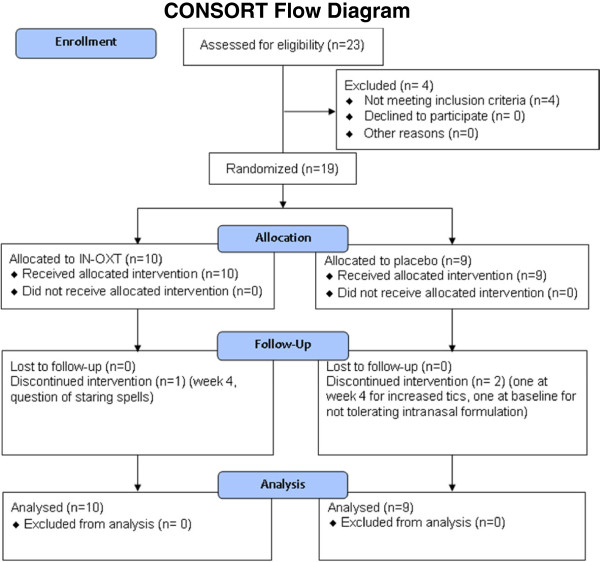
BACKGROUND: There are no effective medications for the treatment of social cognition/function deficits in autism spectrum disorder (ASD), and adult intervention literature in this area is sparse. Emerging data from animal models and genetic association studies as well as early, single-dose intervention studies suggest that the oxytocin system may be a potential therapeutic target for social cognition/function deficits in ASD. The primary aim of this study was to examine the safety/therapeutic effects of intranasal oxytocin versus placebo in adults with ASD, with respect to the two core symptom domains of social cognition/functioning and repetitive behaviors. METHODS: This was a pilot, randomized, double-blind, placebo-controlled, parallel design trial of intranasal oxytocin versus placebo in 19 adults with ASD (16 males; 33.20 ± 13.29 years). Subjects were randomized to 24 IU intranasal oxytocin or placebo in the morning and afternoon for 6 weeks. Measures of social function/cognition (the Diagnostic Analysis of Nonverbal Accuracy) and repetitive behaviors (Repetitive Behavior Scale Revised) were administered. Secondary measures included the Social Responsiveness Scale, Reading-the-Mind-in-the-Eyes Test and the Yale Brown Obsessive Compulsive Scale - compulsion subscale and quality of life (World Health Organization Quality of Life Questionnaire - emotional/social subscales). Full-information maximum-likelihood parameter estimates were obtained and tested using mixed-effects regression analyses. RESULTS: Although no significant changes were detected in the primary outcome measures after correcting for baseline differences, results suggested improvements after 6 weeks in measures of social cognition (Reading-the-Mind-in-the-Eyes Test, p = 0.002, d = 1.2), and quality of life (World Health Organization Quality of Life Questionnaire - emotion, p = 0.031, d = 0.84), both secondary measures. Oxytocin was well tolerated and no serious adverse effects were reported. CONCLUSIONS: This pilot study suggests that there is therapeutic potential to daily administration of intranasal oxytocin in adults with ASD and that larger and longer studies are warranted. TRIAL REGISTRATION: NCT00490802.
Overview
The claims and statistics of this paper haven’t been checked yet.
Run the check — free, no account needed. It reads the open-access text and checks the sources it cites.
Integrity signals
Registry
Cites
Statistics
Figures
Verification
Claims the paper makes
The claims and statistics of this paper haven’t been checked yet.
Run the check — free, no account needed. It reads the open-access text and checks the sources it cites.
Claims other papers make about this one
Each is checked against this paper’s own text: does it say what the citing paper says it does?
The cited source says what the claim attributes to it.
In the citing paper
“Small, randomized, controlled trials of intranasal oxytocin administered for 4 to 24 weeks in persons with autism spectrum disorder have had equivocal results with regard to oxytocin-associated improvements in social functioning, social cognition, or social attention.18–21”
From Intranasal Oxytocin in Children and Adolescents with Autism Spectrum Disorder (2021) · cites this paper as [21]
In the citing paper
“Multiple lines of evidence suggest an involvement of dysregulated neurotransmitter systems (serotonergic, oxytocinergic and dopaminergic systems) in autism.”
From Vitamin D and Autism Spectrum Disorder: A Literature Review (2016) · cites this paper as [181]
In the citing paper
“These systems play key roles in neurotransmission, brain maturation, cortical organisation and behaviours (including social behaviour and repetitive behaviour) [180,181,182,183,184].”
From Vitamin D and Autism Spectrum Disorder: A Literature Review (2016) · cites this paper as [181]
In the citing paper
“Clinical trials of OT in autistic patients are ongoing, yet several studies have produced inconclusive results (4–8)”
From Oxytocin under opioid antagonism leads to supralinear enhancement of social attention (2017) · cites this paper as [6]
In the citing paper
“This route of administration has been validated for both OT (6, 71) and NAL (72–74) in previous human studies”
From Oxytocin under opioid antagonism leads to supralinear enhancement of social attention (2017) · cites this paper as [6]
In the citing paper
“Clinical trials examining core symptoms of ASD have failed to consistently demonstrate efficacy of intranasal OT treatment (Anagnostou et al., 2012; Dadds et al., 2014; Guastella et al., 2015; Hollander et al., 2007)”
From Parallel social information processing circuits are differentially impacted in autism (2020) · cites this paper as Anagnostou et al., 2012
In the citing paper
“There have been generally positive results of OXT in adults with ASD, with trials showing improvements in repetitive behaviors, social reciprocity, and emotion recognition [75–77].”
From An Update on Psychopharmacological Treatment of Autism Spectrum Disorder (2022) · cites this paper as [75]
In the citing paper
“However, all these trials studied only short-term benefits (within a few weeks) of OXT administration.”
From An Update on Psychopharmacological Treatment of Autism Spectrum Disorder (2022) · cites this paper as [75]
In the citing paper
“For example, oxytocin has been shown to increase gazing time on the eye region33, and to improve performance on the Reading the Mind in the Eyes Task in adults and adolescents with ASD48,49.”
From Randomized clinical trial shows no substantial modulation of empathy-related neural activation by intranasal oxytocin in autism (2021) · cites this paper as [49]
In the citing paper
“This pilot study suggested therapeutic potential with daily administration of IN-OT in this population of adults with ASD. This six-week study noted improvements in social cognition, quality of life, RRB, and some measures of emotional well-being with IN-OT, in essence, improvement in the core domains of ASD.”
From Oxytocin and vasopressin systems in genetic syndromes and neurodevelopmental disorders (2014) · cites this paper as Anagnostou et al., 2012
In the citing paper
“Taken together, findings of these initial multiple-dose trials provided indications for a more consistent (positive) pattern of results for OT trials with adults with ASD [8–10], compared to trials with children with ASD [11–14].”
From Behavioral effects of multiple-dose oxytocin treatment in autism: a randomized, placebo-controlled trial with long-term follow-up (2020) · cites this paper as [8]
In the citing paper
“Anagnostou et al. [8] assessed the safety and efficacy of 6 weeks of intranasal OT treatment on core autism symptom domains (social cognition/function and repetitive behaviors) in 19 adults with ASD (16 men, three women), and showed improved emotion recognition, quality of life, and tentative improvements in repetitive behaviors after OT treatment.”
From Behavioral effects of multiple-dose oxytocin treatment in autism: a randomized, placebo-controlled trial with long-term follow-up (2020) · cites this paper as [8]
In the citing paper
“The initial sample size (n = 40) was set to be comparable to three prior studies showing significant effects of multiple-dose OT treatment on similar outcome measures [8, 9, 17].”
From Behavioral effects of multiple-dose oxytocin treatment in autism: a randomized, placebo-controlled trial with long-term follow-up (2020) · cites this paper as [8]
In the citing paper
“In this view, it appears that beneficial effects of OT treatment on repetitive behaviors were mostly demonstrated in studies that adopted assessments based on self-reports (current study, [4, 8]), whereas no beneficial effects were evident in studies adopting informant-based reports of repetitive behavior [9–14].”
From Behavioral effects of multiple-dose oxytocin treatment in autism: a randomized, placebo-controlled trial with long-term follow-up (2020) · cites this paper as [8]
In the citing paper
“Overall, these observed effects on repetitive behaviors are in line with previous trials with adult men with ASD showing beneficial effects of OT on repetitive behaviors after 4 h of intravenous OT administration [4] and after 6 weeks of daily administrations [8, 10].”
From Behavioral effects of multiple-dose oxytocin treatment in autism: a randomized, placebo-controlled trial with long-term follow-up (2020) · cites this paper as [8]
In the citing paper
“Contrary to our findings, Anagnostou et al. [8] reported an OT-specific improvement in quality of life (socio-emotional section) after a 6-week treatment in adult men with ASD.”
From Behavioral effects of multiple-dose oxytocin treatment in autism: a randomized, placebo-controlled trial with long-term follow-up (2020) · cites this paper as [8]
In the citing paper
“Second, in the current study, participants administered the OT nasal spray once a day (in the morning) while the majority of prior multiple-dose OT studies administered two doses/day (one in the morning and one in the afternoon) ([8–10, 12–14], but see [11]).”
From Behavioral effects of multiple-dose oxytocin treatment in autism: a randomized, placebo-controlled trial with long-term follow-up (2020) · cites this paper as [8]
In the citing paper
“Recent studies have suggested that long-term oxytocin administration can alleviate the symptoms of autism spectrum disorder (ASD)”
Self-check
Percentages, sums and reported differences re-computed from the paper’s own numbers.
The self-check needs the paper’s full text.
Citations
Cites
Lord, C., Rutter, M., & Le Couteur, A. (1994) · Journal of Autism and Developmental Disorders · doi:10.1007/bf02172145 · Cited by 9,065
The Yale-Brown Obsessive Compulsive Scale: I. Development, Use, and Reliability
Goodman, W. K. (1989) · Archives of General Psychiatry · doi:10.1001/archpsyc.1989.01810110048007 · Cited by 7,712
Lord, C., Risi, S., Lambrecht, L., Cook, E. H., Leventhal, B. L., DiLavore, P. C., Pickles, A., & Rutter, M. (2000) · Journal of Autism and Developmental Disorders · doi:10.1023/a:1005592401947 · Cited by 7,520
Skevington, S. M., Lotfy, M., & O'Connell, K. A. (2004) · Quality of Life Research · doi:10.1023/b:qure.0000018486.91360.00 · Cited by 4,686
Baron‐Cohen, S., Wheelwright, S., Hill, J., Raste, Y., & Plumb, I. (2001) · Journal of Child Psychology and Psychiatry · doi:10.1111/1469-7610.00715 · Cited by 4,555 · cited 2×
“In the analysis of secondary measures, significant improvements were noted on the RMET – Revised (t = 3.91, df = 9.01, p = 0.004, Cohen’s d effect size = 1.2) and the WHOQOL – emotional (t = 2.42, df = 10.89, p = 0.034, Cohen’s d effect size = 0.84) (Table 2).”
MethodInfluentialBaron‐Cohen, S., Wheelwright, S. J., Hill, J., Raste, Y., & Plumb, I. (2001) · PubMed · Cited by 4,313
Oxytocin increases trust in humans
Kosfeld, M., Heinrichs, M., Zak, P. J., Fischbacher, U., & Fehr, E. (2005) · Nature · doi:10.1038/nature03701 · Cited by 3,690
Strong association of de novo copy number mutations with autism
Sebat, J., Lakshmi, B., Malhotra, D., Troge, J., Lese-Martin, C., Walsh, T., Yamrom, B., Yoon, S., Krasnitz, A., Kendall, J., et al. (2007) · Science · doi:10.1126/science.1138659 · Cited by 2,795
The Yale-Brown Obsessive-Compulsive Scale: measures of internal consistency.
Kim, S.-W., Dysken, M., Pheley, A., & Hoover, K. M. (1994) · Psychiatry Research · doi:10.1016/0165-1781(94)90039-6 · Cited by 2,333
Oxytocin Modulates Neural Circuitry for Social Cognition and Fear in Humans
Kirsch, P., Esslinger, C., Chen, Q., Mier, D., Lis, S., Siddhanti, S., Gruppe, H., Mattay, V. S., Gallhofer, B., & Meyer-Lindenberg, A. (2005) · The Journal of Neuroscience · doi:10.1523/jneurosci.3984-05.2005 · Cited by 1,639
Research works printed but not linked: 1
- 10.1176/appi.neuropsych.23.3.332 · DOI
Cited by
Sorted by citations
Items 101–200 of 359
Damen, L., Grootjen, L. N., Juriaans, A. F., Donze, S., Huisman, T. M., Visser, J. A., Delhanty, P. J. D., & Hokken‐Koelega, A. C. S. (2020) · Clinical Endocrinology · doi:10.1111/cen.14387 · Cited by 59
Greene, R. K., Spanos, M., Alderman, C., Walsh, E., Bizzell, J., Mosner, M. G., Kinard, J. L., Stuber, G. D., Chandrasekhar, T., Politte, L. C., et al. (2018) · Journal of Neurodevelopmental Disorders · doi:10.1186/s11689-018-9228-y · Cited by 55
Oxytocin under opioid antagonism leads to supralinear enhancement of social attention
Dal Monte, O., Piva, M., Anderson, K. M., Tringides, M., Holmes, A. J., & Chang, S. W. C. (2017) · Proceedings of the National Academy of Sciences · doi:10.1073/pnas.1702725114 · Cited by 55
Sniff and mimic–Intranasal oxytocin increases facial mimicry in a sample of men
Korb, S., Malsert, J., Strathearn, L., Vuilleumier, P., & Niedenthal, P. (2016) · Hormones and Behavior · doi:10.1016/j.yhbeh.2016.06.003 · Cited by 54
Oxytocin receptor gene variations predict neural and behavioral response to oxytocin in autism
Watanabe, T., Otowa, T., Abe, O., Kuwabara, H., Aoki, Y., Natsubori, T., Takao, H., Kakiuchi, C., Kondo, K., Ikeda, M., et al. (2017) · Social Cognitive and Affective Neuroscience · doi:10.1093/scan/nsw150 · Cited by 54
Aita, C., Mizoguchi, Y., Yamamoto, M., SeguchI, Y., Yatsuga, C., Nishimura, T., Sugimoto, Y., Takahashi, D., Nishihara, R., Ueno, T., et al. (2018) · Psychiatry Research · doi:10.1016/j.psychres.2018.12.139 · Cited by 53
Cannabidiol for the treatment of autism spectrum disorder: hope or hype?
Pedrazzi, J. F. C., Ferreira, F. R., Silva-Amaral, D., Lima, D. D. A., Hallak, J. E. C., Zuardi, A. W., Bel, E. A. D., Guimarães, F. S., Costa, K. C. M., Campos, A. C., et al. (2022) · Psychopharmacology · doi:10.1007/s00213-022-06196-4 · Cited by 53
An Update on Medication Management of Behavioral Disorders in Autism
Baribeau, D. A., & Anagnostou, E. A. (2014) · Current Psychiatry Reports · doi:10.1007/s11920-014-0437-0 · Cited by 52
Self-citationEffect of a novel nasal oxytocin spray with enhanced bioavailability on autism: a randomized trial
Yamasue, H., Kojima, M., Kuwabara, H., Kuroda, M., Matsumoto, K., Kanai, C., Inada, N., Owada, K., Ochi, K., Ono, N., et al. (2021) · Brain · doi:10.1093/brain/awab291 · Cited by 52
Oxytocin has therapeutic effects on cancer, a hypothesis
Imanieh, M. H., Bagheri, F., Alizadeh, A. M., & Ashkani‐Esfahani, S. (2014) · European Journal of Pharmacology · doi:10.1016/j.ejphar.2014.07.053 · Cited by 51
Baribeau, D. A., Dupuis, A., Paton, T., Scherer, S. W., Schachar, R. J., Arnold, P. D., Szatmári, P., Nicolson, R., Georgiades, S., Crosbie, J., et al. (2017) · Scientific Reports · doi:10.1038/s41598-017-10821-0 · Cited by 51
Self-citationMontag, C., Sindermann, C., Melchers, M., Jung, S., Luo, R., Becker, B., Xie, J., Xu, W., Guastella, A. J., & Kendrick, K. M. (2017) · American Journal of Medical Genetics Part B Neuropsychiatric Genetics · doi:10.1002/ajmg.b.32596 · Cited by 50
The oxytocin receptor gene predicts brain activity during an emotion recognition task in autism
Uzefovsky, F., Bethlehem, R. A. I., Shamay-Tsoory, S., Ruigrok, A., Holt, R., Spencer, M., Chura, L., Warrier, V., Chakrabarti, B., Bullmore, E., et al. (2019) · Molecular Autism · doi:10.1186/s13229-019-0258-4 · Cited by 49
The two fold role of oxytocin in social developmental disorders: A cause and a remedy?
Lefèvre, A., & Sirigu, A. (2016) · Neuroscience & Biobehavioral Reviews · doi:10.1016/j.neubiorev.2016.01.011 · Cited by 48
Hollander, E., Levine, K., Ferretti, C. J., Freeman, K. D., Doernberg, E. A., Desilva, N., & Taylor, B. P. (2020) · Journal of Psychiatric Research · doi:10.1016/j.jpsychires.2020.11.006 · Cited by 48
Self-citationChronic oxytocin administration stimulates the oxytocinergic system in children with autism
Moerkerke, M., Daniëls, N., Tibermont, L., Tang, T., Evenepoel, M., der Donck, S. V., Debbaut, E., Prinsen, J., Chubar, V., Claes, S. J., et al. (2024) · Nature Communications · doi:10.1038/s41467-023-44334-4 · Cited by 46
The neurocircuitry involved in oxytocin modulation of methamphetamine addiction
Baracz, S. J., & Cornish, J. L. (2016) · Frontiers in Neuroendocrinology · doi:10.1016/j.yfrne.2016.08.001 · Cited by 46
Targeting epigenetic dysregulation in autism spectrum disorders
Herrera, M. L., Paraíso‐Luna, J., Bustos-Martínez, I., & Barco, Á. (2024) · Trends in Molecular Medicine · doi:10.1016/j.molmed.2024.06.004 · Cited by 46
Hofmann, S. G., Fang, A., & Brager, D. N. (2015) · Psychiatry Research · doi:10.1016/j.psychres.2015.05.039 · Cited by 44
RetractedOxytocin neurons mediate stress-induced social memory impairment
Zhan, S., Qi, Z., Cai, F., Gao, Z., Xie, J., & Hu, J. (2023) · Current Biology · doi:10.1016/j.cub.2023.11.037 · Cited by 44
Audunsdottir, K., Sartorius, A. M., Kang, H., Glaser, B. D., Bøen, R., Nærland, T., Alaerts, K., Kildal, E. S.-M., Westlye, L. T., Andreassen, O. A., et al. (2024) · Psychoneuroendocrinology · doi:10.1016/j.psyneuen.2024.107067 · Cited by 43
Mansouri, M., Pouretemad, H., Roghani, M., Wegener, G., & Ardalan, M. (2020) · Behavioural Brain Research · doi:10.1016/j.bbr.2020.112756 · Cited by 43
Bertelli, M. O., Azeem, M. W., Underwood, L., Scattoni, M. L., Persico, A. M., Ricciardello, A., Sappok, T., Bergmann, T. J., Keller, R., Bianco, A., et al. (2022) · Springer eBooks · doi:10.1007/978-3-319-95720-3_16 · Cited by 43
Using genetic findings in autism for the development of new pharmaceutical compounds
Vorstman, J. A. S., Spooren, W. P. J. M., Persico, A. M., Collier, D. A., Aigner, S., Jagasia, R., Glennon, J. C., & Buitelaar, J. K. (2013) · Psychopharmacology · doi:10.1007/s00213-013-3334-z · Cited by 43
Yang, S., Dong, X., Guo, X., Han, Y., Song, H., Gao, L., Dai, W., Su, Y., & Zhang, X. (2017) · Frontiers in Neuroscience · doi:10.3389/fnins.2017.00221 · Cited by 42
Alaerts, K., Bernaerts, S., Vanaudenaerde, B. M., Daniëls, N., & Wenderoth, N. (2019) · Biological Psychiatry Cognitive Neuroscience and Neuroimaging · doi:10.1016/j.bpsc.2019.01.008 · Cited by 42
Martins, D., Paduraru, M., & Paloyelis, Y. (2021) · British Journal of Pharmacology · doi:10.1111/bph.15451 · Cited by 42
Pediatric Traumatic Brain Injury and Autism: Elucidating Shared Mechanisms
Singh, R. S., Turner, R. C., Nguyen, L., Motwani, K., Swatek, M., & Lucke-Wold, B. P. (2016) · Behavioural Neurology · doi:10.1155/2016/8781725 · Cited by 41
Wieckowski, A. T., Flynn, L., Richey, J. A., Gračanin, D., & White, S. W. (2020) · Autism · doi:10.1177/1362361320925334 · Cited by 41
Neurochemical evidence for differential effects of acute and repeated oxytocin administration
Benner, S., Aoki, Y., Watanabe, T., Endo, N., Abe, O., Kuroda, M., Kuwabara, H., Kawakubo, Y., Takao, H., Kunimatsu, A., et al. (2021) · Molecular Psychiatry · doi:10.1038/s41380-018-0249-4 · Cited by 40
Lin, I.-F., Kashino, M., Ohta, H., Yamada, T., Tani, M., Watanabe, H., Kanai, C., Ohno, T., Takayama, Y., Iwanami, A., et al. (2014) · Molecular Autism · doi:10.1186/2040-2392-5-20 · Cited by 40
Quintana, D. S., Dieset, I., Elvsåshagen, T., Westlye, L. T., & Andreassen, O. A. (2017) · Frontiers in Neuroendocrinology · doi:10.1016/j.yfrne.2016.12.004 · Cited by 39
The Role of Intranasal Oxytocin in the Treatment of Patients with Schizophrenia: A Systematic Review
Berardis, D. D., Marini, S., Iasevoli, F., Tomasetti, C., de Bartolomeis, A., Mazza, M., Valchera, A., Fornaro, M., Cavuto, M., Srinivasan, V., et al. (2013) · CNS & Neurological Disorders - Drug Targets · doi:10.2174/1871527311312020012 · Cited by 39
Lamy, M., Pedapati, E. V., Dominick, K. C., Wink, L. K., & Erickson, C. A. (2020) · Pediatric Drugs · doi:10.1007/s40272-020-00408-0 · Cited by 39
Wei, J., Ma, L., Ju, P., Yang, B., Wang, Y., & Chen, J. (2020) · Frontiers in Cell and Developmental Biology · doi:10.3389/fcell.2020.564485 · Cited by 39
Anti– N -Methyl- D -Aspartate (NMDA) Receptor Encephalitis
Scott, O., Richer, L. P., Forbes, K., Sonnenberg, L. K., Currie, A., Eliyashevska, M., & Goez, H. (2013) · Journal of Child Neurology · doi:10.1177/0883073813501875 · Cited by 39
Tully, J., Gabay, A. S., Brown, D., Murphy, D., & Blackwood, N. (2017) · Psychiatry Research Neuroimaging · doi:10.1016/j.pscychresns.2017.11.017 · Cited by 39
DNA Methylation of the Oxytocin Receptor Across Neurodevelopmental Disorders
Siu, M. T., Goodman, S. J., Yellan, I., Butcher, D. T., Jangjoo, M., Grafodatskaya, D., Rajendram, R., Lou, Y., Zhang, R., Zhao, C., et al. (2021) · Journal of Autism and Developmental Disorders · doi:10.1007/s10803-020-04792-x · Cited by 38
Self-citationImpaired detection of happy facial expressions in autism
Sato, W., Sawada, R., Uono, S., Yoshimura, S., Kochiyama, T., Kubota, Y., Sakihama, M., & Toichi, M. (2017) · Scientific Reports · doi:10.1038/s41598-017-11900-y · Cited by 38
Finger, E. C., Berry, S. M., Cummings, J. L., Coleman, K. K. L., Hsiung, G. R., Feldman, H., & Boxer, A. L. (2018) · Alzheimer s Research & Therapy · doi:10.1186/s13195-018-0427-2 · Cited by 38
Associations between oxytocin-related genes and autistic-like traits
Hovey, D., Zettergren, A., Jonsson, L., Melke, J., Anckarsäter, H., Lichtenstein, P., & Westberg, L. (2014) · Social Neuroscience · doi:10.1080/17470919.2014.897995 · Cited by 37
Patin, A., & Hurlemann, R. (2015) · Handbook of experimental pharmacology · doi:10.1007/978-3-319-16522-6_10 · Cited by 37
Alaerts, K., Bernaerts, S., Prinsen, J., Dillen, C., Steyaert, J. G., & Wenderoth, N. (2020) · Neuropsychopharmacology · doi:10.1038/s41386-020-0653-8 · Cited by 36
Bernaerts, S., Boets, B., Steyaert, J. G., Wenderoth, N., & Alaerts, K. (2020) · Translational Psychiatry · doi:10.1038/s41398-020-01069-w · Cited by 36
Zhuang, Q., Zheng, X., Becker, B., Lei, W. I., Xu, X., & Kendrick, K. M. (2021) · Psychoneuroendocrinology · doi:10.1016/j.psyneuen.2021.105412 · Cited by 36
Althammer, F., Muscatelli, F., Grinevich, V., & Schaaf, C. P. (2022) · Translational Psychiatry · doi:10.1038/s41398-022-02054-1 · Cited by 35
The promising trajectory of autism therapeutics discovery
Silverman, J. L., & Crawley, J. N. (2013) · Drug Discovery Today · doi:10.1016/j.drudis.2013.12.007 · Cited by 35
Wang, Y., Wang, M.-J., Rong, Y., He, H.-Z., & Yang, C.-J. (2019) · Research in Autism Spectrum Disorders · doi:10.1016/j.rasd.2019.03.007 · Cited by 33
The Potential of Nasal Oxytocin Administration for Remediation of Autism Spectrum Disorders
Okamoto, Y., Ishitobi, M., Wada, Y., & Kosaka, H. (2016) · CNS & Neurological Disorders - Drug Targets · doi:10.2174/1871527315666160413120845 · Cited by 33
Is Oxytocin Application for Autism Spectrum Disorder Evidence-Based?
Lee, S. Y., Lee, A. R., Hwangbo, R., Han, J., Hong, M., & Bahn, G. H. (2015) · Experimental Neurobiology · doi:10.5607/en.2015.24.4.312 · Cited by 33
Li, Y., Zhang, X., & Li, Y. (2019) · CNS Spectrums · doi:10.1017/s1092852919001603 · Cited by 33
Salcedo‐Arellano, M. J., Cabal-Herrera, A. M., Punatar, R., Clark, C. J., Romney, C. A., & Hagerman, R. J. (2020) · Neurotherapeutics · doi:10.1007/s13311-020-00968-6 · Cited by 32
Munesue, S., Liang, M., Harashima, A., Zhong, J., Furuhara, K., Boitsova, E. B., Михайлович, Ч. С., Gerasimenko, M., Yuhi, T., Yamamoto, Y., et al. (2021) · Journal of Neuroendocrinology · doi:10.1111/jne.12963 · Cited by 32
Holdman, R., Vigil, D., Robinson, K. J., Shah, P., & Contreras, A. E. (2021) · Cannabis and Cannabinoid Research · doi:10.1089/can.2020.0154 · Cited by 32
Decades of Progress in the Psychopharmacology of Autism Spectrum Disorder
Henneberry, E. A., Lamy, M., Dominick, K. C., & Erickson, C. A. (2021) · Journal of Autism and Developmental Disorders · doi:10.1007/s10803-021-05237-9 · Cited by 32
Florea, T., Palimariciuc, M., Cristofor, A. C., Dobrin, I., Chiriță, R., Bîrsan, M., Dobrin, R., & Pădurariu, M. (2022) · Medicina · doi:10.3390/medicina58070923 · Cited by 32
Inada, N., Ito, H., Yasunaga, K., Kuroda, M., Iwanaga, R., Hagiwara, T., Tani, I., Yukihiro, R., Uchiyama, T., Ogasahara, K., et al. (2015) · Research in Autism · doi:10.1016/j.rasd.2015.01.002 · Cited by 32
The Oxytocin System and Implications for Oxytocin Deficiency in Hypothalamic-Pituitary Disease
Aulinas, A., & Lawson, E. A. (2025) · Endocrine Reviews · doi:10.1210/endrev/bnaf008 · Cited by 31
Razo, R. A., Berger, T., Conley, A. J., Freeman, S. M., Goetze, L. R., Jacob, S., Lawrence, R. H., Mendoza, S. P., Rothwell, E. S., Savidge, L. E., et al. (2019) · Psychoneuroendocrinology · doi:10.1016/j.psyneuen.2019.104494 · Cited by 31
The Role of Intranasal Oxytocin on Social Cognition: an Integrative Human Lifespan Approach
Horta, M., Pehlivanoglu, D., & Ebner, N. C. (2020) · Current Behavioral Neuroscience Reports · doi:10.1007/s40473-020-00214-5 · Cited by 31
The Role of Oxytocin in Early-Life-Stress-Related Neuropsychiatric Disorders
Jin, Y., Song, D. F., Yan, Y., Quan, Z., & Qing, H. (2023) · International Journal of Molecular Sciences · doi:10.3390/ijms241310430 · Cited by 30
Perception of social interaction compresses subjective duration in an oxytocin-dependent manner
Liu, R., Yuan, X., Chen, K., Jiang, Y., & Zhou, W. (2018) · eLife · doi:10.7554/elife.32100 · Cited by 30
Dysfunction of Social Cognition and Behavior
Dickerson, B. C. (2015) · CONTINUUM Lifelong Learning in Neurology · doi:10.1212/01.con.0000466659.05156.1d · Cited by 30
Quantitative facial expression analysis revealed the efficacy and time course of oxytocin in autism
Owada, K., Okada, T., Munesue, T., Kuroda, M., Fujioka, T., Uno, Y., Matsumoto, K., Kuwabara, H., Mori, D., Okamoto, Y., et al. (2019) · Brain · doi:10.1093/brain/awz126 · Cited by 29
Oxytozin: Evidenz für ein therapeutisches Potenzial des sozialen Neuromodulators
Eckstein, M., & Hurlemann, R. (2013) · Der Nervenarzt · doi:10.1007/s00115-013-3832-6 · Cited by 28
Alaerts, K., Steyaert, J. G., Vanaudenaerde, B. M., Wenderoth, N., & Bernaerts, S. (2020) · European Neuropsychopharmacology · doi:10.1016/j.euroneuro.2020.11.014 · Cited by 28
Althaus, M., Groen, Y., Wijers, A. A., Noltes, H., Tucha, O. M., Sweep, F. C. G. J., Calcagnoli, F., & Hoekstra, P. J. (2016) · Psychopharmacology · doi:10.1007/s00213-016-4339-1 · Cited by 28
Acute and Repeated Intranasal Oxytocin Differentially Modulate Brain-wide Functional Connectivity
Pagani, M., Felice, A. D., Montani, C., Galbusera, A., Papaleo, F., & Gozzi, A. (2020) · Neuroscience · doi:10.1016/j.neuroscience.2019.12.036 · Cited by 27
A randomized controlled trial of intranasal oxytocin in Phelan-McDermid syndrome
Fastman, J., Foss‐Feig, J. H., Frank, Y., Halpern, D. B., Harony‐Nicolas, H., Layton, C., Sandin, S., Siper, P. M., Tang, L., Trelles, M. P., et al. (2021) · Molecular Autism · doi:10.1186/s13229-021-00459-1 · Cited by 27
Self-citationWeinstein, T. A. R., Bales, K. L., Maninger, N., Hostetler, C. M., & Capitanio, J. P. (2014) · Frontiers in Behavioral Neuroscience · doi:10.3389/fnbeh.2014.00295 · Cited by 27
Sakamoto, T., Sugimoto, S., & Uekita, T. (2019) · Physiology & Behavior · doi:10.1016/j.physbeh.2019.112701 · Cited by 27
Shedding Light on Social Reward Circuitry: (Un)common Blueprints in Humans and Rodents
Grimm, C., Balsters, J. H., & Zerbi, V. (2020) · The Neuroscientist · doi:10.1177/1073858420923552 · Cited by 26
Strathearn, L., Kim, S., Bastian, D. A., Jung, J., Iyengar, U., Martinez, S. R., Goin‐Kochel, R. P., & Fonagy, P. (2017) · Development and Psychopathology · doi:10.1017/s0954579417001018 · Cited by 26
Moyal, W. N., Lord, C., & Walkup, J. T. (2013) · Pediatric Drugs · doi:10.1007/s40272-013-0050-4 · Cited by 26
Oxytocin and Prader-Willi Syndrome
Kabasakalian, A., Ferretti, C. J., & Hollander, E. (2017) · Current topics in behavioral neurosciences · doi:10.1007/7854_2017_28 · Cited by 26
Self-citationPreckel, K., Kanske, P., Singer, T., Paulus, F. M., & Krach, S. (2016) · BMC Psychiatry · doi:10.1186/s12888-016-1036-x · Cited by 25
Opportunities and challenges for intranasal oxytocin treatment studies in nonhuman primates
Bauman, M. D., Murai, T., Hogrefe, C. E., & Platt, M. L. (2018) · American Journal of Primatology · doi:10.1002/ajp.22913 · Cited by 25
Razo, R. A., Vázquez, M. D. L. V., Turcanu, P., Legrand, M., Floch, M., Weinstein, T. A. R., Goetze, L. R., Freeman, S. M., BAXTER, A. B., Witczak, L. R., et al. (2022) · Hormones and Behavior · doi:10.1016/j.yhbeh.2022.105126 · Cited by 25
Voinsky, I., Bennuri, S. C., Svigals, J., Frye, R. E., Rose, S., & Gurwitz, D. (2019) · Scientific Reports · doi:10.1038/s41598-019-49617-9 · Cited by 25
Spanos, M., Chandrasekhar, T., Kim, S., Hamer, R. M., King, B. H., McDougle, C. J., Sanders, K. B., Gregory, S. G., Kolevzon, A. L., Veenstra-VanderWeele, J. M., et al. (2020) · Contemporary Clinical Trials · doi:10.1016/j.cct.2020.106103 · Cited by 24
Luo, L., Becker, B., Zheng, X., Zhao, Z., Xu, X., Zhou, F., Wang, J., Kou, J., Dai, J., & Kendrick, K. M. (2017) · Human Brain Mapping · doi:10.1002/hbm.23880 · Cited by 24
Mayer, A. V., Wermter, A.-K., Stroth, S., Alter, P., Haberhausen, M., Stehr, T., Paulus, F. M., Krach, S., & Kamp-Becker, I. (2021) · Scientific Reports · doi:10.1038/s41598-021-94407-x · Cited by 23
The oxytocin receptor gene and social perception
Melchers, M., Montag, C., Felten, A., & Reuter, M. (2015) · Social Neuroscience · doi:10.1080/17470919.2015.1008646 · Cited by 23
Mazahery, H., Conlon, C. A., Beck, K. L., Kruger, M. C., Stonehouse, W., Camargo, C. A., Meyer, B. J., Tsang, B., Mugridge, O., & von Hurst, P. R. (2016) · Trials · doi:10.1186/s13063-016-1428-8 · Cited by 22
Lefter, R. M., Ciobica, A. S., Antioch, I., Ababei, D. C., Hrițcu, L. D., & Luca, A.-C. (2020) · Medicina · doi:10.3390/medicina56060267 · Cited by 22
Alaerts, K., Daniëls, N., Moerkerke, M., Evenepoel, M., Tang, T., der Donck, S. V., Chubar, V., Claes, S. J., Steyaert, J. G., Boets, B., et al. (2023) · Psychotherapy and Psychosomatics · doi:10.1159/000534114 · Cited by 21
Controversies in autism: is a broader model of social disorders needed?
Hrdlička, M., & Dudová, I. (2013) · Child and Adolescent Psychiatry and Mental Health · doi:10.1186/1753-2000-7-9 · Cited by 21
Oxytocin effects on the resting-state mentalizing brain network
Wu, H., Feng, C., Lu, X., Liu, X., & Liu, Q. (2020) · Brain Imaging and Behavior · doi:10.1007/s11682-019-00205-5 · Cited by 21
Zhao, W., Le, J., Liu, Q., Zhu, S., Lan, C., Zhang, Q., Zhang, Y., Li, Q., Kou, J., Yang, W., et al. (2024) · Translational Psychiatry · doi:10.1038/s41398-024-03025-4 · Cited by 20
Hirosawa, T., Kikuchi, M., Ouchi, Y., Takahashi, T., Yoshimura, Y., Kosaka, H., Furutani, N., Hiraishi, H., Fukai, M., Yokokura, M., et al. (2017) · Autism Research · doi:10.1002/aur.1761 · Cited by 20
What’s in the pipeline? Drugs in development for autism spectrum disorder
Sung, M., Chin, C. H., Lim, C. G., Liew, A., Lim, C. S., Kashala-Abotnes, E., & Weng, S. J. (2014) · Neuropsychiatric Disease and Treatment · doi:10.2147/ndt.s39516 · Cited by 20
Clinical potential of oxytocin in autism spectrum disorder: current issues and future perspectives
Benner, S., & Yamasue, H. (2017) · Behavioural Pharmacology · doi:10.1097/fbp.0000000000000341 · Cited by 19
Tiwari, A., Rahi, S., & Mehan, S. (2020) · Current Drug Targets · doi:10.2174/1389450121666201020155010 · Cited by 19
Qiu, W., Go, K. A., Wen, Y., Duarte‐Guterman, P., Eid, R. S., & Galea, L. A. M. (2021) · Brain Behavior and Immunity · doi:10.1016/j.bbi.2021.06.012 · Cited by 19
Borie, A. M., Theofanopoulou, C., & Andari, E. (2021) · Handbook of clinical neurology · doi:10.1016/b978-0-12-819973-2.00009-5 · Cited by 19
Wang, T., Zhao, T., Liu, L., Teng, H., Fan, T., Li, Y., Wang, Y., Li, J., Xia, K., & Sun, Z. S. (2022) · EBioMedicine · doi:10.1016/j.ebiom.2022.104091 · Cited by 19
Baribeau, D. A., & Anagnostou, E. A. (2014) · Europe PMC (PubMed Central) · Cited by 19
Self-citationTsingotjidou, A. (2022) · Biomolecules · doi:10.3390/biom12111603 · Cited by 18
Update on psychopharmacology for autism spectrum disorders
Bertelli, M. O., Rossi, M., Keller, R., & Lassi, S. (2016) · Advances in Mental Health and Intellectual Disabilities · doi:10.1108/amhid-10-2015-0049 · Cited by 18
Available Treatments for Autism Spectrum Disorder: From Old Strategies to New Options
Dell’Osso, L., Bonelli, C., Giovannoni, F., Poli, F., Anastasio, L., Cerofolini, G., Nardi, B., Cremone, I. M., Pini, S., & Carpita, B. (2025) · Pharmaceuticals · doi:10.3390/ph18030324 · Cited by 17
Metadata
- Authors
- Anagnostou, E., Soorya, L., Chaplin, W., Bartz, J., Halpern, D., Wasserman, S., Wang, A. T., Pepa, L., Tanel, N., Kushki, A., & Hollander, E.
- Affiliations
- University of Toronto (CA)
- Rush University (US)
- St. John's University (US)
- Icahn School of Medicine at Mount Sinai (US)
- Albert Einstein College of Medicine (US)
- Corresponding author
- Anagnostou, Evdokia
- ORCID
- Venue
- Molecular Autism
- Published
- 2012
- Volume
- 3
- Issue
- 1
- Pages
- 16
- ISSN
- 2040-2392 (ISSN-L)
- PMC
- PMC3539865
- OpenAlex
- W2134806674
- Cited by
- 350
- References
- 40
- Citations by year
- 2026: 7 · 2025: 14 · 2024: 18 · 2023: 22 · 2022: 24 · 2021: 22 · 2020: 33 · 2019: 23 · 2018: 25 · 2017: 38 · 2016: 31 · 2015: 32 · 2014: 33 · 2013: 26 · 2012: 1
- FWCI
- 44.40
- Type
- journal article
- Language
- en
- Open access
- gold
- doi.org
- Licence
- cc-by
- Locations
- Molecular Autism (publishedVersion, cc-by)
- PubMed Central (publishedVersion, cc-by)
- PubMed (publishedVersion)
- TSpace (University of Toronto) (submittedVersion)
- DOAJ (DOAJ: Directory of Open Access Journals) (submittedVersion)
- Funders
- U.S. Department of Defense
- Ontario Brain Institute
- National Alliance for Research on Schizophrenia and Depression
- Holland Bloorview Kids Rehabilitation Hospital Foundation
- National Institutes of Health
- Canadian Institutes of Health Research
- Topics
- Life Sciences › Neuroscience › Endocrine and Autonomic Systems › Neuroendocrine regulation and behavior
- Life Sciences › Neuroscience › Cognitive Neuroscience › Autism Spectrum Disorder Research
- Life Sciences › Biochemistry, Genetics and Molecular Biology › Genetics › Genetics and Neurodevelopmental Disorders
- Keywords
- intranasal oxytocin, autism spectrum disorder, autistic adults, social cognition, social functioning, repetitive behavior, quality of life, Reading the Mind in the Eyes Test, Yale-Brown Obsessive Compulsive Scale, drug safety
About these checks
Registry, retraction, Cites and statistics results are computed, not judged, with one exception: a printed reference that no index lists is read once by a model before it counts as a citation error. Claims are extracted by a model and kept only when their quote appears verbatim in the text; each cited source is then checked, with a model’s help, for whether it says what the claim relies on. Those verdicts can be wrong — read the claim’s quote and the cited source before relying on one.
Statistics and arithmetic are recomputed, not judged.
Confidence bands are shown only for fields calibrated on our annotated test set. None is calibrated yet, so no band is shown.
What counts as a claim ›How we measure confidence ›How we check this ›
Are you an author, or do you see a problem with this page? Request a review
