

DSM-5 and autism spectrum disorders (ASDs): an opportunity for identifying ASD subtypes
Open accessThe DOI matches its Crossref record; 80 of the 80 references it cites were found in a registry or an index; 17 of the 83 sources its claims cite were checked for support.
Abstract
The heterogeneous clinical presentations of individuals with autism spectrum disorders (ASDs) poses a significant challenge for sample characterization and limits the interpretability and replicability of research studies. The Diagnostic and Statistical Manual of Mental Disorders, 5th edition (DSM-5) diagnostic criteria for ASD, with its dimensional approach, may be a useful framework to increase the homogeneity of research samples. In this review, we summarize the revisions to the diagnostic criteria for ASD, briefly highlight the literature supporting these changes, and illustrate how DSM-5 can improve sample characterization and provide opportunities for researchers to identify possible subtypes within ASD.
Overview
CoChat Summary
## TL;DR
This review argues that DSM-5’s dimensional ASD criteria can improve research sample characterization and make it easier to identify meaningful ASD subtypes. The authors summarize evidence that variability in social-communication, restricted/repetitive behaviors, language, cognitive ability, onset, and comorbidity may help define subgroups.
## Key findings
- DSM-IV’s multi-categorical PDD system had limited reliability and poor predictive value for later outcomes; DSM-5 replaces it with a single ASD diagnosis.
- The paper cites Huerta et al. showing that over 90% of children with DSM-IV-defined PDDs were identified by DSM-5 criteria, and that specificity was substantially improved compared with DSM-IV.
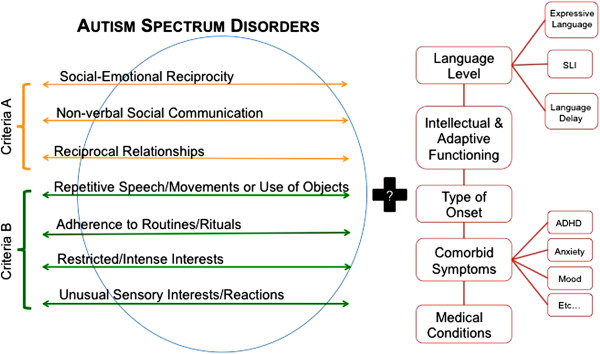
- DSM-5’s two-domain model (social-communication deficits and restricted/repetitive behaviors) is presented as better supported than the DSM-IV triad, with unusual sensory responses and stereotyped language incorporated into the RRB domain.
- The authors highlight several potential subtype dimensions: RRB quantity at age 2 years was inversely related to language skills at 9 years; regressive onset occurs in about 30% of individuals with ASD across a meta-analysis of 85 studies; and regression is often reported around 18 months of age.
## Methods
- Not a primary empirical study; this is a narrative review of DSM-5 revisions and literature relevant to ASD subtyping.
- The paper synthesizes prior studies on ASD symptom structure, language, cognition, onset patterns, comorbidity, and diagnostic validity.
- Main analysis is qualitative comparison and interpretation of published findings to argue for dimensional sample characterization under DSM-5.
## Limitations
- The paper states that no single study will be sufficient to accurately define ASD subgroups because samples vary by factors such as age and IQ.
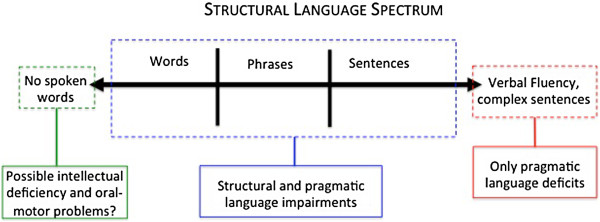
- It notes that evidence on some candidate subtypes remains mixed or incomplete, including regression patterns and whether language impairments in ASD are distinct from or continuous with specific language impairment.
- Evident from the text: this is a review, so it does not present new data or directly test the proposed subtypes.
Model-written summary. Check it against the paper before relying on it.
Integrity signals
Registry
Cites
Statistics
Figures
Verification
Claims the paper makes
5 Valid · 10 Not valid · 25 Not checked · 16 Own results and interpretations
At least one cited source doesn’t support this claim or points to a different paper, and none confirmed it — see the verdicts below.
In the paper
“deficits in cognitive functioning may be more common in females [43-46]”
§ DSM-5 and autism spectrum disorders (ASDs): an opportunity for identifying ASD subtypes > Review > Improved methods for subtyping?
What the sources say
- Disputedcites [43] Dworzynski K Ronald A Bolton P Happé F How different are girls and boys above and below the diagnostic threshold for autism spectrum disorders? J Am Acad Child Adolesc Psychiatry 2012 51 788 797 10.1016/j.jaac.2012.05.018 22840550 sourceExperimental — accuracy not yet measured
The Results (Latent Class Analysis; page unavailable) report that boys and girls were equally likely to belong to each of the four IQ-defined groups. The Discussion likewise states that there were no sex differences in group classification, contrary to the claim that cognitive deficits may be more common in females. (LLM, conf=0.88)
Checked by a reasoning model — may be wrong.
- Not checked — no full text of the sourcecites [44] Nicholas J Charles J Carpenter L King L Jenner W Spratt E Prevalence and characteristics of children with autism-spectrum disorders Ann Epidemiol 2008 18 130 136 10.1016/j.annepidem.2007.10.013 18083540 source
- Not checked — no full text of the sourcecites [45] Szatmari P Bartolucci G Bremner R Asperger's syndrome and autism: comparison of early history and outcome Dev Med Child Neurol 1989 31 709 720 2599265 source
- Not checked — no full text of the sourcecites [46] Wing L Sex ratios in early childhood autism and related conditions Psychiatry Res 1981 5 129 137 10.1016/0165-1781(81)90043-3 6945608 source
hedgedstates an association- Asserted: passes — The authors put it forward as true.
- Checkable: passes — It can be checked against evidence.
- Load-bearing: unclear — It is unclear whether the paper’s conclusions depend on it.
- Based: passes — The paper gives a reason why it holds.
- Disputed
The cited sources that could be checked couldn’t confirm or dispute this claim.
In the paper
“One feature of unusual communication, stereotyped language, has been reassigned to the RRB domain to reflect results from factor analytic studies [25].”
§ DSM-5 and autism spectrum disorders (ASDs): an opportunity for identifying ASD subtypes > Review > Key changes in the DSM-5 ASD criteria
What the sources say
- Could not verifycites [25] Robertson J Tanguay P L’Ecuyer S Sims A Waltrip C Domains of social communication handicap in autism spectrum disorder J Am Acad Child Adolesc Psychiatry 1999 38 738 745 10.1097/00004583-199906000-00022 10361793 sourceExperimental — accuracy not yet measured
Section 3.2 (page unavailable) places stereotyped language, including pedantic speech and delayed echolalia, on a pragmatic-language scale. Our copy does not address whether factor-analytic studies support reassigning it to the RRB domain; searches for factor analysis and RRB reassignment found no such passage. (LLM, conf=0.70)
plainstates a cause- Asserted: passes — The authors put it forward as true.
- Checkable: passes — It can be checked against evidence.
- Load-bearing: passes — The paper’s conclusions depend on it.
- Based: passes — The paper gives a reason why it holds.
- Could not verify
The cited sources that could be checked couldn’t confirm or dispute this claim.
In the paper
“results from a longitudinal study suggested that RRB quantity at 2 years of age is inversely related to language skills at 9 years [37].”
§ DSM-5 and autism spectrum disorders (ASDs): an opportunity for identifying ASD subtypes > Review > Improved methods for subtyping?
What the sources say
- Could not verifycites [37] Anderson D Lord C Risi S DiLavore P Shulman C Thurm A Patterns of growth in verbal abilities among children with autism spectrum disorder J Consult Clin Psychol 2007 75 594 604 17663613 sourceExperimental — accuracy not yet measured
The Intellectual Ability Estimates section says the analyses used verbal-ability measures from ages 2, 3, and 4, rather than later assessments. The passages on autistic traits do not relate RRB quantity at age 2 to language skills at age 9; searches for that longitudinal relationship found no passage in our copy. Page numbers were not available. (LLM, conf=0.76)
hedgedstates an association- Asserted: passes — The authors put it forward as true.
- Checkable: passes — It can be checked against evidence.
- Load-bearing: unclear — It is unclear whether the paper’s conclusions depend on it.
- Based: passes — The paper gives a reason why it holds.
- Could not verify
The cited sources that could be checked couldn’t confirm or dispute this claim.
In the paper
“and poor predictive ability of later outcome based on these subtypes [17,18]”
§ DSM-5 and autism spectrum disorders (ASDs): an opportunity for identifying ASD subtypes > Review
What the sources say
- Could not verifycites [17] Szatmari P Bryson S Duku E Vaccarella L Zwaigenbaum L Bennett T Similar developmental trajectories in autism and Asperger syndrome: from early childhood to adolescence J Child Psychol Psychiatry 2009 50 1459 1467 10.1111/j.1469-7610.2009.02123.x 19686332 sourceExperimental — accuracy not yet measured
The Comparison of DSM-5, DSM-IV-TR, and One-Factor Models section reports that the DSM-IV-TR symptom model did not meet criteria for acceptable fit. The Method and Statistical Analyses sections describe diagnostic categories and cross-sectional model testing, but no passage found on DSM-IV subtype diagnoses predicting later outcomes (searched: predictive ability, longitudinal outcome, diagnostic subtypes). (LLM, conf=0.76)
- Could not verifycites [18] Szatmari P Bryson S Boyle M Streiner D Duku E Predictors of outcome among high functioning children with autism and Asperger syndrome J Child Psychol Psychiatry 2003 44 520 528 10.1111/1469-7610.00141 12751844 sourceExperimental — accuracy not yet measured
The Introduction describes the study as comparing DSM-IV and proposed DSM-5 diagnostic criteria, and the Results report classification sensitivity and specificity against current diagnoses. Neither passage addresses whether DSM-IV subtypes predict later outcomes; searches for outcome, predictive validity, and diagnostic stability found no such finding in our copy. Page numbers were not available. (LLM, conf=0.73)
plain- Asserted: passes — The authors put it forward as true.
- Checkable: passes — It can be checked against evidence.
- Load-bearing: passes — The paper’s conclusions depend on it.
- Based: passes — The paper gives a reason why it holds.
- Could not verify
The sources with a verdict support this claim; the rest weren’t checked yet, have no full text we could read, or their verdicts aren’t rated yet.
In the paper
“with similar core symptom presentations across the categorical diagnoses [12-16]”
§ DSM-5 and autism spectrum disorders (ASDs): an opportunity for identifying ASD subtypes > Review
What the sources say
- Not checked — no full text of the sourcecites [12] Macintosh K Dissanayake C Annotation: the similarities and differences between autistic disorder and asperger’s disorder: a review of the empirical evidence J Child Psychol Psychiatry 2004 45 421 434 10.1111/j.1469-7610.2004.00234.x 15055363 source
- Not checked — no full text of the sourcecites [13] Malhotra S Gupta N Childhood disintegrative disorder re-examination of the current concept Eur Child Adolesc Psychiatry 2002 11 108 114 10.1007/s00787-002-0270-6 12369769 source
- Not checked — no full text of the sourcecites [14] Ozonoff S South M Miller J DSM-IV-defined asperger syndrome: cognitive, behavioral and early history differentiation from high-functioning autism Autism 2000 4 29 46 source
- Not checked — no full text of the sourcecites [15] Snow A Lecavalier L Comparing autism, PDD-NOS, and other developmental disabilities on parent-reported behavior problems: little evidence for ASD subtype validity J Autism Dev Disord 2011 41 302 310 10.1007/s10803-010-1054-3 20556500 source
- Supportedcites [16] Howlin P Outcome in high-functioning adults with autism with and without early language delays: implications for the differentiation between autism and Asperger syndrome J Autism Dev Disord 2003 33 3 13 10.1023/A:1022270118899 12708575 source
The Introduction (page not provided) describes overlapping diagnostic features: Autistic Disorder and Asperger’s Disorder both require social and stereotyped-behavior symptoms, while PDD-NOS requires autistic-like social difficulty plus another impairment. It also describes differences among the diagnoses, but these do not undermine the claim that their core symptom presentations are similar. (LLM, conf=0.90)
plain- Asserted: passes — The authors put it forward as true.
- Checkable: passes — It can be checked against evidence.
- Load-bearing: passes — The paper’s conclusions depend on it.
- Based: passes — The paper gives a reason why it holds.
34 more claims · 7 with their cited sources checked
Create a free account to see all 56 claims and to verify the 3 references still open.
- It may state two separate claims as one. 9
- Probably not a substantial claim. 11
Claims other papers make about this one
Each is checked against this paper’s own text: does it say what the citing paper says it does?
The cited source says what the claim attributes to it.
In the citing paper
“Language impairment is neither specific nor universal to ASD (Baird et al. 2008; Grzadzinski et al. 2013; Hartley and Sikora 2010), though many children with ASD do show delays and/or deficits in this area (Boucher 2012; Matson and Neal 2010; Solomon et al. 2011).”
From The Diagnosis of Autism: From Kanner to DSM-III to DSM-5 and Beyond (2021) · cites this paper as Grzadzinski et al. 2013
The cited source says what the claim attributes to it.
In the citing paper
“Structural brain analyses show similar abnormalities in core language regions of the brain between individuals with ASD and co-occurring language impairment and individuals with specific language impairment without ASD, while individuals with ASD without language deficits do not exhibit this pattern (De Fossé et al. 2004; Grzadzinski et al. 2013).”
From The Diagnosis of Autism: From Kanner to DSM-III to DSM-5 and Beyond (2021) · cites this paper as Grzadzinski et al. 2013
Citations
Cites
Simonoff, E., Pickles, A., Charman, T., Chandler, S., Loucas, T., & Baird, G. (2008) · Journal of the American Academy of Child & Adolescent Psychiatry · doi:10.1097/chi.0b013e318179964f · Cited by 3,399 · cited 1×
“Individuals with ASD often, but not always, present with features consistent with additional non-ASD disorders, such as attention deficit/hyperactivity disorder (ADHD), anxiety disorders, or mood disorders [73].”
BackgroundHandbook of Autism and Pervasive Developmental Disorders
(2005) · Wiley eBooks · doi:10.1002/9780470939352 · Cited by 2,250
Muhle, R., Trentacoste, S. V., & Rapin, I. (2004) · Pediatrics · doi:10.1542/peds.113.5.e472 · Cited by 1,207
The Autism Diagnostic Observation Schedule: Revised Algorithms for Improved Diagnostic Validity
Gotham, K., Risi, S., Pickles, A., & Lord, C. (2007) · Journal of Autism and Developmental Disorders · doi:10.1007/s10803-006-0280-1 · Cited by 1,161 · cited 8×
“Researchers should therefore consider both the quality and quantity of specific ASD symptoms across social-communication and RRBs, as these may provide useful constructs to define ASD subgroups.”
BackgroundInfluentialSelf-citationDescribing the Sensory Abnormalities of Children and Adults with Autism
Leekam, S. R., Nieto, C., Libby, S. J., Wing, L., & Gould, J. (2007) · Journal of Autism and Developmental Disorders · doi:10.1007/s10803-006-0218-7 · Cited by 1,140 · cited 1×
“DSM-5 includes unusual sensory responses in the RRB domain to reflect research showing that these behaviors are prevalent in ASD [31-34] and are useful in distinguishing ASD from other disorders [35,36].”
BackgroundA meta-analysis of sensory modulation symptoms in individuals with autism spectrum disorders
Ben-Sasson, A., Hen, L., Fluss, R., Cermak, S. A., Engel-Yeger, B., & Gal, E. (2009) · Journal of Autism and Developmental Disorders · doi:10.1007/s10803-008-0593-3 · Cited by 1,047 · cited 1×
“DSM-5 includes unusual sensory responses in the RRB domain to reflect research showing that these behaviors are prevalent in ASD [31-34] and are useful in distinguishing ASD from other disorders [35,36].”
BackgroundA Prospective Study of the Emergence of Early Behavioral Signs of Autism
Ozonoff, S., Iosif, A.-M., Baguio, F., Cook, I. C., Hill, M. M., Hutman, T., Rogers, S. J., Rozga, A., Sangha, S., Sigman, M., et al. (2010) · Journal of the American Academy of Child & Adolescent Psychiatry · doi:10.1016/j.jaac.2009.11.009 · Cited by 1,011 · cited 1×
“different patterns of regression [60-64] and some researchers suggest that regressions should be considered along a continuum [65].”
BackgroundAutism From 2 to 9 Years of Age
Lord, C., Risi, S., DiLavore, P. S., Shulman, C., Thurm, A., & Pickles, A. (2006) · Archives of General Psychiatry · doi:10.1001/archpsyc.63.6.694 · Cited by 973 · cited 1×
“found significant differences between groups in symptom severity and later outcomes [41,42].”
BackgroundSelf-citationLanguage and Communication in Autism
Tager‐Flusberg, H., Paul, R., & Lord, C. (2005) · Handbook of Autism and Pervasive Developmental Disorders · doi:10.1002/9780470939345.ch12 · Cited by 960
Self-citationDworzynski, K., Ronald, A., Bolton, P., & Happé, F. (2012) · Journal of the American Academy of Child & Adolescent Psychiatry · doi:10.1016/j.jaac.2012.05.018 · Cited by 633 · cited 1×
“females [43-46], in individuals with known genetic abnormalities [47,48] and in individuals with dysmorphic”
Background
Research works printed but not linked: 1
- Munson J Dawson G Sterling L Beauchaine T Zhou A Koehler E Evidence for latent classes of iq in young children with autism spectrum disorder Am J Ment Retard 2008 113 439 452 10.1352/2008.113:439-452 19127655 PMC2991056 · DOI · Paper page
Cited by
Items 301–378 of 378
Inference and Validation of an Integrated Regulatory Network of AutismPreprint
Ganji, M., Emadi‐Baygi, M., Mohammadtaheri, F., Mirmohammadsadeghi, N., Malek, M., & Nikpour, P. (2020) · Research Square · doi:10.1101/2020.06.08.139733
“early childhood (1, 2) and is characterized by deficits in the fields of social communication, social interaction as well as repetitive behaviors (3).”
BackgroundIntervention of Autism Spectrum Disorder by ISAA Tool using Machine Learning
Kumar, R. R. N. (2020) · International Journal for Research in Applied Science and Engineering Technology · doi:10.22214/ijraset.2020.6105
Socio-Behavioral Development in Siblings of Autistic Children; A Comparative Case-Control Study
Niazi, E., & Arman, S. (2020) · Caspian Journal of Health Research · doi:10.29252/cjhr.5.1.12
“The diagnosis of autism was made based on the Diagnostic and Statistical Manual of Mental Disorders, fifth edition (DSM-5) (15).”
MethodZhang, Z. (2018) · SSRN Electronic Journal · doi:10.2139/ssrn.3249442
Gupta, A., Kharb, A., & Sethi, S. (2021) · PARIPEX-INDIAN JOURNAL OF RESEARCH · doi:10.36106/paripex/3409153
Motion processing in children with autism
Manning, C. (2014) · IOE EPrints · Cited by 1
Bridging the Empathy Gap: Representing Neurological Difference in Contemporary Autism Novels
Makai, P. K. (2016) · SZTE Repository of Dissertations (University of Szeged) · doi:10.14232/phd.2876
A Closer Look at Supporting Elementary Students With Autism in School
Copeland, H. (2021) · IGI Global eBooks · doi:10.4018/978-1-6684-3670-7.ch026
Patel, V. (2019) · Faculty Opinions – Post-Publication Peer Review of the Biomedical Literature · doi:10.3410/f.735861475.793563123
Wang, T. (2020) · Springer eBooks · doi:10.1007/978-3-030-54666-3_12
Carnett, A. (2016) · Open Access Victoria University of Wellington | Te Herenga Waka (Figshare) · doi:10.26686/wgtn.17018774
Hong, E. S. (2019) · Louisiana State University · doi:10.31390/gradschool_theses.5088
Muellerleile, J. (2022) · Publication Server of Goethe University Frankfurt am Main (Goethe University Frankfurt) · doi:10.21248/gups.68693
Identification of Subgroups of Children in the Australian Autism Biobank using Latent Class AnalysisPreprint
Montgomery, A. K., Masi, A., Whitehouse, A., Veenstra-VanderWeele, J. M., Shuffrey, L. C., Shen, M. D., Karlov, L., Uljarević, M., Alvares, G. A., Woolfenden, S. R., et al. (2022) · Research Square · doi:10.21203/rs.3.rs-1888860/v1
Tejkalová, H., Jakob, L., Kvasnová, S., Klaschka, J., Sechovcová, H., Mrázek, J., Páleníček, T., & Fliegerova, K. O. (2022) · bioRxiv (Cold Spring Harbor Laboratory) · doi:10.1101/2022.12.29.522253
A Profile Recognition System Based on Emotions for Children with ASD in an Interactive Museum Visit
Araya, N., Gómez, J., & Montoro, G. (2023) · International Joint Conference on Biomedical Engineering Systems and Technologies (BIOSTEC) · doi:10.5220/0011780000003414
“…2021), hyperreactivity or hyporeactivity to sensory input and unusual interests in sensory a https://orcid.org/0000-0002-7623-7835 b https://orcid.org/0000-0002-7496-7965 c https://orcid.org/0000-0001-7393-1226 aspects of the environment (First, 2013; Grzadzinski et al., 2013; Lord et al., 2018).”
BackgroundBrain organoids modeling of genetic and environmental impact on neurodevelopmental traits
Caporale, N., Stucchi, S., Cheroni, C., & Testa, G. (2023) · Elsevier eBooks · doi:10.1016/b978-0-12-823937-7.00023-7
Mu-Suppression Neurofeedback Training Targeting the Mirror Neuron System: A Pilot StudyPreprint
Dastgheib, S. S., Wang, W., Kaufmann, J. M., Moratti, S., & Schweinberger, S. R. (2023) · Research Square · doi:10.21203/rs.3.rs-3470259/v1
Neurodevelopmental Aspects of Behavioural Differences II. Autism Spectrum Disorder (ASD)
Stevenson, J. (2023) · Springer eBooks · doi:10.1007/978-3-031-45787-6_10
Bourgondien, M. E. V., Dawkins, T., Feldman, M. S., & Marcus, L. M. (2024) · Springer eBooks · doi:10.1007/978-3-031-46463-8_2
Zhang, J., Ji, G., Gao, X., & Guan, J. (2023) · Figshare · doi:10.6084/m9.figshare.22621291
Zhang, J., Ji, G., Gao, X., & Guan, J. (2023) · Figshare · doi:10.6084/m9.figshare.22621279
Zhang, J., Ji, G., Gao, X., & Guan, J. (2023) · Figshare · doi:10.6084/m9.figshare.22621276
Zhang, J., Ji, G., Gao, X., & Guan, J. (2023) · Figshare · doi:10.6084/m9.figshare.22621282
Zhang, J., Ji, G., Gao, X., & Guan, J. (2023) · Figshare · doi:10.6084/m9.figshare.22621285
Peng, J. J., Zhao, M., Havrilla, J. M., Liu, C., Weng, C., Guthrie, W., Schultz, R. T., Wang, K., & Zhou, Y. (2020) · Figshare · doi:10.6084/m9.figshare.13507038
Zhang, J., Ji, G., Gao, X., & Guan, J. (2023) · Figshare · doi:10.6084/m9.figshare.22621288
Davidovitch, N., Krause, Y., Shoham, R. B., Ponomareva, A., & Gendel‐Guterman, H. (2024) · Globalisation, comparative education and policy research · doi:10.1007/978-3-031-53219-1_8
Saes, K. R., Brandão, A. A. F., de Freitas, E. M., & de Paula, F. V. (2024) · Lecture notes in computer science · doi:10.1007/978-3-031-64299-9_17
Intelligence profiles in autism spectrum disorder
Silleresi, S. (2023) · Language acquisition & language disorders · doi:10.1075/lald.68.c4
Interactive technologies for training language skills in children on the autism spectrum
Silleresi, S. (2023) · Language acquisition & language disorders · doi:10.1075/lald.68.c7
Structural language and Autism Spectrum Disorder
Silleresi, S. (2023) · Language acquisition & language disorders · doi:10.1075/lald.68.c2
Silleresi, S. (2023) · Language acquisition & language disorders · doi:10.1075/lald.68.c3
Silleresi, S. (2023) · Language acquisition & language disorders · doi:10.1075/lald.68.c1
Silleresi, S. (2023) · Language acquisition & language disorders · doi:10.1075/lald.68.ack
List of most frequent acronyms and abbreviations
Silleresi, S. (2023) · Language acquisition & language disorders · doi:10.1075/lald.68.abb
Silleresi, S. (2023) · Language acquisition & language disorders · doi:10.1075/lald.68.refs
Silleresi, S. (2023) · Language acquisition & language disorders · doi:10.1075/lald.68.lot
Profiles in children on the autism spectrum: Insights from research
Silleresi, S. (2023) · Language acquisition & language disorders · doi:10.1075/lald.68.c6
Silleresi, S. (2023) · Language acquisition & language disorders · doi:10.1075/lald.68.li
Autism severity and developmental factors
Silleresi, S. (2023) · Language acquisition & language disorders · doi:10.1075/lald.68.c5
Silleresi, S. (2023) · Language acquisition & language disorders · doi:10.1075/lald.68.pre
Silleresi, S. (2023) · Language acquisition & language disorders · doi:10.1075/lald.68.lof
Silleresi, S. (2023) · Language acquisition & language disorders · doi:10.1075/lald.68.si
Silleresi, S. (2023) · Language acquisition & language disorders · doi:10.1075/lald.68.toc
Silleresi, S. (2023) · Language acquisition & language disorders · doi:10.1075/lald.68.prelim
Silleresi, S. (2023) · Language acquisition & language disorders · doi:10.1075/lald.68.c8
Cui, L., Wang, X.-Y., & Wang, H. (2024) · Psychoradiology · doi:10.1093/psyrad/kkae024
Anderson, S. J. (2025) · Journal of the American Academy of Child & Adolescent Psychiatry · doi:10.1016/j.jaac.2025.01.034
Poole, N. A. (2025) · Cambridge University Press eBooks · doi:10.1017/9781911623083.008
Sartorius, A. M., van der Meer, D., Shadrin, A. A., et al. (2025) · medRxiv · doi:10.1101/2025.03.14.25323974
The Experiences of Educators When Teaching Learners with Autism Spectrum Disorder
Loubser, D., Mostert, H. P., & Clayton, A. M. (2025) · Journal of Educational Studies · doi:10.59915/jes.2025.24.1.6
Indonesia, U. I., Putri, K. A., Maharsi, I., & Indonesia, U. I. (2025) · Education of English as A Foreign Language · doi:10.21776/ub.educafl.2024.007.01.06
Guo, X., Xing, Y., Cui, D., Zhou, R., & Gao, L. (2025) · Brain Connectivity · doi:10.1089/brain.2024.0033 · Cited by 1
“The DSM-5 clearly de fi nes the characteristics and diagnosis of ASD (Grzadzinski et al., 2013), but several studies have found different potential relationships among different brain functional networks and ASD clinical symptoms (Guo et al., 2022; Qi et al., 2020; Taluja et al., 2024).”
Diagnostic des troubles du spectre de l’autisme selon le DSM-5
Martin, C., Pepa, L., & Lord, C. (2020) · Elsevier eBooks · doi:10.1016/b978-2-294-76574-2.00003-7
Self-citationDental Care for Autistic Children
Veseli, E., Shabani, L. F., & Joseph, B. (2025) · Springer eBooks · doi:10.1007/978-3-031-40858-8_536-1
MAP-DyS: An Interactive Framework for Mapping Analytic Decision Pathways in Subtyping ResearchPreprint
Leung, A. Y., Kristanto, D., Gießing, C., Ioannidis, J. P. A., Hildebrandt, A., & Schmalz, X. (2025) · medRxiv · doi:10.1101/2025.07.23.25332032
“This variability is evident in conditions such as developmental dyslexia (e.g., [2 – 4]), autism spectrum disorder (ASD) (e.g., [5 – 7]), attention-deficit-hyperactivity disorder (ADHD) (e.g., [8,9]), depression (e.g., [10 – 13]), and developmental coordination disorder (e.g., [14]).”
Communication and Language Challenges in Autism Spectrum Disorder
Hassan, S. (2025) · THE THERAPIST (Journal of Therapies & Rehabilitation Sciences) · doi:10.54393/tt.v6i3.275
Reddy, D. U., Kumar, K. V. P., Ramakrishna, B., & Umaiorubagam, G. S. (2025) · Assistive Technology · doi:10.1080/10400435.2025.2591215
Overview of Autism Spectrum Disorders and Complex Communication Needs
Ganz, J. B. (2014) · Autism and child psychopathology series · doi:10.1007/978-1-4939-0814-1_1
Batrancea, L. M., Akgüller, Ö., Balcı, M. A., & Gãban, L. (2026) · Biomedicines · doi:10.3390/biomedicines14010137 · Cited by 3
Investigating Morphosyntactic Patterns and Phonological Memory in Children With ASD and DLD
Baranes, Y., & Segal, O. (2026) · Autism & Developmental Language Impairments · doi:10.1177/23969415261418495
“…ASD, there is substantial heterogeneity, with some children presenting with language impairments (ASD-LI) and others exhibiting language within the typical range (ASD-LN) (Grzadzinski et al., 2013; Kjelgaard & Tager-Flusberg, 2001; Lord & Jones, 2012; Roberts et al., 2004; Schaeffer et al., 2023).”
Chen, Y., Lin, H., Chu, C.-L., Wu, C., Lin, T. T.-H., Ni, H., Liu, J.-H., Hou, Y., & Chiang, C. (2026) · Autism Research · doi:10.1002/aur.70193
“…adopt dimensional approaches, which are better supported under DSM-5, to capture individual variability in the quantity and quality of specific social-communication difficulties and RRBs, thereby allowing for more nuanced sample characterization and behavioral phenotyping (Grzadzinski et al. 2013).”
Efe, A., & Kaba, D. (2026) · Research in Autism · doi:10.1016/j.reia.2026.202835
Sartorius, A. M., van der Meer, D., Shadrin, A. A., Rokicki, J., Campbell, M. L., Winterton, A., Andreassen, O. A., Schwarz, E., Nærland, T., Westlye, L. T., et al. (2026) · Molecular Psychiatry · doi:10.1038/s41380-026-03508-4
“The R package tidyverse [97] was used to conduct basic core data analyses steps (see below and supplementary document 1 for further R packages used).”
Richter, M. (2019) · theses.fr (ABES) · doi:10.70675/52ffb913z2cedz405ez94c3z122c7728942f · Cited by 1
“These new criteria have provoked some critique since parents and professionals were concerned, whether all persons previously diagnosed with a form of autism would receive the same diagnosis again using the new criteria (Kent et al., 2013; Grzadzinski et al., 2013; Lai, Lombardo, Chakrabarti, & Baron-Cohen, 2013).”
Kuppusamy, S. K., Soon, V. K. L., & Chong, A. P. (2026) · International Journal of Modern Education · doi:10.35631/ijmoe.829072
Oommen, A. M., Morel, M., Cunningham, S., Seoighe, C., & Joshi, L. (2026) · Genes · doi:10.3390/genes17040486
Jiang, J., Yang, L., Wang, B., Hua, R., & Wu, D. (2026) · IBRO Neuroscience Reports · doi:10.1016/j.ibneur.2026.04.007 · Cited by 1
“The core symptoms of ASD based on the DSM-V-TR, and classified children with typical and atypical ASD according to ICD-10 (American Psychiatric Association, 2022; World Health Organization, 2018; Grzadzinski et al., 2013).”
Vinci, M., Musumeci, A., Treccarichi, S., Virgillito, M., Calì, S., Gloria, A., Federico, C., Saccone, S., Elia, M., & Calì, F. (2026) · International Journal of Molecular Sciences · doi:10.3390/ijms27094086 · Cited by 1
“…Statistical Manual of Mental Disorders, Fifth Edition (DSM-5), ASD is defined by persistent deficits in social communication and social interaction, together with restricted, repetitive patterns of behavior, interests, or activities, with symptoms manifesting in early developmental stages [2,3].”
Oliveira, D. D. F. D., Costa, H. E. R., Silva, I. V. E., et al. (2026) · Aracê. · doi:10.56238/arev8n5-060
Jingyao, Y., Dongpo, S., Liu, W., & Xiaofen, L. (2026) · Frontiers in Psychiatry · doi:10.3389/fpsyt.2026.1805431 · Cited by 3
Burrone, M. S., Solís-Soto, M. T., González, M. J., Valenzuela, P., Basagoitia, A., & Colantonio, L. D. (2026) · Acta Psychologica · doi:10.1016/j.actpsy.2026.107314
Zheng, R., Wen, L., Huang, Y., Gan, Z., Yin, H., Xia, W., & Liu, H. (2026) · Journal of Environmental Exposure Assessment · doi:10.20517/jeea.2026.25
Quigley, H., Gardiner, B., Mcdaid, L. J., & O’Donnell, C. (2026) · medRxiv · doi:10.64898/2026.08.27.26361561
Zhu, M., Zhang, J. F., Hu, S. X., Wang, X., & Xu, W. (2026) · Genes · doi:10.3390/genes17101180
Metadata
- Authors
- Grzadzinski, R., Huerta, M., & Lord, C.
- Affiliations
- NewYork–Presbyterian Hospital (US)
- Weill Cornell Medical Center (US)
- Corresponding author
- Grzadzinski, Rebecca
- Venue
- Molecular Autism
- Published
- 2013
- Volume
- 4
- Issue
- 1
- Pages
- 12
- ISSN
- 2040-2392 (ISSN-L)
- PMC
- PMC3671160
- OpenAlex
- W2151812566
- Cited by
- 378
- References
- 80
- Citations by year
- 2026: 20 · 2025: 22 · 2024: 28 · 2023: 51 · 2022: 31 · 2021: 36 · 2020: 29 · 2019: 38 · 2018: 25 · 2017: 16 · 2016: 23 · 2015: 27 · 2014: 21 · 2013: 9
- FWCI
- 14.57
- Type
- journal article
- Language
- en
- Open access
- gold
- doi.org
- Licence
- cc-by
- Locations
- Molecular Autism (publishedVersion, cc-by)
- Europe PMC (PubMed Central) (publishedVersion, cc-by)
- PubMed Central (publishedVersion, cc-by)
- PubMed (publishedVersion)
- Columbia Academic Commons (Columbia University)
- Funders
- National Institute of Mental Health
- Eunice Kennedy Shriver National Institute of Child Health and Human Development (R01HD073975)
- Topics
- Life Sciences › Neuroscience › Cognitive Neuroscience › Autism Spectrum Disorder Research
- Health Sciences › Medicine › Psychiatry and Mental health › Child Nutrition and Feeding Issues
- Life Sciences › Biochemistry, Genetics and Molecular Biology › Genetics › Genetics and Neurodevelopmental Disorders
- Keywords
- autism spectrum disorder, DSM-5, diagnostic criteria, dimensional approach, ASD subtypes, sample homogeneity, sample characterization
About these checks
Registry, retraction, Cites and statistics results are computed, not judged, with one exception: a printed reference that no index lists is read once by a model before it counts as a citation error. Claims are extracted by a model and kept only when their quote appears verbatim in the text; each cited source is then checked, with a model’s help, for whether it says what the claim relies on. Those verdicts can be wrong — read the claim’s quote and the cited source before relying on one.
The claim verdicts this report counts are experimental: their accuracy is not yet measured.
A language model drew the claims from the paper on 2026-10-10, under version 3 of the claim definition (model deepseek-v4.1-flash, prompt extract-v3).
A second model labelled each claim on 2026-10-10 (model jev-1.13-20260917, definition revision gold-guideline-v0.2).
Cited sources are checked with a language model’s help (gpt-6-sol).
Statistics and arithmetic are recomputed, not judged.
Confidence bands are shown only for fields calibrated on our annotated test set. None is calibrated yet, so no band is shown.
What counts as a claim ›How we measure confidence ›How we check this ›
Are you an author, or do you see a problem with this page? Request a review
Data sources
Bibliographic data: Semantic Scholar, OpenAlex, Crossref.
Contains information from the Semantic Scholar Academic Graph Datasets, made available under the ODC Attribution License (ODC-BY 1.0).
Semantic Scholar’s data is described in: Kinney, R., et al. (2023). The Semantic Scholar Open Data Platform. arXiv:2301.10140.
