

Expression and phylogenetic analysis of the zic gene family in the evolution and development of metazoans
Open accessThe DOI matches its Crossref record; 39 of the 39 references it cites were found in a registry or an index.
Abstract
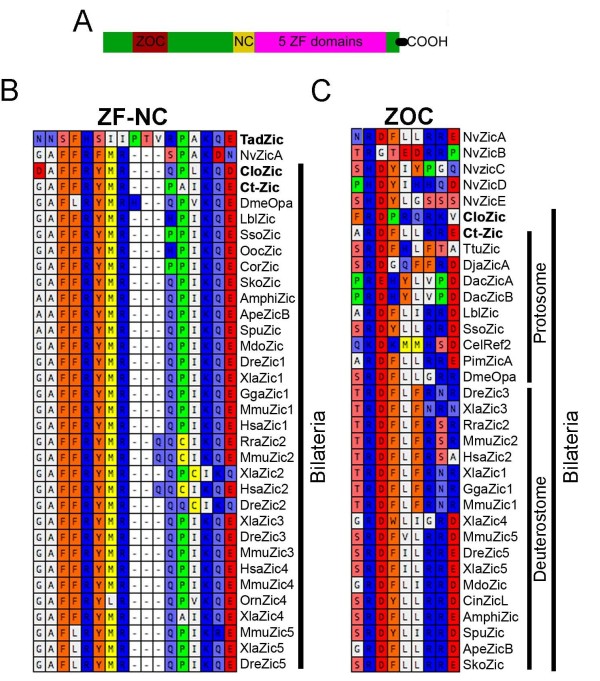
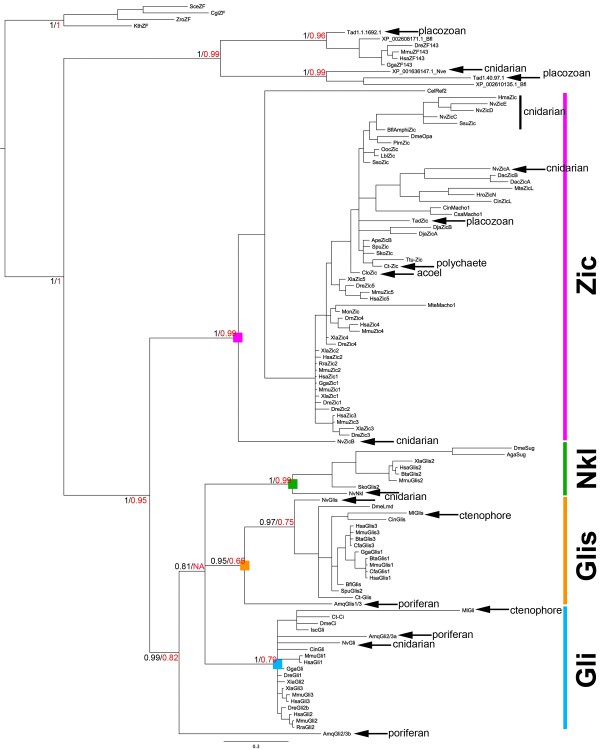
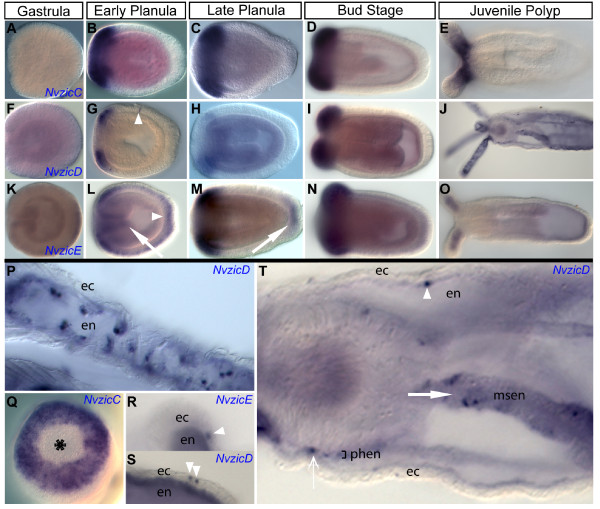
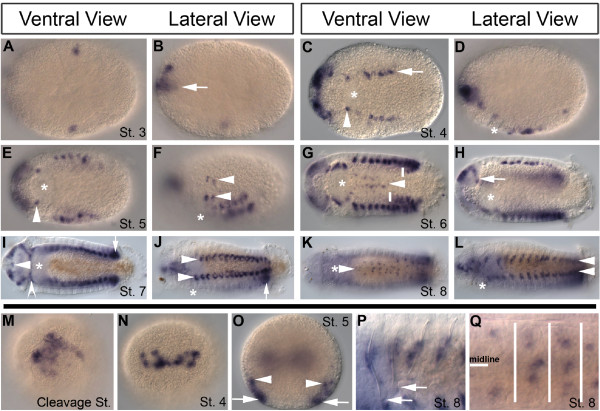
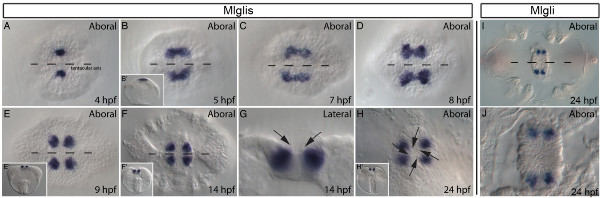
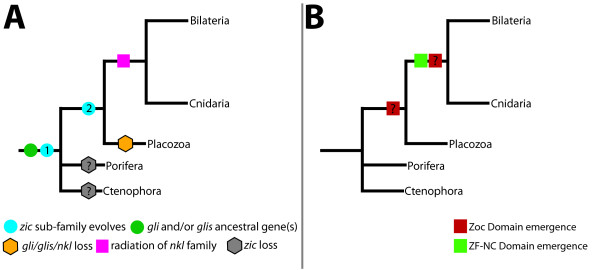
Background: zic genes are members of the gli/glis/nkl/zic super-family of C2H2 zinc finger (ZF) transcription factors. Homologs of the zic family have been implicated in patterning neural and mesodermal tissues in bilaterians. Prior to this study, the origin of the metazoan zic gene family was unknown and expression of zic gene homologs during the development of early branching metazoans had not been investigated. Results: Phylogenetic analyses of novel zic candidate genes identified a definitive zic homolog in the placozoan Trichoplax adhaerens, two gli/glis/nkl- like genes in the ctenophore Mnemiopsis leidyi, confirmed the presence of three gli/glis/nkl-like genes in Porifera, and confirmed the five previously identified zic genes in the cnidarian Nematostella vectensis. In the cnidarian N. vectensis, zic homologs are expressed in ectoderm and the gastrodermis (a bifunctional endomesoderm), in presumptive and developing tentacles, and in oral and sensory apical tuft ectoderm. The Capitella teleta zic homolog (Ct-zic) is detectable in a subset of the developing nervous system, the foregut, and the mesoderm associated with the segmentally repeated chaetae. Lastly, expression of gli and glis homologs in Mnemiopsis. leidyi is detected exclusively in neural cells in floor of the apical organ. Conclusions: Based on our analyses, we propose that the zic gene family arose in the common ancestor of the Placozoa, Cnidaria and Bilateria from a gli/glis/nkl-like gene and that both ZOC and ZF-NC domains evolved prior to cnidarian-bilaterian divergence. We also conclude that zic expression in neural ectoderm and developing neurons is pervasive throughout the Metazoa and likely evolved from neural expression of an ancestral gli/glis/nkl/zic gene. zic expression in bilaterian mesoderm may be related to the expression in the gastrodermis of a cnidarian-bilaterian common ancestor.
Overview
The claims and statistics of this paper haven’t been checked yet.
Free: it reads the open-access text and checks the first 5 claims that cite a source we can check. Create a free account to check every claim.
Integrity signals
Registry
Cites
Statistics
Figures
Verification
Claims the paper makes
The claims and statistics of this paper haven’t been checked yet.
Free: it reads the open-access text and checks the first 5 claims that cite a source we can check. Create a free account to check every claim.
Claims other papers make about this one
Each is checked against this paper’s own text: does it say what the citing paper says it does?
The source backs part of the claim, not all of it — or backs it for a different population, condition or comparison.
In the citing paper
“Other genes known to be involved in bilaterian mesoderm development, such as gli/glis genes, are expressed in neural (but not mesodermal) cells in M. leidyi (47).”
From The Genome of the Ctenophore Mnemiopsis leidyi and Its Implications for Cell Type Evolution (2013) · cites this paper as [47]
Experimental — accuracy not yet measured
Self-check
Percentages, sums and reported differences re-computed from the paper’s own numbers.
The self-check needs the paper’s full text.
Citations
Cites
MUSCLE: multiple sequence alignment with high accuracy and high throughput
Edgar, R. C. (2004) · Nucleic Acids Research · doi:10.1093/nar/gkh340 · Cited by 44,662 · cited 2×
“Full length sequences for Gli, Glis and Zic proteins were aligned using the Muscle Alignment [38] web server http://www.”
MethodMrBayes 3: Bayesian phylogenetic inference under mixed models
Ronquist, F., & Huelsenbeck, J. P. (2003) · Bioinformatics · doi:10.1093/bioinformatics/btg180 · Cited by 29,077 · cited 5×
“A Bayesian phylogenetic analysis was carried out using MrBayes 3.1.2 [19] with a mixed protein model for 1,000,000 generations sampled every 100 generations with four chains.”
BackgroundMethodInfluentialA Simple, Fast, and Accurate Algorithm to Estimate Large Phylogenies by Maximum Likelihood
Guindon, S., & Gascuel, O. (2003) · Systematic Biology · doi:10.1080/10635150390235520 · Cited by 16,806 · cited 2×
“Phylogenetic relationships among candidate genes were determined by performing Bayesian [19] and Maximum Likelihood [20] (Figure 2) analyses using sequences beginning with the first cysteine residue of the first ZF domain (ZF1) through the last histidine residue in the fifth ZF domain (ZF5) (Additional File 1).”
MethodInfluentialMutations affecting segment number and polarity in Drosophila
Nüsslein-Volhard, C., & Wieschaus, E. (1980) · Nature · doi:10.1038/287795a0 · Cited by 4,370 · cited 1×
“opa mutants were originally identified for their pair-rule phenotype (every other segment disrupted) [37].”
BackgroundProtTest: selection of best-fit models of protein evolution
Abascal, F., Zardoya, R., & Posada, D. (2005) · Bioinformatics · doi:10.1093/bioinformatics/bti263 · Cited by 3,063 · cited 3×
“0 so the JTT model of evolution (selected via ProtTest [39]) was used with 1000 bootstrap replicates to find the most likely tree: the JTT model is not present in MrBayes.”
MethodInfluentialBroad phylogenomic sampling improves resolution of the animal tree of life
Dunn, C. W., Hejnol, A., Matus, D. Q., Pang, K., Browne, W. E., Smith, S. A., Seaver, E., Rouse, G. W., Obst, M., Edgecombe, G. D., et al. (2008) · Nature · doi:10.1038/nature06614 · Cited by 1,921 · cited 1×
“Although the phylogenetic relationship between basal metazoans currently is debatable [26-30], the prevailing hypotheses place cnidarians as the sister group to the bilaterians and the divergence of placozoans after the origin of both poriferans and ctenophores [26-29].”
BackgroundSelf-citationThe Amphimedon queenslandica genome and the evolution of animal complexity
Srivastava, M., Simakov, O., Chapman, J., Fahey, B., Gauthier, M. E. A., Mitros, T., Richards, G. S., Conaco, C., Dacre, M., Hellsten, U., et al. (2010) · Nature · doi:10.1038/nature09201 · Cited by 1,049
The Trichoplax genome and the nature of placozoans
Srivastava, M., Begovic, E., Chapman, J., Putnam, N. H., Hellsten, U., Kawashima, T., Kuo, A., Mitros, T., Salamov, A., Carpenter, M. L., et al. (2008) · Nature · doi:10.1038/nature07191 · Cited by 889 · cited 1×
“adhaerens genome does not possess clear gli/glis/nkl-like homologs [31], which may have been lost in conjunction with the loss of these tissues in the placozoan lineage.”
BackgroundAssessing the root of bilaterian animals with scalable phylogenomic methods
Hejnol, A., Obst, M., Stamatakis, A., Ott, M., Rouse, G. W., Edgecombe, G. D., Martinez, P., Baguñà, J., Bailly, X., Jondelius, U., et al. (2009) · Proceedings of the Royal Society B: Biological Sciences · doi:10.1098/rspb.2009.0896 · Cited by 747 · cited 1×
“Although the phylogenetic relationship between basal metazoans currently is debatable [26-30], the prevailing hypotheses place cnidarians as the sister group to the bilaterians and the divergence of placozoans after the origin of both poriferans and ctenophores [26-29].”
BackgroundSelf-citationPhylogenomics Revives Traditional Views on Deep Animal Relationships
Philippe, H., Derelle, R., Lopez, P., Pick, K., Borchiellini, C., Boury-Esnault, N., Vacelet, J., Renard, E., Houliston, E., Quéinnec, E., et al. (2009) · Current Biology · doi:10.1016/j.cub.2009.02.052 · Cited by 695 · cited 1×
“Although the phylogenetic relationship between basal metazoans currently is debatable [26-30], the prevailing hypotheses place cnidarians as the sister group to the bilaterians and the divergence of placozoans after the origin of both poriferans and ctenophores [26-29].”
Background
Research works printed but not linked: 1
- Hernandez-Nicaise ML Herrison FW, Westfall JA Ctenophora Microscopic Anatomy of Invertebrates, Placaozoa, Porifera, Cnidaria and Ctenophora 1991 2 New York: Wiley-Liss 359 418
Cited by
The Genome of the Ctenophore Mnemiopsis leidyi and Its Implications for Cell Type Evolution
Ryan, J. F., Pang, K., Schnitzler, C. E., Nguyen, A.-D., Moreland, R. T., Simmons, D. K., Koch, B. J., Francis, W. R., Havlak, P., Program, N. C. S., et al. (2013) · Science · doi:10.1126/science.1242592 · Cited by 682
Self-citationFrom nerve net to nerve ring, nerve cord and brain — evolution of the nervous system
Arendt, D., Tosches, M. A., & Marlow, H. (2016) · Nature Reviews Neuroscience · doi:10.1038/nrn.2015.15 · Cited by 279
Pluripotency and the origin of animal multicellularity
(2019) · doi:10.1038/s41586-019-1290-4 · Cited by 146
Layden, M. J., Boekhout, M., & Martindale, M. Q. (2012) · Development · doi:10.1242/dev.073221 · Cited by 98
“Fixation, in situ probe synthesis, immunohistochemical detection, and in situ hybridization were carried out as described previously (Layden et al., 2010).”
MethodSelf-citationThe ZIC gene family encodes multi-functional proteins essential for patterning and morphogenesis
Houtmeyers, R., Souopgui, J., Tejpar, S., & Arkell, R. M. (2013) · Cellular and Molecular Life Sciences · doi:10.1007/s00018-013-1285-5 · Cited by 92
“In Zic proteins, however, this number is both increased and highly variable, ranging from 6 to 38 in species so far examined [6, 7].”
Schiemann, S. M., Martín-Durán, J. M., Børve, A., Vellutini, B. C., Passamaneck, Y. J., & Hejnol, A. (2017) · Proceedings of the National Academy of Sciences · doi:10.1073/pnas.1614501114 · Cited by 99
“teleta (63, 65), and also in the region of the forming chaetae sac territories in T.”
BackgroundPhylogenetic evidence for the modular evolution of metazoan signalling pathways
Babonis, L. S., & Martindale, M. Q. (2017) · Philosophical Transactions of the Royal Society B: Biological Sciences · doi:10.1098/rstb.2015.0477 · Cited by 90
Self-citationA two‐step process in the emergence of neurogenesis
Galliot, B., & Quiquand, M. (2011) · European Journal of Neuroscience · doi:10.1111/j.1460-9568.2011.07829.x · Cited by 77
“…et al. (2007), Degnan et al. (2009) and Skinner et al. (2010); nuclear receptors in Bridgham et al. (2010); Gli ⁄ Zic in Aruga et al. (2006) and Layden et al. (2010); bZIP in Amoutzias et al. (2007); Fox in Chevalier et al. (2006) and Larroux et al. (2008); Sox ⁄ TCF in Jager et al. (2006),…”
BackgroundClark, E., & Akam, M. E. (2016) · eLife · doi:10.7554/elife.18215 · Cited by 78
The evolutionary history of vertebrate cranial placodes II. Evolution of ectodermal patterning
Schlosser, G., Patthey, C., & Shimeld, S. M. (2014) · Developmental Biology · doi:10.1016/j.ydbio.2014.01.019 · Cited by 80
“Zic and GATA1/2/3 while being ectodermally expressed in many protostomes, are often not confined to neural or non-neural ectoderm, respectively (Gillis et al., 2007; Layden et al., 2010), while little is known about other transcription factors such as FoxI.”
BackgroundNon-canonical Notch signaling represents an ancestral mechanism to regulate neural differentiation
Layden, M. J., & Martindale, M. Q. (2014) · EvoDevo · doi:10.1186/2041-9139-5-30 · Cited by 68
“All fixation, in situ probe synthesis, and in situ hybridizations were carried out as previously described [30,32,33].”
Self-citationMAPK signaling is necessary for neurogenesis in Nematostella vectensis
Layden, M. J., Johnston, H., Amiel, A., Havrilak, J. A., Steinworth, B. M., Chock, T., Röttinger, É., & Martindale, M. Q. (2016) · BMC Biology · doi:10.1186/s12915-016-0282-1 · Cited by 69
Self-citationFGF signaling induces mesoderm in the hemichordate Saccoglossus kowalevskii
Green, S. A., Norris, R. P., Terasaki, M. R., & Lowe, C. J. (2013) · Development · doi:10.1242/dev.083790 · Cited by 57
“This possibility deserves special consideration, as zic is a homolog of the ascidian gene macho-1 (Layden et al., 2010), which acts in ascidian cellautonomous mesoderm specification (Nishida and Sawada, 2001; Sawada et al.”
BackgroundDid the ctenophore nervous system evolve independently?
Ryan, J. F. (2014) · Zoology · doi:10.1016/j.zool.2014.06.001 · Cited by 55
NF-κB is required for cnidocyte development in the sea anemone Nematostella vectensis
Wolenski, F. S., Bradham, C. A., Finnerty, J. R., & Gilmore, T. D. (2012) · Developmental Biology · doi:10.1016/j.ydbio.2012.10.004 · Cited by 51
“Whole-mount in situ hybridizations were performed according to a previously published protocol (Layden et al., 2010).”
MethodSimmons, D. K., Pang, K., & Martindale, M. Q. (2012) · EvoDevo · doi:10.1186/2041-9139-3-2 · Cited by 38
“Previous studies have described other genes in different regions of the apical organ of Mnemiopsis, including the T-box genes Tbx2/3 and Brachyury [55], the homeobox genes Prd1 and Prd3 [56], the Wnt genes MlWnt6 and MlWntX [46], as well as the zinc fingers MlGli and MlGlis [57].”
Self-citationSeaver, E. C., Yamaguchi, E., Richards, G. S., & Meyer, N. P. (2012) · EvoDevo · doi:10.1186/2041-9139-3-8 · Cited by 37
“Previously, we investigated the evolution of bilaterian segmentation by characterizing the expression of orthologs of the segment polarity genes, en, wg and hh [26] and of the pair-rule genes hairy [29] and odd-paired [30] in C.”
BackgroundSelf-citationRegulation and evolution of muscle development in tunicates
Razy‐Krajka, F., & Stolfi, A. (2019) · EvoDevo · doi:10.1186/s13227-019-0125-6 · Cited by 38
Gli Protein Nuclear Localization Signal
Hatayama, M., & Aruga, J. (2012) · Vitamins and hormones · doi:10.1016/b978-0-12-394622-5.00004-3 · Cited by 34
Andrikou, C., Passamaneck, Y. J., Lowe, C. J., Martindale, M. Q., & Hejnol, A. (2019) · EvoDevo · doi:10.1186/s13227-019-0146-1 · Cited by 28
Self-citationFischer, A., Pang, K., Henry, J. J., & Martindale, M. Q. (2014) · EvoDevo · doi:10.1186/2041-9139-5-4 · Cited by 30
“These planes are defined by axes of rotational symmetry around the oral-aboral axis because diagonally opposed quadrants are more identical to one another than adjacent quadrants [3-610,13,15].”
BackgroundResultSelf-citationPresnell, J. S., Bubel, M. M., Knowles, T., Patry, W. L., & Browne, W. E. (2022) · Nature Protocols · doi:10.1038/s41596-022-00702-w · Cited by 28
Comparative Genomics of the Zic Family Genes
Aruga, J., & Hatayama, M. (2018) · Advances in experimental medicine and biology · doi:10.1007/978-981-10-7311-3_1 · Cited by 25
Whitelaw, B. L., Cooke, I., Finn, J., da Fonseca, R. R., Ritschard, E. A., Gilbert, M. T. P., Simakov, O., & Strugnell, J. M. (2020) · GigaScience · doi:10.1093/gigascience/giaa120 · Cited by 24
“Zinc fingers form an ancient family of transcription factors, which among other roles serve to regulate transposon splicing, as well as embryonic and neural development [69, 70].”
Bonacolta, A. M., Connelly, M. T., Rosales, S., del Campo, J., & Traylor‐Knowles, N. (2021) · FEMS Microbiology Letters · doi:10.1093/femsle/fnab002 · Cited by 18
Mitochondrial Genome of a Japanese Placozoan
Miyazawa, H., Yoshida, M., Tsuneki, K., & Furuya, H. (2012) · ZOOLOGICAL SCIENCE · doi:10.2108/zsj.29.223 · Cited by 17
“…group to sponges and cnidarians (Dellaporta et al., 2006; Signorovitch et al., 2007; Schierwater et al., 2009); (ii) a sister group to cnidarians (Layden et al., 2010); (iii) a sister group to bilaterians (Picks et al., 2010); or (iv) placed between sponges and other metazoans including…”
BackgroundOdd-Paired: The Drosophila Zic Gene
Hursh, D. A., & Stultz, B. G. (2018) · Advances in experimental medicine and biology · doi:10.1007/978-981-10-7311-3_3 · Cited by 14
Evolutionary History of GLIS Genes Illuminates Their Roles in Cell Reprograming and Ciliogenesis
Yasuoka, Y., Matsumoto, M., Yagi, K., & Okazaki, Y. (2019) · Molecular Biology and Evolution · doi:10.1093/molbev/msz205 · Cited by 14
“GLIS1, GLIS2, and GLIS3 with higher reliability than previous studies (Materna et al. 2006; Shimeld 2008; Hatayama and Aruga 2010; Layden et al. 2010).”
BackgroundResultVogg, M. C., Ferenc, J., Buzgariu, W., Perruchoud, C., Papasaikas, P., Sanchez, P. G. L., Nuninger, C., Delucinge-Vivier, C., Rampon, C., Beccari, L. L., et al. (2022) · Science Advances · doi:10.1126/sciadv.abo0694 · Cited by 14
“In the sea anemone Nematostella , several Zic genes are expressed during tentacle formation in distinct tentacle cell types ( 47 ), suggesting that the Zic4 function in tentacle maintenance and tentacle formation is shared among cnidarians.”
Cytoplasmic Polyadenylation Is an Ancestral Hallmark of Early Development in Animals
Rouhana, L., Edgar, A., Hugosson, F., Dountcheva, V., Martindale, M. Q., & Ryan, J. F. (2023) · Molecular Biology and Evolution · doi:10.1093/molbev/msad137 · Cited by 12
“Expression of the CPEB2 ortholog and a second GLD2 homolog (NvGLD2-like) were most obvious in samples obtained 10 and 40-days post-fertilization (dpf), which correlated the timing of expression of the neuronal and neuronal ectoderm marker NvZicD (Figure 2J; [90]).”
BackgroundSelf-citationDiamand, K. E. M., Barratt, K. S., & Arkell, R. M. (2018) · Advances in experimental medicine and biology · doi:10.1007/978-981-10-7311-3_10 · Cited by 12
Changing Faces of Transcriptional Regulation Reflected by Zic3
Winata, C. L., Kondrychyn, I., & Korzh, V. P. (2015) · Current Genomics · doi:10.2174/1389202916666150205124519 · Cited by 9
“In accordance with this idea, the binding sites of Zic3 diverge greatly while their core structure and possibly also their binding specificity remain largely conserved across metazoans [14, 26].”
Origin and Evolution of Nervous Systems
Layden, M. J. (2019) · Fascinating life sciences · doi:10.1007/978-3-030-18202-1_8 · Cited by 8
Self-citationLink between the causative genes of holoprosencephaly: Zic2 directly regulates Tgif1 expression
Ishiguro, A., Hatayama, M., Otsuka, M., & Aruga, J. (2018) · Scientific Reports · doi:10.1038/s41598-018-20242-2 · Cited by 8
Zebrafish Zic Genes Mediate Developmental Signaling
Winata, C. L., & Korzh, V. P. (2018) · Advances in experimental medicine and biology · doi:10.1007/978-981-10-7311-3_9 · Cited by 6
Abdol, A. M., Röttinger, É., Jansson, F., & Kaandorp, J. A. (2017) · Developmental Biology · doi:10.1016/j.ydbio.2017.06.004 · Cited by 7
“Spatial gene expression analysis has further suggested a potential functional conservation between cnidarians and bilaterians of certain genes in germ layer formation, morphogenetic movements, axial patterning and neurogenesis (Fritzenwanker et al., 2007; Layden et al., 2010; Leclère and Rentzsch, 2014; Lee et al., 20…”
BackgroundIdentification and Characterization of Novel Conserved Domains in Metazoan Zic Proteins
Tohmonda, T., Kamiya, A., Ishiguro, A., Iwaki, T., Fujimi, T. J., Hatayama, M., & Aruga, J. (2018) · Molecular Biology and Evolution · doi:10.1093/molbev/msy122 · Cited by 5
“Furthermore, expression profiles suggest that cnidarian Zic genes are involved in the development of the ectoderm, gastrodermis (a bifunctional endomesoderm) (Layden et al. 2010), and nematocytes (Lindgens et al.”
BackgroundMethodResultInfluentialBump, P. A., Loubet-Senear, K. J., Arnold, S. E., & Srivastava, M. (2025) · Development · doi:10.1242/dev.204799 · Cited by 4
Odd-Paired is Involved in Morphological Divergence of Snail-Feeding Beetles
Konuma, J., Fujisawa, T., Nishiyama, T., Kasahara, M., Shibata, T., Nozawa, M., Shigenobu, S., Toyoda, A., Hasebe, M., & Sota, T. (2024) · Molecular Biology and Evolution · doi:10.1093/molbev/msae110 · Cited by 2
“Thus, opa may be involved in body size variations in Carabus beetles. opa is the Drosophila homolog of the Zic gene family, a family of transcription factors involved in metazoan morphogenesis (Layden et al. 2010).”
BackgroundSimmons, D. K., & Martindale, M. Q. (2015) · Oxford University Press eBooks · doi:10.1093/acprof:oso/9780199682201.003.0006 · Cited by 2
Self-citationZic Genes in Nematodes: A Role in Nervous System Development and Wnt Signaling
Bordet, G., & Bertrand, V. (2018) · Advances in experimental medicine and biology · doi:10.1007/978-981-10-7311-3_4 · Cited by 2
“The ZOC domain is only present in the long isoform of the C. elegans protein (REF2-b), while the ZF-NC domain is absent in both isoforms (Aruga et al. 2006; Layden et al. 2010).”
BackgroundAruga, J. (2018) · Advances in experimental medicine and biology · doi:10.1007/978-981-10-7311-3_5 · Cited by 1
Layden, M. J. (2018) · Advances in experimental medicine and biology · doi:10.1007/978-981-10-7311-3_2 · Cited by 1
Self-citationThe transcription factor Zic4 acts as a transdifferentiation switchPreprint
Vogg, M. C., Ferenc, J., Buzgariu, W. C., Perruchoud, C., Papasaikas, P., Sanchez, P. G. L., Nuninger, C., Delucinge-Vivier, C., Rampon, C., Beccari, L. L., et al. (2021) · bioRxiv (Cold Spring Harbor Laboratory) · doi:10.1101/2021.12.22.473838
“In the sea anemone Nematostella, several Zic genes are expressed during tentacle formation in distinct tentacle cell types (Layden et al. 2010), suggesting a function in tentacle formation possibly shared among cnidarians.”
BackgroundCheung, S. (2022) · Utrecht University Repository (Utrecht University) · doi:10.33540/1452
Metadata
- Authors
- Layden, M. J., Meyer, N. P., Pang, K., Seaver, E. C., & Martindale, M. Q.
- Affiliations
- University of Hawaiʻi at Mānoa (US)
- Corresponding author
- Martindale, Mark Q
- Venue
- EvoDevo
- Published
- 2010-11-05
- Volume
- 1
- Issue
- 1
- Pages
- 12-12
- ISSN
- 2041-9139 (ISSN-L)
- PMC
- PMC2988786
- OpenAlex
- W2120892264
- Cited by
- 46
- References
- 39
- Citations by year
- 2025: 1 · 2024: 1 · 2023: 1 · 2022: 3 · 2021: 2 · 2020: 1 · 2019: 5 · 2018: 9 · 2017: 3 · 2016: 3 · 2015: 3 · 2014: 4 · 2013: 3 · 2012: 6
- FWCI
- 1.30
- Type
- journal article
- Language
- en
- Open access
- gold
- doi.org
- Licence
- cc-by
- Locations
- EvoDevo (publishedVersion, cc-by)
- PubMed Central (publishedVersion, cc-by)
- PubMed (publishedVersion)
- DOAJ (DOAJ: Directory of Open Access Journals) (submittedVersion, cc-by-sa)
- Funders
- National Institutes of Health
- National Institute of General Medical Sciences (R01GM093116)
- National Institute of Child Health and Human Development
- National Center for Research Resources (G12RR003061)
- Eunice Kennedy Shriver National Institute of Child Health and Human Development
- Topics
- Life Sciences › Biochemistry, Genetics and Molecular Biology › Molecular Biology › Developmental Biology and Gene Regulation
- Life Sciences › Agricultural and Biological Sciences › Animal Science and Zoology › Marine Invertebrate Physiology and Ecology
- Life Sciences › Biochemistry, Genetics and Molecular Biology › Molecular Biology › Genomics and Phylogenetic Studies
- Keywords
- C2H2 zinc finger transcription factor, animal evolution, Trichoplax adhaerens, Mnemiopsis leidyi, sponges, Nematostella vectensis, Capitella teleta, gene expression, neural development, mesoderm formation, gastrodermis, Placozoa, Cnidaria, Bilateria, apical organ
About these checks
Registry, retraction, Cites and statistics results are computed, not judged, with one exception: a printed reference that no index lists is read once by a model before it counts as a citation error. Claims are extracted by a model and kept only when their quote appears verbatim in the text; each cited source is then checked, with a model’s help, for whether it says what the claim relies on. Those verdicts can be wrong — read the claim’s quote and the cited source before relying on one.
Statistics and arithmetic are recomputed, not judged.
Confidence bands are shown only for fields calibrated on our annotated test set. None is calibrated yet, so no band is shown.
What counts as a claim ›How we measure confidence ›How we check this ›
Are you an author, or do you see a problem with this page? Request a review
Data sources
Bibliographic data: Semantic Scholar, OpenAlex, Crossref.
Contains information from the Semantic Scholar Academic Graph Datasets, made available under the ODC Attribution License (ODC-BY 1.0).
Semantic Scholar’s data is described in: Kinney, R., et al. (2023). The Semantic Scholar Open Data Platform. arXiv:2301.10140.
