

The DOI matches its Crossref record; 87 of the 92 references it cites were found in a registry or an index.
Improving quality of care for persons with diabetes: an overview of systematic reviews - what does the evidence tell us?
Open accessAbstract
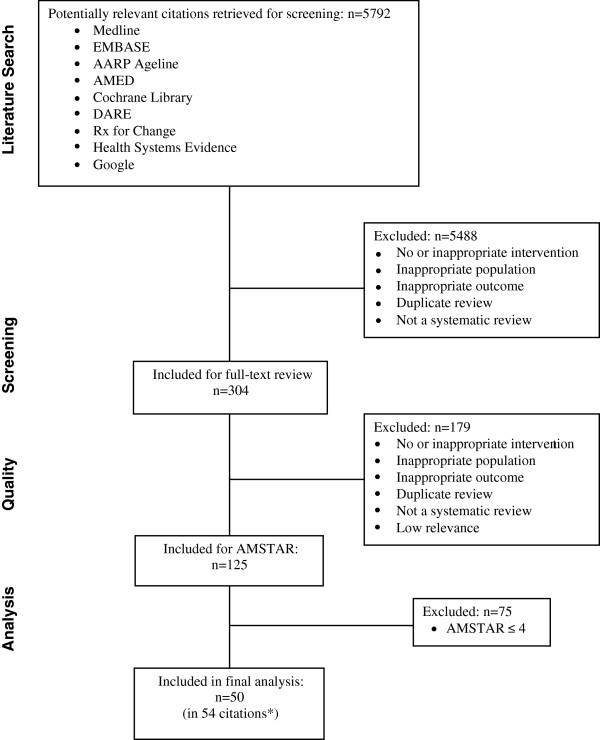
Background: Ensuring high quality care for persons with diabetes remains a challenge for healthcare systems globally with consistent evidence of suboptimal care and outcomes. There is increasing interest in quality improvement strategies to improve diabetes management as reflected by a growing number of systematic reviews. These reviews are of varying quality and dispersed across many sources. In this paper, we present an overview of systematic reviews evaluating the impact of interventions to improve the quality of diabetes care. Methods: We searched for systematic reviews evaluating the effectiveness of any intervention intended to improve intermediate patient outcomes and process of care measures for patients with any type of diabetes. Two reviewers independently screened search results, appraised each systematic review using AMSTAR and extracted data from high quality reviews (AMSTAR score ≥ 5). Within reviews, we used vote counting by direction of effect to report the number of studies favouring an intervention for each outcome. We produced summaries of results for each intervention category. Results: We identified 125 reviews of varying methodological quality and summarised key findings from 50 high quality reviews. We categorised reviews by quality improvement intervention. Eight reviews were broad based (involving a variety of strategies). Other reviews considered: patient education and support (n = 21), telemedicine (n = 10), provider role changes (n = 7), and organisational changes (n = 4). Reviews reported intermediate patient outcomes (e.g. glycaemic control) (n = 49) and process of care outcomes (n = 9). There was evidence of considerable overlap of included studies between reviews. Conclusions: There is consistent evidence from high quality systematic reviews that patient education and support, provider role changes, and telemedicine are associated with improvements in glycaemic and vascular risk factor control in patients. There is less evidence about the impact of quality improvement interventions on other key process measures such as screening patients for diabetic complications. This paper provides decision makers with a comprehensive overview of evidence from high quality systematic reviews about the effects of quality improvement interventions on improving diabetes care.
Overview
The claims and statistics of this paper haven’t been checked yet.
Run the check — free, no account needed. It reads the open-access text and checks the sources it cites.
Integrity signals
Registry
Cites
Statistics
Figures
Verification
Claims the paper makes
The claims and statistics of this paper haven’t been checked yet.
Run the check — free, no account needed. It reads the open-access text and checks the sources it cites.
Claims other papers make about this one
Each is checked against this paper’s own text: does it say what the citing paper says it does?
In the citing paper
“Overviews of systematic reviews are an efficient way to gather and summarize in a single source the best available evidence on the effectiveness of interventions.”
From Effects of Home Telemonitoring Interventions on Patients With Chronic Heart Failure: An Overview of Systematic Reviews (2015) · cites this paper as [10]
Self-check
Percentages, sums and reported differences re-computed from the paper’s own numbers.
The self-check needs the paper’s full text.
Citations
Cites
1 retracted
Group based training for self-management strategies in people with type 2 diabetes mellitus
Deakin, T. A., McShane, C. E., Cade, J. E., & Williams, R. (2005) · Cochrane Database of Systematic Reviews · doi:10.1002/14651858.cd003417.pub2 · Cited by 862
RetractedPreferred Reporting Items for Systematic Reviews and Meta-Analyses: the PRISMA statement
Moher, D., Liberati, A., Tetzlaff, J., Altman, D. G., & for the PRISMA Group (2009) · BMJ · doi:10.1136/bmj.b2535 · Cited by 83,823
Preferred Reporting Items for Systematic Reviews and Meta-Analyses: The PRISMA Statement
Moher, D., Liberati, A., Tetzlaff, J., Altman, D. G., & The PRISMA Group (2009) · PLoS Medicine · doi:10.1371/journal.pmed.1000097 · Cited by 64,042
Preferred reporting items for systematic reviews and meta-analyses: the PRISMA Statement.
(2009) · PubMed Central · Cited by 44,859
Preferred reporting items for systematic reviews and meta-analyses: The PRISMA statement
Moher, D., Liberati, A., Tetzlaff, J., Altman, D. G., & the PRISMA Group* (2009) · Annals of Internal Medicine · doi:10.7326/0003-4819-151-4-200908180-00135 · Cited by 37,554
Cochrane Handbook for Systematic Reviews of Interventions: Cochrane Book Series
(2008) · doi:10.1002/9780470712184 · Cited by 25,048
Preferred Reporting Items for Systematic Reviews and Meta-Analyses: The PRISMA Statement
Moher, D., Liberati, A., Tetzlaff, J., & Altman, D. G. (2009) · Journal of Clinical Epidemiology · doi:10.1016/j.jclinepi.2009.06.005 · Cited by 19,575
Lost in knowledge translation: Time for a map?
Graham, I. D., Logan, J., Harrison, M. B., Straus, S. E., Tetroe, J., Caswell, W., & Robinson, N. (2006) · Journal of Continuing Education in the Health Professions · doi:10.1002/chp.47 · Cited by 4,705
The Handbook of Research Synthesis and Meta-Analysis
(2019) · doi:10.7758/9781610448864 · Cited by 4,553
Development of AMSTAR: A measurement tool to assess the methodological quality of systematic reviews
Shea, B. J., Grimshaw, J. M., Wells, G. A., Boers, M., Andersson, N., Hamel, C., Porter, A. C., Tugwell, P., Moher, D., & Bouter, L. M. (2007) · BMC Medical Research Methodology · doi:10.1186/1471-2288-7-10 · Cited by 4,374
Self-citation
Research works printed but not linked: 6
- Unwin N, Whiting D, Guariguata L, Ghyoot G: Gan De: IDF Diabetes Atlas. 2009, Brussels: International Diabetes Federation
- Williams J, Jackson G, Powers B, Chatterjee R, Prvu Bettger J, Kemper A, Hasselblad V, Dolor R, Irvine R, Heidenfelder B, Gray R: Closing the Quality Gap: A Critical Analysis of Quality Improvement Strategies. Volume 1–Series Overview and Methodology. 2004, Rockville, MD: Agency for Healthcare Research and Quality
- Canadian Diabetes Association Clinical Practice Guidelines Expert Committee: Canadian Diabetes Association 2008 clinical practice guidelines for the prevention and management of diabetes in Canada. Can J Diabetes. 2008, 32: s1-s201.
- Chan B, Daniel I, Anderson G, Misra A, Comrie R, Newman A, Rey M, Chen J, Brien S, Ceccato C, Wu L, Mullen J, Vincent K, Heydon A, Mitchell A, St-Louis C, Kassam N: Quality Monitor: 2010 Report on Ontario's Health System 2010. 2010, 1-125.
- Shojania K, Ranji S, Shaw L, Charo L, Lai J, Rushakoff R, Macdonald K, Owens D: Closing the Quality Gap: A Critical Analysis of Quality Improvement Strategies. Volume 2–Diabetes Mellitus Care. 2004, Rockville, MD: Agency for Healthcare Research and Quality
- Becker L, Oxman A: Chapter 22: Overviews of reviews. Cochrane Handbook for Systematic Reviews of Interventions. Version 5.1.0 (updated March 2011) edition. Edited by: Higgins J, Green S. 2011, London: The Cochrane Collaboration
Cited by
Sorted by citations
Aromataris, E., Fernandez, R., Godfrey, C. M., Holly, C., Khalil, H., & Tungpunkom, P. (2015) · International Journal of Evidence-Based Healthcare · doi:10.1097/xeb.0000000000000055 · Cited by 2,587
Effectiveness of mHealth interventions for patients with diabetes: An overview of systematic reviews
Kitsiou, S., Paré, G., Jaana, M., & Gerber, B. S. (2017) · PLoS ONE · doi:10.1371/journal.pone.0173160 · Cited by 415
Kitsiou, S., Paré, G., & Jaana, M. (2015) · Journal of Medical Internet Research · doi:10.2196/jmir.4174 · Cited by 327
“Taking published systematic reviews as the sole evidence source and not searching for original trials that have not been identified by the included reviews increases the potential effect of publication lag and increases the chance that some evidence has not been considered in the review process [10].”
Hunt, H., Pollock, A., Campbell, P., Estcourt, L., & Brunton, G. (2018) · Systematic Reviews · doi:10.1186/s13643-018-0695-8 · Cited by 314
Prescribable mHealth apps identified from an overview of systematic reviews
Byambasuren, O., Sanders, S., Beller, E., & Glasziou, P. (2018) · npj Digital Medicine · doi:10.1038/s41746-018-0021-9 · Cited by 291
Metadata
- Authors
- Worswick, J., Wayne, S. C., Bennett, R., Fiander, M., Mayhew, A., Weir, M. C., Sullivan, K. J., & Grimshaw, J. M.
- Affiliations
- Ottawa Hospital (CA)
- University of Ottawa (CA)
- Corresponding author
- Grimshaw, Jeremy M
- Venue
- Systematic Reviews
- Published
- 2013-05-07
- Volume
- 2
- Issue
- 1
- Pages
- 26-26
- ISSN
- 2046-4053 (ISSN-L)
- PMC
- PMC3667096
- OpenAlex
- W2105352120
- Cited by
- 130
- References
- 92
- Citations by year
- 2026: 2 · 2025: 2 · 2024: 8 · 2023: 7 · 2022: 13 · 2021: 6 · 2020: 14 · 2019: 14 · 2018: 16 · 2017: 9 · 2016: 21 · 2015: 10 · 2014: 7 · 2013: 1
- FWCI
- 1.92
- Type
- journal article
- Language
- en
- Open access
- gold
- doi.org
- Licence
- Locations
- Systematic Reviews (publishedVersion, cc-by)
- Europe PMC (PubMed Central) (publishedVersion, cc-by)
- PubMed Central (publishedVersion, cc-by)
- PubMed (publishedVersion)
- uO Research (University of Ottawa) (submittedVersion, public-domain)
- Topics
- Health Sciences › Medicine › Endocrinology, Diabetes and Metabolism › Diabetes Management and Education
- Health Sciences › Medicine › Endocrinology, Diabetes and Metabolism › Diabetes Management and Research
- Health Sciences › Medicine › Family Practice › Primary Care and Health Outcomes
- Keywords
- diabetes care quality, quality improvement intervention, telemedicine, organizational change, glycemic control, vascular risk factor control, process of care
- MeSH terms
- Delivery of Health Care, Diabetes Mellitus, Humans, Patient Education as Topic, Telemedicine, Professional Role, Quality Improvement
About these checks
Registry, retraction, Cites and statistics results are computed, not judged, with one exception: a printed reference that no index lists is read once by a model before it counts as a citation error. Claims are extracted by a model and kept only when their quote appears verbatim in the text; each cited source is then checked, with a model’s help, for whether it says what the claim relies on. Those verdicts can be wrong — read the claim’s quote and the cited source before relying on one.
Statistics and arithmetic are recomputed, not judged.
Confidence bands are shown only for fields calibrated on our annotated test set. None is calibrated yet, so no band is shown.
What counts as a claim ›How we measure confidence ›How we check this ›
Are you an author, or do you see a problem with this page? Request a review
