

Systematic review automation technologies
Open accessThe DOI matches its Crossref record; 136 of the 137 references it cites were found in a registry or an index.
Abstract
Systematic reviews, a cornerstone of evidence-based medicine, are not produced quickly enough to support clinical practice. The cost of production, availability of the requisite expertise and timeliness are often quoted as major contributors for the delay. This detailed survey of the state of the art of information systems designed to support or automate individual tasks in the systematic review, and in particular systematic reviews of randomized controlled clinical trials, reveals trends that see the convergence of several parallel research projects.We surveyed literature describing informatics systems that support or automate the processes of systematic review or each of the tasks of the systematic review. Several projects focus on automating, simplifying and/or streamlining specific tasks of the systematic review. Some tasks are already fully automated while others are still largely manual. In this review, we describe each task and the effect that its automation would have on the entire systematic review process, summarize the existing information system support for each task, and highlight where further research is needed for realizing automation for the task. Integration of the systems that automate systematic review tasks may lead to a revised systematic review workflow. We envisage the optimized workflow will lead to system in which each systematic review is described as a computer program that automatically retrieves relevant trials, appraises them, extracts and synthesizes data, evaluates the risk of bias, performs meta-analysis calculations, and produces a report in real time.
Overview
The claims and statistics of this paper haven’t been checked yet.
Free: it reads the open-access text and checks the first 5 claims that cite a source we can check. Create a free account to check every claim.
Integrity signals
Registry
Cites
Statistics
Figures

Verification
Claims the paper makes
The claims and statistics of this paper haven’t been checked yet.
Free: it reads the open-access text and checks the first 5 claims that cite a source we can check. Create a free account to check every claim.
Claims other papers make about this one
Each is checked against this paper’s own text: does it say what the citing paper says it does?
The source backs part of the claim, not all of it — or backs it for a different population, condition or comparison.
In the citing paper
“many of the tools have been developed independently as stand-alone software and are often not compatible with other tools”
From Rayyan-a web and mobile app for systematic reviews. (2016) · cites this paper as [5]
Experimental — accuracy not yet measuredThe source backs part of the claim, not all of it — or backs it for a different population, condition or comparison.
In the citing paper
“An effective parallelisation of SR processes needs to be supported by the use of a purposefully adapted computer technology [11, 12].”
From How to conduct systematic reviews more expeditiously? (2015) · cites this paper as [12]
Experimental — accuracy not yet measuredThe cited source says what the claim attributes to it.
In the citing paper
“An increasing number of projects are underway which focus on the automation of segments of the systematic review process, and although several tools and software have been developed, so far, none of them span the entire process of review production”
From Rayyan-a web and mobile app for systematic reviews. (2016) · cites this paper as [5]
The cited source says what the claim attributes to it.
In the citing paper
“Title and abstract screening is a review step that may be particularly amenable to automation or semi-automation [2–4].”
From Performance and usability of machine learning for screening in systematic reviews: a comparative evaluation of three tools (2019) · cites this paper as [3]
The cited source says what the claim attributes to it.
In the citing paper
“The authors illustrated that not all SR tasks are equally amenable to automation.”
From How to conduct systematic reviews more expeditiously? (2015) · cites this paper as [12]
4 more claims about this paper
Create a free account to see every claim other papers make about this one.
Self-check
Percentages, sums and reported differences re-computed from the paper’s own numbers.
The self-check needs the paper’s full text.
Citations
Cites
Preferred Reporting Items for Systematic Reviews and Meta-Analyses: the PRISMA statement
Moher, D., Liberati, A., Tetzlaff, J., Altman, D. G., & for the PRISMA Group (2009) · BMJ · doi:10.1136/bmj.b2535 · Cited by 83,823
Bias in meta-analysis detected by a simple, graphical test
Egger, M., Smith, G. D., Schneider, M., & Minder, C. (1997) · BMJ · doi:10.1136/bmj.315.7109.629 · Cited by 56,722 · cited 1×
“, funnel plots [130] show whether publication bias is likely to affect the conclusion of the”
BackgroundPreferred reporting items for systematic reviews and meta-analyses: the PRISMA Statement.
(2009) · PubMed Central · Cited by 44,859
Preferred reporting items for systematic reviews and meta-analyses: The PRISMA statement
Moher, D., Liberati, A., Tetzlaff, J., Altman, D. G., & the PRISMA Group* (2009) · Annals of Internal Medicine · doi:10.7326/0003-4819-151-4-200908180-00135 · Cited by 37,554
Scoping studies: towards a methodological framework
Arksey, H., & O'Malley, L. (2005) · International Journal of Social Research Methodology · doi:10.1080/1364557032000119616 · Cited by 36,742 · cited 1×
“Current systems Global evidence maps [18,19] and scoping studies [20] are both literature review methods designed to complement systematic review and identify research gaps.”
BackgroundCochrane Handbook for Systematic Reviews of Interventions: Cochrane Book Series
(2008) · doi:10.1002/9780470712184 · Cited by 25,048
Preferred Reporting Items for Systematic Reviews and Meta-Analyses: The PRISMA Statement
Moher, D., Liberati, A., Tetzlaff, J., & Altman, D. G. (2009) · Journal of Clinical Epidemiology · doi:10.1016/j.jclinepi.2009.06.005 · Cited by 19,575
Statistical Methods for Meta-Analysis
Wasserman, S., Hedges, L. V., & Olkin, I. (1988) · Journal of Educational Statistics · doi:10.2307/1164953 · Cited by 10,326
Cochrane Handbook for Systematic Reviews of Interventions
Tarsilla, M. (2010) · Journal of MultiDisciplinary Evaluation · doi:10.56645/jmde.v6i14.284 · Cited by 5,178
Users' guides to the medical literature
Guyatt, G. H. (1993) · JAMA · doi:10.1001/jama.270.17.2096 · Cited by 2,970
Research works printed but not linked: 15
- 1. Sackett DL, Straus S, Richardson WS, Rosenberg W, Haynes RB. Evidence-based Medicine: How to Teach and Practice EBM. Edinburgh: Churchill Livingstone; 2000.
- 11. Glasziou P, Beller E, Thorning S, Vermeulen M. Manual for systematic reviews. Gold Coast, Queensland, Australia: Centre for Research on Evidence Based Medicine; 2013.
- 40. Collaboration RTC. Review Manager (RevMan). 4.2 for Windows. Oxford, England: The Cochrane Collaboration; 2003.
- 41. Higgins J, Churchill R, Tovey D, Lasserson T, Chandler J. Update on the MECIR project: methodological expectations for Cochrane intervention. Cochrane Meth. 2011;suppl. 1:2.
- 82. REUTERS T. EndNote®. Bibliographies Made Easy™; 2011. http://www.endnote.com.
- 83. ResearchSoft I. ProCite Version 5. Berkeley, CA: Institute for Scientific Information; 1999.
- 88. Saleem O, Latif S. Proceedings of the World Congress on Engineering and Computer Science. San Francisco, USA; 2012. Information extraction from research papers by data integration and data validation from multiple header extraction sources.
- 99. Thomas J, Brunton J, Graziosi S. EPPI-Reviewer 4.0: software for research synthesis. EPPI-Centre, Social Science Research Unit, Institute of Education, University of London UK; 2010.
- 100. DistillerSR. http://www.systematic-review.net.
- 110. PubMed Central. http://www.ncbi.nlm.nih.gov/pmc.
- 111. Google Scholar. http://scholar.google.com.
- 120. Huwaldt JA. Plot Digitizer. 2009. http://plotdigitizer.sf.net.
- 121. Egner J, Mitchell M, Richter T, Winchen T. Engauge Digitizer: convert graphs or map files into numbers. 2013. http://digitizer.sf.net/
- 122. Rohatgi A. WebPlotDigitizer. 2013. http://arohatgi.info/WebPlotDigitizer/
- 133. Rosenberg MS, Adams DC, Gurevitch J. MetaWin: statistical software for meta-analysis. Massachusetts, USA: Sinauer Associates Sunderland; 2000.
Cited by
Items 201–300 of 470
Varanoske, A. N., Margolis, L. M., & Pasiakos, S. M. (2020) · Journal of the Endocrine Society · doi:10.1210/jendso/bvaa090 · Cited by 22
“52a, National Institutes of Health, Bethesda, MD, USA) by digitally measuring the height of data points and error bars and calculating relative to measured y-axis units [45].”
MethodArtificial Intelligence for Rapid Meta-Analysis: Case Study on Ocular Toxicity of Hydroxychloroquine
Michelson, M., Chow, T., Martin, N. A., Ross, M., Ying, A. T. Q., & Minton, S. (2020) · Journal of Medical Internet Research · doi:10.2196/20007 · Cited by 18
“The core innovation of an RMA is replacing as many of the steps of manual meta-analysis as possible with machine intelligence, as has been proposed previously [4,7].”
BackgroundMethodOsseointegration Pharmacology: A Systematic Mapping Using Artificial Intelligence
Mahri, M., Shen, N., Berrizbeitia, F., Rodan, R., Daer, A., Faigan, M., Taqi, D., Wu, K. Y., Ahmadi, M., Ducret, M., et al. (2020) · Acta Biomaterialia · doi:10.1016/j.actbio.2020.11.011 · Cited by 18
A step-by-step guide for conducting an umbrella review
Abdellatif, M., Dadam, M. N., Vu, N. T., Nam, N. H., Nguyen, Q. H., Taoube, Z., Tran, P., & Huy, N. T. (2025) · Tropical Medicine and Health · doi:10.1186/s41182-025-00764-y · Cited by 26
“Systematic reviews and umbrella reviews are vital to evidence-based practice but are time-consuming and resource-intensive [30].”
Schneider, J., Hoang, L., Kansara, Y., Cohen, A. M., & Smalheiser, N. R. (2022) · JAMIA Open · doi:10.1093/jamiaopen/ooac015 · Cited by 18
“A worldwide effort has begun to create automated tools to assist in both the retrieval of relevant articles and the extraction of information from these articles.(3,4) Most of the retrieval tools have focused on identifying articles that are relevant based on topical, textual, or patient inclusion criteria.”
MethodThematic Analysis of Indonesian Physics Education Research Literature Using Machine Learning
Santoso, P. H., Istiyono, E., Haryanto, H., & Hidayatulloh, W. (2022) · Data · doi:10.3390/data7110147 · Cited by 28
Fagnant, H. S., Isidean, S. D., Wilson, L., Bukhari, A. S., Allen, J. T., Agans, R., Lee, D. M., Hatch‐McChesney, A., Whitney, C. C., Sullo, E., et al. (2023) · Advances in Nutrition · doi:10.1016/j.advnut.2023.02.002 · Cited by 22
“Manual measurement was used for outcome data presented graphically by digitally measuring the locations of means and error bars and converting those values using a height-to-unit ratio determined fromdigitalmeasurement of the y-axis units [43].”
MethodAutomation of Legal Precedents Retrieval: Findings from a Literature Review
Mentzingen, H., António, N., & Bacao, F. (2023) · International Journal of Intelligent Systems · doi:10.1155/2023/6660983 · Cited by 16
“However, it frequently takes one to two years to complete the process under the methodological rigor that renders SLR evidence reliable [14–17].”
BackgroundA Reproducibility and Generalizability Study of Large Language Models for Query Generation
Staudinger, M., Kusa, W., Piroi, F., Lipani, A., & Hanbury, A. (2024) · Annual International ACM SIGIR Conference on Research and Development in Information Retrieval in the Asia Pacific Region (SIGIR-AP) · doi:10.1145/3673791.3698432 · Cited by 40
Kusa, W., Hanbury, A., & Knoth, P. (2022) · Lecture notes in computer science · doi:10.1007/978-3-030-99736-6_39 · Cited by 19
Bashir, R., Surian, D., & Dunn, A. G. (2019) · Journal of Clinical Epidemiology · doi:10.1016/j.jclinepi.2019.02.015 · Cited by 18
Self-citationKnowledge in Motion: A Comprehensive Review of Evidence-Based Human Kinetics
Ramalho, A. L. G., & Petrica, J. (2023) · International Journal of Environmental Research and Public Health · doi:10.3390/ijerph20116020 · Cited by 18
RevManHAL: towards automatic text generation in systematic reviews
Torres, M. T., & Adams, C. E. (2017) · Systematic Reviews · doi:10.1186/s13643-017-0421-y · Cited by 15
“Some initiatives help auto-search for relevant papers [11], while others help sift out relevant studies, begin the process of data extraction from existing publications or undertake the synthesis and graphical display of data [8].”
BackgroundMethodHayden, J. A., Hayden, J. A., Ogilvie, R., Singh, S., Kashif, S., Hartvigsen, J., Maher, C. G., Furlan, A. D., Lasserson, T. J., Tugwell, P., et al. (2022) · Journal of Clinical Epidemiology · doi:10.1016/j.jclinepi.2022.09.013 · Cited by 15
Data extraction methods for systematic review (semi)automation: A living review protocol
Schmidt, L., Olorisade, B. K., McGuinness, L. A., & Higgins, J. P. T. (2020) · F1000Research · doi:10.12688/f1000research.22781.1 · Cited by 24
“In 2014, Tsafnat et al. 2 provided a broad overview on automation technologies for different stages of authoring a systematic review.”
InfluentialTool Features to Support Systematic Reviews in Software Engineering - A Cross Domain Study
Marshall, C., Kitchenham, B. A., & Brereton, P. (2018) · Keele Research Repository (Keele University) · doi:10.5277/e-inf180104 · Cited by 20
“[28, 34], and the Cochrane Collaboration website) were incorporated into an online tool”
MethodSalido‐Bueno, B., Gil-Hernández, E., Rueda‐Ruzafa, L., Gómez‐Chica, P., Román, P., & Cardona, D. (2024) · Nutrition Bulletin · doi:10.1111/nbu.12693 · Cited by 13
Šuster, S., Baldwin, T., & Verspoor, K. M. (2023) · Journal of Clinical Epidemiology · doi:10.1016/j.jclinepi.2023.04.006 · Cited by 17
Sanou, J., Tengberg, A. E., Bazié, H. R., Mingasson, D., & Ostwald, M. (2023) · Land · doi:10.3390/land12071329 · Cited by 18
The systematic review in the field of management sciences
Amjad, A., Kordel, P., & Fernandes, G. (2023) · Scientific Papers of Silesian University of Technology Organization and Management Series · doi:10.29119/1641-3466.2023.170.1 · Cited by 19
Integration of Building Services in Modular Construction: A PRISMA Approach
Kazeem, K. O., Olawumi, T. O., Adam, J. J., & Lam, E. W. M. (2024) · Applied Sciences · doi:10.3390/app14104151 · Cited by 19
Pang, X., Saif‐Ur‐Rahman, K., Berhane, S., Yao, X., Kothari, K. U., Taneri, P. E., Thomas, J., & Devane, D. (2025) · Journal of Clinical Epidemiology · doi:10.1016/j.jclinepi.2025.111738 · Cited by 17
Norman, C. R., Leeflang, M., & Névéol, A. (2018) · Europe PMC (PubMed Central) · doi:10.5281/zenodo.2574709 · Cited by 22
Addressing challenges with systematic review teams through effective communication: a case report
O’Dwyer, L., & Wafford, Q. E. (2021) · Journal of the Medical Library Association JMLA · doi:10.5195/jmla.2021.1222 · Cited by 17
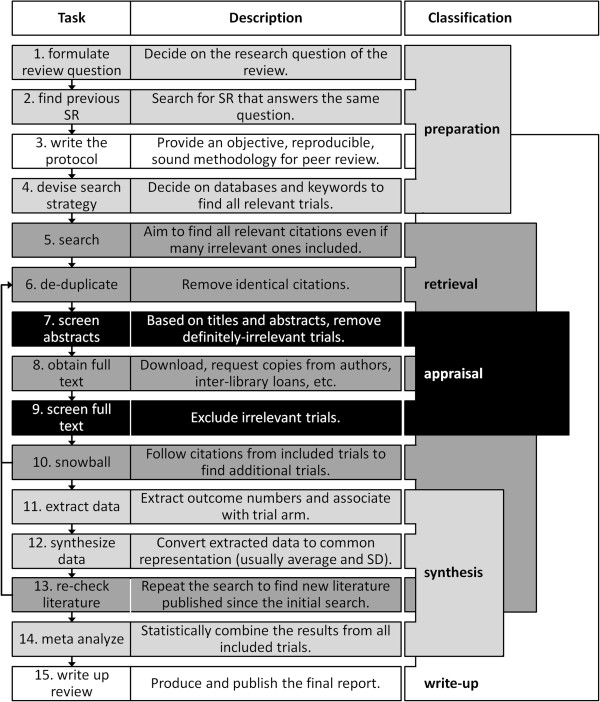
“Resources such as the systematic review process diagram illustrated by Tsafnat et al., found in our Systematic Review Toolkit, help us communicate estimated time requirements for each step of a review [3, 9].”
BackgroundMethodInfluentialMishra, A. K. (2020) · Wiley eBooks · doi:10.1002/9781119602927.ch2 · Cited by 12
Li, L., Mathrani, A., & Sušnjak, T. (2026) · Research Synthesis Methods · doi:10.1017/rsm.2025.10065 · Cited by 30
“Scholars anticipate that automated systematic reviews will revolutionize evidence-based medicine through real-time analysis capabilities and optimized workflows [5, 8].”
A meta-evaluation of climate policy evaluations: findings from the freight transport sector
Trosvik, L., Takman, J., Björk, L., Norrman, J., & Andersson‐Sköld, Y. (2023) · Transport Reviews · doi:10.1080/01441647.2023.2175275 · Cited by 15
“The search strategy used in this paper, which is based on the methodologies described in Tsafnat et al. (2014) and Moher et al. (2009), can be described by the following steps: (1) Preparation: decision of databases and keywords to be used in the search, (2) Retrieval of items: searching in…”
MethodTransformative Automation: AI in Scientific Literature Reviews
Zala, K., Acharya, B., Mashru, M., Palaniappan, D., Gerogiannis, V. C., Kanavos, A., & Karamitsos, I. (2024) · International Journal of Advanced Computer Science and Applications · doi:10.14569/ijacsa.2024.01501122 · Cited by 22
“AI technologies aim to handle time-consuming and repetitive tasks, allowing authors to focus on interpretation, intuitive leaps, and skills [72].”
BackgroundAccelerating research processes with Scopus AI: A place branding case study
Aguilera-Cora, E., Lopezosa, C., Fernández-Cavia, J., & Codina, L. (2024) · Revista Panamericana de Comunicación · doi:10.21555/rpc.v6i1.3088 · Cited by 30
“Previous studies at the intersection between AI and academia include reviews looking into the conceptualisation of AI literacy (Ng et al., 2021) and the automation of literature reviews (Tsafnat et al., 2014; Van-Dinter et al., 2021; De La Torre‐López et al., 2023).”
BackgroundSun, J., Caputo, V., & Taylor, H. (2024) · Applied Economic Perspectives and Policy · doi:10.1002/aepp.13446 · Cited by 18
slr-kit: A semi-supervised machine learning framework for systematic literature reviews
Facchinetti, T., Benetti, G., Giuffrida, D., & Nocera, A. (2022) · Knowledge-Based Systems · doi:10.1016/j.knosys.2022.109266 · Cited by 12
Norman, C. R., Gargon, E., Leeflang, M., Névéol, A., & Williamson, P. R. (2019) · Database · doi:10.1093/database/baz109 · Cited by 11
“Automation has great potential to make systematic reviews quicker and cheaper (2, 26).”
BackgroundSent2Span: Span Detection for PICO Extraction in the Biomedical Text without Span Annotations
Liu, S., Sun, Y., Li, B., Wang, W., Bourgeois, F. T., & Dunn, A. G. (2021) · Findings of the Association for Computational Linguistics: EMNLP 2021 · doi:10.18653/v1/2021.findings-emnlp.147 · Cited by 12
Self-citationAsian households’ dengue-related knowledge, attitudes, and practices: a systematic review
Arham, A. F., Mokhtar, M. I., Zainal, N., Jaafar, M. H., Amin, L., Rusly, N. S., Khaidzir, M. F. S., Aziz, M. F., & Muslim, N. (2025) · Humanities and Social Sciences Communications · doi:10.1057/s41599-025-05017-1 · Cited by 11
“Second, while electronic keyword searches are universally recognised as the most common and effective method for conducting systematic analyses, researchers should also employ supplementary search techniques to locate existing research papers (Tsafnat et al., 2014; Horsley et al., 2011).”
Jamaluddin, F., Razak, A. Z. A., & Rahim, S. S. A. (2024) · STEM Education · doi:10.3934/steme.2025004 · Cited by 28
Recommendations for producing knowledge syntheses to inform climate change assessments
Ford, J. D., Biesbroek, R. G., Berrang‐Ford, L., Creutzig, F., Haddaway, N., Harper, S. L., Minx, J. C., New, M. G., Sietsma, A. J., Zavaleta-Cortijo, C., et al. (2025) · Nature Climate Change · doi:10.1038/s41558-025-02354-6 · Cited by 21
“There are various digital tools that can be used to collect, analyse and synthesize knowledge, with review management software, bibliographic databases and open meta-analysis software widely employed and considered standard practice 56,57 .”
Hassanzadeh, H., Nguyen, A. N., & Verspoor, K. M. (2019) · Journal of Biomedical Informatics · doi:10.1016/j.jbi.2019.103321 · Cited by 13
Research Synthesis Infrastructures: Shaping Knowledge in Education
Hammond, J. W., Moss, P., Huynh, M. Q., & Lagoze, C. (2020) · Review of Research in Education · doi:10.3102/0091732x20907350 · Cited by 12
“…of means— including by machine-based automations (e.g., text-mining and machine-learning algorithms), human-based distributed labor and cognition (e.g., crowdsourcing and task sharing), or some combination of the two (see Elliott et al., 2017; also Marshall & Wallace, 2019; Tsafnat et al., 2014).”
BackgroundBegert, D., Granek, J., Irwin, B., & Brogly, C. (2020) · Canada Communicable Disease Report · doi:10.14745/ccdr.v46i06a04 · Cited by 14
“Machine learning methods have previously been identified for the automation of systematic reviews (1,5).”
MS2: Multi-Document Summarization of Medical Studies
DeYoung, J., Beltagy, I., van Zuylen, M., Kuehl, B., & Wang, L. L. (2021) · arXiv · doi:10.48550/arxiv.2104.06486 · Cited by 10
“time and cost of creating and updating reviews has inspired efforts at automation (Tsafnat et al., 2014; Marshall et al., 2016; Beller et al., 2018; Marshall and Wallace, 2019), and the constant deluge of studies3 has only increased this need.”
BackgroundSousa, M. S. A., Peiris, S., Figueiró, M. F., Haby, M. M., Baraldi, A. C., Revéiz, L., & Souza, J. P. (2026) · Systematic Reviews · doi:10.1186/s13643-025-02842-y · Cited by 14
“Compared to other ES exercises to identify AI tools and platforms [17, 29–31, 38, 39, 41, 42, 46, 49, 61, 67, 130, 131, 148, 153, 156, 157], including those that are permanently being updated [44, 149], our scoping review is the first to identify and map all data science methods and include tools…”
Lam, E. W. M., Chan, A. P. C., Olawumi, T. O., Wong, I., & Kazeem, K. O. (2023) · Smart and Sustainable Built Environment · doi:10.1108/sasbe-04-2023-0094 · Cited by 12
Manion, F. J., Du, J., Wang, D., He, L., Lin, B., Wang, J., Wang, S., Eckels, D., Cervenka, J., Fiduccia, P. C., et al. (2024) · JMIR Medical Informatics · doi:10.2196/54653 · Cited by 12
“There is considerable community interest in using AI such as machine learning (ML) and NLP to improve automation in aspects of literature reviews [2,5-7].”
BackgroundTraining sample selection: Impact on screening automation in diagnostic test accuracy reviews
van Altena, A. J., Spijker, R., Leeflang, M., & Olabarriaga, S. D. (2021) · Research Synthesis Methods · doi:10.1002/jrsm.1518 · Cited by 9
“Therefore, reducing the time spent on these tasks has a big impact on the efficiency of the review process.(2) Within the medical field, diagnostic test accuracy (DTA) studies often do not follow a standard design and are generally poorly reported.”
BackgroundLiu, S., Bourgeois, F. T., & Dunn, A. G. (2022) · Research Synthesis Methods · doi:10.1002/jrsm.1545 · Cited by 9
“Related methods include those that are used in systematic review automation tools, 17 some of which are designed to increase the efficiency of screening by reducing the number needed to screen, 18 or information extraction by annotating key sentences or phrases that relate to outcomes or risk of…”
MethodSelf-citationChristopoulou, S. C. (2022) · BioMedInformatics · doi:10.3390/biomedinformatics2030032 · Cited by 11
Marando, I., Lushington, K., Owen, M. S., Matthews, R. W., & Banks, S. (2023) · Sleep Medicine Reviews · doi:10.1016/j.smrv.2023.101845 · Cited by 12
Waqas, M., Rafiq, S., & Wu, J. (2023) · Global Knowledge, Memory and Communication · doi:10.1108/gkmc-04-2023-0129 · Cited by 18
Identifying Evidence Quality for Updating Evidence-Based Medical Guidelines
Huang, Z., Hu, Q., ten Teije, A., & van Harmelen, F. (2015) · Lecture notes in computer science · doi:10.1007/978-3-319-26585-8_4 · Cited by 10
Uthman, O. A., Court, R. A., Enderby, J., Al-Khudairy, L., Nduka, C. U., Mistry, H., Meléndez‐Torres, G. J., Taylor‐Phillips, S., & Clarke, A. (2022) · Health Technology Assessment · doi:10.3310/udir6682 · Cited by 12
“6,8,9 Machine-learning algorithms are used mainly at the screening stage of the systematic review process.”
MethodLatham, S., & Giannetti, C. (2023) · SN Computer Science · doi:10.1007/s42979-023-02104-5 · Cited by 12
“In manual processes, as the size and complexity of a task increases, it becomes more difficult for humans to manually process data [1].”
BackgroundYoung, R., Matthews, A. M., & Poston, B. (2025) · Algorithms · doi:10.3390/a18050296 · Cited by 11
Rose, C. J., Bidonde, J., Ringsten, M., Glanville, J., Potrebny, T., Cooper, C., Muller, A. E., Bergsund, H. B., Meneses‐Echavez, J. F., & Berg, R. C. (2025) · Cochrane Evidence Synthesis and Methods · doi:10.1002/cesm.70048 · Cited by 8
“The role of automation in systematic review production has been explored for over a decade [8].”
Linking quality indicators to clinical trials: an automated approach
Coiera, E. W., Choong, M. K., Tsafnat, G., Hibbert, P. D., & Runciman, W. B. (2017) · International Journal for Quality in Health Care · doi:10.1093/intqhc/mzx076 · Cited by 10
“By breaking down the steps in such a complex manual process, it is possible to identify individual steps in which computational tools can assist or replace manual work, improving either ef fi ciency or accuracy [8].”
BackgroundSelf-citationMachine learning for semi-automated scoping reviews
Mozgai, S., Kaurloto, C., Winn, J. G., Leeds, A., Heylen, D., Hartholt, A., & Scherer, S. J. (2023) · Intelligent Systems with Applications · doi:10.1016/j.iswa.2023.200249 · Cited by 9
Rapid review: A review of methods and recommendations based on current evidence
Guo, Q., Jiang, G., Zhao, Q., Long, Y., Feng, K., Gu, X., Xu, Y., Li, Z., Huang, J., & Du, L. (2024) · Journal of Evidence-Based Medicine · doi:10.1111/jebm.12594 · Cited by 8
Using rule-based classifiers in systematic reviews
Sellak, H., Ouhbi, B., & Frikh, B. (2015) · International Conference on Information Integration and Web-based Applications & Services (iiWAS) · doi:10.1145/2837185.2837279 · Cited by 8
“Unless, the accuracy of ML in systematic reviews context is questionable, since they can reduce the number of documents that need to be appraised manually by between 30% to 50% usually at the cost of up to 5% reduction in recall [5].”
BackgroundMethodInfluentialWafford, Q. E., & O’Dwyer, L. (2021) · Journal of the Medical Library Association JMLA · doi:10.5195/jmla.2021.1221 · Cited by 13
“• Intake form • Memorandum of understanding (MOU) • Email templates • Systematic review process flow diagram [7]”
BackgroundGates, A., Guitard, S., Pillay, J., Elliott, S. A., Dyson, M. P., Newton, A. S., & Hartling, L. (2019) · doi:10.23970/ahrqepcmethmachineperformance · Cited by 8
Witte, C., Schmidt, D. M., & Cimiano, P. (2024) · Journal of Biomedical Semantics · doi:10.1186/s13326-024-00305-2 · Cited by 7
Framing the relationship between justice and ecosystem services: A systematic review
Locatelli, B., Benra, F., Geneletti, D., Loft, L., Loos, J., Schröter, B., Winkler, K. J., & Zoderer, B. M. (2025) · Ecosystem Services · doi:10.1016/j.ecoser.2025.101755 · Cited by 11
Bütün Parçaların Toplamından Daha Fazladır: Eğitim Bilimlerinde Sistematik Derleme Nasıl Yazılır?
Dibek, M. İ., & TOPTAŞ, B. (2023) · Erzincan Üniversitesi Eğitim Fakültesi Dergisi · doi:10.17556/erziefd.1176257 · Cited by 10
Legate, A. E., Nimon, K., & Noblin, A. (2024) · F1000Research · doi:10.12688/f1000research.151493.1 · Cited by 15
“Two studies tested theproposed techniques on specific article sections, including titles and abstracts (Bayatmakou et al., 2022) and introduction and background sections (Li et al., 2022).”
BackgroundMethodMejía, G., Gutiérrez-Prada, J. A., Portilla-Carreño, O., & Soto-Paz, J. (2024) · ASCE-ASME Journal of Risk and Uncertainty in Engineering Systems Part A Civil Engineering · doi:10.1061/ajrua6.rueng-1363 · Cited by 12
Rojas, M. X., Urrútia, G., Rada, G., Alonso‐Coello, P., Comas, D. R., & Auladell-Rispau, A. (2021) · Open Research Europe · doi:10.12688/openreseurope.14041.1 · Cited by 8
Assessing and Prioritizing Zoonotic Diseases in Punjab, India: A One Health Approach
Sakshi, S., Dhaka, P., Bedi, J. S., Aulakh, R. S., Singh, R. K., & Gill, J. P. S. (2023) · EcoHealth · doi:10.1007/s10393-023-01654-7 · Cited by 8
Basu, T., Kumar, S., Kalyan, A., Jayaswal, P., Goyal, P., Pettifer, S., & Jonnalagadda, S. R. (2016) · arXiv · doi:10.48550/arxiv.1606.06424 · Cited by 7
“For example, if the initial range is considered as [1, 10] then the subsequent finer ranges may be (4.”
BackgroundInfluentialEnslaved to the Trapped Data: A Cognitive Work Analysis of Medical Systematic Reviews
Knight, I. A., Wilson, M. L., Brailsford, D. F., & Milić-Frayling, N. (2019) · Conference on Human Information Interaction and Retrieval · doi:10.1145/3295750.3298937 · Cited by 9
“It is hoped that replacing human effort with machine effort during systematic review production will vastly reduce this latency, improving the relevance of the systematic reviews thus produced [12, 38].”
BackgroundCramond, F., O’Mara-Eves, A., Doran-Constant, L., Rice, A. S. C., Macleod, M. R., & Thomas, J. (2019) · Wellcome Open Research · doi:10.12688/wellcomeopenres.14738.2 · Cited by 7
Scott, A. M., Forbes, C., Clark, J. M., Carter, M., Glasziou, P., & Munn, Z. (2021) · medRxiv · doi:10.1101/2021.04.26.21255833 · Cited by 7
Self-citationQi, R., Li, W., & Lyu, H. (2024) · Lecture notes in computer science · doi:10.1007/978-981-97-9443-0_14 · Cited by 6
Zahra, W., & Rautela, G. (2024) · BENTHAM SCIENCE PUBLISHERS eBooks · doi:10.2174/9789815305180124010014 · Cited by 13
Socket shield technique in implant dentistry: An AI-based bibliometric analysis
Fang, Q., Ramachandran, R. A., Köseoğlu, M., Kan, J. Y. K., & Sukotjo, C. (2025) · Journal of Prosthetic Dentistry · doi:10.1016/j.prosdent.2025.05.014 · Cited by 6
Towards the Utilization of AI-Powered Assistance for Systematic Literature Review
Đukić, M., Škembarević, M., Jejić, O., & Luković, I. (2024) · Communications in computer and information science · doi:10.1007/978-3-031-70421-5_16 · Cited by 8
Transferring knowledge between topics in systematic reviews
Molinari, A., & Kanoulas, E. (2022) · Intelligent Systems with Applications · doi:10.1016/j.iswa.2022.200150 · Cited by 7
“Conducting an SR however is a laborious and expensive task (Shemilt et al., 2016, Michelson & Reuter, 2019, Tsafnat et al., 2014), which takes on average 1.72 years to complete (Michelson & Reuter, 2019), jeopardizing the quality of healthcare.”
InfluentialTomczyk, P., Brüggemann, P., & Doligalski, T. (2024) · International Journal of Artificial Intelligence Tools · doi:10.1142/s0218213024500234 · Cited by 8
Systematic review automation methods
Norman, C. R. (2020) · theses.fr (ABES) · doi:10.70675/044ffa34z5c9bz433az99c8z64697dcd28a2 · Cited by 8
RoBIn: A Transformer-based model for risk of bias inference with machine reading comprehension
Dias, A. C., Moreira, V. P., & Comba, J. L. D. (2025) · Journal of Biomedical Informatics · doi:10.1016/j.jbi.2025.104819 · Cited by 12
Vivekanantha, P., Son, H., Bernardini, L., Bouchard, M. D., Ayeni, O. R., & Kay, J. (2025) · Current Reviews in Musculoskeletal Medicine · doi:10.1007/s12178-025-10001-y · Cited by 6
Clark, L. A., Clark, R., Raffo, D. M., & Williams, R. I. (2024) · Journal of Management Inquiry · doi:10.1177/10564926241235850 · Cited by 5
“Researchers apply these methodologies to look broadly and comprehensively at the body of existing research and to provide an unbiased, complete representation of relevant knowledge related to a selected research question (Tsafnat et al., 2014).”
SWARM-SLR - Streamlined Workflow Automation for Machine-Actionable Systematic Literature Reviews
Wittenborg, T., Karras, O., & Auer, S. (2024) · Lecture notes in computer science · doi:10.1007/978-3-031-72437-4_2 · Cited by 15
Normasari, N. M. E., Yuniarto, H. A., Gunawan, I. C., Silalahi, S. F., Deendarlianto, D., Aditya, I. A., Simaremare, A. A., & Haryadi, F. N. (2025) · Energy Strategy Reviews · doi:10.1016/j.esr.2025.101802 · Cited by 5
Software engineering principles address current problems in the systematic review ecosystem
Bashir, R., & Dunn, A. G. (2018) · Journal of Clinical Epidemiology · doi:10.1016/j.jclinepi.2018.12.014 · Cited by 6
Self-citationWilkins, A. A., Whaley, P., Persad, A. S., Druwe, I. L., Lee, J. S., Taylor, M., Shapiro, A. J., Southard, N. B., Lemeris, C., & Thayer, K. A. (2022) · Heliyon · doi:10.1016/j.heliyon.2022.e09095 · Cited by 5
“However, state-of-the-art methodologies for automated data extraction from text, figures and tables published in studies are to date only achieving limited success (Marshall andWallace, 2019;Wallace et al., 2012, 2013, 2016; Tsafnat et al., 2014).”
BackgroundMethodNur, S., Adams, C. E., & Brailsford, D. F. (2016) · Systematic Reviews · doi:10.1186/s13643-016-0207-7 · Cited by 6
“Automated extraction of data from randomised trials of the effects of healthcare is attractive [1].”
Scells, H., Zuccon, G., Sharaf, M. A., & Koopman, B. (2020) · International World Wide Web Conference (WWW) · doi:10.1145/3366423.3380075 · Cited by 6
“We consider the problem of reducing the cost and time associated with the construction of SRs. SRs require considerable effort to construct and often become out of date by the time of publication [35].”
Silva, J. C. S., Martins, C. A., García-Zapata, M. T. A., & Barbosa, M. A. (2021) · Systematic Reviews · doi:10.1186/s13643-021-01773-8 · Cited by 7
“The snowballing method [23] will be used to identify other studies from the references of selected articles.”
MethodArtificial Intelligence in Evidence-Based Medicine: On the Verge of Breakthrough
Nowak, A. J. (2021) · Springer eBooks · doi:10.1007/978-3-030-58080-3_43-1 · Cited by 5
Synthesizing evidence from clinical trials with dynamic interactive argument trees
Sanchez-Graillet, O., Witte, C., Grimm, F., Grautoff, S., Ell, B., & Cimiano, P. (2022) · Journal of Biomedical Semantics · doi:10.1186/s13326-022-00270-8 · Cited by 6
“The creation of systematic reviews is a long-term process requiring substantial personnel and efforts [24], and keeping them up-to-date represents a significant challenge [25, 26].”
BackgroundOpportunities for Computer Support for Systematic Reviewing - A Gap Analysis
Hoang, L., & Schneider, J. (2018) · Lecture notes in computer science · doi:10.1007/978-3-319-78105-1_40 · Cited by 5
“A 2014 review [3] listed fourteen tasks that could potentially be automated, and identified more than 10 applications being developed to assist different phases of the review process, including search engines (Quick Clinical and Metta); and data extraction support tools using machine learning and natural language proc…”
Alves, L. F., Vasconcellos, F. J. S., & Nogueira, B. M. (2022) · Empirical Software Engineering · doi:10.1007/s10664-021-10084-4 · Cited by 4
“Tsafnat et al. (2014) present a study on the automation of SS.”
BackgroundA taxonomy for decision making in IoT systems
Durán-Polanco, L., & Siller, M. (2023) · Internet of Things · doi:10.1016/j.iot.2023.100904 · Cited by 5
Jor, A., Lau, N. W. K., He, Y., Daryabor, A., Lam, W., Hobara, H., Gao, F., & Kobayashi, T. (2025) · Gait & Posture · doi:10.1016/j.gaitpost.2025.06.003 · Cited by 4
Al-Marridi, A. Z., Said, A. B., Ulde, S. M., & Khwaileh, T. (2025) · Systematic Reviews · doi:10.1186/s13643-025-02895-z · Cited by 8
“Researchers have explored automation across various stages of the SR process, both broadly and within specific domains [3].”
Shokraneh, F. (2019) · Journal of Clinical Epidemiology · doi:10.1016/j.jclinepi.2019.04.008 · Cited by 6
“But how do we know if what has been said in the systematic review has actually been done? We usually trust the researchers but using the existing online semi-automated platforms that documents the steps of the systematic reviews [8-12] could help the transparency if the team share the process, methods, and results in…”
MethodTu, J., Nacke, L. E., & Rogers, K. (2025) · Interacting with Computers · doi:10.1093/iwc/iwaf001 · Cited by 4
Ng, H. K. Y., & Chan, L. C. H. (2024) · International Workshop on Artificial Intelligence and Education (WAIE) · doi:10.1109/waie63876.2024.00033 · Cited by 7
“This issue suggests that the current state of AI technology may be better suited for initial broad screening tasks rather than nuanced categorization [28].”
High-precision information retrieval for rapid clinical guideline updates
Borchert, F., Wullenweber, P., Oeser, A., Kreuzberger, N., Karge, T., Langer, T. G., Skoetz, N., Wieler, L. H., Schapranow, M.-P., & Arnrich, B. (2025) · npj Digital Medicine · doi:10.1038/s41746-025-01648-5 · Cited by 11
Nordmann, K., Schaller, M., Sauter, S., & Fischer, F. (2026) · JAMIA Open · doi:10.1093/jamiaopen/ooaf098 · Cited by 4
Metadata
- Authors
- Tsafnat, G., Glasziou, P., Choong, M. K., Dunn, A., Galgani, F., & Coiera, E.
- Affiliations
- UNSW Sydney (AU)
- Bond University (AU)
- Corresponding author
- Tsafnat, Guy
- Venue
- Systematic Reviews
- Published
- 2014-07-09
- Volume
- 3
- Issue
- 1
- Pages
- 74-74
- ISSN
- 2046-4053 (ISSN-L)
- PMC
- PMC4100748
- OpenAlex
- W2095601341
- Cited by
- 472
- References
- 137
- Citations by year
- 2026: 41 · 2025: 42 · 2024: 56 · 2023: 44 · 2022: 44 · 2021: 68 · 2020: 46 · 2019: 36 · 2018: 32 · 2017: 24 · 2016: 16 · 2015: 18 · 2014: 5
- FWCI
- 5.75
- Type
- journal article
- Language
- en
- Open access
- gold
- doi.org
- Licence
- Locations
- Systematic Reviews (publishedVersion, cc-by)
- PubMed Central (publishedVersion, cc-by)
- Bond University Research Portal (Bond University) (publishedVersion, cc-by)
- PubMed (publishedVersion)
- e-publications@bond (Bond University) (submittedVersion)
- Topics
- Social Sciences › Decision Sciences › Statistics, Probability and Uncertainty › Meta-analysis and systematic reviews
- Physical Sciences › Computer Science › Information Systems › Software Engineering Techniques and Practices
- Health Sciences › Medicine › Public Health, Environmental and Occupational Health › Clinical practice guidelines implementation
- Keywords
- systematic review automation, information systems, randomized controlled trials, evidence-based medicine, risk of bias assessment, data extraction, meta-analysis, system integration
- MeSH terms
- Electronic Data Processing, Review Literature as Topic, Information Storage and Retrieval
About these checks
Registry, retraction, Cites and statistics results are computed, not judged, with one exception: a printed reference that no index lists is read once by a model before it counts as a citation error. Claims are extracted by a model and kept only when their quote appears verbatim in the text; each cited source is then checked, with a model’s help, for whether it says what the claim relies on. Those verdicts can be wrong — read the claim’s quote and the cited source before relying on one.
Statistics and arithmetic are recomputed, not judged.
Confidence bands are shown only for fields calibrated on our annotated test set. None is calibrated yet, so no band is shown.
What counts as a claim ›How we measure confidence ›How we check this ›
Are you an author, or do you see a problem with this page? Request a review
Data sources
Bibliographic data: Semantic Scholar, OpenAlex, Crossref.
Contains information from the Semantic Scholar Academic Graph Datasets, made available under the ODC Attribution License (ODC-BY 1.0).
Semantic Scholar’s data is described in: Kinney, R., et al. (2023). The Semantic Scholar Open Data Platform. arXiv:2301.10140.
