

Systematic review automation technologies
Open accessThe DOI matches its Crossref record; 136 of the 137 references it cites were found in a registry or an index.
Abstract
Systematic reviews, a cornerstone of evidence-based medicine, are not produced quickly enough to support clinical practice. The cost of production, availability of the requisite expertise and timeliness are often quoted as major contributors for the delay. This detailed survey of the state of the art of information systems designed to support or automate individual tasks in the systematic review, and in particular systematic reviews of randomized controlled clinical trials, reveals trends that see the convergence of several parallel research projects.We surveyed literature describing informatics systems that support or automate the processes of systematic review or each of the tasks of the systematic review. Several projects focus on automating, simplifying and/or streamlining specific tasks of the systematic review. Some tasks are already fully automated while others are still largely manual. In this review, we describe each task and the effect that its automation would have on the entire systematic review process, summarize the existing information system support for each task, and highlight where further research is needed for realizing automation for the task. Integration of the systems that automate systematic review tasks may lead to a revised systematic review workflow. We envisage the optimized workflow will lead to system in which each systematic review is described as a computer program that automatically retrieves relevant trials, appraises them, extracts and synthesizes data, evaluates the risk of bias, performs meta-analysis calculations, and produces a report in real time.
Overview
The claims and statistics of this paper haven’t been checked yet.
Free: it reads the open-access text and checks the first 5 claims that cite a source we can check. Create a free account to check every claim.
Integrity signals
Registry
Cites
Statistics
Figures

Verification
Claims the paper makes
The claims and statistics of this paper haven’t been checked yet.
Free: it reads the open-access text and checks the first 5 claims that cite a source we can check. Create a free account to check every claim.
Claims other papers make about this one
Each is checked against this paper’s own text: does it say what the citing paper says it does?
The source backs part of the claim, not all of it — or backs it for a different population, condition or comparison.
In the citing paper
“many of the tools have been developed independently as stand-alone software and are often not compatible with other tools”
From Rayyan-a web and mobile app for systematic reviews. (2016) · cites this paper as [5]
Experimental — accuracy not yet measuredThe source backs part of the claim, not all of it — or backs it for a different population, condition or comparison.
In the citing paper
“An effective parallelisation of SR processes needs to be supported by the use of a purposefully adapted computer technology [11, 12].”
From How to conduct systematic reviews more expeditiously? (2015) · cites this paper as [12]
Experimental — accuracy not yet measuredThe cited source says what the claim attributes to it.
In the citing paper
“An increasing number of projects are underway which focus on the automation of segments of the systematic review process, and although several tools and software have been developed, so far, none of them span the entire process of review production”
From Rayyan-a web and mobile app for systematic reviews. (2016) · cites this paper as [5]
The cited source says what the claim attributes to it.
In the citing paper
“Title and abstract screening is a review step that may be particularly amenable to automation or semi-automation [2–4].”
From Performance and usability of machine learning for screening in systematic reviews: a comparative evaluation of three tools (2019) · cites this paper as [3]
The cited source says what the claim attributes to it.
In the citing paper
“The authors illustrated that not all SR tasks are equally amenable to automation.”
From How to conduct systematic reviews more expeditiously? (2015) · cites this paper as [12]
4 more claims about this paper
Create a free account to see every claim other papers make about this one.
Self-check
Percentages, sums and reported differences re-computed from the paper’s own numbers.
The self-check needs the paper’s full text.
Citations
Cites
Preferred Reporting Items for Systematic Reviews and Meta-Analyses: the PRISMA statement
Moher, D., Liberati, A., Tetzlaff, J., Altman, D. G., & for the PRISMA Group (2009) · BMJ · doi:10.1136/bmj.b2535 · Cited by 83,823
Bias in meta-analysis detected by a simple, graphical test
Egger, M., Smith, G. D., Schneider, M., & Minder, C. (1997) · BMJ · doi:10.1136/bmj.315.7109.629 · Cited by 56,722 · cited 1×
“, funnel plots [130] show whether publication bias is likely to affect the conclusion of the”
BackgroundPreferred reporting items for systematic reviews and meta-analyses: the PRISMA Statement.
(2009) · PubMed Central · Cited by 44,859
Preferred reporting items for systematic reviews and meta-analyses: The PRISMA statement
Moher, D., Liberati, A., Tetzlaff, J., Altman, D. G., & the PRISMA Group* (2009) · Annals of Internal Medicine · doi:10.7326/0003-4819-151-4-200908180-00135 · Cited by 37,554
Scoping studies: towards a methodological framework
Arksey, H., & O'Malley, L. (2005) · International Journal of Social Research Methodology · doi:10.1080/1364557032000119616 · Cited by 36,742 · cited 1×
“Current systems Global evidence maps [18,19] and scoping studies [20] are both literature review methods designed to complement systematic review and identify research gaps.”
BackgroundCochrane Handbook for Systematic Reviews of Interventions: Cochrane Book Series
(2008) · doi:10.1002/9780470712184 · Cited by 25,048
Preferred Reporting Items for Systematic Reviews and Meta-Analyses: The PRISMA Statement
Moher, D., Liberati, A., Tetzlaff, J., & Altman, D. G. (2009) · Journal of Clinical Epidemiology · doi:10.1016/j.jclinepi.2009.06.005 · Cited by 19,575
Statistical Methods for Meta-Analysis
Wasserman, S., Hedges, L. V., & Olkin, I. (1988) · Journal of Educational Statistics · doi:10.2307/1164953 · Cited by 10,326
Cochrane Handbook for Systematic Reviews of Interventions
Tarsilla, M. (2010) · Journal of MultiDisciplinary Evaluation · doi:10.56645/jmde.v6i14.284 · Cited by 5,178
Users' guides to the medical literature
Guyatt, G. H. (1993) · JAMA · doi:10.1001/jama.270.17.2096 · Cited by 2,970
Research works printed but not linked: 15
- 1. Sackett DL, Straus S, Richardson WS, Rosenberg W, Haynes RB. Evidence-based Medicine: How to Teach and Practice EBM. Edinburgh: Churchill Livingstone; 2000.
- 11. Glasziou P, Beller E, Thorning S, Vermeulen M. Manual for systematic reviews. Gold Coast, Queensland, Australia: Centre for Research on Evidence Based Medicine; 2013.
- 40. Collaboration RTC. Review Manager (RevMan). 4.2 for Windows. Oxford, England: The Cochrane Collaboration; 2003.
- 41. Higgins J, Churchill R, Tovey D, Lasserson T, Chandler J. Update on the MECIR project: methodological expectations for Cochrane intervention. Cochrane Meth. 2011;suppl. 1:2.
- 82. REUTERS T. EndNote®. Bibliographies Made Easy™; 2011. http://www.endnote.com.
- 83. ResearchSoft I. ProCite Version 5. Berkeley, CA: Institute for Scientific Information; 1999.
- 88. Saleem O, Latif S. Proceedings of the World Congress on Engineering and Computer Science. San Francisco, USA; 2012. Information extraction from research papers by data integration and data validation from multiple header extraction sources.
- 99. Thomas J, Brunton J, Graziosi S. EPPI-Reviewer 4.0: software for research synthesis. EPPI-Centre, Social Science Research Unit, Institute of Education, University of London UK; 2010.
- 100. DistillerSR. http://www.systematic-review.net.
- 110. PubMed Central. http://www.ncbi.nlm.nih.gov/pmc.
- 111. Google Scholar. http://scholar.google.com.
- 120. Huwaldt JA. Plot Digitizer. 2009. http://plotdigitizer.sf.net.
- 121. Egner J, Mitchell M, Richter T, Winchen T. Engauge Digitizer: convert graphs or map files into numbers. 2013. http://digitizer.sf.net/
- 122. Rohatgi A. WebPlotDigitizer. 2013. http://arohatgi.info/WebPlotDigitizer/
- 133. Rosenberg MS, Adams DC, Gurevitch J. MetaWin: statistical software for meta-analysis. Massachusetts, USA: Sinauer Associates Sunderland; 2000.
Cited by
Items 301–400 of 470
Choong, M. K., Tsafnat, G., Hibbert, P. D., Runciman, W. B., & Coiera, E. W. (2017) · BMC Health Services Research · doi:10.1186/s12913-017-2324-y · Cited by 4
“There is currently strong interest in automating many of the processes associated with systematic review [31, 32], and it is just as plausible to apply this approach to the process of indicator assessment.”
MethodSelf-citationBashir, R., Dunn, A. G., & Surian, D. (2020) · Research Synthesis Methods · doi:10.1002/jrsm.1473 · Cited by 7
“They have the potential to reduce the manual workload associated with searching, screening, extraction, and synthesis.(5) Some methods and techniques were developed to help in searching by identifying the set of potentially relevant clinical trials for systematic reviews, while others support screening.”
MethodSelf-citationChen, Y., Liao, W.-W., Su, M.-C., & Lin, Y.-H. (2021) · Journal of Personalized Medicine · doi:10.3390/jpm11080790 · Cited by 7
Artificial Intelligence in Evidence-Based Medicine: On the Verge of Breakthrough
Nowak, A. J. (2022) · Springer eBooks · doi:10.1007/978-3-030-64573-1_43 · Cited by 6
Tod, D. (2019) · Springer eBooks · doi:10.1007/978-3-030-12263-8_7 · Cited by 3
Timely, Efficient, and Living Systematic Reviews: Opportunities in International Development
Snilstveit, B., Stevenson, J., Shemilt, I., Clarke, M. J., Jiménez, E., & Thomas, J. (2018) · doi:10.51744/cip7 · Cited by 6
“Their survey of informatics systems to support automation of systematic review tasks identified tools tailored for all stages of review production, from protocol development to report writing (Tsafnat et al., 2014).”
BackgroundInfluentialLiu, S., Bourgeois, F. T., Narang, C., & Dunn, A. G. (2023) · Research Synthesis Methods · doi:10.1002/jrsm.1672 · Cited by 7
“12,16,26,27 A key issue is that the best performing tools require human expertise before or during the use of the tools.”
BackgroundSelf-citationAutomating Meta-Analyses of Randomized Clinical Trials: A First Look
Michelson, M. (2014) · National Conference on Artificial Intelligence · Cited by 4
Wang, L., Rouse, B., Marks‐Anglin, A., Duan, R., Shi, Q., Quach, K., Chen, Y., Cameron, C., Schmid, C. H., & Li, T. (2019) · Journal of Clinical Epidemiology · doi:10.1016/j.jclinepi.2019.06.010 · Cited by 4
“gov trials”; (5) trials identified from bibliographic databases but not found on Drugs@FDA or ClinicalTrials.”
BackgroundAdvancing Guideline Development in the United States: A Call to Action by the US GRADE Network
Morgan, R. L., Sultan, S., Murad, M. H., Mustafa, R. A., Dahm, P., Helfand, M., Falck-Ytter, Y. T., & Qaseem, A. (2017) · American Journal of Medical Quality · doi:10.1177/1062860617726855 · Cited by 4
Gates, A., Gates, M., Sim, S., Elliott, S. A., Pillay, J., & Hartling, L. (2021) · doi:10.23970/ahrqepcmethodscreatingefficiencies · Cited by 3
Sujau, M., Wada, M., Vallée, É., Hillis, N., & Sušnjak, T. (2025) · Machine Learning and Knowledge Extraction · doi:10.3390/make7020028 · Cited by 9
“Automation offers a cost-efficient, faster, and more reliable solution, capable of meeting the demands for scale and quality [19–21].”
Şahin, E., & Berk, H. (2023) · Journal of Surgery and Medicine · doi:10.28982/josam.7709 · Cited by 3
Nguyen, T. T., Bekrar, A., Le, T. M., Artiba, A., Chargui, T., Vo, T. L. H., & Trinh, T. T. H. (2024) · Economics and Business Review/The Poznań University of Economics Review · doi:10.18559/ebr.2024.4.1123 · Cited by 3
“…to use a broad definition of automation that encompasses programs that streamline and improve oper - ations through automating even the most basic aspects of tasks, including automatically entering data from manually extracted sources into database fields, as discussed by Tsafnat et al. (2014).”
Maleki, F., & Karami, M. (2024) · Journal of Evidence-Based Medicine · doi:10.1111/jebm.12665 · Cited by 4
Belo, J. D. C., Calheiros, T., & Pereira, M. G. (2026) · Climate · doi:10.3390/cli14070148 · Cited by 3
“…cycle of habitat loss and increased vulnerability among endemic species suggests that the country is facing a shift toward persistent ecological fragility, in which the decline in ecosystem services directly erodes the livelihoods of agriculture-and fishing-dependent communities [37,56,66,75,98].”
Controversial Trials First: Identifying Disagreement Between Clinical Guidelines and New Evidence.
Borchert, F., Meister, L., Langer, T. G., Follmann, M., Arnrich, B., & Schapranow, M.-P. (2021) · PubMed · Cited by 5
Ebrahimi, M., Mohiuddin, M., Hosseini, E., Ed‐Dafali, S., & Parvin, S. S. (2024) · Corporate Ownership and Control · doi:10.22495/cocv21i3art8 · Cited by 5
“It should also provide a clear overview of the research question (Tsafnat et al., 2014).”
BackgroundOberste, M., Sharma, S., & Zimmer, P. (2019) · OBM Integrative and Complementary Medicine · doi:10.21926/obm.icm.1903052 · Cited by 3
Cloud Manufacturing: An Automated Literature Review
Ellwein, C., Neff, S., & Verl, A. W. (2019) · Procedia CIRP · doi:10.1016/j.procir.2020.01.006 · Cited by 5
Legate, A. E., & Nimon, K. (2022) · F1000Research · doi:10.12688/f1000research.125198.1 · Cited by 4
“As relevant study details were not always included in abstracts and often appeared throughout and across various sections of a given study (including tables and figures) discussion turned toward development of data extraction methods supporting full-text corpora (Tsafnat et al., 2014).”
BackgroundRapid Tagging and Reporting for Functional Language Extraction in Scientific Articles
Ramezani, M., Kalivarapu, V., Gilbert, S. B., Huffman, S. R., Cotos, E., & O'Conner, A. M. (2017) · doi:10.1145/3127526.3127533 · Cited by 3
“This step is of critical interest because machine learning provides an opportunity to automate the SR process by requiring manual classification of a much smaller training set of studies [3].”
MethodAutomating Document Discovery in the Systematic Review Process: How to Use Chaff to Extract Wheat
Norman, C. R., Leeflang, M., Zweigenbaum, P., & Névéol, A. (2018) · HAL · doi:10.5281/zenodo.1173076 · Cited by 3
“Retrieving the full text articles, which often needs to be done manually, is generally only feasible for a fraction of the articles in large systematic reviews (Tsafnat et 1 Although primary clinical research is often more expensive. al., 2014).”
BackgroundTowards an Aspect-Based Ranking Model for Clinical Trial Search
Roy, S., Rudra, K., Agrawal, N., Sural, S., & Ganguly, N. (2019) · Lecture notes in computer science · doi:10.1007/978-3-030-34980-6_25 · Cited by 3
Extending green supply chain practices through automation: Multinational best practices
Weeks, K. O., Montabon, F. L., & Kenyon, G. N. (2022) · International Journal of Technology Management and Sustainable Development · doi:10.1386/tmsd_00054_1 · Cited by 2
Trustworthiness of Systematic Review Automation An interview at Coventry UniversityPreprint
Jiang, X. (2023) · medRxiv · doi:10.1101/2023.12.14.23299933 · Cited by 3
“…primary study selection (by title, abstract screening, full-text screening, and citation screening), quality assessment (of selected studies), data extraction (from selected studies), data synthesis and meta analysis, and summarisation and reporting (Tsafnat et al., 2014; also see Figure 1).”
MethodLeveraging AI to improve evidence synthesis in conservationPreprint
Berger‐Tal, O., Wong, B. B. M., Adams, C. A., Blumstein, D. T., Candolin, U., Gibson, M., Greggor, A. L., Lagisz, M., Macura, B., Price, C. J., et al. (2024) · doi:10.32942/x21s64 · Cited by 3
Lee, K., Datta, S., Paek, H., Rastegar-Mojarad, M., Huang, L., He, L., Wang, S., Wang, J., & Wang, X. (2024) · medRxiv · doi:10.1101/2024.07.03.24309897 · Cited by 6
“However, manual SLRs are labor-intensive, costly, and prone to errors.”
BackgroundInfluentialA Scoping Review of Adopted Information Extraction Methods for RCTs.
Aletaha, A., Nemati-Anaraki, L., Keshtkar, A., Sedghi, S., Keramatfar, A., & Korolyova, A. (2023) · Medical Journal of The Islamic Republic of Iran · doi:10.47176/mjiri.37.95 · Cited by 2
“None of the existing reviews focus on the information extraction step to conduct an RCT and systematic review of trials (25, 63, 64).”
BackgroundOpen challenges for the automatic synthesis of clinical trials
Sanchez-Graillet, O., Schmidt, D. M., Kullik, C., & Cimiano, P. (2025) · BMC Research Notes · doi:10.1186/s13104-025-07121-6 · Cited by 2
“However, conducting these studies can be time-consuming and arduous, due to the many steps involved such as literature search, removal of duplicate citations, study selection, data extraction, quality assessment, statistical analysis, data visualization and report writing [1, 2].”
Artificial intelligence policies in neurology journals: a cross-sectional analysis
Kirby, K., Calvert, N. I., Rowsey, K., Brassfield, J., Gardner, T., Crotty, P., Young, A., Tran, A. V., Ford, A. I., & Vassar, M. B. (2026) · Frontiers in Neurology · doi:10.3389/fneur.2026.1766696 · Cited by 4
“Natural language processing tools have demonstrated efficiency in screening abstracts and extracting data for systematic reviews, thereby reducing researcher workload and enhancing reproducibility (37, 38).”
A Systematic Review of Takeover System Design in Highly Automated Driving
Liu, T., Tran, T. T. M., Mah, K., Parker, C., & Globa, A. (2026) · IEEE Transactions on Intelligent Transportation Systems · doi:10.1109/tits.2026.3678653 · Cited by 4
“Automation in systematic literature reviews enhances e ffi ciency, reduces human error and workload, ensures reproducibility, and enables the scalable analysis of large volumes of research data [29], [30].”
El uso de simulaciones PhET en la enseñanza de la física: una revisión sistemática
de Medeiros, R. N., Naia, M. D., & Lopes, J. B. (2026) · Enseñanza de las Ciencias Revista de investigación y experiencias didácticas · doi:10.5565/rev/ensciencias.6230 · Cited by 2
Radócz, L., Nagy, A., Szöllősi, N., Kiss, N. É., Szabó, A., Tamás, J., Siphiwe, N. G., & Radócz, L. (2026) · Remote Sensing · doi:10.3390/rs18132063 · Cited by 2
Automatic extraction of quantitative data from ClinicalTrials.gov to conduct meta-analyses
Fanshawe, T. R., & Perera, R. (2019) · BMJ Evidence-Based Medicine · doi:10.1136/bmjebm-2019-111206 · Cited by 3
Narration with Graphics: An AI Generated Story Teller
Golwalker, M. A. (2024) · INTERANTIONAL JOURNAL OF SCIENTIFIC RESEARCH IN ENGINEERING AND MANAGEMENT · doi:10.55041/ijsrem32119 · Cited by 2
Exploring undiscovered public knowledge in neuroscience
França, T. F. A. (2024) · European Journal of Neuroscience · doi:10.1111/ejn.16396 · Cited by 2
“…development of such tools for the different tasks involved in research synthesis (Adams et al., 2013; Khalil et al., 2022; Marshall & Wallace, 2019; Tsafnat et al., 2014), although current tools still have important limitations and a truly critical review should impose strong limits on automation.”
Sterner, E. A. (2024) · Evidence Based Library and Information Practice · doi:10.18438/eblip30405 · Cited by 5
Cochrane systematic reviews in orthodontics: trends across updates
Reeves, S., Patel, K., Mukeshkumar, K., & Naini, F. B. (2024) · European Journal of Orthodontics · doi:10.1093/ejo/cjae037 · Cited by 3
Jor, A., Kobayashi, T., Khan, M. J., Opu, S. H., Lam, W., Winser, S. J., Gao, F., & Zhang, M. (2025) · Gait & Posture · doi:10.1016/j.gaitpost.2025.109974 · Cited by 3
A Systematic Review on Corporate Philanthropy Disclosure by Malaysian Companies
Yusuf, N. R. M., & Joseph, C. (2021) · International Journal of Academic Research in Accounting Finance and Management Sciences · doi:10.6007/ijarafms/v11-i3/11052 · Cited by 3
“It must be noted that the main disadvantage of citation tracking, references searching and snowballing system is that it can get out of control, retrieving more articles than it is feasible to appraise manually (Tsafnat et al., 2014).”
BackgroundSupporting HIV literature screening with data sampling and supervised learning
Almeida, H., Meurs, M., Kosseim, L., & Tsang, A. (2015) · IEEE International Conference on Bioinformatics and Biomedicine (BIBM) · doi:10.1109/bibm.2015.7359733 · Cited by 3
Applying artificial intelligence in the science & technology cycle
Weber, R. O. (2019) · Information Services & Use · doi:10.3233/isu-190062 · Cited by 8
“Efforts towards automating literature reviews have been proposed since 1999 [35], and continue to be explored (e.g., [36,37]).”
Rainer, A., Williams, A. H., Garousi, V., & Felderer, M. (2020) · IET Software · doi:10.1049/iet-sen.2020.0109 · Cited by 2
A Roadmap for Composing Automatic Literature Reviews: A Text Mining Approach
Júnior, E. M. D. S., & Dutra, M. L. (2021) · Lecture notes of the Institute for Computer Sciences, Social Informatics and Telecommunications Engineering · doi:10.1007/978-3-030-77417-2_17 · Cited by 3
STRATEGIES FOR ORGANISING AND MANAGING RESEARCH AT UNIVERSITIES: SYSTEMIC REVIEW
Shykhnenko, K., & Sbruieva, A. A. (2021) · Advanced Education · doi:10.20535/2410-8286.227831 · Cited by 7
“It relied on a common set of processes such as specifying the research questions and methods, designing the conceptual framework, formulating the selection criteria and coding of the sources, developing the search strategy, evaluating the relevance and quality of the shortlisted papers, interpreting and reporting find…”
MethodKocbek, P., Gosak, L., Musović, K., & Štiglic, G. (2022) · Lecture notes in computer science · doi:10.1007/978-3-031-09342-5_37 · Cited by 9
Widuri, A., Rianto, B. U. D., Indrawati, L. P. L., Nugraha, R., & Wahab, A. (2022) · Medicine · doi:10.1097/md.0000000000031884 · Cited by 3
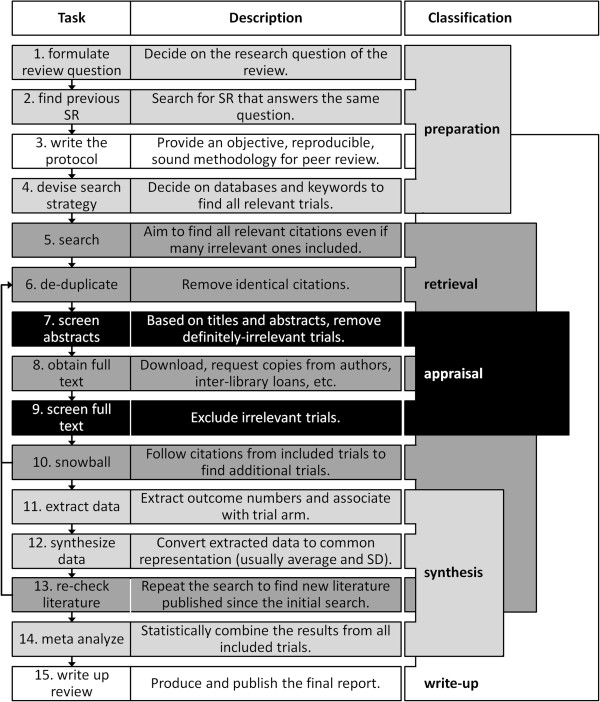
“The task follows 15 steps: formulating review questions, finding previous systematic reviews, writing protocols, developing search strategies, search, de-duplicate, abstract screen, obtain full text, filter full text, snowball, extract data, synthesize data, reexamine literature, meta-analysis and writing a review.[15…”
BackgroundSuescún, E., Leite, J. C. S. D. P., & Pardo, C. (2022) · Revista Facultad de Ingeniería · doi:10.19053/01211129.v31.n60.2022.14189 · Cited by 3
“[48], a literature review is carried out to identify tools that support or automate the processes or tasks of systematic literature studies.”
BackgroundHartling, L., Shave, K., Thomson, D., Fernandes, R. M., Wingert, A., & Williams, K. J. (2016) · Systematic Reviews · doi:10.1186/s13643-016-0276-7 · Cited by 2
Understanding in vivo modelling of depression
Bannach‐Brown, A. (2019) · ERA · Cited by 2
da Silva, E. C. (2020) · doi:10.14393/ufu.di.2020.104 · Cited by 3
Automation of legal precedents retrieval: findings from a rapid literature reviewPreprint
Mentzingen, H., Bação, F., & António, N. (2022) · Research Square · doi:10.21203/rs.3.rs-2292464/v1 · Cited by 2
Queiros, L., Mearns, E. S., Mccarvil, M., Alarcão, J., Garcia, M. J., & Abògúnr̀in, Ṣ. (2023) · Research Square · doi:10.21203/rs.3.rs-3119345/v1 · Cited by 4
Tóth, B., Berek, L., Gulàcsi, L., Péntek, M., & Zrubka, Z. (2023) · Research Square · doi:10.21203/rs.3.rs-3425312/v1 · Cited by 2
Goyal, A., Tariq, M. D., Ahsan, A., Khan, M. H., Zaheer, A., Jain, H., Maheshwari, S., & Brateanu, A. (2025) · World Journal of Methodology · doi:10.5662/wjm.v15.i4.102290 · Cited by 1
Machine Learning in Evidence Synthesis Research
Carrasco‐Labra, A., Urquhart, O., & Spallek, H. (2021) · Springer eBooks · doi:10.1007/978-3-030-71881-7_12 · Cited by 2
Martinou, E., & Angelidi, A. M. (2022) · F1000Research · doi:10.12688/f1000research.127179.1 · Cited by 1
SyROCCo: enhancing systematic reviews using machine learning
Fang, Z., Arana‐Catania, M., van Lier, F.-A., Velarde, J. O., Bregazzi, H., Airoldi, M., Carter, E., & Procter, R. (2024) · Data & Policy · doi:10.1017/dap.2024.33 · Cited by 3
“…learning tools to help with systematic reviews, reducing the human and financial resources required and the time needed to conduct the research (Tsafnat et al., 2014; O ’ Mara-Eves, et al., 2015; Marshal and Brereton, 2015; Howard et al., 2016; Bannach-Brown et al., 2019; Marshal and Wallace,…”
MethodBarrett-Catton, E., Jones, E. P., & Carlson, R. (2025) · Medical Reference Services Quarterly · doi:10.1080/02763869.2025.2471879 · Cited by 1
AI ‐Augmented Search for Systematic Reviews: A Comparative Analysis
Lookingbill, V., Khandelwal, V., Roy, K., Garimella, R., Surana, H., & Sheth, A. (2025) · Proceedings of the Association for Information Science and Technology · doi:10.1002/pra2.1290 · Cited by 2
“However, these tools should align with existing librarian practices, particularly supporting iterative query refinement (Tsafnat et al., 2014), to ensure they complement rather than replace expert judgment.”
Yalçınkaya, A., Kjelmann, K. G., Gholinezhad, S., Rahbek, O., Kold, S., & Husum, H. (2025) · Journal of Orthopaedic Surgery and Research · doi:10.1186/s13018-025-06386-8 · Cited by 1
“ML has demonstrated success in automating data extraction for systematic reviews, reducing review times while maintaining accuracy [7, 11].”
Simulation-based active learning for systematic reviews: A scoping review of literature
Teijema, J. J., Ribeiro, G., Seuren, S., Anadria, D., Bagheri, A., & van de Schoot, R. (2025) · Journal of Information Science · doi:10.1177/01655515251379058 · Cited by 1
Tomczyk, P. (2025) · Marketing of Scientific and Research Organizations · doi:10.2478/minib-2025-0007 · Cited by 2
“…important in fields such as the health sciences and management, where the proliferation of publications entails a need for more effective and dependable methods to condense vast bodies of information into practical insights (Tantawy et al., 2023; Tsafnat et al., 2013, 2014; Tranfield et al., 2003).”
Koh, Z. H., Zarnegar, A., Skues, J., & Murray, G. (2026) · BMC Research Notes · doi:10.1186/s13104-026-07651-7 · Cited by 2
EviMMQA: Multimodal question answering for medical evidence extraction in systematic reviews
Ji, C., Li, Y., Wang, Y., He, W., Cheng, Y., Zhang, Y., Feng, R., & Zhang, X. (2026) · Pattern Recognition · doi:10.1016/j.patcog.2026.113441 · Cited by 2
Bibliometric and systematic literature review of employee sustainable performance
La, T. T. C., Arokiasamy, L., & Salleh, R. (2026) · Discover Sustainability · doi:10.1007/s43621-026-03017-y · Cited by 2
MacAma: Multi‐AI Agent as a Co‐Scientist for Automated Meta‐Analysis
Yuan, Y., Li, P., Wang, Y., Zheng, B., Liu, Y., Yang, D., Lin, H., Wu, M., Zhao, Q., Shuai, J., et al. (2026) · Smart Medicine · doi:10.1002/smmd.70045 · Cited by 1
“…can automatically calculate heterogeneity indicators (like I 2 ) and perform predefined subgroup analyses, it cannot yet deeply understand and interpret potential sources of heterogeneity like a human expert [36] or propose new subgroup or meta‐regression hypotheses based on data characteristics.”
Sustainability outcomes of the United States food system: A systematic review
Knox, C. B., & Miller, S. A. (2022) · Journal of Agriculture Food Systems and Community Development · doi:10.5304/jafscd.2022.113.010 · Cited by 2
Tóth, B., & Oldal, L. G. (2022) · IEEE International Symposium on Intelligent Systems and Informatics (SISY) · doi:10.1109/sisy56759.2022.10036252 · Cited by 1
“While the more technical elements, such as study selection or risk of bias assessment, can be automated better [13].”
BackgroundGupta, V. K., Belland, B. R., Billups, A., & Passonneau, R. J. (2023) · Lecture notes on data engineering and communications technologies · doi:10.1007/978-981-99-7947-9_2 · Cited by 1
Scientometric Analysis for Access Control in the Social Robots Era
Castaneda, J. A. C., Huang, Y., Hung, P. C. K., & Ahmad, R. (2023) · International Conference on Awareness Science and Technology (iCAST) · doi:10.1109/icast57874.2023.10359257 · Cited by 1
“Automation is one of the key core keywords found in cluster 4 (yellow color) with 21 occurrences, 32 links and 65 total link strength; and is the use of technology to accomplish activities automatically, hence reducing the need for human intervention [14].”
BackgroundOCR: Masa Depan Pengenalan Karakter Optik dan Dampaknya pada Kehidupan Modern
Banu, K. S. K. D. S. B., Andreas, D., Anggoro, W., & Setiawan, A. (2023) · Jurnal Teknologi Informasi · doi:10.52643/jti.v9i2.3798 · Cited by 13
“…Durham, pertemuan dengan pakar domain dalam berbagai disiplin yang tertarik pada praktik berbasis bukti, dan buku-buku teks yang menggambarkan prinsip-prinsip tinjauan sistematis: - Panduan Reviewer Cochrane Handbook 163H[7] dan Glossary 164H[8 - Pedoman awalnya dibuat oleh satu orang (Kitchenham).”
BackgroundResources and Capabilities of Malaysian Retailers’: A Systematic Review Toward Competitive Advantage
Hairani, N., & Aziz, Z. A. (2024) · The European Proceedings of Social & Behavioural Sciences · doi:10.15405/epsbs.2024.05.40 · Cited by 2
“Nonetheless, several complementary methods can be considered in search efforts (Tsafnat et al., 2014; Wohlin, 2014).”
Search Strategy Formulation: A Framework For Learning
MacFarlane, A., & Russell‐Rose, T. (2016) · Spanish Conference on Information Retrieval (CERI) · doi:10.1145/2934732.2934752 · Cited by 4
“The choice of search strategy is critical in ensuring that the process is sufficiently exhaustive and that the review is not biased by easily accessible studies [5].”
BackgroundMethodInfluentialLee, C.-J., Devine, B., & Tarczy-Hornoch, P. Z. (2017) · PubMed Central · Cited by 2
Rossetti, A. (2019) · Arrow@dit (Dublin Institute of Technology) · Cited by 11
Adapt or perish: Introducing focused guidelines
Romero, C. S., Afshari, A., & Kranke, P. (2021) · European Journal of Anaesthesiology · doi:10.1097/eja.0000000000001535 · Cited by 1
Chen, Y., Liao, W.-W., Su, M.-C., & Lin, Y.-H. (2021) · doi:10.2196/preprints.31195 · Cited by 1
Rohner, E., Bohlius, J., da Costa, B. R., & Trelle, S. (2022) · Wiley eBooks · doi:10.1002/9781119099369.ch6 · Cited by 1
Koh, Z. H., Zarnegar, A., Skues, J., & Murray, G. (2024) · doi:10.31234/osf.io/e25tn · Cited by 1
Tatsioni, A., & Ioannidis, J. P. A. (2024) · Elsevier eBooks · doi:10.1016/b978-0-323-99967-0.00212-x · Cited by 1
Finding CKD Studies—Automated Searching and Screening
Uhlig, K. (2014) · American Journal of Kidney Diseases · doi:10.1053/j.ajkd.2014.09.003
New Statistical Methods of Combining Results in Comparative Effectiveness Research
Cameron, C. G., & Platt, R. W. (2016) · Springer eBooks · doi:10.1007/978-1-4899-7600-0_22
A framework for developing knowledge bases of scientific artefacts in the biomedical domain
Hassanzadeh, H. (2017) · The University of Queensland · doi:10.14264/uql.2017.167
“However, current information retrieval approaches are unable to effectively find, retrieve and present all relevant information within collections of publications, to meet the needs of specific user groups - such as clinicians seeking specific medical evidence of relevance to challenging patient cases, or researchers…”
BackgroundInfluentialKalvelage, K. J., & Dorneich, M. C. (2014)
Begert, D., Granek, J., Irwin, B., & Brogly, C. (2020) · Relevé des maladies transmissibles au Canada · doi:10.14745/ccdr.v46i06a04f
Identifying Recent Telemedicine Research Trends Using a Natural Language Processing Approach
Maeder, A., George, M., & Naveda, B. (2020) · International Conference on Artificial Intelligence, Big Data, Computing and Data Communication Systems (icABCD) · doi:10.1109/icabcd49160.2020.9183816 · Cited by 2
“The development of computational tools for automating literature reviews is therefore appeal ing and has become an established research area [2].”
MethodHow Artificial Intelligence Can Augment the Collection of Scientific Literature
Mokeddem, A. (2020) · European Journal of Formal Sciences and Engineering · doi:10.26417/772udo89i · Cited by 1
Maeder, A., Tieman, J., Naveda, B., Champion, S., & Agnew, T. (2021) · Hawaii International Conference on System Sciences (HICSS) · doi:10.24251/hicss.2021.095
“Automation of this undertaking using computational tools would offer gains in efficiency and repeatability, and consequently has attracted much recent research attention e.g. [2].”
MethodShokraneh, F. (2020) · Nottingham ePrints (University of Nottingham)
Weak Supervision for Scientific Document Relevance Tagging
Herrmannová, D., Gunaratne, C., Walker, V. R., Rooney, A. A., Patton, R. M., Wolfe, M. S., & Schmitt, C. (2021) · ACM/IEEE Joint Conference on Digital Libraries · doi:10.1109/jcdl52503.2021.00060
Pandey, N. N., & Sharma, S. (2021) · Current Medical Research and Opinion · doi:10.1080/03007995.2021.2015160
New Statistical Methods of Combining Results in Comparative Effectiveness Research
Cameron, C. G., & Platt, R. W. (2015) · Springer eBooks · doi:10.1007/978-1-4899-7586-7_22-1
Innovations in Systematic Review Production
Elliott, J., & Turner, T. (2022) · Wiley eBooks · doi:10.1002/9781119099369.ch23
Shariff, S. H. A., Khodir, W. K. W. A., Hamid, S. A., Haris, M. S., & Ismail, M. W. (2022) · Arabian Journal of Chemistry · doi:10.1016/j.arabjc.2022.104340
RetractedJones, S. H. (2023) · Developing Academic Practice · doi:10.3828/dap.2023.12
(2023) · IAFOR International Conference on Arts & Humanities, official conference proceedings · doi:10.22492/issn.2432-4604.2023 · Cited by 4
Determinants of Consumers' Attitudes Toward Social Media Advertising: Systematic Review
Bakalo, A., & Zewude, S. (2023) · European Business & Management · doi:10.11648/j.ebm.20230905.15 · Cited by 6
Metadata
- Authors
- Tsafnat, G., Glasziou, P., Choong, M. K., Dunn, A., Galgani, F., & Coiera, E.
- Affiliations
- UNSW Sydney (AU)
- Bond University (AU)
- Corresponding author
- Tsafnat, Guy
- Venue
- Systematic Reviews
- Published
- 2014-07-09
- Volume
- 3
- Issue
- 1
- Pages
- 74-74
- ISSN
- 2046-4053 (ISSN-L)
- PMC
- PMC4100748
- OpenAlex
- W2095601341
- Cited by
- 472
- References
- 137
- Citations by year
- 2026: 41 · 2025: 42 · 2024: 56 · 2023: 44 · 2022: 44 · 2021: 68 · 2020: 46 · 2019: 36 · 2018: 32 · 2017: 24 · 2016: 16 · 2015: 18 · 2014: 5
- FWCI
- 5.75
- Type
- journal article
- Language
- en
- Open access
- gold
- doi.org
- Licence
- Locations
- Systematic Reviews (publishedVersion, cc-by)
- PubMed Central (publishedVersion, cc-by)
- Bond University Research Portal (Bond University) (publishedVersion, cc-by)
- PubMed (publishedVersion)
- e-publications@bond (Bond University) (submittedVersion)
- Topics
- Social Sciences › Decision Sciences › Statistics, Probability and Uncertainty › Meta-analysis and systematic reviews
- Physical Sciences › Computer Science › Information Systems › Software Engineering Techniques and Practices
- Health Sciences › Medicine › Public Health, Environmental and Occupational Health › Clinical practice guidelines implementation
- Keywords
- systematic review automation, information systems, randomized controlled trials, evidence-based medicine, risk of bias assessment, data extraction, meta-analysis, system integration
- MeSH terms
- Electronic Data Processing, Review Literature as Topic, Information Storage and Retrieval
About these checks
Registry, retraction, Cites and statistics results are computed, not judged, with one exception: a printed reference that no index lists is read once by a model before it counts as a citation error. Claims are extracted by a model and kept only when their quote appears verbatim in the text; each cited source is then checked, with a model’s help, for whether it says what the claim relies on. Those verdicts can be wrong — read the claim’s quote and the cited source before relying on one.
Statistics and arithmetic are recomputed, not judged.
Confidence bands are shown only for fields calibrated on our annotated test set. None is calibrated yet, so no band is shown.
What counts as a claim ›How we measure confidence ›How we check this ›
Are you an author, or do you see a problem with this page? Request a review
Data sources
Bibliographic data: Semantic Scholar, OpenAlex, Crossref.
Contains information from the Semantic Scholar Academic Graph Datasets, made available under the ODC Attribution License (ODC-BY 1.0).
Semantic Scholar’s data is described in: Kinney, R., et al. (2023). The Semantic Scholar Open Data Platform. arXiv:2301.10140.
