

Systematic review automation technologies
Open accessThe DOI matches its Crossref record; 136 of the 137 references it cites were found in a registry or an index.
Abstract
Systematic reviews, a cornerstone of evidence-based medicine, are not produced quickly enough to support clinical practice. The cost of production, availability of the requisite expertise and timeliness are often quoted as major contributors for the delay. This detailed survey of the state of the art of information systems designed to support or automate individual tasks in the systematic review, and in particular systematic reviews of randomized controlled clinical trials, reveals trends that see the convergence of several parallel research projects.We surveyed literature describing informatics systems that support or automate the processes of systematic review or each of the tasks of the systematic review. Several projects focus on automating, simplifying and/or streamlining specific tasks of the systematic review. Some tasks are already fully automated while others are still largely manual. In this review, we describe each task and the effect that its automation would have on the entire systematic review process, summarize the existing information system support for each task, and highlight where further research is needed for realizing automation for the task. Integration of the systems that automate systematic review tasks may lead to a revised systematic review workflow. We envisage the optimized workflow will lead to system in which each systematic review is described as a computer program that automatically retrieves relevant trials, appraises them, extracts and synthesizes data, evaluates the risk of bias, performs meta-analysis calculations, and produces a report in real time.
Overview
The claims and statistics of this paper haven’t been checked yet.
Free: it reads the open-access text and checks the first 5 claims that cite a source we can check. Create a free account to check every claim.
Integrity signals
Registry
Cites
Statistics
Figures

Verification
Claims the paper makes
The claims and statistics of this paper haven’t been checked yet.
Free: it reads the open-access text and checks the first 5 claims that cite a source we can check. Create a free account to check every claim.
Claims other papers make about this one
Each is checked against this paper’s own text: does it say what the citing paper says it does?
The source backs part of the claim, not all of it — or backs it for a different population, condition or comparison.
In the citing paper
“many of the tools have been developed independently as stand-alone software and are often not compatible with other tools”
From Rayyan-a web and mobile app for systematic reviews. (2016) · cites this paper as [5]
Experimental — accuracy not yet measuredThe source backs part of the claim, not all of it — or backs it for a different population, condition or comparison.
In the citing paper
“An effective parallelisation of SR processes needs to be supported by the use of a purposefully adapted computer technology [11, 12].”
From How to conduct systematic reviews more expeditiously? (2015) · cites this paper as [12]
Experimental — accuracy not yet measuredThe cited source says what the claim attributes to it.
In the citing paper
“An increasing number of projects are underway which focus on the automation of segments of the systematic review process, and although several tools and software have been developed, so far, none of them span the entire process of review production”
From Rayyan-a web and mobile app for systematic reviews. (2016) · cites this paper as [5]
The cited source says what the claim attributes to it.
In the citing paper
“Title and abstract screening is a review step that may be particularly amenable to automation or semi-automation [2–4].”
From Performance and usability of machine learning for screening in systematic reviews: a comparative evaluation of three tools (2019) · cites this paper as [3]
The cited source says what the claim attributes to it.
In the citing paper
“The authors illustrated that not all SR tasks are equally amenable to automation.”
From How to conduct systematic reviews more expeditiously? (2015) · cites this paper as [12]
4 more claims about this paper
Create a free account to see every claim other papers make about this one.
Self-check
Percentages, sums and reported differences re-computed from the paper’s own numbers.
The self-check needs the paper’s full text.
Citations
Cites
Preferred Reporting Items for Systematic Reviews and Meta-Analyses: the PRISMA statement
Moher, D., Liberati, A., Tetzlaff, J., Altman, D. G., & for the PRISMA Group (2009) · BMJ · doi:10.1136/bmj.b2535 · Cited by 83,823
Bias in meta-analysis detected by a simple, graphical test
Egger, M., Smith, G. D., Schneider, M., & Minder, C. (1997) · BMJ · doi:10.1136/bmj.315.7109.629 · Cited by 56,722 · cited 1×
“, funnel plots [130] show whether publication bias is likely to affect the conclusion of the”
BackgroundPreferred reporting items for systematic reviews and meta-analyses: the PRISMA Statement.
(2009) · PubMed Central · Cited by 44,859
Preferred reporting items for systematic reviews and meta-analyses: The PRISMA statement
Moher, D., Liberati, A., Tetzlaff, J., Altman, D. G., & the PRISMA Group* (2009) · Annals of Internal Medicine · doi:10.7326/0003-4819-151-4-200908180-00135 · Cited by 37,554
Scoping studies: towards a methodological framework
Arksey, H., & O'Malley, L. (2005) · International Journal of Social Research Methodology · doi:10.1080/1364557032000119616 · Cited by 36,742 · cited 1×
“Current systems Global evidence maps [18,19] and scoping studies [20] are both literature review methods designed to complement systematic review and identify research gaps.”
BackgroundCochrane Handbook for Systematic Reviews of Interventions: Cochrane Book Series
(2008) · doi:10.1002/9780470712184 · Cited by 25,048
Preferred Reporting Items for Systematic Reviews and Meta-Analyses: The PRISMA Statement
Moher, D., Liberati, A., Tetzlaff, J., & Altman, D. G. (2009) · Journal of Clinical Epidemiology · doi:10.1016/j.jclinepi.2009.06.005 · Cited by 19,575
Statistical Methods for Meta-Analysis
Wasserman, S., Hedges, L. V., & Olkin, I. (1988) · Journal of Educational Statistics · doi:10.2307/1164953 · Cited by 10,326
Cochrane Handbook for Systematic Reviews of Interventions
Tarsilla, M. (2010) · Journal of MultiDisciplinary Evaluation · doi:10.56645/jmde.v6i14.284 · Cited by 5,178
Users' guides to the medical literature
Guyatt, G. H. (1993) · JAMA · doi:10.1001/jama.270.17.2096 · Cited by 2,970
Research works printed but not linked: 15
- 1. Sackett DL, Straus S, Richardson WS, Rosenberg W, Haynes RB. Evidence-based Medicine: How to Teach and Practice EBM. Edinburgh: Churchill Livingstone; 2000.
- 11. Glasziou P, Beller E, Thorning S, Vermeulen M. Manual for systematic reviews. Gold Coast, Queensland, Australia: Centre for Research on Evidence Based Medicine; 2013.
- 40. Collaboration RTC. Review Manager (RevMan). 4.2 for Windows. Oxford, England: The Cochrane Collaboration; 2003.
- 41. Higgins J, Churchill R, Tovey D, Lasserson T, Chandler J. Update on the MECIR project: methodological expectations for Cochrane intervention. Cochrane Meth. 2011;suppl. 1:2.
- 82. REUTERS T. EndNote®. Bibliographies Made Easy™; 2011. http://www.endnote.com.
- 83. ResearchSoft I. ProCite Version 5. Berkeley, CA: Institute for Scientific Information; 1999.
- 88. Saleem O, Latif S. Proceedings of the World Congress on Engineering and Computer Science. San Francisco, USA; 2012. Information extraction from research papers by data integration and data validation from multiple header extraction sources.
- 99. Thomas J, Brunton J, Graziosi S. EPPI-Reviewer 4.0: software for research synthesis. EPPI-Centre, Social Science Research Unit, Institute of Education, University of London UK; 2010.
- 100. DistillerSR. http://www.systematic-review.net.
- 110. PubMed Central. http://www.ncbi.nlm.nih.gov/pmc.
- 111. Google Scholar. http://scholar.google.com.
- 120. Huwaldt JA. Plot Digitizer. 2009. http://plotdigitizer.sf.net.
- 121. Egner J, Mitchell M, Richter T, Winchen T. Engauge Digitizer: convert graphs or map files into numbers. 2013. http://digitizer.sf.net/
- 122. Rohatgi A. WebPlotDigitizer. 2013. http://arohatgi.info/WebPlotDigitizer/
- 133. Rosenberg MS, Adams DC, Gurevitch J. MetaWin: statistical software for meta-analysis. Massachusetts, USA: Sinauer Associates Sunderland; 2000.
Cited by
Items 101–200 of 470
Using machine learning to disentangle homonyms in large text corpora
Roll, U., Correia, R. A., & Berger‐Tal, O. (2018) · Conservation Biology · doi:10.1111/cobi.13044 · Cited by 46
“Use of text mining is becoming more common as a tool to aid systematic reviews (Thomas et al. 2011; Tsafnat et al. 2014; O’Mara-Eves et al. 2015) and will be of even greater importance in coming years as databases become more structured (Lefebvre et al. 2013).”
MethodTangible Interaction for Children’s Creative Learning: A Review
Liang, M., Li, Y., Weber, T., & Hußmann, H. (2021) · Creativity and Cognition · doi:10.1145/3450741.3465262 · Cited by 64
“[129] for our systematic literature review.”
Machine Learning Applications in Surface Transportation Systems: A Literature Review
Behrooz, H., & Hayeri, Y. M. (2022) · Applied Sciences · doi:10.3390/app12189156 · Cited by 63
Data extraction methods for systematic review (semi)automation: Update of a living systematic review
Schmidt, L., Finnerty Mutlu, A. N., Elmore, R., Olorisade, B. K., Thomas, J., & Higgins, J. P. T. (2023) · F1000Research · doi:10.12688/f1000research.51117.2 · Cited by 44
Automated screening of research studies for systematic reviews using study characteristics
Tsafnat, G., Glasziou, P., Karystianis, G., & Coiera, E. (2018) · Systematic Reviews · doi:10.1186/s13643-018-0724-7 · Cited by 44
“…task of appraising the full text is reserved for cases where decisions cannot be made based on the abstract alone, where reviewers disagree on whether to include or exclude, and for those papers that appear relevant at title/abstract screening, but may be disregarded at full-text screening [3].”
BackgroundSelf-citationLeveraging AI to improve evidence synthesis in conservation
Berger‐Tal, O., Wong, B. B. M., Adams, C. A., Blumstein, D. T., Candolin, U., Gibson, M. J., Greggor, A. L., Lagisz, M., Macura, B., Price, C. J., et al. (2024) · Trends in Ecology & Evolution · doi:10.1016/j.tree.2024.04.007 · Cited by 58
The antidepressant impact of minocycline in rodents: A systematic review and meta-analysis
Reis, D. J., Casteen, E. J., & Ilardi, S. S. (2019) · Scientific Reports · doi:10.1038/s41598-018-36507-9 · Cited by 49
Bougioukas, K. I., Bouras, E., Avgerinos, K. I., Dardavessis, T., & Haidich, A. (2020) · Health Information & Libraries Journal · doi:10.1111/hir.12318 · Cited by 57
Nama, N., Hennawy, M., Barrowman, N., O’Hearn, K., Sampson, M., & McNally, J. D. (2021) · Systematic Reviews · doi:10.1186/s13643-021-01632-6 · Cited by 53
“Citation screening is one of the most time-intensive steps in the review process [6].”
BackgroundKryst, J., Majcher‐Maślanka, I., & Chocyk, A. (2022) · Pharmacological Reports · doi:10.1007/s43440-022-00420-w · Cited by 54
“When results were available only in graphical format, data were extracted using WebPlotDigitizer graph digitization software [46] recommended for use in systematic reviews [47].”
MethodAutomatic Boolean Query Refinement for Systematic Review Literature Search
Scells, H., Zuccon, G., & Koopman, B. (2019) · The World Wide Web Conference · doi:10.1145/3308558.3313544 · Cited by 38
“…of medical citations (often in the form of abstract, title, MeSH headings and metadata, which reference full studies of, for example, randomised controlled trials), it is becoming increasingly difficult and highly costly to identify relevant literature to include in a systematic review [29].”
BackgroundHigh-Fat Ketogenic Diets and Physical Performance: A Systematic Review
Murphy, N. E., Carrigan, C. T., & Margolis, L. M. (2021) · Advances in Nutrition · doi:10.1093/advances/nmaa101 · Cited by 38
“Data that were not reported numerically were generated from provided figures by digitally measuring the height of histogram bars and calculating relative to measured y-axis units (38).”
MethodA comparison of automatic Boolean query formulation for systematic reviews
Scells, H., Zuccon, G., & Koopman, B. (2020) · Information Retrieval · doi:10.1007/s10791-020-09381-1 · Cited by 57
“The identification of effective automation methods for systematic review creation can have a significant impact on the costs and time to create systematic reviews (Clark et al. 2020; Tsafnat et al. 2014).”
A roadmap toward the automatic composition of systematic literature reviews
Júnior, E. M. D. S., & Dutra, M. L. (2021) · Iberoamerican Journal of Science Measurement and Communication · doi:10.47909/ijsmc.52 · Cited by 50
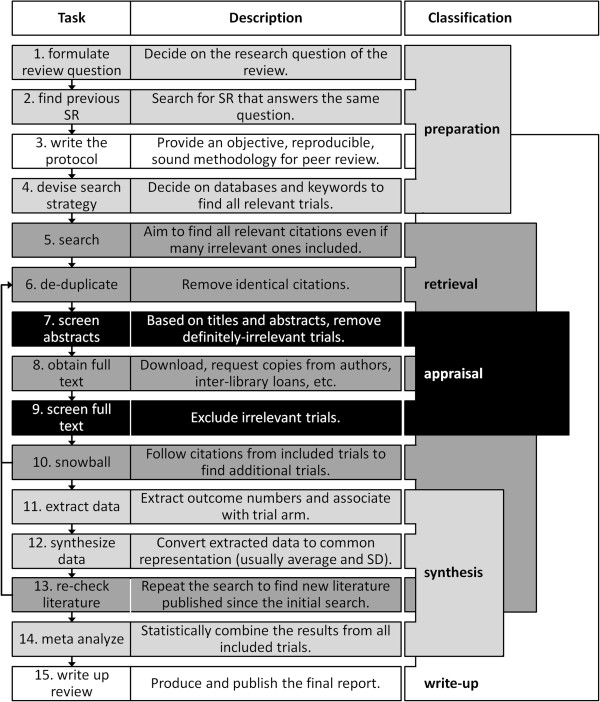
“While some authors propose only three steps, others, like Tsafnat et al. (2014), suggest 15 steps.”
InfluentialArtificial intelligence across the cancer care continuum
Riaz, I. B., Khan, M. A., & Osterman, T. J. (2025) · Cancer · doi:10.1002/cncr.70050 · Cited by 40
Improving the conduct of systematic reviews: a process mining perspective
Pham, B., Bagheri, E., Rios, P., Pourmasoumi, A., Robson, R. C., Hwee, J., Isaranuwatchai, W., Darvesh, N., Page, M. J., & Tricco, A. C. (2018) · Journal of Clinical Epidemiology · doi:10.1016/j.jclinepi.2018.06.011 · Cited by 40
Paying for Digital Health Interventions – What Evidence is Needed?
Zah, V., Burrell, A. D., Asche, C. V., & Zrubka, Z. (2022) · Acta Polytechnica Hungarica · doi:10.12700/aph.19.9.2022.9.10 · Cited by 40
Natukunda, A., & Muchene, L. K. (2023) · Systematic Reviews · doi:10.1186/s13643-022-02163-4 · Cited by 48
“Rather than manually screen such a huge collection of literature, innovative automated methods to speed-up the screening process may be beneficial [11–14].”
Finding Trends in Software Research
Mathew, G., Agrawal, A., & Menzies, T. (2018) · IEEE Transactions on Software Engineering · doi:10.1109/tse.2018.2870388 · Cited by 57
“Increasingly, it has also become very important to have automated tools to do SLR [52].”
MethodInfluentialDecision support tools for SLR search string construction
Marcos-Pablos, S., & García‐Peñalvo, F. J. (2018) · Ninth International Conference on Technological Ecosystems for Enhancing Multiculturality (TEEM'21) · doi:10.1145/3284179.3284292 · Cited by 48
“Diagram of the proposed approach along with the associated SLR tasks described in [2] (left)”
BackgroundMethodInfluentialAhamad, M. A., Arifin, K., Abas, A., Mahfudz, M., Basir-Cyio, M., Khairil, M., Ali, M. N., Lampe, I., & Samad, M. A. (2022) · Sustainability · doi:10.3390/su14137523 · Cited by 55
Machine learning techniques for the automation of literature reviews and systematic reviews in EFSA
Jaspers, S., De Troyer, E., & Aerts, M. (2018) · EFSA Supporting Publications · doi:10.2903/sp.efsa.2018.en-1427 · Cited by 36
“At the same time, it poses challenges due to the exponential growth in evidence production and the consequent high demand in terms of time and resources (Tsafnat et al., 2014).”
BackgroundMethodInfluentialLearning from Demonstrations in Human–Robot Collaborative Scenarios: A Survey
Sosa-Ceron, A. D., González-Hernández, H. G., & Reyes-Avendaño, J. A. (2022) · Robotics · doi:10.3390/robotics11060126 · Cited by 58
“Additionally, the final decision was supported by a text mining software in order to provide more reliability to the results; the benefits of using these kinds of tools are extensively described in [22,23].”
MethodAutomating Systematic Literature Review
Felizardo, K. R., & Carver, J. C. (2020) · Springer eBooks · doi:10.1007/978-3-030-32489-6_12 · Cited by 64
Nunn, J., & Chang, S. (2020) · WikiJournal of Medicine · doi:10.15347/wjm/2020.005 · Cited by 68
Shariff, S. H. A., Khodir, W. K. W. A., Hamid, S. A., Haris, M. S., & Ismail, M. W. (2022) · Polymers · doi:10.3390/polym14224847 · Cited by 39
Acceptance of or resistance to facial recognition payment: A systematic review
Yu, T., Wang, C., Bian, Q., & Teoh, A. P. (2024) · Journal of Consumer Behaviour · doi:10.1002/cb.2385 · Cited by 39
Liu, J., Timsina, P., & El-Gayar, O. (2016) · Information Systems Frontiers · doi:10.1007/s10796-016-9724-0 · Cited by 41
“Systematic reviews are a cornerstone of evidence-based medicine (Tsafnat et al. 2014).”
BackgroundJi, X., Machiraju, R., Ritter, A., & Yen, P. (2015) · PubMed Central · Cited by 56
Advanced analytics for the automation of medical systematic reviews
Timsina, P., Liu, J., & El-Gayar, O. (2016) · Information Systems Frontiers · doi:10.1007/s10796-015-9589-7 · Cited by 33
“…(Chawla et al., 2010 Overall, the findings of extant research show enough promise to further consider the possibility of using data analytics techniques for automatically screening articles for systematic reviews (Cohen et al. 2006; Frunza et al. 2010; Shemilt et al. 2013; Tsafnat et al. 2014).”
BackgroundArroyave, W. D., Mehta, S. S., Guha, N., Schwingl, P., Taylor, K. W., Glenn, B., Radke, E. G., Vilahur, N., Carreón, T., Nachman, R. M., et al. (2021) · Journal of Exposure Science & Environmental Epidemiology · doi:10.1038/s41370-020-0228-0 · Cited by 33
Sundaram, G., & Berleant, D. (2023) · Lecture notes in networks and systems · doi:10.1007/978-981-99-3243-6_7 · Cited by 48
König, L., Zitzmann, S., Fütterer, T., Campos, D., Scherer, R., & Hecht, M. (2024) · Research Synthesis Methods · doi:10.1002/jrsm.1762 · Cited by 40
“3,4 14 Among the solutions discussed in the literature, AI-AS is receiving increasing attention.”
Shop scheduling in manufacturing environments: a review
Márquez, C. R. H., & Ribeiro, C. C. (2022) · International Transactions in Operational Research · doi:10.1111/itor.13108 · Cited by 42
CORE: A Global Aggregation Service for Open Access Papers
Knoth, P., Herrmannová, D., Cancellieri, M., Anastasiou, L., Pontika, N., Pearce, S., Gyawali, B., & Pride, D. (2023) · Scientific Data · doi:10.1038/s41597-023-02208-w · Cited by 79
König, L., Zitzmann, S., Fütterer, T., Campos, D., Scherer, R., & Hecht, M. (2023) · doi:10.31234/osf.io/ybu3w · Cited by 33
Comparing machine and human reviewers to evaluate the risk of bias in randomized controlled trials
Armijo‐Olivo, S., Craig, R., & Campbell, S. (2020) · Research Synthesis Methods · doi:10.1002/jrsm.1398 · Cited by 31
“Several technologies have been developed 4,5,7,8 ; however, most of them remain in early stages of testing.”
BackgroundKarystianis, G., Thayer, K., Wolfe, M., & Tsafnat, G. (2017) · Journal of Biomedical Informatics · doi:10.1016/j.jbi.2017.04.004 · Cited by 31
“Manually extracting information about observational studies from papers is a time-consuming task [2,3] that is nonetheless required in order to synthesize and compare the results of multiple studies in a systematic review [4,5].”
Self-citationData extraction methods for systematic review (semi)automation: A living review protocol.
Schmidt, L., Olorisade, B. K., McGuinness, L. A., Thomas, J., & Higgins, J. P. T. (2020) · F1000Research · doi:10.12688/f1000research.22781.2 · Cited by 30
Ye, A., Maiti, A., Schmidt, M. W., & Pedersen, S. (2024) · Future Internet · doi:10.3390/fi16050167 · Cited by 46
A question-answering framework for automated abstract screening using large language models
Akinseloyin, O., Jiang, X., & Palade, V. (2024) · Journal of the American Medical Informatics Association · doi:10.1093/jamia/ocae166 · Cited by 28
AI meets academia: transforming systematic literature reviews
Tomczyk, P., Brüggemann, P., & Vrontis, D. (2024) · EuroMed Journal of Business · doi:10.1108/emjb-03-2024-0055 · Cited by 55
Decoding semi-automated title-abstract screening: findings from a convenience sample of reviews
Gates, A., Gates, M., DaRosa, D., Elliott, S. A., Pillay, J., Rahman, S., Vandermeer, B., & Hartling, L. (2020) · Systematic Reviews · doi:10.1186/s13643-020-01528-x · Cited by 31
Bernabé‐Zuñiga, J. E., Rodriguez-Lucenilla, M. I., Alias-Castillo, A. J., Rueda‐Ruzafa, L., Román, P., & Sánchez‐Joya, M. D. M. (2024) · European Child & Adolescent Psychiatry · doi:10.1007/s00787-024-02528-1 · Cited by 39
“Prior utilization of this software by other researchers in meta-analyses underscores its effi - cacy in data extraction from graphs [28, 29].”
Making research articles fit for purpose: structured reporting of key methods and findings
Altman, D. G. (2015) · Trials · doi:10.1186/s13063-015-0575-7 · Cited by 30
“What is the solution? One way is to develop textmining software to locate the relevant information, and several groups are working on such initiatives [3-5].”
BackgroundCréquit, P., Trinquart, L., & Ravaud, P. (2016) · BMJ Open · doi:10.1136/bmjopen-2016-011841 · Cited by 30
Jamaluddin, F., & Saibani, N. (2021) · Sustainability · doi:10.3390/su132111935 · Cited by 48
Spatial overview of climate change impacts in Bangladesh: a systematic review
Ahmed, S., & Khan, M. A. (2022) · Climate and Development · doi:10.1080/17565529.2022.2062284 · Cited by 37
Reproducibility and replicability of systematic reviews
Shokraneh, F. (2019) · World Journal of Meta-Analysis · doi:10.13105/wjma.v7.i3.66 · Cited by 29
A Systematic Literature Review on Multi-Label Classification based on Machine Learning Algorithms
Endut, N., Hamzah, W. M. A. F. W., Ismail, I., Yusof, M. K., Baker, Y. A., & Yusoff, H. (2022) · TEM Journal · doi:10.18421/tem112-20 · Cited by 33
Shokraneh, F., & Adams, C. E. (2020) · Schizophrenia Bulletin Open · doi:10.1093/schizbullopen/sgaa061 · Cited by 28
Codepori: Large-Scale System for Autonomous Software Development Using Multi-Agent Technology
Rasheed, Z., Malik, S., Kemell, K.-K., Muhammad, W., Saari, M., Systä, K., & Abrahamsson, P. (2024) · doi:10.2139/ssrn.4979510 · Cited by 27
González, C. S. G. (2021) · Edutec Revista Electrónica de Tecnología Educativa · doi:10.21556/edutec.2021.76.2085 · Cited by 53
Data extraction methods for systematic review (semi)automation: Update of a living systematic review
Schmidt, L., Finnerty Mutlu, A. N., Elmore, R., Olorisade, B. K., Thomas, J., & Higgins, J. P. T. (2025) · F1000Research · doi:10.12688/f1000research.51117.3 · Cited by 27
“provided a broad overview on automation technologies for different stages of authoring a systematic review.(5) O’Mara-Eves et al.”
Tyrer, F., Kiani, R., & Rutherford, M. J. (2020) · Journal of Intellectual & Developmental Disability · doi:10.3109/13668250.2020.1834946 · Cited by 26
“As the number of records achieved was much larger, a machine learning tool was used to facilitate screening (Tsafnat et al., 2014).”
MethodAntwi, E. K., Owusu-Banahene, W., Boakye-Danquah, J., Bernard, A., & Boateng, F. A. F. (2022) · MethodsX · doi:10.1016/j.mex.2022.101935 · Cited by 30
“Advances in computer-aided technology have helped automate aspects of the evidence synthesis process to improve efficiency and cut costs and time while still maintaining the standards of conventional search methods [13] .”
BackgroundGil-Hernández, E., Ruiz‐González, C., Rodríguez-Arrastia, M. J., Ropero‐Padilla, C., Rueda‐Ruzafa, L., Sánchez‐Labraca, N., & Román, P. (2023) · Nutrition Reviews · doi:10.1093/nutrit/nuad027 · Cited by 30
Martin, P. B., Surian, D., Bashir, R., Bourgeois, F. T., & Dunn, A. G. (2019) · JAMIA Open · doi:10.1093/jamiaopen/ooy062 · Cited by 27
Self-citationIterative guided machine learning-assisted systematic literature reviews: A diabetes case study
Zimmerman, J., Soler, R. E., Lavinder, J., Murphy, S., Atkins, C., Hulbert, L., Lusk, R., & Ng, B. P. (2021) · Systematic Reviews · doi:10.1186/s13643-021-01640-6 · Cited by 24
Gates, A., Gates, M., Sim, S., Elliott, S. A., Pillay, J., & Hartling, L. (2021) · BMC Medical Research Methodology · doi:10.1186/s12874-021-01354-2 · Cited by 28
Tercero-Hidalgo, J. R., Khan, K. S., Bueno‐Cavanillas, A., López, R. F., Huete, J. F., Amezcua‐Prieto, C., Zamora, J., & Fernández-Luna, J. M. (2022) · Journal of Clinical Epidemiology · doi:10.1016/j.jclinepi.2022.04.027 · Cited by 24
“This is a resource-intensive undertaking, requiring teams of multiple reviewers to interrogate numerous repositories and databases, screen through thousands of potentially relevant citations and articles, extract the pertinent data from the selected studies, and then prepare cohesive summaries of the findings [2,3].”
Data Sampling and Supervised Learning for HIV Literature Screening
Almeida, H., Meurs, M., Kosseim, L., & Tsang, A. (2016) · IEEE Transactions on NanoBioscience · doi:10.1109/tnb.2016.2565481 · Cited by 26
“, [6–8]).”
Paynter, R. A., Featherstone, R. M., Stoeger, E., Fiordalisi, C. V., Voisin, C. E., & Adam, G. P. (2021) · Journal of Clinical Epidemiology · doi:10.1016/j.jclinepi.2021.03.013 · Cited by 27
“Specific questions included: (1) Do TMTs decrease the time spent developing search strategies? (2) How do TMTs affect the sensitivity and yield of searches? (3) Do TMTs identify groups of records that can be safely excluded in the search evaluation step? (4) Does the complexity of a systematic review topic affect TMT…”
BackgroundWhat have we learned after ten years of systematic reviews in international development?
Waddington, H. S., Masset, E., & Jiménez, E. (2018) · Journal of Development Effectiveness · doi:10.1080/19439342.2018.1441166 · Cited by 35
“Much research and a number of projects are underway that employ machine learning algorithms to assist researchers in conducting systematic reviews (O’Mara-Eves et al. 2015; Tsafnat et al. 2014; see also Snilstveit et al., 2018).”
BackgroundHoai, X. L., & Simonart, T. (2023) · Journal of Clinical Medicine · doi:10.3390/jcm12165410 · Cited by 24
“MAs/NMAs require complex statistical techniques and a significant amount of time to produce (often as long as 1 year) [4] and are, therefore, rarely updated [5,6].”
BackgroundFromm, Y. M., Martin, F., Gezer, T., & Ifenthaler, D. (2025) · Technology Knowledge and Learning · doi:10.1007/s10758-025-09819-9 · Cited by 43
“Systematic reviews in educational sciences should utilize adequate technologies for managing, screening, and coding primary studies (de la Torre-López et al., 2023; Tsafnat et al., 2014).”
InfluentialLee, K., Paek, H., Ofoegbu, N., Rube, S., Higashi, M. K., Dawoud, D., Xu, H., Shi, L., & Wang, X. (2025) · Value in Health · doi:10.1016/j.jval.2025.08.002 · Cited by 25
The Interaction of AI and Early Childhood Education. A State-of-the-art Review 2020–2024
Ljungcrantz, L. (2026) · Early Childhood Education Journal · doi:10.1007/s10643-025-02079-3 · Cited by 39
“The backward snowballing method was used to find stud - ies that had not been included or excluded (Tsafnat et al., 2014 ).”
Dunn, A. G., Coiera, E. W., & Bourgeois, F. T. (2017) · Journal of Clinical Epidemiology · doi:10.1016/j.jclinepi.2017.12.007 · Cited by 24
“If links between trial registrations and articles were comprehensive, trial registrations could be more effectively used to automate the identification of trials for inclusion in systematic reviews [22,23], as well as provide early signals that a systematic review should be updated [24-33].”
BackgroundSelf-citationEvidence-based literature review: De-duplication a cornerstone for quality
Hammer, B., Virgili, E., & Bilotta, F. (2023) · World Journal of Methodology · doi:10.5662/wjm.v13.i5.390 · Cited by 34
Halamoda‐Kenzaoui, B., Rolland, E., Piovesan, J., Puertas Gallardo, A., & Bremer‐Hoffmann, S. (2022) · Journal of Applied Toxicology · doi:10.1002/jat.4204 · Cited by 21
“Currently available tools for data extraction, including textual data, are designed for randomised controlled trials reports (Jonnalagadda et al., 2015; Tsafnat et al., 2014), rather than original research articles.”
BackgroundMethod#CochraneTech: Technology and the Future of Systematic Reviews
Elliott, J., Sim, I., Thomas, J., Owens, N., Dooley, G., Riis, J., Wallace, B., Thomas, J., Noel-Storr, A., Rada, G., et al. (2014) · Cochrane Database of Systematic Reviews · doi:10.1002/14651858.ed000091 · Cited by 21
Buhos: A web-based systematic literature review management software
Bustos, C., Malverde, M. ́. M., Salcedo, P., & Mújica, A. D. (2018) · SoftwareX · doi:10.1016/j.softx.2018.10.004 · Cited by 27
Editorial: Evidence synthesis for accelerated learning on climate solutions
Berrang‐Ford, L., Döbbe, F., Garside, R., Haddaway, N., Lamb, W. F., Minx, J. C., Viechtbauer, W., Welch, V. A., & White, H. (2020) · Campbell Systematic Reviews · doi:10.1002/cl2.1128 · Cited by 31
“…on automation and computer‐assistance for systematic reviews and evidence and gap maps (Haddaway et al n.d.; Nakagawa et al., 2019; O'Connor et al., 2019; Tsafnat et al., 2014; Westgate et al., 2018) as well as broader global environmental assessments (Callaghan et al., 2020; Lamb et al., 2019).”
BackgroundTranstornos mentais comuns em estudantes universitários: uma revisão sistemática da literatura
Lopes, F. M., Lessa, R. T., Carvalho, R. A., Reichert, R. A., Andrade, A. L. M., & de MICHELI, D. (2021) · Revista Psicologia em Pesquisa · doi:10.34019/1982-1247.2022.v16.31105 · Cited by 40
A New Approach to Evidence Synthesis in Traumatic Brain Injury: A Living Systematic Review
Synnot, A., Gruen, R. L., Menon, D. K., Steyerberg, E. W., Büki, A., Peul, W. C., Elliott, J., & Maas, A. I. R. (2015) · Journal of Neurotrauma · doi:10.1089/neu.2015.4124 · Cited by 25
“12,13 In addition, growing momentum in SR task automation, 14 divesting discrete review tasks to the ‘‘crowd’’ 15,16 and open SR data platforms 17,18 offer exciting possibilities to enable the widespread adoption of LSRs.”
Li, Z., Gurgel, H., Dessay, N., Hu, L., Xu, L., & Gong, P. (2020) · International Journal of Environmental Research and Public Health · doi:10.3390/ijerph17124509 · Cited by 21
Coleman, J. L., Hatch-McChesney, A., Small, S. D., Allen, J. T., Sullo, E., Agans, R. T., Fagnant, H. S., Bukhari, A. S., & Karl, J. P. (2022) · Advances in Nutrition · doi:10.1093/advances/nmac086 · Cited by 19
Elkins, M. R. (2017) · Journal of physiotherapy · doi:10.1016/j.jphys.2017.11.009 · Cited by 21
Bannach‐Brown, A., Przybyła, P., Thomas, J., Rice, A. S. C., Ananiadou, S., Liao, J., & Macleod, M. R. (2018) · bioRxiv (Cold Spring Harbor Laboratory) · doi:10.1101/255760 · Cited by 24
LAIGNELOT, F., Martin, G. L., OSSMAN, M., Pingeon, O., BOUBAKER, A., PICOVSCHI, E., Jia, K. I. M., Tannier, X., Cohen, J. F., & Dechartres, A. (2026) · Journal of Clinical Epidemiology · doi:10.1016/j.jclinepi.2026.112221 · Cited by 39
Dymora, P., & Paszkiewicz, A. (2020) · Applied Sciences · doi:10.3390/app10238521 · Cited by 18
A decision support system for automating document retrieval and citation screening
van Dinter, R., Catal, C., & Tekinerdoğan, B. (2021) · Expert Systems with Applications · doi:10.1016/j.eswa.2021.115261 · Cited by 26
Šuster, S., Baldwin, T., Lau, J. H., Yepes, A. J., Martínez, D., Otmakhova, Y., & Verspoor, K. M. (2023) · Journal of Medical Internet Research · doi:10.2196/35568 · Cited by 27
“…scale, further compounded by the ever-growing number of published medical studies [11], researchers have proposed to automate different steps of the reviewing process, including the automation of article classification, screening for primary studies, data extraction, and quality assessment [10,12].”
Machine learning for accelerating screening in evidence reviews
Chappell, M., Edwards, M., Watkins, D., Marshall, C., & Graziadio, S. (2023) · Cochrane Evidence Synthesis and Methods · doi:10.1002/cesm.12021 · Cited by 20
Using MEDLINE Elemental Similarity to Assist in the Article Screening Process for Systematic Reviews
Ji, X., & Yen, P. (2015) · JMIR Medical Informatics · doi:10.2196/medinform.3982 · Cited by 20
“…naive Bayes and support vector machine) [7,12-15] were proposed to focus on facilitating and enhancing the title and abstract level triage, abstracts screening [11], or article screening, which is crucial and time-consuming as it requires expert reviewers to screen a large amount of literature.”
Surian, D., Dunn, A. G., Orenstein, L., Bashir, R., Coiera, E. W., & Bourgeois, F. T. (2018) · Journal of Biomedical Informatics · doi:10.1016/j.jbi.2018.01.008 · Cited by 17
“living systematic reviews and automated systematic review updates [17-19].”
BackgroundSelf-citationA Computational Approach for Objectively Derived Systematic Review Search Strategies
Scells, H., Zuccon, G., Koopman, B., & Clark, J. M. (2020) · Lecture notes in computer science · doi:10.1007/978-3-030-45439-5_26 · Cited by 18
“…the effectiveness of systematic reviews is often hampered by the fact that they are resource-intensive and often become out-of-date at the time of publication [21]: it takes on average 2 years and AUD$350K to create a systematic review [13,9] and currently only 36% of Cochrane SRs are deemed Fig.”
Oberste, M., Sharma, S., Bloch, W., & Zimmer, P. (2021) · Frontiers in Psychology · doi:10.3389/fpsyg.2021.528352 · Cited by 26
Coleman, J. L., Carrigan, C. T., & Margolis, L. M. (2021) · Journal of the International Society of Sports Nutrition · doi:10.1186/s12970-021-00440-6 · Cited by 13
“Data that were not reported numerically were generated from provided figures by digitally measuring the height of the histogram bar and calculating relative to measured y-axis units [32].”
MethodSimulation-based Active Learning for Systematic Reviews: A Scoping Review of Literature
Teijema, J. J., Ribeiro, G., Seuren, S., Anadria, D., Bagheri, A., & van de Schoot, R. (2023) · doi:10.31234/osf.io/67zmt · Cited by 10
Scotti, K. L., Young, S. M. N., Gainey, M. A., & Lan, H. (2025) · Cochrane Evidence Synthesis and Methods · doi:10.1002/cesm.70046 · Cited by 37
“This lack of transparency is particularly problematic for translation, where tool accuracy varies by language and content and where misinterpretation of non ‐ English studies may introduce bias [37, 256, 257].”
Living network meta-analysis was feasible when considering the pace of evidence generation
Créquit, P., Martin-Montoya, T., Attiche, N., Trinquart, L., Vivot, A., & Ravaud, P. (2018) · Journal of Clinical Epidemiology · doi:10.1016/j.jclinepi.2018.12.008 · Cited by 19
Artificial intelligence and automation of systematic reviews in women's health
Amezcua‐Prieto, C., Fernández-Luna, J. M., Huete, J. F., Bueno‐Cavanillas, A., & Khan, K. S. (2020) · Current Opinion in Obstetrics & Gynecology · doi:10.1097/gco.0000000000000643 · Cited by 17
“It can also identify numerical entities, for example, quantities, percentages and statistical variables useful for meta-analysis [38].”
BackgroundGhezzi‐Kopel, K., Ault, J., Chimwaza, G., Diekmann, F., Eldermire, E., Gathoni, N., Kelly, J. A., Kinengyere, A. A., Kocher, M., Lwoga, E. T., et al. (2021) · Research Synthesis Methods · doi:10.1002/jrsm.1528 · Cited by 20
“Examples of our work follow, framed within the context of the five-step evidence synthesis process presented by Tsafnat et al.(17) and outlining librarian-designed tools for preparation, information retrieval, screening and appraisal, synthesis, and write-up.”
MethodMahmić-Kaknjo, M., Tomić, V., Ellen, M., Nußbaumer-Streit, B., Sfetcu, R., Baladía, E., Riva, N., Kassianos, A. P., & Marušić, A. (2023) · Systematic Reviews · doi:10.1186/s13643-023-02223-3 · Cited by 18
Potential application of artificial intelligence in cancer therapy
Riaz, I. B., Khan, M. A., & Haddad, T. C. (2024) · Current Opinion in Oncology · doi:10.1097/cco.0000000000001068 · Cited by 21
Recommendations for kidney disease guideline updating: a report by the KDIGO Methods Committee
Uhlig, K., Berns, J. S., Carville, S. F., Chan, W., Cheung, M., Guyatt, G. H., Hart, A., Lewis, S. Z., Tonelli, M. A., Webster, A. C., et al. (2016) · Kidney International · doi:10.1016/j.kint.2015.11.030 · Cited by 22
“A selection of such tools is shown in Supplementary Table S2.”
MethodInfluentialPredictive models for hotel booking cancellation: a semi-automated analysis of the literature
Instituto Universitário de Lisboa (ISCTE-IUL), P., António, N., de Almeida, A., Instituto Universitário de Lisboa (ISCTE-IUL), P., Nunes, L., & Instituto Universitário de Lisboa (ISCTE-IUL), P. (2019) · Tourism & Management Studies · doi:10.18089/tms.2019.15011 · Cited by 19
“This automation would potentially enable faster and less resource-intensive literature reviews (Bragge, Relander, Sunikka, & Mannonen, 2007; Feng, Chiam, & Lo, 2017; Tsafnat et al., 2014).”
BackgroundMethodInfluential
Metadata
- Authors
- Tsafnat, G., Glasziou, P., Choong, M. K., Dunn, A., Galgani, F., & Coiera, E.
- Affiliations
- UNSW Sydney (AU)
- Bond University (AU)
- Corresponding author
- Tsafnat, Guy
- Venue
- Systematic Reviews
- Published
- 2014-07-09
- Volume
- 3
- Issue
- 1
- Pages
- 74-74
- ISSN
- 2046-4053 (ISSN-L)
- PMC
- PMC4100748
- OpenAlex
- W2095601341
- Cited by
- 472
- References
- 137
- Citations by year
- 2026: 41 · 2025: 42 · 2024: 56 · 2023: 44 · 2022: 44 · 2021: 68 · 2020: 46 · 2019: 36 · 2018: 32 · 2017: 24 · 2016: 16 · 2015: 18 · 2014: 5
- FWCI
- 5.75
- Type
- journal article
- Language
- en
- Open access
- gold
- doi.org
- Licence
- Locations
- Systematic Reviews (publishedVersion, cc-by)
- PubMed Central (publishedVersion, cc-by)
- Bond University Research Portal (Bond University) (publishedVersion, cc-by)
- PubMed (publishedVersion)
- e-publications@bond (Bond University) (submittedVersion)
- Topics
- Social Sciences › Decision Sciences › Statistics, Probability and Uncertainty › Meta-analysis and systematic reviews
- Physical Sciences › Computer Science › Information Systems › Software Engineering Techniques and Practices
- Health Sciences › Medicine › Public Health, Environmental and Occupational Health › Clinical practice guidelines implementation
- Keywords
- systematic review automation, information systems, randomized controlled trials, evidence-based medicine, risk of bias assessment, data extraction, meta-analysis, system integration
- MeSH terms
- Electronic Data Processing, Review Literature as Topic, Information Storage and Retrieval
About these checks
Registry, retraction, Cites and statistics results are computed, not judged, with one exception: a printed reference that no index lists is read once by a model before it counts as a citation error. Claims are extracted by a model and kept only when their quote appears verbatim in the text; each cited source is then checked, with a model’s help, for whether it says what the claim relies on. Those verdicts can be wrong — read the claim’s quote and the cited source before relying on one.
Statistics and arithmetic are recomputed, not judged.
Confidence bands are shown only for fields calibrated on our annotated test set. None is calibrated yet, so no band is shown.
What counts as a claim ›How we measure confidence ›How we check this ›
Are you an author, or do you see a problem with this page? Request a review
Data sources
Bibliographic data: Semantic Scholar, OpenAlex, Crossref.
Contains information from the Semantic Scholar Academic Graph Datasets, made available under the ODC Attribution License (ODC-BY 1.0).
Semantic Scholar’s data is described in: Kinney, R., et al. (2023). The Semantic Scholar Open Data Platform. arXiv:2301.10140.
