

Systematic review automation technologies
Open accessThe DOI matches its Crossref record; 136 of the 137 references it cites were found in a registry or an index.
Abstract
Systematic reviews, a cornerstone of evidence-based medicine, are not produced quickly enough to support clinical practice. The cost of production, availability of the requisite expertise and timeliness are often quoted as major contributors for the delay. This detailed survey of the state of the art of information systems designed to support or automate individual tasks in the systematic review, and in particular systematic reviews of randomized controlled clinical trials, reveals trends that see the convergence of several parallel research projects.We surveyed literature describing informatics systems that support or automate the processes of systematic review or each of the tasks of the systematic review. Several projects focus on automating, simplifying and/or streamlining specific tasks of the systematic review. Some tasks are already fully automated while others are still largely manual. In this review, we describe each task and the effect that its automation would have on the entire systematic review process, summarize the existing information system support for each task, and highlight where further research is needed for realizing automation for the task. Integration of the systems that automate systematic review tasks may lead to a revised systematic review workflow. We envisage the optimized workflow will lead to system in which each systematic review is described as a computer program that automatically retrieves relevant trials, appraises them, extracts and synthesizes data, evaluates the risk of bias, performs meta-analysis calculations, and produces a report in real time.
Overview
The claims and statistics of this paper haven’t been checked yet.
Free: it reads the open-access text and checks the first 5 claims that cite a source we can check. Create a free account to check every claim.
Integrity signals
Registry
Cites
Statistics
Figures

Verification
Claims the paper makes
The claims and statistics of this paper haven’t been checked yet.
Free: it reads the open-access text and checks the first 5 claims that cite a source we can check. Create a free account to check every claim.
Claims other papers make about this one
Each is checked against this paper’s own text: does it say what the citing paper says it does?
The source backs part of the claim, not all of it — or backs it for a different population, condition or comparison.
In the citing paper
“many of the tools have been developed independently as stand-alone software and are often not compatible with other tools”
From Rayyan-a web and mobile app for systematic reviews. (2016) · cites this paper as [5]
Experimental — accuracy not yet measuredThe source backs part of the claim, not all of it — or backs it for a different population, condition or comparison.
In the citing paper
“An effective parallelisation of SR processes needs to be supported by the use of a purposefully adapted computer technology [11, 12].”
From How to conduct systematic reviews more expeditiously? (2015) · cites this paper as [12]
Experimental — accuracy not yet measuredThe cited source says what the claim attributes to it.
In the citing paper
“An increasing number of projects are underway which focus on the automation of segments of the systematic review process, and although several tools and software have been developed, so far, none of them span the entire process of review production”
From Rayyan-a web and mobile app for systematic reviews. (2016) · cites this paper as [5]
The cited source says what the claim attributes to it.
In the citing paper
“Title and abstract screening is a review step that may be particularly amenable to automation or semi-automation [2–4].”
From Performance and usability of machine learning for screening in systematic reviews: a comparative evaluation of three tools (2019) · cites this paper as [3]
The cited source says what the claim attributes to it.
In the citing paper
“The authors illustrated that not all SR tasks are equally amenable to automation.”
From How to conduct systematic reviews more expeditiously? (2015) · cites this paper as [12]
4 more claims about this paper
Create a free account to see every claim other papers make about this one.
Self-check
Percentages, sums and reported differences re-computed from the paper’s own numbers.
The self-check needs the paper’s full text.
Citations
Cites
Preferred Reporting Items for Systematic Reviews and Meta-Analyses: the PRISMA statement
Moher, D., Liberati, A., Tetzlaff, J., Altman, D. G., & for the PRISMA Group (2009) · BMJ · doi:10.1136/bmj.b2535 · Cited by 83,823
Bias in meta-analysis detected by a simple, graphical test
Egger, M., Smith, G. D., Schneider, M., & Minder, C. (1997) · BMJ · doi:10.1136/bmj.315.7109.629 · Cited by 56,722 · cited 1×
“, funnel plots [130] show whether publication bias is likely to affect the conclusion of the”
BackgroundPreferred reporting items for systematic reviews and meta-analyses: the PRISMA Statement.
(2009) · PubMed Central · Cited by 44,859
Preferred reporting items for systematic reviews and meta-analyses: The PRISMA statement
Moher, D., Liberati, A., Tetzlaff, J., Altman, D. G., & the PRISMA Group* (2009) · Annals of Internal Medicine · doi:10.7326/0003-4819-151-4-200908180-00135 · Cited by 37,554
Scoping studies: towards a methodological framework
Arksey, H., & O'Malley, L. (2005) · International Journal of Social Research Methodology · doi:10.1080/1364557032000119616 · Cited by 36,742 · cited 1×
“Current systems Global evidence maps [18,19] and scoping studies [20] are both literature review methods designed to complement systematic review and identify research gaps.”
BackgroundCochrane Handbook for Systematic Reviews of Interventions: Cochrane Book Series
(2008) · doi:10.1002/9780470712184 · Cited by 25,048
Preferred Reporting Items for Systematic Reviews and Meta-Analyses: The PRISMA Statement
Moher, D., Liberati, A., Tetzlaff, J., & Altman, D. G. (2009) · Journal of Clinical Epidemiology · doi:10.1016/j.jclinepi.2009.06.005 · Cited by 19,575
Statistical Methods for Meta-Analysis
Wasserman, S., Hedges, L. V., & Olkin, I. (1988) · Journal of Educational Statistics · doi:10.2307/1164953 · Cited by 10,326
Cochrane Handbook for Systematic Reviews of Interventions
Tarsilla, M. (2010) · Journal of MultiDisciplinary Evaluation · doi:10.56645/jmde.v6i14.284 · Cited by 5,178
Users' guides to the medical literature
Guyatt, G. H. (1993) · JAMA · doi:10.1001/jama.270.17.2096 · Cited by 2,970
Research works printed but not linked: 15
- 1. Sackett DL, Straus S, Richardson WS, Rosenberg W, Haynes RB. Evidence-based Medicine: How to Teach and Practice EBM. Edinburgh: Churchill Livingstone; 2000.
- 11. Glasziou P, Beller E, Thorning S, Vermeulen M. Manual for systematic reviews. Gold Coast, Queensland, Australia: Centre for Research on Evidence Based Medicine; 2013.
- 40. Collaboration RTC. Review Manager (RevMan). 4.2 for Windows. Oxford, England: The Cochrane Collaboration; 2003.
- 41. Higgins J, Churchill R, Tovey D, Lasserson T, Chandler J. Update on the MECIR project: methodological expectations for Cochrane intervention. Cochrane Meth. 2011;suppl. 1:2.
- 82. REUTERS T. EndNote®. Bibliographies Made Easy™; 2011. http://www.endnote.com.
- 83. ResearchSoft I. ProCite Version 5. Berkeley, CA: Institute for Scientific Information; 1999.
- 88. Saleem O, Latif S. Proceedings of the World Congress on Engineering and Computer Science. San Francisco, USA; 2012. Information extraction from research papers by data integration and data validation from multiple header extraction sources.
- 99. Thomas J, Brunton J, Graziosi S. EPPI-Reviewer 4.0: software for research synthesis. EPPI-Centre, Social Science Research Unit, Institute of Education, University of London UK; 2010.
- 100. DistillerSR. http://www.systematic-review.net.
- 110. PubMed Central. http://www.ncbi.nlm.nih.gov/pmc.
- 111. Google Scholar. http://scholar.google.com.
- 120. Huwaldt JA. Plot Digitizer. 2009. http://plotdigitizer.sf.net.
- 121. Egner J, Mitchell M, Richter T, Winchen T. Engauge Digitizer: convert graphs or map files into numbers. 2013. http://digitizer.sf.net/
- 122. Rohatgi A. WebPlotDigitizer. 2013. http://arohatgi.info/WebPlotDigitizer/
- 133. Rosenberg MS, Adams DC, Gurevitch J. MetaWin: statistical software for meta-analysis. Massachusetts, USA: Sinauer Associates Sunderland; 2000.
Cited by
Rayyan-a web and mobile app for systematic reviews.
Ouzzani, M., Hammady, H., Fedorowicz, Z., & Elmagarmid, A. (2016) · Systematic Reviews · doi:10.1186/s13643-016-0384-4 · Cited by 26,092
“An increasing number of projects are underway which focus on the automation of segments of the systematic review process, and although several tools and software have been developed, so far, none of them span the entire process of review production [5].”
BackgroundCochrane Rapid Reviews Methods Group offers evidence-informed guidance to conduct rapid reviews
Garritty, C., Gartlehner, G., Nussbaumer-Streit, B., King, V. J., Hamel, C., Kamel, C., Affengruber, L., & Stevens, A. (2021) · Journal of Clinical Epidemiology · doi:10.1016/j.jclinepi.2020.10.007 · Cited by 1,141
“However, the methodological rigor and process that makes SR evidence trustworthy often take one to 2 years to complete [1 e 4] and limit their utility to meet the time-sensitive needs of stakeholders.”
O’Mara-Eves, A., Thomas, J., McNaught, J., Miwa, M., & Ananiadou, S. (2015) · Systematic Reviews · doi:10.1186/2046-4053-4-5 · Cited by 681
“The use of automation to assist in study selection is possibly the most advanced of all the areas where automation in systematic reviews is being developed; but others range from writing sections of the report, formulating the review question and automated data extraction and quality assessment [90-93].”
BackgroundA full systematic review was completed in 2 weeks using automation tools: a case study
Clark, J., Glasziou, P., Del Mar, C., Bannach-Brown, A., Stehlik, P., & Scott, A. M. (2020) · Journal of Clinical Epidemiology · doi:10.1016/j.jclinepi.2020.01.008 · Cited by 687
Self-citationSearching for and selecting studies
Lefebvre, C., Glanville, J., Briscoe, S., Littlewood, A., Marshall, C., Metzendorf, M., Noel‐Storr, A., Rader, T., Shokraneh, F., Thomas, J., et al. (2019) · Cochrane Handbook for Systematic Reviews of Interventions · doi:10.1002/9781119536604.ch4 · Cited by 647
Meeting the review family: exploring review types and associated information retrieval requirements
Sutton, A., Clowes, M., Preston, L., & Booth, A. (2019) · Health Information & Libraries Journal · doi:10.1111/hir.12276 · Cited by 570
Automation of systematic literature reviews: A systematic literature review
van Dinter, R., Tekinerdogan, B., & Catal, C. (2021) · Information and Software Technology · doi:10.1016/j.infsof.2021.106589 · Cited by 432
“Tsafnat et al. [21] describe each step in the systematic review process, its automation potential, and current tools that have already been developed.”
BackgroundGrames, E. M., Stillman, A. N., Tingley, M. W., & Elphick, C. S. (2019) · Methods in Ecology and Evolution · doi:10.1111/2041-210x.13268 · Cited by 377
“…for automation of the most time‐intensive tasks while still maintaining the standards of conventional search methods (Delaney & Tams, 2018; O’Mara‐Eves, Thomas, McNaught, Miwa, & Ananiadou, 2015; Paisley & Foster, 2018; Tsafnat et al., 2014; Tsertsvadze, Chen, Moher, Sutcliffe, & McCarthy, 2015).”
MethodFact or Fiction: Verifying Scientific Claims
Wadden, D., Lin, S., Lo, K., Wang, L. L., van Zuylen, M., Cohan, A., & Hajishirzi, H. (2020) · Proceedings of the 2020 Conference on Empirical Methods in Natural Language Processing (EMNLP) · doi:10.18653/v1/2020.emnlp-main.609 · Cited by 382
“Automated evidence synthesis (Marshall and Wallace, 2019; Beller et al., 2018; Tsafnat et al., 2014; Marshall et al., 2017) seeks to automate the process of creating systematic reviews of the medical literature7 – for instance, by extracting PICO snippets (Nye et al.”
MethodSearching for studies: a guide to information retrieval for Campbell systematic reviews
Kugley, S., Wade, A., Thomas, J., Mahood, Q., Jørgensen, A. K., Hammerstrøm, K., & Sathe, N. (2017) · Campbell Systematic Reviews · doi:10.4073/cmg.2016.1 · Cited by 371
Living systematic reviews: 2. Combining human and machine effort
Thomas, J., Noel-Storr, A., Marshall, I., Wallace, B., McDonald, S., Mavergames, C., Glasziou, P., Shemilt, I., Synnot, A., Turner, T., et al. (2017) · Journal of Clinical Epidemiology · doi:10.1016/j.jclinepi.2017.08.011 · Cited by 355
Self-citationO’Mara-Eves, A., Thomas, J., McNaught, J., Miwa, M., & Ananiadou, S. (2015) · Systematic Reviews · doi:10.1186/s13643-015-0031-5 · Cited by 353
A systematic review on Asian's farmers' adaptation practices towards climate change
Shaffril, H. A. M., Krauss, S. E., & Samsuddin, S. F. (2018) · Science of The Total Environment · doi:10.1016/j.scitotenv.2018.06.349 · Cited by 347
Bailey, A. P., Hetrick, S. E., Rosenbaum, S., Purcell, R., & Parker, A. G. (2018) · Psychological Medicine · doi:10.1017/s0033291717002653 · Cited by 338
“Where it could not be obtained, the WebPlotDigitizer application (Rohatgi, 2013; Tsafnat et al. 2014) was used to convert graphical to numeric data.”
MethodRobotReviewer: evaluation of a system for automatically assessing bias in clinical trials
Marshall, I. J., Kuiper, J., & Wallace, B. C. (2016) · Journal of the American Medical Informatics Association · doi:10.1093/jamia/ocv044 · Cited by 317
“Ultimately, more efficient bias assessment would help keep systematic reviews up to date.(6) In this paper, we introduce a novel machinelearning (ML) approach, which models risks of bias simultaneously across all domains while identifying text supporting these judgments.”
Williams, R. I., Clark, L. A., Clark, W. R., & Raffo, D. M. (2021) · European Management Journal · doi:10.1016/j.emj.2020.09.007 · Cited by 300
Artificial intelligence and the conduct of literature reviews
Wagner, G., Lukyanenko, R., & Paré, G. (2022) · Journal of Information Technology · doi:10.1177/02683962211048201 · Cited by 296
“…mechanical tasks, which creates exciting opportunities for advanced AI-based tools 1 to reduce prospective authors ’ efforts for time-consuming and repetitive tasks and to dedicate more time to the creative tasks that require human interpretation, intuition, and expertise (Tsafnat et al., 2014).”
InfluentialAutomating data extraction in systematic reviews: a systematic review
Jonnalagadda, S. R., Goyal, P., & Huffman, M. D. (2015) · Systematic Reviews · doi:10.1186/s13643-015-0066-7 · Cited by 287
“Tsafnat et al. [43] surveyed the informatics systems that automate some of the tasks of systematic review and report systems for each stage of systematic review.”
BackgroundMethodInfluentialResearch Weaving: Visualizing the Future of Research Synthesis
Nakagawa, S., Samarasinghe, G., Haddaway, N. R., Westgate, M. J., O’Dea, R. E., Noble, D. W. A., & Lagisz, M. (2019) · Trends in Ecology & Evolution · doi:10.1016/j.tree.2018.11.007 · Cited by 261
Artificial intelligence for literature reviews: opportunities and challenges
Bolaños, F., Salatino, A., Osborne, F., & Motta, E. (2024) · Artificial Intelligence Review · doi:10.1007/s10462-024-10902-3 · Cited by 246
“[ 55]; IC 2.”
Factors influencing users' adoption and use of conversational agents: A systematic review
Ling, E. C., Tussyadiah, I., Tuomi, A., Stienmetz, J., & Ioannou, A. (2021) · Psychology & Marketing · doi:10.1002/mar.21491 · Cited by 199
Chai, K. E. K., Lines, R. L. J., Gucciardi, D. F., & Ng, L. (2021) · Systematic Reviews · doi:10.1186/s13643-021-01635-3 · Cited by 190
“A review of automation technologies identified 14 tasks within the review process which have the potential to be automated (e.g. de-duplication and screening titles and abstracts [39]).”
BackgroundOn behalf of the founding members of the ICASR group, Beller, E., Clark, J., Tsafnat, G., Adams, C., Diehl, H., Lund, H., Ouzzani, M., Thayer, K., Thomas, J., et al. (2018) · Systematic Reviews · doi:10.1186/s13643-018-0740-7 · Cited by 191
“Fortunately, many of the tasks in a systematic review are amenable to automation: screening of titles and abstracts, sourcing full texts of included studies, data extraction and even collation of meta-analysis results are all fertile areas for automation [4].”
BackgroundSelf-citationRaine, R., Fitzpatrick, R., Barratt, H., Bevan, G., Black, N., Boaden, R., Bower, P., Campbell, M., Denis, J.-L., Devers, K., et al. (2016) · Health Services and Delivery Research · doi:10.3310/hsdr04160 · Cited by 186
Bannach-Brown, A., Przybyła, P., Thomas, J., Rice, A. S. C., Ananiadou, S., Liao, J., & Macleod, M. R. (2019) · Systematic Reviews · doi:10.1186/s13643-019-0942-7 · Cited by 185
Artificial intelligence to automate the systematic review of scientific literature
de la Torre-López, J., Ramírez, A., & Romero, J. R. (2023) · Computing · doi:10.1007/s00607-023-01181-x · Cited by 170
“[47] provide an overview of SLR automation in the domain of evidence-based medicine.”
BackgroundO’Connor, A. M., Tsafnat, G., Thomas, J., Glasziou, P., Gilbert, S. B., & Hutton, B. (2019) · Systematic Reviews · doi:10.1186/s13643-019-1062-0 · Cited by 167
Self-citationEgan, K. J., Pinto-Bruno, Á. C., Bighelli, I., Berg-Weger, M., van Straten, A., Albanese, E., & Pot, A.-M. (2018) · Journal of the American Medical Directors Association · doi:10.1016/j.jamda.2017.10.023 · Cited by 166
“Fittingly, collating evidence on online interventions for caregivers of people with dementia could take advantage of the latest technologies, including machine learning approaches 36 whereby much of future review work would be automated.”
BackgroundInformation overload in healthcare: too much of a good thing?
Klerings, I., Weinhandl, A. S., & Thaler, K. J. (2015) · Zeitschrift für Evidenz, Fortbildung und Qualität im Gesundheitswesen · doi:10.1016/j.zefq.2015.06.005 · Cited by 163
Langlois, E. V., Straus, S. E., Antony, J., King, V. J., & Tricco, A. C. (2019) · BMJ Global Health · doi:10.1136/bmjgh-2018-001178 · Cited by 160
“12 15 However, there is little empirical evidence about the implications of innovative technologies on the validity of the review.”
Howard, B. E., Phillips, J., Tandon, A., Maharana, A., Elmore, R., Mav, D., Sedykh, A., Thayer, K., Merrick, B. A., Walker, V., et al. (2020) · Environment International · doi:10.1016/j.envint.2020.105623 · Cited by 157
“Due to the large investment of resources necessary to develop and maintain a systematic review, there has been considerable recent interest in methods and techniques for using machine learning and automation to make this process more efficient (Tsafnat et al., 2014).”
MethodSynthesizing Qualitative Research: Reflections and Lessons Learnt by Two New Reviewers
Soilemezi, D., & Linceviciute, S. (2018) · International Journal of Qualitative Methods · doi:10.1177/1609406918768014 · Cited by 202
Gates, A., Guitard, S., Pillay, J., Elliott, S. A., Dyson, M. P., Newton, A. S., & Hartling, L. (2019) · Systematic Reviews · doi:10.1186/s13643-019-1222-2 · Cited by 133
Yang, J., Robbins, M., Reilly, J., Maerz, T., & Anderson, K. (2016) · The American Journal of Sports Medicine · doi:10.1177/0363546516652900 · Cited by 127
“When postoperative data were presented in a graphical form, graph digitization was utilized to extract numerical means and SDs, and this method has been shown to be an accurate and reliable method for data extraction.(12,40,49) Pain was commonly reported on 2 different scales: a 0-to-10 scale and a 1-to15 scale as a s…”
MethodCréquit, P., Trinquart, L., Yavchitz, A., & Ravaud, P. (2016) · BMC Medicine · doi:10.1186/s12916-016-0555-0 · Cited by 125
“Automated processes, such as meta-search engines, could systematically cover sources such as industry and non-industry trial registries and results databases to identify posted results and improve the evidence synthesis [49, 50].”
BackgroundMethodReis, D. J., Ilardi, S. S., & Punt, S. E. W. (2018) · PLOS ONE · doi:10.1371/journal.pone.0199041 · Cited by 123
How to conduct systematic reviews more expeditiously?
Tsertsvadze, A., Chen, Y.-F., Moher, D., Sutcliffe, P., & McCarthy, N. (2015) · Systematic Reviews · doi:10.1186/s13643-015-0147-7 · Cited by 104
“An effective parallelisation of SR processes needs to be supported by the use of a purposefully adapted computer technology [11, 12].”
BackgroundMethodVandenberg, L. N., Ågerstrand, M., Beronius, A., Beausoleil, C., Bergman, Å., Bero, L. A., Bornehag, C.-G., Boyer, C. S., Cooper, G. S., Cotgreave, I., et al. (2016) · Environmental Health · doi:10.1186/s12940-016-0156-6 · Cited by 123
“are also becoming more acceptable for use [63].”
Backgroundvan Paridon, K. N., Timmis, M. A., Nevison, C. M., & Bristow, M. (2017) · BMJ Open Sport & Exercise Medicine · doi:10.1136/bmjsem-2017-000261 · Cited by 150
“net).(27) 28 (2) When this was not possible, inferential statistical information was used to calculate the effect size.”
MethodText mining approaches for dealing with the rapidly expanding literature on COVID-19
Wang, L. L., & Lo, K. (2021) · Briefings in Bioinformatics · doi:10.1093/bib/bbaa296 · Cited by 116
“Several existing systems focusonautomatingpartsofthesystematicreviewprocessmore broadly [90].”
Physical Activity for the Treatment of Adolescent Depression: A Systematic Review and Meta-Analysis
Oberste, M., Medele, M., Javelle, F., Lioba Wunram, H., Walter, D., Bloch, W., Bender, S., Fricke, O., Joisten, N., Walzik, D., et al. (2020) · Frontiers in Physiology · doi:10.3389/fphys.2020.00185 · Cited by 110
“If our data request was not met, but the article provided data in a graph, the software Web Plot Digitizer was used to obtain data from the figures (Rothagi, 2013; Tsafnat et al., 2014).”
MethodDigital-twin-based testing for cyber–physical systems: A systematic literature review
Somers, R. J., Douthwaite, J. A., Wagg, D., Walkinshaw, N., & Hierons, R. M. (2022) · Information and Software Technology · doi:10.1016/j.infsof.2022.107145 · Cited by 147
Automation of duplicate record detection for systematic reviews: Deduplicator
Forbes, C., Greenwood, H., Carter, M., & Clark, J. M. (2024) · Systematic Reviews · doi:10.1186/s13643-024-02619-9 · Cited by 150
Adoption of Clinical Decision Support in Multimorbidity: A Systematic Review
Fraccaro, P., Arguello Castelerio, M., Ainsworth, J., & Buchan, I. (2015) · JMIR Medical Informatics · doi:10.2196/medinform.3503 · Cited by 110
“There is an ongoing discussion of what should and should not be automated in systematic reviews, particularly to strike the right balance between depth and timeliness [103].”
Data extraction methods for systematic review (semi)automation: a living systematic review
Schmidt, L., Olorisade, B. K., McGuinness, L. A., Thomas, J., & Higgins, J. P. T. (2021) · F1000Research · doi:10.12688/f1000research.51117.1 · Cited by 106
Zhang, M., Murphy, B., Cabanilla, A., & Yidi, C. (2021) · Journal of Occupational Health · doi:10.1002/1348-9585.12243 · Cited by 162
Shokraneh, F., & Adams, C. E. (2017) · BioImpacts · doi:10.15171/bi.2017.25 · Cited by 107
Search strategy formulation for systematic reviews: Issues, challenges and opportunities
MacFarlane, A., Russell‐Rose, T., & Shokraneh, F. (2022) · Intelligent Systems with Applications · doi:10.1016/j.iswa.2022.200091 · Cited by 209
Resource use during systematic review production varies widely: a scoping review
Nussbaumer-Streit, B., Ellen, M., Klerings, I., Sfetcu, R., Riva, N., Mahmić-Kaknjo, M., Poulentzas, G., Martinez, P., Baladia, E., Ziganshina, L. E., et al. (2021) · Journal of Clinical Epidemiology · doi:10.1016/j.jclinepi.2021.05.019 · Cited by 98
“2014 (8) and added other important steps: “critical appraisal” and “grade the certainty of evidence,” (21).”
BackgroundInformation retrieval in the workplace: A comparison of professional search practices
Russell‐Rose, T., Chamberlain, J., & Azzopardi, L. A. (2018) · Information Processing & Management · doi:10.1016/j.ipm.2018.07.003 · Cited by 118
“They are conducted through a robust but resource-270 intensive process (Tsafnat et al., 2014), which requires painstaking and meticulous searching of multiple literature sources.”
BackgroundPoupardin, R., Wolf, M., & Strunk, D. (2021) · Advanced Drug Delivery Reviews · doi:10.1016/j.addr.2021.113872 · Cited by 94
Scott, A. M., Forbes, C., Clark, J., Carter, M., Glasziou, P., & Munn, Z. (2021) · Journal of Clinical Epidemiology · doi:10.1016/j.jclinepi.2021.06.030 · Cited by 81
Self-citationChirgwin, H., Cairncross, S., Zehra, D., & Waddington, H. S. (2021) · Campbell Systematic Reviews · doi:10.1002/cl2.1194 · Cited by 127
Searching clinical trials registers: guide for systematic reviewers
Hunter, K. E., Webster, A. C., Page, M. J., Willson, M., McDonald, S., Berber, S., Skeers, P., Tan-Koay, A. G., Parkhill, A., & Seidler, A. L. (2022) · BMJ · doi:10.1136/bmj-2021-068791 · Cited by 85
A primer on systematic reviews in toxicology
Hoffmann, S., de Vries, R. B. M., Stephens, M. L., Beck, N. B., Dirven, H. A. A. M., Fowle, J. R., Goodman, J. E., Hartung, T., Kimber, I., Lalu, M. M., et al. (2017) · Archives of Toxicology · doi:10.1007/s00204-017-1980-3 · Cited by 85
“(Tsuji et al. 2014).”
BackgroundAutomatic Evidence Retrieval for Systematic Reviews
Choong, M. K., Galgani, F., Dunn, A. G., & Tsafnat, G. (2014) · Journal of Medical Internet Research · doi:10.2196/jmir.3369 · Cited by 84
“Systems designed to perform many of the systematic review tasks are already in use, in development, or in research [12,13].”
Self-citationMSˆ2: Multi-Document Summarization of Medical Studies
DeYoung, J., Beltagy, I., van Zuylen, M., Kuehl, B., & Wang, L. (2021) · Proceedings of the 2021 Conference on Empirical Methods in Natural Language Processing · doi:10.18653/v1/2021.emnlp-main.594 · Cited by 83
“time and cost of creating and updating reviews has inspired efforts at automation (Tsafnat et al., 2014; Marshall et al., 2016; Beller et al., 2018; Marshall and Wallace, 2019), and the constant deluge of studies3 has only increased this need.”
BackgroundOberste, M., Javelle, F., Sharma, S., Joisten, N., Walzik, D., Bloch, W., & Zimmer, P. (2019) · Frontiers in Psychology · doi:10.3389/fpsyg.2019.02616 · Cited by 101
“If relevant data was graphed, data was derived from figures using the Web Plot Digitizer (Tsafnat et al., 2014).”
MethodSchopow, N., Osterhoff, G., & Baur, D. (2023) · JMIR Medical Informatics · doi:10.2196/48933 · Cited by 80
“Thus, there is a pressing need for more sophisticated and automated solutions, such as those provided by NLP, to handle the growing volume and complexity of medical literature [31].”
MethodA Machine Learning Approach for Semi-Automated Search and Selection in Literature Studies
Ros, R., Bjarnason, E., & Runeson, P. (2017) · Proceedings of the 21st International Conference on Evaluation and Assessment in Software Engineering · doi:10.1145/3084226.3084243 · Cited by 80
“Medicine researchers Tsafnat et al. [33] performed a SLR on automation for SLRs, they describe in detail the potential for automation on the different parts of the SLR process.”
Usage of automation tools in systematic reviews
van Altena, A. J., Spijker, R., & Olabarriaga, S. D. (2019) · Research Synthesis Methods · doi:10.1002/jrsm.1335 · Cited by 79
“An analysis by Tsafnat et al 4 showed that several automation tools have been developed to assist the screening of titles and abstracts based on machine learning meth-ods.”
MethodMurphy, N. E., Carrigan, C. T., Karl, J. P., Pasiakos, S. M., & Margolis, L. M. (2018) · Sports Medicine · doi:10.1007/s40279-018-0945-x · Cited by 86
Utility of Ketone Supplementation to Enhance Physical Performance: A Systematic Review
Margolis, L. M., & O'Fallon, K. S. (2020) · Advances in Nutrition · doi:10.1093/advances/nmz104 · Cited by 77
“Data that were not reported numerically were generated from provided figures by digitally measuring the height of histogram bars and calculating relative to measured y-axis units (27).”
Screening articles for systematic reviews with ChatGPT
Syriani, E., David, I., & Kumar, G. (2024) · Journal of Computer Languages · doi:10.1016/j.cola.2024.101287 · Cited by 82
Automating Research Synthesis with Domain-Specific Large Language Model Fine-Tuning
Sušnjak, T., Hwang, P., Reyes, N. H., Barczak, A. L. C., McIntosh, T. R., & Ranathunga, S. (2025) · ACM Transactions on Knowledge Discovery from Data · doi:10.1145/3715964 · Cited by 143
“Meanwhile the body of research dedicated to automating SLR tasks is expanding, with several review papers categorizing these efforts [46, 47, 48, 8, 49, 50, 51, 52, 53, 54, 28].”
BackgroundSystematic map of the literature on carbon lock-in induced by long-lived capital
Fisch-Romito, V., Guivarch, C., Creutzig, F., Minx, J. C., & Callaghan, M. (2020) · Environmental Research Letters · doi:10.1088/1748-9326/aba660 · Cited by 97
Neto, F. G. D. O., Torkar, R., FELDT, R. H., Gren, L., Furia, C. A., & Huang, Z. (2019) · Journal of Systems and Software · doi:10.1016/j.jss.2019.07.002 · Cited by 90
“While it is currently possible to extract primary studies using semi-automatic approaches, the actual synthesis (which an SLR should consist of) still requires substantial human intervention [95].”
BackgroundInformation retrieval methodology for aiding scientific database search
Marcos-Pablos, S., & García‐Peñalvo, F. J. (2018) · Soft Computing · doi:10.1007/s00500-018-3568-0 · Cited by 93
Machine learning to assist risk-of-bias assessments in systematic reviews
Millard, L. A., Flach, P. A., & Higgins, J. P. (2016) · International Journal of Epidemiology · doi:10.1093/ije/dyv306 · Cited by 65
The State of the Art in Methodologies of Course Recommender Systems—A Review of Recent Research
Guruge, D. B., Kadel, R., & Halder, S. J. (2021) · Data · doi:10.3390/data6020018 · Cited by 93
Cowie, K., Rahmatullah, A., Hardy, N., Holub, K., & Kallmes, K. (2022) · JMIR Medical Informatics · doi:10.2196/33219 · Cited by 68
“Because of the time savings of web-based software tools, institutions and individual researchers engaged in evidence synthesis may benefit from using these tools in the review process [7].”
MethodThe nexus of digital transformation and innovation: A multilevel framework and research agenda
Saeedikiya, M., Salunke, S., & Kowalkiewicz, M. (2024) · Journal of Innovation & Knowledge · doi:10.1016/j.jik.2024.100640 · Cited by 102
on behalf of the Cochrane Rapid Reviews Methods Group, Garritty, C., Stevens, A., Gartlehner, G., King, V., & Kamel, C. (2016) · Systematic Reviews · doi:10.1186/s13643-016-0360-z · Cited by 66
Santos, Á. O. D., da Silva, E. S., Couto, L. M., Reis, G. V. L., & Belo, V. S. (2023) · Journal of Biomedical Informatics · doi:10.1016/j.jbi.2023.104389 · Cited by 64
Blake, P., Durão, S., Naude, C. E., & Bero, L. A. (2018) · Nutrition Reviews · doi:10.1093/nutrit/nux074 · Cited by 76
Improving reference prioritisation with PICO recognition.
Brockmeier, A. J., Ju, M., Przybyła, P., & Ananiadou, S. (2019) · BMC Medical Informatics and Decision Making · doi:10.1186/s12911-019-0992-8 · Cited by 62
Feng, Y., Liang, S., Zhang, Y., Chen, S., Wang, Q., Huang, T., Sun, F., Liu, X., Zhu, H., & Pan, H. (2022) · Journal of the American Medical Informatics Association · doi:10.1093/jamia/ocac066 · Cited by 59
Study-based registers reduce waste in systematic reviewing: discussion and case report
Shokraneh, F., & Adams, C. E. (2019) · Systematic Reviews · doi:10.1186/s13643-019-1035-3 · Cited by 65
Biomedical text mining for research rigor and integrity: tasks, challenges, directions
Kilicoglu, H. (2017) · Briefings in Bioinformatics · doi:10.1093/bib/bbx057 · Cited by 61
A Test Collection for Evaluating Retrieval of Studies for Inclusion in Systematic Reviews
Scells, H., Zuccon, G., Koopman, B., Deacon, A., Azzopardi, L., & Geva, S. (2017) · Proceedings of the 40th International ACM SIGIR Conference on Research and Development in Information Retrieval · doi:10.1145/3077136.3080707 · Cited by 58
“report that it can take several years to complete and publish a systematic review [15].”
BackgroundKazeem, K. O., Olawumi, T. O., & Osunsanmi, T. O. (2023) · Buildings · doi:10.3390/buildings13082061 · Cited by 86
Hensel, P. G. (2021) · European Management Journal · doi:10.1016/j.emj.2021.01.002 · Cited by 78
Cramond, F., O’Mara-Eves, A., Doran-Constant, L., Rice, A. S. C., Macleod, M. R., & Thomas, J. (2018) · Wellcome Open Research · doi:10.12688/wellcomeopenres.14738.3 · Cited by 74
Sikombe, S., & Phiri, M. A. (2019) · Cogent Business & Management · doi:10.1080/23311975.2019.1683130 · Cited by 57
Generating Better Queries for Systematic Reviews
Scells, H., & Zuccon, G. (2018) · The 41st International ACM SIGIR Conference on Research & Development in Information Retrieval · doi:10.1145/3209978.3210020 · Cited by 52
“Tsafnat et al. report that it can take several years to complete and publish a systematic review [26].”
BackgroundClark, J., McFarlane, C., Cleo, G., Ishikawa Ramos, C., & Marshall, S. (2021) · JMIR Medical Education · doi:10.2196/24418 · Cited by 54
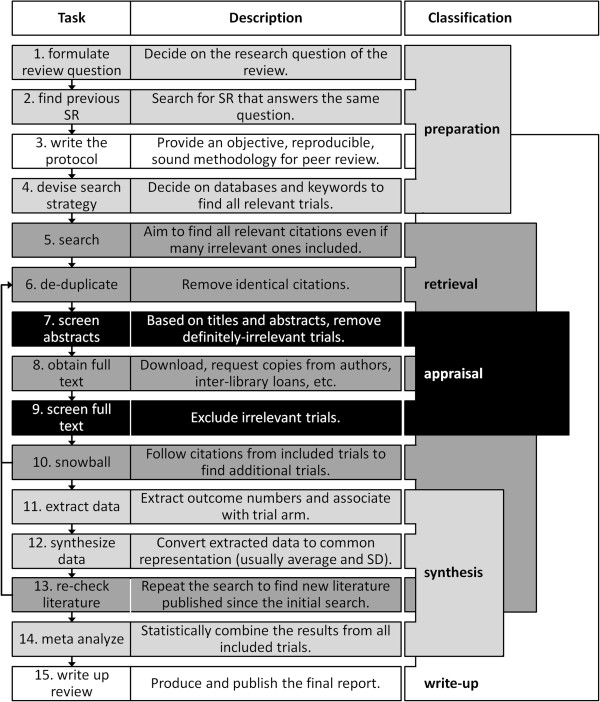
“The Systematic Review Tasks Conducted in the Study The manual team conducted the SR tasks required to complete a draft of the background, methods, and results sections of the SR; in total, this comprised 16 SR tasks (Table 3 [8,9,12,20,21]) [22].”
MethodTangible Technologies for Childhood Education: A Systematic Review
González, C. S. G., Franco, M. D. G., & Moro, A. I. (2019) · Sustainability · doi:10.3390/su11102910 · Cited by 77
Affengruber, L., van der Maten, M. M., Spiero, I., Nussbaumer-Streit, B., Mahmić-Kaknjo, M., Ellen, M. E., Goossen, K., Kantorova, L., Hooft, L., Riva, N., et al. (2024) · BMC Medical Research Methodology · doi:10.1186/s12874-024-02320-4 · Cited by 52
“We were interested in studies assessing their use within one or more of the fifteen steps of the SR process as defined by Tsafnat et al. (2014), further supplemented by the steps “critical appraisal,” “grading the certainty of evidence,” and “administration/project management” [24] [14] (Fig.”
MethodDevelopment of a Search Strategy for an Evidence Based Retrieval Service
Ho, G. J., Liew, S. M., Ng, C. J., Hisham Shunmugam, R., & Glasziou, P. (2016) · PLOS ONE · doi:10.1371/journal.pone.0167170 · Cited by 53
Self-citationAutomatic extraction of quantitative data from ClinicalTrials.gov to conduct meta-analyses
Pradhan, R., Hoaglin, D. C., Cornell, M., Liu, W., Wang, V., & Yu, H. (2019) · Journal of Clinical Epidemiology · doi:10.1016/j.jclinepi.2018.08.023 · Cited by 51
“(2,8) Most of these algorithms, however, extract only baseline data elements such as the demographic characteristics of the patients, the clinical indication, the nature of the interventions, the study design, and the names of the outcomes studied.”
BackgroundRuiz‐González, C., Román, P., Rueda‐Ruzafa, L., Rodríguez-Arrastia, M. J., & Cardona, D. (2020) · Progress in Neuro-Psychopharmacology and Biological Psychiatry · doi:10.1016/j.pnpbp.2020.110189 · Cited by 55
Bashir, R., Bourgeois, F. T., & Dunn, A. G. (2017) · Systematic Reviews · doi:10.1186/s13643-017-0518-3 · Cited by 47
“Systematic review technologies for automating or supporting reviewers rarely consider information from clinical trial registries to improve the searching or screening processes [66] or the prioritisation or scheduling of systematic review updates.”
BackgroundSelf-citationImproving Systematic Literature Review with Automation and Bibliometrics
Pulsiri, N., & Vatananan-Thesenvitz, R. (2018) · Portland International Conference on Management of Engineering and Technology (PICMET) · doi:10.23919/picmet.2018.8481746 · Cited by 72
“Other semi-automation tools such as SESRA or SLuRp are also useful in this stage to help communication among reviewers to finalize the document evaluation and preparation and to suggest the published journals [17,20].”
BackgroundInfluentialCoiera, E., & Liu, S. (2022) · Cell Reports Medicine · doi:10.1016/j.xcrm.2022.100860 · Cited by 48
“51 The promise of digital Write up Produce and publish report Write up RevMan, Replicant 35 The different tasks in a traditional systematic review can be supported by a variety of distinct automation tools that either support humans to complete the task or can complete the task automatically (modified from Tsafnat et a…”
BackgroundSelf-citationSystematic reviews and meta-analysis
Askie, L. M., & Offringa, M. (2015) · Seminars in Fetal and Neonatal Medicine · doi:10.1016/j.siny.2015.10.002 · Cited by 59
Hagan, J. B., Laidlaw, T. M., Divekar, R. D., O’Brien, E. K., Kita, H., Volcheck, G. W., Hagan, C. R., Lal, D., Teaford, H. G., Erwin, P. J., et al. (2017) · The Journal of Allergy and Clinical Immunology In Practice · doi:10.1016/j.jaip.2016.11.004 · Cited by 50
Russell-Rose, T., & Chamberlain, J. (2017) · JMIR Medical Informatics · doi:10.2196/medinform.7680 · Cited by 49
“It involves a lengthy content production process whose output relies heavily on the quality of the initial search strategy, particularly in ensuring that the scope is sufficiently exhaustive and that the review is not biased by easily accessible studies [9].”
BackgroundCramond, F., O’Mara-Eves, A., Doran-Constant, L., Rice, A. S. C., Macleod, M. R., & Thomas, J. (2018) · Wellcome Open Research · doi:10.12688/wellcomeopenres.14738.1 · Cited by 49
Tóth, B., Berek, L., Gulácsi, L., Péntek, M., & Zrubka, Z. (2024) · Systematic Reviews · doi:10.1186/s13643-024-02592-3 · Cited by 48
“The feasibility of automation differs by stages of the SR workflow [21, 22], with search, record screening, full-text selection, data extraction, risk of bias assessment, evidence synthesis, and reporting being the most prominent examples [16, 21].”
MethodUsing machine learning to disentangle homonyms in large text corpora
Roll, U., Correia, R. A., & Berger‐Tal, O. (2018) · Conservation Biology · doi:10.1111/cobi.13044 · Cited by 46
“Use of text mining is becoming more common as a tool to aid systematic reviews (Thomas et al. 2011; Tsafnat et al. 2014; O’Mara-Eves et al. 2015) and will be of even greater importance in coming years as databases become more structured (Lefebvre et al. 2013).”
Method
Metadata
- Authors
- Tsafnat, G., Glasziou, P., Choong, M. K., Dunn, A., Galgani, F., & Coiera, E.
- Affiliations
- UNSW Sydney (AU)
- Bond University (AU)
- Corresponding author
- Tsafnat, Guy
- Venue
- Systematic Reviews
- Published
- 2014-07-09
- Volume
- 3
- Issue
- 1
- Pages
- 74-74
- ISSN
- 2046-4053 (ISSN-L)
- PMC
- PMC4100748
- OpenAlex
- W2095601341
- Cited by
- 472
- References
- 137
- Citations by year
- 2026: 41 · 2025: 42 · 2024: 56 · 2023: 44 · 2022: 44 · 2021: 68 · 2020: 46 · 2019: 36 · 2018: 32 · 2017: 24 · 2016: 16 · 2015: 18 · 2014: 5
- FWCI
- 5.75
- Type
- journal article
- Language
- en
- Open access
- gold
- doi.org
- Licence
- Locations
- Systematic Reviews (publishedVersion, cc-by)
- PubMed Central (publishedVersion, cc-by)
- Bond University Research Portal (Bond University) (publishedVersion, cc-by)
- PubMed (publishedVersion)
- e-publications@bond (Bond University) (submittedVersion)
- Topics
- Social Sciences › Decision Sciences › Statistics, Probability and Uncertainty › Meta-analysis and systematic reviews
- Physical Sciences › Computer Science › Information Systems › Software Engineering Techniques and Practices
- Health Sciences › Medicine › Public Health, Environmental and Occupational Health › Clinical practice guidelines implementation
- Keywords
- systematic review automation, information systems, randomized controlled trials, evidence-based medicine, risk of bias assessment, data extraction, meta-analysis, system integration
- MeSH terms
- Electronic Data Processing, Review Literature as Topic, Information Storage and Retrieval
About these checks
Registry, retraction, Cites and statistics results are computed, not judged, with one exception: a printed reference that no index lists is read once by a model before it counts as a citation error. Claims are extracted by a model and kept only when their quote appears verbatim in the text; each cited source is then checked, with a model’s help, for whether it says what the claim relies on. Those verdicts can be wrong — read the claim’s quote and the cited source before relying on one.
Statistics and arithmetic are recomputed, not judged.
Confidence bands are shown only for fields calibrated on our annotated test set. None is calibrated yet, so no band is shown.
What counts as a claim ›How we measure confidence ›How we check this ›
Are you an author, or do you see a problem with this page? Request a review
Data sources
Bibliographic data: Semantic Scholar, OpenAlex, Crossref.
Contains information from the Semantic Scholar Academic Graph Datasets, made available under the ODC Attribution License (ODC-BY 1.0).
Semantic Scholar’s data is described in: Kinney, R., et al. (2023). The Semantic Scholar Open Data Platform. arXiv:2301.10140.
