

The DOI matches its Crossref record; 40 of the 40 references it cites were found in a registry or an index.
Meta-analyses on prevalence of selected Parkinson's nonmotor symptoms before and after diagnosis
Open accessAbstract
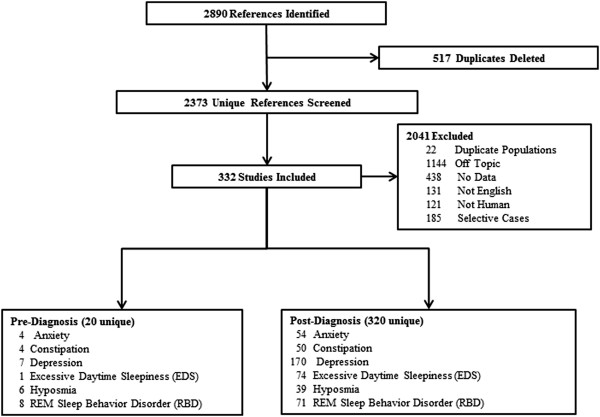
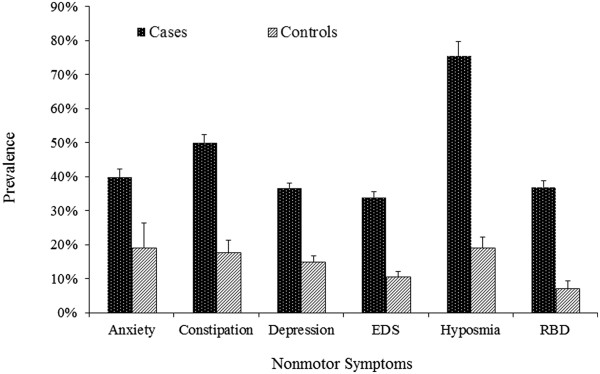
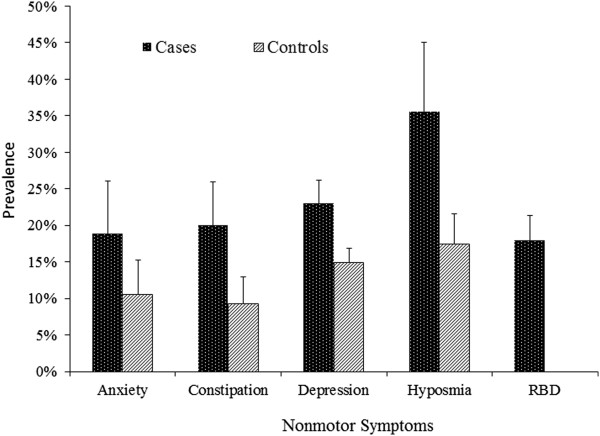
BACKGROUND: Nonmotor symptoms are common among patients with Parkinson's disease (PD) and some may precede disease diagnosis. METHODS: We conducted a meta-analysis on the prevalence of selected nonmotor symptoms before and after PD diagnosis, using random-effect models. We searched PubMed (1965 through October/November 2012) for the following symptoms: hyposmia, constipation, rapid eye movement sleep behavior disorder, excessive daytime sleepiness, depression, and anxiety. Eligible studies were publications in English with original data on one or more of these symptoms. RESULTS: The search generated 2,373 non-duplicated publications and 332 met the inclusion criteria, mostly (n = 320) on symptoms after PD diagnosis. For all symptoms, the prevalence was substantially higher in PD cases than in controls, each affecting over a third of the patients. Hyposmia was the most prevalent (75.5% in cases vs. 19.1% in controls), followed by constipation (50% vs. 17.7%), anxiety (39.9% vs. 19.1%), rapid eye movement sleep behavior disorder (37.0% vs. 7.0%), depression (36.6% vs. 14.9%), and excessive daytime sleepiness (33.9% vs. 10.5%). We observed substantial heterogeneities across studies and meta-regression analyses suggested that several factors might have contributed to this. However, the prevalence estimates were fairly robust in several sensitivity analyses. Only 20 studies had data on any symptoms prior to PD diagnosis, but still the analyses revealed higher prevalence in future PD cases than in controls. CONCLUSION: These symptoms are common among PD patients both before and after diagnosis. Further studies are needed to understand the natural history of nonmotor symptoms in PD and their etiological and clinical implications.
Overview
The claims and statistics of this paper haven’t been checked yet.
Run the check — free, no account needed. It reads the open-access text and checks the sources it cites.
Integrity signals
Registry
Cites
Statistics
Figures
Verification
Claims the paper makes
The claims and statistics of this paper haven’t been checked yet.
Run the check — free, no account needed. It reads the open-access text and checks the sources it cites.
Claims other papers make about this one
Each is checked against this paper’s own text: does it say what the citing paper says it does?
In the citing paper
“Some of these symptoms may precede the classical motor symptoms by several years (Abbott et al., 2001;Chen et al., 2015;Gao et al., 2011)”
From The Gut-Brain Axis in Parkinson’s Disease: Possibilities for Food-Based Therapies (2017) · cites this paper as Chen et al., 2015
Self-check
Percentages, sums and reported differences re-computed from the paper’s own numbers.
The self-check needs the paper’s full text.
Citations
Cites
Bias in meta-analysis detected by a simple, graphical test
Egger, M., Smith, G. D., Schneider, M., & Minder, C. (1997) · BMJ · doi:10.1136/bmj.315.7109.629 · Cited by 56,722
Quantifying heterogeneity in a meta‐analysis
Higgins, J. P. T., & Thompson, S. G. (2002) · Statistics in Medicine · doi:10.1002/sim.1186 · Cited by 36,763
(2000) · Cited by 9,198
Barone, P., Antonini, A., Colosimo, C., Marconi, R., Morgante, L., Avarello, T. P., Bottacchi, E., Cannas, A., Ceravolo, G., Ceravolo, R., et al. (2009) · Movement Disorders · doi:10.1002/mds.22643 · Cited by 1,445
Prevalence of olfactory impairment in older adults.
Murphy, C. (2002) · JAMA · doi:10.1001/jama.288.18.2307 · Cited by 953
Suares, N. C., & Ford, A. C. (2011) · The American Journal of Gastroenterology · doi:10.1038/ajg.2011.164 · Cited by 919
Meta‐analysis of early nonmotor features and risk factors for Parkinson disease
Noyce, A. J., Bestwick, J. P., Silveira‐Moriyama, L., Hawkes, C. H., Giovannoni, G., Lees, A. J., & Schrag, A. E. (2012) · Annals of Neurology · doi:10.1002/ana.23687 · Cited by 834
Quantifying the risk of neurodegenerative disease in idiopathic REM sleep behavior disorder
Postuma, R. B., Gagnon, J., Vendette, M., Fantini, M. L., Massicotte-Marquez, J., & Montplaisir, J. Y. (2008) · Neurology · doi:10.1212/01.wnl.0000340980.19702.6e · Cited by 779
Association of olfactory dysfunction with risk for future Parkinson's disease
Ross, G. W., Petrovitch, H., Abbott, R. D., Tanner, C. M., Popper, J. S., Masaki, K., Launer, L. J., & White, L. R. (2007) · Annals of Neurology · doi:10.1002/ana.21291 · Cited by 739
Development of the 12‐Item Cross‐Cultural Smell Identification Test(CC‐SIT)
Doty, R. L., Marcus, A., & Lee, W. W. (1996) · The Laryngoscope · doi:10.1097/00005537-199603000-00021 · Cited by 734
Cited by
Sorted by citations
Items 101–200 of 213
Nonmotor symptoms and Parkinson disease in United States farmers and spouses
Shrestha, S., Kamel, F., Umbach, D. M., Freeman, L. E. B., Koutros, S., Alavanja, M. C. R., Sandler, D. P., & Chen, H. (2017) · PLoS ONE · doi:10.1371/journal.pone.0185510 · Cited by 20
Self-citationPaul, D., Allakonda, L., Sahu, A. K., Surendran, S., & Satheeshkumar, N. (2017) · Journal of Pharmaceutical and Biomedical Analysis · doi:10.1016/j.jpba.2017.11.008 · Cited by 20
Exosome: an overview on enhanced biogenesis by small molecules
Bavafa, A., Izadpanahi, M., Hosseini, E., Hajinejad, M., Abedi, M., Forouzanfar, F., & Negah, S. S. (2025) · Naunyn-Schmiedeberg s Archives of Pharmacology · doi:10.1007/s00210-024-03762-9 · Cited by 20
Hill, A. E., Wade‐Martins, R., & Burnet, P. W. J. (2021) · Frontiers in Neuroscience · doi:10.3389/fnins.2021.708587 · Cited by 19
What substance P might tell us about the prognosis and mechanism of Parkinson's disease?
Tirassa, P., Schirinzi, T., Raspa, M., Ralli, M., Greco, A., Polimeni, A., Possenti, R., Mercuri, N. B., & Severini, C. (2021) · Neuroscience & Biobehavioral Reviews · doi:10.1016/j.neubiorev.2021.10.008 · Cited by 20
When the microbiome helps the brain‐current evidence
Drljača, J., Milosevic, N. P., Milanović, M., Abenavoli, L., & Milić, N. (2023) · CNS Neuroscience & Therapeutics · doi:10.1111/cns.14076 · Cited by 19
Rosch, J. G., Brown, A. L., DuRoss, A. N., DuRoss, E. L., Sahay, G., & Sun, C. (2018) · Nanoscale Research Letters · doi:10.1186/s11671-018-2748-2 · Cited by 18
Fernández, M., Shamsabadi, A., & Chudasama, V. (2019) · Chemical Communications · doi:10.1039/c9cc08744c · Cited by 18
Daalen, J. M. J., Tosserams, A., Mahlknecht, P., Seppi, K., Bloem, B. R., & Darweesh, S. K. L. (2021) · Parkinsonism & Related Disorders · doi:10.1016/j.parkreldis.2021.01.005 · Cited by 18
Stolle, A.-S., Norkowski, S., Körner, B., Schmitz, J., Lüken, L., Frankenberg, M., Rüter, C., & Schmidt, M. A. (2017) · Frontiers in Cellular and Infection Microbiology · doi:10.3389/fcimb.2017.00119 · Cited by 18
Liu, Y.-S., Wang, Y.-M., & Zha, D.-J. (2021) · Frontiers in Psychiatry · doi:10.3389/fpsyt.2021.772068 · Cited by 17
Convergence of longevity and immunity: lessons from animal models
Xia, J., Gravato-Nobre, M. J., & Ligoxygakis, P. (2019) · Biogerontology · doi:10.1007/s10522-019-09801-w · Cited by 17
Neurological update: non-motor symptoms in atypical parkinsonian syndromes
Ananthavarathan, P., Patel, B., Peeros, S., Obrocki, R., & Malek, N. (2023) · Journal of Neurology · doi:10.1007/s00415-023-11807-x · Cited by 16
Messak, M., Abdelmageed, A., Senbel, A. A., Khattab, Y. A., Mandour, Y., Shaker, O., Rehan, A. H., Oransa, S., Nasr, M., Shabeeb, A. E., et al. (2025) · Naunyn-Schmiedeberg s Archives of Pharmacology · doi:10.1007/s00210-025-03932-3 · Cited by 16
Parkin: A targetable linchpin in human malignancies
Perwez, A., Wahabi, K., & Rizvi, M. M. A. (2021) · Biochimica et Biophysica Acta (BBA) - Reviews on Cancer · doi:10.1016/j.bbcan.2021.188533 · Cited by 16
Stathis, P. G., & Papadopoulos, G. (2022) · Journal of Patient-Reported Outcomes · doi:10.1186/s41687-022-00427-0 · Cited by 16
Post-Translational Modifications During Brain Development
Smith, B. J., & Carregari, V. C. (2022) · Advances in experimental medicine and biology · doi:10.1007/978-3-031-05460-0_3 · Cited by 15
Regulation of Pain Perception by Microbiota in Parkinson Disease
Manjarres, Z., Calvo, M., & Pacheco, R. (2023) · Pharmacological Reviews · doi:10.1124/pharmrev.122.000674 · Cited by 15
Chen, L., Ling, Y., Sun, J., Zhou, S., Xiao, Y., Zou, X., Yang, X., & Zhang, Y. (2025) · Journal of Ethnopharmacology · doi:10.1016/j.jep.2025.119446 · Cited by 15
Sánchez, K. E., & Maguire‐Zeiss, K. A. (2020) · Frontiers in Neuroscience · doi:10.3389/fnins.2020.585544 · Cited by 14
Bispo, J. M. M., Melo, J. E. C., de Gois, A. M., Medeiros, K. A. A. L., Silva, R. S., Leal, P. C., Franco, H. S., Souza, M. F., Lins, L. C. R. F., Ribeiro, A. M., et al. (2022) · Brain Research Bulletin · doi:10.1016/j.brainresbull.2022.06.018 · Cited by 14
Yao, L., Yang, Y., Yang, X., & Rezaei, M. J. (2024) · Molecular Neurobiology · doi:10.1007/s12035-024-04151-2 · Cited by 15
Sun, B., Wang, T., Li, N.-Y., Wu, Q., & Qiao, J. (2021) · World Journal of Gastrointestinal Pharmacology and Therapeutics · doi:10.4292/wjgpt.v12.i1.21 · Cited by 13
Almasi, F., Abbasloo, F., Soltani, N., Dehbozorgi, M., Fard, A. M., Kiani, A., Ghasemzadeh, N., Mesgari, H., Hosseingholi, E. Z., Payandeh, Z., et al. (2025) · Molecular Neurobiology · doi:10.1007/s12035-025-04788-7 · Cited by 12
Iroquois Homeobox Protein 2 Identified as a Potential Biomarker for Parkinson’s Disease
Sim, H., Lee, J., Yoo, H. M., Cho, S., Lee, H., Baek, A., Kim, J., Seo, H., Kweon, M., Kim, H., et al. (2020) · International Journal of Molecular Sciences · doi:10.3390/ijms21103455 · Cited by 12
Parkinson’s Disease Classification Using Random Forest Kerb Feature Selection
Bharath, E., & Rajagopalana, T. (2023) · Intelligent Automation & Soft Computing · doi:10.32604/iasc.2023.032102 · Cited by 11
Duda, K., Chmiela, T., Cieśla-Fuławka, A., Gawryluk, J., & Siuda, J. S. (2024) · Neurologia i Neurochirurgia Polska · doi:10.5603/pjnns.99624 · Cited by 11
Exceeding the Limits with Nutraceuticals: Looking Towards Parkinson’s Disease and Frailty
Montanari, M., Mercuri, N. B., & Martella, G. (2024) · International Journal of Molecular Sciences · doi:10.3390/ijms26010122 · Cited by 12
Lin, J., Lu, C., & Tsai, C. (2017) · Journal of Neurology · doi:10.1007/s00415-017-8723-5 · Cited by 11
Role of rodent models in advancing precision medicine for Parkinson's disease
Simons, E., & Fleming, S. M. (2023) · Handbook of clinical neurology · doi:10.1016/b978-0-323-85555-6.00002-3 · Cited by 10
Tucker, R. M., Ryan, S., Hayee, B., Bjarnason, I., Augustin, A. D., Umamahesan, C., Taylor, D. M., Weller, C., Dobbs, S. M., Dobbs, R. J., et al. (2020) · Journal of Clinical Medicine · doi:10.3390/jcm9061916 · Cited by 10
Cárdenas‐Tueme, M., Montalvo-Martínez, L., Maldonado‐Ruiz, R., Camacho‐Morales, A., & Reséndez‐Pérez, D. (2020) · Frontiers in Neuroscience · doi:10.3389/fnins.2020.00013 · Cited by 10
Investigation of non-motor symptoms in first-degree relatives of patients with Parkinson's disease
Liu, J.-B., Leng, J., Zhang, X., Wang, Z.-X., Duan, Z., Mao, C., & Liu, C. (2018) · Parkinsonism & Related Disorders · doi:10.1016/j.parkreldis.2018.03.021 · Cited by 11
Suzzi, S., Ahrendt, R., Hans, S., Semenova, S. A., Chekuru, A., Wirsching, P., Kroehne, V., Bilican, S., Sayed, S., Winkler, S., et al. (2021) · PLoS Genetics · doi:10.1371/journal.pgen.1009794 · Cited by 9
Iron mishandling in the brain and periphery in Parkinson’s disease
Bolen, M. L., Menees, K. B., Dupreez, A. C., & Tansey, M. G. (2025) · npj Parkinson s Disease · doi:10.1038/s41531-025-01089-7 · Cited by 8
Pilipovich, A. A., Ov, V., Makarov, S. A., Shindryaeva, N. N., & Vorob’eva, Y. D. (2022) · Parkinson s Disease · doi:10.1155/2022/1571801 · Cited by 8
de Oliveira, M. P. B., de Castro, A. E. F., Miri, A. L., Lima, C. R., Truax, B. D., Probst, V. S., & Smaili, S. M. (2023) · BMC Neurology · doi:10.1186/s12883-023-03176-9 · Cited by 8
Correlation of Nutritional Status to Sleep Problems in School Going Children: A Preliminary Study
Anusha, Y., Shetty, V., & Hegde, A. M. (2018) · Indian Journal of Sleep Medicine · doi:10.5005/jp-journals-10069-0015 · Cited by 8
Goltermann, J., Repple, J., Redlich, R., Dohm, K., Flint, C., Grotegerd, D., Waltemate, L., Lemke, H., Fingas, S. M., Meinert, S., et al. (2021) · European Neuropsychopharmacology · doi:10.1016/j.euroneuro.2021.02.006 · Cited by 8
Microtubule-Stabilizing Agents for Alzheimer’s and Other Tauopathies
Ballatore, C., Smith, A. B., Lee, V. M. ‐., Trojanowski, J. Q., & Brunden, K. R. (2016) · Topics in medicinal chemistry · doi:10.1007/7355_2016_15 · Cited by 7
Tang, H., Liao, X., Yao, J., Xing, Y., Zhao, X., Cheng, W., Gu, T., Huang, Y., Xu, G., Luan, P., et al. (2024) · Brain and Behavior · doi:10.1002/brb3.3440 · Cited by 7
Cintra, R. R., Lins, L. C. R. F., Medeiros, K. A. A. L., Souza, M. F., de Gois, A. M., Bispo, J. M. M., Seabra, M. S. D. M., Leal, P. C., Meurer, Y. D. S. R., Ribeiro, A. M., et al. (2021) · Brain Research Bulletin · doi:10.1016/j.brainresbull.2021.03.001 · Cited by 8
de Azevedo, M. A. R., Lisboa, L. L., de Medeiros, C. E. B., de Almeida, V. A., & Gonçalves, R. P. (2021) · Revista Pesquisa em Fisioterapia · doi:10.17267/2238-2704rpf.v11i1.3313 · Cited by 6
Cao, Z., Song, S., Huang, X., Li, C., Luo, Z., D’Aloisio, A. A., Suárez, L., Hernandez, D. G., Singleton, A., Sandler, D. P., et al. (2023) · Journal of Parkinson s Disease · doi:10.3233/jpd-230053 · Cited by 6
Self-citationChai, Z., Ouyang, Y., Debebe, A., Picker, M., Lee, W., Fenton, S., Becker, A., Augustin-Emmerichs, K., Schwiertz, A., Weber, S. N., et al. (2025) · Journal of Parkinson s Disease · doi:10.1177/1877718x251328567 · Cited by 6
Koutsouras, G. W., LeVine, K., Duroseau, N. H., Ciraco, C., Chan, V., Pergament, K. M., Chan, T., Mancini, J., Leder, A. N., & Krishnamachari, B. (2018) · Chronic Illness · doi:10.1177/1742395318796166 · Cited by 6
Zheng, L. J., Su, Y. Y., Wang, Y. F., Zhong, J., Liang, X., Zheng, G., Lu, G., & Zhang, L. J. (2017) · European Journal of Radiology · doi:10.1016/j.ejrad.2017.07.006 · Cited by 6
Non-motor symptoms of Parkinson's disease
El‐Mansoury, B., Khiat, A. E., Skaou, A., Hiba, O. E., Jayakumar, A. R., Hamdan, Y. A., Bitar, A., & Ferssiwi, A. (2024) · Elsevier eBooks · doi:10.1016/b978-0-443-15702-8.00017-8 · Cited by 5
Yun, Q., Wang, S., Li, B., Yang, Z., Wei, C., Yuan, J., Hu, J., Li, Y., Yang, Z., Sha, F., et al. (2025) · Age and Ageing · doi:10.1093/ageing/afaf257 · Cited by 4
Marine Bioactive Components and Chronic Neuroinflammation: Focus on Neurodegenerative Disease
Favari, E., & Parolini, C. (2025) · Marine Drugs · doi:10.3390/md23110446 · Cited by 4
Anti-inflammatory Potential of Lead Compounds and Their Derivatives from Medicinal Plants
Nirmala, N. S., Navina, B., Vivekanandan, V., & Thirugnanasambantham, K. (2023) · Springer eBooks · doi:10.1007/978-3-031-28780-0_50 · Cited by 4
Michael, P., Juhasz, S. B. C., Evagorou, O., Psalta, L., & Mikellides, G. (2022) · Heliyon · doi:10.1016/j.heliyon.2022.e12196 · Cited by 4
Health conditions linked to heightened risk of Alzheimer's disease
Kivimäki, M., & Livingston, G. (2022) · The Lancet Digital Health · doi:10.1016/s2589-7500(21)00293-4 · Cited by 4
The many genomes of Parkinson's disease
Payami, H. (2022) · International review of neurobiology · doi:10.1016/bs.irn.2022.07.007 · Cited by 5
Aquino, Y. C., Pedrão, L. F. A. T., Moreira, T. S., Falquetto, B., & Takakura, A. C. T. (2025) · Brain Research · doi:10.1016/j.brainres.2025.149829 · Cited by 3
Paudel, P., & Sah, A. (2025) · Clinical Parkinsonism & Related Disorders · doi:10.1016/j.prdoa.2025.100374 · Cited by 3
Chien, C.-Y., Tan, C., Hong, W., Chen, K. C., & Yu, R. (2025) · Journal of Psychiatric Research · doi:10.1016/j.jpsychires.2025.10.069 · Cited by 3
Antibiotic Exposure and Risk of Parkinson Disease in South Korea
Kim, M., Park, S. J., Park, Y. J., Choi, J., Song, J., Kim, H. J., Chang, J., Park, S., Kim, J.-W., Lee, H., et al. (2024) · Neurology Clinical Practice · doi:10.1212/cpj.0000000000200400 · Cited by 3
Jones, J., Alexander, L., Hancock, E., & Cooper, K. (2025) · Journal of Parkinson s Disease · doi:10.1177/1877718x251324415 · Cited by 2
Association between anxiety disorder, anxiolytic drugs, and risk of incident Parkinson’s disease
Hao, X., Wang, Z., Feng, Y., Li, M., Hao, C., Liang, Y., Zuo, C., Yang, X., Ma, D., Wang, Y., et al. (2025) · npj Parkinson s Disease · doi:10.1038/s41531-025-01104-x · Cited by 2
Parrella, E., Gennari, M. M., Abate, G., Pucci, M., Schioppa, T., Bosisio, D., Tirelli, E., Benarese, M., Vegezzi, G., Silletti, M., et al. (2025) · Neurobiology of Disease · doi:10.1016/j.nbd.2025.107182 · Cited by 2
Merchak, A. R., Herrick, M. K., Houser, M. C., Keating, C. E., Chang, J., & Tansey, M. G. (2026) · Frontiers in Cellular Neuroscience · doi:10.3389/fncel.2026.1794784 · Cited by 2
Clinical and Pre-Clinical Evidence for Enteric α-Synuclein Involvement in Parkinson's Disease
Kochman, E. M., Akhtar, K., Ali, A., & Shin Damian, S. (2021) · International Journal of Neurodegenerative Disorders · doi:10.23937/2643-4539/1710019 · Cited by 2
Song, S., Luo, Z., Plassman, B. L., Huang, X., Yuan, Y., Shrestha, S., Parks, C. G., Hofmann, J. N., Freeman, L. E. B., Sandler, D. P., et al. (2025) · Movement Disorders · doi:10.1002/mds.30149 · Cited by 2
Self-citationNon-Motor Symptoms and their associated factors in Parkinson’s Disease
Qayyum, W., Khan, S. H., Iqbal, M. S., Khan, M. F., Yousafzai, Z. A., & Jan, F. (2021) · Journal of Islamabad Medical & Dental College · doi:10.35787/jimdc.v10i4.669 · Cited by 2
Suzzi, S., Ahrendt, R., Hans, S., Semenova, S. A., Bilican, S., Sayed, S., Winkler, S., Spieß, S., Kaslin, J., Panula, P., et al. (2017) · bioRxiv (Cold Spring Harbor Laboratory) · doi:10.1101/140608 · Cited by 2
Sleep Disorders in Parkinson\'s Disease
Elavarsi, A., & Shukla, G. (2017) · Indian Journal of Sleep Medicine · doi:10.5005/jp-journals-10069-0009 · Cited by 1
Evaluation of Temporomandibular Joint in Patients with Parkinson’s Disease: A Comparative Study
AKBULUT, A. S., & Karpuzoglu, A. H. A. (2023) · Diagnostics · doi:10.3390/diagnostics13152482 · Cited by 1
Mercado, J., Escobar-Grisales, D., Ríos-Urrego, C. D., García, A. M., Bocanegra, Y., Moreno, L., Nöth, E., & Orozco‐Arroyave, J. R. (2025) · Lecture notes in computer science · doi:10.1007/978-3-032-02551-7_25 · Cited by 1
Bracone, F., Gialluisi, A., Costanzo, S., Bonaccio, M., Panzera, T., Orlandi, S., Persichillo, M., Curtis, A. D., Bartolo, M. I. D., Belvisi, D., et al. (2026) · Journal of Neurology · doi:10.1007/s00415-026-13710-7 · Cited by 1
Yao, W., Liu, L., Wang, J., Chen, S., Zhang, C., Liao, R., Wang, Y., Ou, K., Jiang, L., Yu, Y., et al. (2026) · Cellular and Molecular Neurobiology · doi:10.1007/s10571-026-01738-2 · Cited by 1
Sobrino-Galindo, A. L., & Arce-Huamani, M. A. (2026) · Medicina · doi:10.3390/medicina62071355 · Cited by 1
The role of the gut microbiota in Parkinson’s disease
Verugina, N. I., Levin, O. S., & Lyashenko, E. A. (2021) · S S Korsakov Journal of Neurology and Psychiatry · doi:10.17116/jnevro202112110286 · Cited by 1
Prediction of Conversion to Alzheimer’s Disease Using 3D-DWT and PCA
Yew, A. Y. L., Rahim, M. S. M., & Tan, C. W. (2022) · Lecture notes of the Institute for Computer Sciences, Social Informatics and Telecommunications Engineering · doi:10.1007/978-3-030-99197-5_16 · Cited by 1
Neurology and the gut: Autonomic neuropathy and dysautonomia
Ghafoor, A., Sundar, S., Karunaratne, T. B., Rao, S. S. C., & Sharma, A. (2023) · Elsevier eBooks · doi:10.1016/b978-0-443-13911-6.00028-1 · Cited by 1
Management of Neurogenic Bowel Dysfunction
Emmanuel, A. V. (2018) · Cambridge University Press eBooks · doi:10.1017/9781316882290.019 · Cited by 1
Rajeev, A., & Chattopadhyay, I. (2024) · Springer eBooks · doi:10.1007/978-981-99-8803-7_13 · Cited by 1
Chua, W. Y., Chan, C. K. M., Wang, J. D. J., Chan, L. L., & Tan, E.-K. (2025) · Canadian Journal of Neurological Sciences / Journal Canadien des Sciences Neurologiques · doi:10.1017/cjn.2024.362 · Cited by 1
Stem Cell-Based Therapies for Parkinson’s Disease
Palmer, C., & Liste, I. (2017) · Stem cells in clinical applications · doi:10.1007/978-3-319-33720-3_5 · Cited by 1
Ovallath, S., & Sulthana, B. (2018) · Annals of Movement Disorders · doi:10.4103/aomd.aomd_4_18 · Cited by 1
Jeancolas, L. (2019) · theses.fr (ABES) · doi:10.70675/a50c1f2fza6e6z4180za991zd7797b7056bd · Cited by 1
Muzerengi, S. (2017) · University of Birmingham Institutional Research Archive (University of Birmingham)
Defining the Role of Alpha-Synuclein in Enteric Dysfunction in Parkinsons Disease
Manfredsson, F. P. (2017)
A Predicted Molecular Model for Development of Human Intelligence
Najafi, H., Hosseini, S. M., Tavallaie, M., & Soltani, B. M. (2018) · Neurochemical Journal · doi:10.1134/s1819712418030091
Murray, E. (2018) · CUNY Academic Works (City University of New York)
Hypersomnolence among Adolescents: Narcolepsy an Often Misdiagnosed Condition
Shukla, G., Hashim, Z., Mangla, L., Gupta, A., Nath, A., & Mishra, R. P. N. (2017) · Indian Journal of Sleep Medicine · doi:10.5005/jp-journals-10069-00010
Role of Interferon-Gamma and Leucine-Rich Repeat Kinase 2 in Stress-Related Pathology
Litteljohn, D. (2016) · Carleton University's Institutional Repository (MacOdrum Library, Carleton University) · doi:10.22215/etd/2016-11660
Personality, stress and risk of Parkinson's disease
Sieurin, J. (2020) · Figshare
Microbiota and Parkinson's disease (overview)
Tyutina, R. R., Pilipovich, A. A., Голубев, В. Л., & Danilov, A. B. (2020) · Medical alphabet · doi:10.33667/2078-5631-2020-1-10-14 · Cited by 1
Linking and comparing non-motor symptoms in aging and Parkinson's disease
Rožanković, P. B. (2020) · Elsevier eBooks · doi:10.1016/b978-0-12-815946-0.00015-6
The Impact of Prodromal Stage Non-Motor Symptoms on Clinical Progression in Parkinson’s Disease
Say, B., Ünal, Y., Aksun, Z. Ö., Yılmaz, R., & Akbostancı, M. C. (2022) · Journal of Ankara University Faculty of Medicine · doi:10.4274/atfm.galenos.2021.56578
TAKAHASHI, J. C., & Morizane, A. (2019) · Faculty Opinions – Post-Publication Peer Review of the Biomedical Literature · doi:10.3410/f.734318078.793555630
Mechanisms of development of constipation in Parkinson’s disease and therapeutic approaches
Катунина, Е. А., Shipilova, N. N., & Katunin, D. A. (2022) · S S Korsakov Journal of Neurology and Psychiatry · doi:10.17116/jnevro202212208121
Mikellides, G. (2023) · Research Publications (Maastricht University) · doi:10.26481/dis.20230911gm
Risk Factors of Non-motor Symptoms in Different Stages of Parkinson’s DiseasePreprint
Jiang, J., Jin, W., Lv, Z., Xu, Z. T., Liang, F., & Li, L. (2023) · Research Square · doi:10.21203/rs.3.rs-3269688/v1
Locus coeruleus injury modulates ventral midbrain neuroinflammation during DSS-induced colitisPreprint
Boles, J. S., Holt, J., Cole, C. L., Neighbarger, N. K., Urs, N. M., Huarte, O. U., & Tansey, M. G. (2024) · bioRxiv (Cold Spring Harbor Laboratory) · doi:10.1101/2024.02.12.580010
Locus coeruleus injury modulates ventral midbrain neuroinflammation during DSS-induced colitisPreprint
Tansey, M. G., Boles, J. S., Holt, J., Cole, C. L., Neighbarger, N. K., Urs, N. M., & Huarte, O. U. (2024) · Research Square · doi:10.21203/rs.3.rs-3952442/v1
Lei, S., Fan, J., Quan, J., Li, Y., Cen, M., Xu, X., Liu, X., Wu, S., Liao, K., Lin, S., et al. (2024) · Research Square · doi:10.21203/rs.3.rs-4171150/v1
Metadata
- Authors
- Chen, H., Zhao, E. J., Zhang, W., Lu, Y., Liu, R., Huang, X., Ciesielski-Jones, A. J., Justice, M. A., Cousins, D. S., & Peddada, S.
- Affiliations
- National Institutes of Health (US)
- Social and Scientific Systems (United States) (US)
- Pennsylvania State University (US)
- National Institute of Environmental Health Sciences (US)
- Corresponding author
- Chen, Honglei
- ORCID
- Venue
- Translational Neurodegeneration
- Published
- 2015-01-08
- Volume
- 4
- Issue
- 1
- Pages
- 1-1
- ISSN
- 2047-9158 (ISSN-L)
- PMC
- PMC4322463
- OpenAlex
- W2126909058
- Cited by
- 212
- References
- 40
- Citations by year
- 2026: 11 · 2025: 22 · 2024: 16 · 2023: 21 · 2022: 20 · 2021: 26 · 2020: 20 · 2019: 16 · 2018: 21 · 2017: 28 · 2016: 7 · 2015: 4
- FWCI
- 14.10
- Type
- journal article
- Language
- en
- Open access
- gold
- doi.org
- Licence
- cc-by
- Locations
- Translational Neurodegeneration (publishedVersion, cc-by)
- Europe PMC (PubMed Central) (publishedVersion, cc-by)
- PubMed Central (publishedVersion, cc-by)
- PubMed (publishedVersion)
- Funders
- National Institutes of Health (1z01es101986-03, Z01-ES101986)
- National Institute of Neurological Disorders and Stroke (U01NS082151)
- National Institute of Environmental Health Sciences
- Topics
- Health Sciences › Medicine › Clinical Neurology › Parkinson's Disease Mechanisms and Treatments
- Health Sciences › Medicine › Psychiatry and Mental health › Dementia and Cognitive Impairment Research
- Health Sciences › Medicine › Clinical Neurology › Deep Brain Stimulation and Movement Disorders
- Keywords
- Parkinson's disease, non-motor symptoms, hyposmia, constipation, REM sleep behavior disorder, excessive daytime sleepiness, depression, anxiety, symptom prevalence, preclinical Parkinson's disease
About these checks
Registry, retraction, Cites and statistics results are computed, not judged, with one exception: a printed reference that no index lists is read once by a model before it counts as a citation error. Claims are extracted by a model and kept only when their quote appears verbatim in the text; each cited source is then checked, with a model’s help, for whether it says what the claim relies on. Those verdicts can be wrong — read the claim’s quote and the cited source before relying on one.
Statistics and arithmetic are recomputed, not judged.
Confidence bands are shown only for fields calibrated on our annotated test set. None is calibrated yet, so no band is shown.
What counts as a claim ›How we measure confidence ›How we check this ›
Are you an author, or do you see a problem with this page? Request a review
