

The DOI matches its Crossref record; 24 of the 25 references it cites were found in a registry or an index.
The nasal cavity microbiota of healthy adults
Open accessAbstract
BACKGROUND: The microbiota of the nares has been widely studied. However, relatively few studies have investigated the microbiota of the nasal cavity posterior to the nares. This distinct environment has the potential to contain a distinct microbiota and play an important role in health. RESULTS: We obtained 35,142 high-quality bacterial 16S rRNA-encoding gene sequence reads from the nasal cavity and oral cavity (the dorsum of the tongue and the buccal mucosa) of 12 healthy adult humans and deposited these data in the Sequence Read Archive (SRA) of the National Center for Biotechnology Information (NCBI) (Bioproject: PRJNA248297). In our initial analysis, we compared the bacterial communities of the nasal cavity and the oral cavity from ten of these subjects. The nasal cavity bacterial communities were dominated by Actinobacteria, Firmicutes, and Proteobacteria and were statistically distinct from those on the tongue and buccal mucosa. For example, the same Staphylococcaceae operational taxonomic unit (OTU) was present in all of the nasal cavity samples, comprising up to 55% of the community, but Staphylococcaceae was comparatively uncommon in the oral cavity. CONCLUSIONS: There are clear differences between nasal cavity microbiota and oral cavity microbiota in healthy adults. This study expands our knowledge of the nasal cavity microbiota and the relationship between the microbiota of the nasal and oral cavities.
Overview
The claims and statistics of this paper haven’t been checked yet.
Run the check — free, no account needed. It reads the open-access text and checks the sources it cites.
Integrity signals
Registry
Cites
Statistics
Figures
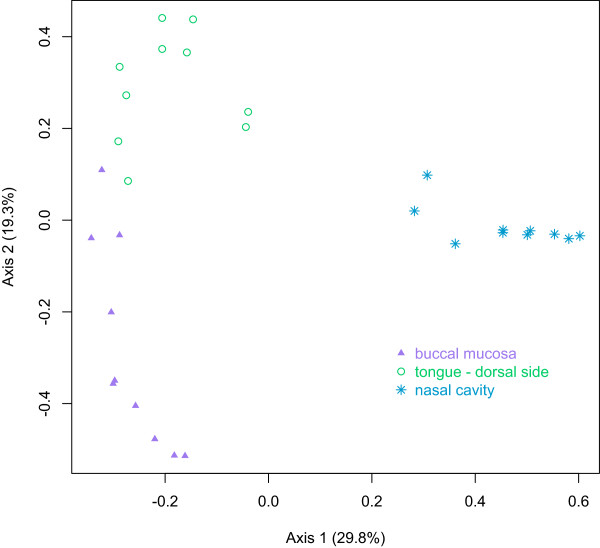
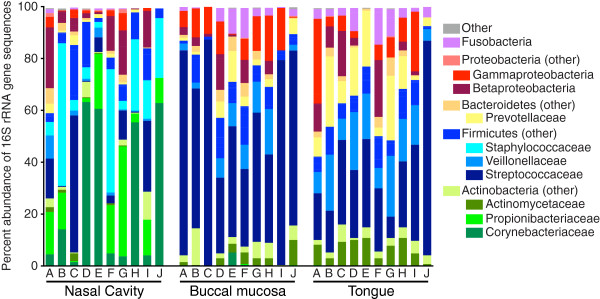
Verification
Claims the paper makes
The claims and statistics of this paper haven’t been checked yet.
Run the check — free, no account needed. It reads the open-access text and checks the sources it cites.
Claims other papers make about this one
Each is checked against this paper’s own text: does it say what the citing paper says it does?
In the citing paper
“In healthy adults, bacteria present in the nasal cavity are typically those associated with skin, predominantly members of the Actinobacteria (e.g., Corynebacterium spp., Propionibacterium spp.), followed by Firmicutes (e.g., Staphylococcus spp.), and Proteobacteria”
From Respiratory viral infection-induced microbiome alterations and secondary bacterial pneumonia. (2018) · cites this paper as [69]
Self-check
Percentages, sums and reported differences re-computed from the paper’s own numbers.
The self-check needs the paper’s full text.
Citations
Cites
The SILVA ribosomal RNA gene database project: improved data processing and web-based tools
Quast, C., Pruesse, E., Yilmaz, P., Gerken, J., Schweer, T., Yarza, P., Peplies, J., & Glöckner, F. O. (2012) · Nucleic Acids Research · doi:10.1093/nar/gks1219 · Cited by 33,055 · cited 1×
“The sequences were aligned to the Silva reference alignment [17,18].”
MethodSchloss, P. D., Westcott, S. L., Ryabin, T., Hall, J. R., Hartmann, M., Hollister, E. B., Lesniewski, R. A., Oakley, B. B., Parks, D. H., Robinson, C. J., et al. (2009) · Applied and Environmental Microbiology · doi:10.1128/aem.01541-09 · Cited by 19,549 · cited 1×
“0 according to the Schloss SOP of November 27, 2012 [15,16].”
MethodUCHIME improves sensitivity and speed of chimera detection
Edgar, R. C., Haas, B. J., Clemente, J. C., Quince, C., & Knight, R. (2011) · Bioinformatics · doi:10.1093/bioinformatics/btr381 · Cited by 15,114
A new method for non-parametric multivariate analysis of variance
Anderson, M. J. (2001) · Austral Ecology · doi:10.1111/j.1442-9993.2001.01070.pp.x · Cited by 13,828 · cited 4×
“Principle coordinates analysis (PCoA) was used to visualize the θ distance matrix, and analysis of molecular variance (AMOVA) [22] was used to test the statistical significance of the differences between bacterial communities of different groups (i.e., nasal cavity communities versus buccal mucosa communities).”
MethodInfluentialStructure, function and diversity of the healthy human microbiome
The Human Microbiome Project Consortium (2012) · Nature · doi:10.1038/nature11234 · Cited by 11,726
Bacterial Community Variation in Human Body Habitats Across Space and Time
Costello, E. K., Lauber, C. L., Hamady, M., Fierer, N., Gordon, J. I., & Knight, R. (2009) · Science · doi:10.1126/science.1177486 · Cited by 3,231 · cited 1×
“However, many studies have characterized the microbiota of the healthy human nares [6-11], which are adjacent and anterior to the nasal cavity.”
BackgroundTopographical and Temporal Diversity of the Human Skin Microbiome
Grice, E. A., Kong, H. H., Conlan, S., Deming, C. B., Davis, J., Young, A. C., Program, N. C. S., Bouffard, G. G., Blakesley, R. W., Murray, P. R., et al. (2009) · Science · doi:10.1126/science.1171700 · Cited by 2,953 · cited 1×
“However, many studies have characterized the microbiota of the healthy human nares [6-11], which are adjacent and anterior to the nasal cavity.”
BackgroundThe role of the gut microbiota in nutrition and health
Flint, H. J., Scott, K. P., Louis, P., & Duncan, S. H. (2012) · Nature Reviews Gastroenterology & Hepatology · doi:10.1038/nrgastro.2012.156 · Cited by 2,283
Reducing the Effects of PCR Amplification and Sequencing Artifacts on 16S rRNA-Based Studies
Schloss, P. D., Gevers, D., & Westcott, S. L. (2011) · PLoS ONE · doi:10.1371/journal.pone.0027310 · Cited by 2,112 · cited 1×
“0 according to the Schloss SOP of November 27, 2012 [15,16].”
MethodSorokin, S. P. (1983) · doi:10.1007/978-1-349-06859-3_23 · Cited by 1,783
Cited by
Sorted by citations
Items 201–209 of 209
Jablonska, S., Shanbhag, N., Kula, A., & Putonti, C. (2026) · Microbiology Spectrum · doi:10.1128/spectrum.00114-26
“The nares has a documented role as a reservoir for mobile genetic elements and horizontally acquired resistance (41, 42), and the skin surface is a hotspot for strong environmental selection pressures and gene exchange (6, 22, 43).”
The microbiome of the head and neck region
Chaurasia, A., & Ponangi, K. C. (2026) · Advances in immunology · doi:10.1016/bs.ai.2026.03.002
Zhou, X. Y., Zhang, Y., Kong, Q., Wang, Z., Luo, Y., Huang, H., Qu, W., Yu, Z., & Luo, X. (2026) · Pharmaceutics · doi:10.3390/pharmaceutics18080916 · Cited by 1
“The nasal cavity hosts a remarkably varied community of commensal microorganisms, whose collaborative biological roles help maintain the intricate balance of the intranasal microbial environment [204,205].”
Alshareedah, I., Green, K. M., Shin, S. M., Jha, R. K., & Kumar, A. (2026) · bioRxiv (Cold Spring Harbor Laboratory) · doi:10.64898/2026.08.27.747404
Wagner, S. B., Keen, K. E., Cinco, I. R., Rincon, M. P., Marshall, N. E., & Messaoudi, I. (2026) · Frontiers in Cellular and Infection Microbiology · doi:10.3389/fcimb.2026.1922369
“…of Staphylococcus in both newborn and maternal samples is consistent with its role as a dominant early colonizer of the nasal cavity in adults and infants, with abundance typically declining over the fi rst year of life (Bassis et al., 2014; Teo et al., 2015; Bosch et al., 2017; Liu et al., 2026).”
The potential of phagotherapy in the treatment of chronic rhinosinusitis without polyps
Kozlova, N. S., Кириченко, И. М., Popadyuk, V. I., & Ильинична, Ч. А. (2026) · Meditsinskiy sovet = Medical Council · doi:10.21518/ms2026-309
Peldyak, J., Reynolds, P. R., Pineda, C. A., Ferrer, G., & Cannon, M. L. (2026) · Biomedicines · doi:10.3390/biomedicines14102268
“…survey of the healthy adult nasal cavity, nasal bacterial communities resembled oral communities more closely than they resembled skin communities from the same individuals, a pattern the authors attributed to posterior nasal drainage and its continuous mixing with the oropharynx [25].”
Dezzaki, Z. S., Hematian, M., Panah, A. K., Boroujeni, M. R. G., Rahmati, R., & Alipourfard, I. (2026) · Folia Microbiologica · doi:10.1007/s12223-026-01614-y
Kang, S., Baik, J. E., Yang, J. S., Cho, K., Yun, C., & Han, S. H. (2015) · Microbial Pathogenesis · doi:10.1016/j.micpath.2015.07.002
Metadata
- Authors
- Bassis, C. M., Tang, A. L., Young, V. B., & Pynnonen, M. A.
- Affiliations
- University of Michigan (US)
- University of Cincinnati (US)
- Corresponding author
- Bassis, Christine M
- Venue
- Microbiome
- Published
- 2014-08-11
- Volume
- 2
- Issue
- 1
- Pages
- 27-27
- ISSN
- 2049-2618 (ISSN-L)
- PMC
- PMC4138944
- OpenAlex
- W2161225919
- Cited by
- 209
- References
- 25
- Citations by year
- 2026: 17 · 2025: 17 · 2024: 25 · 2023: 23 · 2022: 22 · 2021: 15 · 2020: 30 · 2019: 14 · 2018: 11 · 2017: 15 · 2016: 13 · 2015: 6
- FWCI
- 15.10
- Type
- journal article
- Language
- en
- Open access
- gold
- doi.org
- Locations
- Microbiome (publishedVersion)
- Europe PMC (PubMed Central) (publishedVersion, cc-by)
- PubMed Central (publishedVersion, cc-by)
- PubMed (publishedVersion)
- Deep Blue (University of Michigan) (submittedVersion)
- Funders
- National Institutes of Health
- National Heart, Lung, and Blood Institute
- Topics
- Health Sciences › Dentistry › Periodontics › Oral microbiology and periodontitis research
- Life Sciences › Biochemistry, Genetics and Molecular Biology › Molecular Biology › Gut microbiota and health
- Physical Sciences › Environmental Science › Ecology › Microbial Community Ecology and Physiology
- Keywords
- tongue dorsum, buccal mucosa, Staphylococcaceae, bacterial community composition, healthy adults, 16S rRNA gene sequencing, actinobacteria, Firmicutes, Proteobacteria
About these checks
Registry, retraction, Cites and statistics results are computed, not judged, with one exception: a printed reference that no index lists is read once by a model before it counts as a citation error. Claims are extracted by a model and kept only when their quote appears verbatim in the text; each cited source is then checked, with a model’s help, for whether it says what the claim relies on. Those verdicts can be wrong — read the claim’s quote and the cited source before relying on one.
Statistics and arithmetic are recomputed, not judged.
Confidence bands are shown only for fields calibrated on our annotated test set. None is calibrated yet, so no band is shown.
What counts as a claim ›How we measure confidence ›How we check this ›
Are you an author, or do you see a problem with this page? Request a review
