

The DOI matches its Crossref record; 279 of the 280 references it cites were found in a registry or an index.
The composition and stability of the vaginal microbiota of normal pregnant women is different from that of non-pregnant women
Open accessAbstract
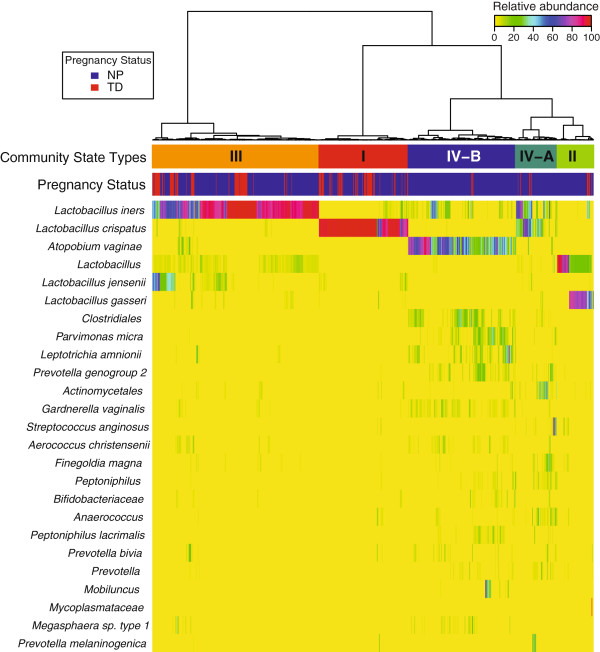
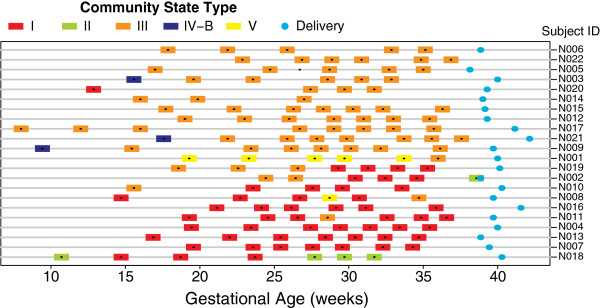
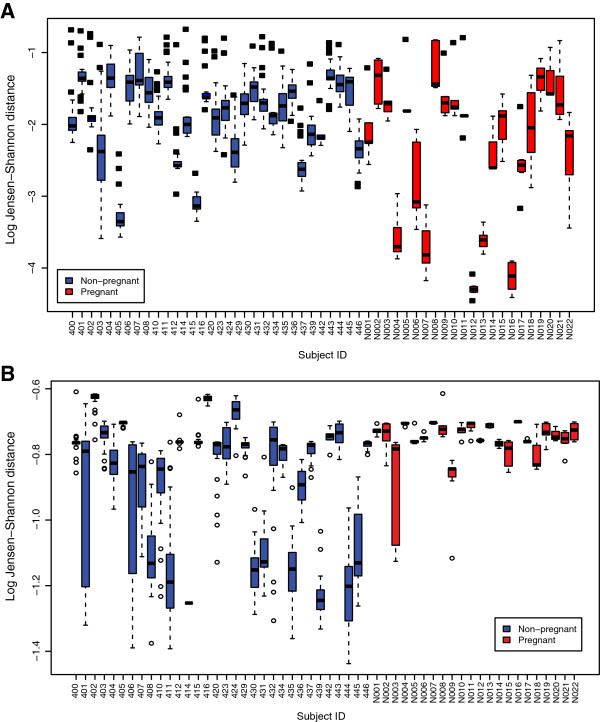
BACKGROUND: This study was undertaken to characterize the vaginal microbiota throughout normal human pregnancy using sequence-based techniques. We compared the vaginal microbial composition of non-pregnant patients with a group of pregnant women who delivered at term. RESULTS: A retrospective case-control longitudinal study was designed and included non-pregnant women (n = 32) and pregnant women who delivered at term (38 to 42 weeks) without complications (n = 22). Serial samples of vaginal fluid were collected from both non-pregnant and pregnant patients. A 16S rRNA gene sequence-based survey was conducted using pyrosequencing to characterize the structure and stability of the vaginal microbiota. Linear mixed effects models and generalized estimating equations were used to identify the phylotypes whose relative abundance was different between the two study groups. The vaginal microbiota of normal pregnant women was different from that of non-pregnant women (higher abundance of Lactobacillus vaginalis, L. crispatus, L. gasseri and L. jensenii and lower abundance of 22 other phylotypes in pregnant women). Bacterial community state type (CST) IV-B or CST IV-A characterized by high relative abundance of species of genus Atopobium as well as the presence of Prevotella, Sneathia, Gardnerella, Ruminococcaceae, Parvimonas, Mobiluncus and other taxa previously shown to be associated with bacterial vaginosis were less frequent in normal pregnancy. The stability of the vaginal microbiota of pregnant women was higher than that of non-pregnant women; however, during normal pregnancy, bacterial communities shift almost exclusively from one CST dominated by Lactobacillus spp. to another CST dominated by Lactobacillus spp. CONCLUSION: We report the first longitudinal study of the vaginal microbiota in normal pregnancy. Differences in the composition and stability of the microbial community between pregnant and non-pregnant women were observed. Lactobacillus spp. were the predominant members of the microbial community in normal pregnancy. These results can serve as the basis to study the relationship between the vaginal microbiome and adverse pregnancy outcomes.
Overview
The claims and statistics of this paper haven’t been checked yet.
Run the check — free, no account needed. It reads the open-access text and checks the sources it cites.
Integrity signals
Registry
Cites
Statistics
Figures
Verification
Claims the paper makes
The claims and statistics of this paper haven’t been checked yet.
Run the check — free, no account needed. It reads the open-access text and checks the sources it cites.
Claims other papers make about this one
Each is checked against this paper’s own text: does it say what the citing paper says it does?
The cited source says what the claim attributes to it.
In the citing paper
“Five major subcategories of cervicovaginal bacterial species were identified and defined as Community State Types (CSTs).”
The cited source says what the claim attributes to it.
In the citing paper
“Among the four groups, there was a high prevalence of lactobacilli. In particular, L. crispatus prevailed in CST I, L. gasseri in CST II, L. iners in CST III, and L. jensenii in CST V. In the remaining Community state type (CST IV) predominate anaerobic bacteria, such G. vaginalis , Atopobium vaginae , and Megasphaera spp., similar to the vaginal microbiota in bacterial vaginosis [27, 28].”
Self-check
Percentages, sums and reported differences re-computed from the paper’s own numbers.
The self-check needs the paper’s full text.
Citations
Cites
Metagenomic biomarker discovery and explanation
Segata, N., Izard, J., Waldron, L., Gevers, D., Miropolsky, L., Garrett, W. S., & Huttenhower, C. (2011) · Genome Biology · doi:10.1186/gb-2011-12-6-r60 · Cited by 16,192
Differential expression analysis for sequence count data
Anders, S., & Huber, W. (2010) · Genome Biology · doi:10.1186/gb-2010-11-10-r106 · Cited by 15,581
UCHIME improves sensitivity and speed of chimera detection
Edgar, R. C., Haas, B. J., Clemente, J. C., Quince, C., & Knight, R. (2011) · Bioinformatics · doi:10.1093/bioinformatics/btr381 · Cited by 15,114
An obesity-associated gut microbiome with increased capacity for energy harvest
Turnbaugh, P. J., Ley, R. E., Mahowald, M. A., Magrini, V., Mardis, E. R., & Gordon, J. I. (2006) · Nature · doi:10.1038/nature05414 · Cited by 12,444
A human gut microbial gene catalogue established by metagenomic sequencing
MetaHIT Consortium, Qin, J., Li, R., Raes, J., Arumugam, M., Burgdorf, K. S., Manichanh, C., Nielsen, T., Pons, N., Levenez, F., et al. (2010) · Nature · doi:10.1038/nature08821 · Cited by 11,624
Phylogenetic identification and in situ detection of individual microbial cells without cultivation
Amann, R., Ludwig, W., & SCHLEIFER, K. H. (1995) · Microbiological Reviews · doi:10.1128/mr.59.1.143-169.1995 · Cited by 9,218
Human gut microbes associated with obesity
Ley, R. E., Turnbaugh, P. J., Klein, S., & Gordon, J. I. (2006) · Nature · doi:10.1038/4441022a · Cited by 8,785
Diversity of the Human Intestinal Microbial Flora
Eckburg, P. B., Bik, E. M., Bernstein, C. N., Purdom, E., Dethlefsen, L., Sargent, M., Gill, S. R., Nelson, K. E., & Relman, D. A. (2005) · Science · doi:10.1126/science.1110591 · Cited by 7,913
Turnbaugh, P. J., Ley, R. E., Hamady, M., Fraser-Liggett, C. M., Knight, R., & Gordon, J. I. (2007) · Nature · doi:10.1038/nature06244 · Cited by 6,091
Divergence measures based on the Shannon entropy
Lin, J.-H. (1991) · IEEE Transactions on Information Theory · doi:10.1109/18.61115 · Cited by 5,877
Research works printed but not linked: 2
- Döderlein A: Das Scheidensekret und seine Bedeutung fuerdas Puerperalfieber. Die Arten des Scheidensekretes. 1892, 11: 699-
- Højsgaard S, Halekoh U, Yan J: The R package geepack for generalized estimating equations. J Stat Softw. 2006, 15: 1-11.
Cited by
Sorted by citations
Items 701–800 of 864
CRISPR immune diversity in simulated and natural microbial populations
England, W. (2016) · Illinois Digital Environment for Access to Learning and Scholarship (University of Illinois at Urbana-Champaign)
Sánchez-Hernández, J. A., Meléndez-García, I., & Muñoz-Zurita, G. (2017) · Atención Familiar · doi:10.1016/j.af.2017.07.005
112 Vaginal and uterine bacterial communities in postpartum lactating cows
Clemmons, B. A., Dantas, F. G., Franco, G. A., Reese, S. T., Adeyosoye, O. I., Smith, T. P. L., Myer, P. R., & Pohler, K. G. (2017) · Journal of Animal Science · doi:10.2527/asasmw.2017.112
Kim, B. (2017) · TSpace (University of Toronto)
Screening the Uterine Microbiome Prior to Embryo Transfer
Moreno, I., & Simón, C. (2019) · Cambridge University Press eBooks · doi:10.1017/9781108236263.007
Amato, K. R. (2019) · Cambridge University Press eBooks · doi:10.1017/9781139019941.006
Measurement of Novelty-Seeking in Wild Vervet Monkeys
Blaszczyk, M. B. (2019) · Cambridge University Press eBooks · doi:10.1017/9781139019941.017
Population Genetic Structure of Vervet Monkeys in South Africa
Coetzer, W. G., Lorenz, J. G., Freimer, N. B., & Grobler, J. P. (2019) · Cambridge University Press eBooks · doi:10.1017/9781139019941.008
Exploring Caribbean Green Monkeys (Chlorocebus sabaeus) through an Ethnoprimatological Lens
Dore, K. M. (2019) · Cambridge University Press eBooks · doi:10.1017/9781139019941.020
Rodrı́guez, R. L., Gaetano, T. J., Grobler, J. P., & Freimer, N. B. (2019) · Cambridge University Press eBooks · doi:10.1017/9781139019941.018
The Promise of Vervet Genomics
Warren, W. C., & Montague, M. J. (2019) · Cambridge University Press eBooks · doi:10.1017/9781139019941.004
African Green Monkeys as a Natural Host of SIV
Apetrei, C., Raehtz, K. D., & Pandrea, I. (2019) · Cambridge University Press eBooks · doi:10.1017/9781139019941.005
Socioecology of Vervet Monkeys
Whitten, P. L. (2019) · Cambridge University Press eBooks · doi:10.1017/9781139019941.010
Predation and Food Competition in Vervet Monkeys (Chlorocebus pygerythrus)
Isbell, L. A. (2019) · Cambridge University Press eBooks · doi:10.1017/9781139019941.012
Sponheimer, M., Loudon, J. E., Grobler, J. P., Moyer, K., & Lorenz, J. G. (2019) · Cambridge University Press eBooks · doi:10.1017/9781139019941.021
Population Genetics and Savanna Monkeys
Turner, T. R., Schmitt, C. A., & Cramer, J. D. (2019) · Cambridge University Press eBooks · doi:10.1017/9781139019941.007
Novelty-Seeking in Vervets: Developmental, Genetic, and Environmental Influences
Fairbanks, L. A. (2019) · Cambridge University Press eBooks · doi:10.1017/9781139019941.016
Vervet Monkeys’ Social Learning Abilities
van de Waal, E. (2019) · Cambridge University Press eBooks · doi:10.1017/9781139019941.013
Biological Complexity in Primate Sociality and Health
Wren, B. T. (2019) · Cambridge University Press eBooks · doi:10.1017/9781139019941.011
Metabolic activity of intestinal microflora in newborns with a different mode of delivery
Nikolaeva, I. V., Shaikhieva, G. S., Anokhin, V. A., Царегородцев, А. Д., & I.Kh., S. (2019) · Rossiyskiy Vestnik Perinatologii i Pediatrii (Russian Bulletin of Perinatology and Pediatrics) · doi:10.21508/1027-4065-2019-64-2-81-86
Early-Life Contributors to Child Well-Being
Lifschitz, C. H., & Lin, W. (2019) · Annals of Nutrition and Metabolism · doi:10.1159/000499153
Caracterização da microbiota vaginal, intestinal e oral durante o período gestacional
Sparvoli, L. G. (2019) · doi:10.11606/d.9.2019.tde-31072019-114756 · Cited by 1
Human microbiome sequences in the light of the NubeamPreprint
Dai, H., & Guan, Y. (2019) · bioRxiv (Cold Spring Harbor Laboratory) · doi:10.1101/763631
Sources of Variation in the Microbiome of Pre-Weaned Dairy Calves
Huffard, H. G. (2019) · VTechWorks (Virginia Tech)
BİLGİ, S. T. (2020) · International Journal of Scientific and Technological Research · doi:10.7176/jstr/6-01-04
Mortensen, M. S., Rasmussen, M. A., Stokholm, J., Brejnrod, A., Balle, C., Thorsen, J., Krogfelt, K. A., Bisgaard, H. F., & Sørensen, S. J. (2020) · bioRxiv (Cold Spring Harbor Laboratory) · doi:10.1101/2020.04.16.044255
Evaluation of Urine and Rectovaginal Culture Results in Pregnant Women with Threatened Preterm Labor
Karuserci, Ö. K., & Sucu, S. (2020) · Ahi Evran Medical Journal · doi:10.46332/aemj.715833 · Cited by 8
Li, D., Tian, S., Zhu, W. Y., Su, Y., Wang, T., Ma, T., Mishra, S. K., Shi, L., Wei, R., Xu, Z., et al. (2020) · doi:10.21203/rs.2.23607/v2
Cappelletti, M., Presicce, P., Ma, F., Senthamaraikannan, P., Miller, L. A., Pellegrini, M. A., Jobe, A. H., Divanovic, S., Way, S. S., Chougnet, C. A., et al. (2021) · bioRxiv (Cold Spring Harbor Laboratory) · doi:10.1101/2021.01.07.425700
Gao, Y., Cheng, L., Xia, Q., Wang, H., Xie, X., Liu, Y., Shang, H., Liu, H., & Diao, Y. (2021) · doi:10.21203/rs.3.rs-37456/v2
Assessment Of Presumed Sterility Of The Human Placenta And Maternal Bladder
Alhousseini, A. (2019) · Human Biology
Gut Bacterial Dysbiosis and Its Clinical Implications
Archer, A. C. (2021) · Springer eBooks · doi:10.1007/978-981-33-6236-9_1 · Cited by 1
Greenberg, J. M. (2020) · Human Biology
Golestani, Z., Ghaedmohammadi, S., & Mozdoori, N. (2021) · Research Square · doi:10.21203/rs.3.rs-291962/v1
Characterization of the vaginal microbiota of women with premature ovarian insufficiencyPreprint
Wen, J., Feng, Y., Yuan, S., Yan, W., Zhang, J., Luo, A., & Wang, S. (2021) · Research Square · doi:10.21203/rs.3.rs-439533/v1
Reasons and Mechanisms of Recurrent Failed Implantation in IVF
Fodina, V., Dudorova, A., & Ērenpreiss, J. (2021) · IntechOpen eBooks · doi:10.5772/intechopen.98301
Early Life Events With Microbiota Mediated Effects on Brain Functions
Ignjatović, Đ. (2021) · Elsevier eBooks · doi:10.1016/b978-0-12-819265-8.00058-9
Impact of Reproductive System Microbiome on Human Health
Sharma, P., & Kumar, T. (2021) · Elsevier eBooks · doi:10.1016/b978-0-12-819265-8.00103-0
Vitamin D deficiency as a cause of premature birth in pregnant women at high infectious risk
Isubova, I. R., Игнатьева, М. А., Novikova, S. V., Dal’nikovskaya, L. A., & Sibryaeva, V. A. (2021) · Russian Bulletin of Obstetrician-Gynecologist · doi:10.17116/rosakush202121041104
Infecção por micoplasma genital e o desfecho de parto pré-termo: coorte BRISA
Cunha, G. K. P. (2021) · Digital Library of Theses and Dissertations (Universidade de São Paulo) · doi:10.11606/d.17.2021.tde-06122021-143746
Turner, T. R., Schmitt, C. A., & Cramer, J. D. (2019) · Cambridge University Press eBooks · doi:10.1017/9781139019941.001
Turner Trudy, R., Schmitt, C. A., & Danzy, C. J. (2019) · Cambridge University Press eBooks · doi:10.1017/9781139019941.023
Krog, M. C., Hugerth, L. W., Fransson, E., Bashir, Z., Andersen, A. N., Edfeldt, G., Engstrand, L. G., Schuppe‐Koistinen, I., & Nielsen, H. S. (2021) · Research Square · doi:10.21203/rs.3.rs-696563/v2
Gao, Y., Cheng, L., Xia, Q., Wang, H., Xie, X., Liu, Y., Shang, H., Liu, H., & Diao, Y. (2020) · doi:10.21203/rs.3.rs-34778/v1
Phillips, B. (2019) · Faculty Opinions – Post-Publication Peer Review of the Biomedical Literature · doi:10.3410/f.732817128.793567067
Fujisaki, M. (2019) · Comprehensive gynecology and obstetrics · doi:10.1007/978-981-13-9875-9_18
Human Microbiota Community Structuring in Association with Pregnancy and Mode of Delivery
Ganu, R., Anders, A. M., Ma, J., & Aagaard, K. M. (2015) · Springer eBooks · doi:10.1007/978-1-4899-7475-4_73
Human Microbiota Community Structuring in Association with Pregnancy and Mode of Delivery
Ganu, R., Anders, A. M., Ma, J., & Aagaard, K. M. (2013) · Springer eBooks · doi:10.1007/978-1-4614-6418-1_73-3
The Impact Of The Vaginal And Endometrial Microbiome Pattern On Assisted Reproduction OutcomesPreprint
Carratalá‐Munuera, C., Diaz-Martínez, M. D. C., Bernabeu, A., Lledó, B., Rico, J. A. Q., Lozano, F. M., Cámara, V. R., Morales, R., Llácer, J., Morro, J. T., et al. (2020) · doi:10.21203/rs.3.rs-22123/v1
Maternal microbiota and the great obstetrical syndromes: When the enemy becomes an ally
Tur, H., & Alijotas‐Reig, J. (2018) · Medicina Clínica (English Edition) · doi:10.1016/j.medcle.2017.12.013
Turner, T. R., Schmitt, C. A., & Cramer, J. D. (2019) · Cambridge University Press eBooks · doi:10.1017/9781139019941.022
Pervaiz, S., Sarwar, F., Rauf, A., & Saifullah, M. (2017) · The Professional Medical Journal · doi:10.29309/tpmj/2017.24.04.1449
Aubaid, A. H. (2020) · Indian Journal of Forensic Medicine & Toxicology · doi:10.37506/ijfmt.v14i2.3036
Gao, Y., Liu, H., Cheng, L., Xia, Q., Xie, X., Wang, H., Shang, H., Liu, Y., & Diao, Y. (2020) · doi:10.21203/rs.3.rs-37456/v1
МИКРОБИОТА И РЕПРОДУКЦИЯ У СЕЛЬСКОХОЗЯЙСТВЕННЫХ ВИДОВ МЛЕКОПИТАЮЩИХ (обзор)
Афанасьева, Ф. Н. П. З. И. К. И. В. А., & ПОПОВ, Д. В. (2022) · Sel skokhozyaistvennaya Biologiya · doi:10.15389/agrobiology.2022.2.222rus
Vaginales Mikrobiom und Frühgeburtlichkeit
Feigl, S., & Fluhr, H. (2022) · Gynäkologische Endokrinologie · doi:10.1007/s10304-022-00471-5
Role of prenatal microbiota in fetal programming
Zhuk, S. I., Shchurevska, O. D., & Yefisko, V. M. (2022) · Reproductive Endocrinology · doi:10.18370/2309-4117.2022.66.32-38
Feigl, S. (2023) · Journal für Klinische Endokrinologie und Stoffwechsel · doi:10.1007/s41969-023-00198-z
Microbiotes génitaux et grossesse
Bohbot, J.-M. (2023) · Actualités Pharmaceutiques · doi:10.1016/j.actpha.2023.03.046
Tripathi, D., Saxena, D. R., & Agarwal, S. (2023) · THE SCIENTIFIC TEMPER · doi:10.58414/scientifictemper.2023.14.2.01
Hidalgo-Pajuelo, C., Sanchez-Godoy, V., & Bernuy-Pajuelo, M. (2023) · Revista Hispanoamericana de Ciencias de la Salud · doi:10.56239/rhcs.2023.92.646
Oluoch, L. M., Tapia, K. A., Kiptinness, C., Casmir, E., Maina, S. G., Makena, L., Selke, S., Wang, M., Chohan, B. H., Sycuro, L. K., et al. (2023) · BMJ Open · doi:10.1136/bmjopen-2023-071746
Die Rolle des Mikrobioms in der Reproduktionsmedizin
Oberle, A. (2023) · Springer eBooks · doi:10.1007/978-3-662-63907-8_15
MODERN DATA ON THE INTESTINAL MICROBIOME AND THE STAGES OF ITS FORMATION
Богданова, Н. М. (2023) · Children s medicine of the North-West · doi:10.56871/cmn-w.2023.62.43.002
Wang, Y., Liu, N., Sun, Y., Ma, L., Yang, X., & Zhang, S. (2023) · Research Square · doi:10.21203/rs.3.rs-3595611/v1
Fan, C., Zhang, Y., Zhang, J., Xu, C., Wang, X., & Fan, Y. (2026) · Women s Health Reports · doi:10.1177/26884844261471777
INTRICACIES OF VAGINAL MICROBIOME IN HUMAN FEMALE HEALTH: A LITERATURE REVIEW
Wasim, S. (2023) · Era s journal of medical research · doi:10.24041/ejmr2023.45
Draft genomes of Lactobacillus jensenii UMB0908, UMB1545, and UMB5777 from the urinary tract
Steiling, M., Jackson, B., Stegman, N., Sedano, C., & Putonti, C. (2024) · Microbiology Resource Announcements · doi:10.1128/mra.01120-23
Łaniewski, P., & Herbst‐Kralovetz, M. M. (2024) · Elsevier eBooks · doi:10.1016/b978-0-443-21477-6.00078-x
Pregravid preparation for women with bacterial vaginosis and a history of early pregnancy loss
Gerasimova, O. P., Solovyeva, A. V., Chegus, L. A., Александровна, В. Е., Doronina, O. K., Александровна, С. М., Aleynikova, E. Y., & Борисовна, Р. Д. (2024) · Meditsinskiy sovet = Medical Council · doi:10.21518/ms2024-146
Chandrakanth, G., Mathu, T., & Thanka, M. R. (2024) · doi:10.1109/iccsp60870.2024.10543941
Intrapartum fever prediction for pregnant woman from microbial data
Hossain, A., Morshed, M. S., Ashraf, F. B., Reena, I., Mumu, S. H., & Uddin, J. (2024) · International Conference on Advancement in Electrical and Electronic Engineering (ICAEEE) · doi:10.1109/icaeee62219.2024.10561686
Викторовна, Ш. Е., & Majidli, E. S. (2024) · Russian Journal of Human Reproduction · doi:10.17116/repro20243003185
Boelsen, L. K., Williams, M. J., Mangwiro, Y. T. M., Hansji, H., Czajko, A., Marcelino, V. R., Forster, S. C., Said, J. M., Satzke, C., & Saffery, R. (2024) · Scientific Reports · doi:10.1038/s41598-024-70431-5
Matulová, J., Musilova, I. K., Kukla, R., Bolehovská, R., Balcarová, K., Wiik, J., Sengpiel, V., Boštík, P., Jacobsson, B., & Kacerovský, M. (2024) · The Journal of Maternal-Fetal & Neonatal Medicine · doi:10.1080/14767058.2024.2425761
Greenberg, J. M., Romero, R. J., Alhousseini, A., Winters, A. D., Tarca, A. L., Gilbert, N. M., Gomez‐Lopez, N., Hassan, S. S., & Theis, K. R. (2024) · bioRxiv (Cold Spring Harbor Laboratory) · doi:10.1101/2024.12.05.627013
Self-citationChen, P.-C., Chen, S., Tung, H. W., Lin, Y., & Chen, P. (2024) · Research Square · doi:10.21203/rs.3.rs-4988154/v1
Rao, M. V., Messina, J. A., & Surana, N. K. (2023) · ClinMicroNow · doi:10.1002/9781683670438.mcm0017
Siniakova, A. A., Budilovskaya, O. V., Khusnutdinova, T. А., Krysanova, A. А., Shalepo, K. V., Bespalova, O. N., Savicheva, A. M., & Kogan, I. Y. (2025) · Journal of obstetrics and women s diseases · doi:10.17816/jowd635626
Kim, K., & Won, S. (2025) · BMC Bioinformatics · doi:10.1186/s12859-024-06002-2
Tláskal, V., Hrbáček, J., Hanáček, V., Baránková, P., Čermák, P., Zachoval, R., & Dobbler, P. T. (2025) · BMC Microbiology · doi:10.1186/s12866-025-03915-7
Ruan, W. H., Thapa, S., & Versalovic, J. A. (2025) · Elsevier eBooks · doi:10.1016/b978-0-323-82763-8.00005-4
Considerations in Result Interpretation and Reporting for Microbiome Analysis
Craney, A. R. (2025) · Wiley eBooks · doi:10.1002/9781683674597.ch30
Metadata
- Authors
- Romero, R., Hassan, S. S., Gajer, P., Tarca, A. L., Fadrosh, D. W., Nikita, L., Galuppi, M., Lamont, R. F., Chaemsaithong, P., Miranda, J., Chaiworapongsa, T., & Ravel, J.
- Affiliations
- National Institutes of Health (US)
- University of Maryland, Baltimore (US)
- Corresponding author
- Romero, Roberto
- Ravel, Jacques
- ORCID
- Venue
- Microbiome
- Published
- 2014-02-03
- Volume
- 2
- Issue
- 1
- Pages
- 10-10
- ISSN
- 2049-2618 (ISSN-L)
- PMC
- PMC3916806
- OpenAlex
- W2100318919
- Cited by
- 852
- References
- 280
- Citations by year
- 2026: 34 · 2025: 43 · 2024: 77 · 2023: 85 · 2022: 72 · 2021: 106 · 2020: 94 · 2019: 104 · 2018: 54 · 2017: 66 · 2016: 49 · 2015: 43 · 2014: 23
- FWCI
- 49.25
- Type
- journal article
- Language
- en
- Update notices
- erratum (2014-04-15)
- Open access
- gold
- doi.org
- Licence
- cc-by
- Locations
- Microbiome (publishedVersion, cc-by)
- Europe PMC (PubMed Central) (publishedVersion, cc-by)
- PubMed Central (publishedVersion, cc-by)
- PubMed (publishedVersion)
- University of Southern Denmark Research Portal (University of Southern Denmark) (publishedVersion)
- Human Biology (submittedVersion)
- Funders
- U.S. Department of Health and Human Services
- Wayne State University
- National Institutes of Health
- National Institute of Child Health and Human Development
- Eunice Kennedy Shriver National Institute of Child Health and Human Development
- Topics
- Life Sciences › Immunology and Microbiology › Microbiology › Reproductive tract infections research
- Life Sciences › Biochemistry, Genetics and Molecular Biology › Molecular Biology › Gut microbiota and health
- Health Sciences › Dentistry › Periodontics › Oral microbiology and periodontitis research
- Keywords
- vaginal microbiota, pregnancy, Lactobacillus, microbiome stability, bacterial vaginosis, Atopobium, Gardnerella, term birth
About these checks
Registry, retraction, Cites and statistics results are computed, not judged, with one exception: a printed reference that no index lists is read once by a model before it counts as a citation error. Claims are extracted by a model and kept only when their quote appears verbatim in the text; each cited source is then checked, with a model’s help, for whether it says what the claim relies on. Those verdicts can be wrong — read the claim’s quote and the cited source before relying on one.
Statistics and arithmetic are recomputed, not judged.
Confidence bands are shown only for fields calibrated on our annotated test set. None is calibrated yet, so no band is shown.
What counts as a claim ›How we measure confidence ›How we check this ›
Are you an author, or do you see a problem with this page? Request a review
