

The DOI matches its Crossref record; 279 of the 280 references it cites were found in a registry or an index.
The composition and stability of the vaginal microbiota of normal pregnant women is different from that of non-pregnant women
Open accessAbstract
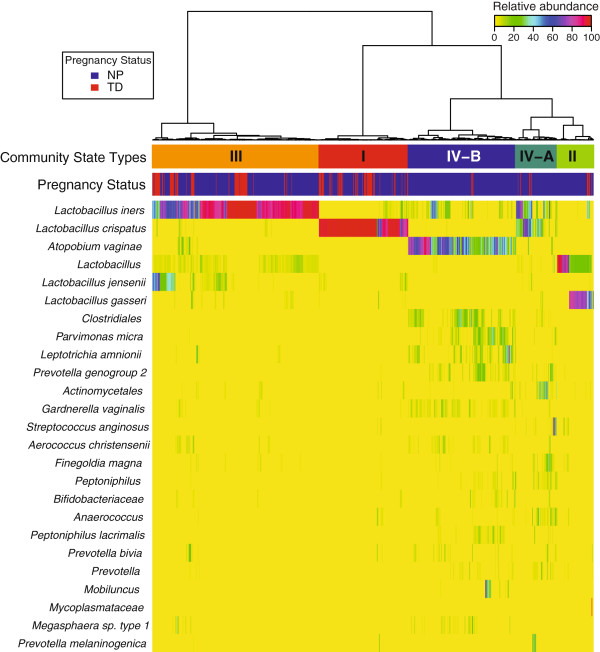
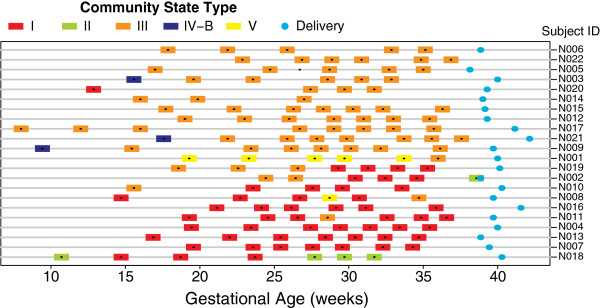
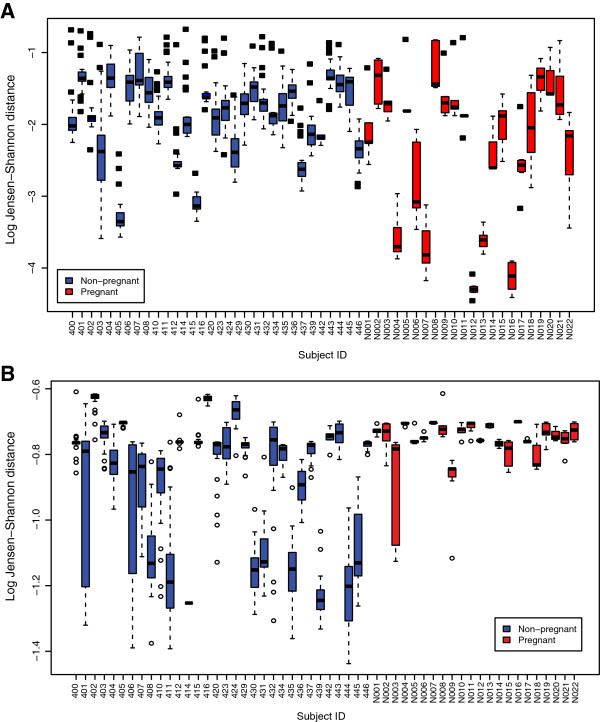
BACKGROUND: This study was undertaken to characterize the vaginal microbiota throughout normal human pregnancy using sequence-based techniques. We compared the vaginal microbial composition of non-pregnant patients with a group of pregnant women who delivered at term. RESULTS: A retrospective case-control longitudinal study was designed and included non-pregnant women (n = 32) and pregnant women who delivered at term (38 to 42 weeks) without complications (n = 22). Serial samples of vaginal fluid were collected from both non-pregnant and pregnant patients. A 16S rRNA gene sequence-based survey was conducted using pyrosequencing to characterize the structure and stability of the vaginal microbiota. Linear mixed effects models and generalized estimating equations were used to identify the phylotypes whose relative abundance was different between the two study groups. The vaginal microbiota of normal pregnant women was different from that of non-pregnant women (higher abundance of Lactobacillus vaginalis, L. crispatus, L. gasseri and L. jensenii and lower abundance of 22 other phylotypes in pregnant women). Bacterial community state type (CST) IV-B or CST IV-A characterized by high relative abundance of species of genus Atopobium as well as the presence of Prevotella, Sneathia, Gardnerella, Ruminococcaceae, Parvimonas, Mobiluncus and other taxa previously shown to be associated with bacterial vaginosis were less frequent in normal pregnancy. The stability of the vaginal microbiota of pregnant women was higher than that of non-pregnant women; however, during normal pregnancy, bacterial communities shift almost exclusively from one CST dominated by Lactobacillus spp. to another CST dominated by Lactobacillus spp. CONCLUSION: We report the first longitudinal study of the vaginal microbiota in normal pregnancy. Differences in the composition and stability of the microbial community between pregnant and non-pregnant women were observed. Lactobacillus spp. were the predominant members of the microbial community in normal pregnancy. These results can serve as the basis to study the relationship between the vaginal microbiome and adverse pregnancy outcomes.
Overview
The claims and statistics of this paper haven’t been checked yet.
Run the check — free, no account needed. It reads the open-access text and checks the sources it cites.
Integrity signals
Registry
Cites
Statistics
Figures
Verification
Claims the paper makes
The claims and statistics of this paper haven’t been checked yet.
Run the check — free, no account needed. It reads the open-access text and checks the sources it cites.
Claims other papers make about this one
Each is checked against this paper’s own text: does it say what the citing paper says it does?
The cited source says what the claim attributes to it.
In the citing paper
“Five major subcategories of cervicovaginal bacterial species were identified and defined as Community State Types (CSTs).”
The cited source says what the claim attributes to it.
In the citing paper
“Among the four groups, there was a high prevalence of lactobacilli. In particular, L. crispatus prevailed in CST I, L. gasseri in CST II, L. iners in CST III, and L. jensenii in CST V. In the remaining Community state type (CST IV) predominate anaerobic bacteria, such G. vaginalis , Atopobium vaginae , and Megasphaera spp., similar to the vaginal microbiota in bacterial vaginosis [27, 28].”
Self-check
Percentages, sums and reported differences re-computed from the paper’s own numbers.
The self-check needs the paper’s full text.
Citations
Cites
Metagenomic biomarker discovery and explanation
Segata, N., Izard, J., Waldron, L., Gevers, D., Miropolsky, L., Garrett, W. S., & Huttenhower, C. (2011) · Genome Biology · doi:10.1186/gb-2011-12-6-r60 · Cited by 16,192
Differential expression analysis for sequence count data
Anders, S., & Huber, W. (2010) · Genome Biology · doi:10.1186/gb-2010-11-10-r106 · Cited by 15,581
UCHIME improves sensitivity and speed of chimera detection
Edgar, R. C., Haas, B. J., Clemente, J. C., Quince, C., & Knight, R. (2011) · Bioinformatics · doi:10.1093/bioinformatics/btr381 · Cited by 15,114
An obesity-associated gut microbiome with increased capacity for energy harvest
Turnbaugh, P. J., Ley, R. E., Mahowald, M. A., Magrini, V., Mardis, E. R., & Gordon, J. I. (2006) · Nature · doi:10.1038/nature05414 · Cited by 12,444
A human gut microbial gene catalogue established by metagenomic sequencing
MetaHIT Consortium, Qin, J., Li, R., Raes, J., Arumugam, M., Burgdorf, K. S., Manichanh, C., Nielsen, T., Pons, N., Levenez, F., et al. (2010) · Nature · doi:10.1038/nature08821 · Cited by 11,624
Phylogenetic identification and in situ detection of individual microbial cells without cultivation
Amann, R., Ludwig, W., & SCHLEIFER, K. H. (1995) · Microbiological Reviews · doi:10.1128/mr.59.1.143-169.1995 · Cited by 9,218
Human gut microbes associated with obesity
Ley, R. E., Turnbaugh, P. J., Klein, S., & Gordon, J. I. (2006) · Nature · doi:10.1038/4441022a · Cited by 8,785
Diversity of the Human Intestinal Microbial Flora
Eckburg, P. B., Bik, E. M., Bernstein, C. N., Purdom, E., Dethlefsen, L., Sargent, M., Gill, S. R., Nelson, K. E., & Relman, D. A. (2005) · Science · doi:10.1126/science.1110591 · Cited by 7,913
Turnbaugh, P. J., Ley, R. E., Hamady, M., Fraser-Liggett, C. M., Knight, R., & Gordon, J. I. (2007) · Nature · doi:10.1038/nature06244 · Cited by 6,091
Divergence measures based on the Shannon entropy
Lin, J.-H. (1991) · IEEE Transactions on Information Theory · doi:10.1109/18.61115 · Cited by 5,877
Research works printed but not linked: 2
- Döderlein A: Das Scheidensekret und seine Bedeutung fuerdas Puerperalfieber. Die Arten des Scheidensekretes. 1892, 11: 699-
- Højsgaard S, Halekoh U, Yan J: The R package geepack for generalized estimating equations. J Stat Softw. 2006, 15: 1-11.
Cited by
Sorted by citations
Items 601–700 of 864
Passmore, J.-A. S., Ngcapu, S., Gitome, S. W., Kullin, B., Welp, K., Martin, D. P., Potloane, D., Manhanzva, M. T., Obimbo, M., Gill, K., et al. (2024) · Frontiers in Reproductive Health · doi:10.3389/frph.2024.1431306 · Cited by 3
Vaginal infections in pregnant women: diagnosis, new paradigms of therapy. A prospective study
Podzolkova, N. M., Зефирова, Т. П., Sozaeva, L. G., & Sadykova, D. A. (2025) · GYNECOLOGY · doi:10.26442/20795696.2025.1.203164 · Cited by 3
Behavioral Ecology of Savanna Monkeys
Turner, T. R., Schmitt, C. A., & Cramer, J. D. (2019) · Cambridge University Press eBooks · doi:10.1017/9781139019941.009 · Cited by 3
Die Rolle des Mikrobioms in der Reproduktionsmedizin
Haitzinger, S. (2020) · Journal für Gynäkologische Endokrinologie/Österreich · doi:10.1007/s41974-020-00155-7 · Cited by 3
En Önemli Miras Anne Mikrobiyotası
Öz, H. G., & Yangın, H. B. (2020) · Hacettepe Üniversitesi Hemşirelik Fakültesi Dergisi · doi:10.31125/hunhemsire.834219 · Cited by 3
The materno-placental microbiome of gravid beef cows under moderate feed intake restriction
Hummel, G. L., Woodruff, K. L., Austin, K. J., Knuth, R. M., Williams, J. D., & Cunningham-Hollinger, H. C. (2021) · Translational Animal Science · doi:10.1093/tas/txab172 · Cited by 3
Draft Genome Sequence of Streptococcus anginosus BVI, a New Vaginal Pathogen Candidate
Zúñiga-Bahamon, A., Tobar-Tosse, F., Ortega, J. G., Wibberg, D., & Tauch, A. (2016) · Genome Announcements · doi:10.1128/genomea.01417-16 · Cited by 3
Probiotics in the Prevention of Gestational Diabetes Mellitus (GDM)
Gómez-Arango, L. F., Barrett, H. L., Callaway, L. K., McIntyre, D. H., & Nitert, M. D. (2017) · Springer eBooks · doi:10.1007/978-3-319-56440-1_22 · Cited by 3
Shishkova, Y. S., Долгушина, В. Ф., Дмитриевна, Г. Е., Zavyalova, S. A., Курносенко, И. В., Евстигнеева, Н. П., Gromakova, K. G., Колесников, О. Л., Chukichev, A. V., & Dolgushin, I. I. (2018) · Journal of microbiology epidemiology immunobiology · doi:10.36233/0372-9311-2018-4-51-56 · Cited by 3
The microbiome in a healthy pregnancy
Neuman, H., & Koren, O. (2020) · Elsevier eBooks · doi:10.1016/b978-0-12-818097-6.00001-8 · Cited by 3
Interactions between the epithelial barrier and the microbiota in the reproductive tract
Takada, K., Komine‐Aizawa, S., Tsuji, N. M., & Hayakawa, S. (2021) · Elsevier eBooks · doi:10.1016/b978-0-12-818508-7.00002-6 · Cited by 3
Pacha-Herrera, D., Vasco, G., Cruz-Betancourt, C., Galarza, J. M., Barragán, V., & Machado, A. (2020) · Vide Leaf, Hyderabad eBooks · doi:10.37247/pamic.1.2020.25 · Cited by 3
Strategies for Managing Vaginal Infection
Banerjee, R., & Bhattacharya, T. (2022) · Global Journal of Medical Research · doi:10.34257/ljmhrvol22is5pg1 · Cited by 3
Vaginal Microbiome and Its Role in HPV Induced Cervical Carcinogenesis
Kúdela, E., Holubeková, V., Kolková, Z., Kašubová, I., Samec, M., Mazuráková, A., & Koklesová, L. (2023) · Advances in predictive, preventive and personalised medicine · doi:10.1007/978-3-031-19564-8_3 · Cited by 3
Drew, R. J., LeBlanc, L., Kent, E., & Eogan, M. (2018) · Obstetrics and Gynecology Reports · doi:10.15761/ogr.1000128 · Cited by 3
Effect of the Arabin pessary and natural progesterone on the vaginal microbiomePreprint
Filho, A. G. D. A., Martins, R. C. R., Franco, L. A. M., Marinelli, J. V. C., Peres, S. V., Francisco, R. P. V., & de Carvalho, M. H. B. (2023) · Research Square · doi:10.21203/rs.3.rs-2493078/v1 · Cited by 3
The role of dysbiosis in shaping host immunity in endometrial cancer development
Wierzbińska, W., Kuźmycz, O., Kowalczyk, A., & Stączek, P. (2025) · Frontiers in Immunology · doi:10.3389/fimmu.2025.1627285 · Cited by 4
Błażejczyk, I., Daniluk, T., Toczyłowski, K., Gorbacz-Konończuk, J., Wnorowska, U., Bucki, R., & Piktel, E. (2026) · Biomedicine & Pharmacotherapy · doi:10.1016/j.biopha.2025.118928 · Cited by 2
Vargas-Robles, D., Yap, Y. R., Singha, B., Tien, J., Purandare, M., Rojas-Correa, M., Madziar, C., Picker, M., Dumont, T., Leftwich, H. K., et al. (2026) · PLoS ONE · doi:10.1371/journal.pone.0335178 · Cited by 2
Hong, X., Zhao, M., Tan, F., Zheng, H., Ding, X., Yin, J., Zhang, X., & Wang, B. (2026) · BMC Microbiology · doi:10.1186/s12866-026-04910-2 · Cited by 2
Mikkelsen, E., Amabebe, E., Olmos‐Ortiz, A., Hamburg‐Shields, E., Bytautiene, E., Shynlova, O. P., Gibbons, D. L., Mesiano, S. A., & Taggart, M. J. (2026) · Reproductive Sciences · doi:10.1007/s43032-026-02108-5 · Cited by 3
Jonouchi, D., Shenoy, S. G., Saintlouis, R., Singh, A., Kashyap, D., Bhargavi, C., Mansoor, R., Mansoor, E., & Honnavar, P. (2026) · Infection and Immunity · doi:10.1128/iai.00542-25 · Cited by 2
Microbiome and Cervical Cancer – A Review
Devi, A., Devi, T. R., Pushpa, N., & Vijayakumar, D. (2022) · Journal of Pure and Applied Microbiology · doi:10.22207/jpam.16.3.05 · Cited by 2
Danieli‐Gruber, S., Greenberg, G., Shechter, S., Romano, A., Shmueli, A., Barbash‐Hazan, S., Bardin, R., Krispin, E., & Hadar, E. (2022) · Journal of Obstetrics and Gynaecology · doi:10.1080/01443615.2022.2109950 · Cited by 2
Amaral, W. Z., Lubach, G. R., Rendina, D. N., Phillips, G. J., Lyte, M., & Coe, C. L. (2023) · Microorganisms · doi:10.3390/microorganisms11061481 · Cited by 2
Vaginal microbiota stability as a marker of successful outcomes of pregnancy
Beliaeva, N. R., Budilovskaya, O. V., Savicheva, A. M., Tapilskaya, N. I., & Kogan, I. Y. (2023) · Journal of obstetrics and women s diseases · doi:10.17816/jowd117519 · Cited by 2
Tchuenté, S. A. M., Youté, O. D., Kweyang, B. P. T., Kougang, E. G., Koul, P. B. W. À. W. À., & Kwetche, P. R. F. (2023) · Microbiology Research Journal International · doi:10.9734/mrji/2023/v33i81399 · Cited by 2
Clinical Applications of the Microbiome in Obstetrics
Pyeon, S. Y., Kang, D. Y., Kim, S. Y., Choi, S. W., Hwang, M. Y., & Lee, Y. J. (2023) · Neonatal Medicine · doi:10.5385/nm.2023.30.4.89 · Cited by 2
16S rRNA Gene-Amplicon-Based Profiling of the Vaginal Microbiome From North African Women
Jbara, S., Azami, A. I., Fadel, S., Idrissi, N. A., Rhalem, W., Allali, I., Bakri, Y., Tissir, R., & Ghazal, H. (2024) · Lecture notes in networks and systems · doi:10.1007/978-3-031-52385-4_14 · Cited by 2
Kalpana, N., Amirtha, C., Lavoanya, P., & Logeswari, B. M. (2024) · Cureus · doi:10.7759/cureus.57502 · Cited by 2
Vaginal Microbiome and the Risk of Preterm Birth in Women Living With HIV: A Scoping Review
Khan, F. Z. A., Ahmed, S., & Powell, A. M. (2024) · American Journal of Reproductive Immunology · doi:10.1111/aji.70011 · Cited by 2
Kan, L., Tuddenham, S., Christian, P. S., Massie, A. B., Labrique, A. B., Wu, L. S. F., Ali, H., Rashid, M., Gough, E. K., Chakraborty, S., et al. (2025) · PLOS Global Public Health · doi:10.1371/journal.pgph.0004768 · Cited by 2
Self-citationLi, C., Cheng, Y., Zong, T., Guo, S., Zhu, H., Dai, P., Chen, C., & Wang, H. (2025) · Probiotics and Antimicrobial Proteins · doi:10.1007/s12602-025-10657-5 · Cited by 2
The silent threat: Pelvic inflammatory disease and long-term health outcomes with management
Rana, S., Panjwal, P., Malik, N., Bhatia, V., Kushawaha, S. K., & Ashawat, M. S. (2025) · Journal of Endometriosis and Pelvic Pain Disorders · doi:10.1177/22840265251350207 · Cited by 2
Asemptomatik Kadınlarda Vajinal ve Rektal Laktobasillerin Tespiti ve İlişkilerinin Belirlenmesi
Kızılyıldırım, S., & Köksal, F. (2021) · Kahramanmaraş Sütçü İmam Üniversitesi Tıp Fakültesi Dergisi · doi:10.17517/ksutfd.780596 · Cited by 2
Evaluating the Assembly Dynamics in the Human Vaginal Microbiomes With Niche-Neutral Hybrid Modeling
Ma, Z. S. (2021) · Frontiers in Microbiology · doi:10.3389/fmicb.2021.699939 · Cited by 2
Zheng, W., Huang, Y., Li, D., Hu, D., Jin, C., Sadykova, A., Cai, W., Liao, C., & Pan, S. (2022) · Medicine in Microecology · doi:10.1016/j.medmic.2022.100074 · Cited by 3
Medsebojni vpliv estrogenov in mikrobioma prebavil in rodil
Troha, N., & Rižner, T. L. (2023) · Slovenian Medical Journal · doi:10.6016/zdravvestn.3382 · Cited by 2
Vaginal Microbiota and Lubricant Use During Labor
McElroy, K. G., & Regan, M. B. (2016) · SAGE Open Nursing · doi:10.1177/2377960816662286 · Cited by 2
The Microbiome in Healthy Children
Vandenplas, Y., & Huysentruyt, K. (2017) · Springer eBooks · doi:10.1007/978-3-319-54033-7_7 · Cited by 2
Atopobium vaginae: a literature review, on findings and potential clinical implications
Mariano, A., Salzo, A., Felice, V., & Scutellà, M. (2019) · Microbiologia medica · doi:10.4081/mm.2019.8014 · Cited by 2
Évaluation du microbiote génital : une approche émergente en assistance médicale à la procréation
Mauries, C., Ranisavljevic, N., Gallet, R., Fournier, A., Gala, A., Ferrières-Hoa, A., Brouillet, S., & Hamamah, S. (2020) · Gynécologie Obstétrique Fertilité & Sénologie · doi:10.1016/j.gofs.2020.07.005 · Cited by 2
Han, Y., Baker, C., Vogtmann, E., Hua, X., Shi, J., & Liu, D. (2021) · Statistics in Biosciences · doi:10.1007/s12561-021-09302-w · Cited by 2
Vaginal microbes confounders and implications on women's health
Nori, W., & Hameed, B. H. (2023) · World Journal of Clinical Cases · doi:10.12998/wjcc.v11.i9.2119 · Cited by 2
Association of Pregnancy and HIV Status With Molecular-Bacterial Vaginosis in Indian Women
Tuddenham, S., Shafiq, M., Mathad, J. S., Alexander, M., Naik, S., Kulkarni, V., Deshpande, P., Humphrys, M. S., Holm, J. B., Khan, N., et al. (2023) · JAIDS Journal of Acquired Immune Deficiency Syndromes · doi:10.1097/qai.0000000000003215 · Cited by 2
Self-citationMolecular Cytology Applications on Gynecological Cytology
Carozzi, F., Negri, G., & Sani, C. (2018) · Springer eBooks · doi:10.1007/978-3-319-74942-6_8 · Cited by 2
Biological Resources for Genomic Investigation in the Vervet Monkey (Chlorocebus)
Jasinska, A. J. (2019) · Cambridge University Press eBooks · doi:10.1017/9781139019941.002 · Cited by 3
Microbial signatures of preterm birth
MacIntyre, D. A., & Bennett, P. R. (2020) · Elsevier eBooks · doi:10.1016/b978-0-12-818097-6.00003-1 · Cited by 2
von Glehn, M. D. P. (2016) · doi:10.26512/2016.03.d.21274 · Cited by 2
Molina, M. A., Leenders, W. P. J., Huynen, M. A., Melchers, W. J. G., & Andralojc, K. M. (2023) · bioRxiv (Cold Spring Harbor Laboratory) · doi:10.1101/2023.06.02.543506 · Cited by 2
Wei, X. L., Tsai, M.-S., Liang, L., Jiang, L., Hung, C.-J., Jelliffe‐Pawlowski, L. L., Rand, L., Snyder, M. P., & Jiang, C. (2023) · bioRxiv (Cold Spring Harbor Laboratory) · doi:10.1101/2023.10.11.561685 · Cited by 2
Microbiome in Embryonic Implantation and Implantation Failure
Franasiak, J. M., Moreno, I., & Simón, C. (2017) · Springer eBooks · doi:10.1007/978-3-319-71967-2_11 · Cited by 3
Mori, H., Shibata, E., Kondo, E., Saito, M., Yoshino, K., & Fukuda, K. (2025) · AJOG Global Reports · doi:10.1016/j.xagr.2025.100460 · Cited by 1
Gut Microbiota and Its Importance in Health and Disease
Midya, S., Banerjee, A., Pathak, S., & Duttaroy, A. K. (2024) · Springer eBooks · doi:10.1007/978-981-96-0297-1_1 · Cited by 1
Nasopharyngeal and oral microbiota profiling in SARS-CoV-2 infected pregnant women
Giovannini, N., Limena, A., Ercolino, C., Renteria, S. U., Strati, F., Giuffrè, M. R., Maragno, P., Carbone, I. F., Facciotti, F., Ceriotti, F., et al. (2025) · Scientific Reports · doi:10.1038/s41598-025-19344-5 · Cited by 1
Alishum, A., Keelan, J. A., Penova‐Veselinovic, B., Christophersen, C. T., Bunce, M., & Allentoft, M. E. (2026) · Microorganisms · doi:10.3390/microorganisms14010128 · Cited by 1
Scale reliant mixed effects models enhance microbiome data analysis
McGovern, K. C., & Silverman, J. D. (2026) · Microbiome · doi:10.1186/s40168-026-02377-x · Cited by 3
Banchi, P., Mila, H., Selma‐Royo, M., Tal, S., Péron, F., & Gaillard, V. (2026) · Frontiers in Veterinary Science · doi:10.3389/fvets.2026.1817504 · Cited by 1
Liu, X., Xu, J., Fan, Z., Cai, J., Zuo, D., & Wang, F. (2026) · Frontiers in Microbiology · doi:10.3389/fmicb.2026.1863564 · Cited by 1
Enos, M. K. (2014) · Scholarship@Western (Western University) · Cited by 1
Obstetricians & Pediatricians: Cornerstone to Infant Gut microbiome Development
Davis, S. C., Dosunmu-Ogunb, S. O., & Robertson, B. K. (2015) · Cited by 1
Life History of Savanna Monkeys
Turner, T. R., Schmitt, C. A., & Cramer, J. D. (2019) · Cambridge University Press eBooks · doi:10.1017/9781139019941.014 · Cited by 1
Alternative Ways to Exchange DNA: Unconventional Conjugation Among Bacteria
Blesa, A., & Berenguer, J. (2019) · Springer eBooks · doi:10.1007/978-3-030-21862-1_2 · Cited by 1
Dysbiosis Disconnect Between Research and Clinical Practice
Wright, M. L. (2020) · Journal of Women s Health · doi:10.1089/jwh.2020.8394 · Cited by 1
The microbiome and pregnancy complications
Fuhler, G. M. (2020) · Elsevier eBooks · doi:10.1016/b978-0-12-818097-6.00002-x · Cited by 1
da Rocha, M. C. J. (2007) · Portuguese National Funding Agency for Science, Research and Technology (RCAAP Project by FCT) · Cited by 1
Gestational Diabetes Mellitus and Maternal Microbiome Alterations
Rafat, D. (2022) · IntechOpen eBooks · doi:10.5772/intechopen.101868 · Cited by 1
The Impact of Infection During Pregnancy on the Mother and Baby
George, C. R. R., Lahra, M. M., & Jeffery, H. E. (2015) · Springer eBooks · doi:10.1007/978-3-319-19207-9_9 · Cited by 1
MICROBIOTA AND REPRODUCTION IN AGRICULTURAL MAMMALS(review)
Popov, D. V. (2022) · Sel skokhozyaistvennaya Biologiya · doi:10.15389/agrobiology.2022.2.222eng · Cited by 1
Probiotics in pregnancy and lactation
Treven, P., Majhenič, A. Č., Paveljšek, D., & Matijašić, B. B. (2022) · Elsevier eBooks · doi:10.1016/b978-0-323-89908-6.00012-1 · Cited by 1
Ovalle, A., & Enrique Oyarzún, E. (2024) · Revista chilena de obstetricia y ginecología · doi:10.24875/rechog.23000039 · Cited by 2
Xing, Y., Wang, W., Wan, N., Zhang, D., Mei, S., & Wang, G. (2024) · SLAS TECHNOLOGY · doi:10.1016/j.slast.2024.100242 · Cited by 1
Focà, A., Mc, L., & Marascio, N. (2015) · CiteSeer X (The Pennsylvania State University) · Cited by 1
Hall, B., Wong, D., Healy, C., Tracy, M. B., Tracy, S., & Rawlinson, W. D. (2016) · Acta Obstetricia Et Gynecologica Scandinavica · doi:10.1111/aogs.13089 · Cited by 1
Pervaiz, S., Sarwar, F., Rauf, A., & Saifullah, M. (2017) · The Professional Medical Journal · doi:10.17957/tpmj/17.3571 · Cited by 1
La microbiota materna y los grandes síndromes obstétricos: cuando el enemigo se convierte en aliado
Tur, H., & Alijotas‐Reig, J. (2017) · Medicina Clínica · doi:10.1016/j.medcli.2017.04.008 · Cited by 1
Bakterielle Vaginose: von Dysbiose, Biofilmen und probiotischer Prophylaxe
Mendling, W. (2017) · gynäkologie + geburtshilfe · doi:10.1007/s15013-017-1243-7 · Cited by 1
Дикке, Г. Б. (2017) · Russian Journal of Human Reproduction · doi:10.17116/repro201723432-36 · Cited by 1
Ethnoprimatology and Savanna Monkeys
Turner, T. R., Schmitt, C. A., & Cramer, J. D. (2019) · Cambridge University Press eBooks · doi:10.1017/9781139019941.019 · Cited by 1
Ako-Nai, K. A., & Omo-Omorodion, B. I. (2019) · Journal of Microbiology & Experimentation · doi:10.15406/jmen.2019.07.00250 · Cited by 1
Пилецкая, У. В., Makarov, K. Y., Соколова, Т. М., & Владимировна, К. Ю. (2021) · Естественные и Технические Науки · doi:10.37882/2223-2966.2021.01.24 · Cited by 1
Focà, A., Liberto, M. C., & Marascio, N. (2015) · Apple Academic Press eBooks · doi:10.1201/b18597-6 · Cited by 1
The placental membrane microbiome and preterm birth
Grigoriu, C., Dima, V., Bacalbaşa, N., Georgescu, T. A., Mihai, B.-M., Vladareanu, I. T., Gheorghe, C.-M., & Bohîlțea, R. E. (2021) · Romanian Medical Journal · doi:10.37897/rmj.2021.s5.2 · Cited by 1
Functional Anabolic Network Analysis of Human-associated Lactobacillus StrainsPreprint
Moutinho, T. J., Neubert, B. C., Jenior, M. L., Carey, M. A., Medlock, G. L., Kolling, G. L., & Papin, J. A. (2019) · bioRxiv (Cold Spring Harbor Laboratory) · doi:10.1101/746420 · Cited by 1
Jašarević, E., Hill, E. M., Kane, P. J., Rutt, L., Gyles, T. M., Folts, L. M., Rock, K. D., Howard, C. D., Morrison, K. E., Ravel, J., et al. (2021) · bioRxiv (Cold Spring Harbor Laboratory) · doi:10.1101/2021.02.01.429213 · Cited by 1
Self-citationWebb, E. M., Holman, D., Schmidt, K. N., Pun, B., Sedivec, K., Hurlbert, J. L., Bochantin, K. A., Ward, A., Dahlen, C., & Amat, S. (2023) · bioRxiv · doi:10.1101/2023.07.31.551361 · Cited by 1
McKee, K. S., Bassis, C. M., Golob, J. L., Palazzolo, B., Sen, A., Comstock, S. S., Rosas‐Salazar, C., Stanford, J. B., O’Connor, T., Gern, J. E., et al. (2023) · Research Square · doi:10.21203/rs.3.rs-3586098/v1 · Cited by 1
Brulin, L., Ducrocq, S., Even, G., Sanchez, M.-P., Martel, S., Merlin, S., Audebert, C., Croiseau, P., & Estellé, J. (2023) · bioRxiv (Cold Spring Harbor Laboratory) · doi:10.1101/2023.12.13.571514 · Cited by 1
RISING STARS: Bumps and bacteria: influence of the maternal microbiota on pregnancy outcomes
Willmott, T., & Cottrell, E. C. (2024) · Journal of Endocrinology · doi:10.1530/joe-23-0360
CREDIBILITY OF ITS PRIMERS IN IDENTIFICATION OF LACTOBACILLUS SPECIES OF IRAQI VAGINAL MICROBIOME
Al-Khafaji, Z. M., Al-Khataua, K. J., Rasheed, M. N., & Ghreeb, A. M. (2017) · doi:10.13140/rg.2.2.17787.00808
Placental Microbiome and Its Role in Preterm
Stout, J. N., Lee, I., Mysorekar, U., & Shriver, K. (2014)
Lactobacillus crispatus and Propionibacterium freudenreichii: A Genomic and Transcriptomic View
Ojala, T. (2016) · Työväentutkimus Vuosikirja
Prevalencia de Corynebacterium spp. y factores asociados en mujeres del Valle de Aburrá.
Botero, A., Úsuga, X., Cuervo, C. M., & Ossa-Giraldo, A. C. (2015) · Acta Médica Colombiana · doi:10.36104/amc.2015.452
Handing on Health to the Next Generation
Holmes, E. C., MacIntyre, D. A., Modi, N., & Marchesi, J. R. (2016) · Elsevier eBooks · doi:10.1016/b978-0-12-800344-2.00008-2
Pathophysiology of Chorioamnionitis
Randis, T. M., & Ratner, A. J. (2016) · Elsevier eBooks · doi:10.1016/b978-0-323-35214-7.00174-8
Amorim, A. T. (2015) · Digital Library of Theses and Dissertations (Universidade de São Paulo) · doi:10.11606/d.42.2015.tde-26082015-184203
Yang, S. (2015) · TSpace (University of Toronto)
Quantitative Inferences from the Lung Microbiome
Tipton, L. (2017) · D-Scholarship@Pitt (University of Pittsburgh)
Metadata
- Authors
- Romero, R., Hassan, S. S., Gajer, P., Tarca, A. L., Fadrosh, D. W., Nikita, L., Galuppi, M., Lamont, R. F., Chaemsaithong, P., Miranda, J., Chaiworapongsa, T., & Ravel, J.
- Affiliations
- National Institutes of Health (US)
- University of Maryland, Baltimore (US)
- Corresponding author
- Romero, Roberto
- Ravel, Jacques
- ORCID
- Venue
- Microbiome
- Published
- 2014-02-03
- Volume
- 2
- Issue
- 1
- Pages
- 10-10
- ISSN
- 2049-2618 (ISSN-L)
- PMC
- PMC3916806
- OpenAlex
- W2100318919
- Cited by
- 852
- References
- 280
- Citations by year
- 2026: 34 · 2025: 43 · 2024: 77 · 2023: 85 · 2022: 72 · 2021: 106 · 2020: 94 · 2019: 104 · 2018: 54 · 2017: 66 · 2016: 49 · 2015: 43 · 2014: 23
- FWCI
- 49.25
- Type
- journal article
- Language
- en
- Update notices
- erratum (2014-04-15)
- Open access
- gold
- doi.org
- Licence
- cc-by
- Locations
- Microbiome (publishedVersion, cc-by)
- Europe PMC (PubMed Central) (publishedVersion, cc-by)
- PubMed Central (publishedVersion, cc-by)
- PubMed (publishedVersion)
- University of Southern Denmark Research Portal (University of Southern Denmark) (publishedVersion)
- Human Biology (submittedVersion)
- Funders
- U.S. Department of Health and Human Services
- Wayne State University
- National Institutes of Health
- National Institute of Child Health and Human Development
- Eunice Kennedy Shriver National Institute of Child Health and Human Development
- Topics
- Life Sciences › Immunology and Microbiology › Microbiology › Reproductive tract infections research
- Life Sciences › Biochemistry, Genetics and Molecular Biology › Molecular Biology › Gut microbiota and health
- Health Sciences › Dentistry › Periodontics › Oral microbiology and periodontitis research
- Keywords
- vaginal microbiota, pregnancy, Lactobacillus, microbiome stability, bacterial vaginosis, Atopobium, Gardnerella, term birth
About these checks
Registry, retraction, Cites and statistics results are computed, not judged, with one exception: a printed reference that no index lists is read once by a model before it counts as a citation error. Claims are extracted by a model and kept only when their quote appears verbatim in the text; each cited source is then checked, with a model’s help, for whether it says what the claim relies on. Those verdicts can be wrong — read the claim’s quote and the cited source before relying on one.
Statistics and arithmetic are recomputed, not judged.
Confidence bands are shown only for fields calibrated on our annotated test set. None is calibrated yet, so no band is shown.
What counts as a claim ›How we measure confidence ›How we check this ›
Are you an author, or do you see a problem with this page? Request a review
