

The freshwater reservoir effect in radiocarbon dating
Open accessThe DOI matches its Crossref record; 95 of the 96 references it cites were found in a registry or an index; none of the 142 sources its claims cite is checked for support yet.
Abstract
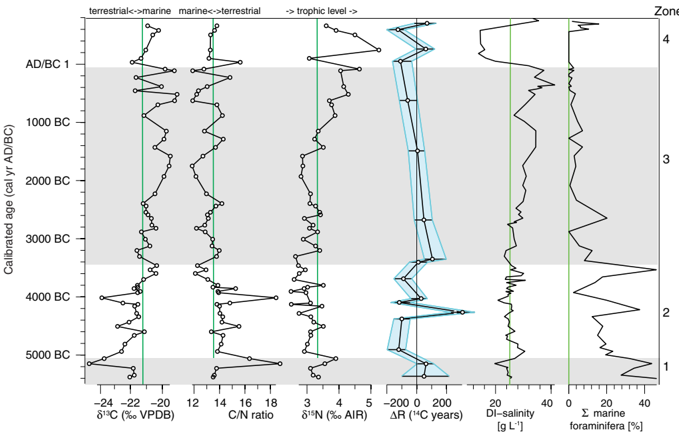
The freshwater reservoir effect can result in anomalously old radiocarbon ages of samples from lakes and rivers. This includes the bones of people whose subsistence was based on freshwater fish, and pottery in which fish was cooked. Water rich in dissolved ancient calcium carbonates, commonly known as hard water, is the most common reason for the freshwater reservoir effect. It is therefore also called hardwater effect. Although it has been known for more than 60 years, it is still less well-recognized by archaeologists than the marine reservoir effect. The aim of this study is to examine the order of magnitude and degree of variability of the freshwater reservoir effect over short and long timescales. Radiocarbon dating of recent water samples, aquatic plants, and animals, shows that age differences of up to 2000 14 C years can occur within one river. The freshwater reservoir effect has also implications for radiocarbon dating of Mesolithic pottery from inland sites of the Ertebølle culture in Northern Germany. The surprisingly old ages of the earliest pottery most probably are caused by a freshwater reservoir effect. In a sediment core from the Limfjord, northern Denmark, the impact of the freshwater reservoir effect on radiocarbon dating in an estuarine environment is examined. Here, freshwater influence causes reservoir ages to vary between 250 and 700 14 C years during the period 5400 BC - AD 700. The examples in this study show clearly that the freshwater reservoir effect can seriously corrupt radiocarbon dating at inland sites. Reservoir effects should therefore be considered whenever food remains on pottery or the bones of omnivores are radiocarbon dated - irrespective of the site’s distance to the coast.
Overview
CoChat Summary
TL;DR
The freshwater reservoir effect (FRE) can make radiocarbon ages from lakes and rivers anomalously old, with offsets varying greatly over short and long timescales. This study synthesizes modern river samples, archaeological pottery/fish remains, and a Limfjord sediment core to show that FREs must be considered for aquatic resources, food crusts, and estuarine samples.
Key findings
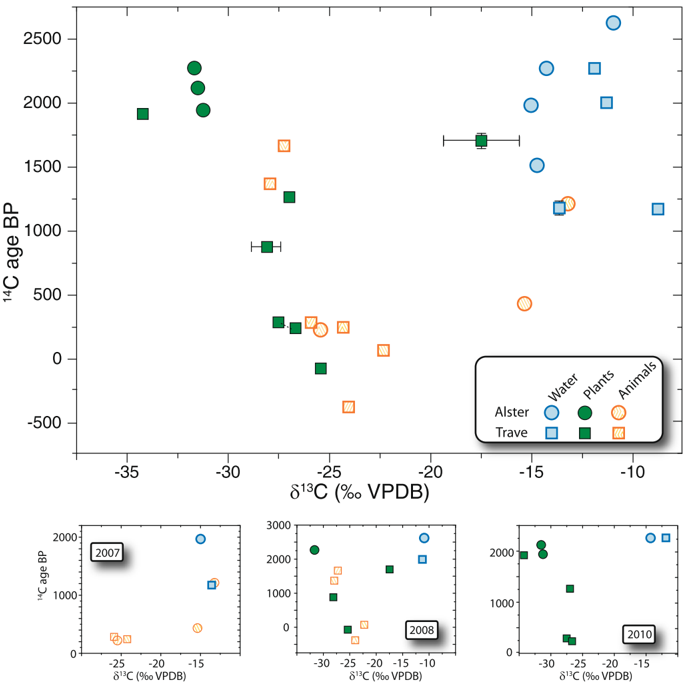
- Modern samples from the Alster and Trave rivers yielded radiocarbon ages between -70 and +2620 14C years, corresponding to estimated reservoir ages of 350 to 3040 14C years; aquatic plants ranged from -70 to +2270 BP (reservoir ages 350–2690 14C years), and animals from 70 to 1660 BP (reservoir ages 490–2090 14C years).
- The FRE is highly variable within one river and on short timescales: average plant reservoir ages were 2490±200 14C years for the Alster and 1270±770 14C years for the Trave; animal averages were 1060±520 and 1150±730 14C years, respectively. Water DIC ages correlated negatively with precipitation before sampling.
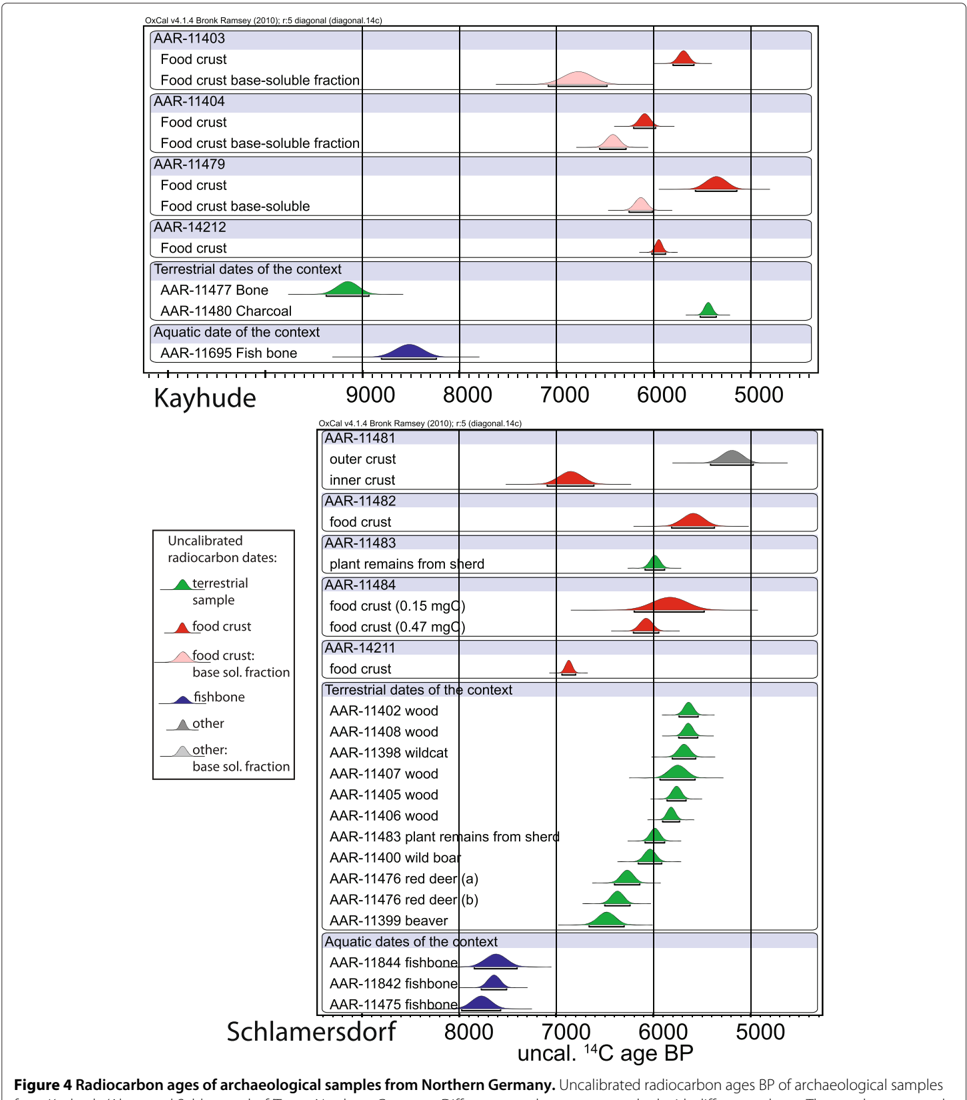
- At Kayhude, food crusts on pottery had estimated reservoir ages of about 300–600 14C years if the charcoal date is correct, while a pike bone was about 3000 14C years older than the charcoal; at Schlamersdorf, an inner/outer crust age difference of approximately 2000 years was measured, and a plant remain in one sherd dated to about 6000 BP, implying pottery production after 5000 cal BC.
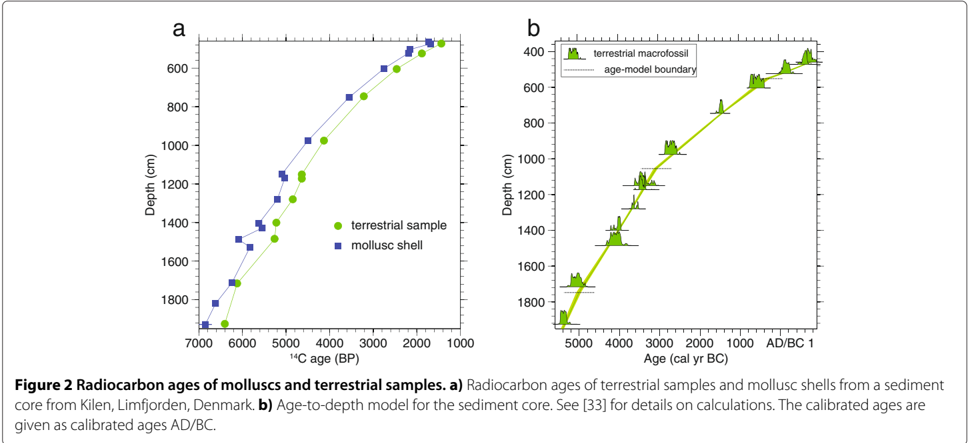
- In the Limfjord sediment core, freshwater influence caused reservoir ages to vary between 250 and 700 14C years during 5400 BC–AD 700; R values ranged from -140 to 300 14C years, and no single reservoir correction could be applied, though between 5000 and 2000 cal yr BP a marine reservoir age of R=0 (R=400 14C years) could be used.
Methods
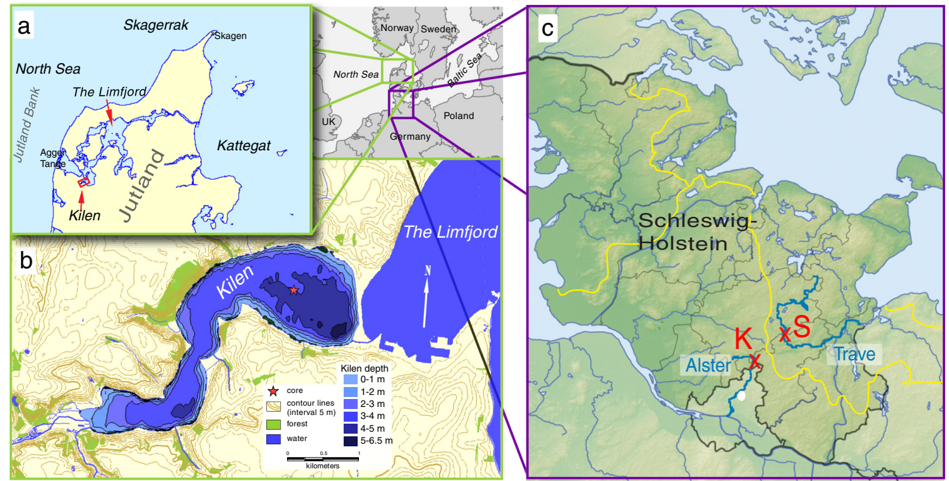
- Modern water DIC, aquatic plants, fish, and shellfish were collected from the Alster and Trave rivers; archaeological samples came from Kayhude/Alster and Schlamersdorf/Trave; a 1560 cm sediment core was obtained from Kilen, Limfjord, and subsampled at 1–2 cm intervals.
- Samples were prepared for AMS 14C dating (water acidification, collagen extraction, shell pretreatment, charcoal/plant pretreatment) and measured at Aarhus University or Queen’s University Belfast; stable carbon isotope measurements were also made.
- Reservoir ages were calculated as the difference between aquatic and contemporaneous terrestrial 14C ages; for modern samples, pmC values and atmospheric 14CO2 records were used, and for the sediment core, direct paired shell/terrestrial samples or an age model with IntCal09/Marine09 were used.
Limitations
- The paper states that the lack of clearly associated samples from Kayhude and Schlamersdorf makes it difficult to give more than rough estimates of the FRE, and that more samples are needed to explain similarities and differences among rivers. It also notes that modern FRE measurements are affected by bomb carbon and are not directly translatable to prehistoric samples, and that future studies should compare aquatic plants with and without acid wash.
- Evident from the text: the study synthesizes results from several sub-projects, with details published elsewhere; archaeological contexts are insecure (e.g., the Kayhude stone layer was not totally undisturbed, and an old wood effect could bias estimates); food crust dating has complications such as different charring locations, possible contamination, and base-soluble fractions that were older than the food crusts.
Model-written summary. Check it against the paper before relying on it.
Integrity signals
Registry
Cites
Statistics
Figures
Verification
Claims the paper makes
0 Valid · 3 Not valid · 90 Not checked · 130 Own results and interpretations
A result the paper reports from its own data — it cites no other source for it, so there is none to check. The quote shows it is in the paper.
In the paper
“Here, freshwater influence causes reservoir ages to vary between 250 and 700 14 C years during the period 5400 BC -AD 700.”
§ The freshwater reservoir effect in radiocarbon dating > Abstract
plainstates a causeSingle case- Asserted: passes — The authors put it forward as true.
- Checkable: passes — It can be checked against evidence.
- Load-bearing: passes — The paper’s conclusions depend on it.
- Based: passes — The paper gives a reason why it holds.
A result the paper reports from its own data — it cites no other source for it, so there is none to check. The quote shows it is in the paper.
In the paper
“Radiocarbon dating of recent water samples, aquatic plants, and animals, shows that age differences of up to 2000 14 C years can occur within one river.”
§ The freshwater reservoir effect in radiocarbon dating > Abstract
plain- Asserted: passes — The authors put it forward as true.
- Checkable: passes — It can be checked against evidence.
- Load-bearing: passes — The paper’s conclusions depend on it.
- Based: passes — The paper gives a reason why it holds.
A result the paper states — it cites no source for it, so there is none to check. The quote shows it is in the paper.
In the paper
“The age range is thus almost as large as that of the aquatic plants.”
§ The freshwater reservoir effect in radiocarbon dating > Aquatic animals
plainstates an association- Asserted: passes — The authors put it forward as true.
- Checkable: passes — It can be checked against evidence.
- Load-bearing: unclear — It is unclear whether the paper’s conclusions depend on it.
- Based: passes — The paper gives a reason why it holds.
A result the paper reports from its own data — it cites no other source for it, so there is none to check. The quote shows it is in the paper.
In the paper
“The δ 13 C values of modern river samples span a large range from -34.2 to -8.9 .”
§ The freshwater reservoir effect in radiocarbon dating > Modern river samples
plain- Asserted: passes — The authors put it forward as true.
- Checkable: passes — It can be checked against evidence.
- Load-bearing: unclear — It is unclear whether the paper’s conclusions depend on it.
- Based: passes — The paper gives a reason why it holds.
A result the paper reports from its own data — it cites no other source for it, so there is none to check. The quote shows it is in the paper.
In the paper
“The most striking result of the analysis of aquatic plants is the fact that floating leaves of aquatic plants do not have younger 14 C ages than submerged plants.”
§ The freshwater reservoir effect in radiocarbon dating > Aquatic plants
plainn = 2- Asserted: passes — The authors put it forward as true.
- Checkable: passes — It can be checked against evidence.
- Load-bearing: passes — The paper’s conclusions depend on it.
- Based: passes — The paper gives a reason why it holds.
122 more claims
Create a free account to see all 223 claims and to verify the 141 references still open.
- It may state two separate claims as one. 77
- Probably not a substantial claim. 27
- The quote only partly states this claim. 1
Self-check
Percentages, sums and reported differences re-computed from the paper’s own numbers.
Each contradiction between two passages listed here was confirmed by an independent check.
Rated major: it would touch a result — a value a result rests on, reported and recomputed p-values on opposite sides of the significance level, two passages that conflict with no sign which is right, or a cited work retracted before this paper was published.
In the paper
§ The freshwater reservoir effect in radiocarbon dating > Schlamersdorf/Trave
“The reservoir effect would, in this case, be approximately 2000 years, or more, if the outer crust had been affected by an old wood effect.”
§ The freshwater reservoir effect in radiocarbon dating > Kayhude/Alster
“11481 SLA5-1713 FC 5190±110 12.33±2.04-27.23±0.45(EA) -11481 SLA5-1713 FC not pretreated -15.96±2.40-27.66±0.25 (EA) 3.95±0.4511481 SLA5-1713 Outer crust 6850±120 16.29±1.58-28.01±0.46(EA)”
Rated minor: it would not touch a result — a value no result rests on, a p-value that stays on the same side of the significance level, or a conflict that is clerical, resolved elsewhere in the paper, or outside its own findings.
In the paper
§ The freshwater reservoir effect in radiocarbon dating > Sediment core from the Limfjord
“This study focuses on the part between 467 and 1935 cm bpsl which was subsampled at 1-2 cm depth intervals.”
§ The freshwater reservoir effect in radiocarbon dating > 57±78 14 C-years. The values thus agree within errors.
“AAR-12150 459-460 1 lf, 1 Betula sp.fruit, 2 bss, 1 Cyperaceae seed 1315±65 -27 AAR-13213 463-464 Tapes sp.[28-33] 1733±34 1247±64 61±112 1.59”
Rated minor: it would not touch a result — a value no result rests on, a p-value that stays on the same side of the significance level, or a conflict that is clerical, resolved elsewhere in the paper, or outside its own findings.
In the paper
§ The freshwater reservoir effect in radiocarbon dating > Schlamersdorf/Trave
“As this outer crust is younger than all the other terrestrial samples, it could be suspected to be influenced by modern contamination.”
§ The freshwater reservoir effect in radiocarbon dating > Kayhude/Alster
“11399 SL5-2761 BC beaver 6480±90”
Rated minor: it would not touch a result — a value no result rests on, a p-value that stays on the same side of the significance level, or a conflict that is clerical, resolved elsewhere in the paper, or outside its own findings.
In the paper
§ The freshwater reservoir effect in radiocarbon dating > Aquatic plants
“Floating and submerged parts of the same plant have the same radiocarbon age, as exemplified by two individuals of Nuphar lutea, where both the tip of the leaf and the end of the petiole were dated (Table 1).”
§ The freshwater reservoir effect in radiocarbon dating > Modern river samples
“Alster, 2010 14334 Nuphar leaf 76.83±0.242117±25 2472±602 -31.50±0.05(DI) Alster, 2010 14335 Nuphar petiole 78.51+0.23 1944±24 2299±602 -31.24±0.05(DI)”
Citations
Cites
IntCal13 and Marine13 radiocarbon age calibration curves 0–50,000 years cal BP
Reimer, P. J., Bard, E., Bayliss, A., Beck, J. W., Blackwell, P. G., Ramsey, C. B., Buck, C. E., Cheng, H., Edwards, R. L., Friedrich, M., et al. (2013) · Radiocarbon · doi:10.2458/azu_js_rc.55.16947 · Cited by 14,591
Bayesian Analysis of Radiocarbon Dates
Bronk Ramsey, C. (2009) · Radiocarbon · doi:10.1017/s0033822200033865 · Cited by 8,725 · cited 1×
“2 [75] and the IntCal04 atmospheric curve [76].”
BackgroundDiscussion Reporting of 14 C Data
Stuiver, M., & Polach, H. A. (1977) · Radiocarbon · doi:10.1017/s0033822200003672 · Cited by 5,640
Characterizing aquatic dissolved organic matter.
Leenheer, J. A., & Croué, J.-P. (2003) · PubMed · Cited by 4,891
IntCal09 and Marine09 radiocarbon age calibration curves, 0–50,000 years cal BP
Reimer, P. J., Baillie, M. G. L., Bard, E., Bayliss, A., Beck, J. W., Blackwell, P. G., Bronk Ramsey, C., Buck, C. E., Burr, G. S., Edwards, R. L., et al. (2009) · Radiocarbon · doi:10.1017/s0033822200034202 · Cited by 4,290
Environmental isotopes in hydrogeology
(1998) · Choice Reviews Online · doi:10.5860/choice.35-3882 · Cited by 3,809
Intcal04 Terrestrial Radiocarbon Age Calibration, 0–26 Cal Kyr BP
(2004) · Radiocarbon · doi:10.1017/s0033822200032999 · Cited by 3,673
Environmental Isotopes in Hydrogeology
Clark, I. D., & Fritz, P. (2013) · CRC Press eBooks · doi:10.1201/9781482242911 · Cited by 3,498
Nitrogen and carbon isotopic composition of bone collagen from marine and terrestrial animals
Schoeninger, M. J., & DeNiro, M. J. (1984) · Geochimica et Cosmochimica Acta · doi:10.1016/0016-7037(84)90091-7 · Cited by 2,057
New Method of Collagen Extraction for Radiocarbon Dating
LONGIN, R. (1971) · Nature · doi:10.1038/230241a0 · Cited by 1,813
Research works printed but not linked: 21
- Olsen J, Heinemeier J: AMS dating of human bone from the Ostorf cemetery in the light of new information on dietary habits and freshwater reservoir effects. In Innovation and Continuity. Non- Megalithic Mortuary Practices in the Baltic. Workshop Schwerin 24.-25. April 2006, Berichte der Römisch-Germanischen Kommission. Edited by Larsson L, Lüth F, Terberger T. Darmstadt/Mainz: Philipp von Zabern; 2009.
- Boudin M, Strydonck MV, Crombé P: Radiocarbon dating of tery food crusts: reservoir effect or not? The case of Swifterbant pottery from Doel "Deurganckdok" (Belgium). In Chronology and Evolution in the Mesolithic of North-West Europe. Proceedings of an International Meeting, Brussels, May 30-June 1st 2007.
- Edited by Crombé P, Strydonck MV, Sergant J, Boudin M, Bats M. Newcastle upon Tyne: Cambridge Scholars Publishing; 2009:753-772.
- Ringkjøbing Amtskommune, Teknik- og Miljøforvaltningen: Kilen. Miljøovervågning 1989. 1991, Vandmiljøovervågning
- Galimov EM: Carbon isotopes in soil CO 2 . Geochem Int 1966, 3:889-898. [Translated from Geokhimiya No. 9, pp.1110-1118, 1966].
- Nixdorf B, Hemm M, Hoffmann A, Richter P: Dokumentation von Zustand und Entwicklung der wichtigsten Seen Deutschlands. Cottbus: Brandenburg University of Technology; 2003.
- Farmer AM: Carbon uptake by roots. In Plant Roots: The hidden half. Edited by Waisel Y, Eshel A, Kafkaki U. New York: Marcel Dekker, Inc; 1996:679-689.
- Keaveney EM: Investigations into Freshwater Radiocarbon Reservoir Offsets from Britain and Ireland. Dissertation. Queen's University, 2009.
- Philippsen B: Der Süßwasser-Reservoireffekt in der 14 C-Datierung: neue Analysen und mesolithische Kochexperimente. In Experimentelle Archäologie in Europa -Bilanz, Volume 2013. Unteruhldingen: Europäische Vereinigung zur Förderung der Experimentellen Archäologie / European Association for the advancement of archaeology by experiment e.V. in press.
- Lanting JN, van der Plicht J: Reservoir effects and apparent ages. J Irish Archaeol 1998, 9:151-165.
- Tan FC: Stable carbon isotopes in dissolved organic carbon in marine and estuarine environments. In The Marine Environment, A, Volume 3 of Handbook of Environmental Isotope Geochemistry. Edited by Fritz P, Fontes JC. Amsterdam, Oxford, New York, Tokyo: Elsevier; 1989:171-190.
- Hallgren F, Possnert G: Pottery design and time. The pottery from the TRB site Skogsmossen, in view of the AMS-datings of organic remains on potsherds. Tor 1997, 29:113-136.
- Clausen I: Steinzeitliches Alstervergnügen. Archäologie in Deutschland 2007, 2:54.
- Hartz S: Inland-Ertebølle in Schleswig-Holstein. Die Fundstelle Schlamersdorf LA5, Kr. Stormarn. Archäologie in Schleswig [Symposium Wohlde] 1993, 1/1991:33-38.
- Hartz S: Zehnter Arbeitsbericht des Archäologischen Landesamtes Schleswig-Holstein. Grabungsberichte der Jahre 1988-1993:
- Göksu, Travenbrück (Altgemeinde Schlamersdorf), Kr. Stormarn, Steinzeitliche Wohnplätze Travenbrück, LA5 und LA15. Offa 1996, 53:374-378.
- Hartz S, Heinrich D, Lübke H: Coastal farmers -the neolithisation of northernmost Germany. In The Neolithisation of Denmark. 150 years of debate. Edited by Fischer A, Kristiansen K. Sheffield: J.R. Collis Publications; 2002:321-340.
- Edited by Knuttson H. Uppsala: Coast to Coast Project; 2004:123-142.
- Heron C, Craig OE, Forster M, Stern B, Andersen SH: Residue analysis of ceramics from prehistoric shell middens in Denmark: Initial investigations at Norsminde and Bjørnsholm. In Shell Middens in, Atlantic Europe. Edited by Milner N, Craig OE, Bailey GN. Norwich: Oxbow Books; 2007:78-85.
- Andersen SH, Malmros C: Madskorpe på Ertebøllekar fra Tybrind Vig. Aarbøger for Nordisk Oldkyndighed og Historie 1984, 1984:78-95.
- Whitney SE: A stable isotope examination of food residues on contemporary and archaeological pottery from southern Somalia. PhD thesis. Athens.
Cited by
Items 301–380 of 380
Li, C., Postl, A. K., Böhmer, T., et al. (2021) · Earth system science data · doi:10.5194/essd-2021-212-rc3
Li, C. (2022) · Earth system science data · doi:10.5194/essd-2021-212-ac4
Li, C. (2022) · Earth system science data · doi:10.5194/essd-2021-212-ac5
Li, C. (2022) · Earth system science data · doi:10.5194/essd-2021-212-ac6
Li, C., Postl, A. K., Böhmer, T., et al. (2021) · Earth system science data · doi:10.5194/essd-2021-212-rc2
An inverse modeling approach to investigate deep ocean ventilation from radiocarbon records
Duffy, F. (2022) · Woods Hole Open Access Server (WHOAS) · doi:10.1575/1912/29354
Working Approach: Lab Investigation and Proxy Development
Mishra, P. K. (2023) · SpringerBriefs in environmental science · doi:10.1007/978-3-031-34709-2_3
Stieg, A., Biskaborn, B. K., Herzschuh, U., et al. (2023) · Climate of the past · doi:10.5194/cp-2023-85-rc1
Stieg, A., Biskaborn, B. K., Herzschuh, U., et al. (2023) · Climate of the past · doi:10.5194/cp-2023-85-rc2
Stieg, A. (2024) · Climate of the past · doi:10.5194/cp-2023-85-ac1
Stieg, A. (2024) · Climate of the past · doi:10.5194/cp-2023-85-ac2
Finkel, P. D. L., Carrizo, D., RASMUSSEN, K. R., Knudsen, N. T., Parro, V., & Sánchez‐García, L. (2024) · The Science of The Total Environment · doi:10.1016/j.scitotenv.2024.171199
Paths to this and the next world: A La Tène sunken hut from Nižbor, Central Bohemia
Venclová, N., Dreslerová, D., Kyselý, R., Dyčka, M., Šebesta, J., Brabcová, K. P., Bíšková, J., & Matoušek, V. (2024) · Archeologické rozhledy · doi:10.35686/ar.2023.25
Sawai, Y., Momohara, A., Ito, K., Shimada, Y., & Matsumoto, D. (2025) · Earth Planets and Space · doi:10.1186/s40623-025-02208-7
Back Matter ("About ARWA and the Sumer and the Sea Conference", "Works Cited")
(2025) · Brepols Publishers eBooks · doi:10.1484/m.aratta-eb.5.151079
Chmiel-Chrzanowska, M., Fetner, R. A., & Krąpiec, M. (2026) · Archaeometry · doi:10.1111/arcm.70113
Barhoumi, C., Rohland, H., Franken, C., Dulamsuren, C., Saindovdon, D., & Behling, H. (2026) · Palaeogeography Palaeoclimatology Palaeoecology · doi:10.1016/j.palaeo.2026.113752
First Younger Dryas-Early Holocene varve chronology of the Russian Plain
Shasherina, L. V., Alexandrin, M. Y., Константинов, Е. А., Zakharov, A. L., Rudinskaya, A. I., Andreev, R. A., & Zazovskaya, E. P. (2026) · The Holocene · doi:10.1177/09596836261450833
Ilijanić, N., Ivkić, I., Miko, S., Hajek–Tadesse, V., Miko, M. Š., McClure, S. B., Kennett, D. J., Hartke, E. R., Freeman, K. H., Sladović, Ž., et al. (2026) · Quaternary · doi:10.3390/quat9040048
Review of numerical methods for dating Quaternary volcanism
McCreary, W., May, V. R., Mueller, D., Serra, E., & Preusser, F. (2026) · E&G Quaternary Science Journal · doi:10.5194/egqsj-75-131-2026
Koivisto, S., Pesonen, P., Lempiäinen-Avci, M. M., & Mannermaa, K. (2026) · Journal of Wetland Archaeology · doi:10.1080/14732971.2026.2713841
Saladié, P., Rodríguez‐Hidalgo, A., Marginedas, F., Solari, A., & López, M. C. B. (2026) · Journal of Archaeological Science · doi:10.1016/j.jas.2026.106666
Gorzkiewicz, K., Pawłowski, D., & Luoto, T. P. (2026) · Journal of Paleolimnology · doi:10.1007/s10933-026-00408-z
Moore, C. R., Larsson, S. A., Baalousha, M., Bizimis, M., Alam, M., West, A., LeCompte, M. A., Kennett, J. P., Kletetschka, G., Chouinard, J., et al. (2026) · ScienceOpen Research · doi:10.14293/s2199-1006.1.sor.2026.0004.v1
Singh, A. K., & Kumar, P. (2022) · Springer climate · doi:10.1007/978-3-031-16254-1_13
Läuchli, B., Augustinus, P. C., & Hopkins, J. L. (2025) · Quaternary Geochronology · doi:10.1016/j.quageo.2025.101706
Bayesian estimates of Lake Titicaca's freshwater reservoir effect
Marsh, E. (2026) · Quaternary Science Reviews · doi:10.1016/j.quascirev.2026.110054
Transferable Mass Spectrometry Methods: Forensics in Time: Palaeoproteomics
Burnett, A., Dennis, R. S., Daled, S., Deforce, D. L. D., Clerck, L. D., & Dhaenens, M. (2023) · Royal Society of Chemistry eBooks · doi:10.1039/bk9781837671922-00265
Andrews, A. H., Welte, C., Haghipour, N., Lougheed, B. C., Heimbrand, Y., Östman, Ö., Rittweg, T. D., & Vitale, F. (2025) · ICES Journal of Marine Science · doi:10.1093/icesjms/fsaf220
Schütz, O. (2025) · SZTE Repository of Dissertations (University of Szeged) · doi:10.14232/phd.12655
Freshwater reservoir effect for mollusks in the lower and central Murray River, Australia
Stringer, C. A., Levchenko, V. A., Hua, Q., Wilson, C., May, J.-H., Drysdale, R. N., Garvey, J., & Prendergast, A. L. (2026) · Radiocarbon · doi:10.1017/rdc.2026.10234
Long-term changes of wildfire regimes in eastern Siberia
Glückler, R. (2024) · publish.UP (University of Potsdam) · doi:10.25932/publishup-66643
Pallacks, S. (2023) · Tesis Doctorals en Xarxa (Consorci de Serveis Universitaris de Catalunya)
Wang, Z., Liu, X., Chen, S., Ma, S., Nan, Q., Ma, W., Chen, J., & Tan, L. (2026) · CATENA · doi:10.1016/j.catena.2026.110433
Stieg, A. (2025) · publish.UP (University of Potsdam) · doi:10.25932/publishup-67953
A Preceramic–Preclassic transition cemetery at the Lowland Maya site of Ceibal, Guatemala
Burham, M., Palomo, J. M., Pinzón, F., Corado, F. J. V., & Inomata, T. (2025) · Antiquity · doi:10.15184/aqy.2025.76
Trullenque-Blanco, V., Juez, C., Montealegre-Gracia, A. L., & Ollero, A. (2026) · Earth-Science Reviews · doi:10.1016/j.earscirev.2026.105718
Nguyen, N., Béon, M. L., Huang, N., Ding, C., Hsieh, M., Ching, K., Pathier, E., Huang, C., Chang, C.-W., Shen, C., et al. (2026) · Tectonics · doi:10.1029/2025tc009275
Using ultra-small radiocarbon dates to obtain reliable ages on shells affected by hard water
Milson, C. E. (2022) · Research Commons (University of Waikato)
Jones, S., Gleeson, P. A., López‐Costas, O., Cortizas, A. M., Mighall, T. M., & Noble, G. (2024) · Journal of Archaeological Science · doi:10.1016/j.jas.2024.106105
Sattraburut, T., Vongvassana, S., & Phutthai, T. (2026) · Ecological Management & Restoration · doi:10.1111/emr.70063
Badino, F., Juan, O., & Pini, R. (2026) · Environmental Archaeology · doi:10.1080/14614103.2026.2755209
Paleček, D., Falini, G., Wacker, L., Mannino, M. A., Bicho, N., Cascalheira, J., Rombolà, A. G., Fabbri, D., & Talamo, S. (2024) · Radiocarbon · doi:10.1017/rdc.2024.80
Paleček, D. (2024) · AMS Dottorato Institutional Doctoral Theses Repository (University of Bologna) · doi:10.48676/unibo/amsdottorato/11184
Hembrow, S. C. (2018) · Cross Connect (Southern Cross University)
A demographic and dietary history of ancient dogs in the Americas using ancient DNA
Witt, K. E. (2017) · Illinois Digital Environment for Access to Learning and Scholarship (University of Illinois at Urbana-Champaign)
Elmas, Ü. C. (2024) · Istanbul Technical University Academic Open Archive (Istanbul Technical University)
Satoh, N. (2020) · Institutional Repositories DataBase (IRDB) · doi:10.15083/0002004579
Sava, T., Mănăilescu, C., Sava, G. O., ILIE, M. V., Gâza, O., Păceșilă, D., & Robu, A. (2019) · AIP conference proceedings · doi:10.1063/1.5091641
Bliujienė, A., Kisielienė, D., Peseckas, K., Šapolaitė, J., Ežerinskis, Ž., Schopper, F., & Minkevičius, K. (2023) · Archaeologia BALTICA · doi:10.15181/ab.v30i0.2566
Kahsay, T. H., Asrat, A., Sinha, N., Marchegiano, M., & Franchi, F. (2026) · Palaeogeography Palaeoclimatology Palaeoecology · doi:10.1016/j.palaeo.2026.114175
Hyland, C., Cameron-Werens, K., Snoeck, C., Shchetnikov, A., Tarasov, P. E., Weber, A. W., & Schulting, R. (2026) · Radiocarbon · doi:10.1017/rdc.2026.10219
Carbon-14 in the environment near the Belarusian and the Ignalina nuclear power plants in 2016–2025
Mažeika, J., Petrošius, R., Skuratovič, Ž., Jefanova, O., & Romanenko, V. (2026) · Radiocarbon · doi:10.1017/rdc.2026.10251
Hydrodynamic control of fluvial oncoid formation in a modern high-energy tropical cascade system
Husinec, A., & Bowman, A. L. (2026) · Scientific Reports · doi:10.1038/s41598-026-56585-4
Reconstructing abrupt, high-magnitude sea-level changes from near-field coastal environments
Lawrence, T. (2016) · Durham e-Theses (Durham University)
Bevins, C. (2019) · Massey Research Online (Massey University)
Tremmel, D. M., Carvalho, C., Silva, T. C. A., Nascimento, N., Bernardes, M. C., & Libardoni, B. G. (2026) · Radiocarbon · doi:10.1017/rdc.2026.10224
Time Matters: Chronology in the European Mesolithic
Schulting, R., & Meiklejohn, C. (2025) · Oxford University Press eBooks · doi:10.1093/oxfordhb/9780198853657.013.3
Freshwater reservoir effect and the radiocarbon chronology of the cemetery in Ząbie, PolandPreprint
Pospieszny, Ł. (2017) · SocArXiv (OSF Preprints) · doi:10.31235/osf.io/nc8rn
Freshwater reservoir effect and the radiocarbon chronology of the cemetery in Ząbie, PolandPreprint
Pospieszny, Ł. (2017) · SocArXiv (OSF Preprints) · doi:10.31235/osf.io/nc8rn_v1
Munroe, J. S. (2020) · Quaternary · doi:10.3390/quat3010009
Moore, C. R., Larsson, S. A., Baalousha, M., Bizimis, M., Alam, M., West, A., LeCompte, M. A., Kennett, J. P., Kletetschka, G., Chouinard, J. E., et al. (2026) · doi:10.14293/pr2199.003441.v1
Moore, C. R., Larsson, S. A., Baalousha, M., Bizimis, M., Alam, M., West, A., LeCompte, M. A., Kennett, J. P., Kletetschka, G., Chouinard, J. E., et al. (2026) · doi:10.14293/pr2199.003441.v2
Time revisited: a revised chronology for the Robberg technocomplex in southern Africa
Arlt, S. (2026) · Quaternary Science Reviews · doi:10.1016/j.quascirev.2026.110285
Lackmann, A. R., Andrews, A. H., Holmquist, L. M., Haghipour, N., Grisak, G., Webb, M. A. H., Clark, M., & Shattuck, Z. R. (2026) · Communications Biology · doi:10.1038/s42003-026-11219-3
Nakajima, K., Welte, C., Heusser, C., Haghipour, N., Engels, S., Eglinton, T. I., & Wacker, L. (2025) · Radiocarbon · doi:10.1017/rdc.2025.10168
Barisevičiūtė, R., Karosienė, J., Kasperovičienė, J., Paškauskas, R., Jefanova, O., Szwarczewski, P., Ežerinskis, Ž., Butkus, L., Šapolaitė, J., & Mažeika, J. (2026) · PLoS ONE · doi:10.1371/journal.pone.0343824
Marine, T. (2026) · CyberLeninK (CyberLeninka)
Grochocki, J. L., & Peck, J. A. (2017) · Abstracts with programs - Geological Society of America · doi:10.1130/abs/2017ne-290082
Pohjola, J., Turunen, J., Lipping, T., Sivula, A., & Marila, M. M. (2018) · Springer briefs in geography · doi:10.1007/978-3-030-00970-0_5
Barisevičiūtė, R., Rakauskas, V., Virbickas, T., Ežerinskis, Ž., Šapolaitė, J., & Remeikis, V. (2022) · Radiocarbon · doi:10.1017/rdc.2022.82
(2025) · Earth system science data · doi:10.5194/essd-2025-109-rc1
Radiocarbon Dating of Late Iron Age Graves from Transylvania
Berecki, S. (2023) · Repository of the Academy's Library (Library of the Hungarian Academy of Sciences)
The Bronze Age Settlement History of the Süttő Plateau (Northwestern Hungary)
Fejér, E. (2025) · Slovenská archeológia · doi:10.31577/slovarch.2025.73.3
Stachowska, Z., van der Bilt, W. G. M., Kavan, J., Furze, M. F. A., Thorseth, I. H., & Strzelecki, M. C. (2026) · Boreas · doi:10.1111/bor.70089
Farming in the shadows of Rome: A multi‐proxy palaeoenvironmental record from Loch Clunie—Perthshire
Jones, S., Blaauw, M., Hunter, F., López‐Costas, O., Cortizas, A. M., Mighall, T. M., & Noble, G. (2026) · Journal of Quaternary Science · doi:10.1002/jqs.70085
Birks, H. H., Sayer, C. D., & Walton, R. E. (2026) · Developments in paleoenvironmental research · doi:10.1007/978-3-032-04170-8_5
Gázquez, F., Cañada-Pasadas, J., Martegani, L., Sánchez-Villanueva, A. I., Voigt, C., García‐Alix, A., Jiménez‐Moreno, G., Turchyn, A. V., Jiménez‐Bonilla, A., & Rodríguez‐Rodríguez, M. (2026) · The Depositional Record · doi:10.1002/dep2.70097
Huang, Y., Meng, H., 朱, 建., Wang, D., Zhu, Z., & Wu, J. (2026) · PLoS ONE · doi:10.1371/journal.pone.0363067
Metadata
- Authors
- Philippsen, B.
- Affiliations
- Aarhus University (DK)
- Corresponding author
- Philippsen, Bente
- ORCID
- Philippsen, Bente
- Venue
- Heritage Science
- Published
- 2013-08-02
- Volume
- 1
- Issue
- 1
- Pages
- 24
- ISSN
- 2050-7445 (ISSN-L)
- OpenAlex
- W2038887123
- Cited by
- 379
- References
- 93
- Citations by year
- 2026: 50 · 2025: 37 · 2024: 35 · 2023: 35 · 2022: 34 · 2021: 43 · 2020: 27 · 2019: 25 · 2018: 22 · 2017: 30 · 2016: 26 · 2015: 10 · 2014: 4
- FWCI
- 19.16
- Type
- journal article
- Language
- en
- Open access
- gold
- doi.org
- Licence
- cc-by
- Locations
- Heritage Science (publishedVersion, cc-by)
- Topics
- Social Sciences › Archeology › Archaeology and ancient environmental studies
- Physical Sciences › Earth and Planetary Sciences › Atmospheric Science › Geology and Paleoclimatology Research
- Physical Sciences › Environmental Science › Ecology › Isotope Analysis in Ecology
- Keywords
- freshwater reservoir effect, radiocarbon dating, lake water, river water, Ertebølle culture, Limfjorden, marine reservoir effect
About these checks
Registry, retraction, Cites and statistics results are computed, not judged, with one exception: a printed reference that no index lists is read once by a model before it counts as a citation error. Claims are extracted by a model and kept only when their quote appears verbatim in the text; each cited source is then checked, with a model’s help, for whether it says what the claim relies on. Those verdicts can be wrong — read the claim’s quote and the cited source before relying on one.
A language model drew the claims from the paper on 2026-11-24, under version 3 of the claim definition (model deepseek-v4.1-flash, prompt extract-v3).
A second model labelled each claim on 2026-11-24 (model jev-1.13-20260917, definition revision gold-guideline-v0.2).
Statistics and arithmetic are recomputed, not judged.
Confidence bands are shown only for fields calibrated on our annotated test set. None is calibrated yet, so no band is shown.
What counts as a claim ›How we measure confidence ›How we check this ›
Are you an author, or do you see a problem with this page? Request a review
Data sources
Bibliographic data: Semantic Scholar, OpenAlex, Crossref.
Contains information from the Semantic Scholar Academic Graph Datasets, made available under the ODC Attribution License (ODC-BY 1.0).
Semantic Scholar’s data is described in: Kinney, R., et al. (2023). The Semantic Scholar Open Data Platform. arXiv:2301.10140.
